• FluTrackers.com Inc. does not provide medical advice. Information on this web site is collected from various internet resources, and the FluTrackers board of directors makes no warranty to the safety, efficacy, correctness or completeness of the information posted on this site by any author or poster. The information collated here is for instructional and/or discussion purposes only and is NOT intended to diagnose or treat any disease, illness, or other medical condition. Every individual reader or poster should seek advice from their personal physician/healthcare practitioner before considering or using any interventions that are discussed on this website. By continuing to access this website you agree to consult your personal physican before using any interventions posted on this website, and you agree to hold harmless FluTrackers.com Inc., the board of directors, the members, and all authors and posters for any effects from use of any medication, supplement, vitamin or other substance, device, intervention, etc. mentioned in posts on this website, or other internet venues referenced in posts on this website.
  • We are not asking for any donations. Do not donate to any entity who says they are raising funds for us.

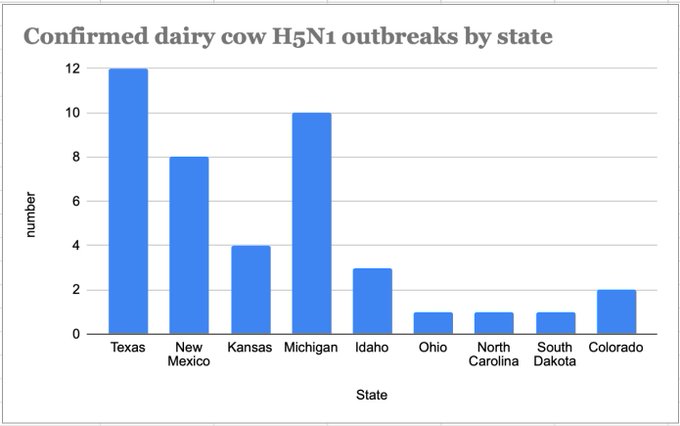
US - Dairy cows test positive for H5N1 avian flu in Texas, Kansas, Idaho, Michigan, New Mexico, Ohio, North Carolina, South Dakota, Colorado, Iowa, Mi

Status
Not open for further replies.
Bird flu cases are likely being missed in dairy workers, experts say

Experts maintain the milk supply is safe. Their focus is on keeping the people who work with cows from getting sick.​

April 26, 2024, 7:06 PM EDT
By Erika Edwards
Dr. Barb Petersen, a dairy veterinarian in Amarillo, Texas, had been caring for sick cows for several weeks in Marchwhen she and a colleague finally pinned down the cause of the illness among the herd: the H5N1 strain of the bird flu.

It was the first time the virus had been detected in cattle.

The sick cows, said Petersen, who owns Sunrise Veterinary Service, tended to produce milk that didn’t look quite right, and had mastitis, an inflammation of the udders.

During that same time, she said, dairy workers — including those who were never in close contact with the sick cows — also fell ill.

“People had some classic flu-like symptoms, including high fever, high fever, sweating at night, chills, lower back pain,” as well as upset stomach, vomiting and diarrhea, Petersen said. “They also tended to have “pretty severe conjunctivitis and swelling of their eyelids.”

Petersen noted that the people were never tested for H5N1; it’s possible that their symptoms were the result of another illness…..


At least 44 others may have been exposed, the CDC said. Some have been tested, while others were asked to monitor symptoms,such as cough, sore throat, pinkeye, fever, headache and diarrhea.

Dr. Keith Poulsen, director of the Wisconsin Veterinary Diagnostic Laboratory, said he’s heard reports of flu-like illnesses on affected dairy farms.

“It’s certainly not a large amount,” he said, “but there’s probably a lot of cases
​…..
Our job right now is to protect farmworkers,” said Jennifer Nuzzo, director of the Pandemic Center at Brown University School of Public Health. “We can’t do that unless we know where the virus is or where it isn’t.”

It’s still unclear how the bird flu virus spreads from cows to people, though some experts said it could be through multiple paths, such as contact with milk, contaminated milking equipment, or even respiratory droplets.

“I think everything’s on the table at this point,” said Dr. Andrew…… :tiphat:

https://www.nbcnews.com/health/heal...y-missed-dairy-workers-experts-say-rcna149520
Experts maintain the milk supply is safe. Their focus is on keeping the people who work with cows from getting sick.​
 
Avian Influenza A(H5N1) U.S. Situation Update and CDC Activities | Avian Influenza (Flu)
Español | Other Languages
Print
April 26, 2024 – CDC continues to respond to the public health challenge posed by a multistate outbreak of avian influenza A(H5N1) virus, or “A(H5N1) virus” in dairy cows and other animals in the U.S. CDC is working in collaboration with the U.S. Department of Agriculture (USDA), the Food and Drug Administration (FDA), state public health and animal health officials, and other partners using a One Health approach. USDA is now reporting that 34 dairy cattle herds in nine U.S. states, including most recently Colorado, have confirmed cases of A(H5N1) virus infections in cattle. The agency has issued a “Federal Order requiring Testing for and Reporting of Highly Pathogenic Avian Influenza (HPAI) in Livestock [118 KB, 2 pages].” Currently, one human case has been confirmed in a person with exposure to presumably infected dairy cows reported by Texas on April 1, 2024[SUP][1][2][/SUP]. Monitoring people with exposure to animals infected or potentially infected with A(H5N1) viruses is important to help us better understand the risk to human health and potential for spread between animals and people.

CDC’s response to this outbreak of influenza A(H5N1) virus in dairy cattle and other animals most recently includes:
  • An updated H5N1 Technical Report posted on April 26. This report updates a December 29, 2023, report to include seven new human cases of H5N1 reported globally since that time (five in Cambodia, one in the United States (Texas), and one in Vietnam) and recent activity in wild birds, poultry and other animals, including the multistate outbreak in U.S. dairy cattle and other animals, and updated information on monitoring for A(H5N1) virus infections in people in the United States. The report concludes that the current risk to the general public remains low at this time.
  • Updated interim recommendations for worker protection expanded to include people who work in slaughterhouses posted on April 26.
  • Continuing work to better characterize the virus from the human case in Texas.
    • Testing for susceptibility to the commercially available and recommended flu antiviral medications was completed this week. Testing confirmed that the A(H5N1) virus from the human case in Texas[SUP][2][/SUP] is susceptible to baloxavir marboxil, in addition to the neuraminidase inhibitors, which was announced last week. With these findings, the virus from the human case in Texas is confirmed to be susceptible to commercially available FDA-approved and recommended flu neuraminidase and polymerase acidic protein (PA) endonuclease inhibitor antiviral medications. Currently the neuraminidase inhibitor oseltamivir is recommended for antiviral treatment of people with confirmed or suspected A(H5N1) virus infection, and for post-exposure prophylaxis.
    • Looking at antiviral resistance properties of more than 200 H5N1 publicly posted virus sequences from cattle. CDC found one virus from a cow with a marker known to be associated with reduced susceptibility to the neuraminidase inhibitors (a change at NA-T438I). This change has been seen rarely in the past in H5N1 viruses isolated from wild birds and poultry. The detection of this marker in one of more than 200 specimens is not surprising or concerning at this time in terms of the clinical usefulness of these drugs, but it does underscore why this kind of constant monitoring is important.
    • Growing H5N1 virus stock from the one human case in Texas to use for additional laboratory experiments to:
      • Learn how the virus reproduces in both human and cow respiratory tract epithelial cells and cow mammary epithelial cells.
      • Assess the severity of illness and transmissibility of the virus under different scenarios by infecting ferrets and assessing the outcome. Ferrets are used as a model for people because they get sick and spread influenza viruses in a manner similar to humans.
    • Testing human sera (blood) from people previously vaccinated with pre-pandemic A(H5) vaccines to see how it reacts to the virus from the human case in Texas. Data to date – including genetic analysis and testing of ferret antisera from multiple clade 2.3.4.4b candidate vaccine viruses – suggest vaccination will offer good cross-protection against cattle outbreak viruses. (The human case in Texas was a 2.3.4.4b virus.)
  • Continuing to support states that are monitoring people with exposure to cows, birds, or other domestic or wild animals infected or potentially infected with influenza A(H5N1) viruses. Testing of symptomatic people who have exposures is being done by state or local officials, and CDC is conducting confirmatory testing when needed.
  • Maintaining multilingual and multidisciplinary epidemiological field teams ready to deploy for on-site studies to better understand the current outbreak, particularly the public health and One Health implications of the emergence of this virus in cattle.
  • Engaging One Health partner organizations from public health, agriculture, wildlife, milk regulatory officials, and others to share information and ensure preparedness to prevent and respond to this emerging infectious disease threat and for any potential human infections. On April 25, CDC participated in an ASTHO-hosted discussion between public health leaders and scientists leading the U.S. Government’s response to Highly Pathogenic Avian Influenza (HPAI).
  • Continuing to monitor flu surveillance data, especially in areas where A(H5N1) viruses have been detected in dairy cattle or other animals, for any unusual trends in flu-like illness, flu, or conjunctivitis. CDC this week posted a webpage on How CDC is monitoring influenza data in people to better understand the current avian influenza A (H5N1) situation | Avian Influenza (Flu). CDC flu surveillance systems show no indicators of unusual flu activity in people, including avian influenza A(H5N1) for the most recent week.
New Measures to Contain Spread in Cows


The multistate outbreak of HPAI A(H5N1) bird flu in dairy cows was first reported by USDA on March 25, 2024. This is the first time that A(H5N1) viruses have been found in cattle. USDA also has reported that the virus has spread through cattle movement between herds and also from dairy cattle premises into nearby poultry premises and has infected a number of barn cats. Additionally, USDA has reported that APHIS National Veterinary Services Laboratories found virus in a lung tissue sample from a dairy cow without symptoms that came from an affected herd (but that cow did not enter the food supply). This week, USDA issued a “Federal Order Requiring Testing for and Reporting of Highly Pathogenic Avian Influenza in Livestock [118 KB, 2 pages]” to protect livestock health. Prior to interstate movement, dairy cattle are now required to receive a negative test for influenza A virus at an approved National Animal Health Laboratory Network laboratory. For more information regarding this Federal Order visit HPAI Detections in Livestock. Containing spread of this virus in animals will help reduce the number of potential human exposures and thus help contain the public health risk.

Ongoing Surveillance Needed

Because of the potential for influenza viruses to constantly change, continual surveillance and preparedness efforts are critical, and CDC is taking measures to be ready in case the current risk assessment for the general public changes. The immediate goal is to prevent further spread of this virus between animals and people. CDC will continue to monitor these viruses and update and adjust guidance as needed. As a reminder, while CDC believes the current risk of A(H5N1) infection to the general public remains low, people with close, prolonged, or unprotected exposures to infected birds, cattle, or other animals, to unpasteurized (“raw”) milk, or to environments contaminated by infected birds, cattle, or other animals or by raw milk, are at a greater risk of infection.

CDC has interim recommendations for prevention, monitoring, and public health investigations of A(H5N1) virus infections in people. CDC also has updated recommendations for worker protection and use of personal protective equipment (PPE) to reduce their risk of exposure. Following these recommendations is central to reducing a person’s risk and containing the overall public health risk.

This is a rapidly changing situation, and CDC is committed to providing frequent and timely updates.

[SUP][1][/SUP] The first human case of A(H5N1) bird flu in the United States was reported in 2022 in a person in Colorado who had direct exposure to poultry and was involved in the depopulating of poultry with presumptive A(H5N1) bird flu. The 2022 human case was not related to dairy cattle. The person recovered. Learn more at U.S. Case of Human Avian Influenza A(H5) Virus Reported.

[SUP][2][/SUP] The second human case of A(H5N1) bird flu in the United States was reported in 2024 and linked with dairy cattle and reported eye redness as their only symptom, consistent with conjunctivitis, and has recovered. Learn more at Highly Pathogenic Avian Influenza A (H5N1) Virus Infection Reported in a Person in the U.S.

Last Reviewed: April 26, 2024
:tiphat:
​​​​​​https://www.cdc.gov/flu/avianflu/spotlights/2023-2024/avian-situation-update.htm
 
:tiphat:3 more cats in New Mexico and 1 in Ohio.. looking for a better link

Four more cats have tested positive for H5N1 bird flu in connection with a growing outbreak in dairy cows in the United States, according to state and federal officials, raising the number of cases in cats in the current outbreak to seven.

Sonja Olsen, the Associate Director of Preparedness and Response at CDC’s Influenza Division, reported three new cases in cats on Thursday and a fourth case was reported on Friday.

“The reports we heard were of cats having neurologic symptoms, rapid decline, and death,” Olsen told BNO News.

Three of the new cases were found at two dairy farms in Curry County, New Mexico and all of them died, according to the state’s Agriculture Department. The fourth case was found at a dairy farm in Wood County, Ohio...:tiphat:
https://bnonews.com/index.php/2024/04/4-more-cats-test-positive-for-h5n1-bird-flu-in-the-u-s/


Based on the last WOAH report from April 19, 2024, H5N1 has been reported in both cattle and cats on 6 farms, with three in Texas, one in Ohio, and two in New Mexico. The state of New Mexico has reported an infection in a raccoon as well.

The H5N1 mammals thread for each of these states was updated on FT on April 22:


OUTBREAK REFERENCE
TX 002

Texas
Farm
Hartley County
A commercial dairy premises. Clinical signs in lactating cattle included a drop in feed intake, tacky feces, thickened milk, increased somatic cell count and pyrexia. HPAI H5N1 clade 2.3.4.4b was detected in a barn cat on the premises.

--------------------------------------
OUTBREAK REFERENCE
TX 007

Texas
Farm
Hale County
A commercial dairy premises. Clinical signs in lactating cattle included off feed, decreased milk production, anorexia, tacky manure, thickened yellow-milk and fever. H5N1 was detected in one feral barn cat on the premises.

----------------------------------------
OUTBREAK REFERENCE
TX 008

Texas
Farm
Dallam County
A commercial dairy premises. Clinical signs in lactating cattle included decreased rumination, tacky manure, creamy/thick milk. Pneumonia noted in some cows. HPAI H5N1 was detected in barn cats on the premises.

------------------------------------------
OUTBREAK REFERENCE
OH 001

Ohio
Farm
Wood County
A commercial dairy premises. Clinical signs in lactating cattle included decreased feed consumption, drop in milk production and yellow/thickened milk. HPAI H5N1 clade 2.3.4.4b was detected in a barn cat on the affected premises.

-------------------------------------------
OUTBREAK REFERENCE
NM 002

New Mexico
Farm
Curry County
A commercial dairy premises. Clinical signs in lactating cattle included acute decrease in production. HPAI H5N1 clade 2.3.4.4b was detected in a barn cat on the affected premises and a wild racoon (Procyon lotor) on the affected premises.

------------------------------
OUTBREAK REFERENCE
NM 006

New Mexico
Farm
Curry County
A commercial dairy premises. Clinical signs in lactating cattle included mastitis. HPAI H5N1 clade 2.3.4.4b was detected in barn cats on the affected premises.​​

https://flutrackers.com/forum/forum...s/970701-texas-avian-flu-in-mammals-2023-2024

https://flutrackers.com/forum/forum...af/ohio/988630-ohio-avian-flu-in-mammals-2024

https://flutrackers.com/forum/forum...o/988629-new-mexico-avian-flu-in-mammals-2024
 
Last edited:
NMPF STATEMENT ON NEW FEDERAL TRAVEL AND TEST ORDER THAT BEGINS TODAY


April 29, 2024

From President & CEO Gregg Doud:

The crossover of this H5N1 virus from birds to dairy cattle has presented some extraordinary challenges to animal and human health regulators in Washington. Throughout my regular contact with Secretary Vilsack, Undersecretary Moffitt, and officials from FDA and other agencies in recent weeks, I have seen how leadership at USDA, FDA and other federal agencies is well-equipped to get us through this challenge.

As new rules on testing and travel take effect today, dairy farmers and their cooperatives are ready to support these efforts to protect animal health and guard against a potential human health risk. We have offered input to federal officials on how to help farmers implement these guidelines, and we will continue sharing feedback as these procedures are put into practice. We appreciate the around-the-clock efforts that federal and local authorities and experts, from USDA and other agencies to state officials and local veterinarians, have been making to get a new system up and running these past few days, and we are grateful for their dedication and commitment.

https://www.nmpf.org/nmpf-statement-on-new-federal-travel-and-test-order-that-begins-today/
 
Research
Highly Pathogenic Avian Influenza A(H5N1) Clade 2.3.4.4b Virus Infection in Domestic Dairy Cattle and Cats, United

Eric R. BurroughComments to Author , Drew R. Magstadt, Barbara Petersen, Simon J. Timmermans, Phillip C. Gauger, Jianqiang Zhang, Chris Siepker, Marta Mainenti, Ganwu Li, Alexis C. Thompson, Patrick J. Gorden, Paul J. Plummer, and Rodger Main

Abstract

We report highly pathogenic avian influenza A(H5N1) virus in dairy cattle and cats in Kansas and Texas, United States, which reflects the continued spread of clade 2.3.4.4b viruses that entered the country in late 2021. Infected cattle experienced nonspecific illness, reduced feed intake and rumination, and an abrupt drop in milk production, but fatal systemic influenza infection developed in domestic cats fed raw (unpasteurized) colostrum and milk from affected cows. Cow-to-cow transmission appears to have occurred because infections were observed in cattle on Michigan, Idaho, and Ohio farms where avian influenza virus–infected cows were transported. Although the US Food and Drug Administration has indicated the commercial milk supply remains safe, the detection of influenza virus in unpasteurized bovine milk is a concern because of potential cross-species transmission. Continued surveillance of highly pathogenic avian influenza viruses in domestic production animals is needed to prevent cross-species and mammal-to-mammal transmission.
...

https://flutrackers.com/forum/forum/national-international-government-ngo-preparation-response/cdc/h5n1-information/989725-highly-pathogenic-avian-influenza-a-h5n1-clade-2-3-4-4b-virus-infection-in-domestic-dairy-cattle-and-cats-united-states-2024​
 
Reuters USDA to test ground beef in US states with outbreaks of bird flu in dairy cows

By Tom Polansek
April 29, 20241:27 PM EDTUpdated an hour ago​

CHICAGO, April 29 (Reuters) - The U.S. Department of Agriculture said on Monday it is collecting samples of ground beef at retail stores in states with outbreaks of bird flu in dairy cows for testing but remains confident the meat supply is safe.
The USDA will analyze the ground beef with tests that determine "whether any viral particles are present," according to a statement. Some dairy cows are processed into ground beef when they grow old.​...
-snip-

The U.S. Food and Drug Administration said on Friday that preliminary results of gold-standard PCR tests of milk showed pasteurization killed the bird flu virus, as Colorado became the ninth U.S. state to report an infected dairy herd.
The USDA said it will analyze the retail beef samples with PCR tests, as well.
​-snip-
In another study, it will use a "virus surrogate" in ground beef and cook it at different temperatures to determine how the virus is affected, according to the statement. USDA said cooking meat to a safe internal temperature kills bacteria and viruses
The department is also collecting beef muscle samples at slaughter facilities of dairy cattle that have been condemned to determine the presence of viral particles.​..

https://www.reuters.com/business/he...ith-outbreaks-bird-flu-dairy-cows-2024-04-29/
 
medRxiv preprint doi: https://doi.org/10.1101/2024.04.26.24306409; this version posted April 29, 2024

Detection of hemagglutinin H5 influenza A virus sequence in municipal
wastewater solids at wastewater treatment plants with increases in influenza A in
spring, 2024


Marlene K. Wolfe1, Dorothea Duong2, Bridgette Shelden2, Elana M. G. Chan3 5 , Vikram
Chan-Herur2, Stephen Hilton1, Abigail Harvey Paulos1, Alessandro Zulli3 6 , Bradley J.
White2, Alexandria B. Boehm3 7 *
...
Abstract

Prospective influenza A (IAV) RNA monitoring at 190 wastewater treatment plants across the US identified increases in IAV RNA concentrations at 59 plants in spring 2024, after the typical seasonal influenza period, coincident with the identification of highly pathogenic avian influenza (subtype H5N1) circulating in dairy cattle in the US. We developed and validated a hydrolysis-probe RT-PCR assay for quantification of the H5 hemagglutinin gene. We applied it retrospectively to samples from three plants where springtime increases were identified. The H5 marker was detected at all three plants coinciding with the increases. Plants were located in a state with confirmed outbreaks of highly pathogenic avian influenza, H5N1 clade 2.3.4.4b, in dairy cattle. Concentrations of the H5 gene approached overall influenza A virus gene concentrations, suggesting a large fraction of IAV inputs were H5 subtypes. At two of the wastewater plants, industrial discharges containing animal waste, including milk byproducts, were permitted to discharge into sewers. Our findings demonstrate wastewater monitoring can detect animal-associated influenza contributions, and highlight the need to consider industrial and agricultural inputs into wastewater. This work illustrates the value of wastewater monitoring for comprehensive influenza surveillance for diseases with zoonotic potential across human and animal populations.
...
Discussion

H5 influenza RNA was readily detected in wastewater solids at sites with atypical
increases in influenza A M gene concentrations in March and April 2024 during a period
of a known H5N1 outbreak in the US. The presence of H5 in municipal wastewater
indicates that contributions into the wastewater system include excretions or byproducts
containing influenza viral RNA with an H5 subtype, but do not indicate the species that
may be shedding an H5 influenza.
During March and April 2024, increases in IAV M
gene concentrations at these plants were not associated with increases in human
influenza activity, as documented by the emergency room influenza case data in Texas.
However, both the increases in M gene concentrations and H5 detection occurred
immediately prior to and during reported outbreaks of H5N1 in dairy cattle in the
region14.
These results suggest that wastewater monitoring is a viable method of
monitoring certain animal pathogens, and can provide a leading edge of detection that
is of particular importance for diseases with zoonotic potential like HPAI.

Hypothesized sources of H5. H5N1 outbreaks in dairy cattle were reported on March
25, 2024 in the Texas panhandle23, which contains the Potter/Randall County area.
There was also a human case of H5N1 reported in Amarillo, TX, in an individual who
worked at a commercial dairy cattle farm and reported close proximity to dairy cows24.
As of April 25, 2024, no outbreaks have been reported within the vicinity of Sunnyvale,
TX. Although no H5N1 outbreaks have been reported within the sewersheds of the
WWTPs in this study, both City of Amarillo Water Utilities Division receive effluent from
industries handling animal bioproducts, including dairies that receive milk from across
the region and beef processing plants (personal communication from local staff).
At
least one dairy processing site is also permitted within the Dallas County sewershed
area. Dairy cattle have been reported to shed H5N1, as well as other viruses, in milk in
high quantities25,26. During the current outbreak, H5N1 has been detected in both raw
and pasteurized milk, according to USDA . Pasteurization is expected to inactivate the
virus, although it may still be detectable as non-infectious genetic material can persist
past pasteurization28. Regardless of whether milk or milk products entering the sewer
system have undergone pasteurization or pre-treatment before they are discharged, our
methods detect viral nucleic acids and their detection does not imply viability.


Given the outbreaks in dairy milking cattle in the region14, reports of H5N1 shedding in
cow milk and detection in milk products on the shelf, and animal industry contributions
into wastewater at the three utilities, we hypothesize that dairy processing discharge
into the sewage system is driving the detection of H5 identified in wastewater solids. It is
important to note that, even if true, this does not eliminate the possibility of contributions
from other animals, including humans. If dairy industry activities in these sewersheds
are a primary source of H5 in wastewater, this suggests that there are may be
additional, unidentified outbreaks among cattle with milk sent to these facilities since
milk from infected animals is required to be diverted from food supply.

...

https://www.medrxiv.org/content/10.1101/2024.04.26.24306409v1.full.pdf/
 
Hat tip Mary Wilson and Sharon Sanders

Preliminary report on genomic epidemiology of the 2024 H5N1 influenza A virus outbreak in U.S. cattle (Part 1 of 2) - Virological

https://flutrackers.com/forum/forum...utbreak-in-u-s-cattle-part-1-of-2-virological

Excerpts from this report:
...
Findings
Below, we list some noteworthy preliminary findings, based on analyses of the above sequence data and metadata.

1. A reassortment event within North American avian H5N1 2.3.4.4b viruses occurred shortly before the start of the cattle outbreak.

The cattle sequences are all Genotype B3.13 [see GitHub - USDA-VS/GenoFLU: Influenza data pipeline to automate genotyping assignment 4 for an explanation of genotypes].

This genotype is a reassortant between the Eurasian panzootic H5N1 genotype and low pathogenicity North American genotypes first seen in late 2023.
...
Genotype B3.13 differs from the virus seen in a recent outbreak where H5N1 2.3.4.4b influenza A virus spilled over from poultry to goats. The outbreak in goats was unrelated to the current cattle outbreak.
...
2. The cattle outbreak likely had a single origin from the avian H5N1 reservoir.

To determine whether the cattle outbreak arose from a single origin, we separately inferred maximum likelihood trees for each genome segment. We find that the viruses sampled from cattle form a monophyletic clade in each segment (Figures 2 & 3), consistent with a single introduction of H5N1 into cows and indicative of cattle-to-cattle spread.
...
3. The H5N1 outbreak in cattle likely went undetected and unidentified for an extended period and is now several months old.
...
We estimated the median time to the most recent common ancestor (tMRCA) of the cattle clade as 18 January 2024 (95% HPD: [11 Dec 2023, 18 Feb 2023]). We estimated the tMRCA of the cattle clade and a related human virus as 22 November 2023 (95% HPD: [26 September 2023, 19 January 2024]). And we estimated the median tMRCA of the cattle clade and avian H5N1 as 13 November 2023 (95% HPD: [25 Sep 2023, 3 Jan 2024]).

Hence, the jump from the avian reservoir into cattle likely happened between ~13 November 2023 and ~18 January 2024, meaning that the virus may have been circulating in cattle for up to 5 months before H5N1 was identified in them (Figures 5 & 6).
...
4. The cattle outbreak may have originated in Texas.

The phylogenetic tree is consistent with an origin of the outbreak in Texas, where the first ill and first infected cattle were reported: the basal diversity on the tree is sampled in Texas (Figures 4 & 6).
...
It cannot be ruled out that genotype B3.13 is especially prone to jumping into cattle and other mammals. Both the cattle H5N1 clade and a closely related virus sampled from an individual reportedly exposed on a dairy farm (see section 6, below) are from the same genotype and may have had separate origins from the primarily avian H5N1 2.3.4.4b reservoir.
...
6. The original cattle H5N1 virus’s HA was not adapted to a human-like receptor.

In the hemagglutinin (HA), the protein that must bind to the host’s cell-surface sialic acid residues for the virus to gain entry to the host cell, the closest-related sequences to the cattle H5N1 HAs come from wild birds (a Canada goose and a peregrine falcon.) There are no amino acid differences between the HAs of these wild bird sequences and the earliest sequences from cattle.

This suggests that the first cattle sequences possessed no (pre)adaptation to mammalian cell-surface receptors. Non-synonymous changes in HA have been acquired by small clades of sequences from cattle and cats nested within the cattle clade (n<=11); however, the significance of these mutations is not well understood. Although mutations have been seen in the polymerase of viruses from cattle, similar mutations have been seen in avian viruses infecting humans and other mammals without leading to sustained transmission. Without changes in HA affecting receptor binding, the risk of the virus becoming transmissible between humans is low. The lack of HA changes may also suggest (at least with the current tissue tropism) that there is not strong selective pressure to change receptor binding, suggesting ‘avian-like’ α-2,3-linked sialic acids are abundant in the main sites of replication in these animals. However, this is also true for dogs and pigs, which in the short term do not strongly select for such changes, yet in the longer term, avian-origin H1N1 and H3N2 viruses in these species gradually adapt to ‘human-like’ α-2,6-linked sialic acids(37) 3(38) 2

7. H5N1 is transmitting from cattle back into wild birds, poultry, cats, and other species.

Several sequences from wild birds (e.g., blackbird, grackle), poultry, domestic cats, and other wildlife (e.g., raccoon) are nested within the main cattle clade of sequences across each genome segment (Figures 2 & 3; see Figure 7 for concatenated genome tree). This tree topology suggests that the virus may be spilling back from cows into other host species, which is consistent with prior reports of virus transmission between cattle and poultry at individual farms(39, 40) 1 [https://www.doi.org/10.1126/science.zoo2sbi 5]and from cows into cats (15) 2 .
While most “spillbacks” from cattle were observed in Texas, one cattle-to-poultry transmission was observed in Michigan (clustering with Michigan cattle viruses), and another spillback to raccoons occurred in New Mexico (clustering with New Mexico cattle viruses).

Whether any onward cat-to-cat or poultry-to-poultry transmission occurred following these spillbacks is difficult to resolve at this time. But these data suggest that H5N1 transmission in cattle is extensive enough to initiate outbreaks in other host species.
...

There have been at least two independent spillbacks to domestic (presumably barn) cats in Texas, most likely due to the consumption of raw milk from infected dairy cattle.
...
​8. A virus closely related to, but distinct from, those sampled from cattle was sampled from an individual who was reportedly a dairy farm worker.
...
Therefore, we can’t currently resolve whether (a) the human sequence is a descendent of an unsampled cattle lineage that branched off early from the (single-origin) cattle H5N1 clade shortly after its establishment, or (b) emerged after a separate jump from the avian reservoir into cattle, and then from cattle to that individual on the farm where the person worked, or (c) is a direct spillover from an avian source. Scenario (c) seems highly unlikely....

There are currently no cattle sequences from the farm where this case occurred (our understanding is that none have been collected there, or that the specific farm might not be known). Nor do we have data on cattle movements which could help distinguish between these possibilities.
...​

 
From:
"Media (CDC)" <sohco@CDC.GOV>
To: <MMWR-MEDIA@LISTSERV.CDC.GOV>
Subject: Readout of CDC Call with State Public Health Partners Regarding Avian Influenza and Farmworker Protection
Date: May 6, 2024 4:31 PM​


For Immediate Release
Monday, May 6, 2024


Contact: CDC Media Relations
(404) 639-3286               


Readout of CDC Call with State Public Health Partners Regarding Avian Influenza and Farmworker Protection


May 6, 2024 – Today, CDC Principal Deputy Director Nirav D. Shah met with state health officials, public health emergency preparedness directors, state epidemiologists, and state public health veterinarians, and leadership from public health partner organizations to discuss farmworker protection and personal protective equipment (PPE) for avian influenza.

CDC asked that jurisdictions make PPE available to workers on dairy farms, poultry farms, and in slaughterhouses. Specifically, CDC asked state health departments to work with their state agriculture department counterparts and partners in communities, such as farmworker organizations, that can help coordinate and facilitate PPE distributions. Shah recommended that states prioritize distribution of PPE to farms with herds in which a cow was confirmed to be infected with avian flu, noting that some states have already distributed PPE to dairy farms. Jurisdictions were asked to use existing PPE stockpiles for this effort. Shah also briefed state officials on how to request additional PPE from HHS/ASPR’s strategic national stockpile, if needed.


Although CDC’s assessment of the immediate risk to the U.S. public from avian influenza remains low, Shah highlighted the importance of states acting now to protect people with work exposures, who may be at higher risk of infection. CDC has actively engaged with state and local health departments, farmworker organizations and public health veterinarians since first learning about the outbreak of HPAI in dairy cattle herds. CDC is also sharing information with staff at Federally Qualified Health Centers, who may care for farmworkers to help ensure that these staff are aware of the importance of PPE and the options to obtain it.


Shah reiterated the agency’s commitment to support state health officials, who are conducting the on-the-ground public health response to this outbreak. CDC offers real-time support for state and local public health officials, as well as staff who are ready to deploy within 24 hours, if requested. CDC will continue to provide states with the latest situational information and advice to help support their public health response efforts.
 
Michigan: Determination of Extraordinary Emergency HPAI Risk Reduction & Response May 1, 2024. Department Of Agriculture And Rural Development

Today, 08:37 PM
The Director of the Michigan Department of Agriculture and Rural Development (MDARD), pursuant to authority under Section 3a of the Animal Industry Act, Public Act 466 of 1988, as amended, MCL 287.703a, hereby determines that a delayed
response to Highly Pathogenic Avian Influenza (HPAI) in cattle and poultry, a reportable animal disease and condition in animals, will cause a significant impact on animals, Michigan’s animal industry, and potentially the public health.

Since MDARD detected HPAI in dairy cattle in Michigan on March 29, 2024, MDARD has identified additional dairy herds as well as commercial poultry flocks that have tested positive for the disease in 7 counties. HPAI is highly transmissible
between birds. Spread among dairy operations is not fully understood.

To control and prevent the continued spread of HPAI in Michigan, effective Wednesday, May 8, 2024, the following requirements are in place through this scientifically based extraordinary emergency order:

• All Michigan dairy farms, as well as poultry operations considered commercial by the U.S. Department of Agriculture Animal & Plant Health Inspection Service (APHIS) must develop and implement biosecurity practices that include:

o Designation of a biosecurity manager.
o Designation of a line of separation to represent the perimeter of a secure area, limiting access points.
o Establishment of cleaning and disinfection practices and procedures at those access points for both vehicles and individuals. This must include deliveries of feed and other supplies, and training for
employees.
o Establishment of a log book maintaining a record of all vehicles and of
individuals who have gotten out of vehicles and crossed those access
points, to be retained and made available for examination upon
request by MDARD.

• All lactating dairy cattle, and those in the last two months of pregnancy, are prohibited from being exhibited until there are no new cases of HPAI in dairy​ cattle in the State of Michigan for at least 60 consecutive days. No dairy cattle of any age from an infected premises may be exhibited until further notice.

• All exhibitions or expositions of poultry are prohibited until such time that there are no new cases of HPAI in domestic poultry in the State of Michigan for at least 30 consecutive days. As defined in the Animal Industry Act, “poultry” means, but is not limited to, chickens, guinea fowl, turkeys, waterfowl, pigeons, doves, peafowl, and game birds that are propagated and
maintained under the husbandry of humans (MCL 287.703(iii)).

For purposes of this order, poultry flocks considered “commercial” by APHIS:
• ≥ 75,000 table egg layers
• ≥ 100,000 broilers raised annually
• ≥ 5,000 breeder poultry
• ≥ 30,000 turkeys raised annually
• ≥ 50,000 gamebirds or waterfowl raised annually for meat or eggs.

This order does not extend to permanent poultry exhibits in venues such as zoos.

This order does not extend to racing pigeons if the following criteria are met:
1. Only lofts certified by the American Racing Pigeon Union may race.
2. Each certified loft must have a premises identification number.
3. For each event - a list of participants will be provided to the State Veterinarian
within 72 hours after the event.
4. The American Racing Pigeon Union must provide a current list of Michigan
certified lofts to the State Veterinarian and as changes are made.
5. Crates used for transporting pigeons can only have pigeons from one loft
within a crate.
6. Vehicle and crates used to transport pigeons must be clean and disinfected
after transporting the birds.

It is recommended racing pigeons do not fly over the counties of Allegan, Barry,
Branch, Calhoun, Cass, Gratiot, Huron, Ingham, Ionia, Kent, Lenawee, Muskegon,
Newaygo, Ottawa, St. Joseph, and Tuscola.
_______________________________
Tim Boring
Director​


https://www.michigan.gov/mdard/-/me.../media/HPAI-Risk-Reduction-Response-Order.pdf
 
WHO Director-General's opening remarks at the media briefing – 8 May 2024

8 May 2024​
...
Now to the United States, and the outbreak of H5N1 avian influenza among dairy cattle.

So far, 36 dairy herds have been infected in nine states. Only one human case has been reported, at least 220 people are being monitored and at least 30 have been tested.

However, many more people have been exposed to infected animals, and it is important that all those exposed are tested or monitored, and receive care if needed.

So far, the virus does not show signs of having adapted to spread among humans, but more surveillance is needed.

The virus has been detected in raw milk in the US, but preliminary tests show that pasteurization kills the virus.

WHO’s standing advice in all countries is that people should consume pasteurized milk.

Based on the available information, WHO continues to assess the public health risk posed by H5N1 avian influenza to be low, and low-to-moderate for people exposed to infected animals.

In recent years, H5N1 has spread widely among wild birds, poultry, land and marine mammals, and now among dairy cattle.

Since 2021, there have been 28 reported cases in humans, although no human-to-human transmission has been documented in that time.

WHO has a strong system for monitoring influenza around the world, through a network of influenza centres in 130 countries, 7 Collaborating Centres and 12 reference laboratories with the capacities and biosafety requirements to deal with H5 viruses.

We also have the Pandemic Influenza Preparedness Framework, to support the rapid development and equitable distribution of vaccines in case of an influenza pandemic.

However, no similar system exists for other pathogens – a gap that WHO Member States are now seeking to close through the Pandemic Agreement.

The outbreak of H5N1 in dairy cattle also demonstrates the importance of a One Health approach that recognizes the intimate links between the health of humans, animals and our environment.

These two systems – one to prevent outbreaks and pandemics through a One Health approach, and another to respond to them by sharing vaccines – are two vital elements of the Pandemic Agreement that WHO Member States are negotiating as we speak.

I am encouraged that all 194 Member States are strongly committed to finalizing the agreement in time for the World Health Assembly. They are working long hours to find common ground, in good faith, for the people of the world.

===

https://www.who.int/director-genera...ning-remarks-at-the-media-briefing-8-may-2024
 
Highly Pathogenic Avian Influenza (HPAI) Public Town Hall

​May 8, 2024

Colorado Department of Agriculture (CDA) and the Colorado Department of Public Health and Environment (CDPHE) hosted a virtual Town Hall meeting to provide updates on the status of avian influenza in Colorado, discuss the pre-testing requirements for dairy cattle, and answer questions about the situation in Colorado.

Speakers: - Dr. Maggie Baldwin, Colorado State Veterinarian and the Director of the Colorado Department of Agriculture’s Animal Health Division - Dr. Rachel Herlihy - CDPHE, State Epidemiologist and Deputy Chief Medical Officer at the Colorado Department of Public Health and Environment
Moderated by Olga Robak, CDA

VIDEO: 1.08:22
Speakers: - Dr. Maggie Baldwin, Colorado State Veterinarian and the Director of the Colorado Department of Agriculture’s Animal Health Division - Dr. Rachel Herlihy - CDPHE, State Epidemiologist and Deputy Chief Medical Officer at the Colorado Department of Public Health and Environment Moderated by Olga Robak, CDA

 
Large amount of bird flu virus in milk suggests asymptomatic cows are infected with H5N1

May 8, 2024
By Megan Molteni

... in recent weeks, studies have found genetic traces of H5N1 in a large percentage of commercial milk products. Significant amounts of viral material from the avian influenza have also turned up in wastewater in Texas, specifically in areas where dairy processing plants are located. The presence of these viral fragments doesn’t mean H5N1 is biologically active in these samples or capable of causing disease. All the evidence generated to date indicates that pasteurization is effective at inactivating H5N1 in milk, though the FDA continues to study the issue. ...

That is a huge relief. But it raises a big and important question: How is it that so much virus is getting off of affected farms and into the national milk supply in the first place? The most plausible and also the most concerning scenario is that visibly sick cows, the ones with strange looking milk and flu-like malaise, are just the tip of the outbreak. ...

https://www.statnews.com/2024/05/08/bird-flu-in-milk-h5n1-levels-suggest-asymptomatic-cows/


Fifth herd of dairy cows in Michigan contracts
citydesk@theblade.com

MAY 9, 2024

2:01 PM​


Another herd of dairy cows in Michigan has been diagnosed with the H5N1 bird flu.

The herd is located in Ionia County, which had one previous herd diagnosed with the disease this year.

The confirmed spread of the H5N1 bird flu was announced one day after Michigan implemented its HPAI Risk Reduction Response Order, requiring farms to maintain biosecurity
​….

As part of the disease response for the dairy herd, Michigan Department of Agriculture and Rural Development is working with the herd's veterinarian to monitor the health of the animals and conduct trace investigations.:tiphat:

https://www.toledoblade.com/busines...chigan-contracts-bird-flu/stories/20240509112
 
hat tip Michael Coston


Thursday, May 09, 2024

USDA Adds 6 More Herds To HPAI Infected List


#18,052

While the number of affected states (n=9) has not changed, and there is evidence suggesting that the number of herds infected is likely far greater than has been identified, the USDA has added 6 more herds to their list (4 from Michigan, 1 from Idaho, and 1 from Colorado).


These are the first additions to the list since April 25th, bringing the total to 42 herds.


We've previously seen official statements, and media reports, indicating that some farms - and even some state agencies - have `resisted' efforts by federal agencies, including the CDC and USDA, to do testing on cattle and farm workers.​


Unfortunately, this `Don't test, don't tell' policy extends beyond just cattle, which means this virus could be expanding its host range without our knowledge.


Posted by Michael Coston at 4:13 PM​:tiphat:
https://afludiary.blogspot.com/2024/05/usda-adds-6-more-herds-to-hpai-infected.html
 
Last edited by a moderator:
Avian flu found in dairy herds in Gratiot, Isabella counties

By Emily Keinath
Published: May. 10, 2024 at 2:14 PM EDT
Updated: 1 hour ago​

MID-MICHIGAN (WNEM) - The highly pathogenic avian influenza (HPAI) has been detected in dairy herds in Gratiot and Isabella counties.

Michigan Department of Agriculture and Rural Development (MDARD) Director Tim Boring made the announcement on Friday, May 10.

The detections were confirmed by the Michigan State University Veterinary Diagnostic Laboratory, and samples were sent to the U.S. Department of Agriculture’s (USDA) National Veterinary Services Laboratory for additional confirmatory testing….:tiphat:

https://www.wnem.com/2024/05/10/avia...ella-counties/
 
5 new dairy cow herds contract bird flu in Michigan


THE BLADE
Got a news tip? 419-724-6050
citydesk@theblade.com

MAY 10, 2024

3:49 PM
0
Five more dairy herds in Michigan have been diagnosed with bird flu, according to an announcement made Friday by Tim Boring, the director of the Michigan Department of Agriculture and Rural Development.

The herds are located in Allegan, Clinton, Gratiot, and Ingham counties with an additional herd in Isabella County. That brings the total count to ten herds in Michigan diagnosed with H5N1.

“Significant collaborative work is currently underway in Michigan and across the nation to better understand how the virus is spreading within and across herds. MDARD, the MSU Veterinary Diagnostic Laboratory and epidemiologists from the College of Veterinary Medicine are partnering to gather information that will guide the local and national response to the ongoing outbreak. As these studie...:tiphat:

https://www.toledoblade.com/busines...ntract-bird-flu-michigan/stories/20240510128​
 
Status
Not open for further replies.
Back
Top