• FluTrackers.com Inc. does not provide medical advice. Information on this web site is collected from various internet resources, and the FluTrackers board of directors makes no warranty to the safety, efficacy, correctness or completeness of the information posted on this site by any author or poster. The information collated here is for instructional and/or discussion purposes only and is NOT intended to diagnose or treat any disease, illness, or other medical condition. Every individual reader or poster should seek advice from their personal physician/healthcare practitioner before considering or using any interventions that are discussed on this website. By continuing to access this website you agree to consult your personal physican before using any interventions posted on this website, and you agree to hold harmless FluTrackers.com Inc., the board of directors, the members, and all authors and posters for any effects from use of any medication, supplement, vitamin or other substance, device, intervention, etc. mentioned in posts on this website, or other internet venues referenced in posts on this website.
  • We are not asking for any donations. Do not donate to any entity who says they are raising funds for us.

US - Dairy cows test positive for H5N1 avian flu in Texas, Kansas, Idaho, Michigan, New Mexico, Ohio, North Carolina, South Dakota, Colorado, Iowa, Mi

Status
Not open for further replies.
Source: https://www.fda.gov/food/alerts-adv...pdates-highly-pathogenic-avian-influenza-hpai

Updates on Highly Pathogenic Avian Influenza (HPAI)

What's New


May 10, 2024

The FDA, alongside our federal and state partners, is continuing to take a stepwise approach to our scientific analysis of commercial milk safety during the first-of-its-kind detection of HPAI H5N1 in dairy cattle. While our initial assessment of the milk safety system continues to be affirmed by sampling and testing of retail dairy products, there remain a number of collective activities being undertaken to ensure the continued effectiveness of the federal-state milk safety system. The FDA will continue to follow a sound scientific process to inform the agency’s public health decisions related to food safety.

Last week we announced preliminary results of a study of 297 retail dairy samples, which were all found to be negative for viable virus. The FDA is today announcing that all final egg inoculation tests associated with this retail sampling study have been completed and were also found to be negative for viable HPAI H5N1 virus. These confirmatory test results mark the completion of our laboratory research efforts related to these 297 retail dairy samples. Additional sampling and other surveillance activities will continue.

While our retail sampling test results to date are clear about the safety of the commercial milk supply and representative of real-world scenarios, additional scientific work is being undertaken to validate the criteria for pasteurization relative to the HPAI H5N1 virus and will include tests using pasteurization equipment typically used by milk processors. Today, we’d like to share more about our additional research efforts.

The established pasteurization process set forth in federal regulation (21 CFR 1240.61) and the Pasteurized Milk Ordinance (PMO) provides specific temperature and time requirements for effective elimination of known pathogens in the milk supply. To further validate pasteurization effectiveness against this recently detected virus, the FDA previously noted it was testing samples of pooled raw milk routed for commercial processing to characterize potential virus levels that the pasteurization process must eliminate. Our pasteurization study is designed to better replicate real-world conditions to deliver the pasteurization treatment parameters set forth in the CFR and PMO, and to assess their effectiveness in inactivating HPAI H5N1 in bovine milk and other dairy products.

The results from this study will help further the FDA’s understanding of pasteurization efficacy against anticipated concentrations of virus under real-world processing conditions. The pasteurization study is ongoing and we anticipate making preliminary results available in the near future.

Today, the agency is also announcing an additional $8 million is being made available to support its ongoing response activities to ensure the safety of the commercial milk supply. This funding will support the agency’s ability to validate pasteurization criteria, conduct surveillance at different points in the milk production system, bolster laboratory capacity and provide needed resources to train staff on biosecurity procedures.

Additionally, these funds will help support HPAI H5N1 activities in partnership with state co-regulatory partners, who administer state programs as part of the federal/state milk safety system. It may also allow the FDA to partner with universities on critical research questions.

To date, the totality of evidence – including studies on the effectiveness of pasteurization against multiple pathogens, recent studies on the effectiveness of pasteurization of HPAI H5N1 in eggs at lower temperatures than generally used in dairy products, negative retail sample results to date, and real-world evidence from the last 100 years of the PMO — continues to indicate that the commercial milk supply is safe.

At the same time, the FDA also continues to advise against the consumption of raw milk (milk that has not been pasteurized). The FDA and CDC have long standing information regarding the increased risk of foodborne illness associated with numerous pathogens that may be present in raw milk. This increased risk exists for both humans and other animals that might drink raw milk. Additional guidance on raw milk and milk handling can be found on our website.

We are committed to continuing to initiate, support, and collaborate on research and surveillance of milk production, processing, and pasteurization to further our public health goals.
 
Avian flu found in another Gratiot Co. dairy herd


By Emily Keinath
Published: May. 15, 2024 at 2:59 PM EDT|
Updated: 2 hours ago
GRATIOT CO., Mich. (WNEM) - Another dairy herd in Gratiot County has contracted the highly pathogenic avian influenza (HPAI).

Michigan Department of Agriculture and Rural Development (MDARD) Director Tim Boring made the announcement on Wednesday, May 15.

It follows an announcement on May 10 that the bird flu had been detected in dairy herds in Gratiot and Isabella counties.​…:tiphat:
https://www.wnem.com/2024/05/15/avian-flu-found-another-gratiot-co-dairy-herd/
 
First case of influenza A (H5) detected in Michigan resident

May 22, 2024

The Michigan Department of Health and Human Services (MDHHS) is announcing the first case of influenza A (H5) virus identified in a Michigan farmworker who had regular exposure to livestock infected with influenza A (H5). This follows extensive public heath actions over the course of the last few months by the state of Michigan to allow farmworkers to monitor and notify local public health officials should they have symptoms. According to the Centers for Disease Control (CDC), the risk to the public remains low; the Michigan farmworker diagnosed with influenza A (H5) had mild symptoms and has recovered. To protect farm and farmworker privacy, additional details are not being provided.

The virus has been circulating in dairy and poultry farms across the U.S. this spring, and state and local public health officials have been closely monitoring for human cases, which can occur sporadically in individuals with close contact to ill animals. This virus has been associated with the ongoing multistate outbreak of influenza A (H5N1). As such, it is not unexpected that comprehensive testing identified a human infection. Information to date suggests this is a sporadic infection, with no associated ongoing spread person-to-person.

“Michigan has led a swift public health response, and we have been tracking this situation closely since influenza A (H5N1) was detected in poultry and dairy herds in Michigan. Farmworkers who have been exposed to impacted animals have been asked to report even mild symptoms, and testing for the virus has been made available,” said Dr. Natasha Bagdasarian, chief medical executive. “The current health risk to the general public remains low. This virus is being closely monitored, and we have not seen signs of sustained human-to-human transmission at this point. This is exactly how public health is meant to work, in early detection and monitoring of new and emerging illnesses.”

MDHHS and local health departments continue to work closely with the Michigan Department of Agriculture and Rural Development (MDARD), farms and workers to conduct monitoring of the health of people exposed to ill animals.

Since the first detection of influenza A (H5N1) in dairy cattle on March 29, Michigan has prioritized both the animal and human health aspects of this disease outbreak. Today’s news underscores the continued importance of limiting nonessential farm visits, including farm tours and field trips, as well as the use of personal protective equipment when working with livestock,” said MDARD Director Tim Boring.

MDARD continues to implement a proactive, science-based approach to mitigating the spread of influenza A (H5N1). Michigan's response to influenza A (H5N1) has been a one-health approach, working with federal, state and local partners to address animal and public health concerns rapidly. Three U.S. Department of Agriculture (USDA) emergency management teams have been on the ground assisting MDARD in day-to-day responses at all impacted poultry facilities statewide. An epidemiological team from USDA is also deployed to further assist in tracing and testing within dairy herds to be able to provide real-time information.

Director Boring has taken proactive actions by signing an "Determination of Extraordinary Emergency" order Wednesday, May 1, which further protects Michigan's poultry and livestock industries from the ongoing threat of influenza A (H5N1). Michigan's order enhances USDA's federal order, which was issued Wednesday, April 24.

MDARD has identified both dairy and poultry farms that have tested positive for influenza A (H5N1) in several Michigan counties. Risk is not limited to those geographies as additional detections may be possible.

MDHHS recommends seasonal flu vaccination for people working on poultry or dairy farms. It will not prevent infection with avian influenza viruses, but it can reduce the risk of coinfection with avian and flu viruses.

Since 2022, there have been two previous human cases related to bird and dairy exposure in the U.S. -- one in Colorado in 2022 and one in Texas in 2024.

For more information, visit Michigan.gov/InfluenzaA.

###

https://www.michigan.gov/mdhhs/inside-mdhhs/newsroom/2024/05/22/influenza-a-detection
 
WHO: Genetic and Antigenic Characteristics of Clade 2.3.4.4b A(H5N1) Viruses Identified in Dairy Cattle in the United States of America


#18,076

Although it will be primarily of interest to researchers and scientists, overnight the WHO published a detailed report on the genetic and antigenic characteristics of the H5N1 virus recently identified in American dairy cattle.

These lengthy and and often ponderous scientific reports don't lend themselves to reading in a blog format (the 3rd paragraph has 475 words!), so I'll try parse out a few key points and encourage those interested to follow the link to read the document in its entirety.​

The WHO has selected nearly 4 dozen H5Nx candidate vaccine viruses (CVVs) for development over the past 20 years. Many of these older CVVs are for viruses that no longer circulate in the wild, having been supplanted by newer versions (see WHO: Candidate Vaccine Viruses for Pandemic Preparedness - Feb 2024).

When a new clade, subtype, or variant appears, they check to see if existing CVVs would still be protective. If not, a new CVV would be authorized for development.​

Although it can be expensive, having a proven CVV already tested and approved can save months of valuable time if mass production and distribution of a pandemic vaccine is ever required.

Today's report finds that the H5N1 virus infecting cattle in the United States - despite accruing several amino acid changes (L104M, L115Q, T195I, V210A) - has not changed antigenically enough to require a new CVV.​

They report that A/Texas/37/2024 was well recognized by several older CVVs, although this could change over time, and conclude:

Based on current genetic, antigenic and epidemiologic data, no new CVVs are proposed.

The full report is available at: .

https://afludiary.blogspot.com/2024/05/who-genetic-and-antigenic.html

 
USDA Expands Support for Producers to Stop the Spread of H5N1 in Dairy Cattle

USDA announces additional details to compensate producers for loss of milk production Release & Contact Info

Press Release
Release No. 0097.24

Contact: USDA Press
Email: press@usda.gov
WASHINGTON, May 23, 2024 -- Since the detection of H5N1 in dairy cattle in March, USDA has worked swiftly and diligently to assess the prevalence of the virus in U.S. dairy herds and to use the latest scientific data to learn about the virus and to quickly contain the disease event. As part of this multifaceted approach, on May 10, USDA announced several financial assistance options for producers with affected herds.

Today, USDA is announcing the expansion of some of these support options to include dairy producers whose herds have not tested positive for H5N1. USDA listened to feedback from state partners and industry stakeholders and is building on the Federal Order addressing pre-movement testing by further equipping producers with tools they can use to keep their herds and workers healthy and reduce risk of the virus spreading to additional herds. These financial tools include:

Support biosecurity planning and implementation. USDA will now provide financial support (up to $1,500 per premises) to any producer to develop and implement a biosecurity plan based on existing secure milk supply plans. This includes recommended enhanced biosecurity for individuals that frequently move between dairy farms – milk haulers, veterinarians, feed trucks, AI technicians, etc. In addition, USDA will provide a $100 payment to producers who purchase and use an in-line sampler for their milk system.

Reimburse producers for veterinary costs associated with sample collection for H5N1 testing. USDA is supporting producers by covering fees for veterinarians to collect samples for H5N1 testing. Veterinary sample collection costs are eligible to be covered from April 29, 2024 (the date the Federal Order went into effect), up to $2,000 per premises.

Offset shipping costs for influenza A testing at laboratories in the National Animal Health Laboratory Network. USDA will pay for the cost of shipping samples to NAHLN labs for testing, not to exceed $50 per shipment for up to 2 shipments per month for each premises. USDA is already providing no-cost testing at NAHLN laboratories for samples associated with this event (e.g., pre-movement, testing of sick/suspect animals, samples from concerned producers).

Interested producers should contact the APHIS Area Veterinarian in Charge (AVIC) to enroll.

For those producers with H5N1 affected herds, USDA is announcing additional details about how farmers will be compensated for the milk their cows do not produce because of illness.

Compensate producers for loss of milk production. USDA will soon issue a rule making funding available from the Emergency Assistance for Livestock, Honey Bees, and Farm-raised Fish Program (ELAP) to compensate eligible producers with positive herds who experience loss of milk production. While dairy cows that have been infected with H5N1 generally recover well, and there is little mortality associated with the disease, it does dramatically limit milk production, causing economic losses for producers with affected premises. USDA can support farmers with the ELAP program to offset some of these losses. USDA anticipates that its forthcoming rule will specify that farmers will receive payments at 90 percent of lost production per cow, for a set period of time retroactive to the date of the confirmation of their positive herd status, starting with the first herd that tested positive in March 2024.

The U.S. government is addressing this situation with urgency and through a whole-of-government approach. USDA is working closely with federal partners at FDA, which has the primary responsibility for the safety of milk and dairy products, by assisting with conducting pasteurization testing at USDA labs. USDA is also working closely with federal partners at CDC, which has the primary responsibility for public health, by encouraging producer and industry cooperation with public health officials to get vital information necessary to assess the level of risk to human health.

To learn more about USDA’s response to H5N1 in dairy cattle, visit www.aphis.usda.gov/livestock-poultry-disease/avian/avian-influenza/hpai-detections/livestock.

:tiphat:

https://www.usda.gov/media/press-re...pport-producers-stop-spread-h5n1-dairy-cattle
 
Helen Branswell

@HelenBranswell
·
1h


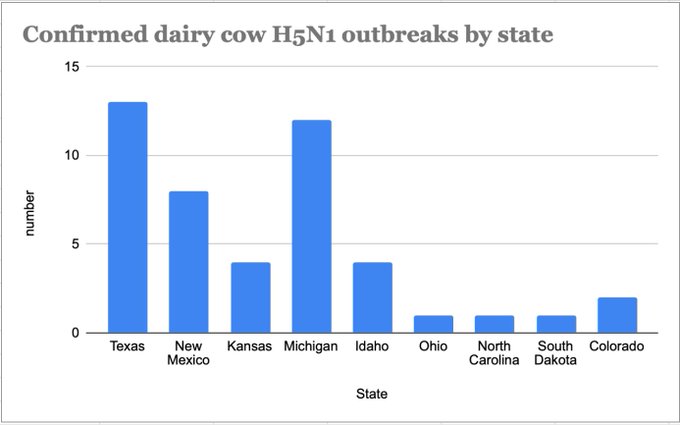
The number of #H5N1 #birdflu infected dairy herds continues to rise.
@USDA
added 5 today, 3 in SD & 2 in Colorado. Michigan announced +3 which USDA hasn't yet put on its list but I've added here because Michigan's doing a bang-up job finding/reporting herds. Total = 66.
Image


This is why Helen is such a professional. When she makes an error (very rare) she always fixes it. No one is perfect - especially in a developing situation.


Helen Branswell
@HelenBranswell
·
2h


CORRECTION: Michigan's total stands at 21, not 22. The cumulative national total of confirmed #H5N1 #birdflu outbreaks in dairy cow herds is 65, not 66. Apologies. The Michigan Ag dept press release saying they'd confirmed 3 new herds confused me. One was previously reported.
Quote
aE2OOz5k_normal.jpeg

Helen Branswell
@HelenBranswell
·
20h
The number of [HASHTAG="c2811"]H5N1[/HASHTAG] [HASHTAG="t52125"]birdflu[/HASHTAG] infected dairy herds continues to rise. @USDA added 5 today, 3 in SD & 2 in Colorado. Michigan announced +3 which USDA hasn't yet put on its list but I've added here because Michigan's doing a bang-up job finding/reporting herds. Total = 66.
Show more
Image


1


Helen Branswell

@HelenBranswell
·
2h


.
@USDA
reports 3 new #H5N1 #birdflu infected dairy herds, in TEX, MI & ID. This graph is getting messy coz MI announces herds faster than USDA (22 vs 20) & USDA added an alpaca herd in ID to a list that is otherwise all dairy cows. USDA's total: 67. With the +2 MI herds, 69.
Image


6


85


105

8.7K


---------------------------------------------------------------------------

A quick note...

We are posting the outbreaks by state now since there are so many. Sadly... :(

​Go to the US forum and scroll down to see the latest avian flu posts in each state:

https://flutrackers.com/forum/forum/united-states/h5n1-tracking-af
 
Once they started actually doing something to help the farmers, the numbers have been steady climbing and will continue to rise till they quarantine everything.
 
Status
Not open for further replies.
Back
Top