Re: :::Emergence of seasonal influenza viruses type A/H1N1 with:::
Re: :::Emergence of seasonal influenza viruses type A/H1N1 with:::
From "Journal - Scott McPherson's Web Presence":
http://www.scottmcpherson.net/display/ShowJournal?moduleId=1366394&categoryId=116462
...
Adding to the conundrum on Tamiflu resistance in Influenza A
Posted on Friday, February 1, 2008 at 09:15AM by
 Scott McPherson
 in
influenza and infectious diseases |
 1 Comment
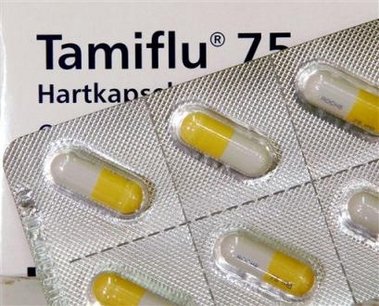
I do much of my strategic thinking in decidedly NON-strategic places (loo, shower, etc.), So it was that this morning, whilst showering, I remembered my blog of October 4, 2007, regarding the Swedish discovery that Tamiflu does not break down in municipal water supplies.
A specific news article stated:
Oct. 3 (Bloomberg) -- Roche Holding AG's Tamiflu persists in waste water, which may make the drug a less effective weapon in an influenza pandemic, Swedish researchers said.
The medicine's active ingredient, oseltamivir carboxylate, is excreted in the urine and feces of those taking it. Scientists at Sweden's Umea University found the drug isn't removed or degraded in normal sewage treatment, and its presence in waterways may allow flu-carrying birds to ingest it and incubate resistant viruses.
My post is at:
http://www.scottmcpherson.net/journal/2007/10/4/killing-two-birds-with-one-stone.html and I hope you all periodically go back and search my blogs, in case my short-term memory ever malfunctions!
The reason why I bring it up is that Japan takes enough Tamiflu to make Roche very, very happy. Yet, despite the theoretical presence of lots of peed-out Tamiflu in its wastewater systems, there is no evidence of Japanese H1N1 with the Tamiflu-resistant gene H274Y. This would further supprt the theories of Dr. Henry Niman and others that this H1N1 mutation is not the result of a mutation derived from people taking mass quantities of Tamiflu.
It does, by proxy, support the theory that the H274Y gene was picked up via some recombination event elsewhere(s), and then came to Europe and North America via human contact. It may also point us toward reservoirs of excreted Tamiflu in wastewater and, in some remote corners of the world, drinking water commingled with drinking water, in the vicinity of Tamiflu blankets. Wherever a Tamiflu blanket is applied, are we checking the waste/groundwater to see how much residual antiviral is still active? Could a combination of excreted Tamiflu in Indonesian, Egyptian, German, Mongolian, Chinese, and Egyptian lakes be a source of Tamiflu-resistant H5N1, incubated and then carried by migrating birds?
So I just wanted to share that thought, link the wastewater discovery of October with the current debate, and move on. Now I must go and do more strategic thinking. Now what did you say your name was?
Has Tamiflu-resistant H1N1 come to the US?
Posted on Thursday, January 31, 2008 at 11:08AM by
Scott McPherson in
influenza and infectious diseases |
2 Comments
My first read every morning when I sit in front of the computer is
www.recombinomics.com, the Website run by Dr. Henry Niman. Dr. Niman has some very interesting information regarding the H274Y Tamiflu-resistant mutation that is the subject of an increasing number of media reports over the past few days. Even the New York Times and AP have picked up on the Helen Branswell/Canadian Press story of this week.
Here's what is peculiar: Normally, you would expect Tamiflu-resistant H1N1 influenza to show up in areas where Tamiflu is prescribed. But that is not the case here! There are no known cases of H1N1 with the H274Y mutation in Japan, where Tamiflu is habitually overprescribed; and 70% of H1N1 is showing Tamiflu resistance in distant Norway, where Tamiflu is rarely, if ever, prescribed. Quite a conundrum.
Dr. Niman believes that Tamiflu-resistant H1N1 with the H274Y mutation has already been detected in these US isolates:
ISDN282211 A/Hawaii/21/2007 H1N1
ISDN282224 A/Hawaii/28/2007 H1N1
ISDN282222 A/Hawaii/28/2007 H1N1
CY027037 A/Kansas/UR06-0104/2007 H1N1
ISDN282240 A/Minnesota/23/2007 H1N1
ISDN263890 A/Texas/31/2007 H1N1
According to Dr. Niman,
The above comments describe the appearance of the oseltamivir resistance marker, H274Y, in recent H1N1 isolates in Europe.
However, a search of public sequences identifies H274Y suddenly appearing in 2007 H1N1 isolates from the United States (see list below. The number of complete human influenza sequences has grown steadily, largely because of the NIAID influenza sequencing project. At the Los Alamos sequence database, there are 1030 N1 sequences from H1N1 human isolates. 340 are from 2007 and all of the sequences below are from 2007. Thus, although the percentage of samples was low, all were from 2007 and all were Solomon Island-like.
In the United States the change was in the Solomon Islands variant, which links back to Asia, where the identical change has been seen in H5N1 from patients treated with Tamiflu, as well as birds, including wild birds in Astrakhan in 2005.
These Solomon-Island lake sequences trace back to Asia, where Tamiflu blankets are frequently applied in the treatment of H5N1. The N1 in H5N1 has donor sequences for human N1 in the region adjacent to the acquisition which generates H274Y, which is the precise change found in the most common form of oseltamivir resistance in H5N1 patients, primarily in Vietnam.
The two complete commentaries from Dr. Niman can be found at:
http://www.recombinomics.com/News/01290802/H1N1_Tamiflu_US.html
http://www.recombinomics.com/News/01300804/H1N1_H274Y_H5N1.html
Remember that the "A" refers to Influenza A, next comes the location where the virus was first typed, then the lab number, then the year, and then the subtype.
Now, over at FluTrackers, the forum is as lively as ever. And speculation centers around the actual inner workings of Tamiflu itself. I am treading dangerously close to incompetence if I speculate any further, having reached the edge of my envelope on the surface properties of N1 vs. N2 subtypes of neuranimidase and their susceptibility to Tamiflu versus Relenza. So I will simply give you the link and let you follow the bouncing ball:
http://www.flutrackers.com/forum/showthread.php?t=51648
So what does this mean? It means that Tamiflu is still the #1 arrow in the quiver against pandemic flu. It also means the people who make Relenza can rejoice somewhat, because it ups the ante for buying their product.
But the deeper meaning is this: After years and years of use, the sudden appearance of this genetic marker in seasonal H1N1 has to be the result of a relatively recent series of developments. Tamiflu resistance
had to be acquired by H1N1. The most likely place for it to have done so is in Asia, or Egypt. Or both: There are compelling arguments for both, as we see geographically distinct Hawaii, Kansas and Minnesota isolates showing the mutation. And talk about geographically distinct! Again, from Branswell's story:
Eight of 81 H1N1 viruses tested carry the H274Y mutation - one each from British Columbia and Newfoundland and Labrador, and six from Ontario. Plummer said that total includes one virus (from British Columbia) recovered from a child who is believed to have been infected in Sudan.
That means this mutation is all over the place! It could have come from anywhere. But it is appropriate to zero in on the areas where Tamiflu resistance is most likely to be manufactured: Wherever a Tamiflu blanket has been applied to try and quell an H5N1 outbreak. Dr. Niman makes a compelling argument that these Tamiflu blankets may have spawned this mutation.
The theory is that H5N1 segments recombined with H1N1 seasonal flu to produce a new, Tamiflu-resistant substrain of H1N1. Also keep in mind that the Southeast Asian strain of H5N1 is of a different clade (Fujian) than the Egyptian strain (Qinghai), so Tamiflu resistance would either have been conferred before the subtype split into two distinct clades (sometime in early 2005?), or they independently mutated with simultaneous Tamiflu resistance. This "parallel development" theory is entirely plausible.
But what if H1N1 was not the only virus that changed? If H1N1 and H5N1 can get together this way, have they already gotten together before and spawned a mild H5N1 that is easily passed off as seasonal flu? Again, Niman postulates that in Southeast Asia and in Egypt, there may be a mild form of H5N1 that is beginning to spread. Now before we rejoice at the thought of a mild, nonlethal reassortant/recombinant H5N1, recall that in 1918, the second pandemic wave -- not the first wave -- was the murderer. The first wave was passed off as normal, seasonal influenza. Experts said, "No biggie; nothing to see here, folks."
Of course, today's typing and surveillance is so much better, right?
If you say "Yes," then you didn't read my blog of yesterday. Go get it:
http://www.scottmcpherson.net/journal/2008/1/30/no-magic-bullets-to-fight-panflu.html
...