You can judge the amount of work by the volume of publications especially those with high citations. It’s indisputable that Wuhan has worked on this since at least mid-2000s, and some really groundbreaking work has come out of that team in recent years. The Wuhan Institute of Virology (WIV) was a BSL3 lab that upgraded to BSL4 in 2018, but by checking author affiliations, we know that some of the work involving dissection of bats to recover e.g. hantavirus is done at the Wuhan CDC (WHCDC) lab which is only BSL2 but which is <300m from the seafood market, plus also being right next door to the hospital with first major HCW outbreak in Dec, from asymptomatic neurosurgical patient.
In fact, this is a district with a large number of hospitals, and one can just as easily say the outbreak started with patients that arrived in those hospitals in that district, people who worked, lived, went to market there. Everything, market, lab, hospitals, are within 1km of each other, except for the WIV lab which is 9 miles away.
The conventional wisdom was bats are the natural reservoir, but bat CoV are not well adapted enough to jump directly to humans, and an intermediate host is required (e.g. civets or camels for MERS). So when a new virus of such transmissibility appears, one of the most urgent things to do is to try and find the intermediate host, because you know, it could still be spreading. Suspicions were first aroused because of the unusual behavior of the Wuhan authorities. Guan Yi was the HKU expert (top 11th cited in microbiology in world) who uncovered the connection with civets in 2003. He went to Wuhan mid-January and then gave an extraordinary interview, that a) the market was shut and decontaminated b) he was denied access to market or any environmental samples taken c) he knocked on several doors of scientific community but "epidemiology experts and scientists do not seem to be welcomed in the city."
That is a red flag, and it's been reinforced by the fact that Chinese researchers don’t seem particularly keen to work on this either. Wuhan is a center of expertise on this very subject, it’s inconceivable that they would decontaminate the market without taking animal samples. That’s like a researcher’s dream to be the first to identify the source. So either they were actively stopped, or they did take samples but kept quiet. (Raw data from environmental as opposed to animal samples have since been shared privately between researchers but not published, and it appears that these are poorly labelled with regards to where exactly they were taken. These partial sequences match patient samples, so they could well be from human shedding only.) The other thing is, even if that market was closed, it would be reasonable to go and take samples from other wildlife markets, because the stuff was being sold on the streets all through January.
Nobody has published anything, even though a ton has been published on all other aspects of this outbreak, including from WIV scientists. The data from market surveillance is so important that even negative results would have been useful (perhaps too useful).
I’m skeptical in general with the bioweapons theory because it’s hard to control a respiratory virus, but I looked into some of these allegations, specifically that the virus may have been subject to human engineering because certain mutations seem suspiciously well adapted to humans or appear to be similar to other sequences from other viruses. But here’s the thing. There’s still a vast universe of bat CoV that’s not yet mapped, but the ones already sequenced show a great deal of heterogeneity and recombination (i.e. these viruses in the wild are mixing and exchanging genetic materials all the time), plus if you dig deeper, there’s published data that some of these specific regions are in fact found in wild-type bat-CoV, so it isn’t as unusual as some would make out, to find such features. Plus, it’s a basic requirement that a virus has to acquire human adaptations to be capable of h2h transmission, so it just seems circular logic to assert human intervention on such grounds alone.
With the 2003 virus, it was found that viruses found in humans and civets were very similar, with a mutation that allow the virus to bind to human-type ACE2 receptors, which was absent from the corresponding bat SLCoV. Since then many labs have done sampling of bat CoV from all over China. Despite diversity, not one sample showed the human-adapted receptor binding domain RBD, so it was believed that bat CoV would have difficulty infecting humans without adaptation via an intermediate host. Secondly, nobody had ever isolated a live bat-SL-CoV, one that could be grown in cell culture.
All that changed in 2013 when the WIV published a study, based on 5 years of surveillance of a particular bat population in Yunnan.
link They found a bunch of bat-SL-CoV and published 2 representative sequences. For the first time, these had the human-adapted RBD mutation. Also, they were able to isolate a live virus, now called WIV1, with which they were able to do experiments. Prior to this experiments were done with genetically engineered viruses using the sequence under investigation on a backbone of a virus that’s lab-adapted to infect e.g. mice but is otherwise harmless. This is common practice.
But now they had this wild-type virus with a human-adapted RBD, which is a whole different ballgame. On top of that, they took samples from villagers and found some of them had antibodies to this wild-type bat virus, thus showing that no intermediate host is required for human infection, although no evidence of h2h was found. All sorts of alarm bells started ringing and other labs started collaborating; one paper was explicitly titled SARS-like WIV1-CoV poised for human emergence.by researchers from N Carolina, Harvard, FDA, Switzerland, a whole who’s who of this field.
link
Amazingly before 2002 the WIV lab was an agricultural lab (insect-borne viruses and pesticide testing), but converted to work on human pathogens in 2003, the same year during which approval was given to convert from BSL3 to BSL4. That seems a degree of haste, but in line with China government policy on rapid expansion of biotech sector. By the time construction was finished in 2015 (but before certification for actual research 2018) 3 other BSL4 were in various stages of completion. This is reminiscent of Chernobyl, when the Soviets brought nuclear power plants online without prototype and without sufficient time for the first one to be robustly tested. It doesn’t help that the French institute that was supposed to build the lab had its contract prematurely terminated and the Chinese finished the work on its own (having copied/stolen the plans to build the other 3). This hastiness is reckless, but also prompts suspicion of dual use intentions, because one can always do with more power plants, but the amount of civilian, medical research that requires such capabilities is kind of limited. SARS itself requires only BSL3, but experiments with non-human primates would require BSL4.
In the 2013 paper and others that followed, they described transmission experiments in mice with WIV1 plus some chimera viruses with the human ACE2 affinity. The next logical step from rodents would be primates, but even smaller mammals they were using such as raccoon cats (simulating civets) would have been perfectly adequate intermediate hosts that could, if biosecurity was lax, result in a human-adapted virus escaping the lab. We already know that the 2003 virus escaped numerous times from a Beijing lab. Bear in mind their own finding, that you don’t even need an intermediate host.
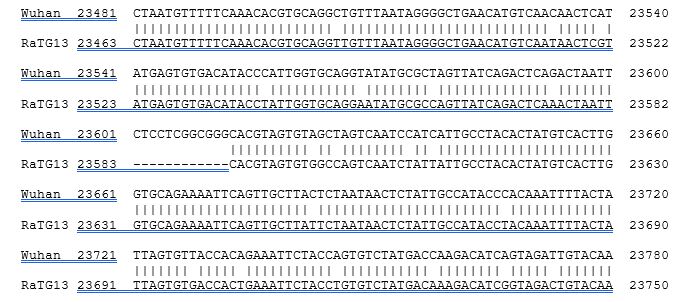
With all that in mind, now check this out. In Jan, scientists studied the new virus in comparison to known sequences in the public database, and found some that were 89% match. And then, a bomb shell. The WIV lab published that the closest match 96% is actually a sequence RaTG13, from their own collection from the 2013 Yunnan studies. At first it was mystifying, because the paper did not give citations for RaTG13.
Turns out this sequence was submitted to GISAID database (for researchers) only on Jan 27 2020, by the very same WIV lab! In other words, the closest match for this pandemic virus is a sample they’ve had in their lab but left unpublished all these years. Now, having a sequence is not the same as having a virus, and not publishing all your findings is not necessarily a sign of nefarious intentions, but at a minimum it shows that the same set of samples that produced the by-now well studied WIV1 group, also contained all along the closest one to this pandemic virus. And, as we know, they’ve been working hard at this, doing all sorts of experiments, all along.
One can still stick with the eating wildlife story, as many still do, and I can’t discount it, but what’s the statistical probability that this once-in-a-century virus would emerge, of all places, out of the millions of wet markets in China, in the exact same city that is on the forefront of this research, that hosts the lab with the closest sequence?
The possibility of lab escape is not hot air, with the WIV, but there’s also the WHCDC. On the surface, they appear to be working on viruses that do not require higher biosafety (BSL2 = general hospital precautions), but who knows?. I read one paper from that lab on hantavirus, and it is concerning, because for this study they were capturing wild animals, a total of 450 bats, 81 insectivores and 2 shrews from different provinces, all kept alive in cages until they were dissected. So if we were to ask, where in the city of Wuhan could you find large numbers of bats kept in close proximity with other wild animals so that the virus could cross species, well, by all accounts, no bats were found in the wet market, but lo and behold, you can find these exact conditions in the WHCDC lab. The bats in the study were from different provinces including Yunnan although not from same region as the 2013 samples, but some were of the same genus that carried RaTG13. So while they might have thought they were working on the hantavirus, did they not realize that CoV was also in there, being shed all over the place? And that’s just one study; I’m sure that line of work has been ongoing for some years.
We know that in the wild mixing and recombination among bat SL-CoV is very common, but the diversity at one single location is still limited geographically. Plus RBD is never the whole story, and even 96% similarity is quite a ways off from human adaptation. For a bat virus to get to h2h, most likely several changes are needed. It’s likely these mutations already exist in the wild, but not necessarily in the same virus, and most importantly not in the same geographic location. One particular mutation may be prevalent in a cave in Yunnan, but another may exist only in Zhejiang or elsewhere, so they would not have a chance to meet and mix,
except now they’re being collected and brought together, not just as blood or swab samples as in the WIV study, but as live animals. Bats are naturally sequestered in their habitats, but when you remove them and put them together with those from other locations, and/or with other animals, you drastically increase the chance of mixing until eventually you hit the (pandemic) jackpot. And if you do that in a metropolis with 11 million people that’s also a transport hub, as opposed to a remote cave in Yunnan, and only under BSL2, technically you may not be deliberately making a bioweapon, but you ought to be accountable for the consequences just the same. Just saying.
More on biosafety. One author of the hantavirus paper, who also published other work in collaboration with WIV on CoV (working in both labs appears to be a common practice), had gotten some national fame for working on bat viruses, having described in media interviews being splashed with bat blood, and being peed on by bats in caves.
On both occasions, he recounted having to self-quarantine for 14 days, so they understood perfectly well their exposure risk. I’m not sure, though, that BSL2 containment measures are sufficient for say, disposal of contaminated waste with such pathogens. I’m not just talking about carelessness and lack of adherence to protocol, both rampant in China. There’s also a whole underground industry of re-packaging medical waste to be sold as new, from syringes, IV sets to bandages and test swabs. Also the sale of ‘surplus’ experimental animals for meat, which in one officially reported case resulted in millions in profit.
So biological waste is one entirely plausible route, for a virus with pandemic potential, to leak into the community.
Another equally plausible but less dramatic possibility would be quite simply someone got infected but was either asymptomatic or had such mild symptoms that they never got tested, but nevertheless infected others, as we now know happens frequently with this virus. The seemingly explosive transmission at the wet market is likely to be a super-spreader event, which has happened so many time all over the world that it should no longer be a curiosity, and certainly not an indicator of origins.