
• FluTrackers.com Inc. does not provide medical advice. Information on this web site is collected from various internet resources, and the FluTrackers board of directors makes no warranty to the safety, efficacy, correctness or completeness of the information posted on this site by any author or poster. The information collated here is for instructional and/or discussion purposes only and is NOT intended to diagnose or treat any disease, illness, or other medical condition. Every individual reader or poster should seek advice from their personal physician/healthcare practitioner before considering or using any interventions that are discussed on this website. By continuing to access this website you agree to consult your personal physican before using any interventions posted on this website, and you agree to hold harmless FluTrackers.com Inc., the board of directors, the members, and all authors and posters for any effects from use of any medication, supplement, vitamin or other substance, device, intervention, etc. mentioned in posts on this website, or other internet venues referenced in posts on this website.
  • We are not asking for any donations. Do not donate to any entity who says they are raising funds for us.

CHINA - Unknown disease kills >1,000,000 pigs in 1 district alone

Sharpe

Senior Moderator
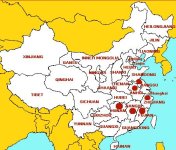
I will not speculate on this, just leave you to read it for yourselves. Map of 6 provinces mentioned attached.

Archive Number20060903.2508
Published Date03-SEP-2006
SubjectPRO/AH> Undiagnosed disease, porcine - China (South), RFI


UNDIAGNOSED DISEASE, PORCINE - CHINA (SOUTH), REQUEST FOR INFORMATION
*********************************************************************
A ProMED-mail post
<http://www.promedmail.org>
ProMED-mail is a program of the
International Society for Infectious Diseases
<http://www.isid.org>

[1]
Date: Sun 3 Sep 2006
From: Dan Silver <dgsilver@yahoo.com>
Source: Sina, 1 Sep 2006 [translated by sender, edited]
<http://news.tfol.com/10026/10032/10102/2006/9/1/10203730.shtml>


Pig illness in the south, agriculture ministry demands strengthened quarantine
-----------------------------------------------
In response to the recent occurrence of pig illness in the south, the
General Office of the Ministry of Agriculture issued a notice yesterday [31
Aug 2006] requiring legally-compliant control and prevention against
transmission or expansion of the disease; requiring increased quarantine
dynamics at sites of production and slaughter; and resolutely implementing
the "four impermissibles, one disposal" for all diseased pigs: no butchery,
no eating, no sale, no transport, and safe onsite disposal.

Since June 2006, a pig disease characterized by rising body temperature,
redness of the skin, and rapid breathing has occurred in portions of Anhui,
Jiangxi, Zhejiang, Hunan, Hubei, Jiangsu, and other provinces.
The
Agriculture Ministry's notice requires conscientious implementation of all
control measures: emphasize improvement of disease control and hoghouse
hygiene among small and mid-size breeders (households) and breeding
districts; establish sound disease control systems; strengthen disease
surveillance and epidemiological investigations; promptly find and report
disease; promptly eliminate hidden risks for disease; be strict with
disease handling work; actively undertake appropriate treatment of diseased
pigs; carry out cremation, burial and other safe disposal of dead pigs;
appropriately select vaccines to conduct immunization work; promptly
control and stamp out disease; strengthen supervision over animal hygiene
production, sale and distribution; prohibit pigs that have not passed
quarantine from entering distribution or slaughter; strike hard against
illegal trafficking of diseased pigs and byproducts.

[byline: Jiang Yuxiao]

--
Dan Silver
<dgsilver@yahoo.com>

******
[2]
Date: Sun 3 Sep 2006
From: Dan Silver <dgsilver@yahoo.com>
Source: Manfangdaily.com, 29 Aug 2006 [translated from Chinese by sender,
edited]
<http://www.nanfangdaily.com.cn/southnews/dd/nc/nccf/200608290664.asp>


Personnel in the industry believe rising pig prices are closely related to
the recent appearance of an unidentified, high-mortality disease in the
Hunan, Jiangxi, Fujian regions.

News obtained from the Hunan, Jiangxi, Fujian regions shows that this
outbreak has caused large-scale pig herd deaths in parts of the region. In
the area of Nanchang in Jiangxi alone, nearly one million pigs may have
died [according to] incomplete statistics. With large-scale deaths of pigs
in each area, the existing pig shortage has expanded, causing pig prices to
rise substantially.

--
Dan Silver
<dgsilver@yahoo.com>

[An administrative map of China is available at
<http://upload.wikimedia.org/wikipedia/en/c/c9/China_administrative.png>.

The sender/translator, Dan Silver, has kindly notified us that additional
similar references have been published recently in China, most of them in
economic articles and government announcements about general preventive
measures employed in a few locales in Hunan.

Any available information, including mortality rates, detailed clinical
signs and pathological changes, and -- it is to be hoped -- excluding
zoonotic diseases, will be appreciated. - Mod.AS]
 

Attachments

  • china_map-pigs.JPG
    china_map-pigs.JPG
    48.8 KB · Views: 0
Re: CHINA - Unknown disease kills >1,000,000 pigs in 1 district alone

Sharpe - How reliable are these reports? One million pigs is a huge number even by Chinese standards.
 
Last edited by a moderator:
Re: CHINA - Unknown disease kills >1,000,000 pigs in 1 district alone

OK, but this is apparantly not bird flu (red skin ?).
Nor does it seem to interact with or relate to birdflu.

Except that it demonstrates how China uses to report
on such things.
 
Re: CHINA - Unknown disease kills >1,000,000 pigs in 1 district alone

gsgs said:
OK, but this is apparantly not bird flu (red skin ?).
Nor does it seem to interact with or relate to birdflu.

Except that it demonstrates how China uses to report
on such things.

Petechia is a common symptom of H5N1 and 1918 pandemic influenza.
 
Re: CHINA - Unknown disease kills >1,000,000 pigs in 1 district alone

Very interesting and it may be interesting to see how this ties in with the previously unprecedented report of virulent Streptococcus suis infection in pigs that apparently also killed 39 of 215 human cases. These were evaluated by a panel of WHO experts with data provided by the Chinese Ministry of Health and thought to be compatible with possibly a new and virulent strain of S. suis but asked for continued monitoring and updating.

http://www.wpro.who.int/media_centre/news/news_20050816.htm

""Outbreak associated with Streptococcus suis in pigs in China: Update
16 August 2005 - As China moves towards concluding its investigation into the recent outbreak in Sichuan Province associated with Streptococcus suis in pigs, the Ministry of Health of China has shared more details with WHO about the outbreak""


I think it's also worth noting that I believe SARS was also at first thought to be due to a bacterial infection. Either way looks like a serious problem that needs further investigation.

Related articles:

http://www.pubmedcentral.nih.gov/articlerender.fcgi?artid=1434494

Streptococcal Toxic Shock Syndrome Caused by Streptococcus suis Serotype 2

Jiaqi Tang,#1* Changjun Wang,#1 Youjun Feng,#2,10 Weizhong Yang,#3 Huaidong Song,#4,9 Zhihai Chen,#5 Hongjie Yu,#3 Xiuzhen Pan,1 Xiaojun Zhou,6 Huaru Wang,1 Bo Wu,6 Haili Wang,1 Huamei Zhao,1 Ying Lin,7 Jianhua Yue,1 Zhenqiang Wu,7 Xiaowei He,7 Feng Gao,2 Abdul Hamid Khan,2,10 Jian Wang,8 Guo-Ping Zhao,9 Yu Wang,3* Xiaoning Wang,7* Zhu Chen,4,9 and George F Gao2*

1Department of Epidemiology, Research Institute for Medicine of Nanjing Command, Nanjing, China , 2Center for Molecular Immunology and State Key Laboratory of Microbial Resources, Institute of Microbiology, Chinese Academy of Sciences, Beijing, China , 3Chinese Center for Disease Control and Prevention (China CDC), Beijing, China , 4State Key Laboratory of Medical Genomics, Ruijin Hospital Affiliated to Medical School of Shanghai Jiao-Tong University, Shanghai, China , 5Beijing Ditan Hospital, Beijing, China , 6Department of Pathology, Jinling Hospital of Nanjing, Nanjing, China , 7School of Biosciences and Bioengineering, South China University of Technology, Guangzhou, China , 8Beijing Genomics Institute, Chinese Academy of Sciences, Beijing, China , 9Chinese National Human Genome Center, Shanghai, China , 10Graduate School, Chinese Academy of Sciences, Beijing, China

and

http://yaleglobal.yale.edu/display.article?id=7518

The Sovereignty of Disease

Outbreaks of infectious disease demand rapid global response for monitoring and protection


David L. Heymann
YaleGlobal, 6 June 2006
 
Re: CHINA - Unknown disease kills >1,000,000 pigs in 1 district alone

There was considerable debate out release of samples from the 2005 outbreak, which was considerably smaller in scope than the current outbreak.

I am not sure that the samples from 2005 have been released (or independently tested for H5N1).
 
Re: CHINA - Unknown disease kills >1,000,000 pigs in 1 district alone

Florida1 said:
Sharpe - How reliable are these reports? One million pigs is a huge number even by Chinese standards.

These reports are being posted on Promed--they are being written by Chinese government officials telling pig herders what to do about their dying pigs. They are being written about in Chinese economic journals--because pig prices in China are rising rapidly due to the lack of pigs. I don't know how much more reliable you want them to be. We're not talking about a million pigs. We're probably talking about tens to hundreds of millions of pigs. The same thing has been occurring across the China Sea in the Philippines this summer. So many pigs were dying that they were worried about a scarcity of pigs. GSGS is right that red rashes have not been very prominently described in reports of H5N1 cases, but as Dr. Niman points out, it is a classic sign of DIC--which is what occurs with bird flu--hence the nosebleeds, etc. And if you go back and look at the reports that I typed up from 1918 yesterday, you will see that it was incredibly common for people to have large red rashes.

One thing that I would like to know is simply this: All the deaths that have suddenly occurred due to encephalitis in Henan and Shanxi in the last few weeks--were they pig-herders?
 
Last edited by a moderator:
Re: CHINA - Unknown disease kills >1,000,000 pigs in 1 district alone

Thanks Sharpe.
 
Last edited by a moderator:
Re: CHINA - Unknown disease kills >1,000,000 pigs in 1 district alone

Friday, September 01, 2006
<SCRIPT language=javascript type=text/javascript>if(uid) {document.write('<a href="javascript: window.print();">');}else {document.write('<a href="/users/login.php?redirect=%2Fswinenews%2F12167%2Fchina-piglet-market-weekly%2Fprint&loginrequired=true&por=true">');}</SCRIPT>Print This Page China Piglet Market Weekly

CHINA - In this weeks China Piglet Market Weekly, eFeedLink report that China's piglet prices were stable to higher during the week ending Aug 31.

Price summary


In Hunan province, piglet prices were slightly higher after the pig disease outbreak was brought under control. Market analysis


Key characteristics of China's piglet market during the week under review were as follows:

Farmers' interest in taking up piglet supplies varied from region to region. In the north, farmers were mostly concerned over the possibility of pig diseases which are likely to occur in autumn. Going forward, lower temperatures will also slow the rate of fattening hogs, and this has discouraged some farmers from taking up supplies.

The temperature in southern China's winter will still be higher than those in the north. Other than in the areas affected by pig diseases, farmers' interest in buying piglets are still higher.

In the initial period of the pig disease outbreak, many hogs and sows had succumbed to the disease. Traders and meat processors had thus seized the opportunity to bargain for very low hog procurement prices. This had affected farmers' interest in taking up piglet supplies, and piglet prices were slightly lower even in the unaffected areas during the first half of the week in review.

Earlier, the pig disease had also killed many hogs, especially in farms with big herds in parts of Hunan province. After authorities there had rolled out measures to bring the outbreak under control, piglet replenishment activities had started to recover.

Meanwhile, deliveries of piglets to other regions had also increased. In regions where piglet inventory had been low, farmers were seen more active in taking up piglet supplies.

By making piglet replenishment during this period (late August to September), farmers were hoping to bring in profits early next year as piglets would have fattened sufficiently to be sold as hogs during the Spring Festival (Feb 18) in 2007.

Parts of south-western China continued to be plagued by a dry spell. With temperature hovering around 40 deg C, farmers there were less active in taking up piglet supplies. Market forecast


As measures to control the pig disease takes effect, analysts expect piglet replenishment in regions previously affected by pig disease to pick up.

In the week ahead, piglet replenishment activities are expected to pick up in southern China, while those in the north may not increase much. Overall, piglet prices are seen stable.

06-09-01eFeedLink1.gif

http://www.thepigsite.com/swinenews/12167/china-piglet-market-weekly
 
Re: CHINA - Unknown disease kills >1,000,000 pigs in 1 district alone

Sharpe said:
These reports are being posted on Promed--they are being written by Chinese government officials telling pig herders what to do about their dying pigs. They are being written about in Chinese economic journals--because pig prices in China are rising rapidly due to the lack of pigs. I don't know how much more reliable you want them to be. We're not talking about a million pigs. We're probably talking about tens to hundreds of millions of pigs. The same thing has been occurring across the China Sea in the Philippines this summer. So many pigs were dying that they were worried about a scarcity of pigs. GSGS is right that red rashes have not been very prominently described in reports of H5N1 cases, but as Dr. Niman points out, it is a classic sign of DIC--which is what occurs with bird flu--hence the nosebleeds, etc. And if you go back and look at the reports that I typed up from 1918 yesterday, you will see that it was incredibly common for people to have large red rashes.

One thing that I would like to know is simply this: All the deaths that have suddenly occurred due to encephalitis in Henan and Shanxi in the last few weeks--were they pig-herders?

What is left unsaid is frequently more infoprmative than what is said with regard to H5N1 infections. The list of examples is very long (i.e. most H5N1 confirmed index cases for a countriy are clusters and today the 2004 H5N1 infections of dogs in Thailand

http://www.recombinomics.com/news/10040401/canine_deaths.html

are being discussed in late 2006 because the Thai governemnt said (in 2004) that the 2004 positives were "mislabeled".

http://www.recombinomics.com/News/05230602/H5N1_Canine.html

In China, the fact that there has been no announced diagnosis on a pig disease that began in June and has spread over a large geographical range in the heart of swine growing territory and has killed 1, 10, or 100 million pigs, speaks volumes.
 
Last edited by a moderator:
Re: CHINA - Unknown disease kills >1,000,000 pigs in 1 district alone

Back in Februrary there were reports of China carrying out a mass cull of dogs in Yunan, officially in a bid to control rabies. I have not been able to find reports of additional dog culls elsewhere, but remember reading several different articles on this, so I beleive it was quite a widespread cull. Given confirmation of H5N1 infected dogs recently and these pig deaths I am wondering if there may be a geographical link between the two incidences, especially as it involves China - which means we must 'watch what they do, not what they say' to glean what is going on.

Does anyone with a better grasp of geography (or ability to find maps electronically) know if the regions with dog culling in China are the same as these mass pig deaths?
 
Re: CHINA - Unknown disease kills >1,000,000 pigs in 1 district alone

Vibrant62 said:
Back in Februrary there were reports of China carrying out a mass cull of dogs in Yunan, officially in a bid to control rabies. I have not been able to find reports of additional dog culls elsewhere, but remember reading several different articles on this, so I beleive it was quite a widespread cull. Given confirmation of H5N1 infected dogs recently and these pig deaths I am wondering if there may be a geographical link between the two incidences, especially as it involves China - which means we must 'watch what they do, not what they say' to glean what is going on.

Does anyone with a better grasp of geography (or ability to find maps electronically) know if the regions with dog culling in China are the same as these mass pig deaths?

The H5N1 dog deaths in Thailand were in 2004 and the culling from rabies was largely limited to a small region (town?) in China.
 
Re: CHINA - Unknown disease kills >1,000,000 pigs in 1 district alone

[FONT=veranda, arial]
The circovirus haved cause many problem in north america.
1000000 cases in china, is ... possible given the scale of the epidemic here.

it cause syndromes named PMWS and PDNS.
but many of its complication can be associate with others pathogens

http://www.thepigsite.com/articles/...ease-focus-pmws-and-pdns-updated-3rd-feb-2001

[/FONT][FONT=veranda, arial]
PMWSSkinLesions3.jpg

Skin lesions associated with PMWS and PDNS

[FONT=veranda, arial]
PMWSEnlargedLymphGlands.jpg

Enlarged lymph glands associated with PMWS
[/FONT]
[/FONT].

[FONT=Arial, Veranda]Symptoms[/FONT]

[FONT=Arial, Veranda]Weaners & Growers [/FONT]
  • [FONT=Arial, Veranda]
    [*]PMWS tends to be a slow and progressive disease with a high fatality rate in affected pigs.
    [*]Starting usually at about 6 - 8 weeks of age, weaned pigs lose weight and gradually become emaciated. Their hair becomes rough, their skins become pale and sometimes jaundiced and they are innappetant.
    [*]Sudden death.
    [*]Enlarged peripheral lymph nodes, particularly in between the back legs. Hold the pig up and you may see the inguinal nodes up to the size of golf balls.
    [*]May show diarrhoea in 30% of cases.
    [*]Cases of porcine dermatitis nephropathy syndrome (PDNS) are often seen in herds affected with PMWS.
    [*]May show respiratory distress or laboured breathing caused by interstitial pneumonia.
    [*]Discoloured ears may also be seen.
    [*]Incoordination.
    [*]Nervous signs may occasionally be seen.
    [*]Post weaning mortality is likely to rise to 6 - 10% but is sometimes much higher (20%). In older pigs mortality can rise to 10%.
    [*]Clinical cases may keep occurring in a herd over many months. They usually reach a peak after 6 - 12 months and then gradually decline. Numbers affected vary from one group to another.
    [*]Growth rates in affected pigs are often normal.
    [*]No response to treatment
    [/FONT]
[FONT=Arial, Veranda]Sows & Piglets [/FONT]
  • [FONT=Arial, Veranda]
    [*]Mature animals, sows, boars and sucking piglets are not affected and it is uncommon for newly weaned pigs to be affected before 6 weeks of age.
    [/FONT]
 
Re: CHINA - Unknown disease kills >1,000,000 pigs in 1 district alone

no mention of increased temperature and rapid breathing, though.
 
Re: CHINA - Unknown disease kills >1,000,000 pigs in 1 district alone

gsgs said:
no mention of increased temperature and rapid breathing, though.
[FONT=Arial, Veranda]
[/FONT][FONT=Arial, Veranda]disease with a high fatality rate in affected pigs.(...)
[/FONT][FONT=Arial, Veranda]Sudden death.(...)
[/FONT][FONT=Arial, Veranda]Cases of porcine dermatitis nephropathy syndrome(...)[/FONT]
[FONT=Arial, Veranda]May show respiratory distress or laboured breathing caused by interstitial pneumonia.


What are the interstitial pneumonia symptoms ?
[/FONT]
 
Re: CHINA - Unknown disease kills >1,000,000 pigs in 1 district alone

I would like to point out that WHO confirmed H5N1 human case have occurred in 5 of the 6 provinces listed.

Anhui, (human H5N1)
Jiangxi, (human H5N1)
Zhejiang, (human H5N1)
Hunan, (human H5N1)
Hubei, (human H5N1)
Jiangsu, (None)
and other provinces
 
Re: CHINA - Unknown disease kills >1,000,000 pigs in 1 district alone

Mingus, you think the symptoms match well ?
I have no expertise here, just noticed the reports.
Temperature maybe was unmentioned since obvious with pneumonia ?
"rapid breathing" could match "respiratory distress or laboured breathing",
I'm not sure.

Well, if the diagnosis were easy, the Chinese would
probably already have told us ?!?!?


what TomDVM wrote at fluwikie:
----------------------------------------------------------
Okay, as far as the clinical signs listed, they are incredibly general and non-specific?

-Pigs have a few quirks and we have a few mistunderstandings about them. They are one of the most closely related animal species to humans and are more intelligent than most other animals?

-they cannot regulate their body temperature by sweating, and that is why they lay in wet muddy areas in the summertime. They are also prone to both ?blushing? and sunburn?

-therefore, any disease would produce the clinical signs mentioned.
...Chinese Government is being deliberately misleading
 
Re: CHINA - Unknown disease kills >1,000,000 pigs in 1 district alone

gsgs said:
Well, if the diagnosis were easy, the Chinese would
probably already have told us ?!?!?


(...)
Okay, as far as the clinical signs listed, they are incredibly general and non-specific?
...Chinese Government is being deliberately misleading

This virus haved first been identify in western canada.

Well, the various circovirus's syndrome where known as "mysterious disease" overhere before the problem was generally accepted as a circovirus caused disease.

It reappeared in New-Zealand last fall where the disease was eradicated before and the media presented the disease as "a mysterious disease".

The disease mysteriously have different syndrome appearance in europe and in america while the strains are almost identicals... this have been blamed on diferential associated-causes.

While only some percentage of the pigs did fall sick, almost all herds (in america) are positives to the virus and this for many years, nobody knows exactly what provoque the symptoms to appear.

The circovirus as the syndrome's causative agent was only recently been proven.

There is a strong chance that if the virus begin to cause some problem in China, amost knowbody there know about it and that it is treated as a "mysterious disease" exactly like it have been covered here in our occidental democratic and free-press country.
 
Back
Top Bottom