Disease Outbreak News
Marburg virus disease - Rwanda
30 September 2024
Situation at a glance
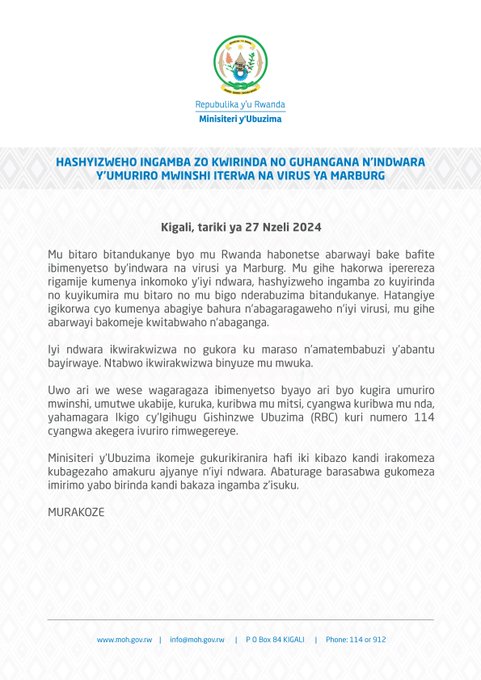
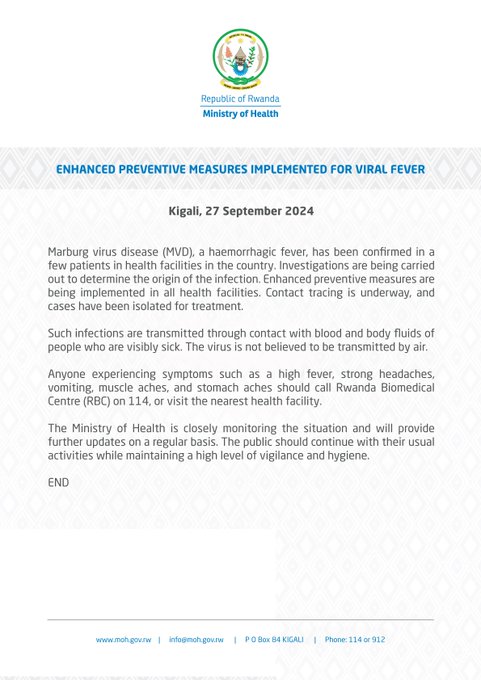
On 27 September 2024, the Rwanda Ministry of Health announced the confirmation of Marburg virus disease (MVD). Blood samples taken from people showing symptoms were tested by real-time reverse transcription polymerase chain reaction (RT-PCR) at the National Reference Laboratory of the Rwanda Biomedical Center and were positive for Marburg virus. As of 29 September 2024, a total of 26 confirmed cases, including eight deaths have been reported. The cases are reported from seven of the 30 districts in the country.
Among the confirmed cases, over 70% are healthcare workers from two health facilities in Kigali. The patients are being cared for in hospitals. Contact tracing is underway, with 300 contacts under follow-up. This is the first time MVD has been reported in Rwanda. The Government of Rwanda is coordinating the response with support from WHO and partners.
There is currently no available treatment or vaccine for MVD. This is why it is important for people showing Marburg-like symptoms to seek care early for supportive treatment which can improve patient survival. WHO assesses the risk of this outbreak as very high at the national level, high at the regional level, and low at the global level.
Description of the situation
On 27 September 2024, the Rwanda Ministry of Health announced the confirmation of MVD in patients in health facilities in the country. Blood samples collected from suspected cases were sent to the National Reference Laboratory of the Rwanda Biomedical Center for testing and were positive for Marburg virus by RT-PCR on 26 September 2024. Samples are being sent to a regional reference laboratory for further confirmation.
As of 29 September 2024, a total of 26 confirmed cases, including eight deaths (CFR: 31%), have been reported. The cases are reported from seven of the 30 districts in the county namely: Gasabo, Gatsibo, Kamonyi, Kicukiro, Nyagatare, Nyarugenge and Rubavu districts. Healthcare workers from two health facilities in Kigali account for over 70% of confirmed cases. The patients are being cared for in hospitals.
Contact tracing is underway, with about 300 contacts under follow-up as of 29 September 2024. One contact travelled internationally. They remained healthy, completed the monitoring period and did not present with any symptoms.
The source of the infection is still under investigation and additional information will be provided when available.
This is the first report of MVD in Rwanda.
Epidemiology
MVD is a highly virulent disease that can cause haemorrhagic fever and is clinically similar to Ebola diseases. Marburg and Ebola viruses are both members of the Filoviridae family (filovirus). People are initially infected with Marburg virus when they come into close contact with Rousettus bats, a type of fruit bat, that can carry the Marburg virus and are often found in mines or caves.
Marburg virus spreads between people via direct contact (through broken skin or mucous membranes) with the blood, secretions, organs or other bodily fluids of infected people, and with surfaces and materials (e.g. bedding, clothing) contaminated with these fluids. Healthcare workers have previously been infected while treating patients with suspected or confirmed MVD. Burial ceremonies that involve direct contact with the body of the deceased can also contribute to the transmission of Marburg virus.
The incubation period varies from two to 21 days. Illness caused by Marburg virus begins abruptly, with high fever, severe headache and severe malaise. Severe watery diarrhoea, abdominal pain and cramping, nausea and vomiting can begin on the third day. Although not all cases present with haemorrhagic signs, severe haemorrhagic manifestations may appear between five and seven days from symptoms onset, and fatal cases usually have some form of bleeding, often from multiple areas. In fatal cases, death occurs most often between eight and nine days after symptom onset, usually preceded by severe blood loss and shock. There is currently no available treatment or vaccine for MVD. Some candidate vaccines are currently under development.
Several outbreaks of MVD have previously been reported from countries neighbouring Rwanda, including the Democratic Republic of the Congo, Uganda and the United Republic of Tanzania. The most recent outbreaks were reported in Equatorial Guinea and the United Republic of Tanzania between February and June 2023. The affected region in the United Republic of Tanzania was the Kagera region, which borders Rwanda. Additional countries that previously reported outbreaks of MVD in the African Region included Angola, Ghana, Guinea, Kenya, and South Africa.
Public health response
- The Government of Rwanda is coordinating the response with support from WHO and partners.
- To support the early detection of cases, the Ministry of Health has shared the Rwanda Biomedical Center hotline number with the public to report symptoms.
- In-depth epidemiological investigation, contact tracing and follow-up is underway and suspected cases are being isolated for testing and treatment.
- Infection prevention and control (IPC) and Water, Sanitation and Hygiene (WASH) measures are being implemented in all health facilities.
- Risk communication and community engagement strategies (RCCE) to inform and mobilize communities, including strategies to manage rumours and misinformation are being strengthened.
- Following the initial confirmation in the country, WHO is supporting the transportation of samples to a regional reference laboratory for confirmation.
- WHO is working on delivering supplies including the shipment and prepositioning of laboratory testing kits and personal protective equipment.
- WHO and partners are working closely with the government to provide information and access to available candidate MVD vaccines and therapeutics for a possible clinical trial. The Ministry of Health has identified two experienced principal investigators to lead the trials.
- WHO is working with neighbouring countries Democratic Republic of Congo, Burundi, Kenya, Tanzania and Uganda to review its operational readiness capabilities to respond to Marburg. WHO is conducting an assessment of the risk for South Sudan due to trade routes between countries. The readiness of unaffected districts in Rwanda is also being ensured to mitigate the spread and quickly identify any spillover.
WHO risk assessment
Marburg virus disease (MVD) is caused by the same family of viruses (Filoviridae) that causes Ebola disease. MVD is an epidemic-prone disease associated with high CFR (24-88%). In the early course of the disease clinical diagnosis of MVD is challenging to distinguish from other infectious diseases such as malaria, typhoid fever, shigellosis, meningitis and other viral haemorrhagic fevers. Epidemiologic features can help differentiate between viral hemorrhagic fevers (including history of exposure to bats, caves, or mining) and laboratory testing is important to confirm the diagnosis.
The notification of 26 confirmed cases, of which over 70% are healthcare workers from two different health facilities in the country is of great concern. Healthcare-associated infections (also known as nosocomial infections) of this disease can lead to further spread if not controlled early. The importance of screening all persons entering health facilities as well as inpatient surveillance for prompt identification, isolation, and notification cannot be overemphasized. This is in addition to the importance of contact identification and monitoring of all probable and confirmed cases. The source of the outbreak, geographical extent, the likely date of onset, and additional epidemiological information on cases are still pending further outbreak investigation.
There is a risk of this outbreak spreading to neighbouring countries since cases have been reported in districts located at the borders with the Democratic Republic of the Congo, the United Republic of Tanzania, and Uganda. Further risk of international spread is also high as confirmed cases have been reported in the capital city with an international airport and road networks to several cities in East Africa. A contact is known to have travelled internationally, and appropriate response measures have been implemented. Optimized supportive care for patients, which includes careful monitoring, intravenous fluid, and early treatment of complications, can improve patient survival. There are promising vaccines and therapeutic candidates for MVD, but these must be proven in clinical trials. WHO has provided guidance to the Ministry of Health on how to manage cases.
WHO assesses the risk of this outbreak as very high at the national level, high at the regional level, and low at the global level. Investigations are ongoing to determine the full extent of the outbreak and this risk assessment will be updated as more information is received.
WHO advice
MVD outbreak control relies on using a range of interventions, including prompt isolation and case management; surveillance including active case search, case investigation and contact tracing; an optimal laboratory service; infection prevention and control, including prompt safe and dignified burial; and social mobilization – community engagement is key to successfully controlling MVD outbreaks. Raising awareness of risk factors for Marburg virus infection and protective measures that individuals can take is an effective way to reduce human transmission. WHO advises the following risk reduction measures as an effective way to reduce MVD transmission in healthcare facilities and in communities:
- To reduce human infections and deaths, it is essential to raise community awareness about the risk factors for Marburg virus infection and the protective measures individuals can take to minimize exposure to the virus. This includes encouraging anyone with symptoms to seek immediate care at a health facility or designated treatment centre to lower the risk of community transmission and improve their chances for recovery.
- Surveillance activities including the wider dissemination of MVD case detection should be strengthened in all affected provinces, including contact tracing and active case finding.
- Critical infection prevention and control measures in health facilities should be strengthened or implemented including:
- Establish a system for screening, referral and isolation of suspect MVD cases. Health facilities should ensure active screening of all persons entering the facility according to suspect MVD case definition and prompt isolation for suspect and confirmed cases.
- Health facilities should ensure IPC programmes and Water, Sanitation and Hygiene (WASH) services are in place, establish/activate their IPC committees for coordination purposes and ensure IPC guidelines, protocol, standard operating procedures for MVD are available (e.g. environmental cleaning, and disinfection, risk assessment for exposed health workers) and sufficient IPC/ personal protective equipment (PPE) supplies.
- Health workers caring for patients with confirmed or suspected MVD should apply Transmission-based precautions in addition to: Standard precautions, including appropriate use of PPE and hand hygiene according to the WHO 5 moments to avoid contact with patient’s blood and other body fluids and with contaminated surfaces and objects.
- Health facilities should ensure the availability of PPE for health workers, cleaning and disinfection of the environment is conducted, processes for appropriate decontamination of medical devices, safe linen and waste management are in place. This includes training/refresher training of health workers on IPC and WASH.
- Rapid health facility IPC & WASH assessments should be undertaken to identify and address gaps.
- Equally important, the identification of deceased patients should be implemented in communities and safe and dignified burials, which requires strong engagement with communities.
- Timely laboratory confirmation of all suspected patients needs to be in place and supported with a sample transportation system in place.
WHO encourages all countries to send samples (positive or negative) to a WHO Collaborating Centre or a regional reference laboratory for confirmation. WHO recommends that clinical data from suspected and confirmed cases of Marburg disease are systematically collected to improve the limited understanding of the clinical course and direct causes and risk factors for poor outcomes. This can be done by contributing anonymized data to the
WHO Global Clinical Platform for viral haemorrhagic fevers.
Based on the current risk assessment, WHO advises against any travel and trade restrictions with Rwanda.
Further information
- World Health Organization (March 2009). Hand hygiene technical reference manual: to be used by health-care workers, trainers and observers of hand hygiene practices. Available at https://www.who.int/publications/i/item/9789241598606
- Ebola and Marburg diseases screening and treatment center design training. Available at: https://openwho.org/courses/ebola-marburg-screen-treat-facilities
- World Health Organization (2 June 2023). Disease Outbreak News; Marburg virus disease in the United Republic of Tanzania. Available at https://www.who.int/emergencies/disease-outbreak-news/item/2023-DON471
- Markotter W, Coertse J, DeVries M, et al. Bat-borne viruses in Africa: a critical review. J of Zoology. 2020;311:77-98. doi:10.1111/jzo.12769. Available at: https://zslpublications.onlinelibrary.wiley.com/doi/10.1111/jzo.12769(link is external)
- Korine C Rousettus aegyptiacus. The IUCN Red List of Threatened Species 2016: e.T29730A22043105. Available at: https://www.iucnredlist.org/species/29730/22043105
- Cross RW, Longini IM, Becker S, Bok K, Boucher D, Carroll MW, et al. (2022) An introduction to the Marburg virus vaccine consortium, MARVAC. PLoS Pathog 18(10): e1010805. Available at: https://doi.org/10.1371/journal.ppat.1010805
- A WHO-Strategic Research Agenda for Filovirus Research and Monitoring (WHO-AFIRM). Available at: https://www.who.int/publications/m/...virus-research-and-monitoring-----(who-afirm)
- Building research readiness for a future filovirus outbreak, Workshop February 20 - 22, 2024, Uganda. Available at: https://www.who.int/news-room/event...-outbreak-workshop-february-20-22-2024-uganda
- WHO Technical Advisory Group – candidate vaccine prioritization. Summary of the evaluations and recommendations on the four Marburg vaccines. Available at: https://www.who.int/publications/m/...-recommendations-on-the-four-marburg-vaccines
- Marburg virus vaccine landscape. Available at: https://www.who.int/publications/m/item/marburg-virus-vaccine-landscape
- Marburg virus therapeutics landscape. Available at: https://www.who.int/publications/m/item/marburg-virus-therapeutics-landscape
Citable reference: World Health Organization (30 September 2024). Disease Outbreak News; Marburg virus disease in the Republic of Rwanda. Available at:
https://www.who.int/emergencies/disease-outbreak-news/item/2023-DON537
https://www.who.int/emergencies/disease-outbreak-news/item/2024-DON537#:~:text=As%20of%2029%20September%202024,being%20cared%20for%20in%20hospitals.