
• FluTrackers.com Inc. does not provide medical advice. Information on this web site is collected from various internet resources, and the FluTrackers board of directors makes no warranty to the safety, efficacy, correctness or completeness of the information posted on this site by any author or poster. The information collated here is for instructional and/or discussion purposes only and is NOT intended to diagnose or treat any disease, illness, or other medical condition. Every individual reader or poster should seek advice from their personal physician/healthcare practitioner before considering or using any interventions that are discussed on this website. By continuing to access this website you agree to consult your personal physican before using any interventions posted on this website, and you agree to hold harmless FluTrackers.com Inc., the board of directors, the members, and all authors and posters for any effects from use of any medication, supplement, vitamin or other substance, device, intervention, etc. mentioned in posts on this website, or other internet venues referenced in posts on this website.
  • We are not asking for any donations. Do not donate to any entity who says they are raising funds for us.

Icelandic volcano spews ash cloud - European flights hampered

Re: Icelandic volcano spews ash cloud - European flights hampered

Update on activity

Eruption in Eyjafjallaj?kull, Iceland

Assessment - 19 May 2010 17:55

According to radar and pilots? observations, the plume has been slightly lower today than yesterday, at 5-6 km (18,000-20,000 ft). Southerly winds prevailed this morning over the volcano, turning to the southwest at 15-18 m/s. The plume drifted northwest early this morning, but then turned north-northeast, and its colour is gray or light gray. The number of lightning strikes has decreased.

Ash has fallen in the south at Fl??ir, Flj?tshl?? and Rang?r?ing ytra. Ash has also fallen with rainfall in the north, in H?sav?k and Skagafj?r?ur, right before noon.

Heavy rainfall caused swelling of Eyjafjallaj?kull rivers today. The rain, together with ash from an area of a few square kilometers, resulted in a mudslide in Sva?b?li river. Hydrologists from IMO, and a scientist from IES, gathered samples from the river and also from Sk?gar river. The discharge at the old bridge over Markarflj?t river has not been greater since 15 April.

The discharge at G?gj?kull is still low.

The plume is up to 5-6 km and drifts to the north-northeast according to reconnaissance flight from the Icelandic Coast Guard this afternoon. The above is based on a status report issued collectively by the Icelandic Meteorological Office and the Institute of Earth Sciences at 17:00.

http://en.vedur.is/earthquakes-and-volcanism/articles/nr/1884
 
Re: Icelandic volcano spews ash cloud - European flights hampered

<TABLE cellSpacing=0 cellPadding=0 width="100%" border=0><TBODY><TR><TD class=categoryname vAlign=center align=left width="100%" background=../images/bg_topbar.gif height=17>Eruption at the Eyjafjallaj?kull volcanic system</TD><TD width=10></TD></TR><TR><TD colSpan=3 height=10>
pix.gif
</TD></TR></TBODY></TABLE><!-- text area--><TABLE cellSpacing=0 cellPadding=0 width="100%" border=0><TBODY><TR><TD width=10></TD><TD width="90%"><TABLE cellSpacing=0 cellPadding=2 width="100%" border=0><TBODY><TR><TD class=Date>19.5.2010</TD></TR><TR><TD>
Eyjafjallaj?kull - a flood in Sva?b?lis? river
</TD></TR><TR><TD>Time: 16:35

This morning a mud flow of water and ash came down the watercourse of the river Sva?b?lis? and flowed over the embankment at ?orvaldseyri. The flood continued throughout the morning but had subsided considerably in the afternoon. Eyewitnesses said the flood looked like flowing concrete.

The flood was caused by surface ash from the slopes of Eyjafjallaj?kull. Visibility at the glacier has been zero, but radar images taken by the Icelandic Coast Guard?s airplane over the glacier this morning clearly show break-lines over the source of the floods, up to a height of 1200 metres. The area where the flood originated is 4 to 5 square km. in size.

Ash needs to contain 20 to 30 % water to form mud flows, and a heavy rain has been falling in the area for the last several hours. Similar events can take place in other drainage areas of the glacier.

Work is in progress to strengthen the embankments at ?orvaldseyri.

http://www.almannavarnir.is/displayer.asp?cat_id=413&module_id=220&element_id=2438

</TD></TR></TBODY></TABLE></TD></TR></TBODY></TABLE>
 
Re: Icelandic volcano spews ash cloud - European flights hampered

Update on activity

Eruption in Eyjafjallaj?kull, Iceland

Assessment 21 May 2010 20:45

Observation from inspection flight and other pilot reports show that the eruption plume is light grey, with a small amount of ash and the height is 3-3.5 km/10,000-12,000ft. (a.s.l.) Plume is blown towards northeast and later northwest by light southerly winds.

No reports of ashfall today. Reports from Ne?ri-?ver? and Hl??arendakot in Flj?tshl?? of bluish gas in Flj?tsdalur and along the hillsides in some sort of clouds, smelling of rot (causing people headaches when dark in colour).

Volcanic tremor levels have decreased since yesterday evening. However, they rose for two hours this morning, but have since continued to decrease. Over twenty earthquakes have been recorded since midnight, the majority at shallow depths.

The eruption has declined a great deal and the flow of magma into the crater can be roughly estimated as 5 tonnes/s, carried away by a plume that rises 1.5-2 km above the creater. No lava flowing.

The above is based on a status report issued collectively by the Icelandic Meteorological Office and the Institute of Earth Sciences at 19:00.

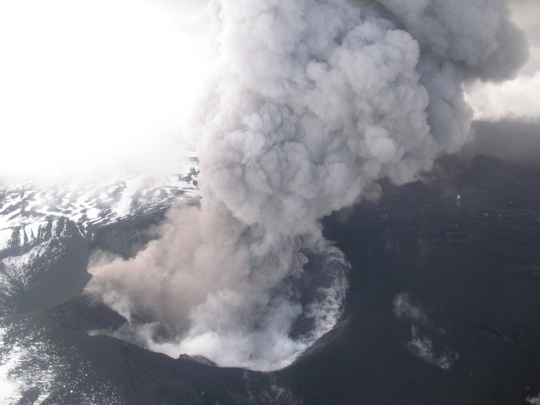
The eruption 21 May
SiHj_img_4279.jpg

The eruption site ca 18:00 21 May 2010. Photo: Sigurlaug Hjaltad?ttir.


http://en.vedur.is/earthquakes-and-volcanism/articles/nr/1884
 
Re: Icelandic volcano spews ash cloud - European flights hampered

<CITE>By Agence France-Presse, </CITE>Updated: 23/05/2010

No activity at Iceland volcano, eruption could be over: expert

Iceland's Eyjafjoell volcano is no longer in activity, a geophysicist said Sunday, raising hopes the eruption which has heavily disrupted European flights for more than a month could be over.

"What I can confirm is that the activity of the crater has stopped. No magma is coming up" Magnus Gudmundsson of Iceland University told AFP.

"The eruption, at least for the time being, has stopped. Now there is only steam coming out of the crater," he said, cautioning however that "it is too early to tell whether this is the end of the eruption or just a temporary stop in activity."

Experts would be monitoring the volcano, which began eruption on April 14, very closely in the days and weeks to come.

"I would say if there are no new earthquakes and no new outburst, then that would suggest that it is over," Gudmundsson said, adding that it could take a very long time before it would be possible to say for sure.

"If you call me in one year's time, I could be pretty certain," he said, pointing out that the previous eruption at the volcano lasted 13 months, from 1821-23.

"It stopped and started again several times with different intervals, so it's difficult to say, difficult to give a timeline," he said.

The latest eruption at Eyjafjoell also began just a day after a more peaceful eruption ended on the Fimmvurduhals flank of the same volcano.

Experts have cautioned that once the current eruption halted, a new blast in another crater or in the neighbouring and much larger and fiercer Katla volcano might follow.

When or if that will happen is also, according to Gudmundsson, "impossible to say."

In recent days, experts had said the activity at the Eyjafjoell volcano, which peaked for a third time just over a week ago, had slowed significantly.

Gudmundsson however said it was difficult to tell exactly when the activity had stopped.

"The flow of magma was very small yesterday, but it was still erupting at 5:00 to 6:00 pm (1700-1800 GMT). Ash was falling to the west of the volcano," he said, adding that "there has not been any eruption since at least this morning."

During Eyjafjoell's highest activity peak in the week after it began erupting, it released ash enough to cause the biggest aerial shutdown in Europe since World War II, affecting more than 100,000 flights and eight million passengers.

http://news.xin.msn.com/en/business/article.aspx?cp-documentid=4106547
 
Re: Icelandic volcano spews ash cloud - European flights hampered

Update on activity

Eruption in Eyjafjallaj?kull, Iceland

Assessment 23 May 2010 18:00

The eruption plume is light in colour, contains steam, and is heading south in a light northerly wind. The plume is estimated at 3 km/10,000ft height (a.s.l.). There are no reports of ashfall; no lightning strikes have been detected and no noises reported. Meltwater discharge from G?gj?kull is low.

Measurements with a heat camera made from an aircraft gave just under 100?C as the highest temperatures at the crater. The crater could not be observed, due to steam rising from it. No signs of extrusion of magma could be seen. Volcanic tremor is still decreasing and is approaching the level it had before the eruption.

Today, the eruption seems to be dormant. There is still a considerable amount of steam coming from the crater, but no ash can be seen in it.

Details in a status report issued collectively by the Icelandic Meteorological Office and the Institute of Earth Sciences at 17:00.

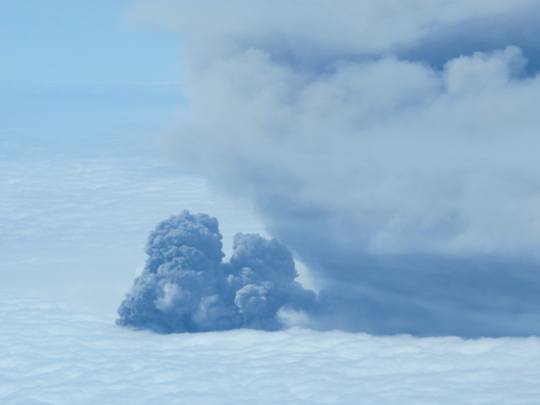
Waning ash cloud?
ssj_0835.jpg
Flight over Eyjafjallaj?kull at 14:15 yesterday, 22nd May 2010: Possibly the last ash explosion. Photo: Steinunn Jakobsd?ttir.
http://en.vedur.is/earthquakes-and-volcanism/articles/nr/1884
 
Re: Icelandic volcano spews ash cloud - European flights hampered

Update on activity

Eruption in Eyjafjallaj?kull, Iceland

Assessment 24 May 2010 15:00

There is still a considerable amount of steam coming from the crater, but no ash can be seen in it. According to a web camera, the steam plume reaches 2 km/6600ft (a.s.l.). Due to light northerly wind, it is heading south.

Conditions at the eruption site are similar to yesterday, estimated through a webcamera. Earthquake activity has decreased since yesterday; only one earthquake has been recorded since midnight. The eruption seems to be dormant.

However, tremor is still higher than before the onset of the eruption, especially in the frequency band 1-2 Hz. Details in a status report issued collectively by the Icelandic Meteorological Office and the Institute of Earth Sciences at 14:00.

http://en.vedur.is/earthquakes-and-volcanism/articles/nr/1884
 
Re: Icelandic volcano spews ash cloud - European flights hampered

Eruption in Eyjafjallaj?kull - Status Report: 17:00 GMT, 25 May 2010

Icelandic Meteorological Office and Institute of Earth Sciences, University of Iceland

Compiled by: Hj?rleifur Sveinbj?rnsson, ?orsteinn J?nsson, Bj?rn S?var Einarsson and Sigr?n Hreinsd?ttir

Based on: IMO seismic monitoring; IES-IMO GPS monitoring; IMO hydrological data; web cameras, ATDnet ? UK Met. Offices lightning detection system, Satellite images and web-based ash reports from the public, and scientist on the volcano.

Eruption plume:
Height (a.s.l.): According to a webcamera, the plume is estimated at 2 km/6600ft. A light northerly wind.
Heading: South.
Colour: White, steam.
Tephra fallout: No reports of ashfall.
Lightning: No lightning strikes have been detected.
Noises: No reports.

Meltwater:
Low discharge from G?gj?kull.

Conditions at eruption site:
Similar as yesterday, estimated through a webcamera and a flight over the volcano. Blue smog (sulfuric gases) could be seen and a strong smell was felt inside the airplane when flying south of the volcano. A group of scientist went to the crater today and they could see a small blast of ash, but mostly it is steam that is formed above the crater that can be seen from distance.

Seismic tremor:
Volcanic tremor is still more than before the eruption and has been rather steady the last couple of days, but small pulses, mostly on the lowest frequency (0.5-1.0 Hz), are being detected on the earthquake
stations around the volcano.

Earthquakes:
Eleven earthquakes have been detected under the volcano today, but 8 earthquakes were detected there yesterday.

GPS deformation:
No significant deformation at sites around Eyjafjallaj?kull in the last couple of days.

Overall assessment:
There is still a considerable amount of steam coming from the crater, and a small blast of ash was seen by scientist standing by the crater, but no ash was seen in the flight nor from the web cameras. The tremor is still higher than before the onset of the eruption, and small tremor pulses have been detected on the lowest frequency.


http://www.earthice.hi.is/page/ies_Eyjafjallajokull_eruption
 
Re: Icelandic volcano spews ash cloud - European flights hampered

Update on activity

Eruption in Eyjafjallaj?kull, Iceland

Assessment 1st June 2010 17:20

Clouds and mist have covered the summit of the volcano both yesterday and today. At 8 o'clock this morning, a white cloud was seen at 2 km a.s.l. on web cameras. Winds of up to 10 m/s are blowing from the east.

There was widespread drifting of existing ash in southwest Iceland, both yesterday and today; and high concentration of airborne dust was recorded in Reykjav?k yesterday, at noon and again at midnight.

Details in a status report issued collectively by the Icelandic Meteorological Office and the Institute of Earth Sciences today at 15:00.

The volcano will continue to be monitored closely as before. Next assessment will be made on Friday 4th June.

http://en.vedur.is/earthquakes-and-volcanism/articles/nr/1884
 
Re: Icelandic volcano spews ash cloud - European flights hampered

Update on activity

Eruption in Eyjafjallaj?kull, Iceland

Assessment 7 June 2010 14:40

Some eruptive activity is still in the western side of the crater. Magma explosions occur off and on producing ash, which falls near the crater.

This explosive activity is accompanied by an abrupt increase in tremor.

White steam clouds have reached a height of 6 km following these explosions. We continue to monitor the volcano closely.

In the western part of the crater, a new crater has formed at the site of explosive activity. Tremor pulses late 6 June accompanied steam plumes from this new crater. The plumes and explosions are small. Caving in of lava in the conduit can be heard between explosions. Only a part of the new active crater has been seen due to the steam. The glacial ice at the top is advancing rapidly to the G?gj?kull otulet glacier.

In the afternoon of 4 June an increase in seismic tremor was recorded at seismic stations around the volcano, but decreased again in the evening. Small pulses of tremor were recorded off and on during the night. At around 0900h on 5 June the tremor reached a maximum before decreasing again. An increase was recorded late 6 June for a short time and small pulses were recorded last night. The tremor has been predominantly at high frequencies. A few small, shallow earthquakes have been recorded beneath the top crater in the last few days.

Details in a status report issued collectively by the Icelandic Meteorological Office and the Institute of Earth Sciences today at 11:00.

See also status report from 12:00 4 June.
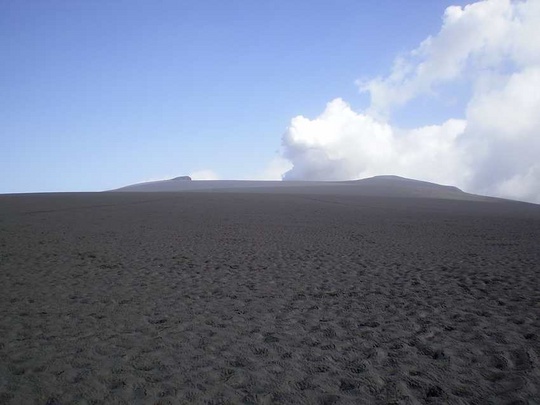
Ash
Aska_2010_0503_022112.jpg
A thick layer of ash on top of Eyjafjallaj?kull 25 May. Steam from the crater. Photo: Matthew J. Roberts.

http://en.vedur.is/earthquakes-and-volcanism/articles/nr/1884
 
Re: Icelandic volcano spews ash cloud - European flights hampered

Update on activity

Eruption in Eyjafjallaj?kull, Iceland

Assessment 14 June 2010 10:40

Details on the crater lake (described below), and on a mud flow last week in river Sva?b?lis?, in a status report issued collectively by the Icelandic Meteorological Office and the Institute of Earth Sciences on Friday night 11 June 2010 at 23:00, where it says that no magma is being erupted and that the activity is confined to steaming.

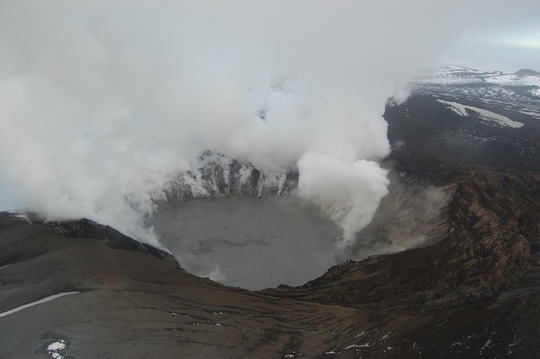
The crater lake


SvBr_gig11juni_003.jpg

Eyjafjallaj?kull crater, Friday evening 11th June 2010, view to the north. Clearly the water is stirred, either from water intake or heat convection or both. Photo: Sveinn Brynj?lfsson.

http://en.vedur.is/earthquakes-and-volcanism/articles/nr/1884
 
Re: Icelandic volcano spews ash cloud - European flights hampered

Eruption in Eyjafjallaj?kull - Status Report: 17:00 GMT, 15 June 2010
Icelandic Meteorological Office and Institute of Earth Sciences, University of Iceland

Compiled by: Bergth?ra S. Thorbjarnard?ttir, Magn?s Tumi Gu?umundsson, Sigr?n Hreinsd?ttir and Gunnar Sigur?sson.

Based on: IMO seismic monitoring; IES-IMO GPS monitoring; IMO hydrological data; web camera; lightning detection system and flights over the eruption site 11 and 14 June.

Steam clouds:
Height (a.s.l.): Have been observed at over a hundred meters.
Heading:
Colour: White.
Tephra fallout: None.
Lightning: None were measured on the UK Met Office's system.
Noises: No reports

Meltwater:
Low discharge from G?gj?kull.

Mudflood:
No mudfloods in the past few days.

Conditions at eruption site:
At the eastern, southern and western sides of the crater lake is a wall of ice. On the northern side a tephra wall rises 20 meters above the water. The ice walls at the southwestern corner of the crater are melting, i.e. at the site of the vent that was active 4 ? 6 June. The rate of melting is assumed to be about one cuber meter per second.

Seismic tremor:
Low tremor level. Pulses are observed off and on.

Earthquakes:
A few small, shallow earthquakes have been recorded beneath the Eyjafjallaj?kull summit in the last weeks. Thirteen microearthquakes were recorded in the M?rdalsj?kull caldera from 11 to 14 June, most at a shallow depth.

GPS deformation:
The seismic activity beneath M?rdalsj?kull glacier does not appear to be related to inflation of the area. No significant vertical deformation has been observed at GPS stations at or around the glacier. However, a station at the northeastern caldera rim (AUST), moved about three centimeters towards the southwest from the 9th to the 13th of June, inward to the caldera.

Overall assessment:

The level of water in the crater lake only rose about 1 ? 2 meters over the weekend. Several days or weeks are therefore likely to pass before the crater has filled with water, and up to months if the melting slows down. It is important that the water level be checked regularly. The water volume is now less than 0.5 million cubic meters. If the water level rises 20 meters, the volume will be 3 million cubic meters. The resulting flood would flow to the north, down the G?gj?kull valley glacier, and could reach a maximum of 1500-2000 cubic meters per second.

http://www.earthice.hi.is/page/ies_Eyjafjallajokull_eruption
 
Re: Icelandic volcano spews ash cloud - European flights hampered

Update on activity

Eruption in Eyjafjallaj?kull, Iceland

Assessment - 23 June 2010 09:15

Very little activity is at Eyjafjallaj?kull volcano. Small ash clouds are seen occasionally, they disappear again in some minutes. Water accumulation in the crater is slow as the ice is no longer in contact with hot material. GPS measurements show slight movements towards the mountain except at Austmannsbunga in M?rdalsj?kull, which shows movement towards southwest. No obvious explanation has been found for this movement.

Status reports from the Icelandic Meteorological Office and the Institute of Earth Sciences will no more be sent on regular basis, but only if something notable is observed.

Ice tunnel in G?gj?kull - 23 June 2010

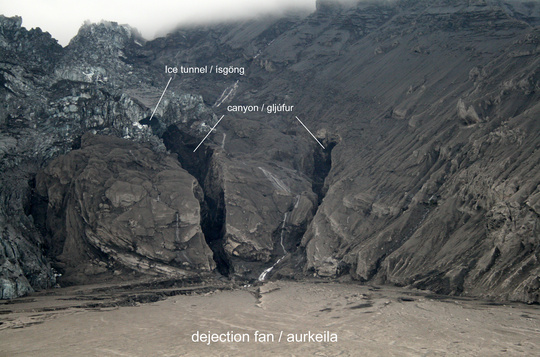
Inspection of a photo from G?gj?kull since 11 June shows an ice tunnel above the main canyon in the palagonite, which has been deepened and enlarged by the glacial bursts on April 14-15. Another canyon has formed to the west.

A quick and rough interpretation of the pictures suggests that the head of the sedimentary fan (upper part starting at the foot of both canyons) is presently at an elevation close to 340 m a.s.l., which is roughly 50 meters more than the elevation of the lake before the eruption (according to Digital Terrain Model, DTM, from ISOR).

Ice tunnel in G?gj?kull
emmanuel_4097bis.jpg

G?gj?kull 11 June 2010: an ice tunnel can be seen above the main canyon in the palagonite. Another canyon has formed to the west. Photo: Emmanuel Pierre Pagneux.

http://en.vedur.is/earthquakes-and-volcanism/articles/nr/1884
 
Last edited:
Back
Top Bottom