• FluTrackers.com Inc. does not provide medical advice. Information on this web site is collected from various internet resources, and the FluTrackers board of directors makes no warranty to the safety, efficacy, correctness or completeness of the information posted on this site by any author or poster. The information collated here is for instructional and/or discussion purposes only and is NOT intended to diagnose or treat any disease, illness, or other medical condition. Every individual reader or poster should seek advice from their personal physician/healthcare practitioner before considering or using any interventions that are discussed on this website. By continuing to access this website you agree to consult your personal physican before using any interventions posted on this website, and you agree to hold harmless FluTrackers.com Inc., the board of directors, the members, and all authors and posters for any effects from use of any medication, supplement, vitamin or other substance, device, intervention, etc. mentioned in posts on this website, or other internet venues referenced in posts on this website.
  • We are not asking for any donations. Do not donate to any entity who says they are raising funds for us.

Icelandic volcano spews ash cloud - European flights hampered

Giuseppe

Emeritus
ICELANDIC VOLCANO SPEWS ASH CLOUD


ICELANDIC VOLCANO SPEWS ASH CLOUD

[Source: Telegraph.co.uk, (LINK).]

<object classid="clsid:D27CDB6E-AE6D-11cf-96B8-444553540000" codebase="http://fpdownload.macromedia.com/get/flashplayer/current/swflash.cab" id="TelegraphPlayer-7592941" height="315" width="560">


<embed type="application/x-shockwave-flash" src="http://www.telegraph.co.uk/telegraph/template/utils/ooyala/telegraph_player.swf" pluginspage="http://www.adobe.com/go/getflashplayer" menu="false" quality="high" play="false" name="TelegraphPlayer-7592941" allowscriptaccess="always" wmode="window" salign="LT" allowfullscreen="true" scale="noscale" bgcolor="#000000" flashvars="embedCode=pjazNjMTosXWPXo0gcR657y0l8-48-kn&offSite=true&showTD=true" height="315" width="560"></object></p>
 
Re: Icelandic volcano spews ash cloud

Re: Icelandic volcano spews ash cloud

Iceland volcano ash disrupts European flights

By Kylie MacLellan, ReutersApril 15, 2010 10:58


<SCRIPT type=text/javascript> showTab("text/html"); </SCRIPT>
<SCRIPT type=text/javascript> function resizeImage() { var imgBox = document.getElementById('imageBox'); var photo = document.getElementById('storyphoto'); if (imgBox != null && photo != null) { if(photo.width >= 460) { imgBox.className = 'imagesize460'; } else { if(photo.width >= 300) { imgBox.className = 'imagesize310'; } else { imgBox.className = 'imageboxpadding'; } imgBox.style.width = photo.width + 'px'; } } } function getStoryFontSize() { var storyfontsize = getCookie('storyfontsize'); var storyfontimage = getCookie('storyfontimage'); // use cookied value, if present if (storyfontsize != null) { setClass('story_content',storyfontsize); if (storyfontimage != null) { setClass('fontsizecontainer',storyfontimage); } } else // default it to para14 if no cookie { setClass('story_content','para14'); setClass('fontsizecontainer','size02'); } } function setStoryFontSize(storyfontsize,storyfontimage) { setClass('story_content',storyfontsize); setClass('fontsizecontainer',storyfontimage); setCookie('storyfontsize', storyfontsize, '365', '/', '', ''); setCookie('storyfontimage', storyfontimage, '365', '/', '', ''); } function setCookie( name, value, expires, path, domain, secure ) { // set time var today = new Date(); today.setTime( today.getTime() ); if ( expires ) { expires = expires * 1000 * 60 * 60 * 24; //days } var expires_date = new Date( today.getTime() + (expires) ); document.cookie = name + "=" + escape( value ) + ( ( expires ) ? ";expires=" + expires_date.toGMTString() : "" ) + ( ( path ) ? ";path=" + path : "" ) + ( ( domain ) ? ";domain=" + domain : "" ) + ( ( secure ) ? ";secure" : "" ); } function getCookie( check_name ) { // split this cookie up into name/value pairs var a_all_cookies = document.cookie.split( ';' ); var a_temp_cookie = ''; var cookie_name = ''; var cookie_value = ''; var b_cookie_found = false; // set boolean t/f default f for ( i = 0; i < a_all_cookies.length; i++ ) { // split apart each name=value pair a_temp_cookie = a_all_cookies.split( '=' ); // and trim left/right whitespace while we're at it cookie_name = a_temp_cookie[0].replace(/^\s+|\s+$/g, ''); // if the extracted name matches passed check_name if ( cookie_name == check_name ) { b_cookie_found = true; // we need to handle case where cookie has no value but exists (no = sign, that is): if ( a_temp_cookie.length > 1 ) { cookie_value = unescape( a_temp_cookie[1].replace(/^\s+|\s+$/g, '') ); } // note that in cases where cookie is initialized but no value, null is returned return cookie_value; break; } a_temp_cookie = null; cookie_name = ''; } if ( !b_cookie_found ) { return null; } } </SCRIPT>

More Images ?


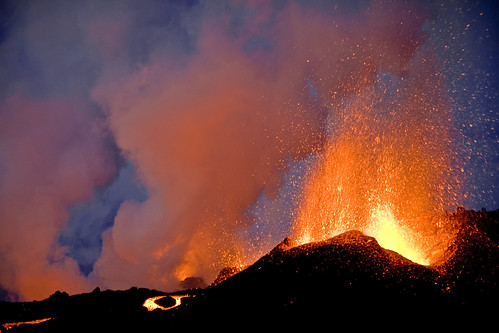
Smoke billows from a volcano in Eyjafjallajokull April 14, 2010. A volcanic eruption in Iceland spewed black smoke and white steam into the air on Wednesday and partly melted a glacier, setting off a major flood that threatened to damage roads and bridges.

Photograph by: Ingolfur Juliusson , Reuters


LONDON - A huge ash cloud from an Icelandic volcano turned the skies of northern Europe into a no-fly zone on Thursday, stranding hundreds of thousands of passengers.

The european air safety organization said the disruption, the biggest seen in the region, could last another two days and a leading volcano expert said the ash could present intermittent problems to air traffic for six months if the eruption continued.

The volcano began erupting on Wednesday for the second time in a month from below the Eyjafjallajokull glacier. It hurled a plume of ash six to 11 kilometres (3.8 to 7 miles) into the atmosphere, and this spread south east overnight.

Icelandic volcanologist Armannn Hoskuldsson said on Thursday the eruption was growing more intense.

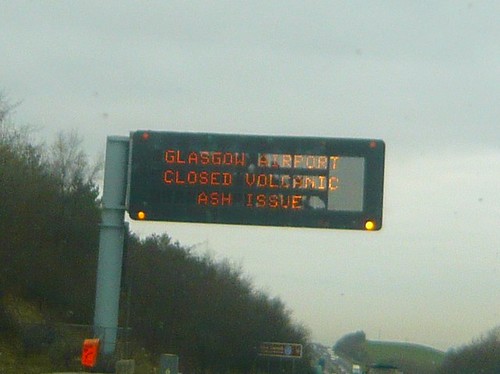
Britain barred flights in its air space, except in emergencies, until at least 0600 GMT on Friday.

It was the first time "within living memory" that a natural disaster had caused such a halt, a spokeswoman for Britain's National Air Traffic Service (NATS) said. Even after the Sept. 11, 2001 attacks on U.S. cities, Britain did not close its air space, she said.

"We continue to work closely with airports, airlines, and the rest of Europe to understand and mitigate the implications of the volcanic eruption," NATS said in a statement.

The precautions were taken because volcanic ash contains tiny particles of glass and pulverized rock which can damage engines and airframes.

"Safety is the first and predominant consideration and if any of the travelling public are inconvenienced I apologize for that," British Prime Minister Gordon Brown said.

Paris, Brussels, Amsterdam and Geneva airports said they had cancelled a large number of flights and Eurocontrol spokesman Brian Flynn said on Thursday afternoon the problem could persist for a further 48 hours.

Airline staff at Stansted airport, north-east of London, told customers it could be closed until Sunday, said stranded passenger Andy Evans.

"People just don't know what to do," he said. "There are hundreds of people in the queues at the sales desks."

A spokesman at Heathrow, Europe's busiest airport, said 840 out of 1,250 flights on Thursday were affected, disrupting about 180,000 passengers. More than 100,000 other passengers were affected at Gatwick and Stanstead.

In 1982 a British Airways jumbo jet lost power in all its engines when it flew into an ash cloud over Indonesia, gliding towards the ground before it was able to restart its engines.

The incident prompted the aviation industry to rethink the way it prepared for ash clouds, resulting in international contingency plans activated on Thursday.

Scientists said the ash did not pose any health threat because it is at such a high altitude.

Bill McGuire, professor at the Aon Benfield UCL Hazard Research Centre, said if the volcano continued erupting for more than 12 months, as it did the last time, periodic disruptions to air traffic could continue.

"The problem is volcanoes are very unpredictable and in this case we have only one eruption to go on," he said. "And a lot depends on the wind. I would expect this shutdown to last a couple of days. But if the eruption continues ? and continues to produce ash ? we could see repeated disruption over six months or so."
/.../

More at:
http://www.canada.com/technology/Iceland+volcano+disrupts+European+flights/2909620/story.html
 
Re: Icelandic volcano spews ash cloud - European flights disrupted

Re: Icelandic volcano spews ash cloud - European flights disrupted

http://www.metoffice.gov.uk/corporate/pressoffice/2010/volcano.html

Icelandic volcano eruption
Last updated: 0810 on Friday, 16 April 2010


The Met Office is continuing to monitor the spread of the ash plume from eruption of the Eyjafjallajökull volcano on Iceland.

Dust and smells have been detected in the Northern Isles. We are currently liaising with Health Protection Scotland and the Health Protection Agency in England. Dust has been collected at Lerwick and is currently being analysed by Scottish Environment Protection Agency.

The current situation regarding the volcanic ash and its affects on airspace, flights and airline movement is controlled by National Air Traffic Services (NATS). As a result NATS have put in place air space restrictions. The Met Office is unable to advise of any details of any flights. However, many airlines are providing information on their websites.

Our forecasters monitor volcanic eruptions as part of the Met Office’s role in the global network of nine Volcanic Ash Advisory Centres. Volcanic ash can be dangerous for aircraft, causing damage, reducing visibility, and potentially clogging engines. Our Environment Monitoring and Response Centre is constantly monitoring the Iceland area.

Our first advisory was issued at 1400 on 14 April and they have subsequently been updated every six hours.

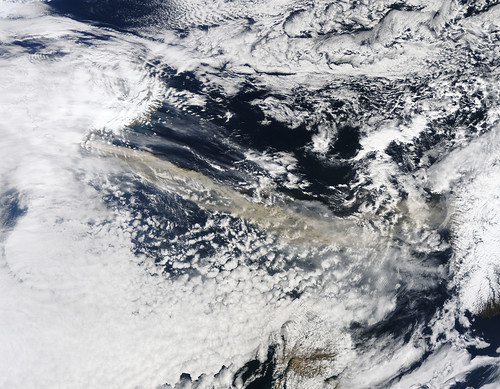
Icelandic volcanic eruption satellite imagery
http://www.metoffice.gov.uk/weather/europe/volcano/iceland.html

Representation of an advisory chart

http://www.metoffice.gov.uk/corporate/pressoffice/2010/volcano.html
Fig. 1 is an illustration of volcanic ash dispersion up to 20,000 ft, issued at 8am on 16 April. Advisory charts are issued every six hours, for up to 18 hours ahead, by the Volcanic Ash Advisory Centre.

As one of only two World Area Forecast Centres, we regularly advise the UK Civil Aviation Authority (CAA) and National Air Traffic Services on the plume trajectories. CAA and NATS have responsibility for safety within UK airspace.
We will continue to produce forecasts of the ash cloud and will assess the impact into the weekend.


http://www.eurocontrol.int/corporate/public/news/20100416_air_traffic_situation.html

Update on European air traffic situation - 09.00 CET

16 Apr 2010

EUROCONTROL expects around 11,000 flights to take place today in European airspace. On a normal day, we would expect 28,000. Yesterday, 15 April, there were 20,334 flights.

Approximately 600 trans-Atlantic flights take place each day, 300 in each direction. Of the 300 flights that would usually arrive in Europe in the morning, today, between 100 and 120 arrived in Europe.

Airspace is currently not available for operation of civilian aircraft in the following countries/areas: Ireland, the UK, Belgium, the Netherlands, Denmark, Sweden, Norway, Finland, Estonia, the north of France including all Paris airports, parts of Germany including Düsseldorf, Cologne, Hamburg, Berlin and the airspace around Frankfurt, parts of Poland including Warsaw airport.

Forecasts suggest that the cloud of volcanic ash is continuing to move east and south-east and that the impact will continue for at least the next 24 hours.

The next update will be available around 15.30 CET on 16 April.


http://www.jaunted.com/tag/volcanoes
Volcanic Ash Clouds Cause Mass Flight Cancellations For Britain, Northern Europe
April 15, 2010 at 8:16 AM

http://www.globaltvcalgary.com/tech...a cancels Heathrow service/2910547/story.html
Iceland volcano ash disrupts European flights
Kylie MacLellan, Reuters: Thursday, April 15, 2010
 
Last edited:
Re: Icelandic volcano spews ash cloud - European flights disrupted

Re: Icelandic volcano spews ash cloud - European flights disrupted

estimated damage ?

how to pronounce/remember the volcano
 
Re: Icelandic volcano spews ash cloud - European flights disrupted

Re: Icelandic volcano spews ash cloud - European flights disrupted

estimated damage ?

how to pronounce/remember the volcano

http://www.bbc.co.uk/blogs/magazinemonitor/2010/04/how_to_say_eyjafjallajoekull.shtml

BBC: 12:53 UK time, Thursday, 15 April 2010

How to Say: Eyjafjallajoekull


An occasional guide to the words and names in the news from Linda Shockey of the BBC Pronunciation Unit.

A volcano has errupted under a glacier in the Eyjafjallajoekull area of Iceland, causing a cloud of volcanic ash to spread which in turn has led to British airports being shut down.

Here is the BBC Pronunciation Unit's guide on how to saw the glacier's name. Eyjafjallajökull (or Eyafallajökull) is pronounced AY-uh-fyat-luh-YOE-kuutl (-uh) , that is -ay as in day, -fy as in few, -oe as in French coeur, -uu as in boot, the -tl as in atlas. The (-uh) is "a" as in ago.

Stressed syllables are in capital letters.
To download the BBC Pronunciation Unit's guide to text spelling:
http://www.bbc.co.uk/blogs/magazinemonitor/2010/04/how_to_say_eyjafjallajoekull.shtml


LISTEN to:

http://commons.wikimedia.org/wiki/File:Eyjafjallajökull.ogg
File:Eyjafjallajökull.ogg
 
Last edited:
Re: Icelandic volcano spews ash cloud - European flights disrupted

Re: Icelandic volcano spews ash cloud - European flights disrupted

Flight disruptions in Europe get even worse


JENNIFER QUINN and ROBERT BARR, Associated Press Writers Jennifer Quinn And Robert Barr, Associated Press Writers ? <ABBR class=recenttimedate title=2010-04-16T04:39:59-0700>1 hr 1 min ago</ABBR><!-- end .byline -->

LONDON ? Volcanic ash blanketed parts of rural Iceland on Friday and left a widening arc of grounded aircraft across Europe, as thousands of planes stayed on the tarmac to avoid the hazardous cloud.

Eurocontrol, the European air traffic agency, said the flight disruptions that upended travel in Europe and reverberated throughout the world
Thursday were even worse on Friday. Half a dozen European nations have closed their airspaces, the cloud was drifting east, about 60 percent of European flights were not operating and delays will continue into Saturday, it said.

"We expect around 11,000 flights to take place today in European airspace. On a normal day, we would expect 28,000," said Kyla Evans, a spokeswoman for Eurocontrol. "The cloud of volcanic ash is continuing to move east and southeast."

Ice chunks the size of houses tumbled down from a volcano beneath Iceland's Eyjafjallajokull (ay-yah-FYAH'-plah-yer-kuh-duhl) glacier Thursday, as hot gases melted the ice. The volcano began erupting Wednesday for the second time in less than a month.

As torrents of water roared down the steep slopes of the volcano, about 40 people nearby were evacuated because of flash flooding. More floods from melting waters are expected as long as the volcano keeps erupting, said Rognvaldur Olafsson of the Civil Protection Department.

The ash cloud, drifting between 20,000 to 30,000 feet (6,000 to 9,000 meters) high and invisible from the ground, left tens of thousands of travelers stranded around the globe and blocked the main air flight path between the U.S. east coast and Europe.

Trains and hotels in key European cities were packed as people scrambled to make alternate travel plans.

Fearing that microscopic particles of highly abrasive ash could endanger passengers by causing aircraft engines to fail, authorities shut down air space over Britain, Ireland, France, Denmark, Norway, Sweden, Finland and Belgium. That halted flights at Europe's two busiest airports ? Heathrow in London and Charles de Gaulle airport in Paris ? as well as dozens of other airports, 25 in France alone.

As the cloud moved east, flights were halted Friday at Frankfurt airport, Europe's third-busiest terminal, and at 10 other German airports including Duesseldorf, Berlin, Hamburg and Cologne. No flights were allowed at the Ramstein Air Base, a key U.S. military hub in southwestern Germany.

No more than 120 trans-Atlantic flights reached European airports Friday morning, compared to 300 on a normal day, said Eurocontrol's Evans. About 60 flights between Asia and Europe were canceled Friday, stranding several thousand passengers.

As the cloud moved to the south and east, some European countries reported a slight easing of conditions. The French Civil Aviation said it will allow some planes to land at the three Paris airports during a four-hour window starting at noon Friday.

Sweden and Norway declared skies in the far north to be safe again for travel even as flights in both capitals ? Stockholm and Oslo ? were still on a lockdown. Aviation authorities in Ireland reopened airports in Dublin and Cork and lifted most restrictions on the country's airspace.

Poland expanded its no-fly zone Friday to most of the country, excluding the southern cities of Krakow and Rzeszow. Anxious Polish officials worried that the ash cloud could threaten the arrival of many world leaders for Sunday's state funeral of President Lech Kaczynski and his wife, Maria, in the southern city of Krakow.

Among those coming are President Barack Obama, Russian President Dmitry Medvedev and German Chancellor Angela Merkel. Officials have said a postponement of the funeral would be an absolute last resort.

The White House says Obama still planned to fly to Poland on Saturday for the funeral.

NATS, the private company which controls British air space, said the air over England would remain closed at least until 1 a.m. Saturday (0000 GMT) but that some international flights might be allowed into Northern Ireland and western Scotland later in the day.

One Toronto-bound flight departed from Glasgow in Scotland on Friday morning and three flights landed.

Professor Jon Davidson of the Department of Earth Sciences at Durham University in England said the dispersal of the cloud is dependent on the weather. The cloud can be blown elsewhere, the ash could all fall to Earth, or the ash particles spread and become diluted, no longer posing a threat to aircraft, he said.

Britain's Meteorological Office said the wind was expected to blow form the north, which would bring further ash across parts of Britain. Small amounts of ash settled in northern Scotland and Norway, but officials said there was little risk to health.

"It's not toxic or poisonous, it's not radioactive ... and shouldn't pose any danger to general health," Scottish first minister Alex Salmond told the BBC.

Officials at the World Health Organization in Geneva disagreed, saying Europeans should try to stay indoors if ash from Iceland's volcano starts raining down from the sky.

WHO spokesman David Epstein says the agency doesn't know the exact health risks from the ash cloud. However, he said the ash is potentially dangerous if it starts to "settle" on the earth because inhaling the particles can cause respiratory problems, especially for those suffering from asthma and respiratory diseases.

Iceland, a nation of 320,000 people, sits on a large volcanic hot spot in the Atlantic's mid-oceanic ridge, and has a history of devastating eruptions.

Explosive volcanic eruptions inject large amounts of highly abrasive ash ? essentially very small rock fragments ? into the upper atmosphere, the cruising altitude of most jet airliners. It can cause significant damage to both airframes and engines.

The U.S. Geological Survey said about 100 aircraft have run into volcanic ash from 1983 to 2000. In some cases engines shut down briefly after sucking in volcanic debris, but there have been no fatal incidents. Still, authorities are very wary, because ash cannot be detected by a plane's normal weather radar.

In 1989, a KLM Royal Dutch Airlines Boeing 747 flew into an ash cloud from Alaska's Redoubt volcano and lost all power, dropping from 25,000 feet to 12,000 feet (7,500 meters to 3,600) before the crew could get the engines restarted. The plane landed safely. In another incident in the 1980s, a British Airways 747 flew into a dust cloud and the grit sandblasted the windshield. The pilot had to stand and look out a side window to land safely.

http://news.yahoo.com/s/ap/eu_iceland_volcano
 
Re: Icelandic volcano spews ash cloud - European flights disrupted

Re: Icelandic volcano spews ash cloud - European flights disrupted

äijufjätljujökutl

I suggest EFJK (Europe flight journeys killed)


Europas Luftfahrtindustrie droht wegen der umfassenden Flugverbote ein Schaden von mehr als 100 Millionen Euro am Tag.


$150M damage for the airlines in Europe per day (up to $200M, Apr.17)
 
Re: Icelandic volcano spews ash cloud - European flights disrupted

Re: Icelandic volcano spews ash cloud - European flights disrupted

Volcano in Iceland

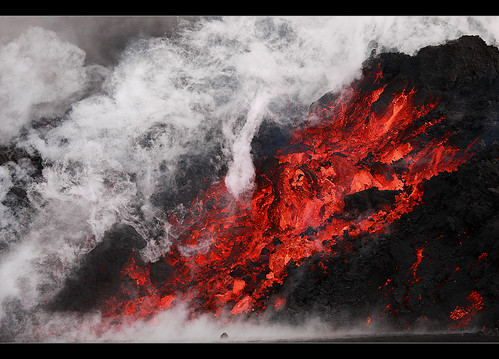
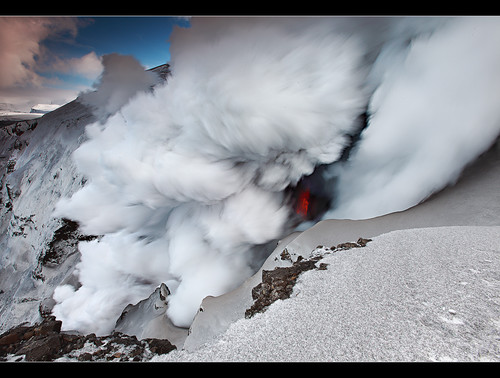
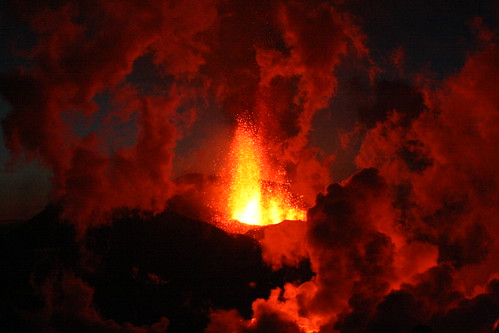
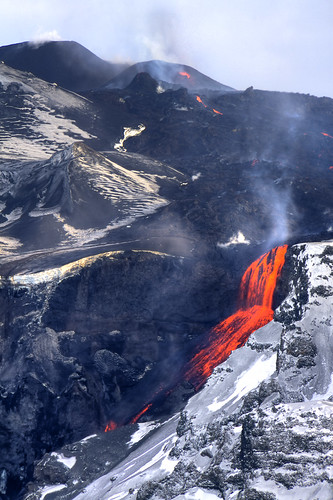
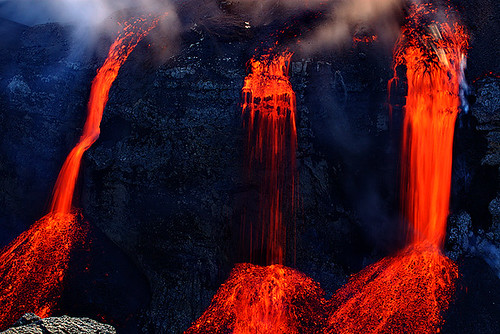
The eruption of a volcano beneath Iceland's Eyjafjallajokull has resulted in dangerous amounts of volcanic ash in the sky, huge headaches for travelers, and, it should be stated, unexpected beauty. Flickr members have captured a slew of photos of the ash and the resulting chaos.

The eruption caused a 3.7 mile high plume of ash, which has wrecked havoc on flights across the Europe and around the world. The ash has the ability to knock out jet engines, an inconvenient fact that has grounded tens of thousands of passengers. Additionally, there is no telling when the ash will disperse. It could take days before the sky clears up.

In the meantime, though, there are photos to see. Many photographers have captured stunning images of the ash's effects on sunsets in Europe. As one commenter notes, the ash has resulted in a "fantastic spectacle."


Just another day in Iceland
by Gunni Prests


ash2
by Craig Murphy


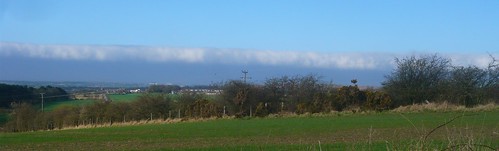
Ash sky.
by Paul Sproat


Yahoo! Editors' Picks says: From Paul Sproat's description, "A Northumbrian sunset on the day that the UK became hostage to the volcanic ash cloud that filtered down from Iceland. "


ash9
by Craig Murphy


NASA'S Terra Satellite Captures?
by NASA Goddard Photo and Video


A Rock is Born - Eyjafjallaj?kull?
by orvaratli


Smoke Landscape HDR
by hugeknot


Smoking Hot - Eyjafjallaj?kull?
by orvaratli


Steam Pump - Eyjafjallaj?kull?
by orvaratli


Volcanic Eruption -?
by Iriya


<SCRIPT type=text/javascript>if (_ge('stewart_swf44937943842_div')) F.decorate(_ge('stewart_swf44937943842_div'), F._stewart_swf_div).stewart_go_go_go(500, 281, {flickr_forceControlSize:'large',onsite:'true',photo_secret: '08d1b85461',photo_id: '4493794384',flickr_photo_page: '/photos/iriya/4493794384/'},1,'http://farm5.static.flickr.com/4023/4493794384_08d1b85461.jpg');</SCRIPT>


Playing with the Devil
by skarpi


Lava River - Eyjafjallaj?kull?
by orvaratli


Volcano in Iceland
by maggi270


365:107 Eruption in?
by benzmar


Eruption in Eyjafjallaj?kull
by Gunnar Gestur


Eyjafjallaj?kull Volcano
by Solbjartur


The eruption in Eyjafjallaj?kull?
by Kaja ?rastard?ttir


Lava falls
by fredrikholm.se


More at:
http://www.flickr.com/photos/yahooeditorspicks/galleries/72157623855495574/page2/
 
Re: Icelandic volcano spews ash cloud - European flights disrupted

Re: Icelandic volcano spews ash cloud - European flights disrupted

Asia-Europe flights halted due to Iceland volcano

TOKYO (AP) -- About 60 flights between Asia and Europe were canceled Friday, stranding several thousand passengers, as ash from an Icelandic volcano filled the skies over northern Europe.

Japan Airlines said nine flights to and from Europe were canceled, including round-trip flights from Narita International Airport to Paris, Amsterdam, London and Frankfurt, affecting around 2,300 passengers. All Nippon Airways Co. canceled six flights to Europe, affecting 1,582 passengers.

In Seoul, 12 flights were canceled, and two flights en route to Europe were forced to turn around. Singapore Airlines canceled seven flights to Europe.

The massive cloud of ash that spread over northern Europe on Thursday caused the biggest flight disruption since the 2001 terrorist attacks, and officials say it isn't known when the skies in one of aviation's most congested areas will be safe again. Volcanic ash diminishes visibility and is capable of knocking out jet engines.

France shut down 24 airports and non-emergency flights in Britain were canceled. Ireland, Denmark, Norway, Sweden, Finland and Belgium closed their air space.

Fifteen flights between Hong Kong and Europe were canceled on Friday and seven were delayed, the southern Chinese territory's Airport Authority said.

Around 1,700 Qantas passengers from five flights that had been heading to Europe were stuck in Asia on Friday, said corporate affairs manager David Epstein. Around 1,000 passengers were stranded in Singapore, and 350 each in Hong Kong and Bangkok. All Qantas flights to Europe were canceled Friday.

Qantas officials were scrambling to find accommodations for the passengers in Singapore, where hotels were flooded with people similarly grounded by other airlines. There were some people that could not be accommodated due to the space restrictions, Epstein said. All passengers were given meal vouchers.

"We're trying to look after them. They're taking it reasonably well," he said. "I think most people appreciate how widespread the situation is."
Epstein said it might take until Sunday for flights to resume.

"If these particles are ingested in an engine, it does pose a safety problem, so it is better to be safe than sorry," he said.
Air China's Web site posted a notice Friday that at least six flights to and from Europe were canceled or delayed, including round-trip flights from Beijing to Moscow, Stockholm, Frankfurt, Paris, London, and a Shanghai trip to Frankfurt.

An official at the news office of the Beijing Capital International Airport said the number of cancellations would likely increase Friday.

"At least eight flights have been delayed as of this morning," said the official, who like many Chinese officials would give only his surname, Zhang.

China Eastern Airlines spokesman Luo Zhuping told The Associated Press on Friday that its passenger flights to Europe were canceled, but he gave no details.

Air New Zealand warned travelers flying to Europe to defer their plans Friday, as it canceled two flights through London and diverted a third to Germany.

Travelers faced "a very uncertain situation (and) significant delays ... because there's such a vast backlog of flights," said the airline's international group general manager, Ed Sims.

"We're strongly advising passengers whose end point is the United Kingdom or the northern hemisphere that they're better off actually not departing, deferring their travel plans," he told New Zealand's National Radio.


(Mainichi Japan) April 16, 2010

http://mdn.mainichi.jp/mdnnews/international/news/20100416p2g00m0in045000c.html
 
Re: Icelandic volcano spews ash cloud - European flights disrupted

Re: Icelandic volcano spews ash cloud - European flights disrupted

Volcanic Dust Cloud: All You Need To Know


2:10pm UK, Friday April 16, 2010
James Davies, Sky News Online

The ash plume from Iceland has created havoc across northern Europe, but why all the the worry about a volcanic eruption that is hundreds of miles away?

<!-- VIDEO PLAYER START -->
<!---->
15604908.jpg

Grounded: An Air Canada plane sits at Heathrow waiting for the ash to disperse
<!---->


Sky News answers the questions surrounding the issue:

Why has UK airspace been shut down, affecting thousands of flights?

Pilots are advised not to fly through volcanic ash cloud because of extreme problems it can cause an aircraft.

As well as reducing visibility for pilots, ash dust can cause partial or total engine power loss and damage aircraft ventilation and air data systems.

Former British Airways pilot Eric Moody has had first-hand experience of flying through an ash cloud.

In 1982 he was piloting a Jumbo 747 from Kuala Lumpur to Perth in Australia when he hit an ash cloud just off Java.

He told Sky News: "All the engines stopped for 14-15 minutes and we didn't know what was happening.

"We glided the aircraft about 80 nautical miles and went down 37,000ft to about 12,000ft."

Dr John Stevenson, an expert in physical volcanology at Manchester University, also told Sky News: "It's incredibly dangerous to fly because the amounts of ash required to present a danger are very small."

How long will flights be grounded for?

British air traffic control say UK airspace will be closed until 1am on Saturday at the earliest, as meteorological authorities across Europe continue to monitor the cloud.

It is difficult to predict the duration of both the eruption and the cloud cover.

A lot depends on whether the volcano continues to produce ash and whether the wind continues to carry that ash towards Europe.

Volcanology expert professor Chris MacLeod, of Cardiff University, told Sky News: "The last recorded eruption of Eyjafjallajokull lasted over a year (1821-1823) but we don't know if it was as intense as this eruption."

He added: "It's difficult to say how long the eruption and consequential flight disruption will go on for.

"The Grimsvotn eruption in 2004 lasted four days but it's possible it could go on for quite some time - maybe a week or two - before the ash plume fully disperses.

He added: "Even if the eruptions stopped now, it's not going to clear up within the next 24 hours. I suspect flights could be grounded for some time."

Could things get worse?

They could, but it's hard to say how likely that is. Because of Iceland's location, the eruption could prompt wider disruption to international flights if it continues.

Dr John Stevenson told Sky News: "The danger remains that an eruption of the neighbouring volcano Katla could be triggered.

"This has happened during each of the only three historic eruptions of Eyjafjallajokull."

He added: "The effect on air traffic will depend strongly on weather patterns. If the wind shifts north, then the ash will move north with it."
<CUT>
15604818.jpg
The Icelandic volcano

</CUT>

How many flights have been cancelled?

Every single commercial flight out of the UK was grounded on Thursday.
A spokesman at Heathrow, Europe's busiest airport, said 840 out of 1,250 flights were affected, disrupting about 180,000 passengers.

More than 120,000 passengers were also affected at Gatwick, Stansted and Glasgow airports.

An Air Transport Association of America spokesman said its member carriers had halted more than 100 flights between the United States and Britain on Thursday.

Flights in Belgium, Holland, Denmark, Norway, Finland and Russia were also affected.

What should I do if I'm flying today?

Airports and airlines recommend passengers should contact their carriers to ensure their flights are not affected.

What are the insurance implications?

Volcanic eruptions are not always covered by travel insurance for cancellation and delay.

However, some policies will cover this, so you should contact your travel insurance company to check what your policy covers.

If your flight is cancelled, most airlines will offer you either a full refund or an alternative flight.

If your flight is cancelled and you do not travel, most travel insurers will refund your premium if you took out a single trip policy.

If you accept an alternative flight at a later date, most travel insurers will amend your policy to cover your new travel arrangements and dates.

Insurance only covers events that happen after the policy is taken out so customers taking out travel insurance from today onwards will not be covered for this event.

Deciding that you no longer wish to travel will not be covered by your travel insurance policy.

Nick Starling, from the Association of British Insurers, said: "Travel insurance policies will differ in this situation.

"There is no standard set of conditions which applies to a situation of this kind.

"Therefore customers should check their travel insurance policy, and speak to their travel insurer to understand what their individual policy covers them for in this situation."

Are there any health risks from the ash?

The World Health Organisation has advised people to try and stay indoors if ash starts raining down.

David Epstein, a spokesperson for the organisation, says the agency does not know the exact health risks from the ash cloud.

But he says the microscopic ash is potentially dangerous for people if it starts to "settle" on the ground because inhaled particles can reach the lungs and cause respiratory problems.

There are warnings that there is a heightened danger for those suffering from asthma and respiratory diseases.

Has this kind of thing happened before?

Yes. In 2004 the eruption of Grimsvotn, also in Iceland, caused the redirection of flights from the North Atlantic.

Why is Icelandic airspace still open?

Because the cloud is drifting south and Icelandic flights usually fly north, there are not any real dangers for flights leaving and arriving into Iceland.

http://news.sky.com/skynews/Home/UK...estions_Youre_Asking_About_Icelandic_Eruption
 
Re: Icelandic volcano spews ash cloud - European flights disrupted

Re: Icelandic volcano spews ash cloud - European flights disrupted

Source: http://www.foxnews.com/scitech/2010...ig-sister-poses-bigger-threat-scientists-say/

Updated April 16, 2010
Iceland Volcano?s Big Sister Poses Bigger Threat, Scientists Say

NewsCore


Iceland's erupting Eyjafjallajokull volcano might be causing its fair share of havoc across Europe but scientists said we haven't seen anything yet.

All eyes in the volcanology community are focused on Eyjafjallajokull?s much larger sister, called Katla, which could cause disruption on a far larger scale, reports The London Times.

Katla is about eight miles to the west, under the Myrdalsjokull ice cap. An eruption could cause widespread flooding and disrupt air traffic between Europe and North America...
 
Re: Icelandic volcano spews ash cloud - European flights disrupted

Re: Icelandic volcano spews ash cloud - European flights disrupted

Smoke and steam hangs over the volcano under the Eyjafjallajokull glacier in Iceland, Wednesday April 14, which has erupted for the second time in less than a month, melting ice, shooting smoke and steam into the air and forcing hundreds of people to flee rising floodwaters.
CAPTION
By Jon Gustafsson, AP

Iceland volcano eruption could last months

The last time Iceland's Eyjafjallajokull volcano blew, the eruption lasted more than a year, from December 1821 until January 1823, reports Sally Sennert, a geologist at the Smithsonian Institution.

"This seems similar to what's happening now," she says.

The volcano is erupting small, jagged pieces of rocks, minerals and volcanic glass the size of sand and silt into the atmosphere, according to the U.S. Geological Survey. This volcanic ash can even be as small as 1/25,000th of an inch across.

Volcanic ash is formed during explosive volcanic eruptions. Once in the air, the wind can blow these tiny ash particles tens to thousands of miles away from the volcano. Life-threatening and costly damages can occur to aircraft that fly through an eruption cloud, reports the geological survey.

"Silica in the ash gets into the engine and heats up and melts, which causes the engines to stop," says Sennert.

Based on reported damages from ash encounters, the hazard posed to aircraft can extend more than 3,000 miles from an erupting volcano. (Click here for a map of the ash zone over Europe).

Fortunately for the USA, Sennert says the wind direction is such that the ash cloud is traveling east-southeast, toward Europe and away from the USA.

However, as Science Fair noted previously, the Eyjafjallajokull volcano isn't necessarily the main problem. It's Katla, Iceland's noisier neighbor, that's the concern. If lava flowing from Eyjafjallajokull melts the glaciers that hold down the top of Katla, then Katla could blow its top, pumping gigantic amounts of ash into the atmosphere.

The potential eruption of Iceland's volcano Katla could send the world, including the USA, into an extended deep freeze.

"There's no telling how long the eruptions could last," says Sennert about the Eyjafjallajokull volcano."These explosions could go on for some time."

By Doyle Rice


http://content.usatoday.com/communi.../iceland-volcano-eruption-could-last-months/1
 
Re: Icelandic volcano spews ash cloud - European flights disrupted

Re: Icelandic volcano spews ash cloud - European flights disrupted

From The Times
<!-- BEGIN: Module - Advert:Top --><SCRIPT type=text/javascript><!--//Retrieve yaoo Cookie Valuevar yahoo = "no";var IsYahoo="no";if (GetQueryString("yahoo")=="yes" || get_cookie('YH') == "yes") IsYahoo="yes";if (IsYahoo == "yes" || get_cookie('YH') == 'open') {set_cookie ("YH", "yes", "", "" );yahoo = "yes";} else {set_cookie ("YH", "no", "", "" );yahoo = "no";}window.onunload = setYahooCookie;//--></SCRIPT><!-- For Travel Search --><!--SECTION:parameter parameter="dart.server" /--><!-- END: Module - Advert:Top -->
April 16, 2010


Icelandic volcanologists carefully watching Eyjafjallajokull?s big sister

a_385x185_708283a.jpg


<DIV id=region-column1-layout2>
<!-- Remove following to not show photographer information --><!-- Remove following to not show image description --><!-- Remove following to not show enlarge option --><!---->Image :1 of 2

Hannah Devlin

The erupting Eyjafjallaj?kull volcano may be causing its fair share of havoc but scientists say we may have seen nothing yet.

All eyes in the volcanology community are focused on Eyjafjallaj?kull?s far larger sister, called Katla, which could cause disruption on a far larger scale. Katla is about eight miles to the west under the Myrdalsj?kull ice cap. An eruption could cause widespread flooding and disrupt air traffic between Europe and North America.

While Katla is not part of the same underground network of magma channels, it is close enough to be affected by power shifts in Eyjafjallaj?kull?s system.

There is also a chance that a horizontal sheet of magma under Eyjafjallaj?kull could shoot out and enter a magma chamber beneath Katla. Hitting the roots of its neighbour would almost certainly trigger an eruption.
<!--#include file="m63-article-related-attachements.html"--><!-- BEGIN: Module - M63 - Article Related Attachements --><SCRIPT src="/tol/js/picture-gallery.js" type=text/javascript></SCRIPT><SCRIPT type=text/javascript>function slideshowPopUp(url){pictureGalleryPopupPic(url);return false;}</SCRIPT><!-- BEGIN: Comment Teaser Module --><!-- END: Comment Teaser Module --><!-- BEGIN: Module - M63 - Article Related Package --><!-- END: Module - M63 - Article Related Package -->
The three eruptions of Eyjafjallaj?kull on record have each been associated with a subsequent eruption of Katla. There have been no signs of turbulence beneath Katla but, having last erupted in 1918, a new blast is overdue. Katla has erupted every 40-80 years.

?So far there have been no signs of the reawakening of the Katla volcano, but a lot of things can still happen, so we are monitoring it quite closely,? P?ll Einarsson, a geophysicist at the University of Iceland, said.

http://www.timesonline.co.uk/tol/news/science/earth-environment/article7099200.ece
 
Re: Icelandic volcano spews ash cloud - European flights disrupted

Re: Icelandic volcano spews ash cloud - European flights disrupted

<TABLE class=storycontent cellSpacing=0 cellPadding=0><TBODY><TR><TD colSpan=2>Page last updated at 11:18 GMT, Friday, 16 April 2010 12:18 UK

The eruption that changed Iceland forever


</TD></TR><TR><TD class=storybody><!-- S BO --><!-- S IIMA -->
_47656323_ash.466.body.jpg
Volcanic ash has halted all UK flights and many in Europe


<!-- E IIMA --><!-- S IBYL --><TABLE cellSpacing=0 cellPadding=0 width=466 border=0><TBODY><TR><TD vAlign=bottom>By Tom de Castella


</TD></TR></TBODY></TABLE>
999999.gif


<!-- E IBYL --><!-- S SF -->A volcanic eruption in Iceland is continuing to ground flights in the UK and Europe, but 227 years ago a far more devastating eruption occurred wiping out a fifth of the island's population - as well as tens of thousands across Europe.<!-- E SF --> On 8 June, 1783, the young country of Iceland - inhabited for less than 1,000 years - had a population of 50,000. In the coming years, as a result of what began that Sunday morning at 9am, 10,000 of those people would die.

The Laki eruption is the worst catastrophe in the country's relatively short history. Laki is a volcanic system in the same south-eastern part of Iceland where this week's eruption took place. But that's where the similarities end.
<!-- S IIMA --><TABLE cellSpacing=0 cellPadding=0 width=226 align=right border=0><TBODY><TR><TD>
_47656324_children.226.jpg
Geology is compulsory in Icelandic schools


</TD></TR></TBODY></TABLE>
<!-- E IIMA -->

Back in 1783 it was ripped open with such force that a huge fissure produced scores of boiling craters. Over the next eight months the Lakagigar - literally "craters of Laki" - spewed 600 square kilometres of boiling lava into the surrounding countryside and belched more toxic gases than any eruption in the last 150 years. The effects were felt all over the northern hemisphere.

It is the second greatest eruption of the last 1,000 years, behind only the 1815 eruption of Mount Tambora in Indonesia, says Stephen Self, visiting professor of Volcanology at the Open University.

Laki's output of sulphur dioxide dwarfs the 1990 eruption of Pinatubo in the Philipinnes, which is famous for halting global warming for several years. While that eruption produced 17 mega tonnes of sulphur dioxide, Laki was pumping the same amount out every three days at its peak, says Self. He estimates Laki's power was over 100 times greater than the current eruption.

"The 1783 eruption pumped out so much sulphur gas, creating a huge cloud of sulphuric acid droplets which began to drift over Europe travelling eastwards over the whole world," he says.

'Apocalypse'

The noxious fog travelled down through Norway, Germany, France and across to Britain, causing panic when farm labourers began dropping like flies. People at this time had no idea where the fog had come from or that sulphur dioxide was mixing with water vapour in the lungs to choke victims. Research into parish records has led to estimates of more than 20,000 deaths in Britain alone during the summer of 1783.

The extreme heat - not connected to the volcano - would have made the fog all the more unpleasant, says Philip Eden, former BBC weatherman.

"July 1783 is the equal warmest month in 300 years of records for the UK. Because of the ash the sun shone from a white sky - it must have felt like the apocalypse."
<!-- S IBOX --><TABLE cellSpacing=0 cellPadding=0 width=231 align=right border=0><TBODY><TR><TD width=5>
o.gif
</TD><TD class=sibtbg>
start_quote_rb.gif
The Icelanders stopped dancing and unlike the Norwegians and Faroe Islanders we lost the old dances
end_quote_rb.gif


Professor Gunnar Karlsson

inline_dashed_line.gif


<!-- S ILIN -->UK flights grounded for second day
<!-- E ILIN -->


</TD></TR></TBODY></TABLE>
<!-- E IBOX -->
It was only in the autumn that the fog finally lifted. But soon an even worse problem was on the way - the most severe winter for 250 years, caused by the build-up of heat absorbing sulphur dioxide in the stratosphere.

But nowhere suffered more than Iceland. It was not the eruption itself that proved deadly but the environmental consequences, says Gunnar Gudmundsson, a geophysicist at the Icelandic Metereological Office.

"People died not because of the eruption, but because of starvation," he says. "The farm animals died, the crops died - it affected the whole country."

Toxic gases poisoned the plants and vegetation, which in turn killed the livestock. Eight of every ten sheep are thought to have died, while half of all the cattle and horses perished. The extreme winters that followed - caused by the sulphuric gases - ensured that a fifth of the country's population died, historians estimate.

'Sins of man'

It is a period of tragedy etched onto the Icelandic psyche, says Magnus Gudmundsson, professor of geophysics at the University of Iceland. It has become the yardstick by which all painful periods in the country's history are measured, he adds.

"We have a word for it - Moduhardindin - meaning "the hardship of the fog". When politicians compare it to the recent economic crisis it causes outrage - of course there's no comparison. Today 20 to 25% of the population are deeply in debt."

But in 1783 the same proportion of the population succumbed to a more terminal fate, he points out.
Today children learn about the Laki in school and because of the frequent volcanic eruptions, geology and the study of lava is a compulsory part of the education curriculum.
<!-- S IBOX --><TABLE cellSpacing=0 cellPadding=0 width=231 align=right border=0><TBODY><TR><TD width=5>
o.gif
</TD><TD class=sibtbg>
_47656325_tourists.226.jpg

start_quote_rb.gif
Icelandic volcanoes have long drawn tourists from across the globe, eager to catch a glimpse of a pillar of smoke from the earth's core or a spectacular lava flow
end_quote_rb.gif


inline_dashed_line.gif


<!-- S ILIN -->A guide to Iceland's volcanoes
<!-- E ILIN -->


</TD></TR></TBODY></TABLE><!-- E IBOX -->Gunnar Karlsson, one of Iceland's leading historians, argues that without the country's fish stocks the suffering would have been even more terrible.

"At the time of the eruption two thirds of people were farmers while the other third were fishermen," he says. "The animals died from lack of hay and the people died the following year."

In coastal areas where cod was plentiful the suffering was less, but the way the country was governed prevented any proper strategy. At the time Iceland was a part of the Danish Kingdom and governed from Copenhagen, 1300 miles away.

"The Danes tried to help," says Professor Karlsson. "There was a collection of money but communication was so sparse that it helped little. It takes weeks to sail between Copenhagen and Iceland and there was no other contact at this time."

Reykjavik was just a village and local officials were spread around the country. But there was no co-ordination when it came to dealing with the famine and sharing out the fish, he says.

"The officials in Iceland were extremely late to react. It's been estimated that more food was being exported than imported at this time. The main export was fish, but no effort was made to distribute this food."

'Turning point'

The Laki struck at a time when supernatural beliefs were beginning to give way to ideas of human progress brought by the Enlightenment.

"The eruption was a great shock because people were beginning to believe in progress and improving their lives," says Prof Karlsson. "It must have been a great blow to realise they did not control their lives and see how powerless they were if the natural conditions were so strong."
<!-- S IIMA --><TABLE cellSpacing=0 cellPadding=0 width=226 align=right border=0><TBODY><TR><TD>
_47656326_red.226.jpg
Iceland recovered from the eruption


</TD></TR></TBODY></TABLE>
<!-- E IIMA -->

The clergy stuck to the view that Iceland was being punished for the sins of man, he adds.

Prof Karlsson also believes Laki had other surprising consequences for Icelandic society. "The Icelanders stopped dancing and unlike the Norwegians and Faroe Islanders we lost the old dances. My guess is they stopped because people were in such shock after the famine that they didn't want to dance anymore."

Despite being the country's darkest hour, the country bounced back and it is argued by some that the event was not the defining moment for Iceland. The population was back to 50,000 within 20 years and continued to grow over the coming decades, and today stands at 320,000.

"It was dramatic when it happened but the effect was only felt for 20 years," says Prof Karlsson. "For the historian it is the events that have the longest effects that are the most important. For me the mechanisation of the fishing fleet in the early 20th Century was the nation's turning point. It turned Iceland from one of the poorest countries in Europe to one of the richest."

Nowadays with the economy again in ruins, some Icelanders may take hope from the way the country bounced back from the Laki nearly 250 years ago.

http://news.bbc.co.uk/2/hi/uk_news/magazine/8624791.stm


</TD></TR></TBODY></TABLE>

 
Re: Icelandic volcano spews ash cloud - European flights disrupted

Re: Icelandic volcano spews ash cloud - European flights disrupted

<CITE class=vcard>By PAISLEY DODDS, Associated Press Writer Paisley Dodds, Associated Press Writer </CITE>? <ABBR class=recenttimedate title=2010-04-17T07:06:59-0700>2 hrs 21 mins ago</ABBR>
<!-- end .byline -->
LONDON ? A lingering volcanic ash plume forced extended no-fly restrictions over much of Europe on Saturday, as Icelandic scientists warned that volcanic activity had increased and showed no sign of abating ? a portent of more travel chaos to come.

Scientists say that because the volcano is situated below a glacial ice cap, the magma is being cooled quickly, causing explosions and plumes of grit that can be catastrophic to plane engines if prevailing winds are right.

"The activity has been quite vigorous overnight, causing the eruption column to grow," Icelandic geologist Magnus Tumi Gudmundsson told The Associated Press on Saturday. "It's the magma mixing with the water that creates the explosivity. Unfortunately, there doesn't seem to be an end in sight."

An expansive cloud of grit hovered over parts of western Europe on Saturday, triggering extended flight bans that stranded people around the globe. Continued volcanic activity could produce more plumes if the weather patterns stay the same.

The Icelandic Meteorological Office said the amount of ash in the plume grew Saturday and that the vast ash cloud is continuing to travel south and southeast. Scientists had planned to fly over the volcano to see how much ice has melted to determine how much longer the eruption could spew ash, but the Icelandic Coast Guard said Saturday's flight had been postponed.

Aviation experts say the volcanic plume has caused the worst travel disruption Europe ? and the world ? has ever seen.

"I've been flying for 40 years but I've never seen anything like this in Europe," said Swedish pilot Axel Alegren, after landing his flight from Kabul, Afghanistan, at Munich Airport; he had been due to land at Frankfurt but was diverted.

http://news.yahoo.com/s/ap/20100417/ap_on_bi_ge/eu_iceland_volcano_109
 
Re: Icelandic volcano spews ash cloud - European flights disrupted

Re: Icelandic volcano spews ash cloud - European flights disrupted

can we have an animation, how the ash distribute over Europe ?

ESA had one, but not updated since 04/16,04:00
 
Re: Icelandic volcano spews ash cloud - European flights disrupted

Re: Icelandic volcano spews ash cloud - European flights disrupted

This situation is dramatic, causes a lot of damage, at least 100 million a day just for the Netherlands. People will lose their jobs, if this will continue.

It seems it is not over yet. The sky will be closed for the weekend.

I must confess: I am enjoing it, I can't help it.

Living some 20 miles from Schiphol - Amsterdam Airport - normally always you see and hear airplanes, almost 24 hours a day. We are used to it, we don't hear it, unless you make a video outside and you play it: then you hear the noise.

Not now.

Now you hear a strange sound: you don't hear the planes no more.

The weather is really, really great, normally the planes would have caused stripes, ending in clouds, hiding the sun. Not today. The sky was blue all day long, this never happens.

Tomorrow I'll attend a horse event in a park near the airport. Normally the planes going to land would comb your hair. And blow you away with their noise.

Tomorrow it will be great. I feel very sorry for all the people losing their money and may be their jobs.

I am looking forward to enjoy the event tomorrow.

Strange world we live in these days.
 
Back
Top Bottom