• FluTrackers.com Inc. does not provide medical advice. Information on this web site is collected from various internet resources, and the FluTrackers board of directors makes no warranty to the safety, efficacy, correctness or completeness of the information posted on this site by any author or poster. The information collated here is for instructional and/or discussion purposes only and is NOT intended to diagnose or treat any disease, illness, or other medical condition. Every individual reader or poster should seek advice from their personal physician/healthcare practitioner before considering or using any interventions that are discussed on this website. By continuing to access this website you agree to consult your personal physican before using any interventions posted on this website, and you agree to hold harmless FluTrackers.com Inc., the board of directors, the members, and all authors and posters for any effects from use of any medication, supplement, vitamin or other substance, device, intervention, etc. mentioned in posts on this website, or other internet venues referenced in posts on this website.
  • We are not asking for any donations. Do not donate to any entity who says they are raising funds for us.

France - Monkeypox outbreak 2022-2026

Translation Google

Opinion of the Health Risk Monitoring and Anticipation Committee
(COVARS)
from November 22, 2022
ON THE MONKEYPOX VIRUS OUTBREAK

...
22 NOVEMBER 2022, Amended on 27 November 2022

REFERRAL ON THE MONKEYPOX VIRUS OUTBREAK
from September 29, 2022
by Mrs Sylvie RETAILLEAU, Minister of Higher Education and Research
and Mr François BRAUN, Minister of Health and Prevention.

For the past few weeks, a decrease in the number of weekly cases has been observed, and a
regular increase in the number of vaccinated subjects with around 100,000 vaccinated subjects at
date with a first dose. The number of reported cases is probably not consistent with the
reality, samples and declarations not being systematically carried out. It nevertheless seems
that the epidemic, in decline, remains confined to subjects at risk. What is the assessment of COVARS on
this subject, its projections on the future of the epidemic, in France and in Europe?
...
22 NOVEMBER 2022, Amended on 27 November 2022

FOREWORD

The COVARS, questioned on the future of the so-called “monkey pox” epidemic due to Monkeypox virus infection
raging in France and around the world since May 2022 has highlighted the particularities of this epidemic, differentiating it
endemic infection in Africa. These peculiarities reside in the affected population - mainly
young men- and in the mode of transmission, mainly linked to multiple sexual contacts. The epidemic
decreased rapidly in France and around the world, after a peak in the summer of 2022, partly thanks to strong actions of
prevention measures implemented by health authorities and associations linking these communities. The control of
the epidemic also benefited from the prior existence of a treatment and a vaccine directed against the neighboring virus
smallpox.

COVARS has carried out a documented review of knowledge and data on the epidemiological situation of the virus
and disease, its treatment and prevention. COVARS also listened to the institutions responsible for monitoring
epidemiology (Santé Publique France [SPF]) and research (National Agency for Research on AIDS,
hepatitis and emerging infectious diseases [ANRS-MIE]) as well as two experts in infectious diseases at
sexual transmission and zoonoses linked to poxviruses.

Like all national and international experts, COVARS has emphasized the preeminent role of
behavioral changes in the initial reduction of the epidemic relayed by the vaccine intervention
allowing a lasting reduction of the epidemic. COVARS also underlined the importance of eliminating
rapid and precautions to be taken vis-à-vis domestic and wild animals in order to avoid retrozoonotic
transmission in our countries. COVARS also raised issues related to the low level of knowledge about this
infection, its natural hosts, its modes of transmission, the efficacy and durability of vaccine protection and
highlighted specific areas for research.

Current uncertainties have not allowed modellers to build robust forecasting models.
However, taking into account the elimination objectives defined by the WHO for the European region, the COVARS has
collectively proposed scenarios concerning the general population for which the epidemic risks are
weak, as well as the population currently affected by the disease. For the latter, a trajectory towards the elimination of
symptomatic infection with Monkeypox virus is possible in the short term thanks to the maintenance of the measures of
prevention.

For COVARS, the most likely scenario in the medium and long term is that of maintaining viral circulation at
Europe-wide low noise making the hypothesis of complete elimination of Monkeypox virus infection
unlikely and leading to a risk of epidemic or even seasonal outbreaks in France and Europe.


In order to limit these risks of resurgence and increase resilience to the disease, COVARS recommends
strengthen the actions of:

▪ PREVENTION by involving, in a coordinated and participatory manner, the actions of health authorities and
associations and by strengthening the vaccination campaign to induce lasting immunity,
▪ SURVEILLANCE in the human population by including this disease in the burden of infections with
sexual transmission,
▪ RESEARCH, in order to better characterize this disease, the vaccine and the treatment and to implement
monitoring and anticipation actions in the human population and in wildlife in order to prevent risks
of epidemic recovery.

...
Téléchargement du pdf (1.2 Mo)

https://solidarites-sante.gouv.fr/actualites/presse/dossiers-de-presse/article/comite-de-veille-et-d-anticipation-des-risques-sanitaires
 
Translation Google
Case of monkeypox: update on January 24, 2023

Update on January 24, 2023 of confirmed cases of monkey pox (Monkeypox in English) reported in France and around the world.

Posted on January 25, 2023
...
Update in France


As of 12:00 p.m. on January 24, 2023, 4,982 cases of Monkeypox virus infection have been recorded in France, including 4,128 (83%) biologically confirmed cases, i.e. 13 additional cases since the December 20 assessment, and 854 (17%) probable or possible cases, not biologically confirmed, i.e. one additional case since the assessment of December 20.

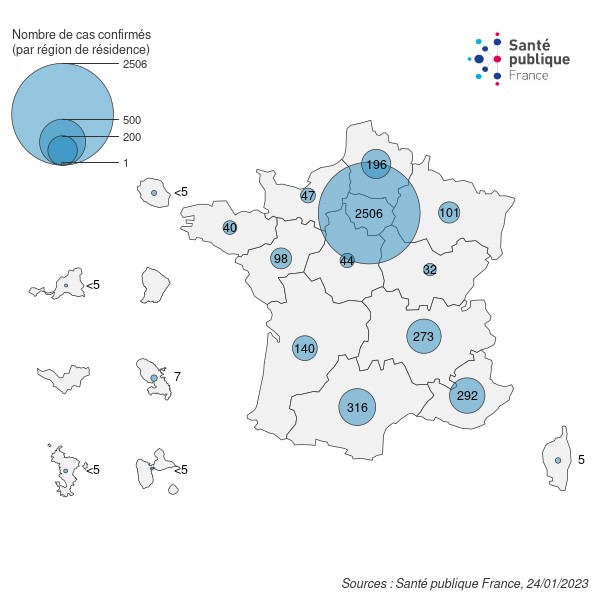
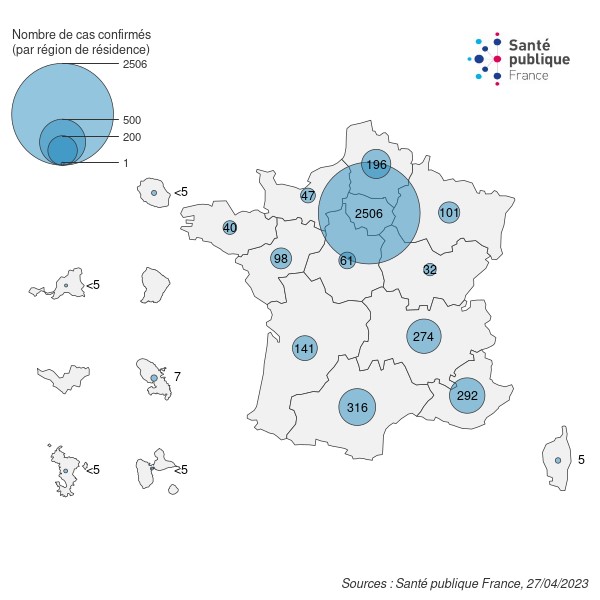
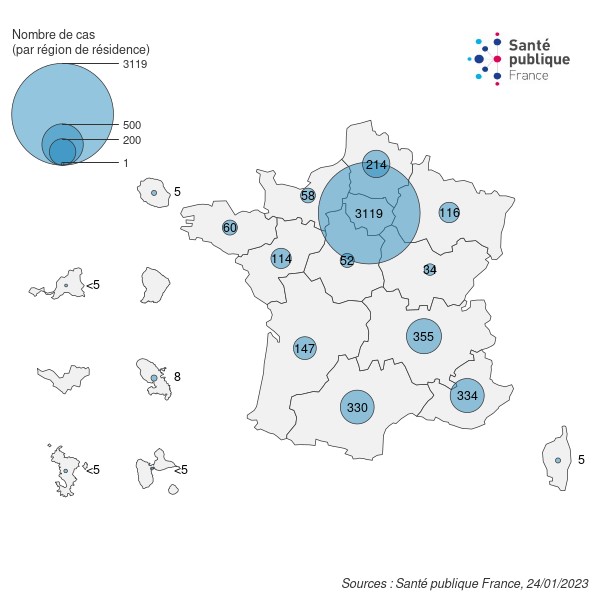
The distribution of cases by region of residence (or by reporting region when the region of residence is unknown) is presented in Figures 1 and 2. The Ile-de-France region concentrates the largest number of cases (3,119, i.e. 63 %), followed by Auvergne-Rhône-Alpes (355 cases), Provence-Alpes-Côte d'Azur (334 cases), and Occitanie (330 cases); 27 cases reside abroad.

The vast majority of adult cases reported to date are male and 2.9% are female over the age of 15 (143 cases, including 113 biologically confirmed cases and 30 unconfirmed cases). The proportion of female cases reached 14.2% in W36/2022 (19 cases out of a total of 134), then decreased to around 10% between W37 and W40. This proportion then increased again until W46, but with a low and decreasing number of cases (1 case in W46). The low numbers and the absence of information on a possible transsexuality of these female cases did not allow to conclude on a possible modification of the dynamics of transmission of the virus. Since S47, only one case has been reported in a woman, in S02/2023 (unconsolidated data).

The median age of adult cases is 36; 25% of cases are under 29 years old and 25% are between 43 and 81 years old.

Twenty-four children under the age of 15 (0.5% of total cases) have been reported since May 2022 (12 biologically confirmed cases and 12 unconfirmed cases).

Non-biologically confirmed cases have a profile similar to confirmed cases: 3.6% of adults are female (vs. 2.8% of confirmed adult cases), the median age of adults is 36 years old as in cases confirmed and the majority reside in Ile-de-France (72% vs. 61% of confirmed cases).

Among all the cases for which information is available, 100 (3.2%) were hospitalized because of their infection with the Monkeypox virus; this proportion is stable over time.

No deaths have been reported to date.

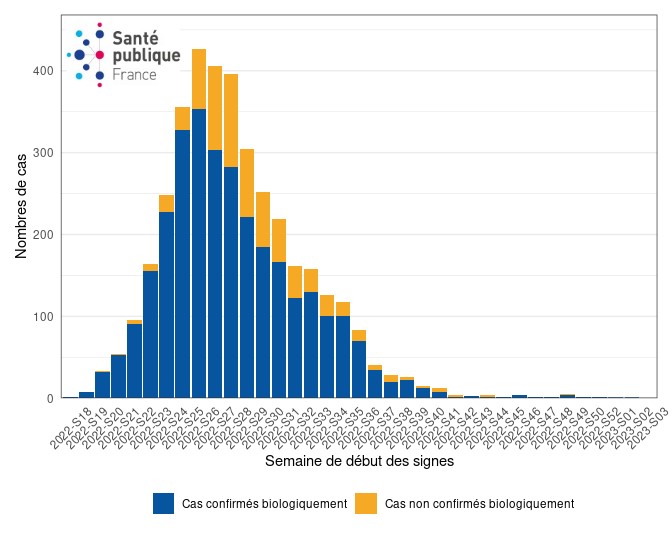
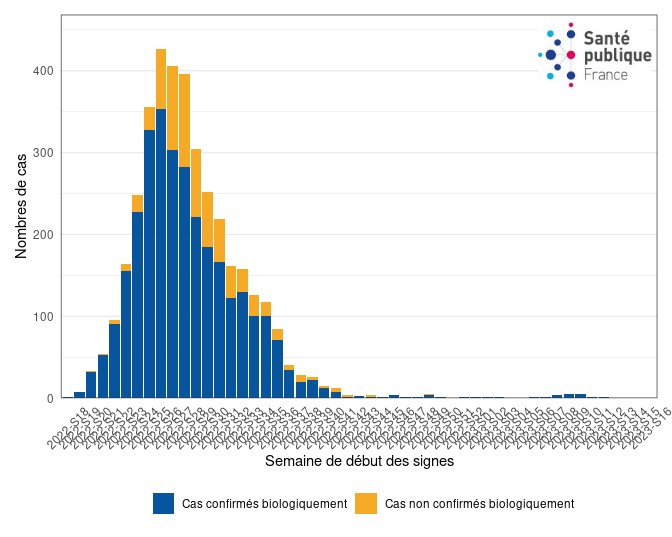
The distribution of cases according to the date of onset of symptoms (when this is known) and the type of case (biologically confirmed or not) is presented in Figure 3.
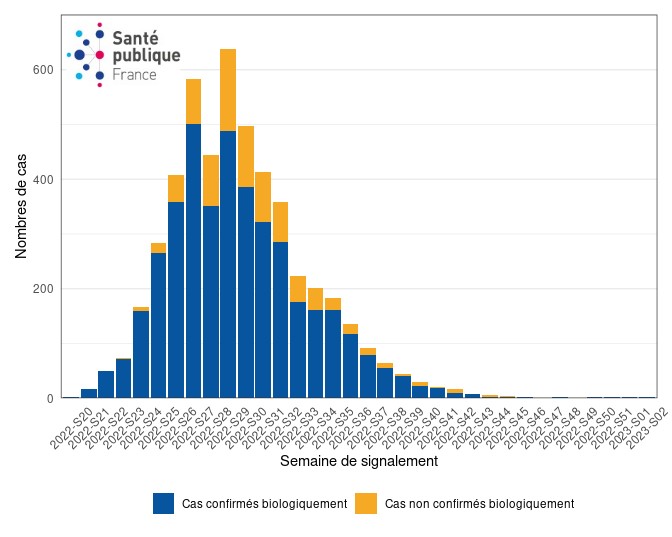
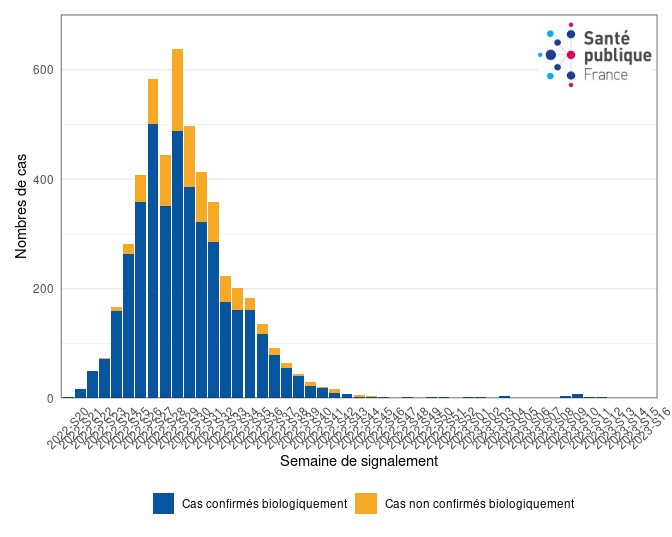
The date of onset of symptoms of the cases extends between the 7 May 2022 and January 13, 2023. Given the reporting deadlines, the data for the last few weeks is not consolidated. The reports received do not always mention the date of onset of the symptoms. As an alternative to this information, the distribution of cases according to their date of reporting is presented in Figure 4.

The interpretation of the dynamics of the epidemic is not modified depending on whether the analysis concerns only confirmed cases or all cases (confirmed, probable and possible). Since the peak of contaminations reached at the end of June/beginning of July, the number of cases has fallen sharply, whether they are biologically confirmed or unconfirmed cases. Currently, the weekly number of declared cases varies between 1 and 3. We must nevertheless remain cautious because the improvement in knowledge of the disease can reduce the use of care by the best informed populations.

This significant decrease in the number of cases is also observed worldwide. The number of new global cases decreased by 3% in S03 2023 compared to the previous week ( https://worldhealthorg.shinyapps.io/mpx_global/ ). The majority of cases reported since S52 2022 have been reported by countries in the Americas (78%) and Africa region (14%).


Figure 1. Total monkeypox cases (n= 4,955 cases) by region of residence (or by reporting region when region of residence is unknown), France, May 2022-January 2023 (data as of 01/24/2023 – 12:00 p.m.)
2429747849b3-carte_cas_confirmes_variole_singe_240123.jpg


Figure 2. Biologically confirmed cases (n= 4,105) by region of residence (or by reporting region when the region of residence is unknown), France, May 2022-January 2023 (data as of 01/24/2023 – 12:00 p.m.)
c494ee837747-carte_cas_confirmes_biologiquement_variole_singe_240123.jpg


Figure 3. Monkeypox cases (n= 3,761 cases, number of missing data = 1,221) by week of onset of symptoms and by type of case (biologically confirmed or not), France, May 2022-January 2023 ( data as of 01/24/2023 – 12:00 p.m.).
4fd06cb5754f-fig_cas_confirmes_semaine_variole_du_singe_240123.jpg


Data for the past three weeks is not fully consolidated.

Figure 4. Monkeypox cases (n= 4,980 cases, number of missing data = 2) by reporting week and by type of case (biologically confirmed or not), France, May 2022-January 2023 (data as of 24 /01/2023 – 12:00 p.m.).
856e183f367d-fig_date_signalement_variole_singe_240123.jpg


Data for the last week is not fully consolidated. The reporting low observed in week 28 (July 11 to 17) can be explained by the July 14 public holiday.

...

https://www.santepubliquefrance.fr/l...4-janvier-2023
 
Translation Google


Monkey pox: update in France as of March 23, 2023

Public Health France publishes an update on March 23, 2023 on cases of monkeypox ( mpox in English and formerly monkeypox ) following the reporting and investigation of clustered cases in the Centre-Val de Loire region.

Posted on March 30, 2023
...
New elements since the last report of January 24, 2023
  1. Occurrence of 17 grouped cases of mpox in the Centre-Val de Loire region
  2. 1 other case reported outside this cluster
  3. The characteristics of the cases identified remain unchanged
This assessment includes cases confirmed biologically by PCR or not. These include probable cases (suggestive clinical signs + at-risk contact of a confirmed case) and possible cases (suggestive clinical signs + exposure to risk of infection).

At the international level and due to differences in surveillance protocols depending on the country, biologically confirmed cases remain the reference indicator for comparing epidemiological situations between countries.

Update in France

In early May 2022, cases of monkeypox ( mpox ) not directly linked to travel to Central or West Africa where the virus is present, or to people returning from travel, were reported in Europe and the the world. Since that date, the disease has been the subject, in France as in Europe, of enhanced surveillance based on the Mandatory Declaration, the form of which has been specifically updated.

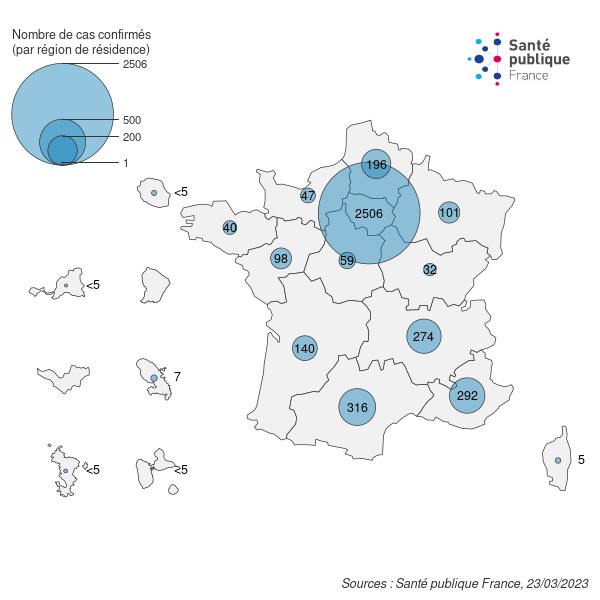
As of 23 March 2023 at 12:00 p.m., 5,000 cases of infection with the mpox virus have been recorded in France, i.e. 18 additional cases since the assessment of 24 January. Among these 5,000 cases, 4,144 (83%) were biologically confirmed and 856 (17%) are probable or possible cases, not biologically confirmed.

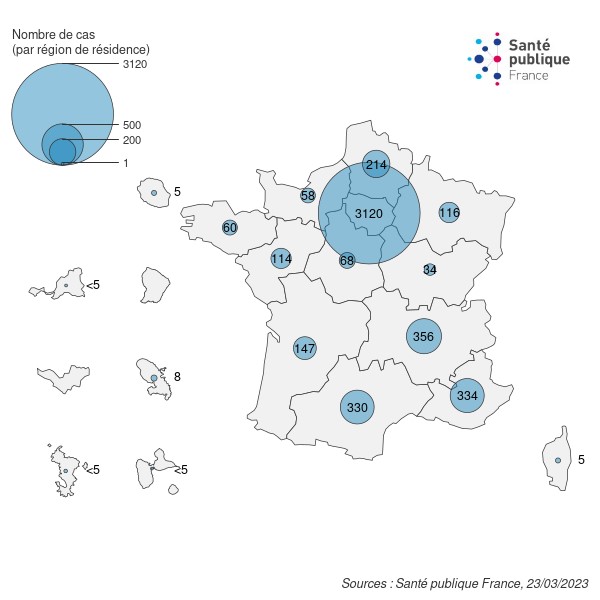
The distribution of cases by region of residence (or by reporting region when the region of residence is unknown) is presented in Figures 1 and 2. The Ile-de-France region concentrates the largest number of cases (3,120, i.e. 63 %), followed by Auvergne-Rhône-Alpes (356 cases), Provence-Alpes-Côte d'Azur (334 cases), and Occitanie (330 cases); 27 cases reside abroad. The 18 new cases declared since the last report all concern men and 17 of them were diagnosed in the Centre-Val de Loire region ( see below ).
The vast majority of adult cases reported to date are male and 2.9% are female over the age of 15 (143 cases, including 113 biologically confirmed cases and 30 unconfirmed cases). No female cases have been diagnosed since the assessment of January 24, 2023.

The median age of adult cases is 36 years; 25% of cases are under 29 years old and 25% are between 43 and 81 years old.

Twenty-four children under the age of 15 (0.5% of total cases) have been reported since May 2022 (12 biologically confirmed cases and 12 unconfirmed cases). No pediatric case has been diagnosed since the assessment of January 24, 2023.

The non-biologically confirmed cases have a profile comparable to the confirmed cases: 3.7% of adults are female (vs. 2.8% of confirmed adult cases), the median age of adults is 36 years as in cases confirmed and the majority reside in Ile-de-France (72% vs. 60% of confirmed cases).

Of all the cases for which information is available, 101 (2.0%) were hospitalized for treatment of their mpox virus infection; this proportion is stable over time.

No deaths have been reported to date.

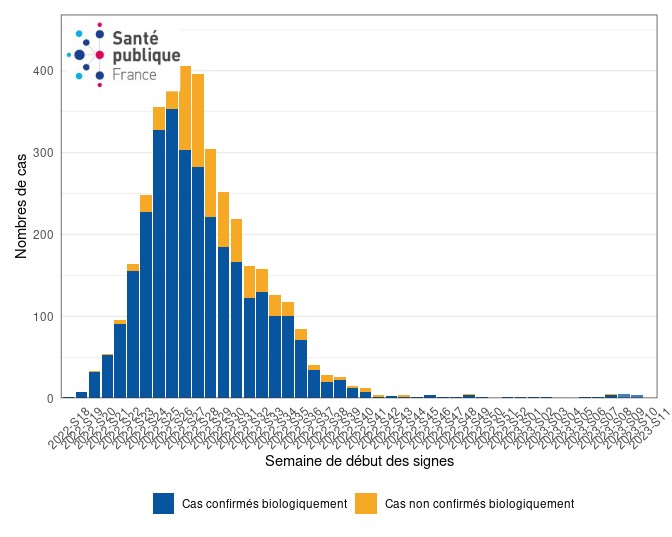
The distribution of cases according to the date of onset of symptoms (when this is known) and the type of case (biologically confirmed or not) is presented in Figure 3. The date of onset of symptoms of the cases extends between the 7 May 2022 and March 12, 2023. Given the reporting delays, the data for the last few weeks is not consolidated.

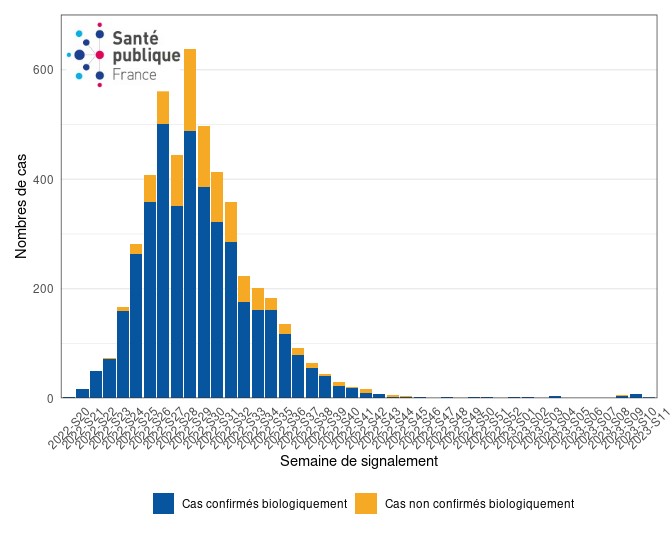
The reports received do not always mention the date of onset of the symptoms. As an alternative to this information, the distribution of cases according to their date of reporting is presented in Figure 4.


Figure 1. Total monkeypox cases (n= 4,973 cases) by region of residence (or by reporting region when region of residence is unknown), France, May 2022-March 2023 (data as of 03/23/2023 – 12:00 p.m.)
8d2b76836780-carte_cas_confirmes_variole_singe_230323.jpg


Figure 2. Biologically confirmed cases (n= 4,122) by region of residence (or by reporting region when the region of residence is unknown), France, May 2022-March 2023 (data as of 03/23/2023 – 12:00 p.m.)
84b1217f7634-carte_cas_confirmes_biologiquement_variole_singe_230323.jpg


Figure 3. Monkeypox cases (n= 3,779 cases, number of missing data = 1,221) by week of onset of symptoms and by type of case (biologically confirmed or not), France, May 2022-March 2023 ( data as of 03/23/2023 – 12:00 p.m.)
af7727e8a71c-fig_date_signalement_variole_singe_230323.jpg

Data for the past three weeks is not fully consolidated.

Figure 4. Monkeypox cases (n= 4,998 cases, number of missing data = 2) by reporting week and by type of case (biologically confirmed or not), France, May 2022-March 2023 (data as of 23 /03/2023 – 12:00 p.m.).
695e13adc4cc-fig_cas_confirmes_semaine_variole_du_singe_230323.jpg

Data for the last week is not fully consolidated. The reporting low observed in week 28 (July 11 to 17) can be explained by the July 14 public holiday.

Grouped cases in the Centre-Val de Loire region, January to March 2023

Between January 1, 2023 and March 23, 2023, 17 confirmed male cases were reported in the Centre-Val de Loire region, including 14 since March 1, 2023.
The investigation carried out showed that all these cases concerned men who have sex with men (MSM), several of whom reported having had several partners without always being able to identify them. No parties or events common to the cases were identified.

The cases are between the ages of 24 and 56 (median 40). The clinical characteristics of these cases remain similar to those previously observed; no case required hospitalization.

Six of the 17 cases received no smallpox vaccination, 1 reported having a non-complete vaccination schedule (vaccination in childhood with a 1st generation smallpox vaccine) and 10 reported a complete vaccination schedule: 5 with a 1st generation smallpox vaccine in childhood + 1 dose of 3rd generation vaccine in 2022, and 5 with 2 doses of 3rd generation vaccine in 2022.

Given the high proportion (59%) of vaccinated in this cluster , investigations were carried out by Public Health France and the Tours Regional Pharmacovigilance Center. The proportion of vaccinated cases is higher than what is observed at the national level (25% of male cases of mpoxdeclared between October and February 2023 in France concerned vaccinated men). It is appropriate to await the results of real-life efficacy studies which will allow better interpretation of these data. To date, there is little perspective on the efficacy of 3rd generation vaccines against mpox infection . There are no data on long-term protection after a full vaccination course, nor in population subgroups. These vaccines are subject to pharmacovigilance monitoring coordinated by the ANSM. To date, no signal has been issued on the quality or safety of these vaccines.

This episode suggests at this stage a localized transmission in the Touraine sector, in a context of almost no cases reported in the rest of the country. Among the reported cases, some indicated at-risk contacts and exposures in other regions, particularly in Ile-de-France.

After a week without reporting, a new case was reported on March 24 and is under investigation.

Pending robust data on the real-life efficacy of mpox vaccines , this cluster urges vigilance. Mpox infections can occur in people who have received a full course of vaccination, and it is important to think about this diagnosis in case of rash or mucous membrane, including in people who are correctly vaccinated. Surveillance of mpox requires that vaccination status be collected for all notifiable mpox cases .

This episode suggests at this stage a localized transmission in the Touraine sector, in a context of almost no cases reported in the rest of the country. The recommendations for prevention remain valid, in particular the avoidance of sexual intercourse in the event of lesions suggestive of mpox and the use of condoms for 2 months after healing. Vaccination remains recommended, and remains effective in the majority of people who have received a complete vaccination schedule to prevent the risk of infection. It is important to verify that eligible persons*, including multipartner MSM, are up to date with the mpox vaccination. For people born before 1979, in the absence of proof of smallpox vaccination on the card or of a characteristic scar, it is recommended that they receive a 2nd dose of 3rd generation vaccine.


After the peak of contamination reached at the end of June/beginning of July, the number of cases fell sharply, whether biologically confirmed or unconfirmed, and very rare cases were reported between November 2022 and February 2023. Cases however, may not seek care and may not be diagnosed or reported.

This low level of apparent incidence is also observed globally, with around 100 cases reported each week, and less than 10 in Europe over the past 3 weeks (https://worldhealthorg.shinyapps.io/mpx_global/ ) .

Pending robust data on the real-life effectiveness of vaccines against mpox , the cluster currently monitored in the Center Val de Loire region calls for vigilance as the season of international MSM festivals and marches approaches. prides. The recommendations for prevention remain valid, in particular the avoidance of sexual intercourse in the event of lesions suggestive of mpox , and the use of condoms.

MPox infections can occur in people who have received a full course of vaccination, and it is important to consider this diagnosis in case of typical mpox lesions even in people who are correctly vaccinated. Surveillance of mpox requires that vaccination status be collected for all notifiable mpox cases


...
https://www.santepubliquefrance.fr/...-point-de-situation-en-france-au-23-mars-2023
 
Google Translate:

West-France with NG
Published on 03/31/2023 at 11:47

A cluster of monkeypox detected in the Centre-Val de Loire

Between January 1, 2023 and March 23, 2023, seventeen cases of monkeypox were recorded in Centre-Val de Loire, fourteen of which since March 1. This cluster is made up exclusively of men between the ages of 24 and 56, and ten of them claimed to have a complete vaccination course. Faced with this large proportion of vaccinated people, the health authorities decided to carry out investigations.

A cluster of monkey pox has been detected in Centre-Val de Loire. From January 1 to March 23, 2023, seventeen cases of "Monkeypox" were identified in the region, including fourteen since March 1, indicates Public Health France in a situation report relayed by Le Parisien . All those affected are men between the ages of 24 and 56 “who have sex with men (MSM)”. “No parties or events common to the cases have been identified. […] No case required hospitalization, ”specifies the health authority.

A majority of cases are in vaccinated people

Six of these seventeen patients were unvaccinated against monkeypox and one reported having an incomplete vaccination schedule. The other ten reported having “a complete vaccination course”. "Given the high proportion (59%) of vaccinated in this cluster, investigations were carried out by Public Health France and the Regional Pharmacovigilance Center of Tours", indicates the organization. At the national level, only 25% of cases concern vaccinated people.
In France, as of March 23, 2023, 5,000 cases of infection with this virus have been identified, i.e. eighteen more than during the last report carried out on January 24. Only one other case was therefore identified in this period outside the Centre-Val de Loire cluster.

Un cluster de variole du singe détecté dans le Centre-Val de Loire

https://www.ouest-france.fr/sante/v...de-loire-b5cdb446-cfa4-11ed-a868-655b51cfc7cb
 
Translation Google

Monkeypox (mpox): update in France as of April 27, 2023

Public Health France publishes an update on April 27, 2023 on cases of monkeypox ( mpox in English and formerly monkeypox ) since the start of the global epidemic.

Posted May 3, 2023
...
New elements since the last report
  1. Occurrence of 2 new cases in addition to the 17 grouped cases of mpox in the Center Val de Loire region.
  2. The most recent case was reported the first week of April.
  3. Modification of the definitions of cases, contact at risk and the action to be taken .


Update in France

This update includes cases confirmed biologically by PCR or not. These include probable cases (suggestive clinical signs + at-risk contact of a confirmed case) and possible cases (suggestive clinical signs + exposure at risk of infection) that have disappeared in the new case definitions and course of action. Indeed, due to the low number of new cases, the predictive value of the clinical diagnosis decreases and these possible cases must be tested again.
At the international level and due to differences in surveillance protocols depending on the country, biologically confirmed cases remain the reference indicator for comparing epidemiological situations between countries.

In early May 2022, cases of monkeypox ( mpox ) not directly linked to travel to Central or West Africa where the virus is present, or to people returning from travel, were reported in Europe and the the world. Since that date, the disease has been the subject, in France as in Europe, of enhanced surveillance based on the Mandatory Declaration, the form of which has been specifically updated.

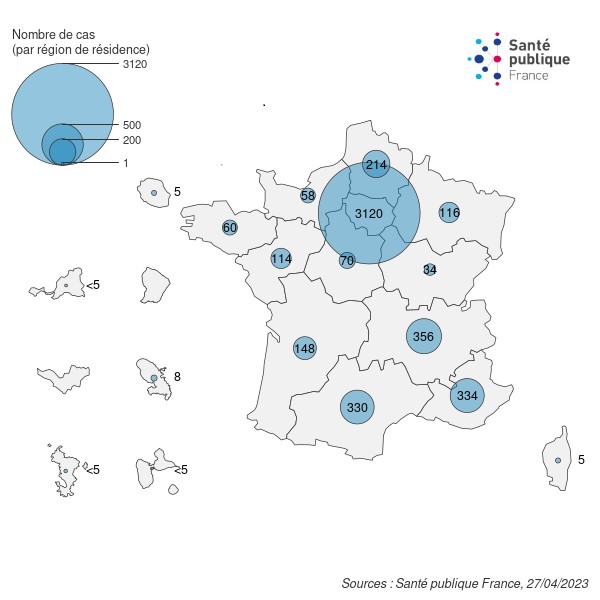
As of 27 April 2023 at 12:00 p.m., 5,002 cases of infection with the mpox virus have been recorded in France, i.e. 2 additional cases since the assessment of 23 March. Of these 5,002 cases, 4,146 (83%) were laboratory confirmed.

The distribution of cases by region of residence (or by reporting region when the region of residence is unknown) is presented in Figures 1 and 2. The Ile-de-France region concentrates the largest number of cases (3,120, i.e. 63 %), followed by Auvergne-Rhône-Alpes (356 cases), Provence-Alpes-Côte d'Azur (334 cases), and Occitanie (330 cases); 27 cases reside abroad. The 22 cases that have occurred since the start of 2023 are all men, and among them, 19 were diagnosed in the Centre-Val de Loire region (see below).

The vast majority of adult cases (15 years and older) reported to date are male. Only 2.9% of them are women (143 cases, including 112 biologically confirmed cases). No female case has been diagnosed since the beginning of 2023.

The median age of adult cases is 36; 25% of cases are under 29 years old and 25% are between 43 and 81 years old.

Twenty-four children under the age of 15 (0.5% of total cases) have been reported since May 2022 (including 12 biologically confirmed cases). No pediatric case has been diagnosed since the beginning of 2023.

Non-biologically confirmed cases have a profile comparable to confirmed cases: 3.7% of adults are female (vs. 2.7% of confirmed adult cases ), the median age of adults is 36 years as in confirmed cases and the majority resides in Ile-de-France (72% vs. 61% of confirmed cases).

Of all the cases for which information is available, 101 (3.2%) were hospitalized for treatment of their infection with the mpox virus; this proportion is stable over time.

No deaths have been reported to date.

The distribution of cases according to the date of onset of symptoms (when this is known) and the type of case (biologically confirmed or not) is presented in Figure 3. The date of onset of symptoms of the cases extends between the 7 May 2022 and March 24, 2023. Given the reporting deadlines, the data for the last few weeks is not consolidated. The reports received do not always mention the date of onset of the symptoms. As an alternative to this information, the distribution of cases according to their date of reporting is presented in Figure 4.


Figure 1. Total monkeypox cases (n= 4,975 cases) by region of residence (or by reporting region when region of residence is unknown), France, May 2022-April 2023 (data as of 04/27/2023 – 12:00 p.m.)
35cf31c04f99-carte_cas_confirmes_variole_singe_230427.jpg


Figure 2. Biologically confirmed cases (n= 4,124) by region of residence (or by reporting region when the region of residence is unknown), France, May 2022-April 2023 (data as of 04/27/2023 – 12:00 p.m.)
484b5e074a7b-carte_cas_confirmes_biologiquement_variole_singe_230427.jpg


Figure 3. Monkeypox cases (n= 3,781 cases, number of missing data = 1,221) by week of onset of symptoms and by type of case (biologically confirmed or not), France, May 2022-April 2023 ( data as of 04/27/2023 – 12:00 p.m.).
fb938d50461b-fig_cas_confirmes_semaine_variole_du_singe_230427.jpg


Data for the past three weeks is not fully consolidated.

Figure 3. Monkeypox cases (n= 5,000 cases, number of missing data = 2) by reporting week and by type of case (biologically confirmed or not), France, May 2022-April 2023 (data as of 27 /04/2023 – 12:00 p.m.).
e2c22e5f7e17-fig_date_signalement_variole_singe_230427.jpg


Data for the last week is not fully consolidated. The reporting low observed in week 28 (July 11 to 17) can be explained by the July 14 public holiday.

Grouped cases in the Centre-Val de Loire region, January to April 2023

Between January 1, 2023 and April 3, 2023, 19 confirmed male cases were reported in the Centre-Val de Loire region, including 16 since March 1.

The investigation carried out showed that all of these cases, with the exception of one, concerned men who have sex with men (MSM), several of whom reported having had several partners without always being able to identify. No party or event common to a majority of cases has been identified.

The cases are between the ages of 24 and 56 (median 40). The clinical characteristics of these cases remain similar to those previously observed; no case required hospitalization.

Among the 19 cases, 7 did not receive any smallpox vaccination, 2 reported having an incomplete vaccination regimen (vaccination in childhood with a 1st generation smallpox vaccine for one, a vaccination dose with a vaccine 3rd generation in 2022 for the other) and 10 reported a complete vaccination schedule: 4 with a 1st generation smallpox vaccine in childhood + 1 dose of 3rd generation vaccine in 2022, and 6 with 2 doses of vaccine 3rd generation in 2022.

Given the high proportion (53%) of vaccinated people in this cluster, investigations were carried out by Public Health France and the Tours Regional Pharmacovigilance Center. The proportion of vaccinated cases is higher than what is observed at the national level (25% of male cases of mpox declared between October and February 2023 in France concerned vaccinated men). It is appropriate to await the results of real-life efficacy studies which will allow better interpretation of these data. To date, there is little perspective on the efficacy of 3rd generation vaccines against mpox infection. There are no data on long-term protection after a full vaccination course, nor in population subgroups. These vaccines are subject to pharmacovigilance monitoring coordinated by the ANSM. To date, no signal has been issued on the quality or safety of these vaccines.

The mpox virus DNAs of the 19 cases (swabs between January 23 and March 21) were sequenced by the national reference laboratory (IRBA). The preliminary results made it possible to relate the sequences for 11 cases to the B1 lineage of clade IIb (clade of this global epidemic). Additional analyzes are still in progress for the last cases.

This episode indicates to date a localized transmission in the Touraine sector, in a context of virtual absence of cases reported in the rest of the country. Among the reported cases, some indicated at-risk contacts and exposures in other regions, particularly in Ile-de-France.

No new cases have been reported since April 3.


Pending robust data on the real-life efficacy of mpox vaccines , this cluster urges vigilance. Mpox infections can occur in people who have received a full course of vaccination, and it is important to think about this diagnosis in case of rash or mucous membrane, including in people who are correctly vaccinated. Surveillance of mpox requires that vaccination status be collected for all notifiable mpox cases .

This episode indicates to date a localized transmission in the Touraine sector, in a context of virtual absence of cases reported in the rest of the country. The recommendations for prevention remain valid, in particular the avoidance of sexual intercourse in the event of lesions suggestive of mpox and the use of condoms for 2 months after healing. Vaccination remains recommended, and remains effective in the majority of people who have received a complete vaccination schedule to prevent the risk of infection. It is important to verify that eligible persons [SUP]*[/SUP] , including multipartner MSM, are up to date with the mpox vaccination. For people born before 1979, in the absence of proof of smallpox vaccination on the card or of a characteristic scar, it is recommended that they receive a 2nd [SUP]dose[/SUP] of 3rd generation vaccine.


After the peak of contamination reached at the end of June/beginning of July 2022, the number of cases fell sharply, whether biologically confirmed or unconfirmed, and very rare cases were reported between November 2022 and April 2023. however, cases may not seek care and may not be diagnosed or reported.

This apparent low level of incidence is also seen globally, with 247 cases reported in the past three weeks, with the majority of these reported in the Americas (63%) and Western Pacific (25%) region. . In Europe, 27 cases have been reported in the last three weeks compared to 6 cases in the previous three weeks (WHO).

While waiting to have robust data on the real-life effectiveness of vaccines against mpox , the cluster that has been observed in the Center Val de Loire region calls for vigilance as the season of international MSM festivals approaches and pride marches. The recommendations for prevention remain valid, in particular the avoidance of sexual intercourse in the event of lesions suggestive of mpox , and the use of condoms.

MPox infections can occur in people who have received a full course of vaccination, and it is important to consider this diagnosis in case of typical mpox lesions even in people who are correctly vaccinated. Surveillance of mpox requires that vaccination status be collected for all notifiable mpox cases


​...

https://www.santepubliquefrance.fr/...point-de-situation-en-france-au-27-avril-2023
 
Translation Google
Mpox epidemic in France: epidemiological characteristics and sexual behavior of cases over 15 years old, 2022

Published on January 15, 2024

Until May 2022, when non-travel related mpox cases occurred in several countries in Europe and North America, locally acquired mpox cases were rarely reported outside of West Africa and center where this virus is endemic. Mpox is a zoonotic disease caused by the mpox virus , sharing genomic and morphological characteristics with the virus that causes smallpox. Human-to-human transmission occurs through close contact with an infected person (e.g., skin-to-skin or sexual contact or with biological fluids) and occasionally through contact with contaminated surfaces, objects or tissues.

At the global level, the latest WHO report reported a total of 92,783 confirmed cases of mpox between the start of the epidemic and November 30, 2023. After a clear drop in the number of cases globally since the end of 2022, we observed a slight increase since July 2023.
In France, while a total of 4,975 cases were declared during the year 2022, 48 cases were declared between January 1 and December 14, 2023. More than 95% of cases involved men who have sex with men (MSM).

From the end of May 2022, Public Health France mobilized its Sexosafe system to alert the MSM population and disseminate targeted prevention messages to them. As part of a graduated communication plan, two campaigns relating to the identification of symptoms and the promotion of vaccination were broadcast from June 9, 2022 to September 30, 2022.

The study published this month in Eurosurveillance covering the first five months of this epidemic makes it possible to describe the cases of mpox and provides, for a subset of cases of men aged 15 and over, information allowing spot changes in sexual behavior patterns as the epidemic progressed.


3 questions to: Catarina Krug, Directorate of Regions, Emilie Chazelle, Directorate of Infectious Diseases and Arnaud Tarantola, Directorate of Regions

9450fd04fb08-3-photos-article-du-mois.jpg
When the first cases were detected in the United Kingdom in May 2022, the French surveillance system moved from routine mandatory reporting of orthopox cases to enhanced surveillance of mpox cases. What does this reinforced surveillance consist of and why was it put in place?

In France, reinforced surveillance of mpox (formerly monkeypox or monkeypox) was put in place on May 20, 2022, concomitantly with the diagnosis of the first case in the territory. We had to learn everything about this emerging disease, and as quickly as possible, to guide treatment and prevention. This reinforced surveillance, based on a case definition and guidelines , consisted of backing up the mandatory declaration of orthopoxviruses (including mpox ) with an epidemiological investigation of all cases using a standardized questionnaire.

The first cases detected in Europe at the beginning of May 2022 occurred preferentially among MSM, a situation different from that known in African countries where the disease is endemic. The objectives of this investigation were multiple: to specify the clinical presentation of the cases, the circumstances of contamination and in particular the type of link between a case and its index case (source case), the profile of the cases (sex, age, sexual practices, profession …) and detect early a possible spread of the epidemic to other population groups. The elements collected thus made it possible to adjust the case definition and the action to be taken, but above all, to develop prevention messages, to define the target audiences as well as those for preventive vaccination.

This involved establishing the communications plan including strategies to reach particularly vulnerable groups. The messages were relayed by community associations and by Public Health France via the Sexosafe site , by posting in gay sociability places, broadcasting messages on affinity radio stations, etc. The questionnaire completed during the investigation of the cases also made it possible to identify the at-risk contacts of the cases for carrying out contact tracing in the region and priority referral for post-exposure vaccination. This monitoring also made it possible to better document transmissibility following daily contact (home, educational, healthcare environment).

In addition to the epidemiological investigation, the National Reference Center (CNR) for orthopoxviruses carried out the sequencing of the strains of certain cases to determine the clade of the monkeypox virus, to monitor the appearance of new lineages or sub-lineages of the virus, to look for the appearance of resistance mutations to the TECOVIRIMAT antiviral treatment or mutations favoring escape from the anti-smallpox vaccine proposed for prevention (or post-exposure) of mpox , or in the event of suspicion of re-infection or cluster .
Does the evolution of the demographic and behavioral profiles of the cases observed during your study allow us to formulate hypotheses? Can these observations be compared to management measures? Have similar observations been made at European level?

Demographic and behavioral profiles were studied among a subset of 2,216 men (aged 15 years or older) with an onset date of mpox symptoms between May and July 2022. Of these men, 96% reported having had sexual relations with other men. We noted a decrease between May and July 2022 in the proportion of cases of mpox declared in Île-de-France (from 78% to 37%) and those declaring having traveled to other countries (from 43% to 21% ) among all the cases. We also noted, during this period, a reduction in the median number of sexual partners (4 to 2), the proportion of cases frequenting places where MSM meet (60% to 46%), and the proportion of men living with HIV (31% to 22%) among all cases. Finally, we observed a drop in the proportion of users of pre-exposure prophylaxis (77% to 58%) among HIV-negative cases.

The evolution of the demographic and behavioral profiles of the cases observed during our study could be interpreted as a first circulation of the monkeypox virus in Île-de-France in May 2022, among an MSM population with high risks of exposure and infection (numerous sexual contacts), followed by nationwide spread of the virus in July 2022, among a lower risk MSM population (lower number of sexual contacts). It is also likely that the population affected by the epidemic has changed its behavior and reduced its number of partners following the prevention messages disseminated via specialized media and via associations.

This change in the behavior of MSM in 2022 has been observed by other international teams, particularly in the United States ( Clay et al 2023 ; Copen et al 2024 ; Delaney et al 2022 ; Phillips et al 2023 ).
Do the behavioral changes observed in this population provide avenues for other preventive actions? Is Public Health France carrying out other complementary studies to improve knowledge of the behavior of the MSM population?

Strengthened surveillance of cases of mpox has enabled the identification of populations most at risk of being exposed to the virus, such as MSM and sex workers, and their involvement in the fight against the epidemic, via associations community or fight against HIV. Targeted prevention messages, including those promoting vaccination, relayed in particular by associations, have favored the control of the mpox epidemic in 2022. The changes in behavior thus observed call for more systematic involvement of stakeholders, in particular associations , in the fight against epidemics, as well as for an expansion of communication targets as an epidemic spreads.
Following our study, the 2023 edition of the “Ratio to sex” (ERAS) survey , conducted among MSM by Public Health France in partnership with the ANRS – Emerging infectious diseases, included questions on changes in behavior during the first months of the mpox epidemic in 2022. Issues included reducing the number of sexual partners and anonymous sexual partners, as well as reducing attendance at places where MSM meet. The results will provide elements to better understand whether the evolution of the demographic and behavioral profiles of mpox cases observed between May and July 2022 is rather due to changes in the behavior of MSM with a lot of sexual contact, who may have had fewer sexual partners. to reduce their risk of infection by the monkeypox virus - or to the spread of the epidemic to less exposed populations.

At the start of 2024, while the number of monthly cases declared in France is relatively low, surveillance through compulsory declaration reinforced by epidemiological investigation of cases (with a simplified questionnaire) remains relevant. It is all the more important as there is currently (following the global clade IIb epidemic in 2022-2023) a major epidemic of clade I monkeypox virus - usually considered more virulent than clade II - in the Democratic Republic of Congo . In this context, it is also requested that any positive sample for the monkeypox virus be transmitted to the CNR of orthopoxviruses for the determination of the clade, in order to early detect a possible introduction into France of a clade I monkeypox virus strain.


[1] Krug Catarina, Tarantola Arnaud, Chazelle Emilie, Fougère Erica, Velter Annie, Guinard Anne, Souares Yvan, Mercier Anna, François Céline, Hamdad Katia, Tan-Lhernould Laetitia, Balestier Anita, Lahbib Hana, Etien Nicolas, Bernillon Pascale, De Lauzun Virginie, Durand Julien, Fayad Myriam, Investigation Team, De Valk Henriette, Beck François, Che Didier, Coignard Bruno, Lot Florence, Mailles Alexandra. Mpox outbreak in France: epidemiological characteristics and sexual behavior of cases aged 15 years or older, 2022 . Euro Surveillance 2023;28(50):pii=2200923


https://www.santepubliquefrance.fr/...ortement-sexuel-de-cas-de-plus-de-15-ans-2022
 
Translation Google
Monkeypox virus infection in France. January to April 2024.


Published on June 13, 2024
Updated on June 13, 2024


Key points

The number of cases of mpox reported every month in France since the start of 2024 has decreased significantly compared to the number of cases reported in 2022, however the virus continues to circulate quietly. The number of cases had already increased moderately in December 2023 (7 reported cases) and this increase continued with a monthly number of reported cases varying between 12 and 14 between January and April 2024.

In terms of geographical distribution, if the Ile-de-France region still concentrates the greatest number of cases, several regions report a greater number of cases over four months than in 2023 (Auvergne-Rhône-Alpes and Nouvelle Aquitaine in particular) .

The characteristics of cases reported in 2024 are generally similar to those of previous years, in terms of age, sex, severity or lack of knowledge of the origin of the contamination.

To date, only clade II monkeypox viruses have been identified and no deaths have been observed.


PDF 0.18 MB


https://www.santepubliquefrance.fr/...rus-monkeypox-en-france.-janvier-a-avril-2024
 
Translation Google

Is monkeypox still circulating in France?

Only about fifty cases were observed between January and April, according to Public Health France, which speaks of "low-level" circulation. The WHO could soon declare a new international emergency related to this disease.

By MC
August 5 , 2024 at 9:40 a.m.

Where are we with the monkeypox epidemic ? Contamination by the monkeypox virus had surged in France in 2022, affecting the vast majority of men. Since then, this disease, which can be transmitted through close contact and sexual intercourse, has not died out. But its spread remains relatively low in France, compared to other regions of the world, starting with Africa. The World Health Organization (WHO) could also declare a new international public health emergency, its director general indicated this Sunday . Le Parisien takes stock.

How does the virus circulate in France?

First observation, the number of cases of mpox reported since the beginning of 2024 has "significantly decreased compared to the number reported in 2022", notes Public Health France in a June bulletin . From January 1 to April 30, only 53 patients were recorded: 14 in January, 13 in February, 12 in March and 14 in April. For comparison, the authorities had counted nearly 3,500 cases in August 2022 , since the start of the epidemic.

All the contaminations observed in 2024 concern adults, between 18 and 65 years old. Only one case was recorded in a woman. More than a third resided in Île-de-France, but other regions also report a significant number of confirmed infections such as Auvergne-Rhône-Alpes (12) or Nouvelle-Aquitaine (8).

Among these people, only one was hospitalized, due to a "bacterial superinfection of skin lesions". No deaths were observed. The virus - that of clade (or variant) II, which has also struck Europe and the United States - is therefore still circulating "quietly", notes Public Health France. It should be noted, however, that monkeypox surveillance is based on a "mandatory declaration". But it may not be exhaustive; some cases with moderate forms may, for example, not seek medical attention.

As a reminder, monkeypox is transmitted from animals to humans, but can also be transmitted through close contact and sexually. Symptoms begin with fever, fatigue or muscle pain. Then, spots and lesions may appear on the skin (including on the genitals). A PCR test can then confirm - or not - the presence of the virus.

And elsewhere ?

The WHO is concerned about a threat to global health , given the outbreak of the mpox epidemic, particularly in several African countries. The first cases have been observed in Uganda, Rwanda, Kenya and Ivory Coast. But it is especially the situation in the Democratic Republic of Congo (DRC) that is worrying, with more than 11,000 cases recorded, including 450 deaths .

Since last September, a new, even more deadly strain of the variant has been spreading across the country. Tests have revealed that it is a new variant, the result of a mutation of Clade I, called Clade Ib.

Authorities are also seeing a geographical expansion of the virus, with urban areas now affected, such as Kinshasa and South Kivu. In response, the East African Community has called on countries to “educate their citizens on how to protect themselves and prevent the spread of Mpox.”

In Europe too, the virus continues to spread, without however reaching the thresholds observed in Africa. In total, 477 cases have been declared by 20 countries other than France, reports Public Health France. In detail, the main countries concerned are Spain (208 cases), Italy (53), the United Kingdom (33), Portugal (31) and Germany (30).

https://www.leparisien.fr/societe/s...nce-05-08-2024-72QK63XQPRGZVJUPBMMYYHSYBI.php
 
Translation Google
MPOX epidemics: update on the health situation and preparation of the French health system

On Wednesday, August 14, the World Health Organization (WHO) declared a Public Health Emergency of International Concern (PHEIC) in response to the active circulation of clade I Mpox in Central Africa. Today, the French health authorities are reminding that no contamination by clade I has been recorded in France and that the State has had, since the 2022 epidemic (active circulation of clade II), an effective response strategy to an Mpox epidemic, in terms of prevention, screening, case and contact management, and vaccination.

Published on August 16, 2024

Press contacts

Health Crisis Center, Ministry of Labor, Health and Solidarity :
alertes-presse@sante.gouv.fr
01 87 05 93 80

Public Health France :
presse@santepubliquefrance.fr
Stéphanie Champion: 01 41 79 67 48
Camille Le Hyaric: 01 41 79 68 64
Céline Coulaud: 06 81 86 57 26


The USPPI declared by the WHO , in a context where several epidemics are raging in different countries with different strains and different levels of risk, aims to call for the establishment of an effective, coordinated and united international response. In this sense, the Ministry of Labor, Health and Solidarity (MTSS) is preparing to be solicited by European and international health authorities for donations of vaccines and treatments. The risk of infection by a clade I Mpox virus for the European population is currently considered low by the European Center for Disease Prevention and Control (ECDC). As in Sweden, this does not prevent it from being likely that sporadic cases will be declared in France, for which the health authorities will put in place the usual management measures.

Indeed, since the 2022 epidemic, the health authorities have had a response strategy for an Mpox epidemic, in terms of surveillance, prevention, screening, case and contact management, and vaccination. In particular, this response is based on raising awareness among the populations most at risk as defined by Public Health France, on a reactive and preventive vaccination strategy for these populations and on a screening offer that covers the entire territory. This strategy is currently being reassessed in conjunction with the health agencies to ensure that it is fully effective against clade I. In terms of surveillance, infections by orthopoxviruses including Mpox are subject to ongoing surveillance by the Mandatory Declaration system and by the characterization of viral strains by the National Reference Center (NRC) for Orthopoxviruses. Given the current alert, surveillance of these infections has been strengthened by Public Health France.

Today, in France, no contamination by clade I has yet been recorded. Since the 2022 epidemic, it is the clade II virus that has been circulating quietly, with a monthly number of reported cases varying between 12 and 26 between January and June 2024. To date, the reported cases are mostly mild and no deaths have been reported. For any request for information, the "Monkeypox info service" telephone system, set up in 2022 by the health authorities, is still accessible to answer questions raised by Mpox. Open every day from 8 a.m. to 11 p.m., on the toll-free number 0 801 90 80 69 (free call and services, anonymous and confidential), this system is responsible for providing information on symptoms, treatments, prevention measures and vaccination, and for directing people to care systems.

The Ministry of Labor, Health and Solidarity would like to remind that the health authorities are fully mobilized in this context of active circulation of Mpox clade I in Central Africa and have a strong national response strategy. Health professionals in the territory are informed specifically and individually of the situation today by DGS Urgent and, in addition, the General Directorate of Health will inform the partners and associations that have been working in the field since 2022 to reduce the risks of spreading the disease at the national and regional level. Finally, a press briefing will be organized in the coming days.


...

https://www.santepubliquefrance.fr/...e-et-preparation-du-systeme-de-sante-francais
 
Translation Google

Mpox: update on the epidemic

Published 08/21/2024 | Modified 08/21/2024

During a briefing on the Mpox epidemic, Prime Minister Gabriel Attal detailed the measures taken by France to strengthen health vigilance, inform travelers, and intensify the fight against the virus.

Prime Minister Gabriel Attal announced on Tuesday, August 20, 2024, during an update on the Mpox epidemic , that the French health system is on maximum alert to deal with all possible scenarios
...

The Prime Minister's announcements on Mpox

Travelers going to or returning from areas where the virus is circulating are now systematically informed of the precautionary measures to adopt.

Health professionals have been alerted and the diagnostic capacities of laboratories and hospitals will be strengthened.

In addition, 232 vaccination sites are already operational across the territory, with more to come.

In addition, France will donate 100,000 doses of vaccine , which will be distributed via the European Union to the most affected regions, demonstrating European solidarity against the epidemic .

"Monkeypox info service"

This telephone service provides information on the symptoms of Mpox, treatments, preventive measures and vaccination, and provides guidance on support systems.
The number 0 801 90 80 69 is open every day from 8 a.m. to 11 p.m. (calls and services are free, anonymous and confidential).
Monkeypox info service


To go further

Mpox: the latest on the virus

All information on the Ministry of Health website.
sante.gouv.fr


https://www.info.gouv.fr/actualite/variole-du-singe-point-de-situation-sur-lepidemie-de-mpox


Translation Google

Mpox: the latest on the virus

updated 23.08.24

Diseases Health


The mpox virus (monkeypox, formerly “monkey pox”) is an infectious disease caused by an orthopoxvirus that is characterized in particular by a skin rash that can be isolated or preceded or accompanied by fever or swollen lymph nodes. The virus is transmitted between people, especially family and close friends. Human-to-human transmission occurs through direct contact with an infected person , through bodily fluids, skin lesions of the disease or internal mucous membranes such as the mouth, as well as indirectly through objects that the patient has contaminated , such as clothing or bed linen or to a lesser extent during prolonged face-to-face contact through droplets (spitting, sneezing).


Situation in France and internationally

There are two main clades of mpox : clade 1, originally present in the Congo Basin in Central Africa, and clade 2 present in West Africa.

Clade 1 mpox outbreaks have been increasing in frequency in Africa since early 2023, and the total number of cases in 2024 is already higher than in 2023. This clade is different from the one responsible for the 2022 mpox outbreak in Europe, particularly in France (clade 2). The main focus of transmission identified is in the Democratic Republic of Congo (DRC), accounting for more than 95% of cases, with only strains belonging to clade 1. Confirmed cases of mpox have also been reported in countries neighbouring the DRC, such as Rwanda, Uganda, Burundi, Kenya, Central African Republic and Congo.

On Wednesday, August 14, 2024, the World Health Organization (WHO) declared a Public Health Emergency of International Concern (PHEIC) due to the active circulation of clade 1 mpox in Central Africa. The overall risk of infection with clade 1 mpox for the general population of the EU/EEA is currently considered by the European Centre for Disease Prevention and Control (ECDC) to be low. This risk is considered moderate for people with multiple sexual partners (who were not infected with mpox or who were not vaccinated during the 2022 epidemic) and is considered high in the event of close contact with imported cases of mpox. Today in France, no contamination by Clade 1 has been recorded, however sporadic cases could occur. A first case of Clade 1 mpox was detected in Sweden on August 15, 2024.

Since the 2022 epidemic, it is the clade 2 virus that has been circulating quietly in Europe and France, with a monthly number of reported cases varying between 12 and 26 in France between January and June 2024.

From January 1 to June 30, 2024, a total of 107 cases of Monkeypox virus (MPOX) infection were reported to Public Health France via the mandatory reporting (MR) of orthopoxviruses: 14 in January, 13 in February, 12 in March, 21 in April, 26 in May and 21 in June.

Of these 107 reported cases, five were not biologically confirmed. All cases involved adults aged between 18 and 65 (median age of 36), and only one involved a woman. More than a third of the cases (n=42, 39%) resided in the Ile-de-France region (including 28 in Paris), 30 in Auvergne-Rhône-Alpes (including 28 in the Rhône), 8 in Nouvelle Aquitaine, 7 in Provence-Alpes-Côte d'Azur and 6 in Occitanie. The other 14 cases were domiciled in Hauts-de-France (3), Bourgogne-Franche-Comté (3), La Réunion (3), Normandy (2), Brittany (2) and Grand Est (1). An increase in the number of cases was noted in April/May in Auvergne-Rhône-Alpes and in May/June in Ile-de-France. To date, the cases are mostly benign and no deaths have been reported.

For more information, see the press release of 08/18/2024: MPOX epidemics: update on the health situation and preparation of the French health system

Consult:
Epidemiological situation update in France. January to June 2024. on the Sante Publique France website

Symptoms and incubation period

Infection with the mpox virus can cause a rash, made up of fluid-filled vesicles that develop into dryness, crusting and then healing. Itching may occur. The vesicles are concentrated on the face, in the anogenital area, the palms of the hands and soles of the feet, may be present but also on the trunk and limbs. The mucous membranes are also affected, in the mouth and genital area. This rash may be accompanied by fever, headache, body aches and asthenia. The lymph nodes may be swollen and painful, under the jaw, in the neck or in the groin crease. Sore throats are also reported.
The incubation period of the disease can range from 5 to 21 days. The fever phase lasts about 1 to 3 days. The disease usually resolves spontaneously, after 2 to 3 weeks but sometimes 4 weeks.


Mode of transmission of the disease

Transmission of the mpox virus occurs when a person comes into contact with an animal, a human being or materials contaminated by the virus. The virus enters the body through a break in the skin (even if not visible), the respiratory tract or the mucous membranes. Transmission from animals to humans can occur through bites or scratches, through the preparation of bushmeat, through direct or indirect contact with body fluids or material from the lesion. There are usually no animal reservoirs present in Europe.
The virus is transmitted between people, especially family and close friends. Human-to-human transmission occurs through direct contact with an infected person , through bodily fluids, skin lesions of the disease or internal mucous membranes such as the mouth, as well as indirectly through objects that the sick person has contaminated , such as clothing or bed linen or to a lesser extent through prolonged face-to-face contact through droplets (spitting, sneezing).

It is therefore important that patients remain isolated for the entire duration of the illness (until the last scabs have disappeared, usually 3 weeks).


What to do if you have symptoms?

If symptoms appear (fever and rash with blisters), contact your doctor or a free information, screening and diagnosis center (CeGIDD) for HIV infections, viral hepatitis and STIs.

Find the contact details of the CEGIDD nearest to you on monkeypox-info-service.fr

IMPORTANT: A diagnosis of monkeypox can be carried out there under certain conditions. Contact the center's secretariat by telephone before any physical travel!

It is recommended to self-isolate while awaiting medical advice and to avoid contact with other people.
For more information, see the information sheet "I have MPOX. What precautions should I take for my loved ones and me?"


Monkeypox info service : a listening device to answer questions about the mpox virus

Since July 2022, a listening service has been open to answer questions raised by the mpox virus.
Subsidized by Public Health France and supported by SIS Association (Sexualities info service Association), the "Monkeypox info service" telephone line is accessible every day from 8 a.m. to 11 p.m., on the toll-free number 0 801 90 80 69 (free call and services, anonymous and confidential) .

Resources and online chat are also available at monkeypox-info-service.fr .

This system is responsible for supporting prevention messages and protective measures, providing information on symptoms, treatments and vaccination, and providing advice and guidance on care systems.


Preventive vaccination against the mpox virus

Adult contacts at high risk of contracting the MPOX virus as defined by Public Health France can be vaccinated, including exposed healthcare professionals without individual protective measures.
This is a post-exposure vaccination, in a reactive strategy around a confirmed case of MPOX. Ideally, the vaccine should be administered within 4 days after the risky contact and no more than 14 days.

In 2022, faced with the spread of the mpox virus, the High Authority for Health, contacted by the General Directorate of Health, recommended in its opinion of July 7, 2022 that preventive vaccination be offered to groups most exposed to the virus.

Since July 11, 2022, in addition to people who have had risky contact with a sick person, people who meet the indications selected by the HAS can make an appointment to be vaccinated throughout the territory:

Men who have sex with men reporting multiple sexual partners;
Trans people reporting multiple sexual partners;
Sex workers;
Professionals working in places of sexual consumption.

Vaccination can also be considered on a case-by-case basis for healthcare professionals who are required to care for sick people.

The contact details of all the vaccination centres against the mpox virus are available on: sante.fr/monkeypox

Following the Public Health Emergency of International Concern (PHEIC) declared by the WHO on 14 August 2024, the health authorities will, if necessary, develop the epidemic response strategy in close collaboration with health professionals and representatives of the health system. In this sense, an opinion from the High Authority for Health will be issued on 30 August 2024 to reassess the vaccination strategy, if necessary.


Review of vaccination in France

Number of vaccinations against the mpox virus [TABLE="class: table spip, width: 100%"]
[TR]
[TD="bgcolor: #e9e9e9"]Total number of doses administered as of July 31, 2024[/TD]
[TD="bgcolor: #e9e9e9"]154,247 vaccinations* * data currently being consolidated[/TD]
[/TR]
[/TABLE]

...

https://sante.gouv.fr/soins-et-mala...as-groupes-d-infection-par-le-virus-monkeypox
 
Translation Google

Mpox (MPXV): HAS updates its vaccination recommendations to better combat the circulation of the virus


PRESS RELEASE - Posted on Sep 02 2024

September 2, 2024 While the mpox epidemic has intensified on the African continent, with the circulation of several clades including clade Ib, clade II is still present in France. In this context, the Ministry of Health has urgently contacted the High Authority for Health (HAS) so that it can update its vaccination recommendations issued during the last epidemic in 2022. In response, the HAS is today publishing an opinion in which it recommends the two complementary strategies used in 2022: one preventive for unvaccinated or incompletely vaccinated people at high risk of exposure to the virus; and the other reactive for people in contact with identified cases. Finally, the HAS recommends the administration of a booster dose for people vaccinated two years ago.

On August 14, the World Health Organization (WHO) declared a Public Health Emergency of International Concern (PHEIC) in response to the emergence in Africa of a new clade of mpox (clade Ib), which has demonstrated the capacity for sexual transmission, and its rapid spread to the Democratic Republic of Congo and other countries on the continent. At the same time, since the 2022 epidemic, France has been one of 13 countries in the European zone where clade IIb continues to circulate quietly [1] : the latest data published by Santé publique France report 126 cases since the beginning of the year. It is in this context, and while the immunity of the world population against orthopoxviruses has almost disappeared since the cessation of smallpox vaccination in the early 1980s, that the Ministry of Health urgently contacted the HAS to reassess the vaccination strategy against the Monkeypox virus (MPXV).

The HAS is publishing its opinion today, which aims to meet three objectives: prevent the emergence of MPXV clade Ib in France, reduce or even eliminate the circulation of clade II in France, and strengthen long-term immunity to prepare for possible epidemic outbreaks.


Protect those most at risk of exposure and vaccinate case-contact persons in response

The HAS relied in particular on the available knowledge concerning MPXV, on national and international epidemiological data, as well as on the efficacy data of the third-generation smallpox vaccine MVA-BN used in 2022 (marketed under the name Imvanex in Europe and Jynneos in the United States), the latter showing in particular a vaccine efficacy in pre-exposure more than 14 days after two doses [2] at 82%. Following its assessment and while the mode of transmission by intimate/sexual contact is mainly observed regardless of the clade, it considers that the targets of this vaccination remain unchanged since its previous recommendations. It therefore recommends implementing the following two complementary strategies:
  • A preventive vaccination campaign for people at high risk of exposure to the virus
The HAS recommends that people at high risk of exposure to the virus be eligible for vaccination with the MVA-BN vaccine (Imvanex or Jynneos), namely:
- Men who have sex with men (MSM) and trans people reporting multiple sexual partners;
- People in prostitution;
- Professionals in sexual encounter places, regardless of the status of these places;
- Partners or people sharing the same living space as the people mentioned above.

  • A reactive vaccination strategy around identified cases
The HAS recommends that people who have had a risky contact, as defined by Public Health France [3] , as well as immunocompromised people who have had close contact with a risky contact person, should also be eligible for vaccination with the MVA-BN vaccine (Imvanex or Jynneos). As a reminder, this reactive vaccination should ideally be administered within 4 days of the first risky contact to have optimal efficacy, and at the latest within 14 days.


Concerning minors, in the absence of marketing authorization (MA) for the vaccine for this population, the HAS reminds that post-exposure vaccination must be considered on a case-by-case basis and as part of a shared medical decision.


What are the vaccination procedures?

As a reminder, primary vaccination with the MVA-BN vaccine (Imvanex or Jynneos) is based on the administration of two doses spaced at least 28 days apart, or a single dose for people who received a smallpox vaccination with a first-generation vaccine before 1980. For immunocompromised people, the schedule is two doses supplemented by a third at least 28 days after the administration of the second, regardless of the history of smallpox vaccination. The HAS also emphasizes that, given the natural immunity conferred by past infection, it is not recommended to vaccinate people who contracted MPOX in 2022 or in subsequent years.

The HAS also supports the administration of a booster dose to people who received a primary vaccination in 2022. Indeed, in the absence of an established protection threshold, uncertainties remain about the duration of protection induced by the vaccine. Available studies show a significant decrease in neutralizing antibodies in the two years following a two-dose primary vaccination. They also suggest that a booster dose is associated with a longer persistence of antibodies than after a simple primary vaccination. The HAS therefore recommends a single booster dose to people who received their first vaccination in 2022 with a complete schedule.

Vaccination schedules for eligible individuals vary depending on whether or not they are immunocompromised and on their history of infection and vaccination. These situations are summarized in the table below.

Summary table of the different vaccination schedules to be carried out in persons eligible for vaccination depending on their history of infection and vaccination

mceclip0_2024-09-02_12-24-19_650.png

a Smallpox vaccine received before 1980
* The booster dose should be given at a distance from the primary vaccination and ideally two years or more after the last dose. Persons eligible for a booster dose who were primary vaccinated in 2022 can therefore be revaccinated.


The HAS reminds that compliance with preventive measures (barrier gestures, isolation, etc.) has proven its effectiveness in reducing transmission, in addition to vaccination. Compliance with these measures remains absolutely necessary, even for vaccinated people.

Finally, the HAS stresses the importance of having data quickly, particularly concerning the monitoring of the epidemic, the duration of protection conferred by vaccines and the effectiveness of post-exposure vaccination and against the different clades . It is continuing its scientific monitoring work and reserves the right to adjust its recommendations in light of this new data.


[1] Continued circulation of mpox- an epidemiological and phylogenetic assessment, European Region, 2023 to 2024 Eurosurveillance August 24
[2] Policy brief: WHO position on smallpox and mpox (orthopoxvirus) vaccines August 24 based on a systematic review of 12 studies : Pischel L, Martini BA, Yu N, Cacesse D, Tracy M, Kharbanda K, et al. Vaccine effectiveness of 3rd generation mpox vaccines against mpox and disease severity: a systematic review and meta-analysis. Vaccine 2024:126053. http://dx.doi.org/10.1016/j.vaccine.2024.06.021
[3] Case and contact definition and contact tracing guidelines (April 2023)

...


https://www.has-sante.fr/jcms/p_353...r-mieux-lutter-contre-la-circulation-du-virus
 
Translation Google
Mpox cases in France. January 1 - September 3, 2024.

Published on September 4, 2024
Updated on September 4, 2024


Key points
  • A total of 143 cases of MPOX have been reported to Public Health France since January 1, 2024, including 14 in the last 7 days.
  • Only clade II Monkeypox viruses were detected by the Orthopoxvirus CNR.
  • The reported cases all concern adults, 140 men and 3 women.

PDF 0.21 MB


https://www.santepubliquefrance.fr/...-mpox-en-france.-1er-janvier-3-septembre-2024
 
Translation Google
Mpox cases in France. January 1 - September 10, 2024.

Published on September 11, 2024
Updated on September 11, 2024


Key points
  • A total of 151 cases of MPOX have been reported to Public Health France since January 1, 2024, including 8 in the last 7 days.
  • Only clade II Monkeypox viruses were detected by the Orthopoxvirus CNR.
  • The reported cases all concern adults, 147 men and 4 women.

PDF 0.21 MB

https://www.santepubliquefrance.fr/...mpox-en-france.-1er-janvier-10-septembre-2024
 
Translation Google
Mpox cases in France. January 1 - September 17, 2024.

Published on September 18, 2024
Updated on September 18, 2024


Key points
  • A total of 160 cases of MPOX have been reported to Public Health France since January 1, 2024, including 9 in the last 7 days.
  • Only clade II Monkeypox viruses were detected by the Orthopoxvirus CNR.
  • The reported cases all concern adults, 154 men and 6 women.

PDF 0.21 MB


https://www.santepubliquefrance.fr/...mpox-en-france.-1er-janvier-17-septembre-2024
 
Translation Google
Mpox cases in France. January 1 - September 24, 2024.


Published on September 25, 2024
Updated on September 25, 2024


Key points
  • A total of 167 cases of MPOX have been reported to Public Health France since January 1, 2024, including 7 in the last 7 days.
  • Only clade II Monkeypox viruses were detected by the Orthopoxvirus CNR.
  • The reported cases all concern adults, 161 men and 6 women.


PDF 0.3 MB


https://www.santepubliquefrance.fr/...mpox-en-france.-1er-janvier-24-septembre-2024
 
Translation Google
Mpox cases in France. January 1 - October 1, 2024.

Published on October 2, 2024
Updated on October 2, 2024


Key points
  • A total of 170 cases of MPOX have been reported to Public Health France since January 1, [SUP]2024[/SUP] , including 3 in the last 7 days.
  • Only clade II Monkeypoxviruses were detected by the Orthopoxvirus CNR.
  • The reported cases all concern adults, 164 men and 6 women.

PDF 0.28 MB


https://www.santepubliquefrance.fr/...-mpox-en-france.-1er-janvier-1er-octobre-2024
 
Translation google
Mpox cases in France. January 1 - October 15, 2024.


Published on October 16, 2024
Updated on October 16, 2024


Key points
  • A total of 186 cases of MPOX have been reported to Public Health France since January 1, 2024, including 11 in the last 7 days.
  • Only clade II Monkeypox viruses were detected by the Orthopoxvirus CNR.
  • The reported cases all concern adults, 180 men and 6 women.

PDF 0.23 MB


https://www.santepubliquefrance.fr/...e-mpox-en-france.-1er-janvier-15-octobre-2024
 
Translation google
Mpox cases in France. January 1 - October 22, 2024.


Published on October 23, 2024
Updated on October 23, 2024


Key points
  • A total of 190 cases of MPOX have been reported to Public Health France since January 1, [SUP]2024[/SUP] , including 4 in the last 7 days.
  • Only clade II Monkeypox viruses were detected by the Orthopoxvirus CNR.
  • The reported cases all concern adults, 183 men and 7 women.

PDF 0.23 MB


https://www.santepubliquefrance.fr/...e-mpox-en-france.-1er-janvier-22-octobre-2024
 
Back
Top