

Pathfinder
Editor, Senior Moderator
Translation Google
Variant Delta: the pessimistic scenarios of the Institut Pasteur for the coming months
Julie kern
Scientific writer
Posted on 07/15/2021
Using mathematical models, the Institut Pasteur is trying to predict the future of the epidemic. Their latest results concern the Delta variant and their projections are rather pessimistic
With the spread of the Delta variant , the number of new cases of Covid-19 is on the rise again in France and around the world. In the Mathematical Modeling of Infectious Diseases Unit at the Institut Pasteur, we are trying to anticipate the future of the epidemic using real data collected in the field, as well as hypotheses.
This research group regularly publishes the results of their work on Covid-19 Modeling . Their last publication of July 12, 2021 focuses on the evolution of the Delta variant in metropolitan France (excluding Corsica).
...
To track down the Delta variant in screening tests , laboratories look for the L452R mutation on the S protein . This is how we can know the proportion of Delta samples compared to total samples. Between June and July, the mean effective reproduction rate (R [SUB]d[/SUB] ) of the Delta variant was 2.0. In other words, it takes 5-6 days for the number of people infected with the Delta variant to double.
Based on this data, the Institut Pasteur proposes two scenarios: a simplified model of exponential growth and a more complex model where natural and vaccine immunities are taken into account. In both cases, it appears that hospitals will again be under intense pressure from the start of the school year.
Two scenarios for an epidemic rebound at the start of the school year
The first exponential modeling suggests that if R [SUB]d [/SUB] remains at 2.0, there would be 40,000 cases daily variant Delta 1 [SUP]st[/SUP] August; 24,000 if the R [SUB]d[/SUB] goes to 1.8 and 11,000 if it falls further to 1.5, from July 8. This pessimistic scenario does not consider the increase in immunization coverage .
The second, more detailed model takes into account vaccination coverage and natural immunity, and the effects of age on the spread of the virus and the risks of serious forms. According to this, if the R [SUB]of[/SUB] rest to 2.0, there could be up to 35,000 Delta varying daily event at 1 [SUP]st[/SUP] August; 20,000 for an R [SUB]d[/SUB] of 1.8 and 10,000 for an R [SUB]d[/SUB] of 1.5, from July 8.
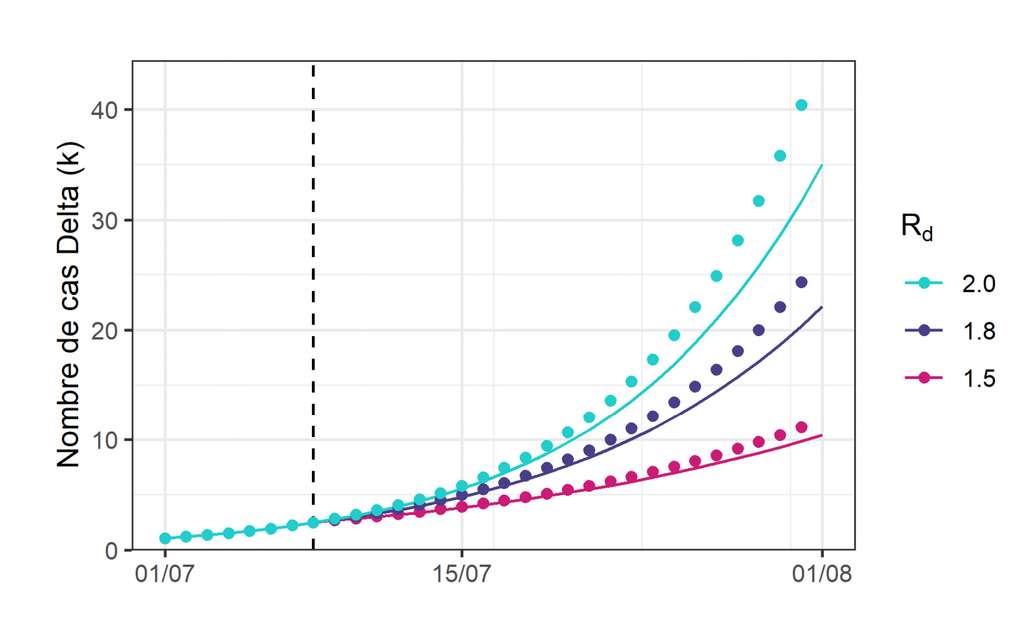
Comparison of the projections of the simplified model (dotted line) and of the complex model (line) for the different R [SUB]d[/SUB] . The x-axis indicates the date, and the vertical line the one at which the R [SUB]d[/SUB] changes. On the y-axis, the number of Delta cases in thousands. © Institut Pasteur
Reduce variant circulation
The Institut Pasteur group has not predicted the future with certainty, these projections are based on uncertain assumptions and incomplete data. For example, the authors explain that the mathematical model “does not take into account the reduction in efficacy 2 observed in first-time recipients of Delta. This could lead to overly optimistic projections when a large proportion of French people are first vaccinated and the loss of efficacy of vaccines against the Delta variant has not been taken into account. If the Delta variant turns out to be more severe than the others, that could also darken the projections, but there is no evidence to support this to date.
Reducing the circulation of the virus appears to be the key to controlling the epidemic in the coming months. If the virus continues to circulate at the same rate or accelerates, hospitals could be overwhelmed as early as August. The number of daily and intensive care admissions would exceed that of the first wave of March 2020 , and that from next September.
" Even relatively small reductions in the transmission rate this summer (in the order of 10 to 25%) would significantly reduce the size of the peak in hospitalizations and delay the onset of this peak to a time when the the hospital would be in a better position to absorb an influx of patients, ”noted scientists from the Institut Pasteur. To achieve this goal, vaccination, isolation of positive cases and respect for barrier gestures remain our best weapons.
https://www.futura-sciences.com/sant...s-venir-92517/
Variant Delta: the pessimistic scenarios of the Institut Pasteur for the coming months
Julie kern
Scientific writer
Posted on 07/15/2021
Using mathematical models, the Institut Pasteur is trying to predict the future of the epidemic. Their latest results concern the Delta variant and their projections are rather pessimistic
With the spread of the Delta variant , the number of new cases of Covid-19 is on the rise again in France and around the world. In the Mathematical Modeling of Infectious Diseases Unit at the Institut Pasteur, we are trying to anticipate the future of the epidemic using real data collected in the field, as well as hypotheses.
This research group regularly publishes the results of their work on Covid-19 Modeling . Their last publication of July 12, 2021 focuses on the evolution of the Delta variant in metropolitan France (excluding Corsica).
...
To track down the Delta variant in screening tests , laboratories look for the L452R mutation on the S protein . This is how we can know the proportion of Delta samples compared to total samples. Between June and July, the mean effective reproduction rate (R [SUB]d[/SUB] ) of the Delta variant was 2.0. In other words, it takes 5-6 days for the number of people infected with the Delta variant to double.
Based on this data, the Institut Pasteur proposes two scenarios: a simplified model of exponential growth and a more complex model where natural and vaccine immunities are taken into account. In both cases, it appears that hospitals will again be under intense pressure from the start of the school year.
Two scenarios for an epidemic rebound at the start of the school year
The first exponential modeling suggests that if R [SUB]d [/SUB] remains at 2.0, there would be 40,000 cases daily variant Delta 1 [SUP]st[/SUP] August; 24,000 if the R [SUB]d[/SUB] goes to 1.8 and 11,000 if it falls further to 1.5, from July 8. This pessimistic scenario does not consider the increase in immunization coverage .
The second, more detailed model takes into account vaccination coverage and natural immunity, and the effects of age on the spread of the virus and the risks of serious forms. According to this, if the R [SUB]of[/SUB] rest to 2.0, there could be up to 35,000 Delta varying daily event at 1 [SUP]st[/SUP] August; 20,000 for an R [SUB]d[/SUB] of 1.8 and 10,000 for an R [SUB]d[/SUB] of 1.5, from July 8.
Comparison of the projections of the simplified model (dotted line) and of the complex model (line) for the different R [SUB]d[/SUB] . The x-axis indicates the date, and the vertical line the one at which the R [SUB]d[/SUB] changes. On the y-axis, the number of Delta cases in thousands. © Institut Pasteur
Reduce variant circulation
The Institut Pasteur group has not predicted the future with certainty, these projections are based on uncertain assumptions and incomplete data. For example, the authors explain that the mathematical model “does not take into account the reduction in efficacy 2 observed in first-time recipients of Delta. This could lead to overly optimistic projections when a large proportion of French people are first vaccinated and the loss of efficacy of vaccines against the Delta variant has not been taken into account. If the Delta variant turns out to be more severe than the others, that could also darken the projections, but there is no evidence to support this to date.
Reducing the circulation of the virus appears to be the key to controlling the epidemic in the coming months. If the virus continues to circulate at the same rate or accelerates, hospitals could be overwhelmed as early as August. The number of daily and intensive care admissions would exceed that of the first wave of March 2020 , and that from next September.
" Even relatively small reductions in the transmission rate this summer (in the order of 10 to 25%) would significantly reduce the size of the peak in hospitalizations and delay the onset of this peak to a time when the the hospital would be in a better position to absorb an influx of patients, ”noted scientists from the Institut Pasteur. To achieve this goal, vaccination, isolation of positive cases and respect for barrier gestures remain our best weapons.
https://www.futura-sciences.com/sant...s-venir-92517/


