• FluTrackers.com Inc. does not provide medical advice. Information on this web site is collected from various internet resources, and the FluTrackers board of directors makes no warranty to the safety, efficacy, correctness or completeness of the information posted on this site by any author or poster. The information collated here is for instructional and/or discussion purposes only and is NOT intended to diagnose or treat any disease, illness, or other medical condition. Every individual reader or poster should seek advice from their personal physician/healthcare practitioner before considering or using any interventions that are discussed on this website. By continuing to access this website you agree to consult your personal physican before using any interventions posted on this website, and you agree to hold harmless FluTrackers.com Inc., the board of directors, the members, and all authors and posters for any effects from use of any medication, supplement, vitamin or other substance, device, intervention, etc. mentioned in posts on this website, or other internet venues referenced in posts on this website.
  • We are not asking for any donations. Do not donate to any entity who says they are raising funds for us.

Discussion - Ebola outbreaks 2026 (DRC & Uganda)

Article translated by AIX

Dr Jackson Ngoy: another doctor carried away by Ebola in Ituri

8 June 2026

The Ebola virus disease epidemic continues to claim victims in Ituri. Dr Jackson Ngoy died while he was hospitalized at the Ebola Treatment Centre of the Evangelical Medical Centre (CME) in Nyankunde, in Bunia.Local medical sources confirmed the news this Monday 8 June.

According to a reliable source within the CME, the doctor was not part of the staff of this health facility. “He will be buried this afternoon,” confided this source.

This death constitutes a new loss recorded among health professionals since the declaration of the Ebola epidemic on 15 May 2026. The doctor’s passing occurs in a context where health teams remain strongly mobilized to contain the spread of the disease and ensure the care of infected persons.

The emotion is all the more intense because before his death, Dr Jackson Ngoy had recorded an audio message in which he described the deterioration of his state of health.

According to the national deputy Gratien Iracan de Saint Nicolas, elected representative of the city of Bunia, the doctor expressed in it his need to be transfused, requested his transfer to another health facility and shared his concerns about his condition.

“Some time after this call for help, he unfortunately died,” declared the parliamentarian.

Reacting to this passing, Gratien Iracan says he learned “with deep sadness” of the doctor’s death which occurred on Sunday 7 June in the context of the Ebola epidemic.

The elected representative believes that the elements contained in the deceased’s testimony raise concerns that deserve to be examined. “If the circumstances reported in this testimony are confirmed, they raise serious questions about the conditions of care for patients in the current context of the response against Ebola,” he indicated.

Faced with this situation, the national deputy announces his intention to officially contact the Minister of Health so that the circumstances of this death can be established. He also calls for measures aimed at strengthening patient care as well as the protection of health personnel engaged in the response.

Editorial team

https://buniaactualite.cd/dr-jackson-ngoy-un-autre-medecin-emporte-par-ebola-en-ituri/
 
Translation Google

Ebola in Ituri: Death of Jonathan Imbalapayi, president of the Mongbwalu civil society involved in the response

Sunday, June 7, 2026 - 3:21 PM

The rural commune of Mongbwalu is in mourning. Jonathan Imbalapayi, president of the civil society of Mongbwalu and its surroundings, died on the morning of Saturday, June 6, causing great emotion among the local population.

A trained nurse and a well-known figure in the citizen movement in this mining town in the Djugu territory, Jonathan Imbalapayi had been heavily involved in recent weeks in the fight against the Ebola virus disease epidemic that is hitting Ituri.

Very active in local media, he increased his awareness campaigns to encourage the population to respect prevention measures and to collaborate with response teams.

According to several concordant sources, he also participated in first aid operations and the transfer of patients with symptoms consistent with Ebola to specialized care facilities.

"Jonathan was one of those who put themselves at risk to save other lives. He was always available when it was necessary to raise awareness or accompany patients to treatment centers," testifies a community actor from Mongbwalu.

According to several local sources, it was during these operations that he contracted the illness that ultimately led to his death. However, health authorities have not yet officially released any information regarding the exact circumstances of his death.

The announcement of his death sparked a wave of emotion on social media where many residents paid tribute to the memory of a man committed to defending the interests of his community.

For several observers, this disappearance also serves as a reminder of the vulnerability of community actors and health personnel mobilized in the response.

Reacting to this disappearance, the Gender, Family and Child service of Mongbwalu calls on the population to become more aware of the seriousness of the epidemic.

"Jonathan's death should be a wake-up call for each of us. Ebola is real. We ask the population to respect the prevention measures, to quickly report suspected cases and to trust the health teams," said Ms. Jeanne Njangusi, acting head of the Gender, Family and Child service in Mongbwalu.

While several cases of contamination among healthcare workers and community actors have already been recorded since the start of the epidemic, health authorities continue to advocate for increased public adherence to prevention measures in order to break the chains of transmission of the virus.

Freddy Upar, in Bunia

https://actualite.cd/index.php/2026...i-president-de-la-societe-civile-de-mongbwalu
 
Translation Google

Bunia: A man was found dead near an orphanage in Mudzi-Maria

Monday, June 8, 2026 - 06:19

A man was found dead this Saturday near the fence of the Saint Kizito orphanage, located in the Mudzi-Maria district, in the city of Bunia.

According to eyewitness accounts, the intervention of the Safe Burial Team (SBT) was delayed until early evening, around 6 p.m., due to tension in the area. The team members reportedly feared being attacked by a hostile local population, in a context marked by sensitivity surrounding Ebola deaths.

The body was finally taken into care and buried under the supervision of the relevant services.

The head of the Saint Kizito orphanage expressed her concern about the situation, recalling the vulnerability of the children cared for in the facility.

"We are very worried because the children here are already vulnerable. Seeing an abandoned body so close to our fence creates fear and confusion. We do not know the identity of the person or the cause of death. We ask the authorities to strengthen security and provide rapid response to this type of situation," she said.

Among some residents of the area, the tension remains palpable. One local woman is calling for greater caution during this sensitive health crisis.

"This situation frightens us. We ask everyone to protect themselves, not to hide the sick and to accompany them to health facilities, especially the elderly. We must prevent similar cases from creating even more panic in the community," she said.

Local authorities have not yet officially communicated on the exact circumstances of the death or on a possible referral to a forensic investigation.

During this period of heightened surveillance related to the response to the Ebola virus disease, health services reiterate the importance of the rapid management of suspected cases and of respecting safe burial procedures in order to avoid health risks and community tensions.

Freddy UPAR, in Bunia

https://actualite.cd/2026/06/08/bunia-un-homme-retrouve-mort-pres-dun-orphelinat-mudzi-maria
 

Attachments

  • Screenshot 2026-06-08 121049.png
    Screenshot 2026-06-08 121049.png
    24.5 KB · Views: 1
Hong Kong: DH further strengthens training on personal protective equipment in light of Ebola disease outbreak in Africa​

In light of the recent outbreak of Ebola disease in the Democratic Republic of the Congo (DRC) and Uganda in Africa, the Scientific Committee on Infection Control (SCIC) under the Centre for Health Protection (CHP) of the Department of Health convened a meeting yesterday (June 8) to review the risk of transmission of Ebola disease and confirm the current recommendations on personal protective equipment (PPE). This is to ensure comprehensive protection for healthcare professionals and related personnel against infection in the event of suspected or confirmed cases in Hong Kong.

At the meeting, the SCIC reviewed the latest developments of the Ebola disease outbreak, its modes of transmission and risks, as well as the infection control guidelines issued by the World Health Organization (WHO) and other health authorities. Following an in-depth discussion, the SCIC confirmed the PPE recommendations for personnel working in different settings and performing different roles to minimise the risk of healthcare professionals and relevant staff contracting Ebola. These recommendations cover healthcare settings (including caring for hospitalised patients, patient registration or triage in hospitals or clinics) and community settings (including health screenings at boundary control points, transporting patients and close contacts, working in quarantine facilities, conducting epidemiological investigations, cleaning and disinfecting community environments, and handling waste). Meanwhile, the SCIC emphasised in its recommendations that while the correct use of PPE is important, other measures, such as timely and proper hand hygiene, thorough cleaning and disinfection of the environment, and proper waste disposal are also indispensable for the effective prevention of infection and transmission.

"Ebola disease is a severe acute viral illness. The virus is introduced into the human population through close contact with the blood, secretions, organs or other body fluids of infected animals. Human-to-human transmission mainly occurs through direct contact (through broken skin or mucous membranes) with the blood, secretions, organs or other body fluids of infected persons, as well as indirect contact with environments contaminated by such body fluids. Although Ebola disease is not a respiratory illness and is not spread through the airborne route, more than 60 per cent of Ebola patients experience vomiting and diarrhoea, which may create infectious droplets. These patients may also undergo medical procedures that generate aerosols. Given the disease's high fatality rate, additional precautionary measures are required," said the Controller of the CHP, Dr Edwin Tsui.

He stressed that the current risk of Ebola disease is mainly confined to the outbreak areas in Africa, including the DRC and Uganda. The immediate impact on public health in Hong Kong remains low. Although no confirmed cases of Ebola have ever been recorded in Hong Kong, as an international city Hong Kong has always remained vigilant in peacetime and stayed alert constantly.

To enhance frontline personnel's understanding of infection control and ensure their safety on the job, the Infection Control Branch (ICB) of the CHP has been providing training to various government departments and organisations since late May this year (including the Food and Environmental Hygiene Department and its contractors for cleansing services, and the Civil Aid Service). The training covers the correct use of PPE, donning and doffing procedures, and related infection control principles.

In addition, the ICB of the CHP, in collaboration with the Infectious Disease Control Training Centre of the Hospital Authority, organised a forum on Ebola disease last month for healthcare professionals in both the public and private sectors, with more than 1 500 participants. The forum aimed to deepen healthcare professionals' understanding of Ebola and response measures, including diagnosis, clinical management and infection control measures.

The CHP will continue to closely monitor the latest developments overseas and the latest recommendations of the WHO, and will take appropriate follow-up action and implement appropriate prevention and control measures according to risk assessments to safeguard public health.

The latest recommendations of the SCIC have been uploaded to the CHP website.

Ends/Tuesday, June 9, 2026
Issued at HKT 14:30​

https://www.info.gov.hk/gia/general/202606/09/P2026060900328.htm
 
SOS Médias Burundi is a small independent news site focused on Burundi and refugee issues.

Translation Google

June 8, 2026
Eric Irambona Refugees Health

Nakivale (Uganda): 13 suspected Ebola cases isolated in a tense camp

SOS Media Burundi

Nakivale, June 8, 2026 – Fears of a possible Ebola outbreak are gripping the Nakivale refugee camp in southwestern Uganda after thirteen suspected cases were quarantined. Health authorities are closely monitoring their condition in a setting marked by overcrowding and concerning hygiene conditions.

According to medical sources, the individuals in question are exhibiting symptoms consistent with Ebola virus disease. They have been isolated and placed under observation at Nyarugugu Health Centre IV to prevent any risk of spread within the camp.

"They have been placed in a quarantine center to ensure regular monitoring of their health," a medical source indicated. Although no cases have yet been confirmed at this stage, the patients are considered suspected cases due to the observed clinical signs.

A local official stated that the isolated individuals are believed to be asylum seekers from the Democratic Republic of Congo (DRC), a country regularly plagued by Ebola virus disease outbreaks. This situation is fueling concerns in a camp where new refugees continue to arrive daily.

The Nakivale camp, which hosts over 150,000 refugees, faces significant structural challenges, particularly regarding hygiene, sanitation, and population density. Many residents have expressed concern about the potential for rapid spread should the outbreak be confirmed.

Awareness campaigns are being conducted jointly by the United Nations High Commissioner for Refugees (UNHCR), the Ugandan authorities in charge of refugees and the NGO Medical Teams International, a UNHCR partner in the health sector.

Authorities have banned mass gatherings and advised against close physical contact, including hugs and kisses. Refugees are encouraged to strengthen hygiene measures, including regular handwashing and the use of disinfectants when available. Community health workers are also conducting door-to-door visits to raise awareness among households.

Epidemiological situation in Uganda

Uganda has recorded a cumulative total of 19 confirmed cases of Ebola virus disease, including 14 imported cases from the Democratic Republic of Congo (DRC) and 5 cases of local transmission. The country has reported two deaths related to imported cases, while at least four patients have recovered and been discharged from healthcare facilities.

Health authorities have established specialized treatment units, including a major facility at Mulago Hospital in Kampala, the country's capital, to bolster the response to the outbreak. Several hundred contacts are also being closely monitored as part of epidemiological surveillance measures.

The Director-General of the World Health Organization (WHO), Dr. Tedros Adhanom Ghebreyesus, visited Uganda on June 8, 2026. He praised the effectiveness of the response put in place by the health authorities, while calling for strengthened regional coordination, particularly with the Democratic Republic of Congo, the epicenter of the epidemic.

Faced with this situation, the authorities are calling for vigilance and strict adherence to preventive measures in order to limit any risk of spread in refugee camps and urban areas.

https://www.sosmediasburundi.org/20...ects-debola-isoles-dans-un-camp-sous-tension/
 
Translation Google

Ebola outbreak: The United States asks Belgium to ban entry to its territory for certain African nationals.

by Louis Vandendriessche
Published on June 10 at 6:38 AM

The United States has asked Belgium to restrict entry to its territory for Congolese nationals due to the Ebola epidemic. This sensitive request is one that Brussels does not intend to comply with at this time, given the approach of the World Cup.

The United States has asked Belgium, through Ambassador Bill White, to impose a ban on Congolese nationals entering the country as part of the fight against the Ebola epidemic, De Morgen and Het Laatste Nieuws reported on Wednesday.

"Urgent action needed": the Ebola epidemic could reach a scale comparable to that of 2014

American diplomats stationed in Europe have confirmed they received instructions from Washington to warn their host countries. During the World Cup in the United States, these countries are expected to adopt strict U.S. travel restrictions related to Ebola. In the absence of such measures, the U.S. administration is reportedly considering imposing entry bans on European countries.

The Belgian federal government has received a request of this nature from Ambassador Bill White, De Morgen has learned. Belgians returning from African countries affected by the pandemic should also observe a quarantine. Public Health Minister Frank Vandenbroucke (Vooruit) does not wish to respond to this request at this time and continues to follow the measures of the World Health Organization (WHO), the newspaper reports.

No cases of Ebola have yet been reported in the United States, but Washington fears that the imminent influx of millions of fans during the World Cup could change the situation. Since mid-May, travelers returning from the Democratic Republic of Congo or Uganda who are not American citizens or permanent residents have been barred from entering the United States.

https://www.rtl.be/actu/magazine/sa...nterdire-lacces-son/2026-06-10/article/791194
 
Hat tip to Michael Coston

IJID: Regional Signals Preceding the 2026 Bundibugyo Virus Disease Outbreak

https://flutrackers.com/forum/forum...ng-the-2026-bundibugyo-virus-disease-outbreak
---------------------------------------------------------------------------------------
Further reading / Related threads on FT:

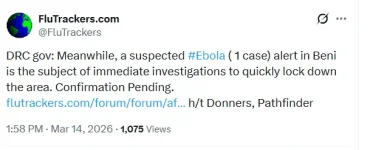
Hat tip to Donners:
DRC: Suspected Ebola case in Beni, North Kivu province - confirmation pending - March 9, 2026
March 13, 2026, 08:50 PM

-https://flutrackers.com/forum/forum...vu-province-confirmation-pending-march-9-2026

DRC - One death from hemorrhagic fever in Mweka, Kasai province - Negative for Ebola (media)
March 15, 2026, 11:53 AM

-https://flutrackers.com/forum/forum...mweka-kasai-province-negative-for-ebola-media

Burundi is investigating a disease that has caused five deaths in the Mpanda district - WHO Africa, April 11, 2026
April 12, 2026, 11:17 AM

-https://flutrackers.com/forum/forum...-the-mpanda-district-who-africa-april-11-2026

DRC - Cholera outbreak 2026
January 3, 2026, 12:12 PM

April 16, 2026, 10:27 AM post #21
CFR very high...5% in the last 2 weeks


-https://flutrackers.com/forum/forum...ra-disaster/1026920-drc-cholera-outbreak-2026

South Sudan - Undiagnosed illness in Lotimor, Kapoeta East County (Africa CDC, April 30, 2026)
April 30, 2026, 08:53 AM

-https://flutrackers.com/forum/forum...-kapoeta-east-county-africa-cdc-april-30-2026

DRC - South Kivu: an unidentified disease is causing child deaths in Bagira, Bukavu
May 1, 2026, 08:14 AM

-https://flutrackers.com/forum/forum...ease-is-causing-child-deaths-in-bagira-bukavu


DRC humanitarian crisis 'world's most neglected', says UN

-https://flutrackers.com/forum/forum...ld-s-most-neglected-says-un/page3#post1032089

Diseases in animals:

DRC - North Kivu: unknown disease in livestock in the territories of Masisi and Walikale
June 26, 2025, 10:25 AM

-https://flutrackers.com/forum/forum...ock-in-the-territories-of-masisi-and-walikale

DRC - Mysterious epidemic affecting goats, chickens and a few cows in Kayna, Nord Kivu (April 14, 2026)
April 22, 2026, 11:38 AM

-https://flutrackers.com/forum/forum...d-a-few-cows-in-kayna-nord-kivu-april-14-2026

 
Translation Google

DRC: The 17th Ebola outbreak is far from being under control, warns the Africa Centres for Disease Control

An Ebola outbreak has been officially declared for four weeks in Ituri province, in eastern DRC. According to the Africa Centres for Disease Control and Prevention (Africa CDC), this 17th outbreak is still not under control in the country. According to its director general, Jean Kaseya, the virus continues to spread. To date, there are 676 confirmed cases and 136 confirmed deaths. Eight more people have recovered this week in the DRC, bringing the total number of recoveries to 30.

Published on:12/06/2026 - 09:01
Modified on:12/06/2026 - 15:52

By : RFI

At the start of the epidemic four weeks ago, only three health zones or health districts were affected: as of June 12, 2026, there are 34. The virus is spreading, but above all exponentially, emphasizes Africa CDC: the number of these affected health zones has doubled in one week.

The main challenge remains contact tracing, explains Jean Kaseya, Director of Africa CDC: “ When you have an outbreak in a densely populated area, such as mining regions, each confirmed case can have up to 40 contacts. In the case of Ituri, this means more than 20,000 contacts. However, today we have only identified 4,955. ”

Contact cases that are very difficult to identify

Community mistrust, population displacement, insecurity in the province and lack of resources and structures in some remote areas: all these obstacles slow down the identification and monitoring of these contact cases.

With less than a quarter of contact cases identified, breaking the chain of transmission becomes very difficult, adds Dr. Jean Kaseya: “ If we don’t identify these people, if we don’t follow them, it means there is a huge risk of transmission within communities. As long as we can’t reach all these people, we can’t say that this epidemic is close to being controlled.

The latest health zone to be affected is Tchomia, 50 kilometers south of Bunia, the capital of Ituri province, on the shores of Lake Albert. Meanwhile, Jean Kaseya stated that the epidemic is under control in Uganda. The Director General of Africa CDC praised the contact tracing efforts in that country.
...
" The more the population moves, the more the virus moves ."

This situation is severely complicating the response, insists Albert Essoun, deputy head of Doctors Without Borders (MSF) programs in Ituri, speaking to our correspondent in Kinshasa, Paulina Zidi : “ Today, we are in a humanitarian crisis that everyone knows about, and the Ebola situation, unfortunately, makes managing the situation much more complex. Right now, we are in a context of very dynamic, very volatile insecurity, which is forcing the population to move in search of a safer place. And this population movement unfortunately only contributes to spreading the virus as well. The more the population moves, the more the virus spreads. ”

He continued: " Our chances of being able to break the chain of transmission of this virus become much more difficult. And so, what I'm saying is that an epidemic like Ebola, which occurs within a context of significant humanitarian crisis, becomes very difficult to manage. Hence the mobilization of the entire humanitarian community, starting with state structures as well. "

Ebola, which is transmitted through close contact and bodily fluids, has killed more than 15,000 people in Africa over the past 50 years.

https://www.rfi.fr/fr/afrique/20260...t-le-centre-africain-de-contrôle-des-maladies
 
Translation Google

Ituri: Ebola response team attacked in Rwampara, doctor kidnapped then released

Published on Thu, 11/06/2026 - 19:08 | Modified on Thu, 11/06/2026 - 21:03

As the response to the Ebola epidemic continues in Ituri, a serious security incident occurred on Tuesday, June 9, in the Tséré area of ​​the Rwampara health zone. A surveillance team, which had come to investigate a suspected case, was violently attacked by residents of the village of Toutou. A doctor was tied up, held captive, and threatened with death before finally being rescued by security forces.

According to testimonies from team members, they were investigating a suspected case of Ebola when they were attacked by several residents armed with machetes and stones. Panicked, some members of the team managed to escape and raise the alarm.

The doctor tasked with taking the sample was not so fortunate. He was captured, tied up, and held against his will by his assailants. The swift intervention of the security services prevented a worse outcome and secured his release.

Reacting to this incident, the head of the Tséré group, Zamundu Batagura, strongly condemned this attack and called on the population to support the health response efforts:

“I ask the public, and especially young people, to stop attacking healthcare workers and response teams. When a suspected case is reported, it must be directed to the hospital. I also urge the public not to be influenced by false information circulating on social media.”

The disinformation in question

This attack comes amid a tense climate, marked by persistent rumors and misinformation surrounding the Ebola epidemic. These disinformation campaigns fuel mistrust among some communities towards medical personnel and response teams.

Faced with this worrying situation, the Attorney General at the Ituri Court of Appeal, Edoxy Maswama, announced firm measures. She instructed magistrates and relevant services to prosecute anyone involved in spreading false information or in acts aimed at hindering the health response.

Health authorities emphasize that community cooperation is essential to containing the epidemic. Prompt reporting of suspected cases not only allows for early treatment of patients but also limits the spread of the virus.

This incident, far from being an isolated case, illustrates the challenges faced by response teams on the ground, where the fight against the disease must also contend with misinformation and community resistance.

On June 1st, four Red Cross workers involved in the Ebola response were seriously injured at the Nyamurongo cemetery in Bunia, the capital of Ituri province, during clashes that erupted during the burial of a person who had died from the disease. The incidents broke out when angry youths attempted to forcibly open the deceased's coffin.

https://www.radiookapi.net/2026/06/...-ebola-attaquee-rwampara-un-medecin-sequestre
 
image.png - Click image for larger version  Name:	image.png Views:	1 Size:	197.1 KB ID:	1036843

The distance from Goma International Airport to Beni, DR Congo is:
224 miles / 360 km driving
150 miles / 241 km flying​
/https://www.travelmath.com/distance/from/GOM/to/Beni,+DR+Congo

---------------------------------------------------------------------------------------------------------------
HI mobilized to respond to the Ebola epidemic in the DRC and Uganda

Health | Emergency | Uganda | Democratic Republic of Congo | PUBLISHED ON June 12, 2026
...
It is in the east of the country that HI, via Atlas Logistique, its unit specializing in delivering aid to the most difficult areas, is concentrating its response – in the province of Ituri, where the epidemic is evolving most rapidly.

Transporting, storing, sourcing... multiple logistical challenges

From May 18, the HI and Atlas Logistique teams began working with several humanitarian partners, including the organizations Alima, Première Urgence Internationale and Medair, to organize the transport flows of aid and store the transported equipment: protective equipment against the virus, tents to isolate patients and provide first aid, medicines, hydroalcoholic gel… In total, Atlas Logistique transported 46.5m3 of equipment, or more than 11 tons, from Goma to the city of Bunia, the epicenter of the epidemic.

Sophie Aït Belaïd, head of operations for Atlas Logistique in the DRC, adds: “This response is quite complex. We have adapted our fleet of vehicles; instead of trucks, we use lighter vehicles, such as Land Cruisers. This allows us to get through more easily when the road conditions are poor, but it forces us to make more trips. This requires organization, but above all, a lot of time and, consequently, more money.”

She continued: “To reach Beni from Goma, it can take us up to 10 days depending on the state of the roads and the security situation. It takes another day to reach the city of Bunia in Ituri. Unfortunately, the humanitarian storage facilities in the city of Bunia quickly become full, and many organizations are asking us to store their supplies in Beni in North Kivu.”

After an initial rapid mobilization, humanitarian organizations are now striving to structure a coordinated response across the region to limit the spread of the epidemic, despite facing numerous unknowns. Several shipments of medical aid are en route from Europe and the Middle East, but their arrival dates and final destinations are still unclear. This uncertainty complicates the preparation of teams, the pre-positioning of supplies, and the organization of interventions. In this context of a health emergency, the entire supply chain is under pressure.

Leave no one behind

As for activities in the rest of the country, a risk analysis and adaptation measures have been carried out to ensure their continuity while minimizing risks for the people supported, partners and HI teams.

Protective equipment has been made available to staff. Preventive measures, such as handwashing, temperature checks, and the wearing of masks, gloves, and other protective equipment, have been reinforced, and Ebola awareness and prevention messages are integrated into activities.

“The restriction of air and cross-border movements from the very first days of the crisis, as well as the implementation of significant controls by the authorities, are limiting the deployment of teams, the import and delivery of supplies to the epicenter of the crisis. Progress has been made recently with the reopening of some routes or discussions with neighboring countries to allow humanitarian workers to pass through, but this progress is not yet sufficient to restore the access necessary for an effective response in the most affected areas,” concludes Baptiste de Gaillande, Country Director for HI in the DRC.
...

https://www.hi.org/fr/actualites/hi-mobilisee-pour-repondre-a-lepidemie-debola-en-rdc-et-en-ouganda
 
DRC: One month on, MSF warns dangerous gaps persist in Ebola disease response

Format News and Press Release Source MSF Posted 15 Jun 2026 Originally published 15 Jun 2026
...
“One month on, the Ebola disease outbreak is outpacing the response effort,” says Kate White, emergency medical coordinator for MSF in DRC. “No one knows the true scale or exactly where the disease is spreading in DRC. What we do know is that most treatment centres in Ituri province are overwhelmed; many of our patients arrive at a late stage of the disease, and the majority were never identified or monitored as contacts before seeking care.”
...
“Testing remains one of the most significant weaknesses in the response, despite recent improvements in laboratory capacity and the arrival of hundreds of mobile test kits in eastern DRC, designed specifically for the Bundibugyo virus,” says White. “Many communities, especially those affected by ongoing insecurity, still have limited access to these kits, while treatment centres continue to face significant delays in receiving laboratory results. Without faster and more widely available testing, we will struggle to detect cases early enough to contain the outbreak.”
...
“This outbreak can still be brought under control, but the window for action is narrowing,” says Lai Manantsoa. “Diagnostics, surveillance, access to care, and community engagement must be urgently strengthened. We urge authorities, and all stakeholders involved in the response, to do everything possible to facilitate the movement of health workers and supplies, and enable a response that matches the scale of this crisis.”
...
https://reliefweb.int/report/democr...dangerous-gaps-persist-ebola-disease-response

 
Ebola confirmed in Niania: Fontaine Mangala calls for the lockdown of Ituri!

15.06.2026

The confirmation of a case of Bundibugyo type Ebola virus disease in the Niania health zone revives concerns about the evolution of the health situation in the East of the Democratic Republic of Congo.

According to reports, a sample taken from a patient admitted on June 7, 2026, to Bethesda Hospital, located at PK 51 Bafwabango on the Isiro road, tested positive according to the National Institute of Biomedical Research (INRB). The patient died the same day at the hospital.

Following this announcement, calls for stricter response measures are beginning to emerge. Among them, Fontaine Mangala believes that the seriousness of the situation demands strong decisions, especially since the Niania health zone borders Tshopo.

"In view of the evolution of the Ebola virus disease, it is becoming urgent to confine the province of Ituri to break the chain of contamination," he said.

This position comes as health teams continue surveillance, contact tracing and community awareness operations in the affected areas.

However, any potential containment measures remain the responsibility of the competent health and administrative authorities, based on ongoing epidemiological assessments.

Pending further official communications, the people of Kisangani are urged to remain vigilant, respect preventive measures and avoid the spread of unverified information.

https://www.mediacongo.net/article-actualite-164705_ebola_confirme_a_niania_fontaine_mangala_de mande_le_confinement_de_l_ituri.html
-------------------------------------------------------------------------------

Note: This case was confirmed yesterday:


SitRep N°30/MVB_13/06/2026
juin 14, 2026
Posted by insp.cd​
...
image.png - Click image for larger version  Name:	image.png Views:	1 Size:	10.4 KB ID:	1036867

...​
Go to post

​​
 
Last edited:
Translation Google

Ebola in Ituri: Health authorities warn against self-medication

Published on Mon, 15/06/2026 - 16:27 | Modified on Mon, 15/06/2026 - 16:27

Health authorities in Ituri are urging the population to avoid any form of self-medication for Ebola and to seek immediate medical attention if they experience any suspicious symptoms. This appeal comes after several deaths in the city of Bunia were reported, with individuals exhibiting signs similar to those of Ebola.

According to health sources, the latest cases date back to last Friday in the Lumumba district, at the Kappa roundabout.

The victims, a father and son, were riding a motorcycle when they suddenly began bleeding from the nose and mouth before collapsing in the street. The motorcyclist reportedly fled the scene, abandoning the two men.

The two patients died before the arrival of the response teams deployed to the scene.

Self-medication is being singled out.

Speaking on Radio Okapi on Monday, June 15, health authorities attributed these deaths to self-medication practices observed in some people with symptoms consistent with Ebola.

The medical director of Bunia General Hospital, Dr. John Kabutabuka, says that this situation is not an isolated case.

According to him, several similar incidents have already been recorded in the Horo and Ndibe districts.


"Patients should go directly to the hospital."

In light of this situation, Dr. Kabutabuka insists on the need for people exhibiting suspicious signs to consult health services promptly.

"As soon as people end up collapsing in the street, it means that the message to raise awareness among the sick about going directly to the hospital has not been properly understood," he said.

For health authorities, early intervention remains essential to limit the risk of death and prevent the spread of the virus within the community.

A freephone number to report suspected cases

In order to strengthen surveillance and response, the health services have made the toll-free number 151 available to the population .

Residents are urged to report without delay any suspected cases or anyone exhibiting symptoms consistent with Ebola.

Authorities hope this will strengthen early detection of cases and prevent further infections in Ituri province, where vigilance remains essential in the face of this highly contagious disease.


https://www.radiookapi.net/2026/06/...-autorites-sanitaires-mettent-en-garde-contre
 
Translation Google

Ebola in the DRC: "We fear the epidemic could last another year," says the Red Cross

The Ebola epidemic in the Democratic Republic of Congo (DRC) could last a year, a Red Cross representative warned on June 16, 2026, adding that its peak had not yet been reached. " We fear that this epidemic could last another year before ending ," said Bruno Michon, head of operations for the International Federation of Red Cross and Red Crescent Societies (IFRC), at a press briefing in Geneva. In a statement released Tuesday morning, the ICRC also expressed its concern that the disease could overshadow the humanitarian response to the various conflicts in the sub-region.

Published on:16/06/2026 - 11:43
Modified on:16/06/2026 - 14:42

By : RFI
With our correspondent in Kinshasa, Paulina Zidi

" The Ebola epidemic could last a year in the Democratic Republic of Congo ( DRC ) ," warns the Red Cross. The international organization believes the peak has not yet passed.

The same message came the day before from the NGO Doctors Without Borders (MSF), which added that the disease is currently progressing faster than the response.

A health crisis affecting a country whose system is already in great difficulty, particularly due to the conflicts raging in the east of the DRC.

For the International Committee of the Red Cross (ICRC), " armed conflicts associated with epidemics constitute a potentially devastating combination ."

" Surgical teams constantly under pressure "

Overcrowded hospitals: this is the situation described by the ICRC in a report published on June 16. These are healthcare facilities located outside of areas affected by the epidemic. “ The health crisis caused by the Ebola virus disease has not slowed down medical emergencies related to the conflict. On the contrary, our surgical teams are constantly under pressure, with continuous admissions of gunshot wounds ,” testifies Moussa Badji, ICRC medical coordinator in the DRC.

In the five hospitals supported by the organization in the provinces of North Kivu and South Kivu, admissions increased by 30% between May 15 and June 15 compared to the previous month. The increase was even more significant in the hospitals of Bukavu, Fizi, and Uvira, a sign, according to the ICRC, of ​​an intensification of hostilities in the South Kivu highlands.

" That the parties to the conflicts act responsibly "

For François Moreillon, head of delegation in the DRC, the combination of disease and conflict is devastating. He appeals to the warring parties: " It is essential that the parties to the conflicts act responsibly to ensure optimal health cooperation and coordination to facilitate the work of humanitarian organizations and the rapid delivery of humanitarian assistance. "
...​

https://www.rfi.fr/fr/en-bref/20260...e-ne-dure-encore-un-an-déclare-la-croix-rouge
 
image.png - Click image for larger version  Name:	image.png Views:	1 Size:	29.3 KB ID:	1036901

Google map
------------------------------------------------------------------------------
Translation Google

A pastor dies, a coffin is vandalized... In Mongbwalu, Democratic Republic of Congo, patient zero of Ebola may have been discovered

June 12, 2026 at 5:19 AM
Updated on June 12, 2026 at 2:17 PM
By Wolf Office Séraphine Charpentier
TV5

Congolese researchers have been trying to identify patient zero since the authorities declared the Ebola outbreak on May 15. Their investigation led them to a pastor who died in February in the town of Mongbwalu, in Ituri province.

It is possible that the Ebola epidemic originated here in the city of Mongbwalu. This is certainly one of the leads being pursued by investigators in their search for patient zero of a virus for which there is no cure . It all began in February in this city of 130,000 inhabitants located in the Ituri province, in the northeast of the Democratic Republic of Congo.

A tragic event has shaken the Nande community, a Bantu people and one of the main ethnic groups in the Democratic Republic of Congo. A prominent figure in the community, Pastor Paluku Makundi Denis, died suddenly at the age of 44 in Bunia, where he lived. The cause of death: peritonitis, a severe abdominal infection, diagnosed on February 3, according to three doctors and a nurse interviewed by the British news agency Reuters .

Two weeks after the burial, nearly 50 deaths were recorded.

The pastor's body was transported on February 4th to his hometown of Mongbwalu, 75 kilometers to the west, for the funeral. In the old Nissan SUV, relatives sat on the coffin. The procession endured rough handling; the dirt road was in poor condition. Nearly three hours later, the coffin containing the body of Paluku Makundi Denis arrived, cracked open.

"My eldest son cannot be buried in a coffin like that ," the deceased's father recalled thinking, speaking to Reuters. The body was then moved to a new coffin around 4 p.m., handled directly by local residents. The funeral was held later that day, attended by dozens of people.

Before becoming a man of the Church and settling in Bunia, the pastor was " a pillar of the Nande ethnic community of Mongbwalu and one of the founders of the local charcoal cooperative ," reports Reuters, citing a close friend of the deceased.

Symptoms include "fever, vomiting, and bleeding"

In the Democratic Republic of Congo, the traditional mourning rituals involve touching the bodies of the deceased. "It is unclear whether this tradition was observed in this case," report our colleagues who investigated on site. Nevertheless, before the burial, a wake is held at the family home in the presence of the deceased's body.

After the ceremony at the cemetery, the more than 80 attendees returned home. It was at this point that news began to circulate that the cracked coffin had been set on fire. The deceased pastor's father and uncle accused a group of young people under the influence of drugs, Reuters reported. The community leader called it an "affront to the ancestors . "

A few days after the burial of Paluku Makundi Denis, the first cases of illness appeared, according to the mayor of Mongbwalu, Sesereki Mandro Israel, interviewed by the press agency. On February 16, the pastor's 36-year-old brother died of suspected appendicitis , according to a report from the provincial health authority.

Two weeks later, nearly fifty people had died in the community, the mayor reported. Some suffered from "fever, vomiting, and bleeding," symptoms of the Ebola variant responsible for the ongoing outbreak. Rumors quickly spread. For some, it wasn't a simple coincidence, but a curse triggered by burning the damaged coffin.

"The coffin case" becomes a viral trend on TikTok

"Apparently, the illness had already started, but people thought it was because of the coffin ," stated Edmond Kambale, president of the Nande community and a resident of Mongbwalu. In this climate of fear, Pastor Makundi's mother witnessed a succession of cases around her.

"A young man from the village fell ill. He had vomiting and diarrhea. After being hospitalized and then transferred to Niakoundé, he died. Shortly after, a friend's mother also fell ill. She suffered from stomach problems and refused to eat. She also died ," she told Reuters.

As rumors of a curse spread, a local group on TikTok wrote a song referencing the "coffin incident ." " We hear that a coffin is wandering around Mongbwalu, leaving devastation in its wake," the song, translated by Reuters, says.

The song "is helping to launch a viral trend on TikTok in eastern Congo," our colleagues report. Users are filming themselves being surprised by flying coffins.

Health investigators tasked with investigating patient zero arrived in the town at the beginning of May. They faced resistance from some members of the population. Nearly 40 people have died of Ebola in Mongbwalu, Congolese authorities confirmed on Tuesday, June 9, according to Reuters, but health experts say the number could rise.

Epidemiologists believe that Ebola could have been circulating in the region for four to six months before the official confirmation of the outbreak by Congolese authorities on May 15. A report from the Ituri health authority indicates at least 108 deaths potentially attributable to Ebola that occurred in Mangbwalu between April and May.

Pastor Makundi is considered one of the first suspected cases identified. However, Congolese experts are not yet able to definitively establish that he is indeed patient zero.

The pastor's family has since been wrongly accused by residents of Mongbwalu of being responsible for the epidemic. "They vandalized my son's coffin and they blame me for the deaths that followed (...). Yet I am the victim, it was my son's coffin that was desecrated," the deceased's father tearfully told our colleagues.

https://information.tv5monde.com/af...t-zero-debola-peut-etre-ete-decouvert-2825714

-----------------------------------------------------------------------
On Reuters:

A cracked coffin, a funeral and the hunt for Ebola's patient zero

https://www.reuters.com/world/africa/cracked-coffin-funeral-hunt-ebolas-patient-zero-2026-06-11/
 
Translation Google

Ebola: The epidemic could be the "worst" ever seen in West Africa and eastern DRC

The Africa Centres for Disease Control and Prevention (Africa CDC) warned on Tuesday, June 16, of the severity of the Ebola outbreak in the Democratic Republic of Congo (DRC). It could be the "worst" in history if infections are not quickly contained, according to the Africa CDC.

June 17, 2026 at 12:15 PM By Séraphine Charpentier

"If we fail to contain this epidemic very quickly, it will be worse than the one we experienced in West Africa and in the eastern Democratic Republic of Congo ," said Jean Kaseya, director general of the Africa Centres for Disease Control and Prevention (Africa CDC) , on Tuesday, June 16, as quoted by the British news agency Reuters .

Currently, tens of thousands of people who have come into contact with infected individuals have still not been located, Jean Kaseya stated during a virtual meeting of African heads of state in Burundi. The current epidemic could be even more devastating than the one that killed more than 11,000 people in Guinea, Liberia, and Sierra Leone between 2014 and 2016.

“One month after the outbreak was declared, the disease is progressing faster than the response ,” warned Kate White, emergency medical coordinator for Doctors Without Borders (MSF) in the Democratic Republic of Congo, on Monday, June 15. MSF also expressed concern about “ dangerous gaps” in the system currently in place to contain the outbreak in the country.

In her statement , quoted by Agence France-Presse, Kate White reiterated that "the true extent of the epidemic" in the country remained unknown, as did "the areas where the virus is circulating." There is no approved vaccine or treatment for the Bundibugyo strain

A World Health Organization (WHO) official stated this Friday, June 12, that " the situation is improving" regarding contact tracing. According to him, 70% of contacts have been properly traced, compared to 45% at the beginning of June, as reported by our colleagues.

https://information.tv5monde.com/af...ique-de-louest-et-lest-de-la-rd-congo-2826514
----------------------------------------------
On Reuters: https://www.reuters.com/business/he...may-be-worst-ever-africa-cdc-says-2026-06-16/
 
Back
Top