• FluTrackers.com Inc. does not provide medical advice. Information on this web site is collected from various internet resources, and the FluTrackers board of directors makes no warranty to the safety, efficacy, correctness or completeness of the information posted on this site by any author or poster. The information collated here is for instructional and/or discussion purposes only and is NOT intended to diagnose or treat any disease, illness, or other medical condition. Every individual reader or poster should seek advice from their personal physician/healthcare practitioner before considering or using any interventions that are discussed on this website. By continuing to access this website you agree to consult your personal physican before using any interventions posted on this website, and you agree to hold harmless FluTrackers.com Inc., the board of directors, the members, and all authors and posters for any effects from use of any medication, supplement, vitamin or other substance, device, intervention, etc. mentioned in posts on this website, or other internet venues referenced in posts on this website.
  • We are not asking for any donations. Do not donate to any entity who says they are raising funds for us.

DRC – 17th Ebola Outbreak (Bundibugyo virus) - Concerns over reliability of Government reported cumulative cases and deaths - May 2026+

image.png - Click image for larger version  Name:	image.png Views:	1 Size:	7.2 KB ID:	1036395


Ebola Outbreak: Current Situation

For Everyone
June 4, 2026 Español

Key points
  • CDC is responding to an outbreak of Ebola disease in remote areas of the Democratic Republic of the Congo (DRC) and Uganda.
  • To date, no cases of Ebola disease have been confirmed in the United States because of this outbreak.
  • The overall risk to the American public and travelers remains low.
...
Key updates
  • On May 18, CDC and DHS announced enhanced travel screening, entry restrictions, and public health measures to prevent Ebola disease from entering the United States amid outbreaks in East and Central Africa.
    • Affected air passengers from DRC, South Sudan, and Uganda will have their air travel re-routed to arrive at Washington-Dulles International Airport (IAD), Atlanta Hartsfield-Jackson International Airport (ATL), George Bush Intercontinental Airport (IAH), or John F. Kennedy International Airport (JFK). Airlines will work directly with affected travelers to rebook flights.
    • To date, South Sudan has not reported any cases, but it is included in these efforts due to shared borders with affected countries.
  • On May 17, an American who was exposed as part of work caring for patients in DRC tested positive for Ebola disease caused by infection with the Bundibugyo (Bun-dee-BOO-joh) virus. The patient was transported to Germany for treatment and care and is currently in stable condition. In addition to being a shorter flight time, Germany has previous experience caring for Ebola patients.
    • High-risk contacts associated with this exposure have been moved to Germany and the Czech Republic. They remain asymptomatic.
​...

https://www.cdc.gov/ebola/situation-summary/index.html
​​
 
Ebola scare: Suspected cases reported in Hyderabad and Jaipur; patients isolated, test results awaited

In Hyderabad, a second Sudanese national was admitted to a state-run hospital after developing a fever, taking the total number of Ebola-related admissions at the facility to two

Our Web Desk, PTI Published 05.06.26, 05:47 PM​
Health authorities in Telangana and Rajasthan have isolated three foreign nationals showing symptoms associated with Ebola virus disease, even as officials stressed that none of the cases has been confirmed and laboratory test results are awaited.

In Hyderabad, a second Sudanese national was admitted to the state-run Gandhi Hospital after developing a fever, taking the total number of Ebola-related admissions at the facility to two….
​:tiphat:
https://www.telegraphindia.com/indi...est-results-awaited/cid/2164150#goog_rewarded
 
Ebola outbreak could exceed 20,000 cases in 3 months without urgent public health measures: CDC


The cases would be centralized to the outbreak region, the model suggests.

ByYouri Benadjaoud
June 5, 2026, 6:49 PM​

Without urgent action, there is a strong likelihood the Ebola outbreakin Africa will exceed 20,000 cases and 4,000 deaths within three months, a new modeling estimate from the U.S. Centers for Disease Control and Prevention suggests.

The cases and deaths would be centralized to the current outbreak region, the model, released Friday, suggests….

If "large-scale and sustained public health interventions are not rapidly implemented to reduce disease transmission, this outbreak could become as large as the 2014-2016 West Africa Ebola virus disease outbreak, which resulted in more than 28,000 cases and more than 11,000 deaths," the CDC wrote in its report.​..
:tiphat:
https://abcnews.com/Health/ebola-outbreak-exceed-20000-cases-3-months-urgent/story?id=133632631
 
Follow-up on post #184

Translation Google

Five inmates at Bunia prison suspected of having Ebola tested negative

Published on Sat, 06/06/2026 - 06:59 | Modified on Sat, 06/06/2026 - 06:59

The five inmates of Bunia Central Prison (Ituri) initially suspected of having Ebola were declared negative this Friday, June 5, after laboratory tests, according to health and prison authorities.

Despite this result, those involved in the response are calling for a strengthening of the prevention measures, in particular through the creation of an isolation center within the prison.

Laboratory tests confirmed the absence of Ebola virus disease contamination in the five inmates concerned.

This news was particularly anticipated, especially since these prisoners had escaped after being transferred to care facilities, fueling concerns about a possible risk of contagion.

The director of Bunia Central Prison, Camille Zonzi, expressed his satisfaction:

"I was overjoyed with these results. We, the prison, all of us inmates are healthy. Since the result is negative, I am truly protected. It is also up to me to protect the people who come to the prison so that they do not bring the disease with them."

An isolation center within the prison

Despite this reassuring outcome, the response teams believe that setting up an isolation and transit center in the prison remains a priority in order to better manage any suspected cases in the future.

According to the MONUSCO Prison Administration Support Unit, steps have already been taken. Protective equipment has been provided and awareness sessions are regularly organized for prisoners and prison staff.

A coordination effort involving WHO, MONUSCO and ICRC is also active within Bunia Central Prison to support prevention measures and strengthen health surveillance.

The actors involved insist on the need to maintain vigilance, in order to avoid any resurgence of suspected cases in a context where the threat of Ebola remains closely monitored in Ituri.

https://www.radiookapi.net/2026/06/...detenus-de-la-prison-de-bunia-testes-negatifs
 
North Kivu -

image.png - Click image for larger version  Name:	image.png Views:	1 Size:	12.0 KB ID:	1036461


#RDC: Preventive measures against Ebola, such as handwashing stations and thermal scanners at the entrances, remain invisible at the central market of Beni, which is heavily frequented in this city in North Kivu, in the east of the Democratic Republic of Congo, ACP noted on Saturday.

"Since the resurgence of the Ebola virus disease, we have been raising awareness among economic operators about respecting barrier measures and have asked each trader to place a handwashing device in front of their shop or stall.
However, we still do not have the logistical means to install these devices at the various entrances and in the market. We have already approached the competent authorities to be provided with the necessary equipment," said Bavo Tengetenge, deputy administrator of the central market of Beni, concerned by the fact that the 17th Ebola virus disease epidemic continues to record deaths and confirmed cases in the three affected provinces.​

image.png - Click image for larger version  Name:	image.png Views:	1 Size:	1.78 MB ID:	1036462
​...
8:28 AM · Jun 6, 2026
 
image.png - Click image for larger version  Name:	image.png Views:	1 Size:	6.0 KB ID:	1036489


Press release

06.06.2026

Patient discharged from Charité’s specialized isolation unit


image.png - Click image for larger version  Name:	image.png Views:	1 Size:	6.0 KB ID:	1036489


Update on the patient’s condition – third statement

csm_01familie_1c482c4287.jpg

Reunited: The family that was cared for in the Charité’s special isolation ward. © Charité | Pia Nitz

The U.S. citizen who contracted Ebola virus in the Democratic Republic of the Congo and was treated at Charité – Universitätsmedizin Berlin was discharged from medical care today following the lifting of quarantine. In its third statement, Charité provides an update on the patient’s condition.

On May 20, 2026, Charité admitted a U.S. citizen with a Bundibugyo Ebola virus infection to its specialized isolation unit. The symptoms of Ebola infection, which were pronounced upon admission and during the first days of treatment, subsided significantly under combined antiviral therapy and additional supportive medical measures during the first week. This improvement was reflected in continuous clinical recovery and normalization of laboratory parameters.

The initially high viral load decreased substantially under antiviral treatment and supportive care. Since May 30, no virus has been detected in the daily follow-up tests. In accordance with internationally accepted criteria—complete absence of symptoms for more than 72 hours and negative virus detection in repeated PCR tests—the competent public health authority lifted the isolation order today at 12:00 PM.

The patient’s five family members, classified as high-risk contacts, were quarantined at Charité. None developed symptoms of infection during the entire observation period, and repeated laboratory tests detected no Bundibugyo Ebola virus. The public health authority lifted the family’s quarantine order today at 12:00 PM, after a total of 21 days since the last high-risk contact.

Following a final examination, the patient and his family were discharged from Charité’s medical care today in good health. “We are very pleased with the successful course of treatment and consider this a significant therapeutic success,” said Prof. Leif Erik Sander, Director of the Department of Infectious Diseases and Critical Care Medicine within the Joint Department of Infectious Diseases, Respiratory Medicine and Critical Care Medicine at Charité. “On behalf of the entire team, we thank all participating specialties and departments that made the successful treatment in the specialized isolation unit possible.”

He added: “Charité’s specialized isolation unit has once again proven to be an indispensable component in responding to highly pathogenic infections. Only by maintaining this dedicated infrastructure, along with expertise in infectious diseases and highly qualified staff, is it possible to provide effective medical treatment to patients like this one under the highest safety standards. In light of increasing global risks, this case underscores the crucial importance of such specialized facilities for health security.”

The patient also expressed his gratitude: “I received first-class care, including experimental therapies currently being trialed for this type of virus. Words cannot adequately express my gratitude. Thank you to everyone who made this possible. Our thoughts remain with the people in the Congo who do not have access to such care.”


https://www.charite.de/en/service/p...scharged_from_charites_special_isolation_unit
 
Ebola disease caused by Bundibugyo virus, Democratic Republic of the Congo & Uganda

8 June 2026

Situation at a glance

The Bundibugyo virus disease (BVD) outbreak in the Democratic Republic of the Congo continues to evolve rapidly, with increasing case numbers, geographic spread, and cross-border transmission to Uganda. As of 6 June, a total of 515 confirmed cases, with 91 deaths among these confirmed cases, have been reported from the Democratic Republic of the Congo; Uganda has reported 19 confirmed cases including two deaths, as well as one probable case who has died. In Uganda, the outbreak remains epidemiologically linked to transmission originating in the Democratic Republic of the Congo, with evidence of both imported infections and secondary transmission among contacts and healthcare workers. National authorities, in collaboration with WHO and partners, are undertaking a wide-ranging package of response measures. On 5 June, the Africa Centres for Disease Control and Prevention (Africa CDC) and WHO, together with partners, launched a joint Ebola continental preparedness and response plan, with an ask of US$ 518 million to support African countries to prepare for, rapidly detect and respond to the outbreak.

Description of the situation


Since the last Disease Outbreak News was published on 29 May 2026, the number of confirmed cases and deaths have increased rapidly in the Democratic Republic of the Congo and Uganda. In total, 534 confirmed cases including 93 deaths (case fatality rate [CFR] 17.4%) have been reported from both countries, while at least 17 people have recovered from the disease.

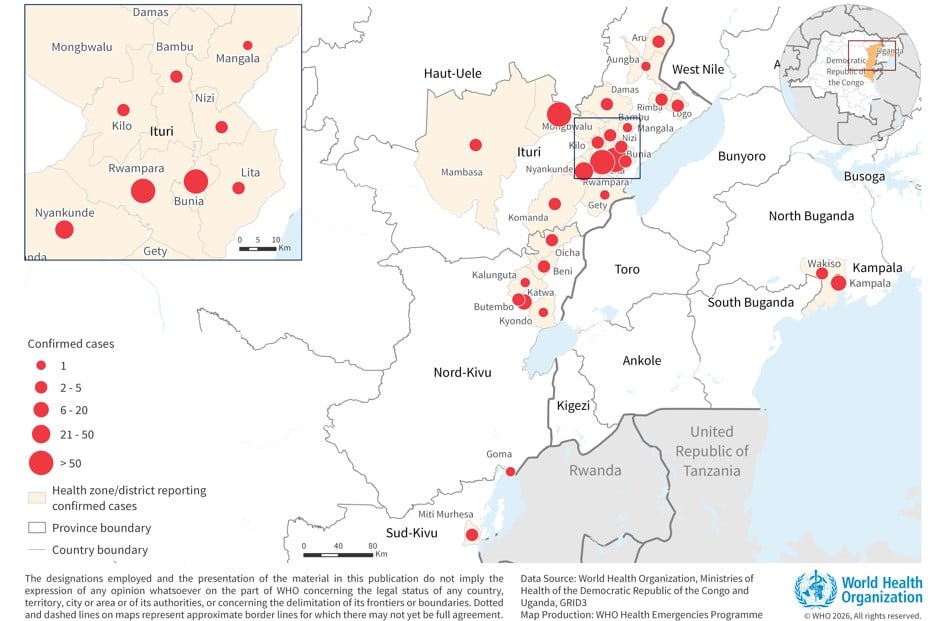
Figure 1. Distribution of confirmed cases of Bundibugyo virus disease in the Democratic Republic of the Congo and Uganda, as of 6 June 2026
Geographical distribution of confirmed cases - Geographical distribution of confirmed cases

Democratic Republic of the Congo

Since 29 May, an additional 390 confirmed cases including 74 confirmed deaths have been reported from the Democratic Republic of the Congo. The increase is in part due to the scale up of testing and diagnostic capacities, enabling testing of the backlog of previously collected samples. As of 6 June 2026, a total of 515 confirmed cases including 91 deaths (CFR 17.7%) have been reported from the Democratic Republic of Congo. The reported CFR is likely an underestimation as many deaths that occurred before the outbreak declaration remain under investigation. So far, 12 patients have recovered. Cases have been reported from 25 health zones (HZ) from Ituri (17/36 HZ), North Kivu (7/35 HZ) and South Kivu Provinces (1/34 HZ)[1]. Sixteen confirmed cases have been reported among health and care workers to date.

The outbreak remains concentrated in Ituri Province, which accounts for 94% (487) of confirmed cases. The CFR in Ituri is 15% (74/487); significantly lower than the CFR in North Kivu which is 64% (16/25). The highest confirmed case numbers in Ituri Province are reported from Bunia (142 cases), Rwampara (98 cases), Mongbwalu (92 cases), and Nyankunde (24 cases) HZ.

As of 6 June, 5040 contacts had been identified and were under follow-up across Ituri (4118), North Kivu (699), and South Kivu (223) provinces. Of these, 2535 contacts were followed up in the last 24 hours, corresponding to follow-up rates of 43.2% in Ituri, 82.5% in North Kivu, and 80.3% in South Kivu.

Increasing security-related incidents affecting health facilities have posed additional operational challenges in affected provinces. These conditions are constraining access for the response, disrupting surveillance and response activities, and increasing the risk of undetected transmission. Such incidents underline the challenges of the context and the importance of working closely with local leaders and communities.

Figure 2: Number of confirmed cases (n = 515), including deaths, in the Democratic Republic of the Congo, by date of reporting and as of 6 June 2026

Number of confirmed cases and deaths in DRC - Number of confirmed cases and deaths in DRC

NB: Newly reported confirmed cases/deaths may be part of the back log of samples and therefore not necessarily newly acquired infections.

Uganda

Since the last update dated 29 May, an additional 10 confirmed cases and one death have been reported from Uganda. As of 6 June 2026, a total of 19 confirmed cases including two deaths in imported cases, and one probable case who has died, have been reported. Five recoveries have been reported. Of the total cases, 14 cases are imported and five are Ugandans. The cases were reported from two districts Kampala and Wakiso. To date, all cases in Uganda can be linked to travelers from the Democratic Republic of the Congo, or secondary infections linked to them; there has been no documented community transmission in Uganda. Exposure risks are associated with healthcare settings and cross-border movements.

About 70% of the cases are Congolese nationals who came to Uganda to seek medical care. This includes a Congolese national who travelled from the Democratic Republic of the Congo, via Uganda, to the United Arab Emirates and then back to Uganda. WHO is working with public health authorities in the United Arab Emirates and Uganda to gather additional information to assess the risk of exposure and facilitate contact tracing through the National International Health Regulations (IHR) Focal Point mechanism. Based on the information available to date, there is no evidence that the case exhibited clearly recognized symptoms consistent with BVD during travel to or from the United Arab Emirates. Following notification of the case, UAE authorities rapidly implemented risk assessment, contact tracing activities, follow-up of identified contacts, public health investigations, enhanced preparedness measures at points of entry, and coordination with relevant national and international partners. Epidemiological investigations to date have not identified any secondary cases, local transmission, or evidence of onward spread in the. The findings support the conclusion that the risk of transmission associated with this event in the United Arab Emirates was very low.

As of 2 June, a total of 668 contacts linked to the cases have been identified and are under follow-up. These include close residential contacts and hospital contacts where the cases were hospitalized.

Figure 3: Number of confirmed cases (n = 19), including deaths, in Uganda by date of reporting and as of 6 June 2026 Number of confirmed cases and deaths in Uganda - Number of confirmed cases and deaths in Uganda
Epidemiology


Bundibugyo virus disease (BVD) is a severe and often fatal form of Ebola disease caused by the Bundibugyo virus, one of the Orthoebolavirus species. It is a zoonotic disease, with fruit bats suspected to be the natural reservoir. Human infection is thought to occur through close contact with the blood or secretions of infected wildlife, such as bats or non-human primates, and it subsequently spreads from person to person through direct contact with the blood, secretions, organs, or other bodily fluids of infected individuals or contaminated surfaces or items. Transmission is particularly amplified in health-care settings when infection prevention and control (IPC) measures are inadequate, and during unsafe burial practices involving direct contact with the deceased.

The incubation period for BVD ranges from two to 21 days, and individuals are not infectious until symptom onset. Early symptoms such as fever, fatigue, muscle pain, headache, and sore throat, are non-specific, which complicates clinical diagnosis and can delay detection. These symptoms then progress to gastrointestinal symptoms, organ dysfunction, and in some cases haemorrhagic manifestations. Case fatality rates in the past two BVD outbreaks, reported in Uganda and in the Democratic Republic of the Congo in 2007 and 2012 were 30% and 50% respectively.

Differentiating BVD from other endemic febrile illnesses such as malaria is challenging without laboratory confirmation using PCR or antigen/antibody-based assays. Control relies on rapid case identification, isolation and care, contact tracing, safe burials, and strong community engagement, as no approved vaccines or specific treatments currently exist for BVD.

Public health response


Health authorities in the Democratic Republic of the Congo and Uganda, in collaboration with WHO and partners, are implementing comprehensive public health measures including implementing the continental response plan, engaging donors and mobilizing additional resources to address critical funding gaps and sustain response operations across affected and at-risk areas.

Key response activities also include interagency coordination and deployment of field teams, delivery of medical supplies, strengthening surveillance, increasing laboratory capacity, infection prevention and control, the set-up of safe and optimized treatment centers, risk communication and community engagement, and research on potential medical countermeasures.

For further information about public health response actions by the respective Ministry of Health, WHO, and partners, please refer to the latest situation reports published by the WHO Regional Office for Africa: Ebola Bundibugyo Virus Disease Outbreak Democratic Republic of the Congo | Uganda Weekly External Situation Report 03, Data as of 31 May 2026 | WHO | Regional Office for Africa

WHO risk assessment


On 6 June 2026, WHO reassessed the risk of the outbreak of BVD to incorporate newly available information and the WHO Temporary Recommendations. The risk for countries sharing land borders with countries with documented Bundibugyo virus (BVDV) detection, as of this report Democratic Republic of the Congo and Uganda, has been separated out from the risk for other countries in the African Region.

The risk in the Democratic Republic of the Congo remains assessed as very high due to ongoing transmission and the continued expansion of the outbreak into new health zones, increasing the potential for further national and regional spread.

The risk in Uganda is still assessed as high due to confirmed cross-border spread through imported cases and ongoing epidemiological links along the eastern Democratic Republic of the Congo–western Uganda corridor, historically affected by Ebola outbreaks, including Bundibugyo and Sudan virus disease outbreaks.

The risk for countries with land borders adjoining countries with documented BDBV detection, is assessed as high due to sustained population mobility linked to cross-border trade and mining activities, variation in capacities and experience of BVD response and variable levels of readiness.

The risk for the rest of the Africa region and at the global level is assessed as low.

WHO advice


WHO advises against any restriction of travel to, or trade with, the Democratic Republic of the Congo or Uganda based on the currently available information. WHO continues to closely monitor and, where necessary, verify travel and trade measures in relation to this event.

For further information on the considerations for implementing border health and international travel-related temporary recommendations, please see the relevant technical note issued on 26 May 2026

The temporary recommendations issued to State Parties on 22 May 2026 underscore the importance of coordinated outbreak control, enhanced cross‑border collaboration, and sustained surveillance and preparedness to prevent further regional spread and ensure an effective public health response.

WHO has convened several technical advisory groups, including the Strategic Advisory group of Experts (SAGE) to assess candidate vaccines and therapeutics for BVD. Key recommendations made are available in the news release published on 28 May 2026.

Regular Information products on the outbreak of BVD in Democratic Republic of the Congo
Further information

​...

https://www.who.int/emergencies/disease-outbreak-news/item/2026-DON606

 
Translation Google

DRC: Inside MSF treatment centers during the Ebola epidemic

June 8, 2026

Several weeks after the start of the Ebola outbreak in the DRC and Uganda, Doctors Without Borders (MSF) is intensifying its efforts to contain the virus. Today, our teams take you inside their treatment centers in Goma and Bunia in Ituri, the epicenter of the virus, where they are mobilized to combat this seventeenth outbreak.
...
MSF opens and rehabilitates Ebola treatment centers

To combat the spread of the Bundibugyo virus and break the chain of transmission, MSF teams are adapting their response in the most affected areas.

In Bunia: a center that is expanding in response to the influx of patients
In Bunia, the center is facing overcrowding . On June 5th, the center had 37 suspected cases and 7 confirmed cases. Faced with the risk of further spread, the center is expanding. "We are developing a new plot of land and will double our capacity to reach 70 beds within a few days ," explains Anthony Kergosien, emergency coordinator in Bunia. If needed, the center can increase its capacity to 100 beds .

In Goma: rehabilitation of a historic center
In Goma, MSF has reopened a dedicated treatment center to isolate suspected cases and treat confirmed patients. The first admissions took place on May 28.

"This is a center that has been used during previous epidemics. The teams start by talking with the patients, trying to reassure them about what will happen, explaining the care, the average length of stay and the samples that will be taken," says Tathy Modjaka Nzoko, head of MSF medical activities in Goma.

Safety of healthcare workers and trust of communities: the pillars of the response

Protecting healthcare workers from the virus
Medical staff are equipped with personal protective equipment to ensure effective protection against the Bundibuguyo virus . Indeed, the infectious dose of this virus is very low. "Just a few viral particles in the wrong place, such as in the eyes or mouth, are enough to trigger the disease."

The main purpose of protective equipment is to keep the Ebola virus off the skin. "For this, it must be waterproof, because the virus arrives via bodily fluids .  This is particularly important because we don't have the vaccines and treatments we usually have , " says Armand Sprecher, an emergency physician and epidemiologist for MSF.

Building trust with local communities
For patients to agree to isolate themselves quickly, explanation and awareness-raising work is essential.
“Trust between MSF and the local population is important. People generally take care of their families at home. However, we need them to go to a treatment center immediately. The fact that, with the equipment, we look like people from another planet can make them reluctant to do so. So we explain why we are wearing this equipment, and that many of these people wearing these outfits are people they know,” according to Armand Sprecher.

Transferring skills and training teams
To ensure a large-scale response, MSF relies on sharing expertise. Specific training is provided in a center in Belgium before teams are deployed to the field.

“With each Ebola outbreak, knowledge transfer is an important part of the response . There are people within MSF who have a lot of experience in responding to epidemics. So we send these people into the field who know what they are doing , or who can train other people ,” says Armand Sprecher.

Understanding the Bundibugyo virus: the specifics of this epidemic
Unlike previous waves in the DRC, this epidemic is caused by the Bundibugyo type Ebola virus (belonging to the orthoebolavirus family, which also includes the Zaire and Sudan viruses).

Although the fatality rate of the Bundibugyo virus is lower than that of the classic Ebola virus ( between 25 and 40% ), the medical response faces a major challenge: there is currently no approved vaccine or treatment for this specific virus.

MSF's humanitarian work continues in the rest of the country
Hundreds of MSF professionals remain deployed in the affected areas of Ituri and North Kivu, while new care capacities are being organized in South Kivu. Every week, several tons of medical and logistical supplies continue to arrive in the DRC from our international centers to support the response.

https://www.msf.fr/actualites/rdc-au-coeur-des-centres-de-traitement-msf-face-a-l-epidemie-d-ebola
 
Translation Google

Alert regarding the risk of Ebola spreading in displacement sites in Ituri

Published on Tue, 09/06/2026 - 17:50 | Modified on Tue, 09/06/2026 - 17:50

Radio Okapi. Photo: Jean-Claude Loky

Displaced persons committees in Ituri are calling on Congolese authorities to strengthen Ebola prevention measures in displacement camps in the province. According to medical sources contacted on Monday, June 8, many new displaced people from areas affected by the epidemic continue to arrive at some displacement sites, notably the one in Djaiba, Fataki.

They report that the displaced people come mainly from Mongwalu, one of the main hotspots of the disease.

Failure of preventive measures

For site managers and health professionals, these new arrivals present a risk of contamination for other displaced people already present in the various sites.

Health officials also report that Ebola prevention measures remain insufficient in most sites for displaced persons, both in Bunia and within the province.

In the Kigonze and ISP displacement sites, for example, Ebola prevention measures are virtually nonexistent. With nearly 30,000 displaced people, these sites have only a handful of handwashing stations, which are often insufficient for the size of the area. Access to clean water also remains a challenge for many displaced families.

Numerous Djugu sites

According to other sources, the same observation has been made in several other sites located on the outskirts of Bunia, notably in Mbala, Tséré and in many sites in the territory of Djugu.

Health workers in Ituri and committees representing displaced persons are calling on authorities and their partners to intensify efforts to prevent the spread of Ebola in the region in order to protect the lives of displaced people. They specifically mention the installation of handwashing stations, the distribution of hygiene supplies, and the strengthening of health monitoring.


https://www.radiookapi.net/2026/06/...agation-debola-dans-les-sites-des-deplaces-en
 
Back
Top