• FluTrackers.com Inc. does not provide medical advice. Information on this web site is collected from various internet resources, and the FluTrackers board of directors makes no warranty to the safety, efficacy, correctness or completeness of the information posted on this site by any author or poster. The information collated here is for instructional and/or discussion purposes only and is NOT intended to diagnose or treat any disease, illness, or other medical condition. Every individual reader or poster should seek advice from their personal physician/healthcare practitioner before considering or using any interventions that are discussed on this website. By continuing to access this website you agree to consult your personal physican before using any interventions posted on this website, and you agree to hold harmless FluTrackers.com Inc., the board of directors, the members, and all authors and posters for any effects from use of any medication, supplement, vitamin or other substance, device, intervention, etc. mentioned in posts on this website, or other internet venues referenced in posts on this website.
  • We are not asking for any donations. Do not donate to any entity who says they are raising funds for us.

Discussion: Chinese Academy of Sciences (CAS) in Wuhan has been working with bats and coronavirus for many years - DNA manipulations, cloning.... - Ja

You are credible, like Redfield.

https://www.vanityfair.com/news/202...inside-the-fight-to-uncover-covid-19s-origins

But for most of the past year, the lab-leak scenario was treated not simply as unlikely or even inaccurate but as morally out-of-bounds. In late March, former Centers for Disease Control director Robert Redfield received death threats from fellow scientists after telling CNN that he believed COVID-19 had originated in a lab. “I was threatened and ostracized because I proposed another hypothesis,” Redfield told Vanity Fair. “I expected it from politicians. I didn’t expect it from science.”
 
Prominent NYC scientist backtracks on COVID origin over ‘disturbing information’

By Bruce GoldingJune 4, 2021 | 3:50pm | Updated
...
Peter Palese was among 27 scientists who signed an influential statement last year in the British scientific journal The Lancet that denounced as “conspiracy theories” the notion that the coronavirus could have escaped from a lab — or even be man-made.

But Palese — chairman of the Microbiology Department at the Icahn School of Medicine at Mount Sinai, where he runs a lab named after him — said he’s no longer convinced that’s the case.
...
“A lot of disturbing information has surfaced since the Lancet letter I signed, so I want to see answers covering all questions.”

Palese declined to specify that information or say what led him to sign the Lancet statement...

https://nypost.com/2021/06/04/prominent-nyc-scientist-backtracks-on-natural-origin-of-covid/
 
COVID lab leak theory: Why Berkeley scientist wants answers
...
By JOHN WOOLFOLK | jwoolfolk@bayareanewsgroup.com | Bay Area News Group
PUBLISHED: June 6, 2021 at 7:00 a.m. | UPDATED: June 6, 2021 at 7:10 a.m.
...
Rasmus Nielsen, a professor of integrative biology at the UC Berkeley, was among 18 researchers from respected universities around the world who in a May 14 article in Science called for the scientific community to explore the lab-leak theory. We asked him why this is suddenly gaining interest.
...
Q: Has anything new been learned this year that raises the possibility of a laboratory accident?

A: We know much more about what was going on at the Wuhan Institute of Virology. They were growing viruses on human cells, adding in elements of another virus, training viruses on human cells to see which ones are most infectious. When you’re doing that, you risk making viruses that are more infectious.
...
Q: What about conflicting reports of the Wuhan lab manipulating coronaviruses with “gain-of-function” methods, in essence intentionally making the viruses more virulent, which they deny?

A: In some sense, it’s a matter of semantics. Technically there’s no evidence of gain-of-function research, but there is evidence of genetic manipulation of coronaviruses in labs. They have published papers that showed they are working on chimeric (man-made) viruses.

Creating a chimeric virus may not be a gain-of-function experiment. You don’t necessarily purposefully insert something into virus that you know will make it more efficient or infectious. You might simply mimic the natural way natural viruses recombine with each other.

Q Would it be hard to tell from the virus’s genetic sequence whether it was a chimera?

A Yes, that is right. Some ways of doing this work would leave no clear traces in the DNA (RNA) sequence.
...
https://www.mercurynews.com/2021/06/06/covid-lab-leak-theory-why-berkeley-scientist-wants-answers/
 
Chinese Military Scientist Filed Patent For A Vaccine Soon After China Revealed Covid-19 Details in 2020

Bhaswati Guha Majumder
Sat, 5 June, 2021, 3:25 am·2-min read

...
According to documents obtained by The Weekend Australian, Zhou Yusen, a respected military scientist for the People’s Liberation Army (PLA) who collaborated with the controversial Wuhan Institute of Virology (WIV) and American experts, submitted a patent for a Covid-19 vaccine on 24 February last year.

The scientist later died under mysterious circumstances in May 2020.

Despite Zhou’s status as an award-winning military scientist, there were no reports or tributes, with him only being labelled as “dead” in a Chinese media item from July and a scientific publication from December last year.

However, the report revealed that the patent, filed by the PLA’s Institute of Military Medicine, was lodged just five weeks after China acknowledged human-to-human transmission of the novel virus.

Professor Nikolai Petrovsky from Flinders University told the paper: “This is something we have never seen achieved before, raising the question of whether this work may have started much ­earlier”.
...

https://in.news.yahoo.com/chinese-military-scientist-filed-patent-082549951.html
 
More from this article posted earlier by Shiloh and Sharon:

https://www.vanityfair.com/news/202...inside-the-fight-to-uncover-covid-19s-origins

...
A growing number of people were demanding to know what exactly had gone on inside the Wuhan Institute of Virology. Were the claims in the State Department’s fact sheet—of sick researchers and secret military research—accurate?

Metzl had managed to question Shi directly a week before the release of the mission report. At a March 23 online lecture by Shi, hosted by Rutgers Medical School, Metzl asked if she had full knowledge of all the research being done at the WIV and all the viruses held there, and if the U.S. government was correct that classified military research had taken place. She responded:

We—our work, our research is open, and we have a lot of international collaboration. And from my knowledge, all our research work is open, is transparency. So, at the beginning of COVID-19, we heard the rumors that it’s claimed in our laboratory we have some project, blah blah, with army, blah blah, these kinds of rumors. But this is not correct because I am the lab’s director and responsible for research activity. I don’t know any kind of research work performed in this lab. This is incorrect information.

A major argument against the lab-leak theory hinged on the presumption that Shi was telling the truth when she said the WIV was not hiding any virus samples that are closer cousins to SARS-CoV-2. In Metzl’s view, if she was lying about the military’s involvement, or anything else, then all bets were off.
...
Though Shi has portrayed the WIV as a transparent hub of international research beset by false allegations, the State Department’s January fact sheet painted a different picture: of a facility conducting classified military research, and hiding it, which Shi adamantly denies. But a former national security official who reviewed U.S. classified materials told Vanity Fair that inside the WIV, military and civilian researchers are “doing animal research in the same fricking space.”

While that, in and of itself, does not prove a lab leak, Shi’s alleged lies about it are “absolutely material,” said a former State Department official. “It speaks to the honesty and credibility of the WIV that they kept this secret…. You have a web of lies, coercion, and disinformation that is killing people.”

Vanity Fair sent Shi Zhengli and the director of the Wuhan Institute of Virology detailed questions. Neither responded to multiple requests for comment by email and phone.
...
 
Chinese Military Scientist Filed Patent For A Vaccine Soon After China Revealed Covid-19 Details in 2020

Bhaswati Guha Majumder
Sat, 5 June, 2021, 3:25 am·2-min read

...
According to documents obtained by The Weekend Australian, Zhou Yusen, a respected military scientist for the People’s Liberation Army (PLA) who collaborated with the controversial Wuhan Institute of Virology (WIV) and American experts, submitted a patent for a Covid-19 vaccine on 24 February last year.

The scientist later died under mysterious circumstances in May 2020.

Despite Zhou’s status as an award-winning military scientist, there were no reports or tributes, with him only being labelled as “dead” in a Chinese media item from July and a scientific publication from December last year.

However, the report revealed that the patent, filed by the PLA’s Institute of Military Medicine, was lodged just five weeks after China acknowledged human-to-human transmission of the novel virus.

Professor Nikolai Petrovsky from Flinders University told the paper: “This is something we have never seen achieved before, raising the question of whether this work may have started much ­earlier”.
...

https://in.news.yahoo.com/chinese-mi...082549951.html

----------------------------------------------------------

2020-06-08

Academician Zhong Nanshan mentioned in the live broadcast that the new crown vaccine can be used as an emergency as early as this fall or the end of the year. Six vaccines in mainland China are already in clinical trials.

https://flutrackers.com/forum/forum...-days-after-the-onset-of-symptoms-june-8-2020

------------------------------------------------------------

September 11, 2020, 04:54 PM

snip

China National Biotec Group Co., a subsidiary of state-owned Sinopharm, has given two experimental vaccine candidates to hundreds of thousands of people under an emergency-use condition approved by Beijing in July

https://flutrackers.com/forum/forum/...id-19-vaccines
 
A few years ago, Zhou Yusen developed a way to work with MERS that he thought would be safe enough to avoid the need for using BSL-3 restrictions.

https://virologyj.biomedcentral.com/...43-422X-10-266
...

In this study, we produced a pseudovirus bearing the full-length S protein of MERS-CoV in the Env-defective, luciferase-expressing HIV-1 backbone. We then established a pseudovirus-based inhibition assay for the detection of neutralizing antibodies and anti-MERS-CoV entry inhibitors. This method was proven to be safe, convenient, reliable and effective for the rapid detection of neutralizing antibodies and viral entry inhibitors against MERS-CoV.

Results

Generated MERS-CoV pseudovirus was able to infect a variety of cell types from human and non-human hosts

We first detected the ability of the generated MERS-CoV pseudovirus to infect cells from various tissues and different hosts, including human cell lines Huh-7, HT-1080, Hep-2, HEP-G2, A549, MT-2, Caco-2, HeLa and 293T, as well as those from mink (NBL-7), pig (PK15), canine (MDCK), and monkey (FRhK-4, Vero, Vero E6 and MA-104) (Table 1). Pseudovirus expressing VSV-G was included as the positive control. The target cells were respectively infected with MERS-CoV pseudovirus normalized for equal HIV-1 p24 content, and luciferase activity was measured at 72 h after infection. As shown in Figure 1, almost all tested human cells and a variety of animal cells could be infected by the produced pseudovirus. Particularly, MERS-CoV pseudovirus infected HT-1080 and SARS receptor-expressing ACE2-293T cells, maintaining a high infective ability in identified MERS-CoV receptor DPP4-expressing Huh-7 cells. In addition, human cell types, such as Hep-2, HEP-G2, A549 and MT-2, and animal cell types, including FRhK-4, MDCK, Vero, Vero E6 and NBL-7, were infected by MERS-CoV pseudovirus to a significantly higher degree than other cell types, such as PK15, Caco-2 and HeLa. However, no high infectivity was observed in MA-104. Our results also demonstrated that VSV-G positive control could highly infect almost all tested cell types, possibly due to the broad host range of VSV-G in the capability of infecting multiple tissues in various hosts, while Env- pseudovirus negative control was unable to infect tested cell lines [10] (Figure 1)
 
Transcript: Scott Gottlieb on "Face the Nation," June 6, 2021
face-the-nation


JUNE 6, 2021 / 11:24 AM / CBS NEWS

The following is a transcript of an interview with former FDA Commissioner Dr. Scott Gottlieb that aired Sunday, June 6, 2021, on "Face the Nation."
...
JOHN DICKERSON:...Let me ask you about this term "gain of function." We've heard that come up in this, that gain-of-function research was going on at the lab and that that is somehow connected to the US government or even Dr. Anthony Fauci. What's your assessment of that?

DR. GOTTLIEB: Well, look, I- I don't think that gain-of-function research- if this did come out of a lab, so big if, it doesn't necessarily need to be the product of deliberate engineering. If they had a novel strain of coronavirus and we know that the WIV was the referral center for coronaviruses. So if the Chinese had discovered a novel strain of coronavirus, it probably would have been sent to the ER for further evaluation. We know that that Wuhan Institute of Virology was doing experiments where they were trying to infect transgenic animals, animals with fully human immune systems, to look at the behaviour of coronaviruses in people, in models.

JOHN DICKERSON: And they do that so that they can fight tougher--

DR. GOTTLIEB: Right. So they could figure out how it works and then they can try to develop drugs and vaccines against it. The process of doing that, the process of growing a vaccine in mammalian cell cultures, which is what they would have tried to do with that novel strain, and the process of then infecting transgenic animals would make it more humanized. So you don't need to deliberately try to engineer features into the virus to end up with a virus that you might have taken from an animal and then it became more humanized in the process of just experimenting with it. And we know that there were some outbreaks of unusual coronaviruses that the Chinese still haven't released. I mean, a real material fact here is the evidence that the Chinese government has not released.
...
https://www.cbsnews.com/news/transcript-scott-gottlieb-face-the-nation-06-06-2021/
 
I copied this post from the "Discussion - 2019-nCoV genetics" as the topic is closely related to this thread.
 
Jimmy Tobias

@JamesCTobias
Very interesting email from the Fauci documents obtained by
@JasonLeopold
:

E20hAKdXEAkcEUs

1:33 PM · Jun 1, 2021·Twitter Web App

Scientist Who Warned Fauci COVID Could Be 'Engineered' Deletes Twitter Account

BY ANDERS ANGLESEY ON 6/7/21 AT 6:34 AM EDT

A virologist who said during the early phase of the pandemic that some of COVID's features "(potentially) look engineered" in an email to Dr. Anthony Fauci has deleted his Twitter account.

Kristian G. Andersen of the Scripps Research Institute removed his page on the social media platform following the release of email exchanges between himself and Dr. Fauci. His account was no longer accessible on Sunday, June 6, according to the internet archive The Wayback Machine.

Before Andersen's account was deleted, the virologist faced explosive claims that the email exchange about his changing views on how the virus came into being showed evidence of a cover-up.
...
https://www.newsweek.com/scientist-...ered-deletes-twitter-account-andersen-1598069
 
‘Damning’ science shows COVID-19 likely engineered in lab: experts

By Aaron FeisJune 6, 2021 | 6:11pm | Updated
...
Writing in an opinion piece for the Wall Street Journal, Dr. Steven Quay and Richard Muller pointed to two key pieces of evidence to support the claim, which has increasingly gained steam after long being derided as little more than speculation.
...
Of the 36 possible genome pairings that can produce two arginine amino acids in a row — which results in boosting a virus’ lethality — the one most commonly used in gain-of-function research is CGG-CGG, or double CGG, wrote Quay and Muller.

Quay and Muller stated the double CGG sequence has never been found naturally among the entire group of coronaviruses that includes CoV-2.
...
But, in what Quay and Muller called a “damning fact,” it was found in CoV-2.

“Proponents of zoonotic origin must explain why the novel coronavirus, when it mutated or recombined, happened to pick its least favorite combination, the double CGG,” they wrote. “Why did it replicate the choice the lab’s gain-of-function researchers would have made?
...
SARS and MERS, which were confirmed to be of natural origin, “evolved rapidly as they spread through the human population, until the most contagious forms dominated,” the pair wrote.

By contrast, COVID-19 proved to be highly contagious from the point it was first detected.

“Such early optimization is unprecedented, and it suggests a long period of adaptation that predated its public spread,” wrote Quay and Muller. “Science knows of only one way that could be achieved: simulated natural evolution, growing the virus on human cells until the optimum is achieved. That is precisely what is done in gain-of-function research.”
...
“The presence of the double CGG sequence is strong evidence of gene splicing, and the absence of diversity in the public outbreak suggests gain-of-function acceleration,” they wrote. “The scientific evidence points to the conclusion that the virus was developed in a laboratory.”

https://nypost.com/2021/06/06/damnin...neered-in-lab/


See also:
(Subscription required to read the full article)


OPINION COMMENTARY
The Science Suggests a Wuhan Lab Leak
The Covid-19 pathogen has a genetic footprint that has never been observed in a natural coronavirus
.

https://www.wsj.com/articles/the-science-suggests-a-wuhan-lab-leak-11622995184
 
Last edited:
Animal sales from Wuhan wet markets immediately prior to the COVID-19 pandemic
Scientific Reports volume 11, Article number: 11898 (2021) Cite this article
Abstract


Here we document 47,381 individuals from 38 species, including 31 protected species sold between May 2017 and November 2019 in Wuhan’s markets. We note that no pangolins (or bats) were traded, supporting reformed opinion that pangolins were not likely the spillover host at the source of the current coronavirus (COVID-19) pandemic. While we caution against the misattribution of COVID-19’s origins, the wild animals on sale in Wuhan suffered poor welfare and hygiene conditions and we detail a range of other zoonotic infections they can potentially vector. Nevertheless, in a precautionary response to COVID-19, China’s Ministries temporarily banned all wildlife trade on 26th Jan 2020 until the COVID-19 pandemic concludes, and permanently banned eating and trading terrestrial wild (non-livestock) animals for food on 24th Feb 2020. These interventions, intended to protect human health, redress previous trading and enforcement inconsistencies, and will have collateral benefits for global biodiversity conservation and animal welfare.


Introduction


Alongside extensive research into the epidemiology, virology and medical treatment of SARS-CoV-2, known generally as COVID-19, it is also vital to better understand and mitigate any role that may have been played by the illegal wildlife trade (IWT) in China, in initiating this pandemic[SUP]1[/SUP]. COVID-19 was first observed when cases of unexplained pneumonia were noted in the city of Wuhan, Hubei Province, in late 2019[SUP]2[/SUP]. Like the SARS-CoV epidemic (another coronavirus, for which there is still no cure) that began in Guangdong Province in 2002[SUP]3[/SUP], this latest coronavirus most closely resembles types found in bats[SUP]4[/SUP]. Initial media coverage suggesting that COVID-19 may have spilled-over via pangolins has been refuted[SUP]5, 6[/SUP]; probably pangolins are simply a natural reservoir of SARS-CoV-2[SUP]7,8,9[/SUP] along with palm civets (Paguma larvata)[SUP]10[/SUP].

The World Health Organization (WHO) sent an investigative team to Wuhan, from 14 January–10 February 2021, to try to retrospectively ascertain what wildlife was being sold in local wet markets in this region[SUP]1[/SUP]. Their findings were inconclusive, with markets having been closed down completely at that point for 4 months; however, they did recommend that pangolins should be included in the search for possible natural hosts or intermediate hosts of the novel coronaviruses[SUP]1[/SUP].

Here we present a unique and original dataset recording wild animal sales across Wuhan City’s animal markets between May 2017 and November 2019. We investigate which wildlife species (including both wild-caught and farmed non-domesticated species) were actually being sold for food and as pets, what quantities were involved, and to what extent vendors violated their trading permits. We also list zoonotic pathogens recorded in Chinese wild animal markets and/ or farms since 2009, along with broader notes on infections established for these species. We evaluate these data in the context of China’s renewed commitment to enforce and build on pre-existing laws within a culture of traditional wildlife exploitation. Finally, we make pragmatic policy recommendations for better regulating the animal trade pervasive in China, integrating with ethics, education and enforcement.

Materials and methods


Serendipitously, prior to the COVID-19 outbreak, over the period May 2017–Nov 2019, we were conducting unrelated routine monthly surveys of all 17 wet market shops selling live wild animals for food and pets across Wuhan City (surveys were conducted by author X.X.). This was intended to identify the source of the tick-borne (no human-to-human transmission) Severe Fever with Thrombocytopenia Syndrome (SFTS), following an outbreak in Hubei Province in 2009–2010 in which there was an unusually high initial case fatality rate of 30%[SUP]11[/SUP]. These shops selling live, often wild, animals included two at Baishazhou market (a large market comprising c. 400 other types of shop), seven at Huanan seafood market (c. 120 other shops), four at Dijiao outdoor pet market (c. 100 other shops), and four at Qiyimen live animal market (c. 40 other shops). Other shops sold a variety of goods, such as live and butchered livestock and poultry, dairy produce, fish, shellfish, other food- related products and domesticated pets (Fig. 1 shows the appearance of these markets upon reopening on 8th April 2020).
Figure 1
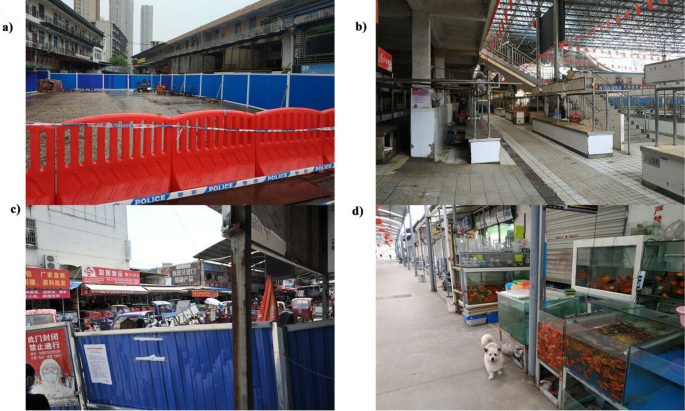
(a) Huanan Seafood market, (b) Qiyimen live animal market, (c) Baishazhou market and (d) Dijiao outdoor pet market (note stray dog) photographed on 10th April 2020.

Full size image

As an objective observer unconnected to law enforcement X.X. was granted unique and complete access to trading practices. On each visit, vendors were asked what species they had sold over the preceding month and in what numbers, along with the prices (US$1:RMB¥6.759) and origin of these goods (wild caught or captive bred/ farmed). Additionally, to substantiate interview data, the number of individuals available for sale at the time of each visit was noted, and animals were checked for gunshot wounds (from homemade firearms—gun ownership is strictly regulated in China[SUP]12[/SUP]) or leg-hold (snap) trap injuries, indicative of wild capture. For 15 species (3 mammals and all 12 reptiles) sold by weight, vendors did not record the number of individuals sold. In these instances, we report numbers of individuals observed to be on sale during monthly visits.

In China, wild animals are state property protected by the Wild Animal Conservation Law (WACL 1988, revised in 2004, 2009, 2016 and 2018), in concert with the Criminal Law (Article 341)[SUP]13[/SUP]. Any convicted trader of species, and/or products derived thereof, protected by China’s list of Fauna under Special State Protection (LFSSP) and/or any non-native species listed in the Convention on International Trade in Endangered Species of Wild Fauna and Flora (CITES) Appendix I, II could face up to 15 years fix-term imprisonment accompanied by fines and/or the confiscation of property. Additionally, if any animal protected by China’s List of Terrestrial Wild Animals of Significant Ecological, Scientific, or Social Value Protected by the State (LESS) is taken from a wild population and traded for the purpose of food, the offender could face up to 3 years fix-term imprisonment accompanied by criminal detention, surveillance and/or fines. Correspondingly, any utilization of these protected species should be approved by the wild animal conservation and animal quarantine administrations through various regulatory schemes. We therefore also noted if vendors had necessary permits allowing them to sell livestock; specifically a License for Domestication and Breeding of Wild Animals, a License for Trade and Processing of Wild Animals and the quarantine certificate, which must be displayed to customers according to the WACL (2018), Animal Epidemic Prevention Law (2013) and Special Provisions of the State Council on Strengthening the Food Safety Supervision and Administration (2007).

All protocols in the market surveys were reviewed and approved by the Ethics Committee of Hubei University of Chinese Medicine (No. 20161111). All vendors provided informed written consent to participate in these surveys, and all protocols were performed in accordance with relevant guidelines and regulations.

Results

Animal sales from Wuhan’s markets


Across all 17 shops, vendors reported total sales of 36,295 individuals, belonging to 38 terrestrial wild animal species, averaging 1170.81 individuals per month (Standard deviation (SD) = 445.01, n = 31; Table 1). Including species sold by weight inflated this total to 47,381 individuals. Notably, no pangolin or bat species were among these animals for sale.

Table 1 List of 38 species sold in Wuhan City markets between May 2017–Nov 2019, including the mean number of live individuals sold per month and price (mean ± SD; n = survey rounds).Full size table

Almost all animals were sold alive, caged, stacked and in poor condition (Fig. 2). Most stores offered butchering services, done on site, with considerable implications for food hygiene and animal welfare. Approximately 30% of individuals from 6 mammal species inspected (labelled W in Table 1) had suffered wounds from gunshots or traps, implying illegal wild harvesting (Table 1). Thirteen of these 17 stores clearly posted the necessary permits from Wuhan Forestry Bureau allowing them to sell legitimate wild animal species (e.g., Siamese Crocodile (Crocodylus siamensis), Indian Peafowl (Pavo cristatus), Common Pheasant (Phasianus colchicus) and Amur hedgehog (Erinaceus amurensis)) for food; four shops had no such permit. Species names were given in Chinese only, with no clear taxonomic binomial designation. None of the 17 shops posted an origin certificate or quarantine certificate, so all wildlife trade was fundamentally illegal. Notably, vendors freely disclosed a variety of protected species on sale illegally in their shops, therefore they would not benefit from specifically concealing pangolin trade or the trade in any particular species, and so we are confident this list is complete (Table 1).
Figure 2
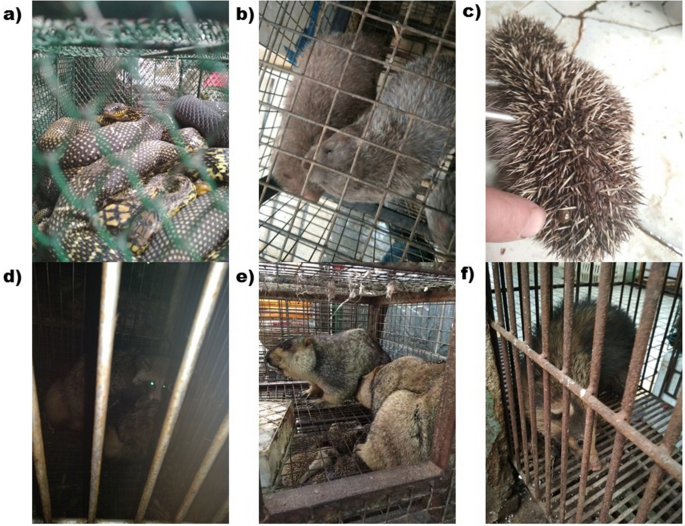
Poor welfare of animals on sale in Huanan seafood market: (a) King rat snake (Elaphe carinata), (b) Chinese bamboo rat (Rhizomys sinensis), (c) Amur hedgehog (Erinaceus amurensis) (the finger points to a tick), (d) Raccoon dog (Nyctereutes procyonoides), (e) Marmot (Marmota himalayana) (beneath the marmots is a cage containing hedgehogs), and (f) Hog badger (Arctonyx albogularis).

Full size image

The most expensive wild mammal species sold for food was the marmot (Marmota himalayana) at over US$ 25 per kg, while raccoon dogs (Nyctereutes procyonoides) and badgers (Arctonyx albogularis and Meles leucurus) were priced at c. $ 15–20 per kg; hedgehogs retailed for as little as $ 2–3 each; all wild caught and intended as food. Squirrels (Callosciurus erythraeus and Sciurus vulgaris) were sold as pets for c. $ 25 each. The most expensive wild bird sold for food was the Indian peafowl (Pavo cristatus) at $ 56 each, while captive-bred crested myna birds (Acridotheres cristatellus), prized for imitating human speech, were sold as pets for c. $ 300. The Sharp-nosed pit viper (Deinagkistrodon acutus) was the most expensive reptile, at $ 70 per kg. For comparison, the average retail prices of pork, poultry and fish in Wuhan were $ 5.75, $ 4.25 and $ 2.32, respectively (source: Municipal Bureau of Commerce http://sw.wuhan.gov.cn/html/ztzl/sjfb/scyx/jgjczb/).

These traded species are capable of hosting a wide range of infectious zoonotic diseases or disease-baring parasites (see Supplementary Table S1 for a non-exhaustive summary of studies reporting diseases in these species in China since 2009).

Discussion


Our findings illustrate both the range and extent of wildlife exploitation in Wuhan markets, prior to new trading bans linked to the COVID-19 outbreak, along with the poor conditions under which these animals were kept prior to sale. Circumstantially, the absence of pangolins (and bats, not typically eaten in Central China; media footage generally depicts Indonesia) from our comprehensive survey data corroborates that pangolins are unlikely implicated as spill-over hosts in the COVID-19 outbreak. This is unsurprising because live pangolin trading has largely ceased in China[SUP]13[/SUP].

We should therefore not be complacent, because the original source of COVID-19 does not seem to have been established. This is doubly important because false attribution can lead to extreme and irresponsible animal persecution. For instance, civets were killed en masse following the SARS-CoV outbreak[SUP]5[/SUP], and any unwarranted vilification or persecution of pangolins and bats in relation to COVID-19 would risk undermining otherwise very successful efforts to better protect and conserve wildlife in China.

Regarding our insights into broader IWT issues in Wuhan, the animals sold were relatively expensive, representing luxury food items, not cheap bushmeat (Table 1). We thus make an ethical distinction here between the subsistence consumption of bush meat in poorer nations, versus the sort of cachet attached to wild animal consumption in parts of the developed world, notably China[SUP]14[/SUP], but also Japan[SUP]15[/SUP]. While c. 30% of mammals were clearly wild-caught, indicated by trapping and shooting wounds, the captive breeding of other species is commonplace in China. Raccoon dog fur farming is legal in China; however, due to a drop in fur prices, raccoon dogs are now frequently sold off in live animal markets, augmented by wild-caught individuals. Similarly, all American mink (Neovison vison) originated from fur farms—noting that SARS-CoV-2 has been reported in mink farms in Europe and North America[SUP]16, 17[/SUP]. In contrast, the captive breeding and sale of Siberian weasels (Mustela sibirica), is totally illegal in China, yet they are easy to breed, and sold openly, without attracting law enforcement. Indeed, prior to COVID-19 reforms, although enforcement officers from the Wuhan Forestry Bureau issued permits to market vendors, they were broadly disinterested in what species were sold. Furthermore, although animals were required to have an origin certificate and be quarantined to ensure they did not exhibit overt disease symptoms, no clear policy was enforced on these conditions. This is important because the species that were traded are capable of hosting a wide range of infectious zoonotic diseases or disease-baring parasites (Supplementary Table S1), aside from COVID-19. These range from potentially lethal viruses, for example, rabies, SFTS, H5N1, to common bacterial infections that, nevertheless, represent a risk to human health (e.g., Streptococcus). Indeed, globally, wildlife is thought to be the source of at least 70% of all emerging diseases[SUP]18[/SUP].

Legislative reform is also vital to clarify unequivocally which species are considered ‘wild’ and cannot be traded legally and safely. Another problem, as encountered by the WHO report is that, retrospectively, it proved difficult to ascertain which species were on sale, even to the genus level, relying solely on the responsible market authority's official sales records and disclosures[SUP]1[/SUP]. As we[SUP]19, 20[/SUP], and others[SUP]21[/SUP], have proposed previously, China’s LFSSP and LESS must be updated to apply proper binomials, and to align with recent taxonomic revisions; for instance, cobra snakes (Nada atra) can be farmed legally for food with permits, but wild caught species, such as water snakes and wolf snakes were also sold in Wuhan, labelled simply as ‘snakes’. Such an application of clear species names would allow for more effective prosecutions[SUP]19[/SUP]. Furthermore, the WHO reports that market authorities claimed all live and frozen animals sold in the Huanan market were acquired from farms officially licensed for breeding and quarantine, and as such no illegal wildlife trade was identified[SUP]1[/SUP]. In reality, however, because China has no regulatory authority regulating animal trading conducted by small-scale vendors or individuals it is impossible to make this determination[SUP]1, 21[/SUP]. Similar discrepancies concerning species identification and origins afflict investigations around the world[SUP]22[/SUP].

Another important animal trade that requires attention, outside of exploitation as food, is the supply of pets, like the squirrels and crested myna birds sold in Wuhan’s market. Our previous research found annual trade volumes equivalent to c. 17,000 parrots and c. 160,000 turtles (many turtles being invasive if escaping to the wild) sold online as pets via Taobao.com between 2016–2017, in contravention of China’s WACL and/or the Animal Epidemic Prevention Law[SUP]23,24,25[/SUP]. While not currently the vector of any major viral epidemics, it would be naive to imagine that unconventional pets do not still also pose a serious concern for public health[SUP]26[/SUP]. This potential for disease is likely exacerbated by poor sanitary and welfare conditions (Fig. 2).

Conclusion


Ultimately, changing the attitudes of consumers is crucial to reduce IWT in China. Efforts to stem the trade in charismatic species, such as elephants/ivory, rhino/horn, tiger bones, etc., have achieved modest success, and have garnered worldwide media attention and public concern[SUP]27[/SUP]. Nevertheless, despite a general decrease in wildlife poaching and trafficking in China[SUP]12[/SUP], attempts to dissuade people from consuming lower-profile, but also higher-volume, species have still fallen-short. Crucially, efforts must be made to change the normative values of consumers through education, raising awareness not only for health, but also for animal welfare and global biodiversity concerns, else continued demand, despite recent national bans, may merely push suppliers into black-market and dark-web operations[SUP]23[/SUP]. Our own previous investigation found that, in China, a substantial desire to purchase and/or own wildlife products as ‘prestige items’ still transcends social classes, age groups, education levels and rural versus urban residents, even though this involves breaking the law[SUP]14[/SUP]. In major part this is because protective legislation has not been enforced consistently, fostering a nonchalant disregard for wildlife exploitation[SUP]23[/SUP].

President Xi Jinping has said that: the COVID-19 outbreak is a major test of China's system and capacity for governance, and we must sum up the experience and draw a lesson from it. In an early precautionary response to the COVID-19 crisis, on the 26th of January 2020, the Chinese government (State Administration for Market Regulation, Ministry of Agriculture and Rural Affairs and National Forestry and Grassland Administration) temporarily banned the sale of all wild animal and their products in markets, restaurants and over e-commerce, to least until the conclusion of the epidemic. Subsequently, on 24th Feb 2020, the Standing Committee of the National People’s Congress implemented a permanent ban on trading terrestrial wild (non-livestock) animals and consuming them as food. The Hubei provincial government announced on 11th April 2020 that the sale of live wild animals and poultry will be strictly prohibited as markets re-open in Wuhan. Ultimately China plans to invest c. $30 million to update Wuhan open-air markets to megamalls and inspire social capital. This is a major and commendable step, redressing previous tacit tolerance for many forms of wildlife trade in China, often already illegal under WACL and/or the CITES, which also carries a huge collateral benefit for global biodiversity and animal welfare[SUP]28, 29[/SUP]. In response to the pandemic, on April 12th 2021 the WHO (co-signed by UNEP and OIE) released interim guidance for ‘Reducing public health risks associated with the sale of live animals on mammalian species in traditional food markets’[SUP]30[/SUP]. Adopting these more responsible practices has the potential to save countless lives in the future.

...

https://www.nature.com/articles/s41598-021-91470-2

 
How Close Are We To Learning COVID's Origin Story?
— Experts discuss practical implications of a natural or accidental introduction for the virus
by Veronica Hackethal, MD, MSc, Enterprise & Investigative Writer, MedPage Today June 7, 2021

As interest grows in the hypothesis that SARS-CoV-2 may have escaped from the Wuhan Institute of Virology in China, more scientists are taking it seriously, in part because of the practical implications associated with it.

While many experts interviewed for this story were hesitant to speculate on the exact implications of a lab leak, they agreed that further research into the virus' origins is necessary, considering practical implications now may help forestall future pandemics.

"In the wake of the COVID-19 disaster -- the greatest disaster the world has faced since World War II -- an investigation of the causes of the disaster and policy changes to reduce the risk and impact of similar future disasters are urgently needed," said Richard Ebright, PhD, a molecular biologist and professor of chemistry and chemical biology at Rutgers University in New Jersey...

Read more: https://www.medpagetoday.com/special-reports/exclusives/92969
 
JUNE 7, 202110:13 AMUPDATED A DAY AGO

WHO official says can't force China to give more information on COVID-19 origins

By Reuters Staff

GENEVA (Reuters) - A top World Health Organization official said on Monday that the WHO cannot compel China to divulge more data on COVID-19’s origins, while adding it will propose studies needed to take understanding of where the virus emerged to the “next level”.

Pressed by a reporter on how the WHO will “compel” China into being more open, Mike Ryan, director of the agency’s emergencies programme, said at a press conference that the “WHO doesn’t have the power to compel anyone in this regard”.
...

https://www.reuters.com/article/us-...information-on-covid-19-origins-idUSKCN2DJ200
 
WHO-China COVID-19 origins team labeled lab leak concerns 'conspiracy theories'

Jerry Dunleavy
Wed, June 9, 2021, 3:05 PM·8 min read

Meeting minutes from discussions between Wuhan lab scientists and the WHO-China COVID-19 origins joint study team reveal lab leak concerns were referred to as “rumors,” “myths,” and “conspiracy theories.”
...
The little-noticed Wuhan lab meeting minutes, which seem to switch between being written from the perspective of the WHO-China team and the Wuhan lab, repeat claims made by lab officials and reveal little pushback or probing questions.

The WHO-China joint team’s numerous annexes totaled 193 pages, but the annex on its Feb. 3, 2021, visit to the Wuhan lab is just four pages. The various annexes contained five mentions of “conspiracy theories,” all in relation to the Wuhan lab, one mention of “myths,” only in relation to the lab, and three mentions of “rumors," two related to the lab.
...
The annex made no use of the phrase “gain-of-function” and doesn't mention alleged Chinese military collaboration.
...
The annex contained a section on “conspiracy theories" and stated, “The WIV Director raised the issue of conspiracy theories, reiterating that the Institute had worked with the media to stress the need to respect science in the fight against COVID-19 and to rebut the theories. The international team’s visit could help to defuse some of the theories that were circulating.”

“The Institute did not respond to conspiracy theories but understood why the WHO team needed to ask," the team wrote. "There had been no reports of unusual diseases, none diagnosed, and all staff tested negative for SARS-CoV-2 antibodies.”
...
Peter Ben Embarek, head of the WHO’s international team, discussed the lab visit in February, saying, "Of course, they’re the best one to be able to dismiss any of these claims and provide answers to all the questions that are out there around it.”

Embarek admitted in late February that “we didn’t do an audit of any of these labs, so we don’t really have hard facts or detailed data on the work done."
...
https://news.yahoo.com/china-covid-19-origins-team-200500171.html

--------------------------------------------------------------------------

See also:

Annex D7 - Wuhan Institute of Virology
3 February 2021


Pages 130-133

https://www.who.int/docs/default-so...ov-2-china-part-annexes.pdf?sfvrsn=3065bcd8_5
 
https://www.theatlantic.com/ideas/archive/2021/06/lab-leak-trap/619150/
Don’t Fall for These Lab-Leak Traps
Recent coverage of the pandemic’s origins has ensnared readers in semantic quibbles, side points, and distractions.

By Daniel Engber
June 10, 2021

About the author: Daniel Engber is a senior editor at The Atlantic.

After months of getting very little coverage, the lab-leak theory for the origins of COVID-19—which holds that the virus emerged from a research setting—is now a source of endless chatter. Vanity Fair has a new, 12,000-word investigative feature on the subject, while lab-leak op-eds continue their exponential spread across the pages of The Washington Post, The Wall Street Journal, and The New York Times.

A careful look at all the ways that the pandemic might have started matters for the future: It should help us figure out the safest regulations, and the most important goals, for research on emerging pathogens. But the sudden rush of coverage hasn’t always made the lab-leak theory or its implications any easier to grasp. Much has done the opposite, in fact, ensnaring readers in semantic quibbles, side points, and distractions...
 
"We should therefore not be complacent, because the original source of COVID-19 does not seem to have been established. This is doubly important because false attribution can lead to extreme and irresponsible animal persecution."

So true. Also these false attribitions waste resources and misdirect from useful research leads.
 
Did covid-19 come from a lab?

Graham Lawton

BEFORE heading off to China as leader of a World Health Organization (WHO) fact-finding mission into the origins of SARS-CoV-2, Peter Ben Embarek recorded an explainer video outlining the state of knowledge at the time, January 2021.

“We know that the first human cases that were detected were detected in Wuhan in December 2019,” he said. “We also know that this virus belongs to a group of viruses that have their original niche in bat populations. In between these two points, we don't know much.”

Five months on, we actually know less, with the two “knowns” now being called into question. Even though Embarek's investigation concluded that one of the possible origins of SARS-CoV-2 — accidental release from a laboratory — was “extremely unlikely“, that possibility still hasn't been ruled out. If anything, the case for a lab leak has grown stronger.

On 23 May, The Wall Street Journal claimed that US intelligence has evidence of several employees of the Wuhan Institute of Virology, which carries out research on bat coronaviruses, being hospitalised with a respiratory illness similar to covid-19 in November 2019. US President Joe Biden subsequently ordered the US intelligence community to pursue a definitive conclusion on whether the virus spilled naturally from a wildlife reservoir, or from a lab.

The origin of the virus remains one of the most important unknowns of the pandemic. “We need to know where it came from,” says David Robertson, an evolutionary virologist at the University of Glasgow, UK. “We have to be worried that that could happen again.”

So what is the evidence for and against a laboratory leak? And what pieces of additional evidence are required for a definitive conclusion on the matter?

For now, there is a near-consensus that SARS-CoV-2 had a natural origin in a wild animal, says microbiologist Rossana Segreto at the University of Innsbruck in Austria.

That consensus is the one strongly favoured by Embarek's WHO investigation. At a press conference at the end of the mission in Wuhan on 9 February, he said that the virus seems to have originated in bats.

However, on 4 March, a group of scientists published an open letter in The New York Times calling for an independent investigation on the grounds that the WHO “did not have the mandate, the independence, or the necessary accesses to carry out a full and unrestricted investigation into all the relevant SARS-CoV-2 origin hypotheses”. Governments of 14 countries subsequently expressed concern that the WHO “lacked access to complete, original data and samples”.

Last month, Science published a letter from 18 distinguished scientists, which argued that theories of accidental lab release and so-called zoonotic spillover (where an infectious disease jumps from an animal to a human) “both remain viable”.

One of the signatories is David Relman at Stanford University in California, who argues that the lab-leak hypothesis must be investigated if only to debunk it. “There's still a lot of scientists who are locked into the assumption that this can only have a natural origin,” he says. “I'm not quite sure why.”

...


https://www.sciencedirect.com/science/article/pii/S0262407921009386?via=ihub
 
Back
Top Bottom