• FluTrackers.com Inc. does not provide medical advice. Information on this web site is collected from various internet resources, and the FluTrackers board of directors makes no warranty to the safety, efficacy, correctness or completeness of the information posted on this site by any author or poster. The information collated here is for instructional and/or discussion purposes only and is NOT intended to diagnose or treat any disease, illness, or other medical condition. Every individual reader or poster should seek advice from their personal physician/healthcare practitioner before considering or using any interventions that are discussed on this website. By continuing to access this website you agree to consult your personal physican before using any interventions posted on this website, and you agree to hold harmless FluTrackers.com Inc., the board of directors, the members, and all authors and posters for any effects from use of any medication, supplement, vitamin or other substance, device, intervention, etc. mentioned in posts on this website, or other internet venues referenced in posts on this website.
  • We are not asking for any donations. Do not donate to any entity who says they are raising funds for us.

Cytokine Storm & Vitamin D relationship?

Re: Cytokine Storm & Vitamin D relationship?

I need to read this thread more carefully. However, here's a nice review of the literature, I believe:

http://www.cfp.ca/cgi/reprint/53/5/841

J.

Here is a quote from the above evidence based medicine review:

Mothers and infants among native Canadian Cree in Manitoba have been found to be severely deficient in vitamin D, even in midsummer. In Inuvik, 48% of Inuit mothers were found to be deficient in vitamin D despite supplementation.

With this contribution to our discussion by cartski we have proof that those currently living within the First Nations settlements, most particularly data from one of the hardest hit regions in Manitoba has a high prevalence of vitamin D deficiency that pre-existed the current novel H1N1 epidemic.

This is important because it is contemporaneous data and therefore can be extrapolated to what is likely present within these communities today unless of course those included in this study reverted back to a vitamin D richer traditional diet or began taking vitamin D supplements in sufficient quantities to reverse this condition.

While both possibilities might have resulted as a result of the impact of this article, my guess is that this fine example of applying evidence based medical standards to the peer reviewed data was recognized but not acted upon by TPTB. The truth is often sacrificed upon the alter of inertia.

Grattan Woodson, MD
 
Re: Cytokine Storm & Vitamin D relationship?

Excerpt from one study listed.....

Obesity
Irreversible sequestration of VTD in the fat pool, especially if body mass index is >30 and person does little outdoor activity.

Could the above also be relevant to the large numbers of overweight people developing more severe symptoms? Or would it go against that argument? Not sure how they are using the term "irreversible sequestration".

Thoughts on Vitamin D & Obesity correlation?

This is an interesting comment. I will need to review it carefully before commenting.

GW
 
Re: Cytokine Storm & Vitamin D relationship?

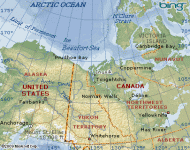
......... In Inuvik, 48% of Inuit mothers were found to be deficient in vitamin D despite supplementation............

Inuvik's location below shows the extreme low probability of sun-sourced Vitamin D availability.
During the short summer, what exposure they have may be merely attempting to fill the winter-depleted D-tank.

inuvik.gif

.
 
Re: Cytokine Storm & Vitamin D relationship?

You can get serum 25(OH)D tested for $40 by ZRT Labs through www.grassrootshealth.org

As for 10,000 IU/day, I suggest you look at the Heaney et al. paper to get an idea of the replenishment rate. It would probably take you less than 3 months to fill the tank.

The product used by Dr. Heaney etal was colecalciferol (vitamin D3) not ergocalciferol (vitamin D2). The two are not the same.

There are several concerns I have about vitamin D3. First, if given in excess of physiologic needs, can it be stored?

Second, what is the metabolism and fate of orally administered vitamin D3? For instance, how much of the orally administered dose of D3 is absorbed by the gut?

Of that absorbed, what proportion is converted into 25 OH vit D3 and how much is metabolized to inactive products destined for excretion and as above, how much is stored?

I have the same questions for ergocalciferol, vitamin D2.

I have sent Dr. Heaney an invitation to join this discussion. I hope he will have the time to do so. He is an international authority on this topic and an excellent teacher.

Grattan Woodson, MD
 
Re: Cytokine Storm & Vitamin D relationship?

Inuvik's location below shows the extreme low probability of sun-sourced Vitamin D availability.
During the short summer, what exposure they have may be merely attempting to fill the winter-depleted D-tank.

View attachment 3451

.

Living at latitude 170 degrees north would make it pretty hard to get a tan even on a good day.

It occurs to me that people who have lived at this latitude have only been able to sustain life there by virtue of their consumption of a traditional diet that has for thousands of years provided them with what they need to thrive.

When one reviews the diets of Canada's First Nations today as documented by several of the peer reveiwed articles referenced above in this thread, is it any wonder that these folks are described as being "in poor health" with an "excess of chronic disease especially obesity and diabetes".

GW
 
Re: Cytokine Storm & Vitamin D relationship?

A significant part of their diet prior to modern introductions appeared to consist of seal oil, some of which was consumed after fermentation, a significant amount of cold water fish, esp. salmon, as well as local native herbivores. Fat and protein were the prime constituents of their diet. Evidently carbohydrates were few and far between. Today, carbohydrates are a significant part of meals they consume. For a people who used to thrive on foods vastly different from today's version, is it any wonder they are suffering diseases that are frequently linked to dietary issues?

A new question occurred to me. Could the lack of available carbohydrates have led over time to a biological imperative to seek out and consume them when they were found? This would explain a number of First Nation issues. Diabetes, alcoholism, etc....
 
Re: Cytokine Storm & Vitamin D relationship?

Autoimmune diseases have disproportionate pockets esp. diabetes, in Finland, Saudi, Uk and New Zealand. There has been speculation that Vitamin D deficiencies are to blame. A cytokine storm is, in effect, an autoimmune problem. I wonder if there is a correlation, especially if obesity causes the same deficiency - and therefore Type 2 diabetes. Could be effect and cause rather than cause and effect. Sorry - am not being clear. Perhaps the same problem that causes people to have type 2 (and perhaps type 1) is the same problem that causes people with diabetes to become very ill when attacked by influenza, not that the diabetes causintg a disproportionate illness, rather the lack of Vitamin D. I hope you can understand the gist of what I am trying to say. Apologies if you can't.
 
Re: Cytokine Storm & Vitamin D relationship?

The tradition diets also included near starvation. Bodies buried by a very old ice sheet intrusion on the northern shores of Alaska were unearthed and studied. The women showed signed of multiple periods of prolonged malnutrition and they all suffered from lung issues related to the use of seal oil lamps and related smoke in a small enclosure.

While traditional diets evolved to suit their needs, they couldn't control the migration routes of caribou herds, or success of whale hunts, etc.

.
 
Re: Cytokine Storm & Vitamin D relationship?

bump this. Thread was split. To keep this topic in the spotlight, and for organizational clarity, please continue to post to this thread. This is a very productive thread.

From my personal standpoint, I am taking it seriously enough to have already ordered a long supply of Vitamin D (5000iu dose / D3 specific). I plan to have my family "boost" our levels, and then maintain them.

My wife is incredibly fair skined, and cannot tolerate long sun exposure - but it has been agreed that 10 - 15 minutes a few times a week in noontime sun has more benefit that potential downside, so even she is imlementing that regiment. Combined with supplements, this should give my family some very solid protection against this emerging pandemic.

In MY opinion, this approach seems to be proven to be one of the easiest thing EVERYONE can do to physically prepare.
 
Re: Cytokine Storm & Vitamin D relationship?

We have a new development. Argentina is announcing a spike in H1N1 deaths. Why? It is winter there but, do they have the same problems that First Nation peoples in Canada have? Are a significant number of victims aboriginals? Are the deaths primarily located in the far south? Are their diets low in foods rich in vitamin D? Time to do some additional research.
 
Re: Cytokine Storm & Vitamin D relationship?

<TABLE border=0 cellSpacing=0 cellPadding=0 width=599 align=center><TBODY><TR><TD width=467>
nyt_geography.gif
</TD><TD width=132 align=middle> </TD></FORM></TR></TBODY></TABLE>
<CENTER><TABLE border=0 cellSpacing=0 cellPadding=3 width=590 align=center><TBODY><TR><TD bgColor=#99cccc vAlign=top><TABLE border=0 cellSpacing=0 cellPadding=3 width=370 align=top><TBODY><TR><TD vAlign=top>
argentina_map.gif
</TD></TR><TR><TD bgColor=#99cccc vAlign=top><TABLE border=0 cellSpacing=0 cellPadding=0 width=102 align=left><TBODY><TR><TD>
argentina_flag.gif
</TD></TR></TBODY></TABLE>[FONT=Arial, Helvetica, sans-serif]The uniforms worn by Argentines when the British attacked Buenos Aires (1806) and the blue ribbons worn by patriots in 1810 may have been the origin of the celeste-white-celeste flag hoisted on Feb. 12,1812. The flag's golden "sun of May" was added on Feb. 25,1818, to commemorate the yielding of the Spanish viceroy in 1810.[/FONT]</TD></TR></TBODY></TABLE></TD><TD bgColor=#ffffcc vAlign=top rowSpan=2 width=231><CENTER>[FONT=Arial, Helvetica, sans-serif]Argentina[/FONT]

argentina_loc.gif
argentina_gra.gif
</CENTER>
[FONT=Arial, Helvetica, sans-serif]Official name: Rep?blica Argentina (Argentina Republic).

Form of government: federal republic with two legislative houses (Senate [72]; Chamber of Deputies [257]).

Head of state and government: President.

Population (1998): 36,125,000.

Population projection: (2000) 37,032,000; (2010) 41,474,000.

Natural increase rate per 1,000 population (1995-2000): 12.0 (world avg. 15.7).

Gross national product (1996): U.S.$295,131,000,000 (U.S.$8,380 per capita).

Land use (1994): forest 18.6%; pasture 51.9%; agriculture 9.9%; other 19.6%.
[/FONT]</TD></TR></TBODY></TABLE></CENTER>http://geography.about.com/gi/dynam...tp://www.m-w.com/cgi-bin/nytmaps.pl?argentina
 
Re: Cytokine Storm & Vitamin D relationship?

Argentinians have the highest beef consumption in the world.

Original Communication

European Journal of Clinical Nutrition (2004) 58, 337?342. doi:10.1038/sj.ejcn.1601786
High prevalence of vitamin D insufficiency in healthy elderly people living at home in Argentina

B Oliveri<SUP>1</SUP>, L Plantalech<SUP>2</SUP>, A Bagur<SUP>1</SUP>, A C Wittich<SUP>3</SUP>, G Rovai<SUP>4</SUP>, E Pusiol<SUP>5</SUP>, J L?pez Giovanelli<SUP>6</SUP>, G Ponce<SUP>7</SUP>, A Nieva<SUP>8</SUP>, A Chaper?n<SUP>9</SUP>, M Ladizesky<SUP>1,*</SUP>, J Somoza<SUP>1</SUP>, C Casco<SUP>1</SUP>, S Zeni<SUP>1,*</SUP>, M S Parisi<SUP>1,**</SUP> and C A Mautalen<SUP>1</SUP>
  1. <SUP>1</SUP>Secci?n Osteopat?as M?dicas, Hospital de Cl?nicas, Universidad de Buenos Aires, Buenos Aires, Argentina
  2. <SUP>2</SUP>Hospital Italiano, Buenos Aires, Argentina
  3. <SUP>3</SUP>Hospital Centro de Salud Tucum?n, Argentina
  4. <SUP>4</SUP>Corrientes, Argentina
  5. <SUP>5</SUP>Mendoza, Argentina
  6. <SUP>6</SUP>Bariloche, Argentina
  7. <SUP>7</SUP>Universidad Nacional de la Patagonia San Juan Bosco, Argentina
  8. <SUP>8</SUP>Centro de Estudios de Osteoporosis Comodoro Rivadavia, Argentina
  9. <SUP>9</SUP>Sanatorio San Jorge Ushuaia, Argentina
  10. Research Comit?e of the Asociaci?n Argentina de Osteolog?a y Metabolismo Mineral (AAOMM)
Correspondence: B Oliveri, Secci?n Osteopat?as M?dicas, Hospital de Cl?nicas, C?rdoba 2351(1120) Buenos Aires, Argentina. E-mail: osteologia@ciudad.com.ar
<SUP id=note1>*</SUP>Researcher of the National Council for Scientific and Technological Research (CONICET).
<SUP id=note2>**</SUP>Fellow of the National Council for Scientific and Technological Research (CONICET).
Guarantor: Beatriz Oliveri.
Contributors: BO, LP and AB took part in the protocol design, and writing and editing of the report. ML took part in the protocol design. CM took part in the writing and editing of the report. MSP carried out statistical analysis and participated in writing the report. AW, GR, EP, JLG, GP, AN and AC participated in recruiting the patients and analyzing their data. SZ, CC and JS provided the biochemical intervention.
Received 13 January 2003; Revised 24 March 2003; Accepted 23 April 2003.

Top of page Abstract

Objective: To evaluate the nutritional status of vitamin D in urban populations of healthy elderly people living at home, in different regions of Argentina.
Design: Cross-sectional study.
Subjects: In total, 386 ambulatory subjects over 65 y of age from seven cities (between latitude 26?S and 55?S) were asked to participate between the end of winter and the beginning of spring. Of these, 369 accepted, 30 were excluded because of medical history or abnormal biochemical determinations. Finally, 339 subjects (226 women and 113 men) (X
glyph.gif
s.d.) (71.3
glyph.gif
5.2 y) were included.
Results: Serum 25OHD levels were lowest in the South (latitude range: 41?S?55?S): 14.2
glyph.gif
5.6 ng/ml (P<0.0001vs North and Mid regions); highest in the North (26?S?27?S): 20.7
glyph.gif
7.4 ng/ml (P<0.03 vs Mid, P<0.0001vs South); and intermediate in the Mid region (33?S?34?S) 17.9
glyph.gif
8.2 ng/ml. Serum mid-molecule PTH (mmPTH) and 25OHD were inversely related: (r=-0.24, P<0.001). A cutoff level of 25OHD at which serum mmPTH levels began to increase was established at 27 ng/ml. A high prevalence (87?52%) of subjects with 25OHD levels in the deficiency-insufficiency range (25OHD levels <20 ng/ml) was detected.
Conclusion: This study shows that vitamin D deficiency/insufficiency in the elderly is a worldwide problem. Correction of this deficit would have a positive impact on bone health of elderly people.
Sponsorship: Asociaci?n Argentina de Osteolog?a y Metabolismo Mineral (AAOMM).
Keywords:

vitamin D insufficiency/deficiency, secondary hyperparathyroidism, elderly people
 
Re: Cytokine Storm & Vitamin D relationship?

The premise here is that people living in Buenos Aires do not suffer from a significant vitamin D loss during the winter months because of adequate sun exposure. Since Buenos Aires is the epicenter in the Argentinian flu spike it argues against vit D as the prime causal agent.

http://www.springerlink.com/content/wvr19ee5m3n9u6j9/

M. B. Oliveri<SUP>1</SUP>, A. Wittich<SUP>1</SUP>, C. Mautalen<SUP>1</SUP>, A. Chaperon<SUP>1</SUP> and A. Kizlansky<SUP>1</SUP>
<TABLE><TBODY><TR vAlign=top><TD>(1) </TD><TD>Secci?n Osteopat?as M?dicas, Hospital de Cl?nicas, Universidad de Buenos Aires, C?rdoba 2351 (1120) Buenos Aires, Argentina and Servicio Cl?nica Medica, Hospital Regional de Ushuaia, Buenos Aires, Argentina, AR</TD></TR></TBODY></TABLE>
Abstract. Low vitamin D levels in elderly people are associated with reduced bone mass, secondary hyperparathyroidism, and increased fracture risk. Its effect on the growing skeleton is not well known. The aim of this study was to evaluate the possible influence of chronic winter vitamin D deficiency and higher winter parathyroid hormone (PTH) levels on bone mass in prepubertal children and young adults. The study was carried out in male and female Caucasian subjects. A total of 163 prepubertal children (X age ? 1 SD: 8.9 ? 0.7 years) and 234 young adults (22.9 ? 3.6 years) who had never received vitamin D supplementation were recruited from two areas in Argentina: (1)Ushuaia (55? South latitude), where the population is known to have low winter 25OHD levels and higher levels of PTH in winter than in summer, and (2)Buenos Aires (34?S), where ultraviolet (UV) radiation and vitamin D nutritional status in the population are adequate all year round. Bone mineral content (BMC) and bone mineral density (BMD) of the ultradistal and distal radius were measured in the young adults. Only distal radius measurements were taken in the children. Similar results were obtained in age-sex matched groups from both areas. The only results showing significant difference corresponded to comparison among the Ushuaian women: those whose calcium (Ca) intake was below 800 mg/day presented lower BMD and BMC values than those whose Ca intake was above that level (0.469 ? 0.046 versus 0.498 ? 0.041 g/cm<SUP>2</SUP>, P < 0.02; 3.131 ? 0.367 versus 3.339 ? 0.386 g, P < 0.05, respectively). In conclusion, peripheral BMD and BMC were similar in children and young adults from Ushuaia and Buenos Aires in spite of the previously documented difference between both areas regarding UV radiation and winter vitamin D status. BMD of axial skeletal areas as well the concomitant effect of a low Ca diet and vitamin D deficiency on the growing skeleton should be studied further.
Key words: Peripheral bone mass ? Childhood bone mass ? Peak bone mass ? Vitamin D deficiency.
Received: 7 June 1999 / Accepted: 22 March 2000
 
Re: Cytokine Storm & Vitamin D relationship?

perhaps this is off topic; please move it.

a friend turned me on to the dangers of linoleic acid in the diet. evidently it lowers the immune system dramatically, and interferes with cytokine production. perhaps it would be useful in the swine flu.

here are some links:

http://www.second-opinions.co.uk/cholesterol_myth_2.html

http://journals.cambridge.org/downl...96a.pdf&code=d550bf734817431d3395fd739ff44a29

http://www.ncbi.nlm.nih.gov/pubmed/10448487

here's from the pubmed article:
Dietary linoleic acid, immune inhibition and disease.

Sammon AM.
Department of Surgery, University of Bristol, Bristol Royal Infirmary, UK.

Review of the evidence available in published literature supports a radical change in viewpoint with respect to disease in countries where maize is the predominant dietary component. In these countries, the pattern of disease is largely determined by a change in immune profile caused by metabolites of dietary linoleic acid. High intake of linoleic acid in a diet deficient in other polyunsaturated fatty acids and in riboflavin results in high tissue production of prostaglandin E2, which in turn causes inhibition of the proliferation and cytokine production of Th1 cells, mediators of cellular immunity. Tuberculosis, measles, hepatoma, secondary infection in HIV and kwashiorkor are all favoured by this reduction in cellular immunity. Diet-associated inhibition of the Th1 subset is a major contributor to the high prevalence of these diseases found in areas of sub-Saharan Africa where maize is the staple.
PMID: 10448487 [PubMed - indexed for MEDLINE]PMCID: PMC1741152/quote]
since i'm not an expert, i have no idea. maybe someone could comment.
 
Re: Cytokine Storm & Vitamin D relationship?

I'd like to welcome you to ft as well Tom.

I, as I stated above, remain unconvinced at this time that there is a significant problem with vit D levels in those living in NE Argentina. But, I don't have an issue with cigarette consumption in both areas. Another common denominator is poverty and at least to some degree a lack of basic infrastructure. The hardest hit area is a suburb of Buenos Aires. This area is one of the fastest growth areas of Argentina. Growth is far faster than infrastructure can be built. It is also an area of significant slums. Whether or not the victims are from these slum areas I do not have any data. I have read of both a young mans death as well as pregnant woman. We have 75 on vents and possibly as many as 31 deaths in 24 hours. It appears ARDs is a significant factor in the deaths. Other than the issues with poverty and quite probably smoking, I can't find many commonalities.
 
Back
Top