
Install the app
How to install the app on iOS
Follow along with the video below to see how to install our site as a web app on your home screen.
Note: This feature may not be available in some browsers.
-
FluTrackers.com Inc. does not provide medical advice. Information on this web site is collected from various internet resources, and the FluTrackers board of directors makes no warranty to the safety, efficacy, correctness or completeness of the information posted on this site by any author or poster. The information collated here is for instructional and/or discussion purposes only and is NOT intended to diagnose or treat any disease, illness, or other medical condition. Every individual reader or poster should seek advice from their personal physician/healthcare practitioner before considering or using any interventions that are discussed on this website. By continuing to access this website you agree to consult your personal physican before using any interventions posted on this website, and you agree to hold harmless FluTrackers.com Inc., the board of directors, the members, and all authors and posters for any effects from use of any medication, supplement, vitamin or other substance, device, intervention, etc. mentioned in posts on this website, or other internet venues referenced in posts on this website. -
We are not asking for any donations. Do not donate to any entity who says they are raising funds for us.
You are using an out of date browser. It may not display this or other websites correctly.
You should upgrade or use an alternative browser.
You should upgrade or use an alternative browser.
Australia (mainland) - Australia Changes How It Reports H5N1 (290 confirmed `events') - Tasmania Detect H5 In Wild Bird - Victoria 1st Penguin
- Thread starter Michael Coston
- Start date

Commonground
Senior Moderator
Zoos closing exhibits in bid to protect their animals
July 12, 2026
Zoos and wildlife parks in Australia are having to temporarily shut down exhibits in a bid to protect their creatures from the deadly new strain of bird flu.
With the H5 strain now confirmed to be on Australian soil, Aussie animal attractions have been forced to make major adjustments to help prevent the spread.
-snip-
At Adelaide Zoo, bosses have made the difficult decision to temporarily close its walk-through aviaries and suspend its little penguin experience.
The CBD attraction, which is the only zoo in Australia that has giant pandas, has also put a halt to its free flight bird shows, which usually take place daily to showcase the aerial skills of birds such as owls and macaws.
-snip-
He said that the main threat to animals in the zoo would be brought by wild birds finding their way into the premises - adding that measures were being taken to mitigate for that.
continued: https://www.news.com.au/technology/...s/news-story/d36ad9661b8b6b27ab0845a7a2bd5d08
July 12, 2026
Zoos and wildlife parks in Australia are having to temporarily shut down exhibits in a bid to protect their creatures from the deadly new strain of bird flu.
With the H5 strain now confirmed to be on Australian soil, Aussie animal attractions have been forced to make major adjustments to help prevent the spread.
-snip-
At Adelaide Zoo, bosses have made the difficult decision to temporarily close its walk-through aviaries and suspend its little penguin experience.
The CBD attraction, which is the only zoo in Australia that has giant pandas, has also put a halt to its free flight bird shows, which usually take place daily to showcase the aerial skills of birds such as owls and macaws.
-snip-
He said that the main threat to animals in the zoo would be brought by wild birds finding their way into the premises - adding that measures were being taken to mitigate for that.
continued: https://www.news.com.au/technology/...s/news-story/d36ad9661b8b6b27ab0845a7a2bd5d08

Pathfinder
Editor, Senior Moderator
Queensland wildlife rescuers prepare for bird flu after sick giant petrel found at Noosa
By Jessica Ross and Kaitlyn Sawrey
ABC Sunshine Coast
7h ago
...
The wildlife rescuer's hazmat suit in Queensland's holiday hotspot drew plenty of attention, but his focus was on a northern giant petrel lying on the sand.
...
The sick bird was taken to RSPCA Queensland's Wildlife Rehabilitation Centre at Eumundi and swab tested on Saturday for H5 avian influenza (bird flu).
It was then transferred to Twinnies Pelican and Seabird Rescue at Landsborough, where it remains in quarantine.
...
https://www.abc.net.au/news/2026-07...a-amid-avian-influenza-preparations/106909104
----------------------------------------------------------------------------------
(screenshot)
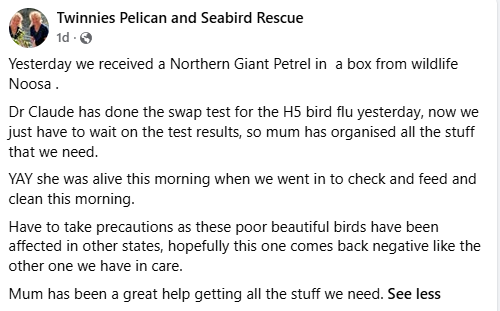
...
https://www.facebook.com/twinniespelicans/
By Jessica Ross and Kaitlyn Sawrey
ABC Sunshine Coast
7h ago
...
The wildlife rescuer's hazmat suit in Queensland's holiday hotspot drew plenty of attention, but his focus was on a northern giant petrel lying on the sand.
...
The sick bird was taken to RSPCA Queensland's Wildlife Rehabilitation Centre at Eumundi and swab tested on Saturday for H5 avian influenza (bird flu).
It was then transferred to Twinnies Pelican and Seabird Rescue at Landsborough, where it remains in quarantine.
...
https://www.abc.net.au/news/2026-07...a-amid-avian-influenza-preparations/106909104
----------------------------------------------------------------------------------
(screenshot)
...
https://www.facebook.com/twinniespelicans/
Pathfinder
Editor, Senior Moderator
Giant petrel found on Noosa Main Beach tests negative for H5 bird flu
8h ago
A northern giant petrel recovered from a Sunshine Coast beach has tested negative to H5 bird flu, authorities have confirmed.
The sick seabird was recovered by wildlife carers from Noosa Main Beach as part of routine duties on Saturday.
The giant petrel was taken to RSPCA Queensland's Wildlife Rehabilitation Centre where it underwent testing by Biosecurity Queensland as part of its surveillance program.
...
https://www.abc.net.au/news/2026-07-14/noosa-beach-giant-petrel-negative-h5-bird-flu/106915374
-------------------------------------------------------------------------------
(screenshot)
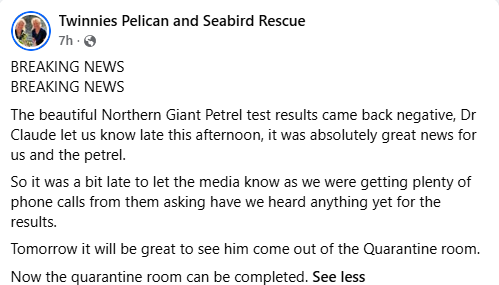
https://www.facebook.com/twinniespelicans/
8h ago
A northern giant petrel recovered from a Sunshine Coast beach has tested negative to H5 bird flu, authorities have confirmed.
The sick seabird was recovered by wildlife carers from Noosa Main Beach as part of routine duties on Saturday.
The giant petrel was taken to RSPCA Queensland's Wildlife Rehabilitation Centre where it underwent testing by Biosecurity Queensland as part of its surveillance program.
...
https://www.abc.net.au/news/2026-07-14/noosa-beach-giant-petrel-negative-h5-bird-flu/106915374
-------------------------------------------------------------------------------
(screenshot)
https://www.facebook.com/twinniespelicans/

Michael Coston
Editor, Senior Moderator
Australia: 8th Confirmed Bird Flu Detection in WA - Nationally Confirmed (N=14)

#19,247
Overnight Western Australia has confirmed an 8th H5N1 detection in a bird (petrel), found at Lancelin Beach (70 km North of Perth), and are awaiting confirmation from CSIRO on an additional a dead giant petrel, found on WA South Coast.
This from the WA government website, after which I'll have more on some of the challenges of collecting, transporting, and testing wildlife samples in Australia.
New bird flu cases at Lancelin and Denmark
Media release
Western Australia has recorded a new positive detection of H5 bird flu in a migratory seabird at Lancelin bringing the State’s total to eight confirmed cases.
Last updated: 15 July 2026
Western Australia has recorded a new positive detection of H5 bird flu in a migratory seabird at Lancelin bringing the State's total to eight confirmed cases.
Testing at the CSIRO's Australian Centre for Disease Preparedness this week confirmed the 'presumed positive' detection in a dead giant petrel, found at Lancelin Beach, north of Perth.
While testing was unable to fully determine the specific H5 bird flu strain, likely due to the sample quality from a decomposed carcass, it will be treated as a positive case.
On the WA South Coast, a dead giant petrel found at Parry Beach in Denmark has also tested positive for the H5 strain.
In this case, additional testing by CSIRO to confirm the H5 bird flu strain has not been finalised and may also not be possible due to carcass degradation. It is likely to be treated as a presumed positive detection.
Both cases were reported by members of the public to the Emergency Animal Disease (EAD) Hotline for further investigation.
There have been more than 1700 wildlife-related reports from WA to the hotline since the first confirmed case on 19 June. Of these reports, 283 have been assessed for further investigation or testing based on the likelihood of disease risk.
To date, a total of 117 negative test results have been recorded across the State.
The risk to human health remains low, but people are reminded to avoid handling the animals, record their observations by photo or video and report to the EAD hotline on 1800 675 888.
More information is available on the Australian Government's Bird flu (Avian influenza) website.
The logistics of following up each prioritized hotline report of dead birds are both extensive and time consuming:
While I've only seen aggregate totals posted by WA, it is apparent that the number of daily reports to their hotline far exceeds their ability to collect and test samples.

Graphic generated by Gemini
Over the past 12 days the number of tested samples has risen from 63 to 125 (avg 5/day), while the number of hotline reports has grown by 900 (avg 75/day). Even if we limit it to prioritized reports, that number has averaged 13.75/day.
Although testing has increased over the past 12 days, the number of new reports of sick or dead birds far outpaces those gains.

Graphic generated by Gemini
None of this is a criticism of Australia's response, only an acknowledgment of the enormity of the problem facing them. No surveillance and testing program can hope to capture more than a fraction of the HPAI activity in birds or animals in the wild.
What testing can do is give us an idea as to the spread, intensity, and host range of HPAI H5 across the continent. And sequencing can alert us to any reassortments or significant changes to the virus over time.
While the absolute number of confirmed detections remains small (n=14) - and we've seen no reports of outbreaks in poultry or mammalian wildlife - the trends are nevertheless concerning.
https://afludiary.blogspot.com/2026/07/australia-8th-confirm-bird-flu.html
#19,247
Overnight Western Australia has confirmed an 8th H5N1 detection in a bird (petrel), found at Lancelin Beach (70 km North of Perth), and are awaiting confirmation from CSIRO on an additional a dead giant petrel, found on WA South Coast.
This brings the nation's total to 14 confirmed.
This from the WA government website, after which I'll have more on some of the challenges of collecting, transporting, and testing wildlife samples in Australia.
New bird flu cases at Lancelin and Denmark
Media release
Western Australia has recorded a new positive detection of H5 bird flu in a migratory seabird at Lancelin bringing the State’s total to eight confirmed cases.
Last updated: 15 July 2026
Western Australia has recorded a new positive detection of H5 bird flu in a migratory seabird at Lancelin bringing the State's total to eight confirmed cases.
Testing at the CSIRO's Australian Centre for Disease Preparedness this week confirmed the 'presumed positive' detection in a dead giant petrel, found at Lancelin Beach, north of Perth.
While testing was unable to fully determine the specific H5 bird flu strain, likely due to the sample quality from a decomposed carcass, it will be treated as a positive case.
On the WA South Coast, a dead giant petrel found at Parry Beach in Denmark has also tested positive for the H5 strain.
In this case, additional testing by CSIRO to confirm the H5 bird flu strain has not been finalised and may also not be possible due to carcass degradation. It is likely to be treated as a presumed positive detection.
Both cases were reported by members of the public to the Emergency Animal Disease (EAD) Hotline for further investigation.
There have been more than 1700 wildlife-related reports from WA to the hotline since the first confirmed case on 19 June. Of these reports, 283 have been assessed for further investigation or testing based on the likelihood of disease risk.
To date, a total of 117 negative test results have been recorded across the State.
The risk to human health remains low, but people are reminded to avoid handling the animals, record their observations by photo or video and report to the EAD hotline on 1800 675 888.
More information is available on the Australian Government's Bird flu (Avian influenza) website.
The logistics of following up each prioritized hotline report of dead birds are both extensive and time consuming:
- Physically collecting and preserving carcasses (assuming they haven't been degraded by exposure or predation), often from remote regions.
- Preliminary tests are run by local/state agricultural institutes to quickly confirm the presence the H5 subtype
- Followed by packaging and sending biological samples to the only national testing laboratory (CSIRO Australian Centre for Disease Preparedness (ACDP) in Geelong, Victoria)
- Upon arrival, confirmation (and full sequencing) can take several days, assuming the sample had not degraded too badly.
While I've only seen aggregate totals posted by WA, it is apparent that the number of daily reports to their hotline far exceeds their ability to collect and test samples.
Graphic generated by Gemini
Over the past 12 days the number of tested samples has risen from 63 to 125 (avg 5/day), while the number of hotline reports has grown by 900 (avg 75/day). Even if we limit it to prioritized reports, that number has averaged 13.75/day.
Although testing has increased over the past 12 days, the number of new reports of sick or dead birds far outpaces those gains.
Graphic generated by Gemini
None of this is a criticism of Australia's response, only an acknowledgment of the enormity of the problem facing them. No surveillance and testing program can hope to capture more than a fraction of the HPAI activity in birds or animals in the wild.
What testing can do is give us an idea as to the spread, intensity, and host range of HPAI H5 across the continent. And sequencing can alert us to any reassortments or significant changes to the virus over time.
While the absolute number of confirmed detections remains small (n=14) - and we've seen no reports of outbreaks in poultry or mammalian wildlife - the trends are nevertheless concerning.
https://afludiary.blogspot.com/2026/07/australia-8th-confirm-bird-flu.html
Michael Coston
Editor, Senior Moderator
Australia: NSW Confirms 2nd Detection of H5N1 (National ttl=15)

#19,251
New South Wales has reported its 2nd confirmed H5N1 detection, bringing the nation's total to 15 (WA has at least one suspected case with results pending).
This brief update from Australia's Department of Agriculture.
https://afludiary.blogspot.com/2026/07/australia-nsw-confirms-2nd-detection-of.html
#19,251
New South Wales has reported its 2nd confirmed H5N1 detection, bringing the nation's total to 15 (WA has at least one suspected case with results pending).
As we discussed yesterday, the backlog of reported bird death reports is growing, and so confirmed cases likely significantly under represent the true incidence across the country.
This brief update from Australia's Department of Agriculture.
H5 bird flu testing updates
16 July 2026
Attributable to the Australian Chief Veterinary Officer, Dr Beth Cookson:
Testing at CSIRO’s Australian Centre for Disease Preparedness has confirmed a further positive detection of H5 high pathogenicity avian influenza (bird flu) in a petrel, found at Hawks Nest, New South Wales.
There have now been 15 confirmed or presumed positive detections of H5 bird flu in Australia.
All of these have been individual wild seabirds found in coastal locations. All but one have been wild migratory seabirds.
There remains no evidence of any mass mortality events and there are no detections in poultry or in our agricultural production system.
The risk to human health remains low.
16 July 2026
Attributable to the Australian Chief Veterinary Officer, Dr Beth Cookson:
Testing at CSIRO’s Australian Centre for Disease Preparedness has confirmed a further positive detection of H5 high pathogenicity avian influenza (bird flu) in a petrel, found at Hawks Nest, New South Wales.
There have now been 15 confirmed or presumed positive detections of H5 bird flu in Australia.
All of these have been individual wild seabirds found in coastal locations. All but one have been wild migratory seabirds.
There remains no evidence of any mass mortality events and there are no detections in poultry or in our agricultural production system.
The risk to human health remains low.
https://afludiary.blogspot.com/2026/07/australia-nsw-confirms-2nd-detection-of.html
Commonground
Senior Moderator
(The Shire of Northam is a local government area in the Wheatbelt region of Western Australia, beyond the northeastern fringe of the Perth metropolitan area centred on the town of Northam itself - wikipedia)
H5 Avian Influenza (Bird Flu) | Community Update
Published on Friday, 17 July 2026 at 4:52:42 PM
The Department of Primary Industries and Regional Development (DPIRD) has issued an update regarding H5 Avian Influenza (Bird Flu). Full details can be found here.
No cases have been reported locally at the time of posting.
https://www.northam.wa.gov.au/news/h5-avian-influenza-(bird-flu)-community-update/692
H5 Avian Influenza (Bird Flu) | Community Update
Published on Friday, 17 July 2026 at 4:52:42 PM
The Department of Primary Industries and Regional Development (DPIRD) has issued an update regarding H5 Avian Influenza (Bird Flu). Full details can be found here.
No cases have been reported locally at the time of posting.
https://www.northam.wa.gov.au/news/h5-avian-influenza-(bird-flu)-community-update/692
Pathfinder
Editor, Senior Moderator
H5 bird flu updates
17 July 2026
Attributable to the Australian Chief Veterinary Officer, Dr Beth Cookson:
Testing at CSIRO’s Australian Centre for Disease Preparedness has confirmed two presumed positive results for petrels, one found at Parry Beach in Denmark on Western Australia’s south coast and one found at Seabird, north of Perth.
The sequencing of the virus could not be determined for these cases, but the Western Australian Department of Primary Industries and Regional Development is treating them as a positive as a precautionary measure.
A range of factors can affect sequencing, particularly in wildlife samples from deceased animals.
There have now been 17 confirmed or presumed positive detections of H5 bird flu in Australia.
All of these have been individual wild seabirds found in coastal locations. All but one have been wild migratory seabirds.
There remains no evidence of any mass mortality events and there are no detections in poultry or in our agricultural production system.
The risk to human health remains low.
...
https://www.agriculture.gov.au/about/news/H5-bird-flu-updates
Commonground
Senior Moderator
Baby whale that died on Sydney beach to be tested for H5N1 bird flu
July 17, 2026 - 2.37am
A baby humpback whale will be tested for H5N1 bird flu after it washed up and died on a beach in Sydney’s south.
The 4.5-metre male calf was found at Greenhills Beach in Cronulla at 6.30am on Friday.
A member of the public alerted the Organisation for the Rescue and Research of Cetaceans in Australia (ORRCA).
...https://www.nine.com.au/australia-n...tested-for-h5n1-bird-flu-20260717-p60gaa.html
July 17, 2026 - 2.37am
A baby humpback whale will be tested for H5N1 bird flu after it washed up and died on a beach in Sydney’s south.
The 4.5-metre male calf was found at Greenhills Beach in Cronulla at 6.30am on Friday.
A member of the public alerted the Organisation for the Rescue and Research of Cetaceans in Australia (ORRCA).
...https://www.nine.com.au/australia-n...tested-for-h5n1-bird-flu-20260717-p60gaa.html
Michael Coston
Editor, Senior Moderator
Queensland Reports `Presumed Positive' H5N1 Test in Migratory Seabird

#19,259
After going a week without any new reports of H5N1 in Australia or New Zealand, overnight Queensland's Department of Agriculture announced that samples from a deceased petrel found on Moreton Island (25 miles N.E. of Brisbane) have (preliminarily) tested positive for H5N1.
Typically, even when CSIRO has been unable to fully sequence a sample, Australia has been treating local test results as `likely positive'. Two announcements from Queensland's government follows:

https://afludiary.blogspot.com/2026/07/queensland-reports-presumed-positive.html
#19,259
After going a week without any new reports of H5N1 in Australia or New Zealand, overnight Queensland's Department of Agriculture announced that samples from a deceased petrel found on Moreton Island (25 miles N.E. of Brisbane) have (preliminarily) tested positive for H5N1.
Initial testing was by the Queensland Government’s Biosecurity Sciences Laboratory (BSL). Samples have been forwarded to CSIRO’s Australian Centre for Disease Preparedness for confirmatory testing.
Typically, even when CSIRO has been unable to fully sequence a sample, Australia has been treating local test results as `likely positive'. Two announcements from Queensland's government follows:
Queensland detects first case of H5 bird flu
The Department of Primary Industries is responding to a suspect positive case of H5 high pathogenicity avian influenza (H5 bird flu) in Queensland.
This is Queensland’s first suspect positive case of H5 bird flu in a wild seabird.
Samples from a deceased petrel found on Moreton Island have tested positive for H5 bird flu during initial testing at the Queensland Government’s Biosecurity Sciences Laboratory (BSL).
Samples have been sent to CSIRO’s Australian Centre for Disease Preparedness for confirmatory testing.
Australia’s first case of H5 bird flu was reported on 20 June in Western Australia, with further detections in wild seabirds in WA, SA and NSW.
There remain no detections in poultry, nor evidence of large-scale deaths in any animals in Queensland.
The community is being urged to continue to report sick or dead wild birds.
Department of Primary Industries Chief Veterinary Officer Allison Crook said the suspect positive detection was expected and Queensland is well prepared for the next steps.
“We have known that a H5 bird flu detection in Queensland was a matter of when, not if,” Dr Crook said.
“The Queensland Government is well prepared to respond. This suspect positive result has not impacted our poultry sector or domestic wildlife,” she said.
“We are continuing our enhanced passive surveillance program throughout the state and would encourage the community and industry to continue to be vigilant,” Dr Crook said.
“If you find sick or dead wild birds or wildlife, avoid contact, keep children and pets away, record what you see, and report immediately to the Emergency Animal Disease Hotline on 1800 675 888.”
The Department of Primary Industries is responding to a suspect positive case of H5 high pathogenicity avian influenza (H5 bird flu) in Queensland.
This is Queensland’s first suspect positive case of H5 bird flu in a wild seabird.
Samples from a deceased petrel found on Moreton Island have tested positive for H5 bird flu during initial testing at the Queensland Government’s Biosecurity Sciences Laboratory (BSL).
Samples have been sent to CSIRO’s Australian Centre for Disease Preparedness for confirmatory testing.
Australia’s first case of H5 bird flu was reported on 20 June in Western Australia, with further detections in wild seabirds in WA, SA and NSW.
There remain no detections in poultry, nor evidence of large-scale deaths in any animals in Queensland.
The community is being urged to continue to report sick or dead wild birds.
Department of Primary Industries Chief Veterinary Officer Allison Crook said the suspect positive detection was expected and Queensland is well prepared for the next steps.
“We have known that a H5 bird flu detection in Queensland was a matter of when, not if,” Dr Crook said.
“The Queensland Government is well prepared to respond. This suspect positive result has not impacted our poultry sector or domestic wildlife,” she said.
“We are continuing our enhanced passive surveillance program throughout the state and would encourage the community and industry to continue to be vigilant,” Dr Crook said.
“If you find sick or dead wild birds or wildlife, avoid contact, keep children and pets away, record what you see, and report immediately to the Emergency Animal Disease Hotline on 1800 675 888.”
Suspect positive case of H5 bird flu
Biosecurity Queensland has detected suspect positive H5 bird flu in a deceased wild migratory seabird found on Moreton Island (Mulgulpin).
This result is not unexpected following the recent detections of H5 bird flu in Western Australia, South Australia and New South Wales.
On this page
What we are doing
What you need to do
Actions for bird and livestock owners
Signs of bird flu in birds
More information
What we are doing
We are:
Biosecurity Queensland has detected suspect positive H5 bird flu in a deceased wild migratory seabird found on Moreton Island (Mulgulpin).
This result is not unexpected following the recent detections of H5 bird flu in Western Australia, South Australia and New South Wales.
On this page
What we are doing
What you need to do
Actions for bird and livestock owners
Signs of bird flu in birds
More information
What we are doing
We are:
- continuing to carry out surveillance
- testing birds and animals
- working with industry, government agencies and response partners
- supporting strong biosecurity practices to help reduce the risk of spread
- keeping Queenslanders informed as the situation develops.
What you need to do
If you see sick or dead wild birds or wildlife:
If you see sick or dead wild birds or wildlife:
- Avoid contact with sick or dead birds, wildlife and their environment. Do not touch or collect them.
- Record what you see, if it is safe. Record the number of dead or sick birds or animals, the species, location, date and time. Take a photo if you can.
- Report sick or dead birds or wildlife to the Emergency Animal Disease Hotline on 1800 675 888.
Actions for bird and livestock owners
If you own, care for or work with poultry, review your biosecurity practices now. A strong biosecurity plan helps protect your birds and your property.
Bird and livestock owners should report unusual signs of disease or sudden deaths immediately to the Emergency Animal Disease Hotline on 1800 675 888.
Poultry owners should:
If you own, care for or work with poultry, review your biosecurity practices now. A strong biosecurity plan helps protect your birds and your property.
Bird and livestock owners should report unusual signs of disease or sudden deaths immediately to the Emergency Animal Disease Hotline on 1800 675 888.
Poultry owners should:
- keep poultry away from wild birds
- keep feed and water where wild birds cannot access it
- keep sheds, yards, aviaries and equipment clean
- limit visitors to areas where birds are kept
- ask essential visitors if they have recently been on other properties with poultry
- wash hands before and after handling birds and eggs
- change into clean footwear before entering poultry areas
- keep good records of bird movements or sales
- report unusual signs of disease or increased deaths in birds.
- Signs of bird flu in birds
- sudden death
- lack of coordination, tremors or swimming in circles
- twisted necks or other unusual posture
- inability to stand or fly
- diarrhoea
- difficulty breathing, coughing or sneezing
- swelling around the head, neck and eyes
- cloudiness or change in colour of the eyes.
Stay up to date with the H5 bird flu current situation in Queensland.
Visit birdflu.gov.au for more information.
Visit birdflu.gov.au for more information.
https://afludiary.blogspot.com/2026/07/queensland-reports-presumed-positive.html
Pathfinder
Editor, Senior Moderator
Doorstop in Adelaide, South Australia
24 July 2026
E&OE TRANSCRIPT
DOORSTOP
ADELAIDE
FRIDAY, 24 JULY 2026
SUBJECTS: H5 bird flu, Political donations
JULIE COLLINS, MINISTER FOR AGRICULTURE, FISHERIES AND FORESTRY: Good afternoon, testing at Queensland’s state laboratory has returned a suspected positive result for the H5 bird flu in samples taken from a deceased petrel found on Moreton Island off Brisbane. This would be the first case of H5 bird flu in Queensland, and it would be the fourth state with the detection of H5 bird flu. The samples have been sent to the CSIRO lab for confirmatory testing, and an update will be provided as soon as we have these lab results. This suspected positive follows the 17 confirmed or presumed positive cases of H5 bird flu in Western Australia, South Australia and New South Wales. Whilst this additional suspect case in Queensland is disappointing, it is a sign of our strong biosecurity working. All cases of the H5 bird flu in Australia have been detections in wild birds. Once again, I confirm that there is still no evidence of any mass mortality at this time in Australia from the H5 bird flu. Nor is there any evidence it has spread to any other animal populations at this time. There is also no evidence currently of any infections in our poultry or our agriculture system, and the risk to human health remains low. As you would be aware, our Government has been preparing for this. We’ve invested over $113 million to boost our H5 bird flu preparedness as part of our additional $2 billion investment into biosecurity since we’ve come to Government. The Australian response to our bird flu has been both swift and coordinated. Our national biosecurity response arrangements are in place and our experts continue to meet on a regular basis with our state and territory governments managing the on ground responses in each of those jurisdictions. Queensland is continuing enhanced surveillance programs throughout the state. And I have, of course, been in contact with the Queensland Agriculture Minister, Minister Perrett. I’m also continuing to receive regular briefings from our chief vet, Dr Beth Cookson, on the situation around Australia. Whilst here in Adelaide, I’ve also met with the South Australian Minister for Primary Industries, Minister Scriven, to discuss the ongoing response to the detection of the H5 bird flu in Australia and particularly here in South Australia. Once again, I do want to pass on my thanks to the Australian public. The public have been tremendous in terms of the reporting of sick or dead birds or animals. And I reiterate, if you do see a sick or a dead bird or animals, please do not touch them. Please avoid contact and please report them through our birdflu.gov.au, and to the national hotline number. Thanks very much, I’mhappy to take some questions.
JOURNALIST: Minister, are you worried about bird flu spreading to poultry farms and what’s been put in place in place to stop that?
COLLINS: Obviously we have been learning from the overseas experience, and certainly our best and strong defence is our biosecurity system. What you’ve been seeing here in Australia is our biosecurity system working in that we are getting early detections and at this stage in migratory birds or wild birds. We have had one Australian bird in the tern, but primarily they’ve all been migratory bird. But that tern obviously is still a wild bird that does sort of group with those other birds. And there has been no evidence of any transmission or mass mortalities here in Australia at this point. And I reiterate it is not in our poultry or agricultural systems.
JOURNALIST: Minister, when the federal Labor business forum asked you to go and talk to a donor, do you get a choice? Do you get the opportunity to say, “No, I don’t want to talk to that donor,” or is it a direction?
COLLINS: As I’m sure you’ll appreciate, my last meeting today has been with our Chief Vet, and I have been focused on the H5 bird flu.
JOURNALIST: It’s a broad question, though?
COLLINS: And I have been at many national Labor conferences over many years. And certainly my focus is on my role as a delegate and my role here as a Minister in my portfolio. And obviously, you know, we do meet with people and we do engage with people both here at National Conference and as a normal part of our job.
JOURNALIST: Do you think it’s a good look for the Prime Minister to be attending a high-profile, you know, event with a Chinese donor who appears to have some questionable links with the ATO and APRA? I mean it’s not a great look, is it?
COLLINS: What I would say to you is that political donations are entirely a matter for the party in that sense. They are disclosed in the usual manner.
JOURNALIST: So you don’t get a choice? You know, if it’s a matter for the party, does that mean you don’t get the chance to say, “No, I don’t want to meet with that donor”?
COLLINS: I meet and engage with people on a regular basis, as you would expect.
JOURNALIST: On the conference, I mean, yesterday we had more than 80 motions, like, that passed unanimously. There seems to be little or no debate on some contentious issues like gambling harm and voluntary assisted dying. Is the Labor Party selling its supporters short? Is this too much of a stage-managed affair?
COLLINS: Look, it’s great to be an ALP National Conference. I’ve been to many of them. Some of them have more robust debate than others. But what they’re about is about rank and file members of the Australian Labor Party having a say in one of Australia’s oldest and most democratic political parties. I’m a very proud member of the Australian Labor Party, and I’ve been attending conferences for decades, and they have been different at every single conference. I think what you see at this conference is a lot of robust debate, but primarily we agree on the direction of the country and we agree on the principles and the aspirations that we have for this nation.
JOURNALIST: Wildlife groups want the Federal Government to invest $200 million to limit other threats to vulnerable wildlife from bird flu. Is the Government considering this sort of funding?
COLLINS: We’ve been working very closely with Wildlife Australia and with experts in this area. As I said, we have invested early. The $113 million to be as prepared as we can be. We have done an assessment of threatened species in Australia knowing that the H5 bird flu does get into mammals, and we have seen that elsewhere across the globe. We have certainly been investing in terms of making sure that we are doing everything that we can do as a Federal Government working with industry and working with those experts, particularly wildlife, about what needs to be done. And that’s what you’ve seen from us. We’ve strengthened biosecurity, for instance, on threatened species in our zoos and aquariums across the country. And we’ve used some of that early investment money to be able to do that. In the last Budget in Minister Watt’s portfolio, there was an additional $99 million for the Saving Native Species program. But we continue to engage with experts about what else we may need to do as a federal and state government working together with industry and with experts in terms of our wildlife.
JOURNALIST: We’ve now seen bird flu in nearly every state. Have we lost the fight on keeping it out of Australia? Is it here to stay?
COLLINS: Well, we’ve always been very clear that it would get to Australia eventually. And obviously we are the last continent to get the bird flu. We’ve seen it come via migratory birds. The fact that we have detected it so early, and the fact that we're detecting it in migratory birds before there’s any evidence of widespread mass mortalities or transmission in Australia continues to give us time to continue to lockdown and prepare and do everything that we need to do as a country to be as secure as we possibly can. Those additional two years have brought us more preparedness and we have not wasted a day of that. We’ve invested early and made sure we’re as prepared as we possibly can be. But obviously this is a very virulent strain, and it’s highly contagious.
JOURNALIST: So what are the poultry farms doing to lockdown? How does that work?
COLLINS: So we’ve been working with the industry in terms of their resilience and their redundancy, investing in their biosecurity systems and being as strong as they can be, particularly about how this may get into the system and making sure that we are protected as much as we possibly can. As I’ve said in the past, we’ve had two outbreaks of the H7 bird flu virus in Australia in the last five or so years. We’ve managed to successfully eradicate those working with industry and governments, state and federal, together.
JOURNALIST: Just one more on donations. What would you say to a member of the public, there’s already a pretty low trust in politicians in Australian politics. What would you say to a member of the Australian public who might feel pretty skeptical to hear Ministers who effectively have a pay-for-access situation going on simply saying, “It’s a matter for the party”? Like, they aren’t willing to actually answer questions about the donors that they meet and the circumstances in which they meet them. Like, doesn’t that just erode trust?
COLLINS: I’ve obviously answered your questions and that I meet with a range of people on a regular basis all the time. As you would expect in my portfolio, it’s a very broad portfolio, and I continue to meet with them. In terms of donations, they are disclosed, as they should be, in the regular course as they usually would be. I don’t think the fact that there are donations in Australia’s political process would come as a surprise to Australians. And as a Government we have strengthened those disclosure and donation laws, because we needed to for Australia to make sure that our democratic system is robust as it needs to be.
https://minister.agriculture.gov.au...transcripts/doorstop-adelaide-south-australia
24 July 2026
E&OE TRANSCRIPT
DOORSTOP
ADELAIDE
FRIDAY, 24 JULY 2026
SUBJECTS: H5 bird flu, Political donations
JULIE COLLINS, MINISTER FOR AGRICULTURE, FISHERIES AND FORESTRY: Good afternoon, testing at Queensland’s state laboratory has returned a suspected positive result for the H5 bird flu in samples taken from a deceased petrel found on Moreton Island off Brisbane. This would be the first case of H5 bird flu in Queensland, and it would be the fourth state with the detection of H5 bird flu. The samples have been sent to the CSIRO lab for confirmatory testing, and an update will be provided as soon as we have these lab results. This suspected positive follows the 17 confirmed or presumed positive cases of H5 bird flu in Western Australia, South Australia and New South Wales. Whilst this additional suspect case in Queensland is disappointing, it is a sign of our strong biosecurity working. All cases of the H5 bird flu in Australia have been detections in wild birds. Once again, I confirm that there is still no evidence of any mass mortality at this time in Australia from the H5 bird flu. Nor is there any evidence it has spread to any other animal populations at this time. There is also no evidence currently of any infections in our poultry or our agriculture system, and the risk to human health remains low. As you would be aware, our Government has been preparing for this. We’ve invested over $113 million to boost our H5 bird flu preparedness as part of our additional $2 billion investment into biosecurity since we’ve come to Government. The Australian response to our bird flu has been both swift and coordinated. Our national biosecurity response arrangements are in place and our experts continue to meet on a regular basis with our state and territory governments managing the on ground responses in each of those jurisdictions. Queensland is continuing enhanced surveillance programs throughout the state. And I have, of course, been in contact with the Queensland Agriculture Minister, Minister Perrett. I’m also continuing to receive regular briefings from our chief vet, Dr Beth Cookson, on the situation around Australia. Whilst here in Adelaide, I’ve also met with the South Australian Minister for Primary Industries, Minister Scriven, to discuss the ongoing response to the detection of the H5 bird flu in Australia and particularly here in South Australia. Once again, I do want to pass on my thanks to the Australian public. The public have been tremendous in terms of the reporting of sick or dead birds or animals. And I reiterate, if you do see a sick or a dead bird or animals, please do not touch them. Please avoid contact and please report them through our birdflu.gov.au, and to the national hotline number. Thanks very much, I’mhappy to take some questions.
JOURNALIST: Minister, are you worried about bird flu spreading to poultry farms and what’s been put in place in place to stop that?
COLLINS: Obviously we have been learning from the overseas experience, and certainly our best and strong defence is our biosecurity system. What you’ve been seeing here in Australia is our biosecurity system working in that we are getting early detections and at this stage in migratory birds or wild birds. We have had one Australian bird in the tern, but primarily they’ve all been migratory bird. But that tern obviously is still a wild bird that does sort of group with those other birds. And there has been no evidence of any transmission or mass mortalities here in Australia at this point. And I reiterate it is not in our poultry or agricultural systems.
JOURNALIST: Minister, when the federal Labor business forum asked you to go and talk to a donor, do you get a choice? Do you get the opportunity to say, “No, I don’t want to talk to that donor,” or is it a direction?
COLLINS: As I’m sure you’ll appreciate, my last meeting today has been with our Chief Vet, and I have been focused on the H5 bird flu.
JOURNALIST: It’s a broad question, though?
COLLINS: And I have been at many national Labor conferences over many years. And certainly my focus is on my role as a delegate and my role here as a Minister in my portfolio. And obviously, you know, we do meet with people and we do engage with people both here at National Conference and as a normal part of our job.
JOURNALIST: Do you think it’s a good look for the Prime Minister to be attending a high-profile, you know, event with a Chinese donor who appears to have some questionable links with the ATO and APRA? I mean it’s not a great look, is it?
COLLINS: What I would say to you is that political donations are entirely a matter for the party in that sense. They are disclosed in the usual manner.
JOURNALIST: So you don’t get a choice? You know, if it’s a matter for the party, does that mean you don’t get the chance to say, “No, I don’t want to meet with that donor”?
COLLINS: I meet and engage with people on a regular basis, as you would expect.
JOURNALIST: On the conference, I mean, yesterday we had more than 80 motions, like, that passed unanimously. There seems to be little or no debate on some contentious issues like gambling harm and voluntary assisted dying. Is the Labor Party selling its supporters short? Is this too much of a stage-managed affair?
COLLINS: Look, it’s great to be an ALP National Conference. I’ve been to many of them. Some of them have more robust debate than others. But what they’re about is about rank and file members of the Australian Labor Party having a say in one of Australia’s oldest and most democratic political parties. I’m a very proud member of the Australian Labor Party, and I’ve been attending conferences for decades, and they have been different at every single conference. I think what you see at this conference is a lot of robust debate, but primarily we agree on the direction of the country and we agree on the principles and the aspirations that we have for this nation.
JOURNALIST: Wildlife groups want the Federal Government to invest $200 million to limit other threats to vulnerable wildlife from bird flu. Is the Government considering this sort of funding?
COLLINS: We’ve been working very closely with Wildlife Australia and with experts in this area. As I said, we have invested early. The $113 million to be as prepared as we can be. We have done an assessment of threatened species in Australia knowing that the H5 bird flu does get into mammals, and we have seen that elsewhere across the globe. We have certainly been investing in terms of making sure that we are doing everything that we can do as a Federal Government working with industry and working with those experts, particularly wildlife, about what needs to be done. And that’s what you’ve seen from us. We’ve strengthened biosecurity, for instance, on threatened species in our zoos and aquariums across the country. And we’ve used some of that early investment money to be able to do that. In the last Budget in Minister Watt’s portfolio, there was an additional $99 million for the Saving Native Species program. But we continue to engage with experts about what else we may need to do as a federal and state government working together with industry and with experts in terms of our wildlife.
JOURNALIST: We’ve now seen bird flu in nearly every state. Have we lost the fight on keeping it out of Australia? Is it here to stay?
COLLINS: Well, we’ve always been very clear that it would get to Australia eventually. And obviously we are the last continent to get the bird flu. We’ve seen it come via migratory birds. The fact that we have detected it so early, and the fact that we're detecting it in migratory birds before there’s any evidence of widespread mass mortalities or transmission in Australia continues to give us time to continue to lockdown and prepare and do everything that we need to do as a country to be as secure as we possibly can. Those additional two years have brought us more preparedness and we have not wasted a day of that. We’ve invested early and made sure we’re as prepared as we possibly can be. But obviously this is a very virulent strain, and it’s highly contagious.
JOURNALIST: So what are the poultry farms doing to lockdown? How does that work?
COLLINS: So we’ve been working with the industry in terms of their resilience and their redundancy, investing in their biosecurity systems and being as strong as they can be, particularly about how this may get into the system and making sure that we are protected as much as we possibly can. As I’ve said in the past, we’ve had two outbreaks of the H7 bird flu virus in Australia in the last five or so years. We’ve managed to successfully eradicate those working with industry and governments, state and federal, together.
JOURNALIST: Just one more on donations. What would you say to a member of the public, there’s already a pretty low trust in politicians in Australian politics. What would you say to a member of the Australian public who might feel pretty skeptical to hear Ministers who effectively have a pay-for-access situation going on simply saying, “It’s a matter for the party”? Like, they aren’t willing to actually answer questions about the donors that they meet and the circumstances in which they meet them. Like, doesn’t that just erode trust?
COLLINS: I’ve obviously answered your questions and that I meet with a range of people on a regular basis all the time. As you would expect in my portfolio, it’s a very broad portfolio, and I continue to meet with them. In terms of donations, they are disclosed, as they should be, in the regular course as they usually would be. I don’t think the fact that there are donations in Australia’s political process would come as a surprise to Australians. And as a Government we have strengthened those disclosure and donation laws, because we needed to for Australia to make sure that our democratic system is robust as it needs to be.
https://minister.agriculture.gov.au...transcripts/doorstop-adelaide-south-australia
Michael Coston
Editor, Senior Moderator
Australia: CSIRO Confirms Qld's H5N1 - SA Reports 2 `Suspected' Local Birds

Confirmed Positive H5N1 in Birds (n=18)
#19,261
While there was never much doubt, we now have confirmation from Australia's National Lab CSIRO that the seabird recovered from Moreton Island (25 miles N.E. of Brisbane) has tested positive for H5N1.
H5 bird flu confirmed in a wild seabird found at Moreton Island
A dead petrel found by Queensland Parks and Wildlife Service (QPWS) rangers at Moreton Island (Mulgulpin) has been confirmed positive for H5 high pathogenicity avian influenza (H5 bird flu) in laboratory tests by the CSIRO Australian Centre for Disease Preparedness.
The positive test is the first confirmed detection of H5 bird flu in Queensland.
There remain no detections in poultry, nor evidence of large-scale deaths in any animals in Queensland.
The risk to human health remains low.
The community is being urged to continue to report sick or dead wild birds.
Queensland has been preparing for H5 bird flu and has strong response arrangements in place. Australia also has national arrangements to respond to emergency animal disease incidents.
Australia’s first case of H5 bird flu was reported on 20 June 2026 in Western Australia, with further detections in wild seabirds in WA, SA and NSW.
Department of Primary Industries Chief Veterinary Officer Dr Allison Crook said the confirmed positive detection was expected, and the Queensland Government was well prepared to respond.
“We have known that a H5 bird flu detection in Queensland was a matter of when, not if,” Dr Crook said.
“This confirmed positive result has not impacted our poultry sector or native wildlife.
“We have further escalated our surveillance program throughout the state, and are delivering heightened H5 bird flu awareness and engagement activities to ensure industries and communities know what to do.
“There have been more than 1,000 reports from Queensland to the hotline since the first reported case on 20 June 2026, and I thank the public for their support.
“I encourage the community and industry to continue to be vigilant,” Dr Crook said.
“If you find sick or dead wild birds or wildlife, avoid contact, keep children and pets away, record what you see, and report immediately to the Emergency Animal Disease Hotline on 1800 675 888.”
Meanwhile Australia's ABC News is reporting that South Australia has recovered 2 deceased local birds (greater crested terns), and has sent samples to CSIRO for confirmation. While not explicitly stated in the article, this generally indicates a local test has returned a positive result.
While I haven't found any official press releases, ABC News quotes SA Environment Minister Emily Bourke as saying one of these birds was recovered just 4 km from where Australia's first local infected seabird was detected earlier this month.
They quote the SA Environmental Minister as saying:
Until now, all but one detection of H5N1 in Australian seabirds have been in migratory species. Additional spread in local birds, while not unexpected, increases the chances of H5 establishing a permanent beach head.
Results from CSIRO are expected early next week.
https://afludiary.blogspot.com/2026/07/australia-csiro-confirms-qlds-h5n1-sa.html
Confirmed Positive H5N1 in Birds (n=18)
#19,261
While there was never much doubt, we now have confirmation from Australia's National Lab CSIRO that the seabird recovered from Moreton Island (25 miles N.E. of Brisbane) has tested positive for H5N1.
H5 bird flu confirmed in a wild seabird found at Moreton Island
A dead petrel found by Queensland Parks and Wildlife Service (QPWS) rangers at Moreton Island (Mulgulpin) has been confirmed positive for H5 high pathogenicity avian influenza (H5 bird flu) in laboratory tests by the CSIRO Australian Centre for Disease Preparedness.
The positive test is the first confirmed detection of H5 bird flu in Queensland.
There remain no detections in poultry, nor evidence of large-scale deaths in any animals in Queensland.
The risk to human health remains low.
The community is being urged to continue to report sick or dead wild birds.
Queensland has been preparing for H5 bird flu and has strong response arrangements in place. Australia also has national arrangements to respond to emergency animal disease incidents.
Australia’s first case of H5 bird flu was reported on 20 June 2026 in Western Australia, with further detections in wild seabirds in WA, SA and NSW.
Department of Primary Industries Chief Veterinary Officer Dr Allison Crook said the confirmed positive detection was expected, and the Queensland Government was well prepared to respond.
“We have known that a H5 bird flu detection in Queensland was a matter of when, not if,” Dr Crook said.
“This confirmed positive result has not impacted our poultry sector or native wildlife.
“We have further escalated our surveillance program throughout the state, and are delivering heightened H5 bird flu awareness and engagement activities to ensure industries and communities know what to do.
“There have been more than 1,000 reports from Queensland to the hotline since the first reported case on 20 June 2026, and I thank the public for their support.
“I encourage the community and industry to continue to be vigilant,” Dr Crook said.
“If you find sick or dead wild birds or wildlife, avoid contact, keep children and pets away, record what you see, and report immediately to the Emergency Animal Disease Hotline on 1800 675 888.”
Meanwhile Australia's ABC News is reporting that South Australia has recovered 2 deceased local birds (greater crested terns), and has sent samples to CSIRO for confirmation. While not explicitly stated in the article, this generally indicates a local test has returned a positive result.
While I haven't found any official press releases, ABC News quotes SA Environment Minister Emily Bourke as saying one of these birds was recovered just 4 km from where Australia's first local infected seabird was detected earlier this month.
They quote the SA Environmental Minister as saying:
"Unfortunately, we are finding that these two cases are in our local [bird] species, so we need to send these tests off now to Geelong for them to have confirmation at that centralised location that they are, or are not, the H5 high strand of this disease."
Until now, all but one detection of H5N1 in Australian seabirds have been in migratory species. Additional spread in local birds, while not unexpected, increases the chances of H5 establishing a permanent beach head.
Results from CSIRO are expected early next week.
https://afludiary.blogspot.com/2026/07/australia-csiro-confirms-qlds-h5n1-sa.html
Pathfinder
Editor, Senior Moderator
H5 bird flu updates
25 July 2026
Attributable to the Acting Australian Chief Veterinary Officer, Dr Sam Hamilton:
Testing at CSIRO’s Australian Centre for Disease Preparedness (ACDP) has confirmed a positive H5 bird flu result for a petrel found on Moreton Island, Queensland.
There have now been 18 confirmed or presumed positive detections of H5 bird flu in Australia.
All of these have been individual wild seabirds found in coastal locations.
There remains no evidence of any mass mortality events and there are no detections in poultry or in our agricultural production system.
The risk to human health remains low.
...
https://www.agriculture.gov.au/about/news/H5-bird-flu-updates
Michael Coston
Editor, Senior Moderator
South Australia Confirms 6th & 7th Seabird Infection - National Ttl = 20

#19,263
As mentioned yesterday, Australia's National Lab CSIRO was testing samples from 2 suspected H5N1 infected seabirds from South Australia. Not unexpectedly, both have now been confirmed, bringing the nation's total to 20 detections.
While most of these H5N1 infections have been found in migratory seabirds, 3 of the 7 from South Australia have been in local seabirds (greater crested terns).
Two brief updates. First from https://www.birdflu.sa.gov.au/
Current situation
South Australia’s first confirmed detection of H5 bird flu was in a wild migratory bird (southern giant petrel) on Wednesday, 24 June at Knights Beach at Port Elliot on the Fleurieu Peninsula.
Further confirmed detections include a giant petrel (8 July at Hardwicke Bay, Yorke Peninsula); a southern giant petrel (10 July at Emu Bay, Kangaroo Island); a northern giant petrel (10 July at Port Vincent, Yorke Peninsula); and three greater crested terns (10 July at Robe, Limestone Coast; 26 July at Semaphore, metro Adelaide; and 26 July at Robe, Limestone Coast).
The strain of virus is consistent with the strain detected in the Southern Indian Ocean Sub-Antarctic Territories, including Heard Island.
This strain has not been detected in poultry and has not become established in any part of Australia.
Up-to-date national information is available at birdflu.gov.au.
Second, from national birdflu.gov.au website.
Detection of H5 bird flu
As of 1.00 pm AEST, 26 July 2026, Australia has 20 confirmed detections of H5 bird flu in wild seabirds.
There have been no detections in poultry or the wider agriculture industry. There is no evidence of any large scale deaths.
The Consultative Committee for Emergency Animal Disease (CCEAD) has reviewed its previous advice and continues to support heightened biosecurity measures in poultry for up to a further two weeks while risk-based guidance is finalised. This includes options for states and territories to utilise non-mandatory measures, including voluntary housing of free-range poultry where practical and consistent with animal welfare requirements.
State and territory governments are responsible for surveillance and response activities on the ground. They are actively working with industry to provide guidance on implementation of enhanced biosecurity measures, as appropriate. Find out more about bird flu in your state or territory.
National coordination is being led by the Department of Agriculture, Fisheries and Forestry (DAFF).
The risk to human health remains low.
Australia is well prepared to respond quickly.
https://afludiary.blogspot.com/2026/07/south-australia-confirms-6th-7th.html
#19,263
As mentioned yesterday, Australia's National Lab CSIRO was testing samples from 2 suspected H5N1 infected seabirds from South Australia. Not unexpectedly, both have now been confirmed, bringing the nation's total to 20 detections.
While most of these H5N1 infections have been found in migratory seabirds, 3 of the 7 from South Australia have been in local seabirds (greater crested terns).
Two brief updates. First from https://www.birdflu.sa.gov.au/
Current situation
South Australia’s first confirmed detection of H5 bird flu was in a wild migratory bird (southern giant petrel) on Wednesday, 24 June at Knights Beach at Port Elliot on the Fleurieu Peninsula.
Further confirmed detections include a giant petrel (8 July at Hardwicke Bay, Yorke Peninsula); a southern giant petrel (10 July at Emu Bay, Kangaroo Island); a northern giant petrel (10 July at Port Vincent, Yorke Peninsula); and three greater crested terns (10 July at Robe, Limestone Coast; 26 July at Semaphore, metro Adelaide; and 26 July at Robe, Limestone Coast).
The strain of virus is consistent with the strain detected in the Southern Indian Ocean Sub-Antarctic Territories, including Heard Island.
This strain has not been detected in poultry and has not become established in any part of Australia.
Up-to-date national information is available at birdflu.gov.au.
Second, from national birdflu.gov.au website.
Detection of H5 bird flu
As of 1.00 pm AEST, 26 July 2026, Australia has 20 confirmed detections of H5 bird flu in wild seabirds.
- 10 in Western Australia (WA)
- 7 in South Australia (SA)
- 2 in New South Wales (NSW)
- 1 in Queensland (QLD).
There have been no detections in poultry or the wider agriculture industry. There is no evidence of any large scale deaths.
The Consultative Committee for Emergency Animal Disease (CCEAD) has reviewed its previous advice and continues to support heightened biosecurity measures in poultry for up to a further two weeks while risk-based guidance is finalised. This includes options for states and territories to utilise non-mandatory measures, including voluntary housing of free-range poultry where practical and consistent with animal welfare requirements.
State and territory governments are responsible for surveillance and response activities on the ground. They are actively working with industry to provide guidance on implementation of enhanced biosecurity measures, as appropriate. Find out more about bird flu in your state or territory.
National coordination is being led by the Department of Agriculture, Fisheries and Forestry (DAFF).
The risk to human health remains low.
Australia is well prepared to respond quickly.
https://afludiary.blogspot.com/2026/07/south-australia-confirms-6th-7th.html
Michael Coston
Editor, Senior Moderator
South Australia Reports 7 More `Suspect' H5N1 Detections In Native Shore Birds

Video Link
#19,264
Once again Southern Australia is reporting a number (n=7) of `presumed positive' H5N1 tests in local seabirds, all found in greater crested terns recovered on the state's southeast Limestone Coast (5 at Southend Jetty near Beachport, plus 1 at Cape Jaffa and 1 at Port MacDonnell).
Some of the birds were sick, while others were dead. This comes on the heels of yesterday's announcement of South Australia Confirms 6th & 7th Seabird Infection - National Ttl = 20,
Samples from all 7 birds have been sent to the National laboratory CSIRO for confirmation and WGS (Whole Gene Sequencing). If confirmed, this would bring the nation's total to 27.
Authorities continue to stress that, so far, there have been no detections in poultry, or indications of any large-scale deaths in wildlife. This recent change, however - from detections in migratory seabirds to local species - raises new concerns over how the virus may be spreading.
Add in the close proximity of these recent reports to denser poultry production regions, and spillovers into the agricultural section become a genuine concern.
A few hours ago Professor Raina MacIntyre posted the following on X, showing the recent H5N1 detections overlaid on a map of poultry production regions.

You can visit the interactive map at EPIWATCH.

While past performance isn't always a guarantee of future results, the unfortunate history with HPAI H5N1 - particularly over the past 5 years - has been once it reaches new territories, it tends to establish itself fairly quickly in local wildlife.
We should expect an update from CSIRO in the next couple of days.
Stay tuned.
https://afludiary.blogspot.com/2026/07/south-australia-reports-7-more-suspect.html
Video Link
#19,264
Once again Southern Australia is reporting a number (n=7) of `presumed positive' H5N1 tests in local seabirds, all found in greater crested terns recovered on the state's southeast Limestone Coast (5 at Southend Jetty near Beachport, plus 1 at Cape Jaffa and 1 at Port MacDonnell).
Some of the birds were sick, while others were dead. This comes on the heels of yesterday's announcement of South Australia Confirms 6th & 7th Seabird Infection - National Ttl = 20,
Samples from all 7 birds have been sent to the National laboratory CSIRO for confirmation and WGS (Whole Gene Sequencing). If confirmed, this would bring the nation's total to 27.
Authorities continue to stress that, so far, there have been no detections in poultry, or indications of any large-scale deaths in wildlife. This recent change, however - from detections in migratory seabirds to local species - raises new concerns over how the virus may be spreading.
Add in the close proximity of these recent reports to denser poultry production regions, and spillovers into the agricultural section become a genuine concern.
A few hours ago Professor Raina MacIntyre posted the following on X, showing the recent H5N1 detections overlaid on a map of poultry production regions.
You can visit the interactive map at EPIWATCH.
While past performance isn't always a guarantee of future results, the unfortunate history with HPAI H5N1 - particularly over the past 5 years - has been once it reaches new territories, it tends to establish itself fairly quickly in local wildlife.
We should expect an update from CSIRO in the next couple of days.
Stay tuned.
https://afludiary.blogspot.com/2026/07/south-australia-reports-7-more-suspect.html
Pathfinder
Editor, Senior Moderator
South Australia records spike in bird flu cases
...
Jackson Robb
July 27, 2026 - 4:48PM
NewsWire
...
Federal Agricultural Minister Julie Collins said several terns had been sent to a CSIRO testing facility to understand how the deadly virus had been transmitted.
“We have overnight had seven further suspected cases from South Australia,” Ms Collins said.
“These have now been raced off to the CSIRO laboratory in terms of determining whether or not … that means we have local transmission here in Australia or not.”
...
https://www.news.com.au/technology/...s/news-story/6c0bd4e13b26f13737ea1390abef39b6
...
Jackson Robb
July 27, 2026 - 4:48PM
NewsWire
...
Federal Agricultural Minister Julie Collins said several terns had been sent to a CSIRO testing facility to understand how the deadly virus had been transmitted.
“We have overnight had seven further suspected cases from South Australia,” Ms Collins said.
“These have now been raced off to the CSIRO laboratory in terms of determining whether or not … that means we have local transmission here in Australia or not.”
...
https://www.news.com.au/technology/...s/news-story/6c0bd4e13b26f13737ea1390abef39b6
Michael Coston
Editor, Senior Moderator
New Zealand to Require Biosecurity Plans From Poultry Sector as Australia's H5N1 Count Rises to 27

#19,265
No unexpectedly, the results overnight from Australia's National Lab CSIRO have confirmed the 7 suspected bird flu detections reported yesterday in Southern Australia, doubling their total to 14.
H5 bird flu updates
28 July 2026
Attributable to Australian Chief Veterinary Officer, Dr Beth Cookson:
Testing at CSIRO’s Australian Centre for Disease Preparedness (ACDP) has confirmed H5 bird flu in 7 greater crested terns found in South Australia.
Of these, 1 was found at Cape Jaffa, 5 at Southend and 1 at Port MacDonnell.
There have now been 27 confirmed or presumed positive detections of H5 bird flu in Australia.
All of these have been wild seabirds found in coastal locations. Further laboratory analysis will be undertaken to help determine if there is evidence of local transmission.
There remains no evidence of any mass mortality events and there are no detections in poultry or in our agricultural production system.
Notably, these are native seabirds (greater crested terns), which raises concerns over the local transmission of the virus. Additional genetic testing is underway to try to determine transmission dynamics.
Meanwhile, the tally in New Zealand remains at 2, but officials fully expect that number to increase. Two weeks ago, New Zealand's Associate Biosecurity Minister Andrew Hoggard made it clear that - unlike a lot of other countries - the government would not be compensating poultry farmers for losses.
Overnight New Zealand announced plans to require poultry farmers (flocks > 100) to create and submit biosecurity plans - including the management of any outbreaks - to the government by the end of the year.
28 July 2026
Poultry sector gets stronger biosecurity backing to fight bird flu
Hon Andrew Hoggard
Biosecurity
The Government is introducing new biosecurity regulations to help poultry farmers manage H5 bird flu, protect livelihoods, and secure domestic food supply, Biosecurity Minister Andrew Hoggard says.
“Now that H5 bird flu is here, it will almost certainly establish in wild birds.
“Cabinet has approved regulations to ensure the sector has the practices, infrastructure, reporting, and compliance tools needed to manage that risk.”
Poultry operators with more than 100 birds will be required to develop, register, and implement a farm biosecurity plan for avian disease, setting out how they will prevent and manage H5 bird flu.
“Biosecurity measures are currently voluntary in the poultry sector. While there is strong industry co-operation, farmers doing the right thing can still be put at risk by those who are not.”
“Biosecurity New Zealand and industry have been working together on a long-term approach to managing H5 bird flu. There is a good understanding of what good on-farm biosecurity looks like and plenty of information available to poultry farmers through the industry’s bird flu website”
“MPI is available, especially for smaller operators, through it’s On Farm Support team to help with the development of biosecurity plans and enhanced preparedness, including response plans.”
The regulations will focus on outcomes and the risks operators must manage, while giving them flexibility in how they do it.
Operators will need to keep records, undergo audits, and show clear plans for humane culling, disposal, cleaning, and disinfection if their operation is affected.
“When H5 bird flu becomes widespread in wild birds, poultry operators will face a constant infection risk. These regulations will lift on-farm readiness and give farmers the best possible chance to protect their businesses.”
Mr Hoggard says regulating the sector under the Biosecurity Act 1993 will also help protect food supply, trade, wild and captive birds, other animals, and people.
MPI consulted on the proposed regulations late last year and received 36 submissions, with feedback broadly supportive.
The regulations will now be drafted and shared with the industry bodies before coming into force by the end of 2026.
While full details haven't been fleshed out, last August the MPI and the poultry industry signed an agreement on biosecurity, whereby the costs would be shared by both parties.
“This agreement formally recognises industry bodies as decision-makers, alongside the Government, guaranteeing PIANZ and EPF a seat at the table if any of these diseases are detected in New Zealand.”
The agreement covers Newcastle disease, infectious bursal disease virus and all strains of high pathogenicity avian influenza (HPAI), including the HPAI strain H5N1 clade 2.3.4.4b.
“Importantly, the agreement also sets out cost-sharing arrangements between taxpayers and the industry. This recognises the benefits to both parties of being well prepared, reporting early, and responding rapidly,” says Mr Hoggard.
“By sharing the costs of preparation and response, we ensure there are strong incentives on farmers to take preventative measures while also encouraging them to report suspected disease as soon as possible.”
Under the agreement, industry will contribute 45 per cent of readiness costs for all poultry diseases and 45 per cent of response costs, with the exception of HPAI – for which industry will meet 40 per cent of the response costs.
Readiness costs can include the cost of developing plans for response operational activities, running exercises for testing plans, and applied research to improve response operations. Response costs can include diagnostics, communications and activities to control a disease.
For backyard flock owners (with < 100 birds), the MPI offers the the following advice:
Bird flu and protecting your birds and other pets
While New Zealand has been planning for this grim eventuality for years, even countries with decades of experience dealing with H5N1 continue to find biosecurity a challenge.
For more, you may wish to revisit:

https://afludiary.blogspot.com/2026/07/new-zealand-to-require-biosecurity.html
#19,265
No unexpectedly, the results overnight from Australia's National Lab CSIRO have confirmed the 7 suspected bird flu detections reported yesterday in Southern Australia, doubling their total to 14.
H5 bird flu updates
28 July 2026
Attributable to Australian Chief Veterinary Officer, Dr Beth Cookson:
Testing at CSIRO’s Australian Centre for Disease Preparedness (ACDP) has confirmed H5 bird flu in 7 greater crested terns found in South Australia.
Of these, 1 was found at Cape Jaffa, 5 at Southend and 1 at Port MacDonnell.
There have now been 27 confirmed or presumed positive detections of H5 bird flu in Australia.
All of these have been wild seabirds found in coastal locations. Further laboratory analysis will be undertaken to help determine if there is evidence of local transmission.
There remains no evidence of any mass mortality events and there are no detections in poultry or in our agricultural production system.
Notably, these are native seabirds (greater crested terns), which raises concerns over the local transmission of the virus. Additional genetic testing is underway to try to determine transmission dynamics.
Meanwhile, the tally in New Zealand remains at 2, but officials fully expect that number to increase. Two weeks ago, New Zealand's Associate Biosecurity Minister Andrew Hoggard made it clear that - unlike a lot of other countries - the government would not be compensating poultry farmers for losses.
Overnight New Zealand announced plans to require poultry farmers (flocks > 100) to create and submit biosecurity plans - including the management of any outbreaks - to the government by the end of the year.
28 July 2026
Poultry sector gets stronger biosecurity backing to fight bird flu
Hon Andrew Hoggard
Biosecurity
The Government is introducing new biosecurity regulations to help poultry farmers manage H5 bird flu, protect livelihoods, and secure domestic food supply, Biosecurity Minister Andrew Hoggard says.
“Now that H5 bird flu is here, it will almost certainly establish in wild birds.
“Cabinet has approved regulations to ensure the sector has the practices, infrastructure, reporting, and compliance tools needed to manage that risk.”
Poultry operators with more than 100 birds will be required to develop, register, and implement a farm biosecurity plan for avian disease, setting out how they will prevent and manage H5 bird flu.
“Biosecurity measures are currently voluntary in the poultry sector. While there is strong industry co-operation, farmers doing the right thing can still be put at risk by those who are not.”
“Biosecurity New Zealand and industry have been working together on a long-term approach to managing H5 bird flu. There is a good understanding of what good on-farm biosecurity looks like and plenty of information available to poultry farmers through the industry’s bird flu website”
“MPI is available, especially for smaller operators, through it’s On Farm Support team to help with the development of biosecurity plans and enhanced preparedness, including response plans.”
The regulations will focus on outcomes and the risks operators must manage, while giving them flexibility in how they do it.
Operators will need to keep records, undergo audits, and show clear plans for humane culling, disposal, cleaning, and disinfection if their operation is affected.
“When H5 bird flu becomes widespread in wild birds, poultry operators will face a constant infection risk. These regulations will lift on-farm readiness and give farmers the best possible chance to protect their businesses.”
Mr Hoggard says regulating the sector under the Biosecurity Act 1993 will also help protect food supply, trade, wild and captive birds, other animals, and people.
MPI consulted on the proposed regulations late last year and received 36 submissions, with feedback broadly supportive.
The regulations will now be drafted and shared with the industry bodies before coming into force by the end of 2026.
While full details haven't been fleshed out, last August the MPI and the poultry industry signed an agreement on biosecurity, whereby the costs would be shared by both parties.
“This agreement formally recognises industry bodies as decision-makers, alongside the Government, guaranteeing PIANZ and EPF a seat at the table if any of these diseases are detected in New Zealand.”
The agreement covers Newcastle disease, infectious bursal disease virus and all strains of high pathogenicity avian influenza (HPAI), including the HPAI strain H5N1 clade 2.3.4.4b.
“Importantly, the agreement also sets out cost-sharing arrangements between taxpayers and the industry. This recognises the benefits to both parties of being well prepared, reporting early, and responding rapidly,” says Mr Hoggard.
“By sharing the costs of preparation and response, we ensure there are strong incentives on farmers to take preventative measures while also encouraging them to report suspected disease as soon as possible.”
Under the agreement, industry will contribute 45 per cent of readiness costs for all poultry diseases and 45 per cent of response costs, with the exception of HPAI – for which industry will meet 40 per cent of the response costs.
Readiness costs can include the cost of developing plans for response operational activities, running exercises for testing plans, and applied research to improve response operations. Response costs can include diagnostics, communications and activities to control a disease.
For backyard flock owners (with < 100 birds), the MPI offers the the following advice:
Bird flu and protecting your birds and other pets
While New Zealand has been planning for this grim eventuality for years, even countries with decades of experience dealing with H5N1 continue to find biosecurity a challenge.
For more, you may wish to revisit:
https://afludiary.blogspot.com/2026/07/new-zealand-to-require-biosecurity.html
Pathfinder
Editor, Senior Moderator
Television interview, News24 Afternoon Agenda
28 July 2026
E&OE TRANSCRIPT
TELEVISION INTERVIEW
NEWS24 AFTERNOON AGENDA
TUESDAY, 28 JULY 2026
SUBJECTS: H5 bird flu, Victorian Government, ABC.
TRUDY MCINTOSH, HOST: There are growing concerns today about the spread of H5 bird flu across the country. The CSIRO has confirmed a further seven cases in birds in South Australia. Joining me live from the CSIRO’s Centre for Disease Preparedness is the Federal Agriculture Minister, Julie Collins.
JULIE COLLINS, MINISTER FOR AGRICULTURE, FISHERIES AND FORESTRY: Good afternoon.
MCINTOSH: Julie, are you concerned that this could be a sign that we’re seeing local transmission of bird flu, or is it still the belief that is birds that have flown to Australia?
COLLINS: Well, I think it’s important here that we look at what the evidence shows us to date. This is now 27 birds that Australia has had confirmed with the H5N1 bird flu virus, as we call it. And this H5 bird flu, as we know overseas and we’ve seen what it can do, we’ve been really lucky here in Australia that we have not had the disease for the past two years that has been spreading globally. But clearly it’s now arrived on Australian shores. What exactly that looks like and the detail, we are getting more work done by the CSIRO laboratory here to be able to tell us that, to see if they can actually provide us with more information in terms of what has occurred here. But to reiterate, we’re talking 27 wild birds. These have all been found along the coast. They’re coastal birds in Australia, and at this stage we have no evidence of any mass mortalities, nor is there any evidence of it being in our poultry or agriculture systems, and the risk to human health remains low, which is a really important message for Australians. The other really important message here, of course, is if people see these dead birds or other dead animals to make sure that they avoid touching them, that they do report them and they do go through to birdflu.gov.au to that phone number to report it.
MCINTOSH: How confident are you, though, that there hasn’t been local transmission? Are you able to tell that from the CSIRO testing that these birds are ones that have flown here and that they haven’t been contracting it whilst in Australia?
COLLINS: Well, our fabulous scientists at CSIRO are actually doing the work to see if we can tell. What they have been able to tell to date is in that first tern that we found a week or so ago is that that had the same sequencing and the same virus of the subantarctic migratory birds. So we need to allow the CSIRO the time to be able to do that important scientific work to see what they may be able to tell us in the coming days. And as soon as we have an update, we’ll make that public, as we have at every stage of this H5 incursion. We’re being as upfront with the Australian public at the very earliest opportunity we can.
...
https://minister.agriculture.gov.au...ts/news24-h5-birdflu-victorian-government-abc
28 July 2026
E&OE TRANSCRIPT
TELEVISION INTERVIEW
NEWS24 AFTERNOON AGENDA
TUESDAY, 28 JULY 2026
SUBJECTS: H5 bird flu, Victorian Government, ABC.
TRUDY MCINTOSH, HOST: There are growing concerns today about the spread of H5 bird flu across the country. The CSIRO has confirmed a further seven cases in birds in South Australia. Joining me live from the CSIRO’s Centre for Disease Preparedness is the Federal Agriculture Minister, Julie Collins.
JULIE COLLINS, MINISTER FOR AGRICULTURE, FISHERIES AND FORESTRY: Good afternoon.
MCINTOSH: Julie, are you concerned that this could be a sign that we’re seeing local transmission of bird flu, or is it still the belief that is birds that have flown to Australia?
COLLINS: Well, I think it’s important here that we look at what the evidence shows us to date. This is now 27 birds that Australia has had confirmed with the H5N1 bird flu virus, as we call it. And this H5 bird flu, as we know overseas and we’ve seen what it can do, we’ve been really lucky here in Australia that we have not had the disease for the past two years that has been spreading globally. But clearly it’s now arrived on Australian shores. What exactly that looks like and the detail, we are getting more work done by the CSIRO laboratory here to be able to tell us that, to see if they can actually provide us with more information in terms of what has occurred here. But to reiterate, we’re talking 27 wild birds. These have all been found along the coast. They’re coastal birds in Australia, and at this stage we have no evidence of any mass mortalities, nor is there any evidence of it being in our poultry or agriculture systems, and the risk to human health remains low, which is a really important message for Australians. The other really important message here, of course, is if people see these dead birds or other dead animals to make sure that they avoid touching them, that they do report them and they do go through to birdflu.gov.au to that phone number to report it.
MCINTOSH: How confident are you, though, that there hasn’t been local transmission? Are you able to tell that from the CSIRO testing that these birds are ones that have flown here and that they haven’t been contracting it whilst in Australia?
COLLINS: Well, our fabulous scientists at CSIRO are actually doing the work to see if we can tell. What they have been able to tell to date is in that first tern that we found a week or so ago is that that had the same sequencing and the same virus of the subantarctic migratory birds. So we need to allow the CSIRO the time to be able to do that important scientific work to see what they may be able to tell us in the coming days. And as soon as we have an update, we’ll make that public, as we have at every stage of this H5 incursion. We’re being as upfront with the Australian public at the very earliest opportunity we can.
...
https://minister.agriculture.gov.au...ts/news24-h5-birdflu-victorian-government-abc
Michael Coston
Editor, Senior Moderator
Australia Confirms `Some Local Spread' of H5N1 - CSIRO Testing An Additional 11 Samples From SA

" I can advise that today the consultative committee on animal diseases, emergency animal diseases met and has agreed based on testing and sequencing by the CSRO lab that some local transmission has occurred between a number of greater crested terns that are resident in South Australia.
While there remains no evidence of any mass mortalities at this point in time, we do expect with this local transmission that there will be further detections in Australian wildlife." - From Transcript of remarks by Agriculture Minister Julie Collins
#19,267
Overnight South Australia updated their avian flu web portal, announcing that another 11 presumed positive samples have been sent to CSIRO for confirmation and genetic testing.
Current situation
South Australia’s first confirmed detection of H5 bird flu was in a wild migratory bird (southern giant petrel) on Wednesday, 24 June at Knights Beach at Port Elliot on the Fleurieu Peninsula.
Further confirmed detections include a giant petrel (8 July at Hardwicke Bay, Yorke Peninsula); a southern giant petrel (10 July at Emu Bay, Kangaroo Island); a northern giant petrel (10 July at Port Vincent, Yorke Peninsula); three greater crested terns (10 July at Robe, Limestone Coast; 26 July at Semaphore, metro Adelaide; and 26 July at Robe, Limestone Coast); and seven greater crested terns (28 July at Cape Jaffa, Port MacDonnell and Southend, Lower South East).
A further 11 suspected H5 bird flu detections are undergoing further confirmatory testing at the Australian Centre for Disease Preparedness in Victoria.
The strain of virus is consistent with the strain detected in the Southern Indian Ocean Sub-Antarctic Territories, including Heard Island.
This strain has not been detected in poultry and has not become established in any part of Australia.
Up-to-date national information is available at birdflu.gov.au .
This comes just 1 day after CSIRO confirmed 7 new cases in local seabirds from the state's southeast Limestone Coast. The results of those tests also strongly suggest local transmission of the virus has occurred among native birds.
Although disappointing, none of this is particularly surprising.
The history with HPAI H5 - particularly since the emergence and subsequent evolution of the 2.3.4.4x clade - has been that it travels well in migratory birds, and that when it reaches new territories, it often finds suitable native hosts.
While the situation in Australia continues to evolve, so far there are no reports of spillovers into poultry.
On Monday I shared an X/Twitter post by Professor Raina Macintyre showing the recent H5N1 detections overlaid on a map of Australia's poultry production regions.
Yesterday, the above mentioned data was published in a preprint on bioRxiv.
HPAI H5N1 risk in Australia: a model for the prediction of poultry outbreaks
Pan Zhang, Samsung Lim, Ashley Quigley, C Raina MacIntyre
doi: https://doi.org/10.64898/2026.07.27.740638
This article is a preprint and has not been certified by peer review
Abstract
The panzootic highly pathogenic avian influenza (HPAI) H5N1 virus has now been detected on the Australian mainland, with incursions from the sub-Antarctic region posing an increasing threat to domestic wildlife and poultry populations. Our study aimed to predict the risk of HPAI H5N1 poultry outbreaks across Australia at the local government area (LGA) level using a range of influential risk factors.
We first used a Maximum Entropy (MaxEnt) model to estimate the environmental suitability for HPAI H5N1 occurrence across Australia. The resulting suitability layer was then integrated with five additional predictor layers, including abundance data for two Southern Ocean wild birds, one of which has introduced HPAI H5N1 into Australia; abundance data for 28 native Australian wild birds; native bird flyways across Australia; Australian chicken density; and poultry farm density. The six layers were aggregated and averaged to generate an HPAI H5N1 risk map for poultry outbreaks across Australian LGAs.
Although most incursions have occurred in Western Australia (WA) and South Australia (SA), we identified New South Wales (NSW) and Victoria (VIC) as having the highest predicted risk of HPAI H5N1 poultry outbreaks. Additional high-risk areas were identified in WA, SA, and Tasmania (TAS).
In contrast, the Northern Territory (NT) and large parts of Queensland (QLD), WA, and SA were predicted to be at low risk. These findings provide a spatially explicit framework to support targeted surveillance, preparedness, and biosecurity measures aimed at mitigating the impact of future HPAI H5N1 outbreaks in Australian poultry.
The Australian government has provided a number of resources for both commercial and backyard poultry producers to help improve their biosecurity:
Biosecurity manuals
" I can advise that today the consultative committee on animal diseases, emergency animal diseases met and has agreed based on testing and sequencing by the CSRO lab that some local transmission has occurred between a number of greater crested terns that are resident in South Australia.
While there remains no evidence of any mass mortalities at this point in time, we do expect with this local transmission that there will be further detections in Australian wildlife." - From Transcript of remarks by Agriculture Minister Julie Collins
#19,267
Overnight South Australia updated their avian flu web portal, announcing that another 11 presumed positive samples have been sent to CSIRO for confirmation and genetic testing.
Current situation
South Australia’s first confirmed detection of H5 bird flu was in a wild migratory bird (southern giant petrel) on Wednesday, 24 June at Knights Beach at Port Elliot on the Fleurieu Peninsula.
Further confirmed detections include a giant petrel (8 July at Hardwicke Bay, Yorke Peninsula); a southern giant petrel (10 July at Emu Bay, Kangaroo Island); a northern giant petrel (10 July at Port Vincent, Yorke Peninsula); three greater crested terns (10 July at Robe, Limestone Coast; 26 July at Semaphore, metro Adelaide; and 26 July at Robe, Limestone Coast); and seven greater crested terns (28 July at Cape Jaffa, Port MacDonnell and Southend, Lower South East).
A further 11 suspected H5 bird flu detections are undergoing further confirmatory testing at the Australian Centre for Disease Preparedness in Victoria.
The strain of virus is consistent with the strain detected in the Southern Indian Ocean Sub-Antarctic Territories, including Heard Island.
This strain has not been detected in poultry and has not become established in any part of Australia.
Up-to-date national information is available at birdflu.gov.au .
This comes just 1 day after CSIRO confirmed 7 new cases in local seabirds from the state's southeast Limestone Coast. The results of those tests also strongly suggest local transmission of the virus has occurred among native birds.
Although disappointing, none of this is particularly surprising.
The history with HPAI H5 - particularly since the emergence and subsequent evolution of the 2.3.4.4x clade - has been that it travels well in migratory birds, and that when it reaches new territories, it often finds suitable native hosts.
While the situation in Australia continues to evolve, so far there are no reports of spillovers into poultry.
On Monday I shared an X/Twitter post by Professor Raina Macintyre showing the recent H5N1 detections overlaid on a map of Australia's poultry production regions.
Yesterday, the above mentioned data was published in a preprint on bioRxiv.
HPAI H5N1 risk in Australia: a model for the prediction of poultry outbreaks
Pan Zhang, Samsung Lim, Ashley Quigley, C Raina MacIntyre
doi: https://doi.org/10.64898/2026.07.27.740638
This article is a preprint and has not been certified by peer review
Abstract
The panzootic highly pathogenic avian influenza (HPAI) H5N1 virus has now been detected on the Australian mainland, with incursions from the sub-Antarctic region posing an increasing threat to domestic wildlife and poultry populations. Our study aimed to predict the risk of HPAI H5N1 poultry outbreaks across Australia at the local government area (LGA) level using a range of influential risk factors.
We first used a Maximum Entropy (MaxEnt) model to estimate the environmental suitability for HPAI H5N1 occurrence across Australia. The resulting suitability layer was then integrated with five additional predictor layers, including abundance data for two Southern Ocean wild birds, one of which has introduced HPAI H5N1 into Australia; abundance data for 28 native Australian wild birds; native bird flyways across Australia; Australian chicken density; and poultry farm density. The six layers were aggregated and averaged to generate an HPAI H5N1 risk map for poultry outbreaks across Australian LGAs.
Although most incursions have occurred in Western Australia (WA) and South Australia (SA), we identified New South Wales (NSW) and Victoria (VIC) as having the highest predicted risk of HPAI H5N1 poultry outbreaks. Additional high-risk areas were identified in WA, SA, and Tasmania (TAS).
In contrast, the Northern Territory (NT) and large parts of Queensland (QLD), WA, and SA were predicted to be at low risk. These findings provide a spatially explicit framework to support targeted surveillance, preparedness, and biosecurity measures aimed at mitigating the impact of future HPAI H5N1 outbreaks in Australian poultry.
The Australian government has provided a number of resources for both commercial and backyard poultry producers to help improve their biosecurity:
Biosecurity manuals
Watch