• FluTrackers.com Inc. does not provide medical advice. Information on this web site is collected from various internet resources, and the FluTrackers board of directors makes no warranty to the safety, efficacy, correctness or completeness of the information posted on this site by any author or poster. The information collated here is for instructional and/or discussion purposes only and is NOT intended to diagnose or treat any disease, illness, or other medical condition. Every individual reader or poster should seek advice from their personal physician/healthcare practitioner before considering or using any interventions that are discussed on this website. By continuing to access this website you agree to consult your personal physican before using any interventions posted on this website, and you agree to hold harmless FluTrackers.com Inc., the board of directors, the members, and all authors and posters for any effects from use of any medication, supplement, vitamin or other substance, device, intervention, etc. mentioned in posts on this website, or other internet venues referenced in posts on this website.
  • We are not asking for any donations. Do not donate to any entity who says they are raising funds for us.

Australia (mainland) - Australia Changes How It Reports H5N1 (290 confirmed `events') - Tasmania Detect H5 In Wild Bird - Victoria 1st Penguin

Detection of H5 bird flu

As of 8pm AEST, 11 August 2026, Australia has 236 confirmed detections of H5 bird flu in wild birds.
  • 10 in Western Australia (WA)
  • 163 in South Australia (SA)
  • 4 in New South Wales (NSW)
  • 1 in Queensland (QLD)
  • 58 in Victoria (VIC).
Individual detection numbers are no longer the most meaningful indicator of the situation. Identifying significant developments, including new detection locations, new species affected, or other major events will remain critical. Event-based reporting will commence soon.

This is the serious H5 bird flu strain that has been circulating globally.

There have been no detections in poultry or the wider agriculture industry.

The Consultative Committee for Emergency Animal Disease (CCEAD) has reviewed its previous advice and endorsed a framework on national poultry biosecurity measures that will commence from 31 July. Under this framework, state and territory governments are responsible for issuing advice on biosecurity measures using a risk-based approach.

State and territory governments are responsible for surveillance and response activities on the ground. They are actively working with industry to provide guidance on implementation of enhanced biosecurity measures, as appropriate. Find out more about bird flu in your state or territory.

National coordination is being led by the Department of Agriculture, Fisheries and Forestry (DAFF).

The risk to human health remains low.

Australia is well prepared to respond quickly.

See what we are doing Report signs of bird flu

If you notice sick or dead birds or other animals showing signs of bird flu, you should not touch them or get too close. Record your location and report multiple sick or dead birds or other animals to the 24-hour Emergency Animal Disease Hotline on 1800 675 888.

See other ways to report suspected H5 bird flu.

https://www.agriculture.gov.au/campaigns/birdflu
 
Australia to vaccinate vulnerable species against H5N1 bird flu

​2026-08-11​
CANBERRA, Aug. 11 (Xinhua) -- The Australian government on Tuesday announced it will begin vaccinating high-risk birds in captivity against the H5N1 strain of avian influenza amid an ongoing surge in cases.

Agriculture, Fisheries and Forestry Minister Julie Collins said in Canberra that the government has acquired an initial 1,500 vials of the H5N1 vaccine and will begin administering it to species in captivity based on their vulnerability and risk of contracting the highly pathogenic strain.

continued: https://english.news.cn/20260811/e99f96a84e7b49148e57bc1c98efe63c/c.html


Doorstop at Parliament House, Canberra

11 August 2026

E&OE TRANSCRIPT
DOORSTOP
PARLIAMENT HOUSE, CANBERRA
TUESDAY, 11 AUGUST 2026


SUBJECTS: H5 bird flu; podcast; SA AI Royal Commission.

JULIE COLLINS, MINISTER FOR AGRICULTURE, FISHERIES AND FORESTRY: It's good to be with you and it's good to be with my colleague, Senator Murray Watt, who is the Minister for the Environment and of course our chief vet Dr Beth Cookson and today we want to provide you an update on the H5 bird flu vaccines. Since 2024 our Government has undertaken a significant amount of work to prepare for the possible use of vaccinations to protect some of Australia's most vulnerable native birds from the H5 bird flu. We've secured suitable vaccines and undertaken trials and pilots so that if vaccination was needed that Australia would be ready. Today I can announce that the first vaccines are expected to roll out in coming days and weeks, based on an agreed national approach to the targeted vaccination priority native bird species. This approach will mean that the states and territories are able to commence vaccination activities, initially focusing on priority species in captivity identified by those states and territories. The priority species will be identified based on vulnerability to the H5 bird flu and the potential conservation impact, informed as always by scientific advice. We've been very clear that we cannot stop the H5 bird flu from spreading amongst wild birds, but we can take action to protect the species most at risk and the vaccination is now a part of that response. This work has been backed by our investment of almost $2 million into vaccines and trials as part of the $113 million in funding that supported preparedness and response capabilities.Vaccination activities will be guided as always by expert scientific advice and will build on the work that the states and territories are undertaking on the ground to manage the impact on the H5 bird flu. I want to be clear, as I said last week, and we have been abundantly clear, that Australians should expect to see more spread and larger numbers particularly of dead birds and mass mortalities around the country from the H5 bird flu. We have been very clear that this will continue to spread across the country. We also know that as the disease becomes more widespread in wildlife, counting individual confirmed birds no longer gives us the clearest picture of how this disease is spreading. So our reporting will evolve to focus on confirmed H5 events and the developments that matter the most: where the disease is spreading, new locations, more species affected in emerging areas of risk. Australians can rest assured that our government will continue to communicate updates regularly as we have from the very beginning and been transparent. And these updates will be in addition to the regular updates that we've put on our birdflu.gov.au with all the latest numbers and detail that we have available. I do want to finish by reiterating that at this time there have been no detections in poultry or in the wider agricultural industry, and the risk to human health remains low. And again a reminder to the Australian public who are doing such a terrific job, if you do see sick or dead birds or other animals please do not touch them. This is particularly important as we are going to be seeing more of these around Australia. Please avoid contact and record what you see and make a report through birdflu.gov.au so Australians can keep up-to-date. I’ll now hand to Minister Watt.

MURRAY WATT, MINISTER FOR THE ENVIRONMENT AND WATER: Thanks very much Julie. Australia's birds are something that we all love. The sounds, the colours, the role they play in our ecosystems and that's why as a government we're determined to do everything we possibly can to protect them. Today's announcement is another step in supporting our bird population to face up to the massive challenge of bird flu and as Julie has indicated let there be no doubt how serious a challenge this is, obviously for our native wildlife but also for Australians as well. As Julie has indicated we are going to see more mass mortalities of birds, that's going to be a very distressing thing for Australians and as a government we are determined not only to protect our birds as best we can but also to support Australians through what is going to be a very difficult journey. As the Environment Minister I very much welcome this development and this announcement by Minister Collins to roll out targeted vaccinations of priority native bird species. As we've heard Australia has been doing vaccination trials for some period of time and now we're making a commitment to roll out those vaccinations more broadly with the federal government supporting states and territories to vaccinate priority species that they identify based on expert advice. As you may have heard Julie and me say, it is difficult to vaccinate birds in the wild. It does take two vaccination doses to vaccinate birds and it is difficult enough to catch wild birds once, let alone twice. Where it's possible to vaccinate wild birds we will do so but the priority here is to vaccinate birds that are in captivity and of course in our zoos and various other institutions. We’ve been taking steps to ensure that we do have populations of our most vulnerable bird species and they're going to be the priority when it comes to vaccinations. We are taking this step now because of course the situation regarding bird flu in Australia is escalating. We're taking a graduated response to step up that response as developments unfold based on expert advice so this is announcement to broaden out our vaccination program is another step to protect our native birds and that builds on the steps that we've already taken over the last couple of years. As you've heard me say before, as part of the government's $113 million investment in bird flu preparedness, that has included $47 million of investments towards wildlife resilience to make sure that our wildlife is as resilient as possible for the bird flu arriving in the way that we expected that it would. And that's done things like seal off enclosures in zoos, to ensure that wild birds can't make it into zoos and spread infection to captive populations. As I've mentioned we've increased our captive breeding populations in those zoos to make sure that we do have viable populations of our most endangered species and we've eradicated feral animals and weeds to allow a better chance for those populations to thrive and be resilient for bird flu and now of course we're spreading towards vaccinations. As I say this is going to continue to be a serious event. We will continue to update you as developments unfold and again, to all Australians, the best thing you can do is avoid, record, report. Avoid contact with what appear to be sick animals, record what you see and report it to authorities so that action can be taken.

JOURNALIST: What are some of the species that we can expect to see vaccinated and how many species will you be helping?

COLLINS: So that obviously depends on the work states and territories are doing in relation, as I said to captive native species but also whether the vaccines are effective in that species. But also this is obviously part of the response, for some threatened species the response might not include vaccine it might be much more about biosecurity, it might be much more about resilience of the species, but I'll hand to Dr Cookson to answer the details of that question.

DR BETH COOKSON, AUSTRALIAN CHIEF VETERINARY OFFICER: Thanks for the question. I think really important to note that we are not starting today, as you've heard from the Ministers we have been working very carefully for the last 18 months as part of our national preparedness to make sure that we have the safety and efficacy data available to us, as well as appropriate vaccines to use in captive and managed populations where it can be a complementary tool. It's not a standalone solution, biosecurity will remain very important for the protection to these species. The trials and pilots we've undertaken so far has provided us some safety data across a range of different species and there's now active consideration being taken with our state and territory colleagues who are guiding the prioritisation of those species and the identification of the populations that can appropriately be vaccinated.

JOURNALIST: So you can't say where you would start or which species or which geographical locations or facilities?

COLLINS: So the states and territories will be making their own announcements in coming days in relation to starting the vaccinations and what they've identified as their priority species so we’ve been working very closely with them. I'm not going to make that announcement on their behalf because they have been doing the work on the ground. But Dr Cookson can probably talk a little bit about some more of the types of things in terms of the birds that we have been working with.

COOKSON: Yes, certainly the approach that we've undertaken through the pilot, and those pilots have been undertaken in close collaboration with the jurisdictions also, has been focused on making sure that we've got safety data across a range of different species, as you can appreciate birds come in all different sizes and the vaccines that we've got are made for poultry so it was really important as part of the preparedness that we have that safety information. We'll continue to gather that information and to prioritise vaccination in those species where we have got sufficient evidence. As I've mentioned vaccines are not necessarily risk free and only one part of the suite of tools that we've got available, but a very important one that we starting to see applied now.

JOURNALIST: Will ma​mmals be included in the vaccination trial?

COOKSON: There are no commercially available vaccines suitable for mammals. We are working very closely with counterparts internationally to follow some of the trials that have been undertaken including in the United States and certainly we will be looking in the future to make sure that we've got all of the tools available to us to make the right decisions and protect Australian wildlife as best we can, noting that as we've heard today broad scale vaccination in the wild is not practical or feasible and so it is very much a tool that we will be looking to prioritise for certain captive populations and managed populations where appropriate.

JOURNALIST: Minister, does the evolution of this increase the risk of an inflation spike, is the government considering that Australians may be forced to pay more for eggs and chicken?

COLLINS: Well as I've said there is no evidence of it in our poultry or agricultural system. And certainly we have been doing everything we can do to keep it out of that system for the very reasons that you indicate and certainly we want to make sure that important staples remain available to the Australian public which is why we have done the preparedness, why we've invested early and we continue to work really closely particularly with the chicken and the egg industry in relation to keeping it out of our system. We have learnt from the H7 incursions that we did manage to eradicate is a lot of lessons and we have applied them as well and we have also done that early investment to make sure that we are doing everything we can possibly do. But I’ve also been very clear that overseas we have seen it spill over into agriculture so we’re doing everything we can do to keep it out of our agriculture system and at this time it is not in our agriculture system.

SPEAKER: Could I ask you both, on another matter, on the melons controversy.

COLLINS: While we’ve got the chief vet, could we finish off bird flu and come back?

JOURNALIST: How many vaccinations are there?

COLLINS: So we've secured $2 million worth of vaccinations so that is I think 1,500 vials but the doses vary depending in those vials on the size of the bird. So we have sufficient vaccines in terms of undertaking the initial vaccination program but we've also been very clear we are working with states and territories if we need more vaccines we're able to secure those. I'll let Dr Cookson add if she needs to.

JOURNALIST: Is there an estimate as to how many birds can be vaccinated?

COOKSON: So we are working to prioritise carefully the initial vaccines that will be rolled out. There are some limitations in terms of the way the vaccine can be used including the vials needing to be disposed of after being opened so part of what we are looking at doing is making sure that, one, we're prioritising but that also where possible, we're making sure that other species within the same sort of collections where possible can also make use of the vaccines. But we are confident that we have enough to provide the initial priorities for vaccination in Australia and as the Minister has mentioned we will get more vaccines if we need them.

JOURNALIST: Hundreds of pelicans were found dead near Broken Hill last week. Testing hasn't come up with any evidence of bird flu. How many cases are you seeing where there's mass death of birds but there isn't evidence of bird flu?

COOKSON: Thanks for the question. It is a really good one and a good reminder to the Australian community that whilst we are of course all concerned with what we're seeing with the spread of H5 bird flu, there is always an underlying level of mortality in our wild populations in Australia, not everything will be bird flu. That's why we are asking the public to continue to report when they see sick and dead birds, especially in groups so we can continue to undertake those investigations to exclude bird flu and look for other causes as appropriate.

COLLINS: I would just say also that we've obviously taken, you know, I think over 12,000 calls to the national hotline and then they're triaged and then appropriate testing is done whereby the state jurisdictions on the ground think there may be a chance of bird flu so we are appropriately triaging all the calls as well.

JOURNALIST: You mentioned efficacy before. How protective is it and does it range from species to species?

COOKSON: That's another really good question and something that we are learning all the time. Like all influenza vaccines, including in humans, influenza vaccines are not 100 percent protective and that's why we do need to make sure that we're seeing this as not a standalone tool but as complementary to those other measures that we've spoken about including enhancing biosecurity. So we would expect that there will be variation in the level of immunity that vaccines can bring to these populations and as I've mentioned that's why it is a complementary tool and enhanced biosecurity will always be the first line of defence.

JOURNALIST: One of the concerns around vaccination is silent transmission. Is that something that you're worried about in the particular roll out of this scale and what are you doing to minimise that?

COOKSON: As I've mentioned these vaccines are not 100 percent protective. No influenza vaccine is 100 percent protective. Whilst we have bird flu in our wild populations I would say that the silent transmission, it will provide some benefit to birds that are vaccinated potentially in lowering the severity of the disease that they develop. So this will be an important consideration in the captive populations. The silent transmission is probably more important when we start thinking about whether vaccines would be a complementary tool for use in our poultry industries where it can have greater impact.

JOURNALIST: What is the deadline for the states and territories to come back to you with that priority list that they've identified, and just on mass culling of poultry, if this is inevitable this spread, what's the timeline for that, when do you expect that we're going to have to do that in the poultry industry?

COLLINS: So in terms of the vaccines and the use we expect a couple of states to announce in coming days that they will start the vaccination program and as I've said I'll leave it to them in terms of their announcements and what they're doing on the ground because we have been working very closely with states in relation to their prioritisation lists, of what types of captive species that are threatened that we should start vaccinations on, based on the scientific evidence and the advice from the trials. So the states have been involved in the trials process in terms of the types of birds and those types of details, they've been working very, very closely so we are working really closely with them. So we'll continue to work with them but it really is for the state and territories on the ground in terms of the timing of when they start vaccinations and whether or not they are doing vaccinations.

JOURNALIST: But mostly in the next week you'd expect.

COLLINS: We'd expect some of them to come back within days, yes. Beth I don’t know if you have any further detail on that?

COOKSON: That's right. We do have a national approach that has been agreed which will include the states and territories identifying the initial priorities for vaccination and we'll continue to work very closely with them. I think you had another question about impacts in the poultry industry as the Minister has mentioned, we don't have bird flu yet in our agriculture system or our poultry production system and we are working very closely with those industries to keep it that way for as long as possible. If we do start to see increased transmission and spill over into those poultry industries a lot of our preparedness efforts over the last two years including working closely with states and territories through our emergency response frameworks, ensuring that we will be appropriately equipped to respond to those circumstances if they do arise. For now our focus is making sure that we continue to monitor the situation so that there is good understanding of where the risk is, that those biosecurity procedures on farm can be enhanced and you will have also seen that there are some other measures being advised to poultry producers in some locations at the moment including housing orders in Victoria, whilst the situation continues to evolve.

JOURNALIST: Minister, you mentioned that you have the option of buying more vaccines if you need to extend this roll out further. Would that be a straightforward process or could there be a lag of weeks or even months before those extra vaccines come into Australia?

COLLINS: My understanding is that they are available, I'll hand to Dr Cookson to see if there's anything further, but it will depend obviously on the prioritisation list from the states and territories.

COOKSON: Yeah, we are working closely with the vaccine manufacturers to know what’s on the market, what's available and of course as we get an appreciation of the priorities for the state and territories, we will be in a position to assess when we made need to buy more and we’ll certainly be looking at doing that.

JOURNALIST: Where are the vaccines coming from?

COOKSON: The vaccines are an H5 N2 inactivated vaccine. It's a commercially available vaccine that's registered for use in poultry globally.

JOURNALIST: I think you said that some species, there was evidence to suggest it would be effective for some species, are you able to say which ones they are?

COOKSON: There's, as I mentioned, there's quite limited efficacy data available for the use of vaccines in wildlife and that's globally. I would say that across the globe countries that have been dealing with H5 bird flu for many years, vaccination in wild populations is not widely used. So we are at the forefront of making sure that we got some of that safety and efficacy data that allows us to move towards this step in having a national approach to vaccination. Where we have that safety and efficacy data that will help to inform the initial prioritisation and we’ll certainly keep working with our state and territory colleagues to make sure we build up that evidence base.

COLLINS: Not very many countries across the globe are vaccinating.

JOURNALIST: So just to clarify a couple of your answers, so you mentioned that on every continent where there's been bird flu it's got into the agricultural sector. Is it the government's view that it's inevitable that this will eventually get into poultry. And then the second question is, is poultry on the list of potentially vaccinated birds or is it just wild birds at this point?

COLLINS: So I will respond to that. In terms of, is it inevitable, I don't think it's ever inevitable and we've learned a lot of lessons from the H7 incursion. But I am being realistic about biosecurity is our first front line. We also have a lot of particularly in free range producers in Australia and keeping wild birds out it is very difficult and we've also been very upfront about that. What we want to do is be able to be in a position to respond as quickly as we possibly can, and certainly we’re ready to be able to do that but our first line of defence is our biosecurity, and we've made that as strong as we can learning from incursions overseas and learning what we did with the H7 incursion as well. So I'd say Australia's biosecurity system is one of the strongest across the globe and certainly we learned a lot of lessons from previous incursions of different forms of bird flu and we've learnt from overseas and we have seen other countries globally be able to eradicate it. So we're very confident that we will do everything we can do to keep it out for as long as possible, but we're also being realistic that we have seen spillover events globally. When it comes to poultry vaccinations I might hand over to Dr Cookson but we're certainly working very closely with industry about whether or not this is viable and whether or not this is feasible.

COOKSON: Yeah, that's right. We have continued to work very closely with the poultry industry to make sure that we are looking at what's happened within the global context and that we are as prepared as possible. We will always look to biosecurity as the first line of defence for on-farm biosecurity but there are a range of other considerations as it relates to vaccines. Some of those are quite complex and we're starting to see a shift in the global attitudes and practices around vaccines that we're also learning from. It's not been a widespread tool in some of these countries that have continued to eliminate it from our poultry farms and certainly our first line approach is to do that based on our H7 experience. But we do want to have all tools available to us and we continue to look at those opportunities to consider when and how vaccines might be applied and we're doing that with industry.

JOURNALIST: Is that because there will be export restrictions on vaccinated birds? Is that potentially why you wouldn't want to use vaccines in poultry?

COOKSON: Yeah there's a range of quite complex considerations when it relates to vaccination of poultry. One of those is that the vaccine itself is not 100 per cent protective. So even in flocks that are vaccinated they can still have the virus introduced if their biosecurity is not keeping the infection out. In those populations where virus is introduced and H5 bird flu is detected they still need to be eliminated because they can spread the virus further and be harder to detect. We also see that in some countries that has started to consider the use of vaccines that trading partners have increased some restrictions, so we need to work through those.

WATT: Done on bird flu?

JOURNALIST: Yeah, just on the other issues. So even if we accept the Prime Minister's explanation, the Prime Minister's office explanation, at the very least do you think that he should have spoken up for a woman, a very important woman, who was being made the subject of a crude joke?

COLLINS: I don't accept the premise of the way that you described that. Can I say that I know the Prime Minister very well and the Prime Minister's been very clear that the type of inference that you're applying there is not what he was –

JOURNALIST: Well there's definitely a crude joke going on, whether or not he was in on it is another point. But Minister Watt what do you think?

WATT: Well the Prime Minister has been clear that some media interpretations of that episode of that podcast had been misinterpreted. Minister Collins can talk to you about the strength of the relationship between Australia and Japan as it relates to agricultural trade. This government's - Minister Collins again is probably more appropriate to talk about this government's record when it comes to women. So I do note that the cable that apparently had been sent referred to some of the sensationalised media coverage regarding this and that's probably something we should all take into account.

JOURNALIST: Is it appropriate though for a man to let a crude joke like that go by without saying anything, without standing up for the woman involved?

WATT: We have been clear that any statements or the Prime Minister's participation in that part of that episode has been misinterpreted.

JOURNALIST: Even if it's a misinterpretation, even if it's sensational media coverage, it's clearly becoming an issue for the government and certainly it's been noticed in other parts of country and the world, wouldn't it be an opportunity to apologise or try and move on?

WATT: Well with the greatest of respect, the cable that apparently has been issued, one of the things that is noted has been the sensationalised media coverage of this issue and that's probably something we should all reflect on.

JOURNALIST: But the fact that it's in a cable from one of our closest Asian partners suggests that they might have noticed that there's some kind of problem going on.

WATT: We have an incredibly strong relationship with Japan. This government has strengthened that relationship with Japan whether it's about trade, whether it's about security, there is no evidence whatsoever that that relationship has been damaged at all.

JOURNALIST: Should a man stand by though and allow a crude joke about a woman without speaking out?

WATT: I've answered that question a couple of times.

JOURNALIST: South Australia has announced a Royal Commission into AI. Should this be a federal enquiry? Do you think there should be a Federal Royal Commission into AI?

WATT: We might make this the last one if that's okay because we do have to go, but look it's obviously a matter for state governments to choose what matters they hold Royal Commissions on. From the federal government's perspective, the Prime Minister's made some very strong statements recently about the need for nationwide standards. We have been working on that when it comes to energy. There will be a meeting of Ministers, Water Ministers later in the week to consider what action should be taken around data centres and water use. But it's obviously up to the state government there to determine what they want to have a Royal Commission on.

https://minister.agriculture.gov.au...oorstop-h5birdflu-podcast-saairoyalcommission

 
Australia Changes How They Report H5N1 - Tasmania Detects 1st H5 Positive Bird


Credit https://www.agriculture.gov.au/campaigns/birdflu

#19,291


As we discussed a month ago, the number of daily citizen reports of sick or dead birds in Australia was already far outpacing their government's ability to investigate and test carcasses.


Graphic generated by Gemini

Yesterday, DAFF announced major changes in how they will report H5N1. No longer will individual detections be announced, instead they will track individual `events'.

*From 12 August 2026, we have changed how we report on H5 bird flu detections. Reporting will be based on events, rather than individual bird detections, where an event may involve one or more birds. The new number of positive events captures all previously reported individual confirmed detections.

As of 4pm AEST, 13 August 2026, Australia has 186 confirmed events of H5 bird flu in wild birds.
  • 10 in Western Australia (WA)
  • 123 in South Australia (SA)
  • 4 in New South Wales (NSW)
  • 1 in Queensland (QLD)
  • 48 in Victoria (VIC).
As H5 bird flu is confirmed in more locations and species in Australia it will not be necessary to continue testing all species in known areas of transmission, or to test every bird involved in an investigation. Reporting will be targeted to provide a clear picture of the national H5 bird flu situation in wildlife in Australia and key developments.
Definitions

Investigation: An event where one or more wild birds or wild mammals showing signs of H5 bird flu have been reported to state or territory authorities and samples have been collected for laboratory testing.

Positive event: An investigation where H5 bird flu has been confirmed through laboratory testing.

Negative event: An investigation where laboratory testing has ruled out H5 bird flu.

Hotline report: A report to relevant state or territory authorities through the Emergency Animal Disease Hotline or other official sources.
Disclaimer

Data reflects information provided by state and territory governments to the Australian Government as at 17:00 AEST daily. The Australian Government publishes this information for national reporting purposes. Responsibility for the accuracy, completeness and currency of the data remains with the relevant state or territory government. Due to differences in reporting timing, information on the national dashboard may differ from information published on state or territory government websites.

While it is always disappointing to get less precise data, with the number of citizen reports (n=18,869) now running 13 times higher than the number of completed investigations (n=1459), something had to give.

It isn't clear how this change will affect individual state and territorial reporting, as this new format hasn't yet appeared on either the Victoria or South Australia bird flu update web pages.​

Meanwhile, Tasmania has reported its first local positive detection of H5 in a brown skua. Samples have been sent to CSIRO for confirmation and subtyping.

This from NRE Tas.

H5 bird flu detected in Tasmania

​The Department of Natural Resources and Environment Tasmania (NRE Tas) has detected H5 avian influenza (bird flu) in a wild brown skua.

The bird was identified through NRE Tas surveillance efforts near Rocky Cape in the state’s north west and sent for testing at the Animal Health Laboratory in Launceston.

Following the initial positive test result, samples have been sent to the CSIRO’s Australian Centre for Disease Preparedness in Geelong to confirm the positive detection.

This is Tasmania’s first positive detection in a wild bird. There have been no detections in poultry and there is no evidence of other species mortalities at this time.

Tasmania has been preparing for the arrival of H5 bird flu, working with other government agencies, stakeholders and the community, and is well prepared to respond.

NRE Tas will expand planned surveillance in and around the detection area, including King and Flinders islands. This will include further wildlife monitoring, sample collection and risk assessment activities.

Tasmania has a robust biosecurity system but it is not possible to stop infected wildlife from entering Tasmania.

The Tasmanian Avian Influenza Readiness and Response Plan sets out how NRE Tas will respond to an outbreak of H5 bird flu, and how you can prepare.

In the event of an outbreak, our response will also be guided by the Animal Health Australia AUSVETPLAN response strategy for avian influenza. AUSVETPLAN contains the nationally agreed approach for responding to emergency animal disease incidents in Australia.

Tasmania is also actively advancing vaccination for captive Orange-bellied Parrots as an additional protection measure for this endangered species however vaccination is not practical for most wild bird populations.

There is no approved vaccine in Australia for backyard, domestic or commercial poultry and birds. There is also no vaccine available for seals, dolphins and Tasmanian devils. The Australian Government is working to make new vaccines available and ensure they are safe for use.


For now, H5N1 has not been detected in poultry, livestock, or non-avian wildlife. But the odds that status quo will last are slim. Hopefully Australia is working on new and better ways to effectively communicate this rapidly evolving crisis to its public, and the world.

A little over 2 weeks ago we looked at a preprint by Raina MacIntyre et al. (HPAI H5N1 risk in Australia: a model for the prediction of poultry outbreaks) which included a map showing current HPAI H5 detections overlaying poultry production zones.​


You can still view an updated interactive map at EPIWATCH, which shows the continued encroachment of HPAI in wild birds to these sensitive regions.


https://afludiary.blogspot.com/2026/08/australia-changes-how-they-report-h5n1.html


/https://en.wikipedia.org/wiki/Fluttering_shearwater
-------------------------------------------------------------


H5 bird flu update: first detection in fluttering shearwater


14 August 2026

New positive detections of H5 bird flu have been confirmed in Victoria in the past couple of days as the virus continues to move through wild bird populations. No detections have yet been found in poultry or other animals.

There are 11 new positive detections of H5 bird flu. Detections were primarily along the south-west coast (in Warrnambool, near Apollo Bay and at Port Fairy), with one at Christmas Hill. Terns accounted for most of the new detections, with two silver gulls and a fluttering shearwater also identified. The total current number of positive detections statewide is 71 from 50 investigations.

Chief Biodiversity Officer James Todd says detections in new species and at new locations are not unexpected.

“Although these new identifications are difficult news, we are seeing what we would expect in terms of a growing impact among wild bird populations.

“We are anticipating further impacts and are working with communities to prepare.”

Several webinars and community activities have been hosted across the state in key locations over recent weeks, with more being planned as the response to H5 bird flu continues to evolve.

Community members should avoid touching sick or dead wildlife wherever possible and keep pets away from animals and carcasses. If you see sick or dead birds or wildlife, report via the Agriculture Victoria website or call the Emergency Animal Disease Hotline on 1800 675 888.

To keep up to date with Victoria’s response to H5 bird flu, visit avian influenza.

https://agriculture.vic.gov.au/abou...date-first-detection-in-fluttering-shearwater
 
Australia H5N1 Update: 1st Detection in A Penguin (Victoria) - Penguin Vaccination Campaign Begins Monday


#19,294

In the 24 hours between Thursday's update and the latest (Friday's) above, more than 1,800 new hotline reports were received from the public, while the number of confirmed H5N1 `events' rose from 186 to 219.

The states of South Australia and Victoria continue as the nation's hotspots, with Victoria overnight reporting the first confirmed local penguin infected with the virus.​


This little penguin was found on Phillip Island, home to one of the largest colonies (est. 40,000) of little penguins in the world. First today's announcement, followed by details on the state's plan to vaccinate a large number of endangered penguins.

H5 bird flu update: new detections in wild birds

15 August 2026

H5 bird flu vaccinations of Phillip Island’s little penguins will begin on Monday evening following Victoria’s first detection of the disease in a penguin.

Three new positive detections of H5 bird flu have been confirmed in wild birds in Victoria, showing spread to East Gippsland. No detections have been found in poultry or other animals.

The latest positive detections are:

  • One little penguin from Phillip Island
  • One crested tern from Lakes Entrance
  • One crested tern from Dromana on the Mornington Peninsula.
Chief Biodiversity Officer James Todd said the detection at Lakes Entrance is significant because it confirms H5 bird flu in East Gippsland and shows the virus is continuing to move through wild bird populations across Victoria.

‘The Gippsland Lakes are also habitat for large numbers of seabirds, shorebirds and waterbirds at higher risk from H5 bird flu, so spread of the virus through this area is likely to have significant impacts on wildlife,’ Mr Todd said.

Chief Veterinary Officer Dr Graeme Cooke said Agriculture Victoria and Phillip Island Nature Parks activated plans to vaccinate more than 5,000 little penguins at Phillip Island and St Kilda as soon as the Federal Government authorised the use of H5N1 vaccines for priority native bird species.

‘Agriculture Victoria is working closely with Phillip Island Nature Parks to support vaccination of little penguins from Monday.

‘While the first detection in a little penguin is a concern, vaccination of little penguins on Phillip Island remains a meaningful way to help protect this important colony.

‘Vaccination is not a guarantee against infection but remains an important tool that may help reduce the impact of H5 bird flu in this population.

‘We will continue to monitor the colony closely and adapt our approach as new information becomes available,’ he said.

Community members should avoid touching sick or dead wildlife wherever possible and keep pets away from animals and carcasses. If disposal is required in an affected area, follow the advice provided and take appropriate precautions.

If you see sick or dead birds or wildlife, report it via the Agriculture Victoria website or call the Emergency Animal Disease Hotline on
1800 675 888.

To keep up to date with Victoria's response to H5 bird flu, visit birdflu.

Media contact: sboc.media@agriculture.vic.gov.au


At the time of the following release, no confirmed infections of H5N1 had been reported in penguins, although given H5's history, it was all but inevitable. While only on fraction of the island's birds can be vaccinated, it will hopefully reduce the virus's impact on the colony.

Protecting Victoria's Penguins From Bird Flu

Published:Wednesday 12 August 2026

The Carroll Labor Government is moving quickly to protect Victoria’s little penguins from H5 bird flu.

Following the Commonwealth’s vaccine announcement yesterday, doses have arrived at Phillip Island and are ready to be administered early next week, pending final regulatory approvals.

More than 5,000 little penguins at Phillip Island and St Kilda are expected to be vaccinated as part of the program.

Vaccinating wild birds is challenging because each bird needs to be caught twice to receive two doses.

Little penguins usually return to the same colonies and burrows, providing a rare opportunity to vaccinate a wild population and monitor their response over time.

Vaccination won’t stop H5 bird flu from circulating, but it can help reduce its impact alongside existing biosecurity, surveillance and wildlife response measures.

The broader vaccine rollout will also prioritise vulnerable species held in captivity, including animals in zoos and other managed populations across Victoria.

The rollout comes as H5 bird flu continues to be detected in wild birds, predominantly greater crested terns, with new cases at Phillip Island, Mildura, Warrnambool, Hamilton, St Andrews Beach and Hawkesdale.

There have been no detections of H5 bird flu in little penguins in Victoria or Australia to date.

Over the past three years, Phillip Island Nature Parks has invested significantly in protecting little penguin habitat.

Victoria has invested more than $130 million in biosecurity and continues to strengthen surveillance and respond as the situation evolves.


https://afludiary.blogspot.com/2026/08/australia-h5n1-update-1st-detection-in.html
 
Follow-up on Michael Coston’s post above concerning the death of a little penguin.


The little penguin (Eudyptula minor) is the smallest species of penguin in the world, and originates from New Zealand and Australia.
/https://en.wikipedia.org/wiki/Little_penguin
-----------------------------------------------------------------------------------------------------------

First Australian death of little penguin with H5 bird flu confirmed on Phillip Island
...
Lisa Cox Environment and climate correspondent
Sat 15 Aug 2026 03.01 EDT
...
The government did not provide the exact location where the bird was found, but said it was not inside the island’s famous penguin parade area.
...
There are about 40,000 little penguins on Phillip Island, making it the world’s biggest colony of the species and a major tourist attraction.
...
Euan Ritchie, a professor in wildlife ecology and conservation at Deakin university, said the detection of H5 bird flu in the much-loved little penguin population was “devastating”.

“Phillip Island is home to a diverse array and significant populations of native wildlife, including Australian fur seals, eastern barred bandicoots, and recently reintroduced bush stone curlews,” he said.
...
The government said it would vaccinate up to 5,000 little penguins across populations at Phillip Island and at Melbourne’s St Kilda beach...

But vaccination requires the delivery of two doses with a gap of a few weeks between each dose.

The detection on Phillip Island will spark concern that it may be too late for some little penguins to develop immunity.
...

https://www.theguardian.com/world/2...-with-h5-bird-flu-on-victorias-phillip-island
​​
 

Bird flu (avian influenza)
...
H5 bird flu events in wildlife

Event data

As of 4pm AEST, 15 August 2026, Australia has 236 confirmed events of H5 bird flu in wild birds.
  • 10 in Western Australia (WA)
  • 166 in South Australia (SA)
  • 4 in New South Wales (NSW)
  • 1 in Queensland (QLD)
  • 53 in Victoria (VIC)
  • 2 in Tasmania (TAS)
As H5 bird flu is confirmed in more locations and species in Australia it will not be necessary to continue testing all species in known areas of transmission, or to test every bird involved in an investigation. Reporting will be targeted to provide a clear picture of the national H5 bird flu situation in wildlife in Australia and key developments.
​...
(screenshots)

...

...


...

...

https://www.agriculture.gov.au/campaigns/birdflu/latest-data#event_data
 

...
H5 bird flu events in wildlife
...
Event data


​As of 4pm AEST, 16 August 2026, Australia has 239 confirmed events of H5 bird flu in wild birds.
  • 10 in Western Australia (WA)
  • 169 in South Australia (SA)
  • 4 in New South Wales (NSW)
  • 1 in Queensland (QLD)
  • 53 in Victoria (VIC)
  • 2 in Tasmania (TAS)
As H5 bird flu is confirmed in more locations and species in Australia it will not be necessary to continue testing all species in known areas of transmission, or to test every bird involved in an investigation. Reporting will be targeted to provide a clear picture of the national H5 bird flu situation in wildlife in Australia and key developments.
​...

https://www.agriculture.gov.au/campaigns/birdflu/latest-data#event_data
 
Bird flu ruled out after hundreds of dead pelicans found at Menindee Lakes

By Sarah McConnell
ABC Broken Hill
Posted about 12h ago
...
The cause of the deaths of hundreds of pelicans in outback New South Wales is unclear, but bird flu has been ruled out.

Ecologist Damien Cook was kayaking at the Menindee Lakes earlier this month when he spotted about 400 dead baby and juvenile pelicans at Lake Cawndilla.
...
"There were basically piles of young pelicans that looked like they'd been standing around in little creches and all of a sudden just collapsed on each other, like they died quite quickly."
...
NSW Deputy Chief Veterinary Officer Rhys Powell said it was a relief to confirm the 400 dead birds discovered by Mr Cook were not infected.
..
Dr Powell said it could take weeks to establish the cause of the deaths.
...
"Some tests have a very long lead time and botulism is one of those where it can take three to four weeks to get a diagnosis.
...

https://www.abc.net.au/news/2026-08...e-lakes-h5n1-bird-flu-negative-test/107027670
 
...
H5 bird flu events in wildlife

Event data


As of 4pm AEST, 17 August 2026, Australia has 251 confirmed events of H5 bird flu in wild birds.
  • 10 in Western Australia (WA)
  • 169 in South Australia (SA)
  • 4 in New South Wales (NSW)
  • 1 in Queensland (QLD)
  • 62 in Victoria (VIC)
  • 5 in Tasmania (TAS)
As H5 bird flu is confirmed in more locations and species in Australia it will not be necessary to continue testing all species in known areas of transmission, or to test every bird involved in an investigation. Reporting will be targeted to provide a clear picture of the national H5 bird flu situation in wildlife in Australia and key developments.
​...

...
https://www.agriculture.gov.au/campaigns/birdflu/latest-data
 
Question Time at Parliament House, Canberra

18 August 2026


E&OE TRANSCRIPT
QUESTION TIME
PARLIAMENT HOUSE, CANBERRA
TUESDAY, 18 AUGUST 2026

ANNE URQUHART, MEMBER FOR BRADDON: My question is to the Minister for Agriculture, Fisheries and Forestry. How is the Albanese Labor Government working with state and territory governments and with industry in order to support the response to the detection of H5 bird flu in Australia?

JULIE COLLINS, MINISTER FOR AGRICULTURE, FISHERIES AND FORESTRY: Thanks, Mr. Speaker. And I do want to thank our fabulous Member for Braddon. And I know that the Member for Braddon has been closely following the H5 bird flu outbreak and she now has obviously some detections in her electorate, quite a number in Tasmania. And I do want to reassure the House and the public that our response has been swift and coordinated. And that's because of the early investments that we made. $113 million to make sure we are as prepared as we possibly could be, and that our response capability on the ground with the states and territories is what it should be. But I'm pleased to update the House that the vaccine rollout that I announced last week is progressing, as guided by an agreed national approach and the technical advice of the experts, with states and territories identifying the priority species for vaccination. Over the weekend, the NSW Government has announced priority species identified for potential vaccinations in NSW and they include little penguins and the regent honeyeaters. This builds, of course, on the announcements last week from the Western Australian Government about its vaccination trial of threatened cockatoos at the Perth Zoo, including the Carnaby’s, the Baudin’s and the Forest Red-Tailed Black Cockatoos. The Tasmanian Government, of course, has indicated that it will prioritise the vaccination of the orange-bellied parrots. And I'm pleased to advise the House an update today, the Victorian Government has now commenced the vaccinations of little penguins at Phillip Island and will then do St Kilda. As I have said, the vaccinations are one part of Australia's bird flu response. But strong biosecurity remains our strongest line of defence. The technical advice that our Government has received is that as bird flu becomes more widespread in the wildlife, counting individual confirmed birds no longer gives us the clearest picture of where the disease is spreading. And that's why our reporting of the bird flu detections has now evolved from individual cases to focus on H5 events. And over the weekend, our Government launched a new national reporting dashboard on birdflu.gov au. This dashboard collates the data provided by the states and territories. It shows where the disease is spreading, which species are affected and the number of events in each area. This allows people on the ground to easily understand and see where the bird flu is in Australia. I can report that there have now been over 250 events in Australia of the H5 bird flu, and Australians can be assured that our Government will continue to update the public as regularly as we can, as things change. I want to again thank the Australian public for reporting sick birds. And I can advise that we've now had over 22,000 calls to the national hotline. I want to reiterate that there remains no detection of our bird flu in the poultry or agricultural systems, and that the risk to human health remains low. If you see sick or dead birds, please do not touch them. Avoid contact, record what you see, and go to birdflu.gov.au.


https://minister.agriculture.gov.au...ranscripts/question-time-canberra-h5-bird-flu
 
Fears mass bird deaths in south-west Victoria linked to bird flu

By Olivia Sanders, Jean Bell, Jeremy Lee, and Violette Storm
ABC South West Vic
Posted about 19h ago
...
Hundreds of dead and dying birds are scattered along a beach in the south-west Victorian town of Portland, where residents have started removing the carcasses themselves to curb the spread of bird flu.

Authorities are yet to confirm if the deaths are linked to the deadly H5 bird flu, but the first Victorian case of the deadly strain was recorded in Portland in July.

Portland locals say it's "distressing" to see so many birds dying and are calling on the state government to strengthen its response.
...
https://www.abc.net.au/news/2026-08...uthwest-victoria-linked-to-bird-flu/107049616
---------------------------------------------------------------------------------------
(screenshot from the video)


Expert Commentary: What do we know about H5 bird flu?

Following the arrival of H5 bird flu in Australia, scientists from CSIRO's Australian Centre for Disease Preparedness (ACDP) explain what their testing has told us about the virus.

18 August 2026 - 4 min read​

In June 2026, Australia recorded its first cases of the highly contagious H5 bird flu.

As Australia's national reference laboratory for animal diseases, CSIRO's Australian Centre for Disease Preparedness (ACDP) plays a critical role in protecting Australia's valuable livestock and aquaculture industries and the wider community from infectious diseases such as bird flu.

Scientists at ACDP have been conducting testing and genetic analysis to learn more about exactly which strain of the virus has arrived on our shores, and how it is spreading.

All quotes below are available for use by media. Spokespeople quoted:
  • Dr Frank Wong, Senior Research Scientist at CSIRO's Australian Centre for Disease Preparedness. Dr Wong is also a World Organization for Animal Health-designated reference expert on avian influenza
  • Dr Matt Neave, Team Leader of Sequencing and Agent Characterisation at CSIRO's ACDP
  • Dr Debbie Eagles, Director of CSIRO's ACDP.
What is H5N1 and why is it a concern?


Dr Frank Wong:

For the past 5 or 6 years the world has been affected by a bird flu panzootic. This is what we call a pandemic in animals. In this case, because the virus is an avian virus, it has mostly impacted birds around the world.

The clade 2.3.4.4b lineage of H5N1 is a highly pathogenic bird flu virus that emerged around 2020-2021, first spreading across Europe and then moving on to other continents, including Asia and North America.

Along the way it has caused mass mortalities in both domestic poultry as well as many species of wild bird.

H5N1 has been able to spread rapidly across different continents largely due its ability to be sustained in migratory wild birds, like waterfowl such as ducks and geese.

The genotype that we're talking about for Australia, known as genotype B3.2, arose from reassortment in North America and then spread to South America and the sub-Antarctic islands.

It had a great impact on South American poultry industries as well as wild bird life and marine mammals, so that's why we're concerned about the introduction of the virus to Australia.

What does ACDP's genetic testing show us?


Dr Matt Neave:

Sequencing the virus genome has become really important in disease outbreaks like this one. We're now able to do it much quicker than in the past and can get a whole influenza genome in around 15 to 26 hours.

From the viral genome we are able to determine several important things, including the exact strain of the virus. Another thing we can do is compare that viral genome to other reference sequences in our database or public databases online. This allows us to determine how closely related our Australian cases are to the sub-Antarctic ones, for example.

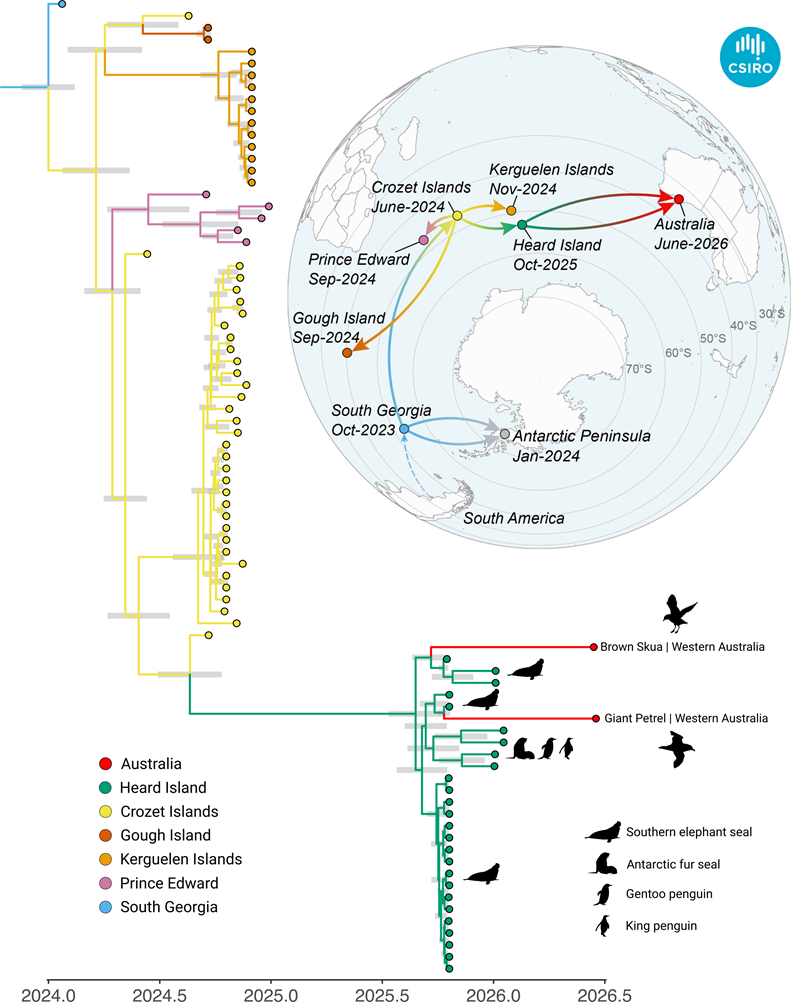
Our testing shows us that the sequences from the first two cases in Australia were closely related to ones from Heard Island. From the data we have at hand, it appears Heard Island is the most likely source of the Australian infections.

CSIRO-Australia-H5N1-origins.png


By comparing genetic sequences from virus samples, scientists can trace the relationships between the first Australian H5 bird flu cases and those detected on Heard Island. Credit: Matthew J. Neave et al. Show image description


What is our current understanding of the number of individual introductions of the virus to Australia?


Dr Matt Neave:

We've detected at least 6 or 7 separate introduction events that we think came from Heard Island. Although we call them separate, they are very similar genomes. Of course, this is very likely an underestimate of the true number of incursions we've seen in Australia.

However, with South Australia's crested terns, for example, through sequencing we can see that's not a separate introduction event because the genomes are so similar to each other. Some of the genomes are actually identical. That's why we think there is now transmission of the virus in that area.

Can we tell what mammal species might be particularly vulnerable to this strain of the virus?


Dr Frank Wong:

The genotypes that are associated with infections in dairy cattle in the United States are quite specific and have not been detected outside the US to date.

The genotype we now have here in Australia certainly can infect marine mammals. In South America it has impacted colonies of southern elephant seals and sea lions. On Heard Island it had a significant impact on the resident southern elephant seal population.

We should maintain all of the controls and biosecurity that we would do regardless of the strain to protect Australian livestock, but the risk of this genotype infecting our livestock is considered low. You would need an alignment of ecological circumstances for the virus to spill over and impact livestock.

What about the risk to humans?


Dr Debbie Eagles:

The risk to humans is low and that has been consistent internationally since this strain has been circulating since 2021. In most cases, where human infection occurs, the disease is mild.

For more human health information refer to Australia's Centre for Disease Control.

What do we know about how this strain might behave in Australia, and whether it will become embedded?


Dr Frank Wong:

In terms of its long-term sustenance in Australia, it's probably too early to tell. But I would say one important aspect in terms of being able to lessen that opportunity would be to keep on top of it as much as possible and not just let the virus spread without continued monitoring and control where circumstances allow, whether though wild animal populations or through livestock or domestic poultry.

Are there specific changes to the virus that you look out for while sequencing?


Dr Matt Neave:

When we do sequencing there are certain parts of the genome that we take a particular interest in.

We want to know if this particular virus constellation that's come to Australia switches up one of its genes with a local Australian virus. That doesn't necessarily mean something bad will happen, but that's a virus we'd want to perhaps test here in the lab.

There are also a couple of mutations in the genes themselves we that we want to look out for, particularly ones that might increase the risk of spread to people.

Further information about bird flu and what to do if you notice a sick bird is available at birdflu.gov.au

https://www.csiro.au/en/news/All/Articles/2026/August/Bird-flu-expert-commentary
 
Australia: Media Reports of Multiple Mass Mortality Events in Birds (H5N1 Suspected)


Data as of 4pm AEST, 19 August 2026

#19,300


While HPAI H5N1 reporting from governmental sources have slowed in recent days, overnight the Australian press reported on multiple mass mortality events involving birds in South Australia and Tasmania (see ABC News Bird flu suspected after more than 1,000 birds found dead in SA, more deaths in Tasmania).

According to multiple news sources (see here and here), South Australian Premier Peter Malinauskas addressed the SA parliament (Aug 20th) to announce that more than 1,000 crested terns had died across three mass mortality events on several remote offshore islands.​

Additionally there are reports of > 2 dozen dead penguins in Tasmania. While H5N1 has not been confirmed, HPAI is strongly suspected. For now, there are no reports of H5N1 in non-avian wildlife, poultry, or livestock.

While we await further details (and/or confirmation) we've two other sources of background information; an expert commentary from Australia's National Testing laboratory CSIRO, and a series of academic analyses from The Conversation.

First this analysis from CSIRO (h/t Pathfinder on FluTrackers):

Expert Commentary: What do we know about H5 bird flu?

18 AUGUST 2026 4 MIN READ

In June 2026, Australia recorded its first cases of the highly contagious H5 bird flu.

As Australia's national reference laboratory for animal diseases, CSIRO's
Australian Centre for Disease Preparedness (ACDP) plays a critical role in protecting Australia's valuable livestock and aquaculture industries and the wider community from infectious diseases such as bird flu.

Scientists at ACDP have been conducting testing and genetic analysis to learn more about exactly which strain of the virus has arrived on our shores, and how it is spreading.

All quotes below are available for use by media. Spokespeople quoted:

  • Dr Frank Wong, Senior Research Scientist at CSIRO's Australian Centre for Disease Preparedness. Dr Wong is also a World Organization for Animal Health-designated reference expert on avian influenza
  • Dr Matt Neave, Team Leader of Sequencing and Agent Characterisation at CSIRO's ACDP
  • Dr Debbie Eagles, Director of CSIRO's ACDP.
What is H5N1 and why is it a concern?
Dr Frank Wong:

For the past 5 or 6 years the world has been affected by a bird flu panzootic. This is what we call a pandemic in animals. In this case, because the virus is an avian virus, it has mostly impacted birds around the world.

The clade 2.3.4.4b lineage of H5N1 is a highly pathogenic bird flu virus that emerged around 2020-2021, first spreading across Europe and then moving on to other continents, including Asia and North America.

Along the way it has caused mass mortalities in both domestic poultry as well as many species of wild bird.

H5N1 has been able to spread rapidly across different continents largely due its ability to be sustained in migratory wild birds, like waterfowl such as ducks and geese.

The genotype that we're talking about for Australia, known as genotype B3.2, arose from reassortment in North America and then spread to South America and the sub-Antarctic islands.

It had a great impact on South American poultry industries as well as wild bird life and marine mammals, so that's why we're concerned about the introduction of the virus to Australia.
What does ACDP's genetic testing show us?
Dr Matt Neave:

Sequencing the virus genome has become really important in disease outbreaks like this one. We're now able to do it much quicker than in the past and can get a whole influenza genome in around 15 to 26 hours.

From the viral genome we are able to determine several important things, including the exact strain of the virus. Another thing we can do is compare that viral genome to other reference sequences in our database or public databases online. This allows us to determine how closely related our Australian cases are to the sub-Antarctic ones, for example.


Our testing shows us that the sequences from the first two cases in Australia were closely related to ones from Heard Island. From the data we have at hand, it appears Heard Island is the most likely source of the Australian infections.
CSIRO-Australia-H5N1-origins.png
By comparing genetic sequences from virus samples, scientists can trace the relationships between the first Australian H5 bird flu cases and those detected on Heard Island. Credit: Matthew J. Neave et al. Show image description

(Follow link to read the full report).


Although there are now roughly 2 dozen entries, going back to H5N1's arrival in Australia in mid-June, over the past few days these 4 essays have been published.

Published: August 20, 2026
The first wave of bird flu is the worst: what Australia can learn from overseas
Bethany J Hoye, University of Wollongong
The rest of the world has already had to grapple with bird flu – and there are lessons for Australia.

Published: August 18, 2026

More than 5,000 little penguins will be vaxxed against bird flu. How will this protect them?
Julie Old, Western Sydney University
Little penguins are flightless and return at night to the same burrow, making it easier to capture and vaccinate them.

Published: August 17, 2026
From the coasts to the plains, bird flu could threaten not just birds – but their homes
Penny Olsen, Australian National University
From raucous honeyeaters to top predators, Australia’s birds are vital to nature.

Published: August 16, 2026
Is bird flu infecting humans? How would we know?

Allen Cheng, Monash University
Even with bird flu circulating in Australia, the risk to humans is low. But some groups are still at increased risk.


https://afludiary.blogspot.com/2026/08/australia-media-reports-of-multiple.html
 
Department of Natural Resources and Environment Tasmania
...
​H5 bird flu: current situation

20 August 2026

Surveillance and monitoring activities on King Island are being increased as part of our H5 bird flu response.

The total number of confirmed bird flu cases in Tasmania remains at 11 wild birds, however 28 dead little penguins and three dead crested terns were found at the Port of Grassy on King Island through on-ground surveillance by NRE Tas.

Samples have been collected and sent to our Animal Health Laboratory for testing. The bird carcasses will be collected to minimise any potential for disease spread, noting it is not yet known if these birds died from H5 bird flu.

There have been no detections in Tasmanian poultry, and chicken meat and eggs remain safe to eat. NRE Tas continues surveillance and response activities across the state.

Keep pets such as dogs and cats away from sick or dead wildlife. Keep cats contained. When walking dogs, keep dogs on a lead and observe no dog zones.


​If you see sick or dead birds or other wildlife:

  • AVOID contact.
  • RECORD the location and, if safe, take photos.
  • REPORT it immediately to the Emergency Animal Disease Hotline on 1800 675 888.
Check current advice on these webpages.

​H5 bird flu is a contagious, viral disease affecting wild, commercial, and domesticated bird species and other animals. 

How to make a report​

To report sick or dead birds or other animals:

  • Call the ​Emergency Animal Disease Hotline 1800 675 888 ​
  • Make an online report using our on​line reporting forms:​
Fill in the general enquiry form to make an enquiry about bird flu.

​​Do not touch sick or dead birds or other animals.

The Tasmanian Avian Influenza Readiness and Response Plan outlines how we will respond to an outbreak of bird flu and how you can prepare. The Plan will be reviewed regularly as new information emerges. ​


Read the Plan:


Tasmanian Avian Influenza Readiness and Response Plan (PDF 1Mb)​

https://nre.tas.gov.au/biosecurity-...ty/animal-health/poultry-and-pigeons/bird-flu
---------------------------------------------------------------------------------------------------------


Mayors Statement – Bird Flu – Community Resilience

20 August 2026 “King Island is indeed blessed to be a bird rich environment and something we locals take great pride and enjoyment in. From a community resilience standpoint as Mayor, I don’t need to remind you of all of the trials and tribulations we have successfully dealt with in recent years and although battle weary, we remain a united and confident country community. The resolve of our historic island is again being tested with this new Bird Flu threat but make no mistake, we will again show Australia that we pass this test. King Island Council continues to provide necessary local support to the deployed Tasmanian NRE personnel [as the lead agency for Bird Flu]. We thank NRE for the priority deployment of those technical resources and experts to King Island. We are well informed by and coordinated with State authorities. Meantime, we best get on with business as usual while this situation evolves and plays out over time”.

https://kingisland.tas.gov.au/mayors-statement-bird-flu-community-resilience/
----------------------------------------------------------------------------------------------------------------------
​​​​​​​​
​​​​​​​https://www.facebook.com/jeremyrock...ter-28-dead-penguins-were-d/1500588618546013/
 

...
H5 bird flu: current situation

21 August 2026

Tasmania has recorded seven additional positive detections of H5 bird flu, bringing the total positive detections to 18.

​The detections were in four silver gulls, two crested terns and one white-fronted tern collected from beaches and bays near Currie on King Island. This is the first detection of H5 bird flu in a white-fronted tern.

Samples have been sent to CSIRO's Australian Centre for Disease Preparedness for confirmation testing and sequencing.

An additional 23 little penguins have been found dead, bringing the total to 51. Test results on these birds are pending.

Surveillance and monitoring on King Island has been increased as part of our H5 bird flu response.

There have been no detections in Tasmanian poultry, and chicken meat and eggs remain safe to eat. NRE Tas continues surveillance and response activities across the state.

Keep pets such as dogs and cats away from sick or dead wildlife. Keep cats contained. When walking dogs, keep dogs on a lead and observe no dog zones.

​If you see sick or dead birds or other wildlife:
  • AVOID contact.
  • RECORD the location and, if safe, take photos.
  • REPORT it immediately to the Emergency Animal Disease Hotline on 1800 675 888.
Check current advice on these webpages or view our previous ​updates​.
...

https://nre.tas.gov.au/biosecurity-...ty/animal-health/poultry-and-pigeons/bird-flu


​​
...
H5 bird flu events in wildlife

​...

Event data


As of 4pm AEST, 20 August 2026, Australia has 290 confirmed events of H5 bird flu in wild birds.
  • 10 in Western Australia (WA)
  • 177 in South Australia (SA)
  • 11 in New South Wales (NSW)
  • 1 in Queensland (QLD)
  • 84 in Victoria (VIC)
  • 7 in Tasmania (TAS)
As H5 bird flu is confirmed in more locations and species in Australia it will not be necessary to continue testing all species in known areas of transmission, or to test every bird involved in an investigation. Reporting will be targeted to provide a clear picture of the national H5 bird flu situation in wildlife in Australia and key developments.
​...
Events by species


...

https://www.agriculture.gov.au/campaigns/birdflu/latest-data#event_data
 
Little penguin on King Island tests positive for bird flu

Pulse Tasmania
Sat August 22, 2026
1:58pm

Tasmania has recorded another positive bird flu case, with a little penguin collected from Grassy on King Island testing positive overnight.

A second little penguin returned an inconclusive result, with both samples sent to the Australian Centre for Disease Preparedness for further testing.

It comes after 23 more dead penguins were found on King Island on Friday, bringing the total to 51.
...
“The condition of the remaining deceased birds meant they were unsuitable for testing,” he said.

“As a result, the cause of death could not be confirmed, although it may be assumed to have been from bird flu.”
...
Ford reiterated there is still no evidence of a mass mortality event and no detection in Tasmanian poultry.
...

https://pulsetasmania.com.au/news/little-penguin-on-king-island-tests-positive-for-bird-flu/
 
Back
Top