Announcement

Collapse
No announcement yet.

Virological.org - Complete sequence of Orthohantavirus andesense virus: Swiss resident 2026 - May 8, 2026

Collapse
X
 
  • Filter
  • Time
  • Show
Clear All
new posts

  • Virological.org - Complete sequence of Orthohantavirus andesense virus: Swiss resident 2026 - May 8, 2026

    h/t @RajlabN
    ·

    Complete sequence of Orthohantavirus andesense virus: Swiss resident 2026

    Hantavirus


    read4 min
    May 8
    Back
    2h ago post by Laubscher 2 days ago


    Laubscher
    1
    2d
    Posted on behalf of the Swiss National Reference Center for Emerging Viral Infections, Geneva University Hospitals and the Institute of Medical Virology, University of Zurich (Partner Laboratory National Reference Center for Emerging Viral Infections).

    On 5 May 2026, the Swiss National Reference Center for Emerging Viral Infections (Geneva University Hospitals) confirmed a case of Andes strain in a Swiss resident who had travelled on the MV Hondius cruise ship. The virus was sequenced from blood samples jointly by the Institute of Medical Virology (University of Zurich) and the Swiss National Reference Center for Emerging Viral Infections (Geneva University Hospitals) using Illumina technology (MiSeq instrument). The consensus sequence was generated with a minimum coverage of 5 reads.

    The complete ANDV/Switzerland/Hu-3337/2026 consensus sequence for each of the 3 segments can be found here:

    ANDV-Switzerland-Hu-3337-2026.fasta.gz (3.8 KB)​

    Posted on behalf of the Swiss National Reference Center for Emerging Viral Infections, Geneva University Hospitals and the Institute of Medical Virology, University of Zurich (Partner Laboratory National Reference Center for Emerging Viral Infections). On 5 May 2026, the Swiss National Reference Center for Emerging Viral Infections (Geneva University Hospitals) confirmed a case of Andes strain in a Swiss resident who had travelled on the MV Hondius cruise ship. The virus was sequenced from bloo...


  • #3
    May 9, 2026

    expert reaction to first complete sequence of the hantavirus from the current cluster from MV Hondius (from the Swiss patient with confirmed Andes strain) uploaded to the Virological.org platform by the Swiss National Reference Center for Emerging Viral Infections, Geneva University Hospitals and the Institute of Medical Virology, University of Zurich

    Dr Damien Tully, Associate Professor at the Medical Research Council/Uganda Virus Research Institute and London School of Hygiene & Tropical Medicine (MRC/UVRI and LSHTM) Uganda Research Unit said:
    ...
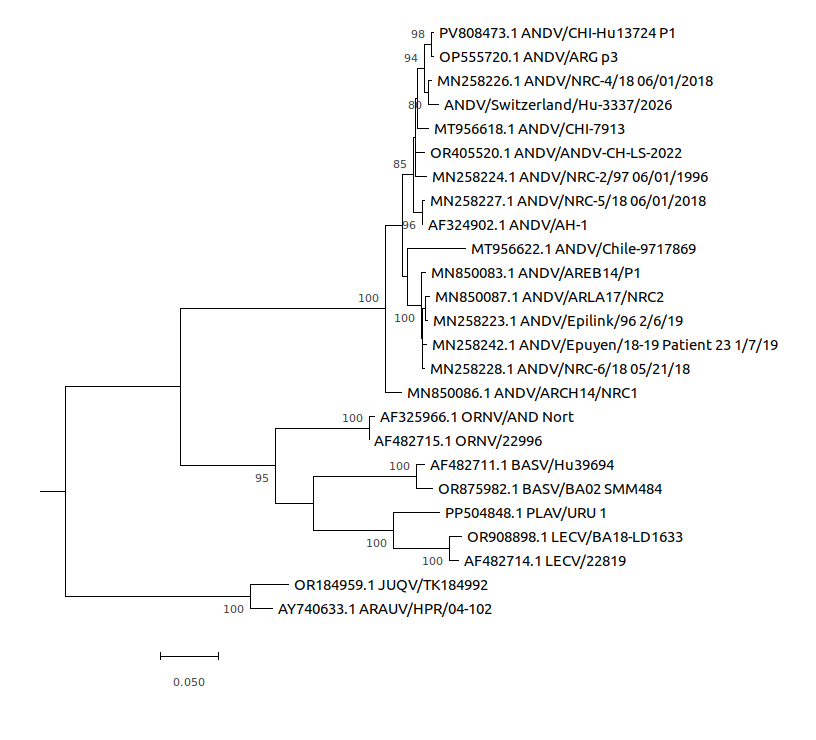
    “The sequence is broadly consistent with what we would expect from a hantavirus spillover from its natural reservoir rather than the emergence of a dramatically altered virus. Reassuringly, the closest related sequences are from the 2018–2019 outbreak in Argentina, suggesting the virus remains part of a known viral lineage rather than representing a highly divergent new strain. Viruses naturally accumulate mutations over time as they replicate, so some genetic differences compared with earlier outbreak sequences are expected. Preliminary analyses indicate only a relatively small degree of change from the most closely related Argentine sequences. At present, there is no clear evidence from this single genome of major genetic shifts, unusual evolution, or reassortment.

    “These findings are therefore compatible with another spillover event from the natural reservoir host rather than a virus that has substantially changed biologically. ...
    ...
    Prof Piet Maes, President-elect of the Hantavirus Society, and Virologist at the Plotkin Institute, University of Brussels, said:

    “I’ve done a quick analysis this afternoon using other available Andes virus sequences from rodents and previously published Andes virus infection clusters. It is of course still too early to draw in-depth conclusions, particularly since this currently remains only a single full-length sequence from the cluster.

    “The available phylogenetic and sequence data nevertheless suggest that the Swiss patient isolate represents a relatively typical naturally circulating ANDV lineage originating from the established rodent reservoir in Chile/Argentina, rather than a highly divergent or newly emerged variant.
    ...

    Comment


    • #4

      gustavo_palacios
      15h

      Preliminary analysis of Orthohantavirus andesense virus sequences from a cruise-ship related cluster, May 2026.
      ​...
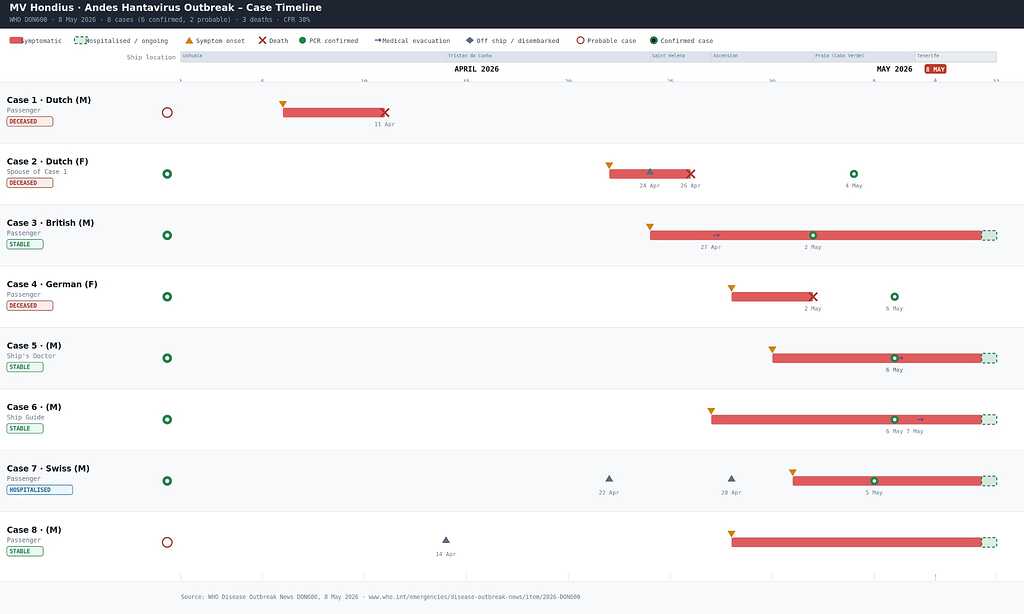
      Figure 1: Timeline of the hantavirus positive cases from most of which sequence data has been generated by 10 May 2026.

      Rapid review of protocols and analysis methods for quality control purposes to ensure comparability of data generated:

      Because these suspected and confirmed infections were managed across several countries, clinical samples were collected, tested, and sequenced at multiple laboratories, including institutes in South Africa, Senegal, Switzerland, and the Netherlands. On 5 May, initial partial genome sequencing of the L-segment from case 2 in Johannesburg and a strain specific RT-PCR in Geneva from case 7 confirmed the presence of ANDV. On May 8th the full genome from case 7, who disembarked April 22nd at St Helena and flew back to Switzerland (from 27-28 April, via South Africa and Qatar), was shared (https://virological.org/t/complete-s...dent-2026/1023). At the same date, the full genome of case 6 was also generated, and its submission to Virological and Pathoplexus is currently pending. In the context of a multi-national outbreak investigation, the participating laboratories were convened early to exchange data and assess how differences in sequencing platforms, bioinformatic pipelines, and parameter settings could affect consensus-level nucleotide polymorphisms.
      ​...
      Comparison of consensus sequences:

      Sequences from all S and M segments are identical to each other. The sequences from the L segment showed 2 SNPs: one for case 5 (position C2139T based on reference sequence MN258159) and one for case 7 (position G576A based on reference sequence MN258159) which were labelled as true SNPs rather than difference arising from technological or analytical variation. Both SNPs were synonymous mutations. All segments have high sequence identity (98.76% and 98.75% based on the L segment, 98.71% and 98.68% on the M segment and 98.73% and 98.73% on the S segment) to Andes virus sequences detected in humas in Argentina in 1997 and 2018 respectively.
      ​...
      The overall high level of genetic similarity — with a maximum of one detected SNP per individual — strongly suggests that the outbreak most likely originated from a single zoonotic spillover event, or a very limited number of closely related spillover events.
      The limited and consistent variation observed in the L segment is interpreted as true viral mutations rather than methodological artifact. Taken together, these findings support a scenario of initial zoonotic introduction followed by subsequent human‑to‑human transmission during the outbreak. The lack of diversity observed in the outbreak is similar to that observed during a cluster of human-to-human transmission in the Epuyén 2018 outbreak, in Argentina. The genomic data cannot exclude the possibility that the initial environmental exposure involved more than one passenger infected from the same source. Resolving this will require additional epidemiological data, including timelines and contact/exposure histories, together with environmental investigations such as rodent trapping and testing.
      ...

      Preliminary analysis of Orthohantavirus andesense virus sequences from a cruise-ship related cluster, May 2026. In May 2026, an Andes virus (ANDV) outbreak occurred aboard the Dutch-flagged cruise ship MV Hondius. The ship initially departed from Ushuaia, Argentina, on 1 April 2026 for a transatlantic voyage via remote South Atlantic islands. The index case (case 1) reportedly developed fever, headache, stomach pain and diarrhoea on 6 April and died onboard on 11 April, without indication of ca...

      Comment

      Working...
      X