• FluTrackers.com Inc. does not provide medical advice. Information on this web site is collected from various internet resources, and the FluTrackers board of directors makes no warranty to the safety, efficacy, correctness or completeness of the information posted on this site by any author or poster. The information collated here is for instructional and/or discussion purposes only and is NOT intended to diagnose or treat any disease, illness, or other medical condition. Every individual reader or poster should seek advice from their personal physician/healthcare practitioner before considering or using any interventions that are discussed on this website. By continuing to access this website you agree to consult your personal physican before using any interventions posted on this website, and you agree to hold harmless FluTrackers.com Inc., the board of directors, the members, and all authors and posters for any effects from use of any medication, supplement, vitamin or other substance, device, intervention, etc. mentioned in posts on this website, or other internet venues referenced in posts on this website.
  • We are not asking for any donations. Do not donate to any entity who says they are raising funds for us.

Water Issues Region IX; California, Arizona, Nevada, Hawaii

kiwibird

Editor, Senior Moderator
California?s current drinking water standard for nitrate is 45 mg nitrate/L (equivalent to 10 mg
nitrate-nitrogen/L) and for nitrite is 1 mg nitrite-nitrogen/L. In addition, there is a joint
nitrate/nitrite standard of 10 mg/L, expressed on a nitrogen basis. These values were adopted by
the DHS in 1994 from U.S. EPA?s MCLs promulgated in 1991.
http://oehha.ca.gov/water/phg/pdf/nit2_c.pdf

Moreover, well contamination is aggravated by low groundwater levels (Davisson and Criss 1993), so one can predict that further rapid degradation of drinking-water supplies will accompany the current drought conditions in the western United States. This problem has been most severe in California, where several municipalities in the Central Valley and coastal valleys such as the Salinas have been forced to abandon entire well fields because nitrate levels have risen sharply above the maximum contaminant level (Davisson and Criss 1996).
http://findarticles.com/p/articles/mi_m0CYP/is_10_112/ai_n15688580/

Charles Springer reported that nitrate concentrations exceeding California Drinking Water Standards (45mg/L) are present in Yucca Valley and have resulted in four major potable water supply wells becoming unusable. Due to the absence of waste water treatment facilities, the community disposes of municipal waste water via septic systems.
Yucca Valley is very close to Coachella and probably upstream if the water drains into the Salton Sea.http://docs.google.com/gview?a=v&q=...ifornia+nitrates+"drinking+water"&hl=en&gl=nz
  • slide-4.jpg
  • slide-2.jpg
  • slide-3.jpg
  • slide-1.jpg
  • slide-5.jpg
  • slide-6.jpg


<script type="text/javascript" charset="utf-8"> new Slideshow({ id: 'slideshow', width: 734, height: 132, wait_duration: 3, images: [{"id": 4, "image": "/uploads/slide-4.jpg"}, {"id": 2, "image": "/uploads/slide-2.jpg"}, {"id": 3, "image": "/uploads/slide-3.jpg"}, {"id": 1, "image": "/uploads/slide-1.jpg"}, {"id": 5, "image": "/uploads/slide-5.jpg"}, {"id": 6, "image": "/uploads/slide-6.jpg"}] }); </script>


In This Section


Related News


Nitrates in Groundwater

Mapping Nitrate Contamination in California?s Groundwater Aquifers

These maps developed by CCKA, using U.S. Geological Survey (USGS) data, provide a picture of nitrate contamination in the aquifers of central California. The wells mapped are domestic, private water supply wells, and the water quality data taken at these wells are intended to provide an indication of the drinking water quality of Californians that rely on private domestic wells for drinking water. Data points are largely clustered in the Central Valley because this is where USGS studies have focused in California.
The primary source of nitrate contamination in California is agriculture. Commercial fertilizers and animal wastes release highly soluble nitrates, which then leach through the soil from land application or run off into surface waters and eventually work their way down into groundwater aquifers. The U.S. Environmental Protection Agency?s (EPA) Maximum Contaminant Level (MCL) for nitrates is 10 milligrams per liter (mg/L), though nitrate concentrations far less than that can damage aquatic species. Infants and children are particularly susceptible to illness from nitrate contamination: immature human digestive systems convert nitrate into nitrites, which enters the bloodstream and reduces the ability of blood to carry oxygen. This can lead to the potentially fatal "blue baby syndrome". The maps below show that numerous areas of the state have groundwater concentrations of nitrates above or near the maximum contaminant level, even in areas where residents? primary source of drinking water is groundwater. Visit CCKA?s Groundwater Page to learn more about pollution in California?s aquifers.

Pick a Map to View
Wells and Agricultural Irrigation
Wells and Domestic Groundwater Withdrawals
Wells and Land Cover

121-full.png


California Coastkeeper Alliance
P.O. Box 3156, Fremont, CA 94539


<script type="text/javascript"> var gaJsHost = (("https:" == document.location.protocol) ? "https://ssl." : "http://www."); document.write(unescape("%3Cscript src='" + gaJsHost + "google-analytics.com/ga.js' type='text/javascript'%3E%3C/script%3E")); </script><script src="http://www.google-analytics.com/ga.js" type="text/javascript"></script> <script type="text/javascript"> try { var pageTracker = _gat._getTracker("UA-5307799-1"); pageTracker._trackPageview(); } catch(err) {} </script>
 
Re: Water Issues in California

Re: Water Issues in California


  • slide-4.jpg
  • slide-2.jpg
  • slide-3.jpg
  • slide-1.jpg
  • slide-5.jpg
  • slide-6.jpg


<script type="text/javascript" charset="utf-8"> new Slideshow({ id: 'slideshow', width: 734, height: 132, wait_duration: 3, images: [{"id": 4, "image": "/uploads/slide-4.jpg"}, {"id": 2, "image": "/uploads/slide-2.jpg"}, {"id": 3, "image": "/uploads/slide-3.jpg"}, {"id": 1, "image": "/uploads/slide-1.jpg"}, {"id": 5, "image": "/uploads/slide-5.jpg"}, {"id": 6, "image": "/uploads/slide-6.jpg"}] }); </script>


In This Section


Related News


Nutrient Pollution

Nutrients, such as in fertilizers, are important to the good health of plants and animals. But too many nutrients can disturb the natural balance of aquatic ecosystems, creating nutrient pollution. For example, high concentrations of nutrients such as nitrogen and phosphorous can cause excessive growth of algae, which blocks sunlight from aquatic plants. Algal growth also uses up the oxygen that fish and other aquatic species need to survive. High levels of nitrogen-based compounds reaching groundwater can also impact the health of people relying on well water. Agricultural and household fertilizers, dairies, household cleaners, treated sewage, deposition from vehicle exhaust, and other sources contribute dangerous levels of nutrients to many of California's water bodies.
Selected pollutant maps: Nutrient Pollution | Bacteria Pollution | Mercury Pollution | Sediment Pollution | Back to all impaired waterbodies
182-large.png
Nutrients


California Coastkeeper Alliance
P.O. Box 3156, Fremont, CA 94539


<script type="text/javascript"> var gaJsHost = (("https:" == document.location.protocol) ? "https://ssl." : "http://www."); document.write(unescape("%3Cscript src='" + gaJsHost + "google-analytics.com/ga.js' type='text/javascript'%3E%3C/script%3E")); </script><script src="http://www.google-analytics.com/ga.js" type="text/javascript"></script> <script type="text/javascript"> try { var pageTracker = _gat._getTracker("UA-5307799-1"); pageTracker._trackPageview(); } catch(err) {} </script>
 
Re: Water Issues Region IX; California, Arizona, Nevada, Hawaii

Nitrate is perhaps the most widespread
groundwater contaminant besides
salt, both in the United States
and globally. As many as 10 percent of
public water-supply wells in California
exceed the maximum contamination level
(MCL) of nitrate and must be treated or
blended with high-quality water (see map,
right). In some areas of California, well
over one-third of domestic wells (typically
shallow) may exceed the nitrate MCL.
Naturally occuring
concentrations in the Southwest are
generally less than 2 milligrams per liter
nitrate as nitrogen (mg/l nitrate-N).
.....
The major regions with
high groundwater nitrate pollution are
therefore not surprisingly the major
agricultural regions: Imperial, Central,
Salinas, and other coastal valleys in
California; the Snake River Plain in
Idaho; the Wasatch Front in northcentral
Utah; the Rio Grande Valley
in New Mexico; and the Gila and Salt
River valleys in Central Arizona.
http://www.swhydro.arizona.edu/archive/V8_N4/feature2.pdf
 
Re: Water Issues Region IX; California, Arizona, Nevada, Hawaii

Arizona
In Arizona, high nitrate-N concentrations
(15 to 40 mg/l) associated with
agricultural practices were noted near
Phoenix in the West Salt River Valley.
Confined animal feeding operations
and septic systems also are a major
source of nitrate here, producing
concentrations as high as 20 mg/l.
Concentrations as high as 150 mg/l in
groundwater beneath confined feeding
operations in New Mexico also have
been reported. Dissolved minerals from
evaporite deposits present in the West
Salt River aquifer may also elevate
groundwater nitrate-N concentrations
by about 5 mg/l.
snipped fromhttp://www.swhydro.arizona.edu/archive/V8_N4/feature1.pdf

The potential effects of land use such as
irrigation, mining, urbanization, and waste
disposal on ground water quality have been
documented. Irrigation of agricultural fields has
been found to degrade ground water quality by
concentrating salts and adding nitrogen from
fertilizers. Mining operations have impacted
ground water quality due to the leachate seepage
of acidic mining and milling process solutions.
Wastewater treatment by large numbers of
domestic septic systems has been found to
increase nitrate levels in some developing areas.
Disposal of toxic wastes as well as leachates
from landfills have impacted ground water quality
in localized areas throughout Arizona though
most waste sites are located near the cities of
Phoenix and Tucson.
snipped from http://www.gwpc.org/e-library/documents/state_fact_sheets/arizona.pdf
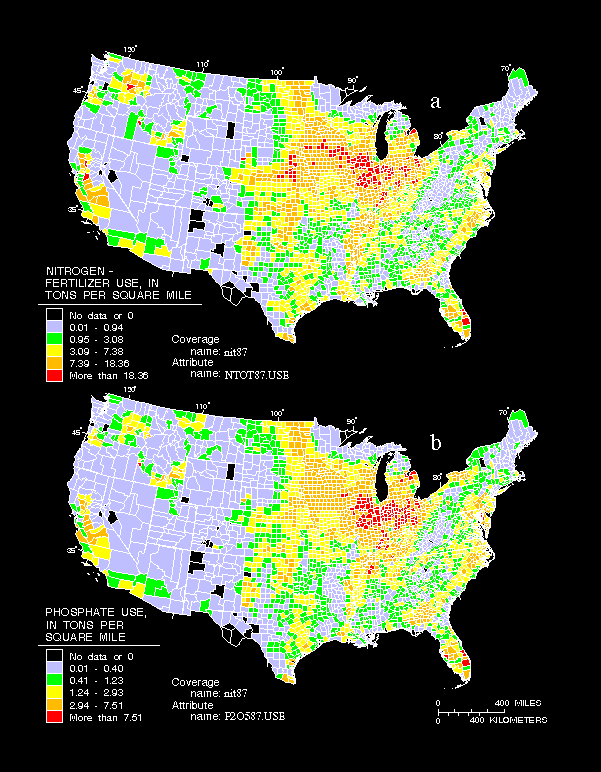
fig5.gif

http://pubs.usgs.gov/wri/wri944176/fig5.gif
 
Back
Top Bottom