Re: Washington 2010-2011 Season: Weeks 40-9 (One New Death, Total 8)
Re: Washington 2010-2011 Season: Weeks 40-9 (One New Death, Total 8)
Seattle and King County (Week 8/9): 1 new death; total 8 for state
Influenza activity increased in King County during week 8. Some indicators are at levels approaching past season peaks:
Among the pediatric age groups, the proportion of Emergency Department (ED) visits for influenza-like illness (a chief complaint or diagnosis of flu, fever and cough, or fever and sore throat) has been on an increasing trend since early November. Among adults, the proportion of ED visits for ILI has not significantly increased compared to prior weeks.
ED ILI trends are at or above the 5 year average for all ages combined as well as for the pediatric age groups.
In week 9 a middle-aged woman with pre-existing health conditions died with lab-confirmed H1N1; she was a resident of the same long-term care facility (LTCF) as the man who died in week 8 with H1N1. Four lab-confirmed flu deaths (two H1N1, one influenza A not subtyped, and one AH3N2) have occurred this season, all in middle-aged individuals with pre-existing health conditions.
In week 9 PHSKC was notified of three LTCFs with lab-confirmed influenza in residents, and one LTCF with flu testing pending. In week 8 one LTCF experienced the lab-confirmed flu death of a resident, with a second death in week 9. PHSKC has investigated ILI in a total of 11 LTCFs this season; influenza in residents was confirmed in six of these facilities.
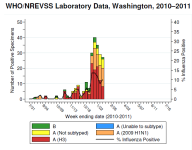
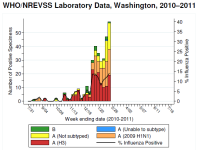
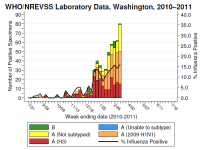
The UW Virology Laboratory had 52 positive tests for influenza (16 pandemic AH1N1, 12 AH3N2, 18 influenza A not subtyped and six influenza B). This is up from 37 positive tests in week 7, and is the highest number positive this season. Other viruses currently circulating include respiratory syncytial virus (RSV), which continues to circulate at high levels, as well as parainfluenza, adenovirus, metapneumovirus, and rhinovirus.
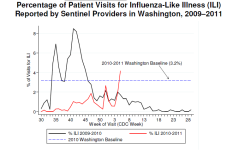
7 of 20 (35.0%) specimens submitted by the outpatient sentinel surveillance system were positive for influenza (1 AH3, 2 influenza A not subtyped, 3 H1N1 and 1 flu B). Excluding the spring 2009 H1N1 wave, the peak count of samples submitted over the past five seasons has ranged from 37 (in 2005-06 season) to 72 (in Oct 2009), with a mean peak of 56 samples submitted.
42 of 231 (18.2%) rapid antigen tests reported by five hospital laboratories were positive for influenza (34 influenza A and 8 influenza B), the highest number of tests reported this season. Excluding the spring 2009 H1N1 wave, the peak count of rapid antigen tests reported since the initiation of the current rapid antigen reporting system in the 2007-08 season has ranged from 483 (in 2008-09 season) to 710 (in Oct 2009), with a mean peak of 586 rapid antigen tests reported.
No pregnant women with laboratory-confirmed influenza admitted to ICU were reported; none have been reported since Dec. 2009.
The proportion of deaths attributable to pneumonia and influenza was 5.1%, below the epidemic threshold of 8.0%.
Most schools were out of session for mid-winter break; absenteeism has been low and stable since the start of the school year.
http://www.kingcounty.gov/healthservices/health/communicable/immunization/fluactivity.aspx