• FluTrackers.com Inc. does not provide medical advice. Information on this web site is collected from various internet resources, and the FluTrackers board of directors makes no warranty to the safety, efficacy, correctness or completeness of the information posted on this site by any author or poster. The information collated here is for instructional and/or discussion purposes only and is NOT intended to diagnose or treat any disease, illness, or other medical condition. Every individual reader or poster should seek advice from their personal physician/healthcare practitioner before considering or using any interventions that are discussed on this website. By continuing to access this website you agree to consult your personal physican before using any interventions posted on this website, and you agree to hold harmless FluTrackers.com Inc., the board of directors, the members, and all authors and posters for any effects from use of any medication, supplement, vitamin or other substance, device, intervention, etc. mentioned in posts on this website, or other internet venues referenced in posts on this website.
  • We are not asking for any donations. Do not donate to any entity who says they are raising funds for us.

Washington 2010-2011 Season: Weeks 40-36

Re: Washington 2010-2011 Season: Weeks 40-5 (One New Death, Total 5)

Re: Washington 2010-2011 Season: Weeks 40-5 (One New Death, Total 5)

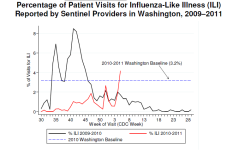
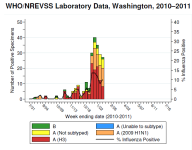
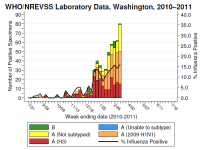
Here are the isolates and %ILI charts:

The %ILI has shot up past baseline for the first time this season.

Week 5 WA ILI.png

The number of positive specimens for the prior 3-4 weeks were increased in this updated chart. If you look at the chart a few posts above, you can see that the total positives in Week 2 was 30. In this week's chart, the total positives for Week 2 is shown as 40.

Week 5 WA Isolates.png
 
Re: Washington 2010-2011 Season: Weeks 40-6 (No New Deaths, Total 5)

Re: Washington 2010-2011 Season: Weeks 40-6 (No New Deaths, Total 5)

Week 6:
State Report:
• Influenza virus continues to circulate in Washington. Flu activity increased slightly during week 6.
• The proportion of emergency room visits for influenza-like illness (ILI) was just above the baseline in both Western and Eastern Washington. The proportion of outpatient visits for ILI was below the baseline.
• There were no laboratory-confirmed influenza deaths reported to the Washington State Department of Health (DOH) during week 6. No pregnant women with laboratory-confirmed flu admitted to an intensive care unit have been reported to DOH this season.
• During week 5-6 (1/30/11–2/12/11), 78 (11.5%) specimens tested by the World Health Organization/National Respiratory and Enteric Virus Surveillance System (WHO/NREVSS) collaborating laboratories in Washington were positive for influenza. Of these specimens, 96% were influenza A and 4% were influenza B. Of the subtyped influenza A specimens, slightly more than half were 2009 H1N1 viruses.

OF NOTE: Majority of hospitalizations to-date have been A (subtype unknown)
http://www.doh.wa.gov/EHSPHL/Epidemiology/CD/fluupdate.pdf

Local Influenza Surveillance Reports:
Whatacom County Report:
There was one lab confirmed influenza related hospital admission. No Long term care facilities reported an influenza outbreak. Schools reported no elevated absenteeism due to cough related illness. There were no new reportable Influenza cases of Whatcom residents with a total of one case this season.
http://www.co.whatcom.wa.us/health/flu/pdf/Whatcominflurpt_wk_2011_6.pdf
http://www.co.whatcom.wa.us/health/flu/index.jsp

During CDC week 5 (1/30/11-2/5/11) influenza activity continued to increase in Clark County.
Thirteen positive tests were reported to Clark County Public Health.
There was a slight increase in influenza activity in Washington during week 5.
Nationally, influenza activity increased.
Clark County: http://www.clark.wa.gov/public-health/diseases/flu.html

Lab-confirmed influenza A was reported in week 7 in residents of two unrelated residential treatment programs.
The proportion of deaths attributable to pneumonia and influenza was 6.9%, below the epidemic threshold of 8.0%.
School absenteeism was low and stable, as it has been since the start of the school year.
57.1% positive for influenza
King County: http://www.kingcounty.gov/healthservices/health/communicable/immunization/fluactivity.aspx

Week 3: number of cases increasing
21.7% positive for influenza
Yakima County: http://yakimahealthdistrict.org/commhealth/immproviders.htm
 
Re: Washington 2010-2011 Season: Weeks 40-7 (One New Death, Total 6)

Re: Washington 2010-2011 Season: Weeks 40-7 (One New Death, Total 6)

http://www.doh.wa.gov/EHSPHL/Epidemiology/CD/fluupdate.pdf

Summary:
  • Influenza viruses continue to circulate in Washington. Flu activity has increased during recent weeks but remains lower than levels seen during the peak of previous seasons.
  • The proportion of emergency room visits for influenza-like illness (ILI) was above the baseline in Eastern Washington and at the baseline in Western Washington. The proportion of outpatient visits for ILI was above the baseline.
  • There was one laboratory-confirmed influenza death reported to the Washington State Department of Health (DOH) during week 7. No pregnant women with laboratory-confirmed flu admitted to an intensive care unit have been reported to DOH this season.
  • During week 7 (2/13/11?2/19/11), 58 (14%) specimens tested by the World Health Organization/National Respiratory and Enteric Virus Surveillance System (WHO/NREVSS) collaborating laboratories in Washington were positive for influenza. Of these specimens, 57 (98%) were influenza A and 1 (2%) was
    influenza B virus. Of the subtyped influenza A specimens, half were 2009 H1N1 viruses.

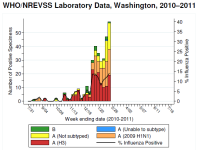
Overall number of positive samples has increased and the proportion of pH1N1 is growing.

Week 7 WA Isolates.png
 
Re: Washington 2010-2011 Season: Weeks 40-7 (One New Death, Total 6)

Re: Washington 2010-2011 Season: Weeks 40-7 (One New Death, Total 6)

The death reported at the state level was reported in Seattle and King County in week 4. It has made it to the state level report in this week. At this time, the total deaths are at 5 (unless at the county level they are reporting more). Sorry about the confusion.

"From WA State report (week 5), deaths have occurred weeks 47, 49, 52 and 3. I do not believe the one reported in Seattle and King County for week 4 has been counted in WA report, but I included it in total."

I do not believe this death has been counted in state report, but is now counted in the total at 6
From Seattle and King County: One New Death
"In week 8 one long-term care facility (LTCF) experienced the lab-confirmed H1N1 death of a resident; investigation is ongoing and
PHSKC is working with the facility."

http://www.kingcounty.gov/healthservices/health/communicable/immunization/fluactivity.aspx
 
Re: Washington 2010-2011 Season: Weeks 40-8 (One New Death, Total 7)

Re: Washington 2010-2011 Season: Weeks 40-8 (One New Death, Total 7)

Week 8:
1 new death; total 7 (Of these deaths, 3 were due to influenza A (H3) viruses, 2 were due to influenza A virus of unknown subtype and 1 was due to influenza B virus. Five of these six patients had at least one pre-existing medical condition which put them at high risk for complications from influenza. The other death is from week 8 out of Seattle and King County reported as H1N1)

• Influenza activity was elevated and geographically widespread in Washington during week 8.
• The proportion of emergency room visits for influenza-like illness (ILI) was above the baseline in both Eastern and Western Washington. The proportion of outpatient visits for ILI was also above the baseline.
• There was one laboratory-confirmed influenza death reported to the Washington State Department of Health (DOH) during week 8. No pregnant women with laboratory-confirmed flu admitted to an intensive care unit have been reported to DOH this season.
• During week 8 (2/20/11–2/26/11), 61 (16%) specimens tested by the World Health Organization/National Respiratory and Enteric Virus Surveillance System (WHO/NREVSS) collaborating laboratories in Washington were positive for influenza. Of these specimens, 54 (89%) were influenza A and 7 (11%) were influenza B viruses. Of the subtyped influenza A specimens, almost 60% were 2009 H1N1 viruses.

Spokane Regional Health District requires that their hospitals and providers report patients hospitalized with laboratory-confirmed influenza. Since October 3, 2010, 37 adults and 21 children hospitalized with laboratory confirmed influenza have been reported among Spokane County residents.
http://www.doh.wa.gov/EHSPHL/Epidemiology/CD/fluupdate.pdf
 
Re: Washington 2010-2011 Season: Weeks 40-9 (One New Death, Total 8)

Re: Washington 2010-2011 Season: Weeks 40-9 (One New Death, Total 8)

Seattle and King County (Week 8/9): 1 new death; total 8 for state
Influenza activity increased in King County during week 8. Some indicators are at levels approaching past season peaks:
Among the pediatric age groups, the proportion of Emergency Department (ED) visits for influenza-like illness (a chief complaint or diagnosis of flu, fever and cough, or fever and sore throat) has been on an increasing trend since early November. Among adults, the proportion of ED visits for ILI has not significantly increased compared to prior weeks. ED ILI trends are at or above the 5 year average for all ages combined as well as for the pediatric age groups.

In week 9 a middle-aged woman with pre-existing health conditions died with lab-confirmed H1N1; she was a resident of the same long-term care facility (LTCF) as the man who died in week 8 with H1N1. Four lab-confirmed flu deaths (two H1N1, one influenza A not subtyped, and one AH3N2) have occurred this season, all in middle-aged individuals with pre-existing health conditions.

In week 9 PHSKC was notified of three LTCFs with lab-confirmed influenza in residents, and one LTCF with flu testing pending. In week 8 one LTCF experienced the lab-confirmed flu death of a resident, with a second death in week 9. PHSKC has investigated ILI in a total of 11 LTCFs this season; influenza in residents was confirmed in six of these facilities.

The UW Virology Laboratory had 52 positive tests for influenza (16 pandemic AH1N1, 12 AH3N2, 18 influenza A not subtyped and six influenza B). This is up from 37 positive tests in week 7, and is the highest number positive this season. Other viruses currently circulating include respiratory syncytial virus (RSV), which continues to circulate at high levels, as well as parainfluenza, adenovirus, metapneumovirus, and rhinovirus.

7 of 20 (35.0%) specimens submitted by the outpatient sentinel surveillance system were positive for influenza (1 AH3, 2 influenza A not subtyped, 3 H1N1 and 1 flu B). Excluding the spring 2009 H1N1 wave, the peak count of samples submitted over the past five seasons has ranged from 37 (in 2005-06 season) to 72 (in Oct 2009), with a mean peak of 56 samples submitted.

42 of 231 (18.2%) rapid antigen tests reported by five hospital laboratories were positive for influenza (34 influenza A and 8 influenza B), the highest number of tests reported this season. Excluding the spring 2009 H1N1 wave, the peak count of rapid antigen tests reported since the initiation of the current rapid antigen reporting system in the 2007-08 season has ranged from 483 (in 2008-09 season) to 710 (in Oct 2009), with a mean peak of 586 rapid antigen tests reported.

No pregnant women with laboratory-confirmed influenza admitted to ICU were reported; none have been reported since Dec. 2009.

The proportion of deaths attributable to pneumonia and influenza was 5.1%, below the epidemic threshold of 8.0%.

Most schools were out of session for mid-winter break; absenteeism has been low and stable since the start of the school year.
http://www.kingcounty.gov/healthservices/health/communicable/immunization/fluactivity.aspx

 
Re: Washington 2010-2011 Season: Weeks 40-9 (Three New Deaths, Total 10)

Re: Washington 2010-2011 Season: Weeks 40-9 (Three New Deaths, Total 10)

This is the state report for week 9:
3 new deaths; total 10 (one from Seattle and King County from above report)
• Influenza activity was elevated and geographically widespread in Washington during week 9.
• The proportion of emergency room visits for influenza-like illness (ILI) was above the baseline in both Eastern and Western Washington. The proportion of outpatient visits for ILI was also above the baseline.
• There were three laboratory-confirmed influenza deaths reported to the Washington State Department of Health (DOH) during week 9. No pregnant women with laboratory-confirmed flu admitted to an intensive care unit have been reported to DOH this season.
• During week 9 (2/27/11–3/5/11), 62 (14%) specimens tested by the World Health Organization/National Respiratory and Enteric Virus Surveillance System (WHO/NREVSS) collaborating laboratories in Washington were positive for influenza. Of these specimens, 61 (98%) were influenza A and 1 (2%) was influenza B viruses. Of the subtyped influenza A specimens, 65% were 2009 H1N1 viruses.
http://www.doh.wa.gov/EHSPHL/Epidemiology/CD/fluupdate.pdf
 
Re: Washington 2010-2011 Season: Weeks 40-10 (Five New Deaths, Total 15)

Re: Washington 2010-2011 Season: Weeks 40-10 (Five New Deaths, Total 15)

Week 10: Widespread, elevated activity
5 new deaths; total 15 NOTE: 1 death reported by state was counted last week in Seattle and King county report.
Since July 25, 2010, the Department of Health (DOH) has received reports of 15 laboratory-confirmed influenza deaths. Of these deaths, 4 were due to influenza A (H3) viruses, 5 were due to influenza A (2009 H1N1), 4 were due to influenza A virus of unknown subtype and 2 were due to influenza B virus. Fourteen of these fifteen patients had at least one pre-existing medical condition which put them at high risk for complications from influenza.

? The proportion of emergency room visits for influenza-like illness (ILI) was above the baseline in both Eastern and Western Washington. The proportion of outpatient visits for ILI (2.9%) was below the baseline.
? There were six laboratory-confirmed influenza deaths reported to the Washington State Department of Health (DOH) during week 10. No pregnant women with laboratory-confirmed flu admitted to an intensive care unit have been reported to DOH this season.
? During week 10 (3/6/11?3/12/11), 80 (16%) specimens tested by the World Health Organization/National Respiratory and Enteric Virus Surveillance System (WHO/NREVSS) collaborating laboratories in Washington were positive for influenza. Of these specimens, 79 (99%) were influenza A viruses and 1 (1%) was influenza B virus. Of the subtyped influenza A specimens, 70% were 2009 H1N1 viruses.

Since October 3, 2010, 57 adults and 25 children hospitalized with laboratory confirmed influenza have been reported among Spokane County residents.
http://www.doh.wa.gov/ehsphl/Epidemiology/CD/fluupdate.pdf
 
Re: Washington 2010-2011 Season: Weeks 40-11 (Five New Deaths, Total 20)

Re: Washington 2010-2011 Season: Weeks 40-11 (Five New Deaths, Total 20)

Week 11:
5 new deaths; total 20 (All deaths have been 25 years and older)

Influenza activity remained elevated in Washington but decreased slightly during week 11.
• The proportion of emergency room visits for influenza-like illness (ILI) was above the baseline in both Eastern and Western Washington. The proportion of outpatient visits for ILI was below the baseline.
• There were five laboratory-confirmed influenza deaths reported to the Washington State Department of Health (DOH) during week 11. A total of 20 lab-confirmed flu deaths have been reported this season.
Two pregnant women with laboratory-confirmed flu admitted to an intensive care unit have been reported to DOH this season. One of these women was infected with 2009 H1N1 virus and the other was infected with an influenza A virus of unknown subtype.
• During week 11 (3/13/11–3/19/11), 74 (17.9%) specimens tested by the World Health Organization/ National Respiratory and Enteric Virus Surveillance System (WHO/NREVSS) collaborating laboratories in Washington were positive for influenza. Of these specimens, 73 (99%) were influenza A viruses and 1 (1%) was influenza B virus. Of the subtyped influenza A specimens, 74% were 2009 H1N1 viruses.

P&I: 13.5%
http://www.doh.wa.gov/ehsphl/Epidemiology/CD/fluupdate.pdf
 
Re: Washington 2010-2011 Season: Weeks 40-12 (Four New Deaths, Including Pediatric; Total 24)

Re: Washington 2010-2011 Season: Weeks 40-12 (Four New Deaths, Including Pediatric; Total 24)

Week 12:
4 new deaths, including pediatric; total 24

• Influenza activity (2.4%) decreased in Washington during week 12.
• The proportion of emergency room visits for influenza-like illness (ILI) was at the baseline in Western Washington and just below the baseline in Eastern Washington.
• Four laboratory-confirmed influenza deaths, including one pediatric death, were reported to the Washington State Department of Health (DOH) during week 12.
Two pregnant women with laboratory-confirmed flu admitted to an intensive care unit have been reported to DOH this season.
• During week 12 (3/20/11–3/2611), 74 (17%) specimens tested by the World Health Organization/National Respiratory and Enteric Virus Surveillance System (WHO/NREVSS) collaborating laboratories in Washington were positive for influenza. Of these specimens, 68 (92%) were influenza A viruses and 6 (8%) were influenza B viruses. Of the subtyped influenza A specimens, 72% were 2009 H1N1 viruses.
http://www.doh.wa.gov/ehsphl/Epidemiology/CD/fluupdate.pdf
 
Re: Washington 2010-2011 Season: Weeks 40-14 (Five New Deaths; Total 32)

Re: Washington 2010-2011 Season: Weeks 40-14 (Five New Deaths; Total 32)

Week 14:
5 new deaths; total 32

? Influenza activity continued to decrease in Washington during week 14.
? The proportion of emergency room visits for influenza-like illness (ILI) was below the baseline. The proportion of outpatient visits for ILI was also below the baseline.
? During week 14 (4/3/11?4/9/11), 21 (6.2%) specimens tested by the World Health Organization/National Respiratory and Enteric Virus Surveillance System (WHO/NREVSS) collaborating laboratories in Washington were positive for influenza. Of these specimens, 16 (76%) were influenza A viruses and 5 (24%)
were influenza B viruses. Of the subtyped influenza A specimens, 100% were 2009 H1N1 viruses.
http://www.doh.wa.gov/ehsphl/Epidemiology/CD/fluupdate.pdf
 
Re: Washington 2010-2011 Season: Weeks 40-15 (One New Death; Total 33)

Re: Washington 2010-2011 Season: Weeks 40-15 (One New Death; Total 33)

Week 15:
1 new death; total 33 (majority 50-64 years)
ILI: 0.8%

Influenza activity continued to decrease in Washington during week 15.
? The proportion of emergency room visits for influenza-like illness (ILI) was below the baseline.
? During week 15 (4/10/11?4/16/11), 13 (4.0%) specimens tested by the World Health Organization/National Respiratory and Enteric Virus Surveillance System (WHO/NREVSS) collaborating laboratories in Washington were positive for influenza. Of these specimens, 12 (92%) were influenza A viruses and 1 (8%)
were influenza B viruses. Of the subtyped influenza A specimens, 86% were 2009 H1N1 viruses.
http://www.doh.wa.gov/EHSPHL/Epidemiology/CD/fluupdate.pdf
 
Re: Washington 2010-2011 Season: Weeks 40-16 (Three New Deaths; Total 36)

Re: Washington 2010-2011 Season: Weeks 40-16 (Three New Deaths; Total 36)

Week 16:
3 new deaths; total 36 (majority 50-64 years of age)

Influenza activity continued to decrease in Washington during week 16.
? The proportion of emergency room visits for influenza-like illness (ILI) was below the baseline. The proportion of outpatient visits for ILI was also below the baseline.
? Three laboratory-confirmed influenza deaths were reported to the Washington State Department of Health(DOH) during week 16.
? During week 16 (4/17/11?4/23/11), 12 (4.5%) specimens tested by the World Health Organization/National Respiratory and Enteric Virus Surveillance System (WHO/NREVSS) collaborating laboratories in Washington were positive for influenza. Of these specimens, 10 (83%) were influenza A viruses and 2 (17%) were influenza B viruses. Of the subtyped influenza A specimens, 100% were 2009 H1N1 viruses.
http://www.doh.wa.gov/EHSPHL/Epidemiology/CD/fluupdate.pdf
 
Re: Washington 2010-2011 Season: Weeks 40-17 (No New Deaths; Total 36)

Re: Washington 2010-2011 Season: Weeks 40-17 (No New Deaths; Total 36)

Week 17:
No new deaths; total 36

ILI: 0.4%
The proportion of emergency room visits for influenza-like illness (ILI) was low.

2.4% specimens were positive for influenza. Of these specimens, 6 (86%) were influenza A viruses and 1 (14%) was an influenza B virus. Of the subtyped influenza A specimens, 2 (50%) were 2009 H1N1 viruses.

P&I: 4.5%
http://www.doh.wa.gov/ehsphl/Epidemiology/CD/fluupdate.pdf
http://www.doh.wa.gov/notify/nc/influenza.htm
 
Re: Washington 2010-2011 Season: Weeks 40-20 (No New Deaths; Total 36)

Re: Washington 2010-2011 Season: Weeks 40-20 (No New Deaths; Total 36)

Week 20:
No new deaths; total 36
This is the last weekly Influenza Update for the 2010?2011 season.
? There was almost no influenza activity detected in Washington during week 20.
? The proportion of outpatient and emergency room visits for influenza-like illness (ILI) was very low.
? No laboratory-confirmed influenza deaths were reported to the Washington State Department of Health (DOH) during week 20.
? During week 20 (5/15/11?5/21/11), no specimens tested by the World Health Organization/National Respiratory and Enteric Virus Surveillance System (WHO/NREVSS) collaborating laboratories in Washington were positive for influenza.
http://www.doh.wa.gov/EHSPHL/Epidemiology/CD/fluupdate.pdf
 
Re: Washington 2010-2011 Season: Weeks 40-32

Re: Washington 2010-2011 Season: Weeks 40-32

Weeks 30-32

1.4% positive for influenza B

Western Washington: For week 32, emergency departments in Western Washington reported 56 ILI visits (0.3%) out of 18078 total patient visits.

Eastern Washington: For week 32, emergency departments in Eastern Washington reported 24 ILI visits (0.4%) out of 5771 total patient visits.

Since July 24, 2011, the Department of Health (DOH) has received reports of no laboratory-confirmed influenza deaths.
http://www.doh.wa.gov/notify/nc/influenza.htm
 
Back
Top