

Pathfinder
Editor, Senior Moderator
Preliminary report on H5N1 highly pathogenic avian influenza in Utah mink, August 2026
Influenza virusH5N1-globalOct 22
1h
post by Martha_NIH 1 hour ago

Martha_NIH
1h
Alvin Crespo-Bellido1, Jennifer L. Havens1, Thomas P. Peacock2,3, Florence Débarre4, Martha I. Nelson1
1 Division of Intramural Research, National Library of Medicine, National Institutes of Health, Bethesda, MD USA
2 The Pirbright Institute, Woking, UK
3Department of Infectious Disease, Imperial College London, UK
4 Institut d’Écologie et des Sciences de l’Environnement, CNRS, Sorbonne Université, UPEC, IRD, INRAE, Paris, France
Abstract
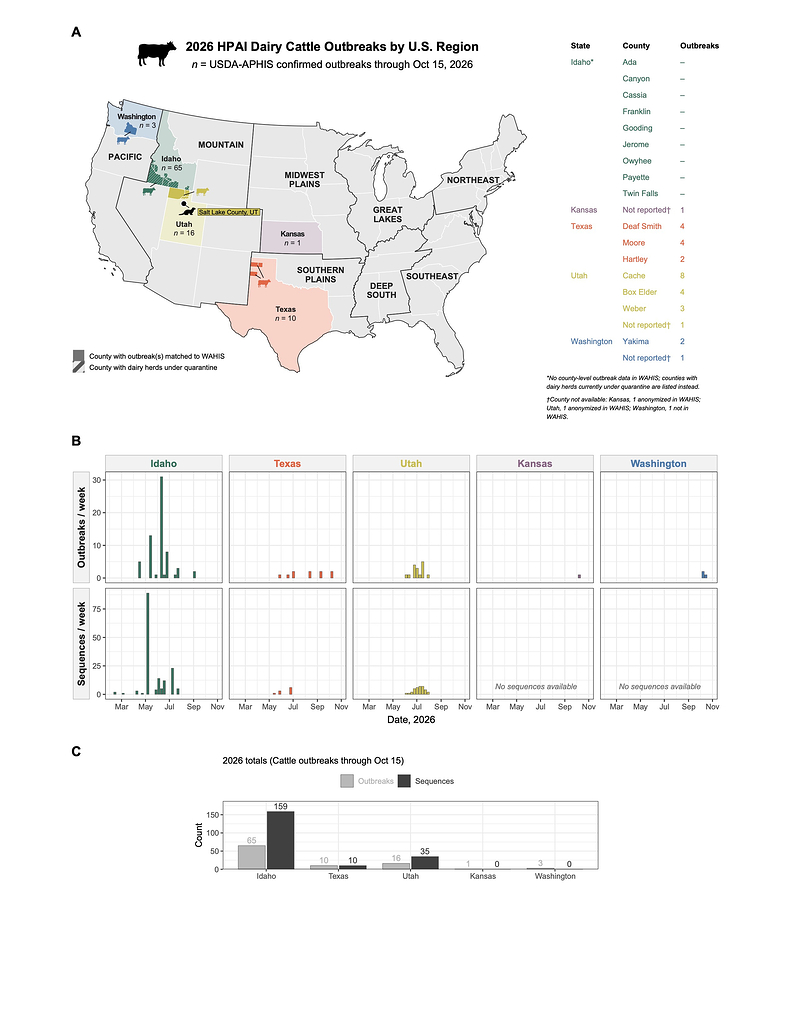
Here, we describe an outbreak of highly pathogenic avian influenza viruses belonging to H5N1 clade 2.3.4.4b in August 2026 that caused high mortality on a mink farm in Salt Lake County, Utah, using data generated by the US Department of Agriculture. Genetic sequencing of the mink viruses identified the genotype as B3.13, which currently circulates in US dairy cattle and has been reported on dairies in Utah, Texas, and Idaho in 2026. Based on ten genome sequences in Utah mink collected August 7, 2026, the mink outbreak is positioned within the 2026 cattle clade. The most closely related viruses were sampled in May 2026 in Texas cattle. Several months of unsampled transmission chains between the Texas cattle and Utah mink outbreaks leave many open questions about how the virus entered the mink farm. Additional PB2 mammalian adaptations were not selected for in mink, since the cattle-adapted B3.13 virus already had the PB2-M631L mutation that increases replication in mammals. However, all ten Utah mink viruses had a PB1-K388R substitution that was previously observed in the H5N1 mink outbreak in Spain but rarely occurs in avian hosts and was not seen in cattle.
...
Outstanding Questions
● How did B3.13 spread from cows to mink? In Europe, wild birds (gulls) are the most likely source of H5N1 outbreaks in mink in Spain and Finland, based on genetic evidence (the BB genotype found in mink predominantly circulates in European gulls) and the fact that gulls are attracted to food waste in mink barns. The transmission route between Texas cattle to Utah mink is considerably less clear. Shared workers, vehicles, or equipment have also been proposed to spread the B3.13 virus locally from dairies to poultry farms. Since mink receive a wide variety of food sources that are transported long distances, the source of the mink outbreak could involve poultry or cattle products from a different state.
● Will the virus spread to additional mink farms? Thus far, the Utah mink outbreak appears to be contained to one farm, but local spread to additional farms is a concern. In contrast to pigs and cows, mink are not routinely transported between farms. Yet, in 2020, SARS-CoV-2 spread between six mink farms in Utah. Local free roaming cats were infected by mink, but their role in spread between farms remains unclear (13). Mink infected with SARS-CoV-2 were not culled, and there are currently no plans to cull HPAI-infected mink in Utah.
● Is the virus already adapted to mink, or will it continue to adapt to a new host? A limitation of this report is that the sequences analyzed were collected during the earlier stage of the mink outbreak (August 7, 2026). As of October 21, 2026 there are no additional sequences available from more recent mink samples.
● How much cryptic transmission occurs in cattle? Almost three years into the B3.13 outbreak in US dairy cattle, the virus appears to have been eliminated in most states, including California, which is a major achievement. However, the persistence of B3.13 in dairy cattle in Idaho, Texas, and Utah continues to provide opportunities for spillover to new species, including mink. Despite active surveillance, large sampling gaps in dairy cattle make it difficult to track the shifting geography of spillover risk, identify key reservoirs for the virus, and determine the origins of outbreaks in other species, including mink.
● What other US mink populations are at risk for B3.13? Two states where B3.13 continues to circulate in dairy cattle, Utah and Idaho, also happen to be two of the country’s largest mink producers. Texas does not have commercial mink farms, which are concentrated in cooler climates, for example Wisconsin, Utah, Idaho, and Oregon. Fortunately, the B3.13 virus has never been detected in dairy cattle in Oregon or Wisconsin. However, other H5N1 clade 2.3.4.4b genotypes circulate in wild birds in Wisconsin and Oregon and have been detected in a dairy farm (WI; D1.1 genotype (14,15)) and swine (OR; D1.2 genotype (16)). The absence of documented spillovers of H5N1 from wild birds to mink in North America is not well explained, given the role of wild birds in the mink outbreaks in Spain and Finland. There are gaps in our understanding of HPAI ecology in North America, especially in gulls. The recent outbreak in Utah is a reminder that mink are highly susceptible to both avian influenza and human seasonal viruses. H5N1 peaks in North American wild birds at the same time as seasonal influenza in humans, during cooler winter months, providing opportunities for avian and human-origin viruses to spill over into mink at the same time and potentially reassort.
...
Preliminary report on H5N1 highly pathogenic avian influenza in Utah mink, August 2026
Alvin Crespo-Bellido1, Jennifer L. Havens1, Thomas P. Peacock2,3, Florence Débarre4, Martha I. Nelson1 1 Division of Intramural Research, National Library of Medicine, National Institutes of Health, Bethesda, MD USA 2 The Pirbright Institute, Woking, UK 3Department of Infectious Disease...
 virological.org