Fluview week 2
Fluview week 2
2009-2010 Influenza Season Week 1 ending January 9, 2010All data are preliminary and may change as more reports are received.
Synopsis:
During week 1 (January 3-9, 2010), influenza activity continued to decrease in the U.S.
?139 (3.6%) specimens tested by U.S. World Health Organization (WHO) and National Respiratory and Enteric Virus Surveillance System (NREVSS) collaborating laboratories and reported to CDC/Influenza Division were positive for influenza.
?
All subtyped influenza A viruses reported to CDC were 2009 influenza A (H1N1) viruses.
?
One human infection with a novel influenza A virus was reported.?The proportion of deaths attributed to pneumonia and influenza (P&I) was below the epidemic threshold.
?Seven influenza-associated pediatric deaths were reported. Six deaths were associated with 2009 influenza A (H1N1) virus infection and one was associated with an influenza A virus for which the subtype was undetermined.
?The proportion of outpatient visits for influenza-like illness (ILI) was 1.9% which is below the national baseline of 2.3%. One of the 10 regions (region 9) reported ILI above their region-specific baseline.
?No states reported widespread influenza activity, nine states reported regional influenza activity, the District of Columbia, Puerto Rico, and 15 states reported local influenza activity, Guam and 24 states reported sporadic influenza activity, and the U.S. Virgin Islands and two states reported no influenza activity.
-snip-
Novel Influenza A Virus:
One case of human infection with a novel influenza A virus was reported by the Iowa Department of Public Health. The case patient had onset of symptoms in September 2009, but did not require hospitalization and has fully recovered. The virus was identified as swine influenza A (H3N2) and investigated in November 2009. No clear exposure to swine was identified, but no evidence of sustained human-to-human transmission with this virus was found. Early identification and investigation of novel influenza A cases is critical to evaluate the extent of the outbreak and possible human-to-human transmission. Surveillance for human infections with novel influenza A viruses is conducted year-round.
-snip-
From August 30, 2009 ? January 9, 2010, 38,454 laboratory-confirmed influenza-associated hospitalizations and 1,779 laboratory-confirmed influenza-associated deaths were reported to CDC.
-snip-
A total of 52 cases of oseltamivir resistant 2009 influenza A (H1N1) viruses have been identified in the United States since April 2009. While the total number of cases has not increased over the previous week, one previously reported case was reclassified and one new case was identified. Forty-two of these specimens were collected after September 1, 2009.
-snip-
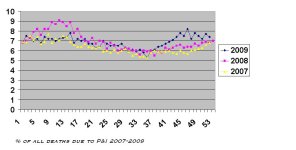
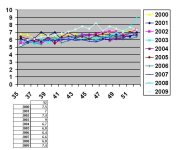
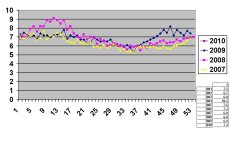
During week 1, 7.3% of all deaths reported through the 122-Cities Mortality Reporting System were due to P&I. This percentage was below the epidemic threshold of 7.6% for week 1.
-snip-
Seven influenza-associated pediatric deaths were reported to CDC during week 1 (Illinois, Michigan, New York [2], Oregon, and Texas [2]). Six deaths were associated with 2009 influenza A (H1N1) virus infection and one was associated with an influenza A virus for which the subtype was undetermined.. The deaths reported during week 1 occurred between October 11 and December 19, 2009.
Since August 30, 2009, CDC has received 236 reports of influenza-associated pediatric deaths that occurred during the current influenza season (43 deaths in children less than 2 years old, 26 deaths in children 2-4 years old, 87 deaths in children 5-11 years old, and 80 deaths in children 12-17 years old). One hundred ninety-five (83%) of the 236 deaths were due to 2009 influenza A (H1N1) virus infections, 40 were associated with an influenza A virus for which the subtype is undetermined, and one was associated with an influenza B virus infection. A total of 255 deaths in children associated with 2009 influenza A (H1N1) virus infection have been reported to CDC.
Among the 236 deaths in children, 121 children had specimens collected for bacterial culture from normally sterile sites and 39 (32.2%) of the 121 were positive; Streptococcus pneumoniae was identified in 10 (25.6%) of the 39 children and Staphylococcus aureus was identified in 11 (28.2%) of the 39 children. Two S. aureus isolates were sensitive to methicillin, eight were methicillin resistant, and one did not have sensitivity testing performed. Twenty-six (66.7%) of the 39 children with bacterial coinfections were five years of age or older, and 14 (35.9%) of the 39 children were 12 years of age or older.
-snip-
Rates [EIP (new sites)] for children aged 0-4 years and 5-17 years were 5.9 (9.7) and 2.5 (3.6) per 10,000, respectively. Rates [EIP (new sites)] for adults aged 18-49 years, 50-64 years, and ≥ 65 years were 2.2 (1.7), 2.9 (1.8) and 2.4 (1.7) per 10,000, respectively.
-snip-
Nationwide during week 01, 1.9% of patient visits reported through the U.S. Outpatient Influenza-like Illness Surveillance Network (ILINet) were due to influenza-like illness (ILI). This percentage is above the national baseline of 2.3%.
The increase in the percentage of outpatient visits for ILI during weeks 51 and 52 is likely influenced by a reduction in routine health care visits during the holiday season, as has occurred during previous seasons.
http://www.cdc.gov/flu/weekly/