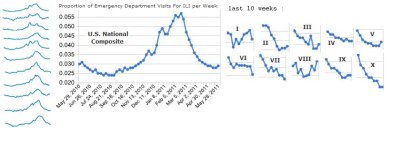
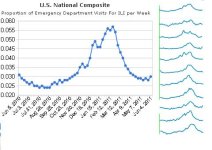
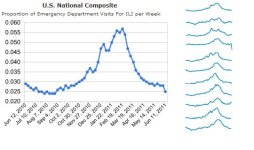
Re: USA - Actual ISDS flu trends
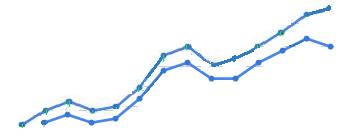
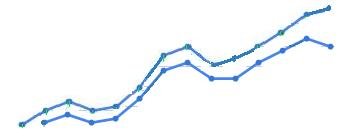
The latest report from LA County, California makes a good point this week and indicates how unusual this season has been/will be. They indicated that %ILI is going down, and the number of flu casing is decreasing, but percent positives are still high and there are more severe cases and new deaths every week. Of their 17 deaths, only one is from flu B and 100% of the Flu A deaths that were subtyped are pH1N1. If you look at the isolates data, Flu B and H3N2 are decreasing, while pH1N1 is increasing.
http://www.flutrackers.com/forum/showthread.php?t=160981
If you look at the state of Washington, they haven't reached peak with respect to any indicators.
http://www.doh.wa.gov/EHSPHL/Epidemiology/CD/fluupdate.pdf
On the other extreme, Louisiana has had a very active flu season and appears to have peaked when looking at their %ILI.
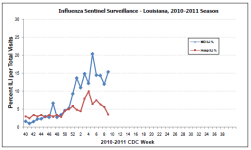
First, their samples were dominated by Flu B, then H3N2, and only in the past couple of weeks has pH1N1 shown up. Despite the severe flu season to date, they have only reported one pediatric death. I'm not sure if it was the Texas child that died in a Shreveport hospital or a different child. Unfortunately, the graph does not indicate the percent positive or the number of samples taken. But, it's clear that they have had overlapping waves of Flu B and H3N2 that has kept their %ILI over 10% since Week 1. My concern is that pH1N1 will begin to dominate in a few weeks, causing the severe cases and deaths to mount.
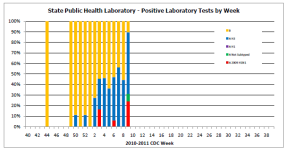
Bear with me for one other example. Illinois (who is chronically a week behind in reporting) is showing past peak for %ILI:
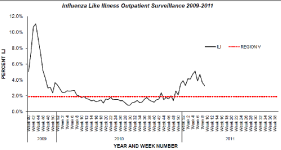
However, there was very little pH1N1 until Week 9:
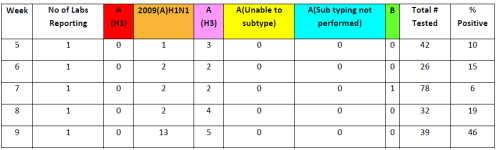
Illinois has reported 5 pediatric deaths and 2 adult deaths. The Week 9 report of increased %positives is attributed to an outbreak of pH1N1 in a correctional facility.
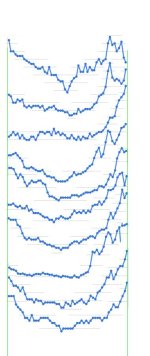
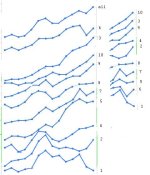
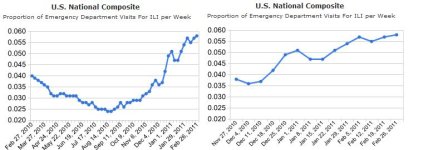
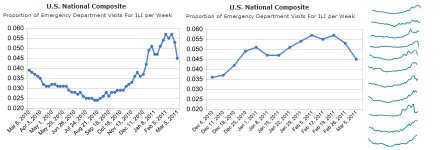
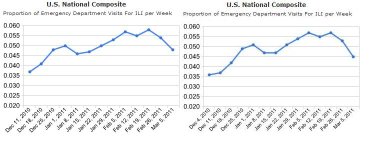
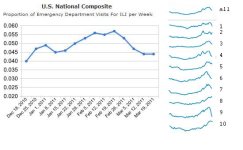
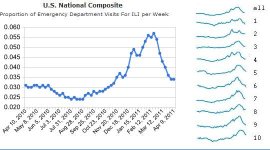
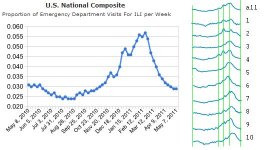
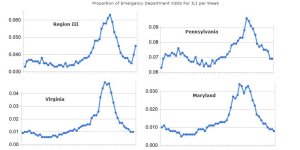
My point in all this is that although %ILI data in the U.S. suggests that the flu season is nearly over, I believe that the isolates data indicate a strong potential for a second wave dominated by pH1N1. This might not be evident in the national or even regional %ILI data until it is well under way since different states are at various stages of relative increases or decreases of seasonal flu and pH1N1. And, if another wave is dominated by the mutated pH1N1 strain that has apparently escaped the vaccine, then we could have a spring epidemic in the U.S. comparable to the fall of 2009.