• FluTrackers.com Inc. does not provide medical advice. Information on this web site is collected from various internet resources, and the FluTrackers board of directors makes no warranty to the safety, efficacy, correctness or completeness of the information posted on this site by any author or poster. The information collated here is for instructional and/or discussion purposes only and is NOT intended to diagnose or treat any disease, illness, or other medical condition. Every individual reader or poster should seek advice from their personal physician/healthcare practitioner before considering or using any interventions that are discussed on this website. By continuing to access this website you agree to consult your personal physican before using any interventions posted on this website, and you agree to hold harmless FluTrackers.com Inc., the board of directors, the members, and all authors and posters for any effects from use of any medication, supplement, vitamin or other substance, device, intervention, etc. mentioned in posts on this website, or other internet venues referenced in posts on this website.
  • We are not asking for any donations. Do not donate to any entity who says they are raising funds for us.

Uganda - 21 Ebola cases, incl. 3 deaths (confirmed & probable) - May 15+

Related to posts #14 and #18

Uganda postpones Martyrs’ Day celebrations amid Ebola outbreak concerns

Uganda has postponed the annual Martyrs’ Day commemorations, set for 3 June, due to Ebola concerns in eastern Democratic Republic of Congo.

Christopher Kisekka - Kampala

President Yoweri Kaguta Museveni made the announcement following consultations with the national epidemic response task force and religious leaders.

Pilgrims to return home

“Fellow Ugandans...After consultations with the national epidemic response task force and religious leaders, we have decided to postpone the Martyrs’ Day to a later date, which will be communicated. This decision was made because Uganda receives thousands of pilgrims annually from Eastern Congo, which is currently experiencing an Ebola outbreak. To safeguard everyone’s lives, it is essential that this important event be postponed.”

The President urged pilgrims already on the journey to return home, to observe all precautionary measures, to report any cases of illness, and to seek prompt medical attention. “We regret any inconvenience caused, but the protection of life must come first,” he added.

Health officials screen pilgrims

A sizable number of foot pilgrims from the Catholic Diocese of Butembo-Beni in eastern DRC, an area affected by the current Ebola outbreak, crossed into Uganda on 15 May and are currently hosted at St. Michael Church-Kabuyiri in Kasese District. They were received by Bishop Francis Aquirinus Kibira of the Kasese Diocese. Several additional groups are reported to be en route. Health authorities have initiated screening, and onward travel has been suspended.

Legacy of the martyrs

The Uganda Martyrs: 22 Catholic and 23 Anglican converts, were executed between 1885 and 1887 on the orders of Kabaka Mwanga II of Buganda for refusing to renounce their Christian faith.

Pope Benedict XV beatified the 22 Catholic martyrs in 1920. On 18 October 1964, Pope St. Paul VI canonised them in a historic ceremony at St. Peter’s Basilica in Rome.

Uganda Martyrs Day is one of the largest annual Christian gatherings on the continent, attracting hundreds of thousands to several million pilgrims and visitors from Uganda and across East and Central Africa and beyond.

...
18 May 2026, 09:07

https://www.vaticannews.va/en/afric...s-day-celebrations-amid-ebola-outbreak-c.html
 
Hat tip to Alan Kasujja@kasujja

image.png
​​
 
Source: https://www.reuters.com/business/he...w-ebola-cases-bringing-total-five-2026-05-23/


Uganda confirms three new Ebola cases, bringing total to five
By Reuters
May 23, 20264:49 AM EDTUpdated 52 mins ago​

May 23 (Reuters) - Uganda has confirmed three new cases of Ebola, bringing the total number of infections ​in the current outbreak there to five, the health ‌ministry said on Saturday, as authorities stepped up contact tracing to contain the spread...
 
..On Thursday, Uganda suspended all public transport to the DRC after confirming its first two cases -- one infection and one death -- involving Congolese nationals who crossed the border.

It said the driver confirmed infected on Saturday had been at the wheel of the vehicle in which one of the ill Congolese nationals had travelled to Uganda.

The health worker was exposed to the virus when she was treating that Congolese patient.

- 'Especially challenging' -

The third new case, the ministry said, was a Congolese woman who had been treated in Kampala for abdominal pains and discharged 'in good condition' on May 14.

She tested positive for Ebola after she returned to the DRC.

'All contacts linked to the confirmed cases have since been identified and are being closely monitored,' the health ministry said.
​:tiphat:
https://zeta.com.pa/ingles/74814-uganda-confirms-new-ebola-cases-linked-to-dr-congo.html
 
Africa CDC proposes continental Ebola response team in Uganda
Health
igiheIcon.png

ByXinhua
On May 23, 2026 at 10:31 AM
The Africa Centers for Disease Control and Prevention (Africa CDC) on Friday proposed establishing a continental Ebola Incident Management Support Team in Uganda to strengthen coordination and monitoring of the disease response across Africa.

The proposal was presented during a meeting between a visiting Africa CDC delegation and Ugandan President Yoweri Museveni at State House Entebbe, according to an official statement.

During the meeting, the delegation briefed Museveni on the current status of the Ebola outbreak and assured him that the situation was being appropriately managed.

Jean Kaseya, director-general of Africa CDC, emphasized the need to establish the continental support team in Kampala to enhance coordination and monitoring efforts in responding to Ebola.

"Ebola only becomes deadly when there is a lack of attention. Otherwise, it is very manageable," said Museveni, who welcomed the proposal and pledged Uganda's full support.
​:tiphat:
https://en.igihe.com/health/article/africa-cdc-proposes-continental-ebola-response-team-in-uganda
 
Uganda Airlines suspends Kinshasa flights over Ebola


Airline says cancellations will take effect from May 23 until further Uganda Airlines suspends Kinshasa flights over Ebola/X
Uganda Airlines has announced the temporary suspension of flights to and from Kinshasa following what it described as recent Ebola developments in the region.

In a public notice issued by the airline’s management, the carrier said the cancellations would take effect from May 23, 2026, and remain in place until further notice.

….
Atwine said authorities have already identified and placed 127 contacts under institutional quarantine as part of efforts to ..,.
:tiphat:
https://www.the-star.co.ke/news/afr...airlines-suspends-kinshasa-flights-over-ebola
 
image.png


Health Alert: Worldwide Caution – Updated Public Health Arrival Restrictions and Enhanced Ebola Screening – May 22, 2026

By U.S. Embassy Uganda

10 MINUTE READ
23 May, 2026

Event: U.S.-bound American citizens and lawful permanent residents (LPRs) who have been present in the Democratic Republic of the Congo, Uganda, or South Sudan within 21 days of arrival in the United States must only enter through the following airports for enhanced screening:
  • Washington Dulles International Airport (IAD) for flights after 11:59 PM on May 21, 2026
  • Hartfield-Jackson Atlanta International Airport (ATL) for flights after 11:59 PM on May 22, 2026
  • George Bush Intercontinental Airport, (IAH), Houston, for flights departing after 11:59 PM on May 26, 2026
The U.S. Centers for Disease Control and Prevention (CDC) and the Department of Homeland Security’s (DHS) Customs and Border Protection (CBP) will apply enhanced public health screening at IAD in response to the Ebola outbreak.

This requirement applies to all passengers, including U.S. citizens and LPRs, who were present in those countries.

Please be prepared for flight changes or cancellations.

Actions to take:
https://ug.usembassy.gov/health-ale...ons-and-enhanced-ebola-screening-may-22-2026/
---------------------------------------------------------------------------------------------------------------

image.png

Health Alert – U. S. Embassy Kampala, Uganda (May 22, 2026 )

By U.S. Embassy Uganda

11 MINUTE READ
23 May, 2026

Location: Uganda – DRC Border

Event:

Due to the Ebola outbreak, Uganda has limited crossings at the border with DRC and some markets:
  • On May 21, 2026, the Uganda National Task Force on Ebola Virus Disease communicated that Uganda intends to limit traffic crossing the Uganda-DRC border.
  • Only essential traffic will be permitted for the next four weeks.
  • All public passenger service on bus transport, public transport, flights, and Semliki River ferries are suspended. Goods and food transport are excepted. 
  • Uganda will also suspend weekly markets in high-risk districts for the next four weeks.
These restrictions are expected to take effect within 48 hours of the announcement.

Travel to the U.S. 

Review the U.S. Centers for Disease Control and Prevention (CDC) information on what travelers need to know about returning to the United States from DRC, Uganda, and South Sudan.

Actions to Take:
Assistance:

U.S. Embassy Uganda

1577 Ggaba Road

Kampala, Uganda

+256-312-306-001 / +256-414-306-001 / +256-414-259-791

https://ug.usembassy.gov

State Department – Consular Affairs

888-407-4747 or 202-501-4444

Uganda Country Information

Enroll in Smart Traveler Enrollment Program   (STEP) to receive security and health updates.

Follow us on Facebook  , X  , and Instagram  .

https://ug.usembassy.gov/health-alert-u-s-embassy-kampala-uganda-may-22-2026/


Government of Canada introduces temporary border measures in response to the Ebola disease outbreak

From: Public Health Agency of Canada

News release

May 26, 2026 | Ottawa, Ontario | Public Health Agency of Canada

In response to the Ebola disease outbreak in the Democratic Republic of the Congo, and increasing risks in Uganda and South Sudan, the Government of Canada is taking decisive action by introducing temporary border measures to reduce the risk of the virus entering and spreading within Canada.

The Government of Canada intends to suspend immigration documents for residents of countries that have a high or very high risk of outbreak of Ebola disease for the next 90 days beginning May 27, 23:59 EDT. At this time, this includes the Democratic Republic of the Congo, Uganda and South Sudan. This will mean that even those with a previously approved temporary resident visa, electronic travel authorization (eTA) or permanent resident visa will not be allowed to travel to Canada while their immigration document is suspended. During this time, we also intend to temporarily pause making decisions on applications for these documents from residents of these countries.

The government intends to implement an additional measure effective May 30 at 23:59 pm EDT until August 29, 2026, whereby Canadian citizens, permanent residents, persons registered under the Indian Act, and foreign nationals, who have been in these areas within the previous 21 days and do not have symptoms, will have to quarantine for 21 days. If they do not have a place where they can quarantine safely, they will be provided with an appropriate location. Travellers who have symptoms will be isolated at a hospital for further assessment. These measures are being implemented under the Quarantine Act.

Those who are already in Canada are not impacted by these measures, and may continue to stay here for their authorized period of stay. As per standard procedure, these travellers were already screened upon their arrival by a Canada Border Services Agency Border Services Officers. Canadian citizens and permanent residents could still return to Canada and would undergo screening at ports of entry upon their arrival.

While the risk to people in Canada remains low, the Government of Canada is taking a precautionary approach given the severity of Ebola disease and the evolving international situation, including the FIFA World Cup. There has never been a case of Ebola disease imported into Canada and there are currently no cases of Ebola disease in North America.

The Government of Canada continues to monitor the situation closely and will adjust these measures as needed based on available evidence, including the epidemiological situation in Canada and internationally.

Travellers are reminded that border measures may change with little notice and are encouraged to check the latest information before travelling at travel.gc.ca.

Quotes

"The health and safety of people in Canada is our top priority. These temporary border measures will help reduce the risk of Ebola disease entering the country while ensuring that travellers are managed based on their level of risk. We will continue to take action guided by science and evidence to protect Canadians."

The Honourable Marjorie Michel
Minister of Health​

"Canadians can be assured that their health and safety is our top priority. The measures we plan to introduce are necessary to protect Canadians and reinforce the integrity of our border against this threat to public health. We will continue to take proactive and decisive action in response to the emerging Ebola outbreak."

The Honourable Lena Metlege Diab
Minister of Immigration, Refugees and Citizenship​

​...

https://www.canada.ca/en/public-hea...n-response-to-the-ebola-disease-outbreak.html
 

Attachments

  • image.png
    image.png
    7.6 KB · Views: 2
Translation Google

Ebola in Uganda: After two new cases, Kampala tries to prevent a new chain of transmission

Two weeks after the official announcement of a new Ebola outbreak on May 15, 2026, Ugandan authorities are trying to reassure the public that the epidemic remains under control and confined to a single, clearly identified cluster. This message is intended to be reassuring following the identification of two new cases on Monday.

Published on:26/05/2026 - 19:54
By : Christina Okello

" We have identified only one chain of transmission. All cases recorded so far are linked to the two patients who came from Congo ," Daniel Kyabayinze, director of public health at the Ugandan Ministry of Health, told RFI.

The two new cases are healthcare workers infected after caring for the first patients who arrived from the Democratic Republic of Congo to receive treatment in Uganda . The other identified cases also include healthcare workers, domestic staff, and the driver who transported the patients.

According to Kampala, the fact that all cases remain concentrated in the capital for now is a rather reassuring element for health authorities, as the city is considered easier to monitor and control than a spread dispersed in several regions of the country.

"We are in a race against time."

Behind this reassuring discourse, Kampala nevertheless acknowledges that part of the virus probably circulated even before the official announcement of the epidemic.

“ We are in a race against time ,” acknowledges Daniel Kyabayinze.

The two patients at the origin of the outbreak had already entered the Ugandan health system around May 10. Since then, the authorities have been trying to reconstruct their precise movements: which plane they took, what transport they used, which health facilities they visited.

Health teams are also working to reconstruct what epidemiologists call a "line list": a table detailing all identified cases, their contacts, their movements and their potential exposures to the virus.

But the system remains imperfect, Kampala acknowledges.

“ If there were more cases today, we would start to see a second chain of transmission or unexplained deaths. For now, that is not the case. So we are confident, but that does not mean that there are none. The risk remains high ,” explains Daniel Kyabayinze.

The critical threshold of 21 days

Uganda is now closely monitoring the 21-day threshold corresponding to the maximum incubation period of the Ebola virus .

On Wednesday, May 27, thirteen days will have passed since the official announcement of the epidemic and approximately eighteen days since the first patients arrived in the Ugandan healthcare system. Authorities are therefore approaching the first complete incubation period.

If no new unexpected clusters emerge by then, Kampala hopes to be able to confirm that the epidemic remains limited to this single chain of transmission.

To try to limit the spread of the virus, more than 600 health workers have been deployed to health facilities across the country to sift through several months of hospital records, trace patient movements, and investigate any unexplained deaths. The 37 districts bordering the DRC have also been placed under heightened surveillance.

Alerts on the rise despite false leads

Ugandan authorities also say they are seeing an increase in reports from the public about suspicious symptoms – something Kampala considers encouraging.

According to Daniel Kyabayinze, awareness campaigns are starting to have an effect, even though a large proportion of the alerts ultimately turn out to be false leads.

Many of the symptoms of Ebola – fever, vomiting, fatigue – also resemble those of malaria or other infections that are widespread in the region.

" Our greatest success would be if people reported suspected cases to us ," he explains.

But despite this mobilization, the authorities acknowledge that some contacts could still escape health surveillance. The movements of the first patients between the DRC, Arua, and Kampala considerably complicate the contact tracing effort.

Kampala, however, emphasizes the scientific logic of virus transmission to justify its cautious optimism.

“ We are not contagious as long as we do not show symptoms (…) even if there has been movement along the transport corridor with the DRC, transmission occurs mainly when patients are seriously ill ,” explains Daniel Kyabayinze.

https://www.rfi.fr/fr/afrique/20260...-d-éviter-une-nouvelle-chaîne-de-transmission
 
image.png


Health Alert: U. S. Embassy Kampala, Uganda – May 26, 2026

By U.S. Embassy Uganda
12 MINUTE READ
26 May, 2026

Location: Uganda – DRC Border

Event:

The Department of State updated the Uganda Travel Advisory to Level 4 and advises U.S. citizens Do Not Travel to Uganda due to the Ebola outbreak. The Department also advises Americans not to travel to the Democratic Republic of Congo.

On May 15, the U.S. Centers for Disease Control and Prevention (CDC) issued a Level 1 (Practice Usual Precautions) Travel Health Notice for Ebola  for Uganda.

Due to the Ebola outbreak, Uganda has limited crossings at the border with DRC and temporarily closed some markets:
  • On May 21, 2026, the Uganda National Task Force on Ebola Virus Disease communicated that Uganda intends to limit traffic crossing the Uganda-DRC border.
  • Only essential traffic will be permitted for the next four weeks.
  • All public passenger service on bus transport, public transport, flights, and Semliki River ferries is suspended. Goods and food transport are excepted.
  • Uganda will also suspend weekly markets in high-risk districts for the next four weeks.
Travel to the U.S.

Review the U.S. Centers for Disease Control and Prevention (CDC) information on what travelers need to know about returning to the United States from DRC, Uganda, and South Sudan.

Actions to Take:
Assistance:

U.S. Embassy Uganda
1577 Ggaba Road
Kampala, Uganda
+256-312-306-001 / +256-414-306-001 / +256-414-259-791
https://ug.usembassy.gov

State Department – Consular Affairs
888-407-4747 or 202-501-4444

Uganda Country Information
Enroll in Smart Traveler Enrollment Program   (STEP) to receive security and health updates.
Follow us on Facebook  , X  , and Instagram  .​

https://ug.usembassy.gov/health-alert-u-s-embassy-kampala-uganda-may-26-2026/
 
Ebola disease caused by Bundibugyo virus, Democratic Republic of the Congo & Uganda

29 May 2026
...
Uganda

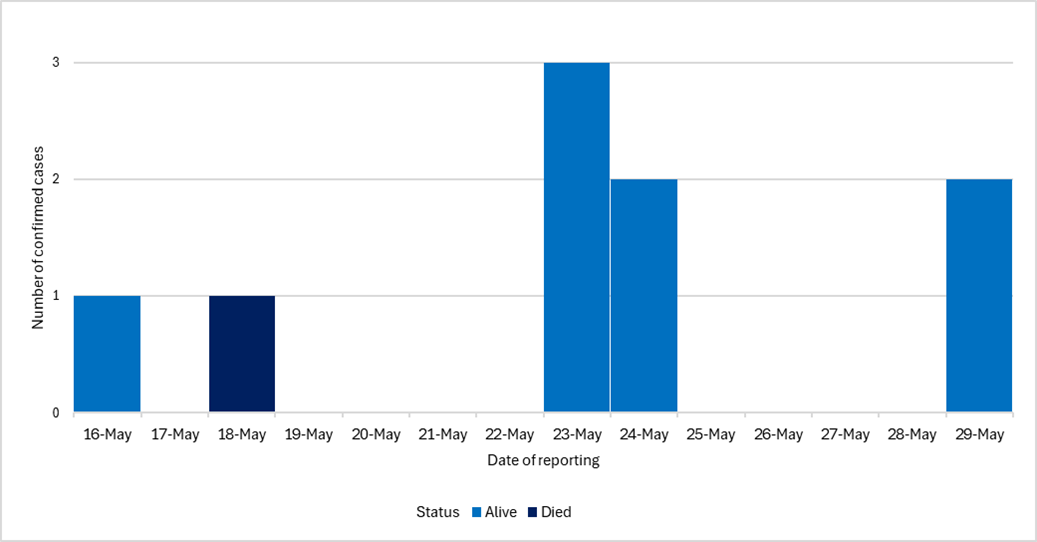
Since the last update dated 21 May, an additional seven confirmed cases have been reported from Uganda. As of 29 May 2026, a total of nine confirmed cases including one death have been reported in Kampala (n=8) and Wakiso (n=1), Uganda. Recent cases include a Ugandan driver who transported the first reported case, a Congolese health worker with linkage to the index case, a Congolese woman who travelled to Uganda for medical care, and two Ugandan health workers linked to earlier confirmed case.

As of 26 May, a total of 436 contacts linked to the cases have been identified and are under follow-up. These include close household contacts and hospital contacts where the cases were hospitalized.

Exposure risks are associated with healthcare settings and cross-border movements.

Figure 3: Number of confirmed cases (n=9) and deaths (n=1) by date of reporting in Uganda as of 29 May 2026

Number of confirmed cases and deaths in Uganda - Number of confirmed cases and deaths in Uganda

Source: Ministry of Health, Uganda

Epidemiology


Bundibugyo virus disease (BVD) is a severe and often fatal form of Ebola disease caused by the Bundibugyo virus, one of the Orthoebolavirus species. It is a zoonotic disease, with fruit bats suspected to be the natural reservoir. Human infection is thought to occur through close contact with the blood or secretions of infected wildlife, such as bats or non-human primates, and it subsequently spreads from person to person through direct contact with the blood, secretions, organs, or other bodily fluids of infected individuals or contaminated surfaces or items. Transmission is particularly amplified in health-care settings when infection prevention and control (IPC) measures are inadequate, and during unsafe burial practices involving direct contact with the deceased.

The incubation period for BVD ranges from 2 to 21 days, and individuals are not infectious until symptom onset. Early symptoms such as fever, fatigue, muscle pain, headache, and sore throat, are non-specific, which complicates clinical diagnosis and can delay detection. These symptoms then progress to gastrointestinal symptoms, organ dysfunction, and in some cases haemorrhagic manifestations. Case fatality rates in the past two BVD outbreaks, reported in Uganda and in the Democratic Republic of the Congo in 2007 and 2012, have ranged from approximately 30% to 50%.

Differentiating BVD from other endemic febrile illnesses such as malaria is challenging without laboratory confirmation using PCR or antigen/antibody-based assays. Control relies on rapid case identification, isolation and care, contact tracing, safe burials, and strong community engagement, as no approved vaccines or specific treatments currently exist for BVD.

Public health response


Health authorities in the Democratic Republic of the Congo and Uganda, in collaboration with WHO and partners, are implementing comprehensive public health measures. WHO Director-General, Dr Tedros Adhanom Ghebreyesus, traveled to the Democratic Republic of the Congo on 28 May to support the ongoing response.

For further information about public health response actions by the respective Ministry of Health, WHO, and partners, please refer to the latest situation reports published by the WHO Regional Office for Africa: Weekly External Situation Report 02, Data as of 24 May 2026 - DRC and Uganda


WHO risk assessment


On 22 May 2026, WHO assessed the risk of the outbreak of BVD to be very high at the national level in the Democratic Republic of the Congo, high at the regional level, and low at the global level. The risk assessment will be continuously reassessed in the coming days based on available and shared information.

For further information, please see the WHO Rapid Risk Assessment-Ebola disease caused by Bundibugyo virus, Democratic Republic of the Congo and Uganda v2.


WHO advice


On 19 May 2026, the Director-General of WHO convened the first meeting of the IHR Emergency Committee, which issued the temporary recommendations on 22 May 2026 to States Parties. These recommendations underscore the importance of coordinated outbreak control, enhanced cross‑border collaboration, and sustained surveillance and preparedness to prevent further regional spread and ensure an effective public health response

WHO advises against any restriction of travel to, or trade with, the Democratic Republic of the Congo or Uganda based on the currently available information. WHO continues to closely monitor and, where necessary, verify travel and trade measures in relation to this event.

For further information on the considerations for implementing border health and international travel-related temporary recommendations, please see the relevant technical note issued on 26 May 2026

Regular Information products on the outbreak of BVD in Democratic Republic of the Congo
Further information
...

https://www.who.int/emergencies/disease-outbreak-news/item/2026-DON605


​​
 
Translation Google

Ebola: Border closures imposed in the region to contain the epidemic have not stopped cross-border movements

Sunday, May 31, 2026 - 12:41

Border closures imposed in the region to contain the Bundibugyo epidemic have not stopped cross-border movements, which continue in particular through informal channels, according to a situation report by the International Organization for Migration published this week.

Between May 15 and 24, IOM monitored population flows at formal and informal border crossings along the Uganda-DRC border, including Cyanika, Busunga, Bunagana, Mpondwe, Goli, Vurra, Busanza, and Ntoroko. Its teams observed that movements continued despite border closures, driven by economic, family, and home-return reasons.

The report, which covers the period from May 22 to 27, also confirms that the high-level trilateral meeting held in Kampala on May 22 and 23 between the DRC, Uganda, and South Sudan resulted in the signing of a memorandum of understanding and collective funding pledges to strengthen regional preparedness and response. The amount of these commitments is not specified in the document.

The IOM reports significant funding gaps that continue to hinder the deployment of the response in affected and at-risk countries. It identifies community monitoring, community engagement, psychosocial support, logistics, and mobility tracking in insecure areas as unmet priorities.

The document also specifies the hierarchy established by the WHO among countries at risk. Priority 1 countries include the DRC, Uganda, South Sudan, Burundi, and Rwanda. Priority 2 countries include Angola, the Central African Republic, Ethiopia, Kenya, the Republic of Congo, Tanzania, and Zambia.
...

https://actualite.cd/2026/05/31/ebo...s-dans-la-region-pour-contenir-lepidemie-nont
--------------------------------------------------------------------------------------------------------------------------
Multi-Country Bundibugyo Ebola Virus Disease Outbreak - Situation Report #2

Source
Posted 31 May 2026 Originally published 29 May 2026
​...
https://reliefweb.int/report/democr...ola-virus-disease-outbreak-situation-report-2
-----------------------------------------------------------------------------------------------
Excerpt from the report (pdf link above):

(screenshot)

image.png - Click image for larger version  Name:	image.png Views:	1 Size:	88.4 KB ID:	1036089

...​

image.png - Click image for larger version  Name:	image.png Views:	1 Size:	88.4 KB ID:	1036089

...
------------------------------------------------------------------------------------------------------------------------
Uganda — Flow Monitoring– Ebola Virus Disease Outbreak

1779900515.png


https://dtm.iom.int/reports/uganda-flow-monitoring-ebola-virus-disease-outbreak?close=true

 
Health Alert:


U.S. Embassy Kampala, Uganda (May 28, 2026)


By U.S. Embassy Uganda
9 MINUTE READ

28 May, 2026

Location: Uganda, countrywide

Event:

The Department of State’s Uganda Travel Advisory  is currently Level 4 and advises U.S. citizens Do Not Travel to Uganda due to the Ebola disease outbreak. The Department also advises Americans not to travel to the Democratic Republic of Congo or South Sudan.

On May 27, the U.S. Centers for Disease Control and Prevention (CDC) increased its Travel Health Notice for Ebola Bundibugyo Virus Disease from a Level 1 to Level 2. Review the Level 2 (Practice Enhanced Precautions) Travel Health Notice for Ebola  for Uganda.

Due to the Ebola disease outbreak, Uganda has closed the border with DRC and set restrictions on mass gatherings in Kampala and high-risk districts along the DRC border:
  • On May 27, 2026, the Uganda National Task Force on Ebola Response  closed the border with DRC.  Only essential traffic is permitted.
  • Uganda also suspended weekly markets in high-risk districts.
  • Any person entering Uganda from the DRC must self-quarantine for 21 days under the supervision of the Ministry of Health.
  • The Ministry of Health issued restrictions on mass gatherings in Kampala and high-risk districts along the DRC border.
U.S. Embassy Restrictions

The U.S. Embassy is strictly limiting official U.S. government employee travel to western Uganda to mission-critical travel.
  • U.S. government employees are discouraged from personal travel to western Uganda.
  • U.S. government employees are limiting non-essential visits to healthcare facilities in Uganda.
  • The U.S. Embassy in Uganda recommends that U.S. citizens take the same precautions.
Travel to the U.S.

Review the U.S. Centers for Disease Control and Prevention (CDC) information on what travelers need to know about returning to the United States from DRC, Uganda, and South Sudan.

Actions to Take:
Assistance:
U.S. Embassy Uganda
1577 Ggaba Road
Kampala, Uganda
+256-312-306-001 / +256-414-306-001 / +256-414-259-791
https://ug.usembassy.gov

State Department – Consular Affairs
888-407-4747 or 202-501-4444
Uganda Country Information 

Enroll in Smart Traveler Enrollment Program   (STEP) to receive security and health updates.
Follow us on Facebook , X , and Instagram .​

https://ug.usembassy.gov/health-alert-u-s-embassy-kampala-uganda-may-28-2026/
 
Back
Top