• FluTrackers.com Inc. does not provide medical advice. Information on this web site is collected from various internet resources, and the FluTrackers board of directors makes no warranty to the safety, efficacy, correctness or completeness of the information posted on this site by any author or poster. The information collated here is for instructional and/or discussion purposes only and is NOT intended to diagnose or treat any disease, illness, or other medical condition. Every individual reader or poster should seek advice from their personal physician/healthcare practitioner before considering or using any interventions that are discussed on this website. By continuing to access this website you agree to consult your personal physican before using any interventions posted on this website, and you agree to hold harmless FluTrackers.com Inc., the board of directors, the members, and all authors and posters for any effects from use of any medication, supplement, vitamin or other substance, device, intervention, etc. mentioned in posts on this website, or other internet venues referenced in posts on this website.
  • We are not asking for any donations. Do not donate to any entity who says they are raising funds for us.

Toxic red sludge - Hungarian Metals Plant Restarts, Residents Return

Re: Hungary races to build dam amid new sludge threat - The wall now looked beyond repair

Re: Hungary races to build dam amid new sludge threat - The wall now looked beyond repair

Satellite Views of Toxic Sludge in Hungary

http://earthobservatory.nasa.gov/NaturalHazards/view.php?id=46360&src=nha
devecser_ali_2010282.jpg
acquired October 9, 2010
 
Re: Hungary races to build dam amid new sludge threat - The wall now looked beyond repair

Re: Hungary races to build dam amid new sludge threat - The wall now looked beyond repair

Hungarian video reports of several aspects of the disaster.

English:


http://www.youtube.com/watch?v=3rU2vz-bV0k&NR=1

http://www.youtube.com/watch?v=LSFcZ4QgrCA&feature=related

http://www.youtube.com/watch?v=YjGv0A6nKrI&NR=1

http://www.youtube.com/watch?v=K_605trjyjU


Hungarian:

Alumina red sludge catastrophe in Hungary - 2010. okt. 4. 18 hours (TV2)

http://www.youtube.com/watch?v=qqG9ewbDrwI&NR=1


Mindent El?nt?tt A V?r?siszap - Everything got flooded with red sludge - Catastrophe in Hungary

http://www.youtube.com/watch?v=Wu93r46ACTI&NR=1


http://www.youtube.com/watch?v=IPwopGICC-E&feature=related
 
Re: Hungary races to build dam amid new sludge threat - The wall now looked beyond repair

Re: Hungary races to build dam amid new sludge threat - The wall now looked beyond repair

Composition of red mud

Google translate from:
http://strehogergo.w3h.hu/vorosiszap_katasztrofa_veszprem_megyeben

After the disaster, the alumina (MAL), the following was published in the composition of red mud:

pH: 13

Content is toxic?
Fe2O3 (iron (III) oxide) (iron oxide, hematite, rust), 40-45% of the practical life, it does not cause poisoning. But if you yourself filled with all kinds of filling materials magnificent charlatan dietary supplement, you can get from iron poisoning., 6 years old children are more sensitive to that sort of thing. But it is not an easy thing to do, because the iron is poorly absorbed, much, much more happens is that someone of iron deficiency - but it is not recommended, of course, rust in the form of iron intake.
Al2O3 (aluminum oxide, alumina, corundum, ruby, sapphire), 10-15% do not. Although the aluminum itself more and more lately accused of everything. Responsible for making such a gyorsn?veked?s and the cause of Alzheimer's disease. Neurotoxicant and carcinogen think.
Aluminium salts are mainly used in preparations inhibit sweating. In addition, you better aluminum containers (especially sour things) do not cook, do not use an aluminum spoon and fork.
SiO2 (silicon oxide, quartz, sand) 0 -15% Non-
CaO (calcium oxide, limestone) 6-10%

No, but an alkaline caustic. Avoid contact with eyes.
Strong contact with water, heat and hydrogen development during the same effect of calcium hydroxide, formed by far.
TiO2 (titanium oxide) 4 to 5% of our knowledge, the human body in the state of science has no effect. But the BBC's claims about the website to be a carcinogen. This is very interesting because bleaching agent soap, toothpaste, sunscreen, paints, and even food that is loaded onto the otherwise wasted precious metal oxidj?t. Foods are also known as E171.
If that's true, then you will not receive the v?r?siszapt?l the titanium oxide r?kunkat.
Na2O (sodium oxide) or NaOH (sodium hydroxide, caustic soda, l?gkő) 5-6% No, but both are very strongly alkaline caustic. In contact with water, NaOH Na2O-da occurs. Both animal and plant tissues to a large extent destroy. Contact with water, a strong exothermic effect, which is too alkaline milling, plus burn injury. If the crystal is a solid NaOH for a short time pick up, if the skin is intact, at first just to see that it will be slippery. This feeling is caused by the epidermis of our skin that has already begun to dissolve. If we would do such a thing, your hand does not fogdossunk with anything, and especially do not touch your eyes! But as soon as possible with plenty of water to wash it off!. To me, webmaster of this website once a minor accident had the opportunity to taste a few drops of NaOH solution. Fortunately, not swallowed. The solution was 1 M, which means that in case of NaOH to 1 liter of water 40 g NaOH was dissolved. It's not a lot like eating a heaping spoonful. I knew what to do: I ran the water supply at the moment, one is already 5 seconds under running water in my mouth. Nevertheless, some 2 weeks after the incident strongly hurt my tongue! This case also warns of NaOH is not a toy!
But not only the water but the air sz?ndioxidj?val would like to merge, bypassing the soil, sziks?v? (Na2CO3, soda) has rearranged the cause of soil salinity / alkalinity.


Not much later, the Hungarian Academy of Sciences, also published an analysis, which can be found here:
http://mta.hu/cikkek/a-vorosiszap-szennyezes-hatasai-125707

Then the environmental organization Greenpeace also performed blood chemistry tests, and have been calculated, accusing the MTA of the total, with intent to substantially lower values have been the reality.

The data from Greenpeace:

arsenic: 110 mg / kg of mercury: 1.3 mg / kg, Cr: 660 mg / kg

The effects of arsenic poisoning can cause serious, in some places but unfortunately the water is included, but such water, if the arsenic content reaches a specified value, you should not drink. Very, very small amounts (0.012 to 0.025 mg / day) is also in the human body needs it, but above this is already dominated by a toxic effect, mainly in the digestive tract, bone marrow and nervous system damage. 50-50 mg / day over the toxic arz?nterhel?s of 100-300 mg / day range becomes deadly szoktat?ssal This volume increase is anyone accustomed to a daily 0.5 g of arsenic can also be enjoyed without damaging their health from the legcsek?lyebben.
Relating to arsenic in the Wikipedia: http://hu.wikipedia.org/wiki/Arz% C3% A9n

The mercury is already very dangerous poison, so that just 1 gram, 1 million liters of water can be ihatatlann?! Therefore, if a mercury thermometer ?sszet?rn?nk, sprinkle sulfur powder available in pharmacies or chemical store, so now it does not evaporate easily and ?sszetakar?that? mercuric sulfide is produced by a gathering to give off a hazardous waste collection!

Today also are increasingly replacing incandescent bulbs for compact fluorescent lamps (energy-saving bulbs is incorrect names). These ?vegj?nek belsőfel?let?n in white powder, also mercury compounds. Therefore, they are also not just throw in the bin and do not break up, but put into receptacles placed in department stores!
The mercury on Wikipedia: http://hu.wikipedia.org/wiki/Higany

No specific toxic effects of chromium, but if ingested, it can be as heavy metal precipitates and the szervezetfeh?rj?it can cause problems. In practice, the major impact of causing allergies, a population equal to about 2-4% of chromium exposure causes an allergic reaction.

The minimum amounts of chromium in the body, nyomelemk?nt need.
However, larger quantities of highly toxic chromium salts. For example, chromium oxide, chromium trioxide, CrO3 - already has 0.6 grams can be fatal. Mainly attacks the kidneys, but also harmful to other organs. Acting carcinogens and mutagens.

The kr?mr?l on Wikipedia: http://hu.wikipedia.org/wiki/Kr% C3% B3m

The chromium trioxide on Wikipedia: http://hu.wikipedia.org/wiki/Kr% C3% B3m trioxide

The MTA and the huge difference between the results of Greenpeace Greenpeace has explained to the Greenpeace spilled sludge sample, while the MTA uses the model's pre-party: hence it is concluded that the party has spilled sludge samples and the composition must be different, even , because the sludge disposed of hazardous waste could be concealed in other post-iszapk?z?. such as galvanic, which unfortunately has been the alm?sf?zitői timf?ldgy?rn?l example.

The National Disaster Management (OKF), the Hungarian Academy of Sciences (MTA) and the National Public measurements, as authentic and scientific information resources - responded to the OKF Friday afternoon, MTI has been said a Greenpeace press conference that day, the environmental organization with reference to two independent testing lab said that the toxic red mud kolont?ri officially ?ll?tottn?l.

Greenpeace is now a more detailed test results for Monday, scheduled for the 11 promised to be ready by then more anal?zis?kből.
<hr width="90%" size="1">

 
Re: Hungary races to build dam amid new sludge threat - The wall now looked beyond repair

Re: Hungary races to build dam amid new sludge threat - The wall now looked beyond repair

UN sends experts to Hungary to help assess health impact of sludge spill

12-10-2010danube.jpg
The river Danube

12 October 2010 ? The United Nations health agency today dispatched a team of experts to Hungary to support the Government-led assessment of potential immediate and longer-term health impacts of a sludge spill that affected the country?s western territories earlier this month.

The acute public health impact of the 4 October spill has been serious, but localized, with eight people killed and over 120 injured, the World Health Organization (WHO) said. The immediate health effects of the spill included drowning and chemical burns due to the elevated acidity of the red sludge.

Assessment is needed of the health effects of possible exposure to dust, water and locally-produced food that may contain increased amounts of heavy metals. The Hungarian authorities are continuously monitoring the situation and have taken the public health actions required at this stage, according to WHO.

The sludge entered the river Danube at the end of last week, and it may spread in attenuated form to countries downstream. This possibility and related heath effects will be evaluated.

While serious short-term health effects are considered unlikely, potential medium- and long-term effects through contamination from heavy metals can only be assessed as more information becomes available. The risk of contaminated dust spreading from the spill site to neighbouring countries is considered negligible.

The WHO mission will make an expert assessment of the short-, medium- and long-term effects of the spill on public health in the affected area. The Hungarian authorities will use the results to develop appropriate preventive action.

The team includes international experts in evaluating and managing health risks from the environment, particularly from contaminated water and chemicals. WHO?s office for Europe is ready to provide technical assistance to the affected countries, if requested, the agency added.

http://www.un.org/apps/news/story.asp?NewsID=36414&Cr=health&Cr1=
 
Re: Hungary races to build dam amid new sludge threat - The wall now looked beyond repair

Re: Hungary races to build dam amid new sludge threat - The wall now looked beyond repair

CEO doesn't 'feel' responsible in Hungary spill

<!--startclickprintexclude--><!--endclickprintexclude-->By the CNN Wires Staff<SCRIPT type=text/javascript>cnnAuthor = "By the CNN Wires Staff";</SCRIPT>
<SCRIPT type=text/javascript>if(location.hostname.indexOf( 'edition.' ) > -1) {document.write('October 14, 2010 -- Updated 1742 GMT (0142 HKT)');} else {document.write('October 14, 2010 1:42 p.m. EDT');}</SCRIPT>October 14, 2010 1:42 p.m. EDTOctober 14, 2010 -- Updated 1742 GMT (0142 HKT)

<!--endclickprintinclude--><!-- google_ad_section_end --><!-- google_ad_section_start --><!-- CONTENT --><!--startclickprintinclude--><SCRIPT language=JavaScript type=text/javascript>var clickExpire = "-1";</SCRIPT><!-- REAP --><!--startclickprintexclude--><!--===========IMAGE============-->
t1larg.jpg
<!--===========/IMAGE===========-->


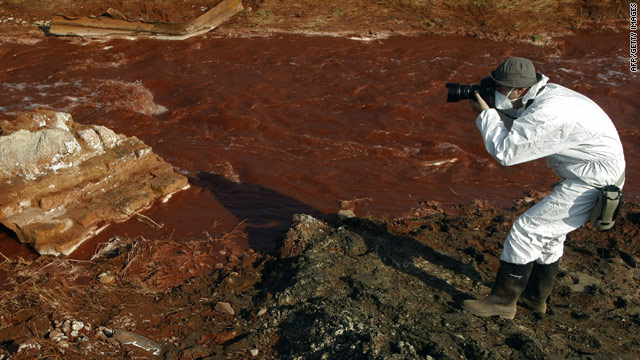
A photographer wearing a protective suit takes shots of a stream thick with sludge in Kolontar village on October 14

(CNN) -- The CEO of the Hungarian company behind a huge toxic spill on Thursday said he "doesn't know" if he's responsible for the disaster, but adds "I have moral duties and I will fulfill them."

Zoltan Bakonyi, the chief executive of the MAL aluminum plant, spoke with CNN's Diana Magnay a day after he was released from jail pending trial. Bakonyi was detained on Monday, accused of public endangerment and harming the environment.

"It's said I should be responsible although I don't feel it," Bakonyi told Magnay. He insisted that MAL was in compliance with all Hungarian safety regulations and pointed out that he has only been CEO for two years. Bakonyi argued that the problems presented by the reservoir and the accumulation of toxin in it stretched back 25 years or more.

But he added that it is his "moral duty" is to "help" and put his energies "120-percent into the aid effort."

[...]
http://edition.cnn.com/2010/WORLD/europe/10/14/hungary.sludge.ceo/
 
Re: Hungary races to build dam amid new sludge threat - The wall now looked beyond repair

Re: Hungary races to build dam amid new sludge threat - The wall now looked beyond repair

101011-ruptured-resevoir-hmed-1a.grid-8x2.jpg

Balint Porneczi / AFP - Getty Images A TV crew films a crack on the ruptured reservoir wall of the aluminum plant near Ajka, Hungary, on Sunday.http://www.msnbc.msn.com/id/39610356/ns/world_news-europe/18424719


Hungary sludge pool crack widens slightly

Residents in affected area still on track to return to homes by Friday, official says

msnbc.com news services
updated <ABBR style="DISPLAY: inline" class="dtstamp updated" title=2010-10-14T14:46:01 itxtvisited="1">10/14/2010 10:46:01 AM ET</ABBR> 2010-10-14T14:46:01

BUDAPEST, Hungary ? Officials said Thursday that one of the cracks on the damaged reservoir that flooded towns in western Hungary with red sludge has widened slightly but is not expected to upset plans for area residents to return to their homes soon.

Disaster agency spokeswoman Gyorgyi Tottos said a crack on the northern wall of the metals plant's storage pool holding a byproduct of aluminum manufacturing widened by around half an inch.

Tottos said plans are still on for residents of Kolontar, the town closest to the 24-acre reservoir, to return to their homes starting Friday and a new protective wall will be in place.

[...]
http://www.msnbc.msn.com/id/39668167/ns/world_news-europe/39669224
 
Toxic red sludge - Hungarian Metals Plant Restarts, Residents Return

Hungarian Metals Plant Restarts, Residents Return

By PABLO GORONDI, Associated Press Writer Monday, October 18, 2010

BUDAPEST, Hungary (AP) ? Production restarted Friday at the metals plant whose broken reservoir unleashed a massive flood of caustic red sludge, even as villagers began returning to one of the affected towns in western Hungary despite warnings from environmentalists that it was too early and too dangerous to return.

Some 800 Kolontar residents were evacuated last Saturday after authorities said a wall of the factory reservoir could collapse further, releasing a second wave of red sludge after a calamitous break Oct. 4 created a deadly torrent.

Nine people died in the toxic flood and around 50 are still hospitalized, several in serious condition.

On Friday, about 30 people were driven to Kolontar in buses from a sports arena in the nearby town of Ajka, where they had been staying.

"Others are returning in their own vehicles from the homes of friends and relatives in the area," disaster agency spokeswoman Gyorgyi Tottos said.
...

"As a result of preparatory tasks, the restart of the technological processes at the plant has begun," said Timea Petroczi, a spokeswoman for Gyorgy Bakondi, a former head of the national disaster agency who was appointed by the government to take temporary control of MAL Rt. "It will take a maximum of four days to reach normal operations. Full capacity will be reached next Tuesday."

Bakondi and an 18-member committee now have a decisive say in all aspects of the company and were talking with managers about how best to ramp up operations at the plant, which employs 1,100 people.

A protective wall of dolomite and earth ? 610 yards (620 meters) long, with an average height of nearly 9 feet ( 2.7 meters) ? has been built in Kolontar to shield the area from further spills of the red sludge, a highly caustic waste produced when making alumina, which is used to make aluminum.
...

Authorities refused to let journalists into Kolontar on Friday.

Greenpeace said it was too early to send residents back into Kolontar or restart the alumina plant because there was not enough data yet on the area's safety.


[...]
http://www.chem.info/News/2010/10/Safety-Hungarian-Metals-Plant-Restarts-Residents-Return/
 
Re: Toxic red sludge - Hungarian Metals Plant Restarts, Residents Return

18 October 2010 Last updated at 08:21 ET

Dorset vet charity helps Hungary animals hit by sludge

_49546073_jex_5755_de29-1.jpg
The charity is in daily contact with workers in Hungary and send veterinary supplies to them


A Dorset based charity is sending boxes of veterinary supplies to Hungary to help animals caught up in the toxic sludge leak.

Worldwide Veterinary Service in Cranborne has joined forces with the RSPCA, World Society for the Protection of Animals (WSPA) and other charities.

They are helping wildlife, pets and farm animals burned by the toxic spill.
[...]

http://www.bbc.co.uk/news/uk-england-dorset-11566134
 
Re: Toxic red sludge - Hungarian Metals Plant Restarts, Residents Return

Hungary

<!-- section name level 4 -->WHO/Europe concludes mission on health impact of sludge spill in Hungary

20-10-2010

A four-day WHO expert field mission to Hungary concluded on 16 October by making recommendations to minimize the short- and long-term health impact of a sludge spill at an alumina plant of Magyar Alum?nium Zrt. (MAL Zrt.), Ajkai Timfoldgyar in the town of Ajka, and to prevent similar events with potential transboundary effects.

The team was led by staff of WHO/Europe?s WHO European Centre for Environment and Health, Rome, and included experts from the WHO collaborating centre for chemical incidents in the United Kingdom and ICARO, the Italian consulting company on environment and health risk assessment. The team added international know-how to the efforts and expertise of the national authorities and the WHO Country Office, Hungary; it focused on the public health aspects of the event, complementing the work of a European Union mission.

Acute health risk diminished

The spill caused 9 deaths and over 150 injuries, mostly due to drowning and chemical burns from the corrosive effect of the red mud. It destroyed or severely damaged over 300 houses in the villages of Kolont?r, Devecser and Soml?v?s?rhely in western Hungary.

At the affected sites, measures were promptly taken to neutralize the corrosive mud and reduce the immediate danger of exposure. As the sludge has receded and its pH decreased, the risk of direct health damage from contact has been substantially reduced.

Focus on resident population and rescue workers

As the recovery and rehabilitation phase is under way, particular attention now needs to be paid to preventing potential health risks to the population of the affected areas, and the nearly 4000 rescue workers and volunteers involved in the clean-up.

Exposure to the mud by contact, inhalation or ingestion should be minimized. This requires completing the removal of the sludge from the affected areas (particularly houses), monitoring the concentration of outdoor and indoor air pollutants, and providing the population and first-line workers with clear advice on protecting themselves.

As the psychological effects of the disaster are recognized, a specialized team of Hungarian psychologists is providing support on site to people who have been evacuated, suffered injuries and/or deaths in their families, and/or sustained losses of and damage to property. This need will persist for both the short and medium terms.

No danger to health from drinking-water

Importantly, the quality of drinking-water supplied to the affected areas has remained adequate and poses no health risk to the community.
Continued monitoring of outdoor and indoor air, drinking-water and the quality of soil and food production will remain essential to assess the risk of exposure, particularly to heavy metals, in the medium and long terms and to take action as required.

No risk from international spread

Great effort has been dedicated to preventing the further spread of the spill to the river Danube, as this could result in environmental damage to neighbouring countries. The information available indicates that the quality of Danube water has remained substantially unaffected.

Nevertheless, with some 150 waste reservoirs located along the river, the spill highlights the need for comprehensive mapping and assessment of these installations, their resilience to extreme weather events and to any risk of contamination of soil and ground water from poorly isolated reservoirs.

Risk from currently used and heritage industrial sites is common to many countries in the lower Danube. Existing policy instruments, such as the Protocol on Water and Health, can support action to identify and remediate particularly contaminated sites with a potential to harm health through water contamination. The upcoming second meeting of the Parties to the Protocol, taking place on 22?25 November 2010 in Bucharest, Romania, offers a unique opportunity to discuss possible options on this important topic.

http://www.euro.who.int/en/where-we...n-on-health-impact-of-sludge-spill-in-hungary
 
Re: Toxic red sludge - Hungarian Metals Plant Restarts, Residents Return

Impacts of the Hungarian toxic sludge disaster


http://<EMBED height=501 type=application/x-shockwave-flash width=620 src=http://www.youtube.com/v/L74O4VfydPM&hl=&fs=1&showinfo=0&cc_load_policy=1 allowscriptaccess="always" allowfullscreen="true" wmode="transparent"></EMBED>

Greenpeace International video

On October 4th 2010, a flood of toxic sludge wrought havoc on villages and towns in Western Hungary. The spill left nine people dead and created a huge environmental disaster.

http://www.greenpeace.org/internati...pacts-of-the-Hungarian-toxic-sludge-disaster/
 
Re: Toxic red sludge - Hungarian Metals Plant Restarts, Residents Return

Hungary catastrophe can repeat in Russia

October 25, 2010


Russian Federation ? In Russia there are about 26 thousand hydraulic structures only 30% of which are considered safe and more than 10% - abandoned.
Besides the dams and reservoirs hydraulic structures (HS) include also slurry reservoirs and tailing ponds. According to only official figures the Russian sludge storages store about 8 billion cubic meters of industrial waste of different classes of hazard. It is approximately 10 thousand times as much as the amount of sludge in Hungary.

...

According to latest available data (2007) 337 complexes of tailing ponds and sludge storages of mineral industry store about 6 billion cubic meters of tailings. Metallurgy industry has stored 400 million cubic meters of wastes in 107 complexes. Other 282 storages with capacity of 500 million cubic meters belong to the plants of chemical, oil-chemical and oil refining industries. According to data of trade section of the Customs Service register of the Russian Federation industrial and power facilities have 951 complexes of hydraulic structures.


Full text: http://www.greenpeace.org/russia/en/news/hungary-catastrophe-can-repeat
 
Back
Top Bottom