Re: Hungary toxic sludge spill an 'ecological catastrophe' says government
Re: Hungary toxic sludge spill an 'ecological catastrophe' says government
<TABLE id=apex_layout_271110100662109808 class=formlayout border=0 summary=""><TBODY><TR><TD noWrap align=right>
Archive Number</TD><TD noWrap align=left>20101007.3634</TD></TR><TR><TD noWrap align=right>
Published Date</TD><TD noWrap align=left>07-OCT-2010</TD></TR><TR><TD noWrap align=right>
Subject</TD><TD noWrap align=left>PRO/EDR> Toxic spill - Hungary: fatal, water contamination</TD></TR></TBODY></TABLE>
TOXIC SPILL - HUNGARY: FATAL, WATER CONTAMINATION*************************************************A ProMED-mail post<
http://www.promedmail.org>ProMED-mail is a program of theInternational Society for Infectious Diseases<
http://www.isid.org>[1]Date: Wed 6 Oct 2010Source: Standart News [edited]<
http://paper.standartnews.com/en/article.php?d=2010-10-06&article=34365>
</PRE>
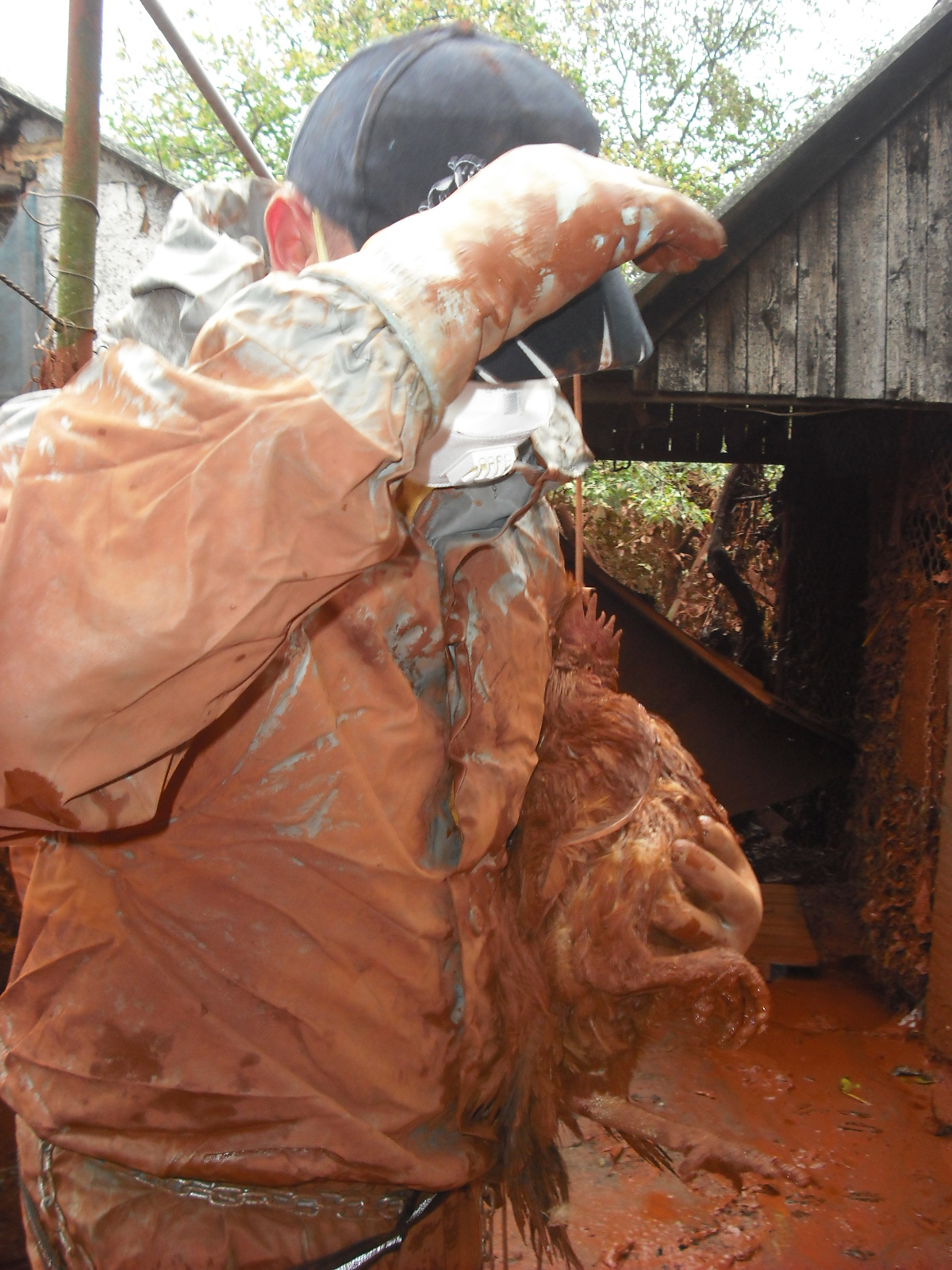
The poisonous substance from Hungary spilled into the waters of the
Danube. The dam of a huge tailing pond broke and nearly 1 million
cubic meters of dangerous red sludge poured into rivers. The drama
which took place in western Hungary has taken 4 lives and another 120
people have been injured. The disaster is expected to spread. Budapest
has declared emergency situation due to the burning poison, which is
more hazardous than melted lava. Even the dust of the so-called red
sludge causes lung cancer immediately if inhaled. The hellish mixture
of silicon, iron, lead, and other heavy metals are slowly but
unavoidably moving towards Bulgaria.
Bulgaria's ministry of environment announced yesterday [5 Oct 2010]
that the toxic mixture, which is also radioactive, may reach Bulgaria
within a week. The only hope is that poison will dissolve and its
concentration will not be so harmful when it reaches Bulgaria.
--
Communicated by:
ProMED-mail
<
promed@promedmail.org>
******
[2]
Date: Tue 5 Oct 2010
Source: Reuters [summ., edited]
<
http://www.reuters.com/article/idUSTRE69415O20101005>
Hungary declared a state of emergency in 3 western counties on Tuesday
[5 Oct 2010], the day after a torrent of toxic red sludge from an
alumina factory tore through local villages, killing 3 people and
injuring 100 more.
The red mud, waste generated during bauxite refining, poured through
Kolontar and 2 other villages on Monday [4 Oct 2010] after bursting
out of an open containment pond at the nearby Ajkai Timfoldgyar Zrt
plant, owned by MAL Zrt.
The flood threw cars off roads and damaged bridges and homes, forcing
the evacuation of local residents.
"We have declared a state of emergency in Veszprem, Gyor-Moson-Sopron,
and Vas counties," government spokeswoman Anna Nagy told Reuters.
[Byline: Gergely Szakacs]
--
Communicated by:
ProMED-mail
<
promed@promedmail.org>
******
[3]
Date: Tue 5 Oct 2010
Source: BBC News [edited]
<
http://www.bbc.co.uk/news/world-europe-11475361>
Hungary has declared a state of emergency in 3 western counties after
sludge from an alumina plant killed 3 people and injured 120.
The red chemical sludge flooded out of a burst dam, affecting at least
7 villages and towns including Devecser, where it stood 2 m (6.5 ft)
deep.
The sludge is said to contain caustic material and to be toxic if ingested.
While the cause of the deaths has not been established officially, it
is believed the victims probably drowned.
Some 600 000-700 000 cubic metres (21m-24m cubic feet) of sludge
escaped from the plant, 160 km (100 miles) from the capital, Budapest.
With 7000 people affected directly by the disaster, a state of
emergency was declared in the counties of Veszprem, Gyor-Moson-Sopron,
and Vas.
At least 390 residents have been relocated and 110 rescued from
flooded localities, Hungary's National Directorate General for
Disaster Management (NDGDM) said.
Nearly 500 police officers and soldiers, including 6 emergency
detection teams, have been deployed.
Plaster has been poured into the Marcal river in a bid to bind the
sludge and stop further flooding.
So far 6 people have been reported missing in the disaster, described
as the worst chemical accident in Hungary's history by Zoltan Illes,
state secretary for the environment ministry, who visited Kolontar on
Tuesday [5 Oct 2010].
Tamas Toldi, mayor of Devecser, told MTI news agency that between 80
and 90 people had been taken to hospital with chemical burns.
Dr Attila Nyikos, an NDGDM [official, told the BBC News website the
victims had probably been drowned by the sludge, which had flowed out
with the speed of water.
The sludge, he explained, triggers an alkaline reaction on the skin
but the effect can be neutralised by washing with plenty of fresh water.
Peter Jakabos, a doctor on duty at a hospital in Gyor where several of
the injured were taken, said on state TV that some burns could take
days to reveal themselves and what might seem like superficial
injuries could later cause damage to deeper tissue.
One eyewitness in Devecser said his uncle had been taken to Budapest
by helicopter after the sludge "burnt him to the bone."
Alumina, a synthetically produced aluminium oxide, is a white or
nearly colourless crystalline substance that is used as a starting
material for the smelting of aluminium metal.
It also serves as the raw material for a broad range of advanced
ceramic products and as an active agent in chemical processing.
There has been no official explanation of the cause of the disaster,
but weeks of heavy rain are likely to have played a role. The sludge
escaped from a reservoir at the Ajkai Timfoldgyar plant in the town of
Ajka. Police say they have confiscated documents from the company's
headquarters.
The sludge flooded 19 streets in Devecser and 2 in Kolontar, where the
3 deaths occurred. 5 other localities were under threat.
Rescue workers used an axe to cut through the living room door of [the
Devecser resident], to let the red liquid flow out, the Associated
Press news agency reports.
"When I heard the rumble of the flood, all the time I had was to jump
out the window and run to higher ground," said his wife.
[Environment secretary] Illes said there were fears that the sludge
could reach the Raba and Danube rivers.
The Hungarian government said it was not seeking any international
assistance for the time being.
--
Communicated by:
Kunihiko Iizuka
[This is an enormous spill.
Bauxite is a naturally occurring, heterogeneous material composed
primarily of one or more aluminum hydroxide minerals. Bauxite is
usually strip mined as it is most often near the surface of the ground.
In the processing of bauxite it is mixed with sodium hydroxide, a
chemical capable of causing chemical burns, and placed under pressure.
Temperatures are raised to as high as 200 deg C [392 deg F]. This is
where the aluminate, which is dissolved aluminum, is found. A process
of filtering the ferruginous residue, also known as red mud or red
sludge is removed and pure gibbsite precipitates when the solution is
cooled. Gibbsite can be purified and then heated to form aluminum oxide.
This red mud or red sludge has high concentrations of sodium
hydroxide, titanium, and silicon. Concentrations of these components
may be quite high and as they are molten, are more like lava than mud.
The heat, the chemicals, and the sheer force of the amount of this
substance could be overwhelming. The fumes are likely to be equally
hard on people. - Mod.TG]
[The HealthMap/ProMED-mail interactive map of Hungary is available at
<
http://healthmap.org/r/0c2o>. - Sr.Tech.Ed.MJ]
...................................tg/mj/dk
...
http://www.promedmail.org/pls/apex/..._BACK_PAGE,F2400_P1001_PUB_MAIL_ID:1000,85193


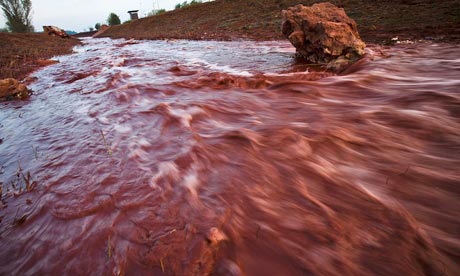 <FIGCAPTION>Hungary has declared a state of emergency after huge toxic waste spill. Photograph: Zsolt Szigetvary/EPA</FIGCAPTION> </FIGURE>