• FluTrackers.com Inc. does not provide medical advice. Information on this web site is collected from various internet resources, and the FluTrackers board of directors makes no warranty to the safety, efficacy, correctness or completeness of the information posted on this site by any author or poster. The information collated here is for instructional and/or discussion purposes only and is NOT intended to diagnose or treat any disease, illness, or other medical condition. Every individual reader or poster should seek advice from their personal physician/healthcare practitioner before considering or using any interventions that are discussed on this website. By continuing to access this website you agree to consult your personal physican before using any interventions posted on this website, and you agree to hold harmless FluTrackers.com Inc., the board of directors, the members, and all authors and posters for any effects from use of any medication, supplement, vitamin or other substance, device, intervention, etc. mentioned in posts on this website, or other internet venues referenced in posts on this website.
  • We are not asking for any donations. Do not donate to any entity who says they are raising funds for us.

South Korea Discovers Third Bird-Flu Outbreak in Three Weeks

Reeves

Resident
South Korea Discovers Third Bird-Flu Outbreak in Three Weeks
By Heejin Koo
Dec. 11 (Bloomberg) -- South Korean health authorities found the third outbreak of a highly-pathogenic H5N1 avian influenza strain in three weeks, raising concern that the deadly virus is spreading in the Asian nation.
The latest discovery was on a farm in the town of Gimjae, in North Jeolla province, where about 1,000 quails died in the past four days, said the Agricultural Ministry based in Gwacheon, outside Seoul. The National Veterinary & Quarantine Service confirmed the strain as highly pathogenic, it said in an e- mailed statement.
The outbreaks are the first discovered in South Korea since 2003.
To contact the reporter on this story: Heejin Koo in Seoul at hjkoo@bloomberg.net
 
Re: South Korea Discovers Third Bird-Flu Outbreak in Three Weeks

817-grey.gif
Reuters
<SCRIPT>if ((!document.images && navigator.userAgent.indexOf("Mozilla/2.") >= 0) || navigator.userAgent.indexOf("WebTV") >= 0) { document.write('');document.write('[URL="http://ad.doubleclick.net/ad/reuters.co.uk/news/health/article;'+(typeof(seg)=='undefined'?'':seg)+'type=interstitial;sz=1x1;articleID=2006-12-11T022742Z_01_SEO352367_RTRIDST_0_HEALTH-KOREA-BIRDFLU-DC.XML;tagc=ccccccccc;ord=' + (typeof(tmstmp)=='undefined'?12345:tmstmp) + '?"]http://ad.doubleclick.net/ad/reuters.co.uk/news/health/article;'+(typeof(seg)=='undefined'?'':seg)+'type=interstitial;sz=1x1;articleID=2006-12-11T022742Z_01_SEO352367_RTRIDST_0_HEALTH-KOREA-BIRDFLU-DC.XML;tagc=ccccccccc;ord=' + (typeof(tmstmp)=='undefined'?12345:tmstmp) + '?[/URL]');}</SCRIPT><!--/ReutersAd:VerticalMenu1_Ad1-->
<!-- LEFT NAV END --><!-- ### IE5 fix: Do not remove spacer GIF! ### -->
spacer.gif
<!--### Cross-Channel Content --> S.Korea says third bird flu case confirmed

Mon Dec 11, 2006 2:27 AM GMT
spacer.gif


SEOUL (Reuters) - South Korea's agriculture ministry said on Monday it had found a third case of highly pathogenic bird flu in North Cholla province south of Seoul.
Last month South Korea confirmed its first two outbreaks of the H5N1 strain in about three years, saying the virus had been found at two poultry farms close to each other in North Cholla province.
The third case was discovered at a quail farm in the same province about 170 km (100 miles) south from Seoul, some 18 km from the original outbreak, according to the ministry.

[URL="http://i.today.reuters.co.uk/misc/genImage.aspx?uri=2006-12-11T022742Z_01_NOOTR_RTRIDSP_2_HEALTH-KOREA-BIRDFLU-DC.jpg&resize=w160"]http://i.today.reuters.co.uk/misc/genImage.aspx?uri=2006-12-11T022742Z_01_NOOTR_RTRIDSP_2_HEALTH-KOREA-BIRDFLU-DC.jpg&resize=w160[/URL]
"The case has been confirmed as the H5N1 strain of avian influenza," the ministry said in a statement, adding thousands of birds at the farm had died over the past four days.


The fresh case emerged after South Korea had completed culling all 760,000 poultry near the two farms already discovered to have been infected with H5N1.
Between December 2003 and March 2004, about 400,000 poultry at South Korean farms were infected by bird flu.
During that outbreak, the country destroyed 5.3 million birds and subsequent testing in the United States indicated at least nine South Korean workers involved in the culling had been infected with the H5N1 virus, but none developed major illnesses.
 
Re: South Korea Discovers Third Bird-Flu Outbreak in Three Weeks

Quails have both a2,3 and a2,6 receptors in the RBD.

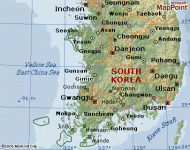
Gimje is about 10 miles south of Iksan (earlier outbreak), see map...

gimje, SK 2006.gif
 
Re: South Korea Discovers Third Bird-Flu Outbreak in Three Weeks

Originally posted by Donaldson.

http://news.kbs.co.kr/article/econom...1/1266290.html
Translate :

From chollapuk_do Kimje quail farm AI additional outbreaks of illness
The veteran complaint birds influenza addition became ill from chollapuk_do Kimje.
The ministry of agriculture and forestry officials revealed the cause of the quail lung company which, occurs recently from one farmhouse of chollapuk_do Kimje was confirmed as H5N1 elder brother birds influenzas where the contagion is possible even in the person.
This farm was located in the place which 15 kilometer degree falls from the chollapuk_do [ik] mountain which the previous month birds influenza initially occurs, from the 7th day which passes about 3 thousand 7 hundred the quail did the lung company.
The veteran complaint birds influenza occurring this year from our country this time is third.
The ministry of agriculture and forestry leads urgent briefing after short time and it is a plan official announcement a prosecuting attorney result.
 
Re: South Korea Discovers Third Bird-Flu Outbreak in Three Weeks

AlaskaDenise said:
Quails have both a2,3 and a2,6 receptors in the RBD.

Gimje is about 10 miles south of Iksan (earlier outbreak), see map...

View attachment 1150


Could someone explain about those receptors in layman's terms?
 
Re: South Korea Discovers Third Bird-Flu Outbreak in Three Weeks

The receptors are a type of viral "docking mechanism" which varies with species. Most birds have only a2,3, while some species (e.g., quail) have both and can serve as an adaptation path between birds and mammals, which contain mostly a2,6.

A virus can undergo many adaptations to make it more infectious to humans, but without being able to successfully "dock" it cannot infect.

Hope that helps a little.

.
 
Re: South Korea Discovers Third Bird-Flu Outbreak in Three Weeks

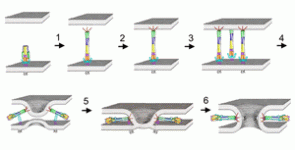
Here's a model of the "docking" (aka receptor binding) process. The receptors we're referring to are on the host cell. Think of the process as a key, where the little red "fingers" in the model are little keys. The virus must have the correct key for any given lock before it can open the door to viral infection.

HAModell joining process.gif

The grey area below is the viral cell, while the grey area above is the host (e.g., human) cell. The whole contraption with many parts that sticks out is the hemaglutanin (aka HA).

.
 
Last edited:
Re: South Korea Discovers Third Bird-Flu Outbreak in Three Weeks

I see. This is not good. Thanks for explaining. One more thing, what does RBD stand for?
 
Re: South Korea Discovers Third Bird-Flu Outbreak in Three Weeks

Receptor Binding Domain.

For a good explanaitions see threads under "Mingus Little Lab" - he's a very good teacher. The thread titled "How Hemaglutinin works" should help.

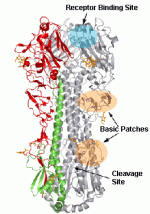
Here's a model of 1918 H1N1, showing exactly where the receptor binding area is located....
1918flu_smaller.gif
 
Re: South Korea Discovers Third Bird-Flu Outbreak in Three Weeks

AlaskaDenise said:
Quails have both a2,3 and a2,6 receptors in the RBD.

Gimje is about 10 miles south of Iksan (earlier outbreak), see map...

View attachment 1150

Denise come up are you saying that these particular quails in this location have the 2, 6 receptor-- or are you saying that quails in general that have been infected with h5n1 have the 2, 6 receptor?
 
Re: South Korea Discovers Third Bird-Flu Outbreak in Three Weeks

4-ABBA said:
......these particular quails in this location have the 2, 6 receptor-- or are you saying that quails in general that have been infected with h5n1 have the 2, 6 receptor?

All quails have BOTH a2,3 and a2,3 receptors.

See Mellie's thread at http://www.flutrackers.com/forum/showthread.php?p=31972&highlight=quail+receptors#post31972

Details about your question are in post #4....
Using a lectin-based staining based on specific agglutinins, we found that, in addition to the presence of sialic acid alpha2,3-galactose (SAalpha2,3-gal) linked receptors, there are abundant sialic acid alpha2,6-galactose (SAalpha2,6-gal) linked receptors in quail trachea and intestine. The presence of abundant SAalpha2,6-gal-linked receptors explains, at least in part, the circulation of avian influenza viruses with human-like receptor specificity in quail.

.
 
Re: South Korea Discovers Third Bird-Flu Outbreak in Three Weeks

3rd LD) S. Korea confirms new case of pathogenic bird flu

SEOUL, Dec. 11 (Yonhap) -- South Korean officials said Monday they discovered a new case of highly pathogenic avian influenza at a quail farm in the southwestern part of the country.

The disease was suspected to have recently killed about 1,000 quails at the farm in Gimje, 262 kilometers southwest of Seoul, the Ministry of Agriculture and Forestry said in a press release.

The discovery was the third case since Nov. 25, when an outbreak of highly pathogenic bird flu was confirmed, the first case in three years, on a poultry farm in Iksan, about 230 kilometers south of Seoul. The latest outbreak occurred 18 kilometers south of the farm in Iksan.

Quarantine officials are conducting epidemiological tests to uncover the cause of the outbreak, the ministry said.

The ministry said it plans to cull around 70,000 poultry within a 500-meter radius of the latest outbreak in an effort to prevent the spread of the potentially deadly disease.

"Officials are going to discuss whether or not to expand the radius to 3 kilometers," Lee Sang-kil, director of the ministry's livestock bureau, said in a press conference. An expansion isn't likely to be a problem since there are reportedly no large-scale farms within the zone, he added.

The latest outbreak follows the government's recent completion of slaughtering 764,000 poultry near last month's outbreak, found to have been caused by a highly pathogenic strain of the H5N1 virus, which has killed hundreds of people throughout the world.

No human casualties from the avian virus have been reported in South Korea, which destroyed more than five million poultry and spent about 45 billion won (US$48 million) in 2003, when the first case of avian influenza was reported there, according to the country's quarantine officials.

http://english.yna.co.kr/Engnews/20061211/660000000020061211141805E8.html
 
Re: South Korea Discovers Third Bird-Flu Outbreak in Three Weeks

South Korea on Monday confirmed its third outbreak in three weeks of highly pathogenic bird flu after about 4,000 quail died at a southern farm.
The confirmation by the Agriculture and Forestry Ministry of the outbreak of H5N1, the strain of bird flu that can also infect humans, was the third since last month in North Cholla province, 160 miles south Seoul. Before these outbreaks, South Korea had not reported any cases of H5N1 avian influenza in three years.

The latest outbreak occurred on a quail farm.

"Since December 7, about 4,000 quails have been killed at this farm," said Lee Sang Gil, a senior official at the Agriculture Ministry

The outbreak site was 18 kilometres south of the site of a November 19 outbreak on a chicken farm. A second outbreak on a chicken farm occurred November 26, three kilometres from the first.

Since then, the government has culled hundreds of thousands of birds to prevent a further spread of the disease.

The minister said it would kill another 70,000 poultry within a 500-metre radius of the third outbreak site. It also plans to regulate movement of poultry and eggs in a 10-kilometre radius from the quail farm.

http://www.playfuls.com/news_003261...rd_Bird_flu_Outbreak_In_3_Weeks_In_Birds.html
 
Re: South Korea Discovers Third Bird-Flu Outbreak in Three Weeks

<TABLE class=text cellSpacing=0 cellPadding=0 width=634 align=center border=0><TBODY><TR><TD class=td_font_title05 width=627 bgColor=#ededed>New outbreak of bird flu puts nation on alert</TD></TR><TR><TD width=7 bgColor=#ededed height=10></TD><TD width=627 bgColor=#ededed height=10></TD></TR><TR><TD colSpan=2 height=20></TD></TR><TR><TD width=7></TD><TD class=td_font_no id=font_kh width=627><!-- // =================== 기사 막단 로그분석코드 ==================================// --><TABLE cellSpacing=0 cellPadding=0 border=0><TBODY><TR><!-- <td>
1pix.gif
</td> --><TD>
tracker_ad.tsp
</TD></TR></TBODY></TABLE><!-- // ===================================================================================// --><SCRIPT language=JavaScript src="/inc/banner.js" type=text/javascript></SCRIPT><TABLE width=250 align=right border=0 valign="top"><TBODY><TR><TD>
</TD></TR></TBODY></TABLE>The government yesterday confirmed a new case of highly pathogenic bird flu at a poultry farm in southwestern Korea.
The Ministry of Agriculture and Forestry said the latest case of avian influenza is suspected of having killed over a thousand quail at a farm in Gimje, North Jeolla Province.
"An examination of the dead quail showed that the deaths were caused by a highly pathogenic strain of avian influenza," said Lee Sang-kil, director of the ministry's livestock bureau.
The highly pathogenic strain of the H5N1 virus is deadly to humans.
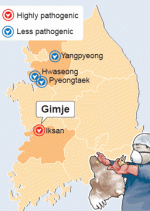
The discovery was the third of its kind since the first case was discovered at a farm in Iksan, 18 kilometers north of Gimje three years ago. The second case was also discovered in Iksan on Nov. 25 this year.
The farm in Gimje is outside the 10-km radius special quarantine area of Iksan.
<TABLE style="PADDING-RIGHT: 5px" cellSpacing=0 cellPadding=0 width=150 align=left border=0><TBODY><TR><TD>
200612110019.gif
</TD></TR></TBODY></TABLE>"At the moment, the outbreak at this farm does not appear to be related to the first and second cases in Iksan. But we need to investigate further," said Lee. The Agriculture Ministry and North Jeolla Province officials decided to kill all poultry - estimated to be 70,000 - within a 500-meter radius of the farm. All poultry within a 10-km radius alert area will be subject to examination, officials said.
There are three other farms in the village that reported the latest avian influenza outbreak, each with 70,000 birds.
"Officials are going to discuss whether or not to expand the radius to 3 kilometers," Lee said.
Since the latest outbreak was reported, officials in North Jeolla Province have been on full alert, holding emergency meetings and preparing quarantine measures to prevent the spread of the disease, officials said. The local officials immediately evacuated the farm in Gimje and blocked access to it.
"We did everything we could to prevent further outbreaks but it didn't work. We will prepare more measures to minimize damage to other farms," said an official.
The government slaughtered 764,000 poultry around Iksan after last month's outbreak was confirmed.
There have been no human casualties from bird flu in Korea. The government has destroyed more than 5 million poultry and spent about 45 billion won ($48 million) since 2003 when the initial case of bird flu was reported, according to Korean quarantine officials.
(yoonmi@heraldm.com)

By Kim Yoon-mi<!-- www.koreaherald.co.kr -->


2006.12.12

</TD></TR></TBODY></TABLE>http://www.koreaherald.co.kr/SITE/data/html_dir/2006/12/12/200612120007.asp
 
Re: South Korea Discovers Third Bird-Flu Outbreak in Three Weeks

Another outbreak of deadly bird flu reported in Gimje<!--@제목끝@-->
<!-- //기사타이틀 -->
<!-- 서브타이틀 --><TABLE cellSpacing=0 cellPadding=0 width=652 border=0><TBODY><TR><TD class=Sarticle><!--@부제목시작@-->Officials say 3rd case this year means containment efforts may have failed<!--@부제목끝@--></TD></TR></TBODY></TABLE><!-- //서브타이틀 --><!-- 기사내용 --><TABLE cellSpacing=0 cellPadding=0 width=652 border=0><TBODY><TR><TD class=txt_index_02><!--@본문시작@-->December 12, 2006 ㅡ The nation's health authorities believe their efforts to keep bird flu from spreading may have failed, as the Ministry of Agriculture and Forestry yesterday confirmed the country's third outbreak this year at a poultry farm in Gimje.
The farm is located about 18 kilometers (11 miles) south of a poultry farm in Iksan, North Jeolla province, where the first bird flu outbreak occurred on Nov. 19.
The nation's health authorities launched an investigation to find out how the disease spread to a third farm. Experts and farm owners in the region suspect the disease might have been spread along a local road, Route 23. The three farms were located within 10 kilometers of the road, which connects Cheonan, South Chungcheong and Gangjin, North Jeolla.
After the first two outbreaks last month in the Iksan area, officials quarantined a 10-kilometer radius around the sites.
The farm in Gimje, North Jeolla province, was attacked, like the others, by a strain of the highly pathogenic avian influenza virus that is capable of infecting humans, the ministry said yesterday.
The owner of the farm told the provincial government on Sunday that about 1,000 quails had died during the previous four days. The farm was quarantined immediately on Sunday and the nearby areas disinfected. The provincial government said the farm's 290,000 quails and 75,000 chickens would be slaughtered by this morning.
Following the two outbreaks in Iksan last month, the Gimje city government set up seven additional guard posts to monitor incoming traffic. The city said it will prevent any outsiders from entering the area.
To try to prevent any further spread of the disease, health authorities drew another quarantine zone within a 10-kilometer radius of the Gimje outbreak. Farm workers, health officials and those working inside the zone were given anti-virus medicine.
Iksan, where the first two outbreaks took place, is known to be the nation's largest poultry-supplying region. About 440 farms raise 5.2 million chickens. In Gimje, 220 farms grow 2.7 million chickens. Harim, the nation's largest poultry supplier, is also located in the region.
People who work in the poultry industry expressed concern about the latest outbreak, but said the news was unlikely to put a serious dent in sales as the industry recovers from the aftermath of last month's outbreaks.
"Over the last weekend, our 1,800 stores nationwide sold 1.4 billion won ($1.5 million) worth of chickens," said Kim Young-jin, a manager with Genesis, which operates fried chicken restaurants such as BBQ. "That is close to what we sold during a typical weekend before the bird flu outbreak."
Mr. Kim said yesterday the company was paying special attention to the news about the additional outbreaks.
"I don't think it will be a fatal blow to the industry, because customers are educated now that it is okay to eat chicken if fully cooked," Mr. Kim said. "The winter is particularly a popular season for chicken because of school vacations. We expect sales will be normal."


by Ser Myo-ja <myoja@joongang.co.kr><!--@본문끝@-->
</TD></TR></TBODY></TABLE>

http://joongangdaily.joins.com/200612/11/200612112141551079900090409041.html

 
Re: South Korea Discovers Third Bird-Flu Outbreak in Three Weeks

Bird Flu Outbreak In Quail Farm In South Korea

11 Dec 2006 <input onclick="return printPage()" value="Click to Print" type="button">

An outbreak of H5N1 bird flu was confirmed at a quail farm in Kimje, South Korea, say officials from the Ministry of Agriculture.

The farm has 270,000 quail. Authorities are currently removing the quail from the farm and have set up a quarantine zone around the area to stem the spread of the disease. All poultry within 500 meters of the farm will be destroyed, say officials.

This is be the country's third outbreak in one month. On November 18th and November 26th there were two outbreaks in two separate chicken farms - both farms are within a 22 km radius of the infected quail farm.

So far, no humans have become ill, say ministry officials.

Approximately 3,000 quail died of bird flu during the weekend.

Since 2003 over 5 million poultry have been destroyed in South Korea, in measures to prevent the spread of bird flu.

Ministry of Agriculture and Forestry, Republic of Korea (English version)

Written by: Christian Nordqvist
Editor: Medical News Today Article URL: http://www.medicalnewstoday.com/healthnews.php?newsid=58667
 
Re: South Korea Discovers Third Bird-Flu Outbreak in Three Weeks

niman said:
Commentary

H5N1 On Third South Korean Farm
Recombinomics Commentary
December 11, 2006

The Ministry of Agriculture and Forestry said the latest case of avian influenza is suspected of having killed over a thousand quail at a farm in Gimje, North Jeolla Province.

"An examination of the dead quail showed that the deaths were caused by a highly pathogenic strain of avian influenza," said Lee Sang-kil, director of the ministry's livestock bureau.

"At the moment, the outbreak at this farm does not appear to be related to the first and second cases in Iksan.

There are three other farms in the village that reported the latest avian influenza outbreak, each with 70,000 birds.

"Officials are going to discuss whether or not to expand the radius to 3 kilometers," Lee said.

The above comments indicate that the massive culling of birds in or near the two farms with confirmed H5N1 did not prevent the spread to a third farm near the site of the H5N1 outbreak in December, 2003. The outbreak in the same region almost exactly three years later add additional evidence for spread by migratory birds, some of which summer in Mongolia prior to migrating over South Korea at this time of the year.
The 2003/2004 H5N1 isolates from South Korea / Japan were related to the Qinghai strain of H5N1, which has a novel cleavage site of GERRRKKR, although the cleavage site of the 2003/2004 isolates from Korea / Japan were missing an R.
The release of the HA cleavage site sequence from the 2006 H5N1 isolates would be useful.
 
Back
Top