Re: South Korea Discovers Third Bird-Flu Outbreak in Three Weeks
Another outbreak of deadly bird flu reported in Gimje<!--@제목끝@-->
<!-- //기사타이틀 -->
<!-- 서브타이틀 --><TABLE cellSpacing=0 cellPadding=0 width=652 border=0><TBODY><TR><TD class=Sarticle><!--@부제목시작@-->Officials say 3rd case this year means containment efforts may have failed<!--@부제목끝@--></TD></TR></TBODY></TABLE><!-- //서브타이틀 --><!-- 기사내용 --><TABLE cellSpacing=0 cellPadding=0 width=652 border=0><TBODY><TR><TD class=txt_index_02><!--@본문시작@-->
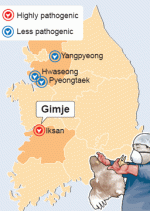
December 12, 2006 ㅡ The nation's health authorities believe their efforts to keep bird flu from spreading may have failed, as the Ministry of Agriculture and Forestry yesterday confirmed the country's third outbreak this year at a poultry farm in Gimje.
The farm is located about 18 kilometers (11 miles) south of a poultry farm in Iksan, North Jeolla province, where the first bird flu outbreak occurred on Nov. 19.
The nation's health authorities launched an investigation to find out how the disease spread to a third farm. Experts and farm owners in the region suspect the disease might have been spread along a local road, Route 23. The three farms were located within 10 kilometers of the road, which connects Cheonan, South Chungcheong and Gangjin, North Jeolla.
After the first two outbreaks last month in the Iksan area, officials quarantined a 10-kilometer radius around the sites.
The farm in Gimje, North Jeolla province, was attacked, like the others, by a strain of the highly pathogenic avian influenza virus that is capable of infecting humans, the ministry said yesterday.
The owner of the farm told the provincial government on Sunday that about 1,000 quails had died during the previous four days. The farm was quarantined immediately on Sunday and the nearby areas disinfected. The provincial government said the farm's 290,000 quails and 75,000 chickens would be slaughtered by this morning.
Following the two outbreaks in Iksan last month, the Gimje city government set up seven additional guard posts to monitor incoming traffic. The city said it will prevent any outsiders from entering the area.
To try to prevent any further spread of the disease, health authorities drew another quarantine zone within a 10-kilometer radius of the Gimje outbreak. Farm workers, health officials and those working inside the zone were given anti-virus medicine.
Iksan, where the first two outbreaks took place, is known to be the nation's largest poultry-supplying region. About 440 farms raise 5.2 million chickens. In Gimje, 220 farms grow 2.7 million chickens. Harim, the nation's largest poultry supplier, is also located in the region.
People who work in the poultry industry expressed concern about the latest outbreak, but said the news was unlikely to put a serious dent in sales as the industry recovers from the aftermath of last month's outbreaks.
"Over the last weekend, our 1,800 stores nationwide sold 1.4 billion won ($1.5 million) worth of chickens," said Kim Young-jin, a manager with Genesis, which operates fried chicken restaurants such as BBQ. "That is close to what we sold during a typical weekend before the bird flu outbreak."
Mr. Kim said yesterday the company was paying special attention to the news about the additional outbreaks.
"I don't think it will be a fatal blow to the industry, because customers are educated now that it is okay to eat chicken if fully cooked," Mr. Kim said. "The winter is particularly a popular season for chicken because of school vacations. We expect sales will be normal."
by Ser Myo-ja <
myoja@joongang.co.kr><!--@본문끝@-->
</TD></TR></TBODY></TABLE>
http://joongangdaily.joins.com/200612/11/200612112141551079900090409041.html