• FluTrackers.com Inc. does not provide medical advice. Information on this web site is collected from various internet resources, and the FluTrackers board of directors makes no warranty to the safety, efficacy, correctness or completeness of the information posted on this site by any author or poster. The information collated here is for instructional and/or discussion purposes only and is NOT intended to diagnose or treat any disease, illness, or other medical condition. Every individual reader or poster should seek advice from their personal physician/healthcare practitioner before considering or using any interventions that are discussed on this website. By continuing to access this website you agree to consult your personal physican before using any interventions posted on this website, and you agree to hold harmless FluTrackers.com Inc., the board of directors, the members, and all authors and posters for any effects from use of any medication, supplement, vitamin or other substance, device, intervention, etc. mentioned in posts on this website, or other internet venues referenced in posts on this website.
  • We are not asking for any donations. Do not donate to any entity who says they are raising funds for us.

Seasonal Flu 2008 - 2009

Re: Seasonal Flu 2008 - 2009

Source: http://www.tweednews.com.au/storydisplay.cfm?storyid=3782191

AU: Schools hit by flu outbreak
August 20, 2008

A FLU outbreak across both Lindisfarne Anglican Grammar School's senior and junior campuses is being blamed for the absence of more than 100 students.

More than 54 students from the junior campus in Tweed Heads were away for medical reasons yesterday and another 50 were absent from the middle and senior school in Terranora.

The number of students calling in sick began to average more than 30 a day since term three commenced in late July before a spike this week.

Junior school support officer Donna Ayers said some students had been presenting symptoms of the flu, including sore throats, headaches, high fever and vomiting.

"We are encouraging parents to keep their kids away from school when they are sick," Ms Ayers said.

"It is too hard to learn when they are this bad. I have been here 11 years and I can only remember one other occasion where it was this bad."

Marketing and enrolments director Myfanwy Stanfield said the average number of sick students a day was normally 10.

"A lot of the staff has also been affected by it as well. We had 10 away last week," she said.

Terranora Public School, only kilometres away from the middle and senior campus of Lindisfarne, was experiencing its own problems with the flu virus.

Principal James Hackett said the flu was common for this time of year in students.

"Most schools go through this during term three," Mr Hackett said.

"We had 17 kids away sick in a class last week and a third of the staff have also been affected."

A North Coast Area Health spokesman said the outbreak is nothing to worry about and the NSW Public Health unit had not been informed.
 
Re: Seasonal Flu 2008 - 2009

Source: http://www.stuff.co.nz/stuff/marlboroughexpress/4665381a6008.html


NZ: Flu bug sweeps schools
Rose Daly - The Marlborough Express | Friday, 22 August 2008

Blenheim colleges are battling an attack of 'flu and staff are begging parents to keep their sick children at home.

More than 200 students at Marlborough girls' and 100 at Marlborough boys' colleges were off school sick yesterday. Both schools have rolls of about 1000.

"It'd be good for them to stay away until they're well, until the symptoms are gone," office manager Kaye Bickson said.

"We've been heavily hit with it. We're taking 70 messages (calling in sick) ... maybe 100 plus for this week and last week." she said, adding that one of the staff who normally deals with absences is herself off sick.

"We're finding the average stay away is three or five days but some are coming back after only one day. Chest infections are predominant and we've had a couple of cases of students developing pneumonia, even one staff member."

Ms Bickson said this year's bout of winter illness was worse than last year and it had also arrived later than usual. There was also concern that with half of term three gone, there was still a lot more work to come.


"We've got a few weeks yet to persevere and with exams coming up at the end of term."

Marlborough Girls' College principal Karen Stewart said 209 of the school's 1040 pupils were absent yesterday, about 70 more than usual.

"It's particularly noticeable in assembly, the hall's strangely empty. It's been this way all week."

Teachers had also noticed large gaps in the classroom, but the school was fortunate staff had not been badly affected, Ms Stewart said.

Queen Charlotte College reported increased absences this week, though pupils were suffering from a variety of illnesses.

Nelson Marlborough medical officer of health Ed Kiddle said data from two weeks ago suggested there was a lot of 'flu around and we might not have seen the worst of it.

"We don't know if it's peaked yet. We're at a high point so far but we may see more cases ... it's highly likely."

According to Environment Science Research (ESR), the crown research institute that monitors notifiable diseases, this 'flu season has knocked more people back into bed than last year, but the latest figures show Marlborough has been let off lightly compared to other parts of the country.

The Influenza weekly update is compiled by ESR from data provided by doctors across the country.

Wanganui and Eastern Bay of Plenty reported more than 400 cases per 100,000 population between August 4 and 8 which puts them into epidemic status. By comparison, Nelson Marlborough had just less than 100 per 100,000 at that same time which is considered normal. In the week prior to that period however, Northland was plagued by the 'flu with the highest consultation rate of 826 per 100,000 followed by South Canterbury with 233 per 100,000 which is still considered in the normal band.

The strains of 'flu that vaccinations were supplied to combat this year were Solomon Islands (H1N1), Brisbane (H3N2) and Florida. Mr Kiddle said the vaccination supplied for this year's flu season have matched the strains identified in laboratory tests.

``In the swabs I've seen reported locally here, the ones here have matched the three strains ... two A and one B type.''


The region's emergency departments had reported a steady stream of patients but that they were not overloaded, he said.

Businesses around town appear to have escaped the virus so far. Big employers, such as Marlborough District Council, Cuddon Engineering Innovation and New World supermarket, say they have not noticed a big dip in staffing levels. The Marlborough Express, like many employers, offered staff a 'flu vaccination earlier in the year which appeared to lessen the amount of sick leave taken.
However, council support services manager Dean Heiford said a number of staff had children who had been sick.

``We may be hit yet.''
Base Woodbourne warrant officer John Bray said they had also not been affected by the virus.
 
Re: Seasonal Flu 2008 - 2009

Source: http://www.stuff.co.nz/stuff/marlboroughexpress/4665381a6008.html


The strains of 'flu that vaccinations were supplied to combat this year were Solomon Islands (H1N1), Brisbane (H3N2) and Florida. Mr Kiddle said the vaccination supplied for this year's flu season have matched the strains identified in laboratory tests.

``In the swabs I've seen reported locally here, the ones here have matched the three strains ... two A and one B type.''
Last season there was virtually no H1N1 Solomon Island in circulation. It is mliekly that the H1N1 in New Zealand is Brisbane/59 and is Tamiflu resistant. The first 10 H1N1 sequenced from Australia this season had H274Y (Tamiflu resistant).
 
Re: Seasonal Flu 2008 - 2009

<TABLE cellSpacing=0 cellPadding=0 width="100%" border=0><TBODY><TR title="Click on column header to change the sort order"><TD class=viewDataBorderTBLBold height=30></TD><TD class=viewDataBorderTBRBold>Country</TD><TD class=viewDataBorderBold>Subgroup</TD><TD class=viewDataBorderBold align=middle>Period</TD><TD class=viewDataBorderBold align=middle>Year</TD><TD class=viewDataBorderBold align=middle>Value</TD><TD class=viewDataBorderBold align=middle>Source</TD></TR><TR><TD class=categoryPath align=middle colSpan=7>Communicable Diseases -> Influenza -> Influenza viruses detected</TD></TR><TR><TD class=indicatorInfo align=middle colSpan=7>(Periodicity: Week, Applied Time Period: from 1/2008 to 53/2008)</TD></TR><TR><TD class=content vAlign=top>1.</TD><TD class=content vAlign=top width=161>New Caledonia</TD><TD class=content vAlign=top>A (H1)</TD><TD class=content vAlign=top align=middle>15</TD><TD class=content vAlign=top align=middle>2008</TD><TD class=content vAlign=top align=middle>0</TD><TD class=content vAlign=top align=middle>view</TD></TR><TR><TD class=content vAlign=top>2.</TD><TD class=content vAlign=top width=161>New Caledonia</TD><TD class=content vAlign=top>A (H1)</TD><TD class=content vAlign=top align=middle>16</TD><TD class=content vAlign=top align=middle>2008</TD><TD class=content vAlign=top align=middle>0</TD><TD class=content vAlign=top align=middle>view</TD></TR><TR><TD class=content vAlign=top>3.</TD><TD class=content vAlign=top width=161>New Caledonia</TD><TD class=content vAlign=top>A (H1)</TD><TD class=content vAlign=top align=middle>17</TD><TD class=content vAlign=top align=middle>2008</TD><TD class=content vAlign=top align=middle>0</TD><TD class=content vAlign=top align=middle>view</TD></TR><TR><TD class=content vAlign=top>4.</TD><TD class=content vAlign=top width=161>New Caledonia</TD><TD class=content vAlign=top>A (H1)</TD><TD class=content vAlign=top align=middle>18</TD><TD class=content vAlign=top align=middle>2008</TD><TD class=content vAlign=top align=middle>0</TD><TD class=content vAlign=top align=middle>view</TD></TR><TR><TD class=content vAlign=top>5.</TD><TD class=content vAlign=top width=161>New Caledonia</TD><TD class=content vAlign=top>A (H1)</TD><TD class=content vAlign=top align=middle>19</TD><TD class=content vAlign=top align=middle>2008</TD><TD class=content vAlign=top align=middle>0</TD><TD class=content vAlign=top align=middle>view</TD></TR><TR><TD class=content vAlign=top>6.</TD><TD class=content vAlign=top width=161>New Caledonia</TD><TD class=content vAlign=top>A (H1)</TD><TD class=content vAlign=top align=middle>20</TD><TD class=content vAlign=top align=middle>2008</TD><TD class=content vAlign=top align=middle>0</TD><TD class=content vAlign=top align=middle>view</TD></TR><TR><TD class=content vAlign=top>7.</TD><TD class=content vAlign=top width=161>New Caledonia</TD><TD class=content vAlign=top>A (H1)</TD><TD class=content vAlign=top align=middle>21</TD><TD class=content vAlign=top align=middle>2008</TD><TD class=content vAlign=top align=middle>0</TD><TD class=content vAlign=top align=middle>view</TD></TR><TR><TD class=content vAlign=top>8.</TD><TD class=content vAlign=top width=161>New Caledonia</TD><TD class=content vAlign=top>A (H1)</TD><TD class=content vAlign=top align=middle>22</TD><TD class=content vAlign=top align=middle>2008</TD><TD class=content vAlign=top align=middle>0</TD><TD class=content vAlign=top align=middle>view</TD></TR><TR><TD class=content vAlign=top>9.</TD><TD class=content vAlign=top width=161>New Caledonia</TD><TD class=content vAlign=top>A (H1)</TD><TD class=content vAlign=top align=middle>23</TD><TD class=content vAlign=top align=middle>2008</TD><TD class=content vAlign=top align=middle>0</TD><TD class=content vAlign=top align=middle>view</TD></TR><TR><TD class=content vAlign=top>10.</TD><TD class=content vAlign=top width=161>New Caledonia</TD><TD class=content vAlign=top>A (H1)</TD><TD class=content vAlign=top align=middle>24</TD><TD class=content vAlign=top align=middle>2008</TD><TD class=content vAlign=top align=middle>0</TD><TD class=content vAlign=top align=middle>view</TD></TR><TR><TD class=content vAlign=top>11.</TD><TD class=content vAlign=top width=161>New Caledonia</TD><TD class=content vAlign=top>A (H1)</TD><TD class=content vAlign=top align=middle>25</TD><TD class=content vAlign=top align=middle>2008</TD><TD class=content vAlign=top align=middle>0</TD><TD class=content vAlign=top align=middle>view</TD></TR><TR><TD class=content vAlign=top>12.</TD><TD class=content vAlign=top width=161>New Caledonia</TD><TD class=content vAlign=top>A (H1)</TD><TD class=content vAlign=top align=middle>26</TD><TD class=content vAlign=top align=middle>2008</TD><TD class=content vAlign=top align=middle>0</TD><TD class=content vAlign=top align=middle>view</TD></TR><TR><TD class=content vAlign=top>13.</TD><TD class=content vAlign=top width=161>New Caledonia</TD><TD class=content vAlign=top>A (H1)</TD><TD class=content vAlign=top align=middle>27</TD><TD class=content vAlign=top align=middle>2008</TD><TD class=content vAlign=top align=middle>0</TD><TD class=content vAlign=top align=middle>view</TD></TR><TR><TD class=content vAlign=top>14.</TD><TD class=content vAlign=top width=161>New Caledonia</TD><TD class=content vAlign=top>A (H1)</TD><TD class=content vAlign=top align=middle>28</TD><TD class=content vAlign=top align=middle>2008</TD><TD class=content vAlign=top align=middle>0</TD><TD class=content vAlign=top align=middle>view</TD></TR><TR><TD class=content vAlign=top>15.</TD><TD class=content vAlign=top width=161>New Caledonia</TD><TD class=content vAlign=top>A (H1)</TD><TD class=content vAlign=top align=middle>29</TD><TD class=content vAlign=top align=middle>2008</TD><TD class=content vAlign=top align=middle>0</TD><TD class=content vAlign=top align=middle>view</TD></TR><TR><TD class=content vAlign=top>16.</TD><TD class=content vAlign=top width=161>New Caledonia</TD><TD class=content vAlign=top>A (H1)</TD><TD class=content vAlign=top align=middle>30</TD><TD class=content vAlign=top align=middle>2008</TD><TD class=content vAlign=top align=middle>0</TD><TD class=content vAlign=top align=middle>view</TD></TR><TR><TD class=content vAlign=top>17.</TD><TD class=content vAlign=top width=161>New Caledonia</TD><TD class=content vAlign=top>A (H1)</TD><TD class=content vAlign=top align=middle>31</TD><TD class=content vAlign=top align=middle>2008</TD><TD class=content vAlign=top align=middle>0</TD><TD class=content vAlign=top align=middle>view</TD></TR><TR><TD class=content vAlign=top>18.</TD><TD class=content vAlign=top width=161>New Caledonia</TD><TD class=content vAlign=top>A (H1)</TD><TD class=content vAlign=top align=middle>32</TD><TD class=content vAlign=top align=middle>2008</TD><TD class=content vAlign=top align=middle>0</TD><TD class=content vAlign=top align=middle>view</TD></TR><TR><TD class=content vAlign=top>19.</TD><TD class=content vAlign=top width=161>New Caledonia</TD><TD class=content vAlign=top>A (H1)</TD><TD class=content vAlign=top align=middle>33</TD><TD class=content vAlign=top align=middle>2008</TD><TD class=content vAlign=top align=middle>0</TD><TD class=content vAlign=top align=middle>view</TD></TR><TR><TD class=content vAlign=top>20.</TD><TD class=content vAlign=top width=161>New Caledonia</TD><TD class=content vAlign=top>A (H1)</TD><TD class=content vAlign=top align=middle>34</TD><TD class=content vAlign=top align=middle>2008</TD><TD class=content vAlign=top align=middle>1</TD><TD class=content vAlign=top align=middle>view</TD></TR></TBODY></TABLE>
 
Re: Seasonal Flu 2008 - 2009

[ECDC] The science and practicalities of making recommendations for the composition of influenza vaccines.

The contents of the syringe - Salzberg S. - Nature 2008. 454, 160-161 (09 Jul 2008)

Description:
In this commentary the author argues that the influenza vaccination essentially failed in the USA in the 2007-8 season and that public confidence fell.(1)

He notes that vaccine effectiveness in the field was estimated to be only 44% (2) and he suggests that as a consequence the influenza season was especially bad last year in the USA, noting in passing that for this coming 2008/9 season WHO has recommended changing all three of components of vaccines: A(H3N2), A(H1N1) and influenza B compared to what was recommended for 2007/8 (Table).(3,4,5)

He goes on to criticise the WHO and others for holding closed meetings where recommendations on vaccination are made, not allowing debate and not publishing the data on which the decisions are based.

He argues that those like himself who make available sequence data publicly available could especially contribute to the process and improve strain selection (1,4)

He also recommends moving to producing influenza vaccines by cell-culture rather than the predominant technology which uses embryonated (fertilised) chicken eggs.(1)

Table: Comparing Influenza Vaccine Strain Recommendations for 2007/8 and 2008/9 Northern Hemisphere Influenza Seasons

WHO Northern Hemisphere 2007/8 season recommendation (February 2007)(3)
-- an A/Solomon Islands/3/2006(H1N1)-like virus;
-- an A/Wisconsin/67/2005 (H3N2)-like virus;
-- a B/Malaysia/2506/2004-like virus

WHO Northern Hemisphere 2008/9 season recommendations (February 2008)(4)
-- an A/Brisbane/59/2007 (H1N1)-like virus;
-- an A/Brisbane/10/2007 (H3N2)-like virus;+
-- a B/Florida/4/2006-like virus.#
+) A/Brisbane/10/2007 is a current southern hemisphere vaccine virus.
#) B/Florida/4/2006 and B/Brisbane/3/2007 (a B/Florida/4/2006-like virus) are current southern hemisphere vaccine viruses.

ECDC Comment (21/08/08):
The 2007/8 winter influenza season in the United States (US) was interesting and instructive for at least two reasons.

Firstly it was one of the few areas of the world there was significant circulation of influenza A(H3N2) viruses.(4)

In most other parts of the world where surveillance took place (including Europe) the season was dominated by A(H1N1) and influenza B viruses.(4)

Secondly for the first time ever CDC and its collaborator the Marshfield clinic in Wisconsin successfully produced interim in-season estimates of vaccine effectiveness.

However it would be wrong to characterise the 2007/8 influenza vaccine as having failed in the USA, or elsewhere.

In controlled trials among health adults it has been found that vaccines well-matched to the circulating strains often give between 70% and 90% protection against laboratory confirmed infection.

However what is observed in the field against clinical disease, hospitalisation and deaths is often lower.(2,5)

This is partially because of methodological issues (using less precise end-points than in trials) and also because the elderly and those with chronic medical conditions have the highest rates of severe outcomes from infection but often respond less well to immunisation.

Nevertheless because the prevalence of influenza infections in the population is high the protection afforded remains invaluable preventing much illness and saving many lives.(2,5)

Salzberg argues that there is a need to publish more of the data on which the recommendations are made, and to have some more debate.(1)

But WHO does publish the data quickly, and in some detail.(3,4,6)

Also in Europe and the USA, after the global recommendations are made, both the European Medicines Agency and the US Food and Drug Administration rapidly hold further discussions and debates.

However it is crucial to set this decision-making in the context of the industrial, scientific and public health process of vaccine production.

This works extraordinarily well despite its complexity with virological surveillance data well-linked to public health action.(7,8)

In order to have millions of doses available for the early autumn in the Northern Hemisphere the manufacturers have to have recommendations on vaccine composition as early as possible in the calendar year.

Then the best-growing strains have to selected and there also has to be time to for specialist laboratories (for Europe the National Institute for Biological Standards and Controls) to produce essential reagents for measuring vaccine potency before the vaccines are released.(7,8)

Running in completely the opposite direction is the need to wait as late as possible to get a good idea of what viruses are circulating in the current season, characterised not only by sequence analysis (as implied by Salzberg) but also be antigenicity, which requires growth and titration with appropriate antisera.

This is difficult especially since epidemics in the Northern Hemisphere have moved forward in recent years so that they are only become established in January or even February.

Usually the specialists have to meet in a short window in February which means intense pressure to get the most recent isolates in and generate the large amounts of data needed to make judgements.

This is why referral of specimens to National Influenza Centres (NICs) is so important, especially early each influenza season.

Again this works surprisingly well despite the testing, isolating and forwarding of viruses by primary laboratories is financially unsupported in many countries.

There can be no time for more public debate and peer-review before the decisions are made.

Salzberg suggests that more use should be made of sequence data in the decisions. That may be true but the decisions do not depend on structure and sequence data alone but also the antigenic similarity between vaccine candidate and the circulating wild-type viruses.

Classically this is judged not by sequencing but by seeing how the new season?s predominant isolates react in haemagglutination inhibition tests against post-infection ferret sera. (3,4,6)

Antigenic cartography (looking at where new strains are emerging in other parts of the world) is now starting to be added to the decision making.(9)

After the decisions are made at there is then always an element of chance.

Whether or not decisions that had to be made for the northern hemisphere in February based on last season?s data will hold ten to twelve months later in the next season. I.e. How much will the viruses alter before the next winter?

Even with hindsight it is difficult to see that the changes that were considered necessary for 2008/9 could have been anticipated in February 2007 (as they were by the time of the Southern Hemisphere discussion in the Summer of 2007)(6).

Though it may be desirable to see more data being published and there being an invitation for debate after the event it will be interesting to see whether this improves the decision after the event.

Finally of course the manufacturers still need to act on the February recommendation and having them second-guessed later may not be helpful, not inspire confidence in the public.

Salzberg?s recommendation to grasp the new technologies like cell-culture vaccine production is correct but as a statement it is out-dated.(1) The cutting edge of industry is already looking past animal cells to other growth systems. This kind of forward look is already part of WHO?s programme to expand global vaccine production and use where ECDC acts as an observer.(10)

However these new processes are expensive and potentially hazardous processes requiring high levels of biosafety. Though they are not dependent on the supply of special eggs switching manufacturing plants from egg-based technologies to cell culture will not be accomplished overnight. They will also not necessarily be much quicker in production where the rate-limiting steps are quality control, formulation and packaging irrespective of the use of cell culture or egg-based vaccines.(6,7)

What is interesting and important for the future is investing in virological and epidemiological surveillance in the tropical Far-East which seems to be the engine-room for production at least of new A(H3N2) influenza viruses which then disseminate out to the temperate zones.(9)

This may give better indication on what is coming to the Northern and Southern Hemispheres.

1) Salzberg S. The Contents of the syringe Nature 2008 Nature 454, 160 - 161 (09 Jul 2008), doi: 10.1038/454160a
2) Centers for Disease Control and Prevention. Interim within-season estimate of the effectiveness of trivalent inactivated influenza vaccine. 2007-8 Influenza Season. MMWR 2008; 57:393-398
3) WHO Recommended composition of influenza virus vaccines for use in the 2007-2008 (northern hemisphere) influenza season. WER 2007; 82: 69-76 (March 2nd)
4) WHO Recommended composition of influenza virus vaccines for use in the 2008-2009 (northern hemisphere) influenza season. WER 2008 83: 81-87(February 29th)
5) Mangtani P, Cumberland P, Hodgson CR, Roberts JA, Cutts FT, Hall AJ. A cohort study of the effectiveness of influenza vaccine in older people using the United Kingdom General Practice Research Database. JID 2004; 190:1-10.
6) WHO Recommended composition of influenza virus vaccines for use in the 2007 southern hemisphere influenza season. WER 2007, 82: 345?356 (October 5th)
7) Gerdil C. The annual production cycle for influenza vaccine. Vaccine 2003; 21: 1776-9.
8) Inglis S, Wood J, Minor P. Making flu vaccines is a race against time in an uncertain world (correspondence). Nature 2008, 454, 939 (21 August 2008) | doi:10.1038/454939c
9) Russell C, Jones T, Barr I et al The global circulation of seasonal influenza A (H3N2) viruses Science 2008; 320 340-6.
10) WHO Global pandemic influenza action plan to increase vaccine supply. WHO Geneva Immunization, Vaccine and Biologicals. Epidemic and Pandemic Alert and Response. September 2006.

ECDC would like to thank a number of specialists who assisted in producing this text

Comments are invited to influenza@ecdc.europa.eu

ECDC discussed this earlier in the year in ECDC Influenza News Scientific Advances May 8th 2008. It should be noted that final vaccine effectiveness results from the 2007/8 season are pending and that the observed vaccine effectiveness against the most dangerous viruses, the A(H3N2) group was 58%.(2)
-
http://www.ecdc.europa.eu/Health_topics/influenza/news/news_Influenza_080821.html
--------

 
Re: Seasonal Flu 2008 - 2009

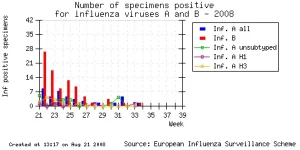
EISS - Inter-season Electronic Bulletin - Week 33 : 11/08/2008-17/08/2008 - 22 August 2008, Issue N? 270 - Sporadic laboratory confirmed cases of influenza in Europe

? Summary:
Influenza virus detections occur sporadically in Europe. While no detections were reported in week 32/2008, there were two detections of influenza virus in week 33/2008.

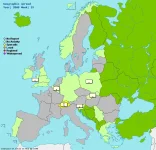
Fourteen countries reported an assessment of the geographical spread of influenza activity in week 33/2008 of which thirteen reported no influenza activity and Switzerland reported sporadic activity.

In weeks 32-33/2008, only two influenza viruses were detected in Europe: an influenza A(H1N1) virus in the Netherlands and an influenza B virus detected in Switzerland.

Since week 21/2008 (i.e. 21/2008-33/2008), there have been a total of 118 influenza virus detections in Europe: 83 (70%) type B, 19 (16%) type A not subtyped, 11 (9%) type A subtype H3 and 5 (4%) type A subtype H1.

The majority of cases (91%) in the weeks 21-33/2008 were reported from non-sentinel sources.

The proportion of influenza B was quite substantial at the end of the 2007/2008 season but has now gradually diminished (see also the graph for Europe).

There have been no reports of unusual influenza activity in Europe at a community level (i.e. in a region or local area such as a city, county or district) since week 16/2008.

Background:
The Inter-season Electronic Bulletin presents and comments influenza activity based on virological data reported to EISS.

In weeks 32/2008 and 33/2008, a total of 16 countries reported virological data to EISS.

The Inter-season Electronic Bulletin will be published between week 21/2008 and week 39/2008.

The spread of influenza virus strains and their epidemiological impact in Europe are being monitored by EISS in collaboration with the WHO Collaborating Centre in London (United Kingdom) and the European Centre for Disease Prevention and Control in Stockholm (Sweden).

Graph
The graph presents the total number of specimens positive for influenza A and B viruses in Europe during the inter-season period.

Map
The map presents the geographical spread as assessed by each of the networks in EISS.

A = Dominant virus A
H1N1 = Dominant virus A(H1N1)
H3N2 = Dominant virus A(H3N2)
H1N2 = Dominant virus A(H1N2)
B = Dominant virus B
A & B = Dominant virus A & B
= : stable clinical activity
+ : increasing clinical activity
- : decreasing clinical activity

No activity = no evidence of influenza virus activity (clinical activity remains at baseline levels)
Sporadic = isolated cases of laboratory confirmed influenza infection
Local outbreak = increased influenza activity in local areas (e.g. a city) within a region, or outbreaks in two or more institutions (e.g. schools) within a region. Laboratory confirmed.
Regional activity = influenza activity above baseline levels in one or more regions with a population comprising less than 50% of the country's total population. Laboratory confirmed.
Widespread = influenza activity above baseline levels in one or more regions with a population comprising 50% or more of the country's population. Laboratory confirmed.
Finland : Where available, the epidemiological data are provided by a health-care district in South-Western Finland (the health-care district serves 54,000 inhabitants i.e. approximately one percent of the Finnish population).

Network comments (where available)

-- Switzerland: No activity observed in Sentinel network. One non-sentinel specimen was detected influenza B in a 17 years old girl from North of the country.
-
http://www.eiss.org/cgi-files/bulletin_v2.cgi
-------
 

Attachments

  • europe_1_viro_2008_33.png
    europe_1_viro_2008_33.png
    4.8 KB · Views: 0
  • 2008_33_v2.png
    2008_33_v2.png
    32.4 KB · Views: 0
Re: Seasonal Flu 2008 - 2009

Nonprofits promote flu shots at polling places

Aug 22, 2008 (CIDRAP News) ?

Two national nonprofit health groups are offering local public health departments a shot in the arm for fall influenza vaccination efforts by helping them organize immunization clinics at or near polling places.

The Vote and Vax program is a collaboration between the Robert Wood Johnson Foundation (RWJF), a healthcare philanthropy organization, and SPARC (Sickness Prevention Achieved through Regional Collaboration), a nonprofit organization focused on disease prevention, according to background materials posted on the initiative's Web site.

The program provides health agencies with technical expertise to set up the clinics and marketing muscle to promote them, but does not provide the vaccine. Public health agencies are advised to charge for the shots as they normally would at other fall flu-vaccination clinics.

Offering flu vaccinations on Election Day in November is a way to target seniors, who typically vote in large numbers, Vote and Vax organizers say. Seniors are one of the US Centers for Disease Control and Prevention's (CDC's) priority groups for flu immunization.

SPARC started offering fall election clinics in the late 1990s, but the
program expanded in 2006 when it partnered with the RWJF to enable 25 public health agencies to sponsor Vote and Vax clinics at polling places. That year, the clinics delivered 13,790 vaccine doses at 127 polling sites in 14 states. The program's goal for Nov 4 is to expand to 1,000 polling places across the United States.

This November, the Guilford County Department of Public Health in north-central North Carolina will offer Vote and Vax clinics at eight polling places, according to an Aug 20 report in the Greensboro (N.C.) News & Record. Lynne Beck, the health department's spokeswoman, said officials will visit 11 of the county's 165 polling sites before narrowing the number to eight. The department expects to charge $25 to $30 for the flu vaccine, the same as it charges at other sites, she told the News & Record.

In a report on the effect of the 2006 Vote and Vax, Douglas Shenson, MD, MPH, president of SPARC, and Mary Adams, MPH, an epidemiologist and partner at On Target Health Data in Hartford, Conn., wrote that Election Day in early November is an optimal time for flu vaccination. They also said that polling places, because they meet strict accessibility requirements, are likely to attract other vulnerable people besides seniors, who might be difficult to reach with the vaccination message. The report was published in the July-August issue of the Journal of Public Health Management Practice.

Survey results from the 2006 Election-Day immunization clinics revealed that more than 80% of the adults who were vaccinated were in the CDC's flu-immunization priority groups. About 43% of the recipients were men and 57% were women. Nearly 900 pediatric vaccine doses were administered at the Vote and Vax clinics. Eleven percent of the recipients did not have health insurance.

On a scale of 1 to 10, public health agencies rated the overall success of the program at 8.5. Health officials gave the program high marks for organization, ease of planning, publicity, and convenience for recipients. However, some sites reported problems with vaccine supply. One group had to cancel its clinic after its plan to offer free vaccinations at a polling place in a medically underserved neighborhood was criticized by political activists, who perceived it as "get out the vote" campaign for Democrats.

"We are encouraged that not only were significant numbers of participants 'new' vaccine recipients, but also 28% reported they would not have likely received an influenza vaccination had they not been offered one at a Vote and Vax site," Shenson and Adams wrote.

The Vote and Vax program could be a model for the delivery of other preventive health services such as cancer screenings or pandemic influenza measures, they wrote. Though the program isn't deployed in emergency conditions, it involves delivering a large single-day supply of vaccine to many residents in many non-healthcare settings across communities, they added.

The authors said, however, that some questions about the Vote and Vax strategy remain. For example, it's unclear if the program increases communitywide vaccine coverage. Also, they wrote that the political response in one community emphasized the importance of clearly separating public health activities from any perception of "political intrigue."

Shenson D, Adams M. The Vote and Vax program: public health at polling places. J Public Health Management Practice 2008 Jul-Aug;14(3):1-5 [Full text]

See also:
Vote & Vax Web site
http://www.voteandvax.org
-
http://www.cidrap.umn.edu/cidrap/content/influenza/general/news/aug2208votevax.html
------
 
Re: Seasonal Flu 2008 - 2009

Source: http://www.nzherald.co.nz/section/story.cfm?c_id=204&objectid=10528682

New Zealand: Flu woes worsen
5:00AM Sunday August 24, 2008
By Michelle Coursey

Flu figures have hit a three-year high as wet weather extends the virus season.

Schoolchildren have been particularly hard hit as rain forces them to stay indoors. Schools in Marlborough and Porirua have been blitzed by the virus, with large numbers of children absent.

Further north, Auckland Regional Public Health Service medical officer Craig Thornley said his office was aware of above-average levels of sickness, some schools reporting a 100 per cent rise in students off sick.


"It's likely that kids are spending more time inside, so there's more chance of transmission between them, and just some seasonal change in the types of viruses that seem to be going around," said Thornley.

Latest flu figures from Environmental Science and Research show type B influenza as the most common strain from August 11-15.

Eastern Bay of Plenty had experienced epidemic levels of the bug that week with more than 550 in every 100,000 people seeing doctors, while south Canterbury had the second-highest rates.


Auckland Public Health advises parents and pupils to stay home if sick, cover their coughs and wash their hands often to help stop the transmission of viruses. Parents should take children to a GP if they had difficulty breathing, chest pain, or severe vomiting.
 
Re: Seasonal Flu 2008 - 2009

Source: http://www.nzherald.co.nz/section/story.cfm?c_id=204&objectid=10528682

New Zealand: Flu woes worsen
5:00AM Sunday August 24, 2008
By Michelle Coursey

Flu figures have hit a three-year high as wet weather extends the virus season.

Schoolchildren have been particularly hard hit as rain forces them to stay indoors. Schools in Marlborough and Porirua have been blitzed by the virus, with large numbers of children absent.

Further north, Auckland Regional Public Health Service medical officer Craig Thornley said his office was aware of above-average levels of sickness, some schools reporting a 100 per cent rise in students off sick.

"It's likely that kids are spending more time inside, so there's more chance of transmission between them, and just some seasonal change in the types of viruses that seem to be going around," said Thornley.

Latest flu figures from Environmental Science and Research show type B influenza as the most common strain from August 11-15.

Eastern Bay of Plenty had experienced epidemic levels of the bug that week with more than 550 in every 100,000 people seeing doctors, while south Canterbury had the second-highest rates.

Auckland Public Health advises parents and pupils to stay home if sick, cover their coughs and wash their hands often to help stop the transmission of viruses. Parents should take children to a GP if they had difficulty breathing, chest pain, or severe vomiting.
<TABLE cellSpacing=0 cellPadding=0 width="100%" border=0><TBODY><TR><TD class=indicatorInfo align=middle colSpan=7>(Periodicity: Week, Applied Time Period: from 1/2008 to 53/2008)</TD></TR><TR><TD class=content vAlign=top>1.</TD><TD class=content vAlign=top width=161>New Zealand</TD><TD class=content vAlign=top>Total B</TD><TD class=content vAlign=top align=middle>19</TD><TD class=content vAlign=top align=middle>2008</TD><TD class=content vAlign=top align=middle>1</TD><TD class=content vAlign=top align=middle>view</TD></TR><TR><TD class=content vAlign=top>2.</TD><TD class=content vAlign=top width=161>New Zealand</TD><TD class=content vAlign=top>Total B</TD><TD class=content vAlign=top align=middle>20</TD><TD class=content vAlign=top align=middle>2008</TD><TD class=content vAlign=top align=middle>0</TD><TD class=content vAlign=top align=middle>view</TD></TR><TR><TD class=content vAlign=top>3.</TD><TD class=content vAlign=top width=161>New Zealand</TD><TD class=content vAlign=top>Total B</TD><TD class=content vAlign=top align=middle>21</TD><TD class=content vAlign=top align=middle>2008</TD><TD class=content vAlign=top align=middle>0</TD><TD class=content vAlign=top align=middle>view</TD></TR><TR><TD class=content vAlign=top>4.</TD><TD class=content vAlign=top width=161>New Zealand</TD><TD class=content vAlign=top>Total B</TD><TD class=content vAlign=top align=middle>22</TD><TD class=content vAlign=top align=middle>2008</TD><TD class=content vAlign=top align=middle>0</TD><TD class=content vAlign=top align=middle>view</TD></TR><TR><TD class=content vAlign=top>5.</TD><TD class=content vAlign=top width=161>New Zealand</TD><TD class=content vAlign=top>Total B</TD><TD class=content vAlign=top align=middle>23</TD><TD class=content vAlign=top align=middle>2008</TD><TD class=content vAlign=top align=middle>0</TD><TD class=content vAlign=top align=middle>view</TD></TR><TR><TD class=content vAlign=top>6.</TD><TD class=content vAlign=top width=161>New Zealand</TD><TD class=content vAlign=top>Total B</TD><TD class=content vAlign=top align=middle>24</TD><TD class=content vAlign=top align=middle>2008</TD><TD class=content vAlign=top align=middle>3</TD><TD class=content vAlign=top align=middle>view</TD></TR><TR><TD class=content vAlign=top>7.</TD><TD class=content vAlign=top width=161>New Zealand</TD><TD class=content vAlign=top>Total B</TD><TD class=content vAlign=top align=middle>25</TD><TD class=content vAlign=top align=middle>2008</TD><TD class=content vAlign=top align=middle>6</TD><TD class=content vAlign=top align=middle>view</TD></TR><TR><TD class=content vAlign=top>8.</TD><TD class=content vAlign=top width=161>New Zealand</TD><TD class=content vAlign=top>Total B</TD><TD class=content vAlign=top align=middle>26</TD><TD class=content vAlign=top align=middle>2008</TD><TD class=content vAlign=top align=middle>5</TD><TD class=content vAlign=top align=middle>view</TD></TR><TR><TD class=content vAlign=top>9.</TD><TD class=content vAlign=top width=161>New Zealand</TD><TD class=content vAlign=top>Total B</TD><TD class=content vAlign=top align=middle>27</TD><TD class=content vAlign=top align=middle>2008</TD><TD class=content vAlign=top align=middle>3</TD><TD class=content vAlign=top align=middle>view</TD></TR><TR><TD class=content vAlign=top>10.</TD><TD class=content vAlign=top width=161>New Zealand</TD><TD class=content vAlign=top>Total B</TD><TD class=content vAlign=top align=middle>28</TD><TD class=content vAlign=top align=middle>2008</TD><TD class=content vAlign=top align=middle>7</TD><TD class=content vAlign=top align=middle>view</TD></TR><TR><TD class=content vAlign=top>11.</TD><TD class=content vAlign=top width=161>New Zealand</TD><TD class=content vAlign=top>Total B</TD><TD class=content vAlign=top align=middle>29</TD><TD class=content vAlign=top align=middle>2008</TD><TD class=content vAlign=top align=middle>7</TD><TD class=content vAlign=top align=middle>view</TD></TR><TR><TD class=content vAlign=top>12.</TD><TD class=content vAlign=top width=161>New Zealand</TD><TD class=content vAlign=top>Total B</TD><TD class=content vAlign=top align=middle>30</TD><TD class=content vAlign=top align=middle>2008</TD><TD class=content vAlign=top align=middle>10</TD><TD class=content vAlign=top align=middle>view</TD></TR><TR><TD class=content vAlign=top>13.</TD><TD class=content vAlign=top width=161>New Zealand</TD><TD class=content vAlign=top>Total B</TD><TD class=content vAlign=top align=middle>31</TD><TD class=content vAlign=top align=middle>2008</TD><TD class=content vAlign=top align=middle>13</TD><TD class=content vAlign=top align=middle>view</TD></TR><TR><TD class=content vAlign=top>14.</TD><TD class=content vAlign=top width=161>New Zealand</TD><TD class=content vAlign=top>Total B</TD><TD class=content vAlign=top align=middle>32</TD><TD class=content vAlign=top align=middle>2008</TD><TD class=content vAlign=top align=middle>23</TD><TD class=content vAlign=top align=middle>view</TD></TR><TR><TD class=content vAlign=top>15.</TD><TD class=content vAlign=top width=161>New Zealand</TD><TD class=content vAlign=top>Total B</TD><TD class=content vAlign=top align=middle>33</TD><TD class=content vAlign=top align=middle>2008</TD><TD class=content vAlign=top align=middle>16</TD><TD class=content vAlign=top align=middle>view</TD></TR></TBODY></TABLE><!-- END OF CONTENT -->
 
Re: Seasonal Flu 2008 - 2009

Source: http://www.nzherald.co.nz/section/story.cfm?c_id=204&objectid=10528682

New Zealand: Flu woes worsen
5:00AM Sunday August 24, 2008
By Michelle Coursey

Flu figures have hit a three-year high as wet weather extends the virus season.

Schoolchildren have been particularly hard hit as rain forces them to stay indoors. Schools in Marlborough and Porirua have been blitzed by the virus, with large numbers of children absent.

Further north, Auckland Regional Public Health Service medical officer Craig Thornley said his office was aware of above-average levels of sickness, some schools reporting a 100 per cent rise in students off sick.

"It's likely that kids are spending more time inside, so there's more chance of transmission between them, and just some seasonal change in the types of viruses that seem to be going around," said Thornley.

Latest flu figures from Environmental Science and Research show type B influenza as the most common strain from August 11-15.

Eastern Bay of Plenty had experienced epidemic levels of the bug that week with more than 550 in every 100,000 people seeing doctors, while south Canterbury had the second-highest rates.

Auckland Public Health advises parents and pupils to stay home if sick, cover their coughs and wash their hands often to help stop the transmission of viruses. Parents should take children to a GP if they had difficulty breathing, chest pain, or severe vomiting.
<TABLE cellSpacing=0 cellPadding=0 width="100%" border=0><TBODY><TR><TD class=content><TABLE cellSpacing=0 cellPadding=0 width="100%" border=0><TBODY><TR><TD class=content vAlign=top>1.</TD><TD class=content vAlign=top width=161>New Zealand</TD><TD class=content vAlign=top>A (not suptyped)</TD><TD class=content vAlign=top align=middle>19</TD><TD class=content vAlign=top align=middle>2008</TD><TD class=content vAlign=top align=middle>2</TD><TD class=content vAlign=top align=middle>view</TD></TR><TR><TD class=content vAlign=top>2.</TD><TD class=content vAlign=top width=161>New Zealand</TD><TD class=content vAlign=top>A (not suptyped)</TD><TD class=content vAlign=top align=middle>20</TD><TD class=content vAlign=top align=middle>2008</TD><TD class=content vAlign=top align=middle>2</TD><TD class=content vAlign=top align=middle>view</TD></TR><TR><TD class=content vAlign=top>3.</TD><TD class=content vAlign=top width=161>New Zealand</TD><TD class=content vAlign=top>A (not suptyped)</TD><TD class=content vAlign=top align=middle>21</TD><TD class=content vAlign=top align=middle>2008</TD><TD class=content vAlign=top align=middle>0</TD><TD class=content vAlign=top align=middle>view</TD></TR><TR><TD class=content vAlign=top>4.</TD><TD class=content vAlign=top width=161>New Zealand</TD><TD class=content vAlign=top>A (not suptyped)</TD><TD class=content vAlign=top align=middle>22</TD><TD class=content vAlign=top align=middle>2008</TD><TD class=content vAlign=top align=middle>4</TD><TD class=content vAlign=top align=middle>view</TD></TR><TR><TD class=content vAlign=top>5.</TD><TD class=content vAlign=top width=161>New Zealand</TD><TD class=content vAlign=top>A (not suptyped)</TD><TD class=content vAlign=top align=middle>23</TD><TD class=content vAlign=top align=middle>2008</TD><TD class=content vAlign=top align=middle>1</TD><TD class=content vAlign=top align=middle>view</TD></TR><TR><TD class=content vAlign=top>6.</TD><TD class=content vAlign=top width=161>New Zealand</TD><TD class=content vAlign=top>A (not suptyped)</TD><TD class=content vAlign=top align=middle>24</TD><TD class=content vAlign=top align=middle>2008</TD><TD class=content vAlign=top align=middle>8</TD><TD class=content vAlign=top align=middle>view</TD></TR><TR><TD class=content vAlign=top>7.</TD><TD class=content vAlign=top width=161>New Zealand</TD><TD class=content vAlign=top>A (not suptyped)</TD><TD class=content vAlign=top align=middle>25</TD><TD class=content vAlign=top align=middle>2008</TD><TD class=content vAlign=top align=middle>12</TD><TD class=content vAlign=top align=middle>view</TD></TR><TR><TD class=content vAlign=top>8.</TD><TD class=content vAlign=top width=161>New Zealand</TD><TD class=content vAlign=top>A (not suptyped)</TD><TD class=content vAlign=top align=middle>26</TD><TD class=content vAlign=top align=middle>2008</TD><TD class=content vAlign=top align=middle>11</TD><TD class=content vAlign=top align=middle>view</TD></TR><TR><TD class=content vAlign=top>9.</TD><TD class=content vAlign=top width=161>New Zealand</TD><TD class=content vAlign=top>A (not suptyped)</TD><TD class=content vAlign=top align=middle>27</TD><TD class=content vAlign=top align=middle>2008</TD><TD class=content vAlign=top align=middle>12</TD><TD class=content vAlign=top align=middle>view</TD></TR><TR><TD class=content vAlign=top>10.</TD><TD class=content vAlign=top width=161>New Zealand</TD><TD class=content vAlign=top>A (not suptyped)</TD><TD class=content vAlign=top align=middle>28</TD><TD class=content vAlign=top align=middle>2008</TD><TD class=content vAlign=top align=middle>5</TD><TD class=content vAlign=top align=middle>view</TD></TR><TR><TD class=content vAlign=top>11.</TD><TD class=content vAlign=top width=161>New Zealand</TD><TD class=content vAlign=top>A (not suptyped)</TD><TD class=content vAlign=top align=middle>29</TD><TD class=content vAlign=top align=middle>2008</TD><TD class=content vAlign=top align=middle>4</TD><TD class=content vAlign=top align=middle>view</TD></TR><TR><TD class=content vAlign=top>12.</TD><TD class=content vAlign=top width=161>New Zealand</TD><TD class=content vAlign=top>A (not suptyped)</TD><TD class=content vAlign=top align=middle>30</TD><TD class=content vAlign=top align=middle>2008</TD><TD class=content vAlign=top align=middle>8</TD><TD class=content vAlign=top align=middle>view</TD></TR><TR><TD class=content vAlign=top>13.</TD><TD class=content vAlign=top width=161>New Zealand</TD><TD class=content vAlign=top>A (not suptyped)</TD><TD class=content vAlign=top align=middle>31</TD><TD class=content vAlign=top align=middle>2008</TD><TD class=content vAlign=top align=middle>9</TD><TD class=content vAlign=top align=middle>view</TD></TR><TR><TD class=content vAlign=top>14.</TD><TD class=content vAlign=top width=161>New Zealand</TD><TD class=content vAlign=top>A (not suptyped)</TD><TD class=content vAlign=top align=middle>32</TD><TD class=content vAlign=top align=middle>2008</TD><TD class=content vAlign=top align=middle>9</TD><TD class=content vAlign=top align=middle>view</TD></TR><TR><TD class=content vAlign=top>15.</TD><TD class=content vAlign=top width=161>New Zealand</TD><TD class=content vAlign=top>A (not suptyped)</TD><TD class=content vAlign=top align=middle>33</TD><TD class=content vAlign=top align=middle>2008</TD><TD class=content vAlign=top align=middle>3</TD><TD class=content vAlign=top align=middle>view</TD></TR></TBODY></TABLE><!-- END OF CONTENT --></TD><TD class=ContentTop width=14>
spacer.gif
</TD></TR></TBODY></TABLE>
 
Re: Seasonal Flu 2008 - 2009

From Shiloh's post no. 28:

''Eastern Bay of Plenty had experienced epidemic levels of the bug that week with more than 550 in every 100,000 people seeing doctors, while south Canterbury had the second-highest rates.''

Here below the graph of epi-curve in Italy during 2007/08 influenza season with co-circulation of H1N1/Brisbane - H3N2 and B strains. To note the highest incidence of ILI for 0-4 class age. (Source http://www.iss.it/binary/iflu/cont/Italia2008-17.1209724991.pdf)

 
Re: Seasonal Flu 2008 - 2009

Source: http://www.nzherald.co.nz/section/story.cfm?c_id=204&objectid=10528682

New Zealand: Flu woes worsen
5:00AM Sunday August 24, 2008
By Michelle Coursey

Flu figures have hit a three-year high as wet weather extends the virus season.

Schoolchildren have been particularly hard hit as rain forces them to stay indoors. Schools in Marlborough and Porirua have been blitzed by the virus, with large numbers of children absent.

Further north, Auckland Regional Public Health Service medical officer Craig Thornley said his office was aware of above-average levels of sickness, some schools reporting a 100 per cent rise in students off sick.

"It's likely that kids are spending more time inside, so there's more chance of transmission between them, and just some seasonal change in the types of viruses that seem to be going around," said Thornley.

Latest flu figures from Environmental Science and Research show type B influenza as the most common strain from August 11-15.

Eastern Bay of Plenty had experienced epidemic levels of the bug that week with more than 550 in every 100,000 people seeing doctors, while south Canterbury had the second-highest rates.

Auckland Public Health advises parents and pupils to stay home if sick, cover their coughs and wash their hands often to help stop the transmission of viruses. Parents should take children to a GP if they had difficulty breathing, chest pain, or severe vomiting.
The latest bulletin was published on 14th August, covering weeks 30?32. It recorded that in the southern hemisphere, the regular winter epidemics had started with a considerable increase in both influenza activity and detection of influenza viruses. Influenza A (H1), A(H3) and influenza B were circulating. Widespread outbreaks were reported in New Zealand. To date there is no information on whether any of the A(H1) viruses are resistant to oseltamivir.

http://ecdc.europa.eu/Health_topics/influenza/news/news_Influenza_080821.html
 
Re: Seasonal Flu 2008 - 2009

Source: http://www.stuff.co.nz/stuff/4667440a11.html

NZ: Tamiflu-resistant viruses spreading rapidly
NZPA | Monday, 25 August 2008

Tamiflu retroviral drugs being stockpiled by the Government may not be an effective weapon against the next flu pandemic.

Tamiflu-resistant forms of the "ordinary" seasonal influenza are rapidly spreading and the drug may be ineffective in fighting the dominant flu strain in South Africa this winter.

World Health Organisation data show tests on 107 people in South Africa with the H1N1 strain one of the three most common flu viruses in humans found all had a mutant bug resistant to Tamiflu, the WHO said. Only one patient was taking Tamiflu at the time.

Tests on 788 samples taken from H1N1 flu patients in 12 countries, mostly in the southern hemisphere, from April 1 to August 20 found that 242, or 31 per cent, had the so-called H274Y mutation associated with Tamiflu resistance, the WHO said.

Southern hemisphere incidence of the mutation in tests on the H1N1 virus ranged from 100% in South Africa to 13% in Chile, compared with a resistance rate of 16% found in 7528 samples tested from the last quarter of 2007 to March 31 in 34 countries, mostly in the northern hemisphere.


"What we're seeing is the evolution of the resistance gene and the distribution of it throughout the world," said Lance Jennings, a clinical virologist with the Canterbury District Health Board, who is chairman of the Asia-Pacific Advisory Committee on Influenza. "We have a lot to learn about the molecular epidemiology of influenza viruses."

The Tamiflu-resistant form of flu has been reported in 40 countries in Europe, North and South America, Africa, Asia and Australia since widespread resistance to the pill was first reported to the WHO by Norway in January.

Until birdflu vaccines are developed for the specific pandemic influenza virus once it evolves and starts spreading work likely to take three months or more Tamiflu and another retroviral treatment, Relenza, are the main medical weapons to battle pandemic flu.

Tamiflu is being stockpiled by the WHO and governments around the world for use in the event of a pandemic, and to treat the H5N1 avian flu strain that has infected humans in 15 of the 60 countries to which it has spread.

Last year, Swedish researchers warned that sewage systems do not break down Tamiflu, and that the drug was being discharged in rivers and streams used by the waterfowl thought to be the main carriers of avian flu.

They urged doctors not to overprescribe Tamiflu to avoid creating resistance in avian flu carried by ducks. If those viruses combined with other viruses that made humans sick they could mutate into strains resistant to Tamiflu, they said early in 2007.


Health Minister David Cunliffe said this year that 103 of the 1229 treatment courses of Tamiflu the Government had bought at a cost of $300,000 had reached their expiry dates.
 
Re: Seasonal Flu 2008 - 2009

Source: http://www.stuff.co.nz/stuff/4667440a11.html

NZ: Tamiflu-resistant viruses spreading rapidly
NZPA | Monday, 25 August 2008

Tamiflu retroviral drugs being stockpiled by the Government may not be an effective weapon against the next flu pandemic.

Tamiflu-resistant forms of the "ordinary" seasonal influenza are rapidly spreading and the drug may be ineffective in fighting the dominant flu strain in South Africa this winter.

World Health Organisation data show tests on 107 people in South Africa with the H1N1 strain one of the three most common flu viruses in humans found all had a mutant bug resistant to Tamiflu, the WHO said. Only one patient was taking Tamiflu at the time.

Tests on 788 samples taken from H1N1 flu patients in 12 countries, mostly in the southern hemisphere, from April 1 to August 20 found that 242, or 31 per cent, had the so-called H274Y mutation associated with Tamiflu resistance, the WHO said.

Southern hemisphere incidence of the mutation in tests on the H1N1 virus ranged from 100% in South Africa to 13% in Chile, compared with a resistance rate of 16% found in 7528 samples tested from the last quarter of 2007 to March 31 in 34 countries, mostly in the northern hemisphere.

"What we're seeing is the evolution of the resistance gene and the distribution of it throughout the world," said Lance Jennings, a clinical virologist with the Canterbury District Health Board, who is chairman of the Asia-Pacific Advisory Committee on Influenza. "We have a lot to learn about the molecular epidemiology of influenza viruses."

The Tamiflu-resistant form of flu has been reported in 40 countries in Europe, North and South America, Africa, Asia and Australia since widespread resistance to the pill was first reported to the WHO by Norway in January.

Until birdflu vaccines are developed for the specific pandemic influenza virus once it evolves and starts spreading work likely to take three months or more Tamiflu and another retroviral treatment, Relenza, are the main medical weapons to battle pandemic flu.

Tamiflu is being stockpiled by the WHO and governments around the world for use in the event of a pandemic, and to treat the H5N1 avian flu strain that has infected humans in 15 of the 60 countries to which it has spread.

Last year, Swedish researchers warned that sewage systems do not break down Tamiflu, and that the drug was being discharged in rivers and streams used by the waterfowl thought to be the main carriers of avian flu.

They urged doctors not to overprescribe Tamiflu to avoid creating resistance in avian flu carried by ducks. If those viruses combined with other viruses that made humans sick they could mutate into strains resistant to Tamiflu, they said early in 2007.

Health Minister David Cunliffe said this year that 103 of the 1229 treatment courses of Tamiflu the Government had bought at a cost of $300,000 had reached their expiry dates.

SIC 1) ''Tamiflu retroviral drugs being stockpiled by the Government may not be an effective weapon against the next flu pandemic.'' NOT retroviral. Oseltamivir is a Neuraminidase-Inhibitor. Anti-retroviral drugs are employed in treatment of HIV/AIDS (AZT, 3TC, DDI, other protease-inbibitors, fusion-inhibitors, etc.).

SIC 2) ''They urged doctors not to overprescribe Tamiflu to avoid creating resistance in avian flu carried by ducks'' Use of oseltamivir for treatment of influenza isn't - to date - proven to cause emersion of this kind of strain of seasonal human influenza subtype A/H1N1 with specific mutation H274Y.

SIC 3) '' another retroviral treatment, Relenza, are the main medical weapons to battle pandemic flu'', zanamvir is also a NA-inhibitor and there are also amantadine/rimantadine M2-inhibitors and ribavirin also worth to be further investigated.

When avian influenza virus will be isolated in wild avifauna and tested properly for subtyping and genetic presence of NA-inhibitors motifs we also know if oseltamivir sporadic use is enough to drive mutations via sewage system.

We expect the results of ongoing surveillance in wild avifauna:oops:
 
Re: Seasonal Flu 2008 - 2009

Source: http://www.wanganuichronicle.co.nz/...localnews&thesubsection=&thesecondsubsection=

New Zealand: Monday influx swamps emergency department

27.08.2008
By LIN FERGUSON

Wanganui Hospital's emergency department was stretched almost beyond its limits on Monday night by a huge, unexplained influx of sick people.

Emergency department director Athol Steward said yesterday 80 people were seen and 30 of those had to be admitted.


"It was very, very hectic for the staff."

Dr Steward said Monday night's phenomenon had staff running until the early hours of Tuesday morning. And it hadn't helped that the department was short-staffed, he said.

"But not only did the staff do an incredible job, the public waiting were all wonderful as well."

The triage nurse and the receptionist had constantly updated and told people there was going to be a long wait, but no one had complained, he said.


Patients on Monday night had ranged from small babies to elderly people, with many of them suffering from respiratory complications from the flu that has swept through Wanganui over the past month.

"There was also a few accidents and other medical problems."

The mad rush into the emergency department had started about 4pm on Monday and steadily built up through the night, he said.

"It was just exceptional."

One man told the Chronicle he had taken his wife in at 8.30pm and it was 1.30am before she was seen.

Dr Steward said the average patient number through emergency was usually between 50-55 a day and that Monday had been the busiest, with the greatest number of patients through for more than three years. He attributed the increase in patient numbers over the past year to people now preferring to go to the emergency department rather than their GP.

"It's a choice people in Wanganui are making.

"It's the time of the year as well, with the winter weather."

Fortunately, though, with higher numbers of patients coming through, the new facility, which opened in April, had helped enormously.

"It's so much easier to work."

Though Mondays numbers were beyond anything the staff would have envisaged a bed was found for everyone, he said.

"No one was left waiting in a corridor, and that is remarkable  a real achievement."

However, things will pick up by the end of this week, when four new junior doctors will have started, he said.

"Even though patient numbers can't be predicted, the four new doctors will make a huge difference. Were a very busy hospital for a small place."

Even though Wanganui was geographically small, with a small population, the health problems were enormous, he said.

"It's an older population, and it's a sickly population. Wanganui is not the healthiest town. There are a lot of health problems here."
 
Re: Seasonal Flu 2008 - 2009

Source: http://www.news.com.au/mercury/story/0,22884,24254246-3462,00.html

AU: Flu hits school's 270 students
Article from: The Mercury

SALLY GLAETZER

August 28, 2008 10:10am

ALMOST half of the students at Lauderdale Primary School are off sick today as the school grapples with a severe flu outbreak.

Principal Mike Woods of Lauderdale Primary School said up to four children have spent a night in hospital and one staff member has spent three nights in hospital.


"We have had over the last almost two weeks now varying reports of the illness," Mr Woods said.

He said an average of 80 out of the 590 students were away each day last week, but the epidemic has worsened in more recent days.

Today 270 students, 11 teachers and 5 support staff are off sick.
Mr Woods said the symptoms are vomiting, diarrhoea, severe upper body aches and difficulty breathing.

"We're still waiting on pathology results to see if it is Influenza A," Mr Woods said.


He said the remaining 38 teachers are handling two classes each and education department staff have been made available to help out.

"Even doubling up we barely have 20 students in a class," Mr Woods said.
 
Re: Seasonal Flu 2008 - 2009

Flu outbreak: 291 off school

August 28, 2008 - 12:05PM

Several primary school students and a teacher in Tasmania have been hospitalised by a flu outbreak that has affected almost 300 children and staff from the one school.

The Lauderdale Primary School near Hobart is dealing with a suspected Influenza A epidemic with 271 students and 20 staff off sick today - almost half the school's population.

School principal Mike Woods today said several children and one teacher had been treated in hospital for suspected Influenza A.

"Most alarmingly it seems to be affecting young children's breathing and several children have been hospitalised, usually overnight, over the last week, as a precaution," Mr Woods said.

"We did have a staff member admitted to hospital for a couple of nights as well but she's home now.

"Today we have 271 students absent and 20 staff, including 11 classroom teachers."

Mr Woods said symptoms of the virus which started spreading at the school 10 days ago included vomiting, diarrhoea, aches and pains, and headaches.

Health authorities have decided against closing the school unless the situation deteriorates.

http://www.smh.com.au/news/national/flu-outbreak-291-off-school/2008/08/28/1219516630225.html
 
Re: Seasonal Flu 2008 - 2009

Rice bowled over by pneumonia
28th August 2008, 13:45 WST

Olympian Stephanie Rice says she has mild pneumonia and has been ordered to rest, putting an end to a planned trip to Perth.
Rice and fellow Olympic medallist Eamon Sullivan today appeared at the Myer store in Brisbane’s CBD to promote Davenport underwear.

The triple gold medallist swimmer said she started to feel sick towards the end of the Beijing games.

“I haven’t been well since Beijing and it’s gotten a lot worse since coming home,” the former Brisbane schoolgirl told the crowd of several hundred autograph hunters.

“Perth is not what I should be doing right now. I really want to go to Perth but I can’t until I get better.

“(The doctors said) I have the early stages of pneumonia, which a lot people probably have.”

http://www.thewest.com.au/default.aspx?MenuId=77&ContentID=94737
 
Re: Seasonal Flu 2008 - 2009

Qld govt under pressure over health

27th August 2008, 14:22 WST
The Queensland government has come under renewed pressure over its troubled health system after being hit with a barrage of fresh complaints in state parliament on Wednesday.
Opposition Leader Lawrence Springborg said a major north Queensland hospital was on Tuesday unable to find beds for 24 people.

Townsville Hospital reportedly declared a "code yellow", using ambulances as makeshift beds and cancelling elective surgery for Wednesday and Thursday.

The crisis came on the same day as the government extended its Health Action Plan, designed to improve the health system, with the five-point Advancing Health Action plan, Mr Springborg said.

"How long do you have to masterplan before you actually do anything?" he said.

Opposition health spokesman Mark McArdle said central Queensland health services were also in crisis, with Aramac Hospital's 22 staff on Tuesday told the facility would be downgraded to a health centre.

In addition, problems on the Sunshine Coast, where Nambour Hospital was on bypass on Tuesday with 24 emergency patients waiting, and in Cairns, where patients have complained about golden staph, also emerged in parliament.

Mr McArdle said it was "incredible hypocrisy" for the government to shed a rural hospital on the same day it was lauding a new health plan.

"Aramac is again a symptom of the larger malaise that is impacting across Queensland Health," Mr McArdle told reporters in Brisbane on Wednesday.

"Add all these issues together you still find that 10 years after being in government the health crisis continues to roll out, unfortunately, day in, day out."

Barcaldine mayor Robert Chandler said the decision would "gut" Aramac - removing 22 families that support the town's school and businesses.

"I'm not much of a politician, but I do know that the government of the day has a ... community service obligation, to look after all Queenslanders, and that goes for the little places like Aramac with 300 people," Mr Chandler said.

But Health Minister Stephen Robertson said the 10-bed facility had only 12 overnight admissions over the past 12 months.

"It's hardly a hospital now when we haven't had a full-time doctor there for the last four years because we can't attract a full-time doctor there," Mr Robertson told reporters.

"What we want to do is find a new model of care that will deliver health services for the people of Aramac and stop this charade about pretending that they have a fully functioning hospital, because they clearly don't."

Mr Robertson said Townsville's problems were caused by 22 nurses calling in sick with the flu and additional staff were being sought.

"Winter always is our busiest time, but staff sickness hasn't helped on this occasion, along with an increase in the number of elderly patients presenting to the hospital," he said.

Mr Robertson denied the health system was still failing, despite the government's efforts.

"People carry on calling it a third-world health system, that it's in crisis - that's nonsense," he said.

"If it was in crisis, we wouldn't be able to treat record numbers of patients, we'd be going backwards, and that is not the case on every indices."

AAP
http://www.thewest.com.au/aapstory.aspx?StoryName=509872
 
Re: Seasonal Flu 2008 - 2009

Source: http://www.media.tas.gov.au/release.php?id=24621

FLU IN TASMANIA

Public health authorities are waiting on test results to show the reason for a spike in flu-like illness affecting Lauderdale Primary School in Southern Tasmania.

Senior Medical Advisor, Dr Avner Misrachi, said it was not clear yet what is causing the illness.

?So far this winter the flu season has been mild compared to last year? Dr Misrachi said.

?52 adults and children from around Tasmania have been confirmed to have influenza so far this year, but there has been an increase in notifications in the last few weeks.

?We won?t know what is causing the flu-like illness affecting Lauderdale Primary School until we get test results back in the next 24 hours.?


The main symptoms of influenza are sudden onset of fever, chills, dry cough, extreme tiredness and body aches.

Dr Misrachi urged all parents to keep unwell children at home.

?Flu spreads easily and can cause serious illness and hospitalisation, especially for older people and people with chronic illnesses,? Dr Misrachi said.

?If you or your child has flu symptoms, keep them at home.

?Its important not to go back to work or school until you are fully recovered, so you don?t spread the disease to others.?

Dr Misrachi said influenza can cause severe illness but it is largely vaccine preventable.

?The flu vaccine is effective against influenza.

?Vaccine is still available but it takes around two weeks to be fully effective.?

Dr Misrachi said there are a number of simple steps people can take to protect themselves and others from flu.

?The flu is very contagious, and a person can infect others before they even realise they are sick.

?Wash your hands often with soap and water or alcohol rubs, especially before touching your face or anything that goes in your mouth. This is because the virus can be picked up unknowingly on your hands.

?Always cover your cough or sneeze with a tissue or your elbow if you don?t have a tissue.

?Throw dirty tissues in the bin straight away.

?And if you have a fever and other flu symptoms, stay home,? Dr Misrachi said.
 
Back
Top