Translation Google
Acute respiratory infections (influenza, bronchiolitis, COVID-19). Review of the 2025-2026 season.
Published on April 15, 2026
Updated on April 15, 2026
Print Share
Key points
Acute respiratory infections (ARI)
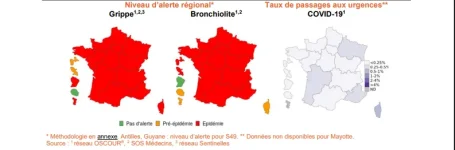
- Activity concentrated between November 2025 and February 2026 with a peak of moderate intensity in the city but high in the hospital, occurring at the end of 2025 and driven mainly by influenza.
Flu
- Epidemic caused exclusively by type A viruses occurring between December 2025 and mid-February 2026 (duration: 10 weeks), of low to moderate intensity in the city but high in the hospital, and with a significant impact on mortality observed at the beginning of 2026.
Bronchiolitis
- Epidemic with the usual time frame and short duration (8 weeks) between November and December 2025, of low intensity and comparable to the 2024-2025 epidemic.
COVID-19
- Low use of healthcare during the 2025-2026 season despite continued circulation of SARS-CoV-2 in the general population.
PDF 5.77 MB
https://www.santepubliquefrance.fr/...olite-covid-19-.-bilan-de-la-saison-2025-2026
--------------------------------------------------------------
Excerpts from the PDF link above:
Situational Update
Acute Respiratory Infections (ARI)
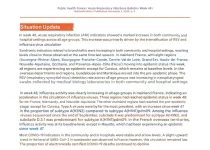
During the 2025–2026 season (Weeks 40/2025 – 15/2026), an increase in healthcare utilization for acute respiratory infections (ARI) was observed between November 2025 and February 2026. Overall, this activity was of low to moderate intensity in primary care settings, peaking in Week 52/2025. Conversely, activity was of moderate to high intensity in hospitals, with peaks in emergency department visits in Week 52/2025 and hospital admissions in Week 01/2026 (Oscour® network).
Lower respiratory tract ARI activity was driven primarily by RSV in November and December—accounting for approximately 303,000 attributable consultations in primary care (Sentinelles network) across all age groups, and 16,200 hospital admissions following emergency department visits for bronchiolitis among infants under one year of age—followed by influenza between December and mid-February,accounting for approximately 1.2 million attributable consultations in primary care and 28,300 hospital admissions following emergency department visits for influenza or influenza-like illness. Healthcare utilization for COVID-19 remained at a low level throughout the season, with approximately 181,000 consultations attributable to SARS-CoV-2 in primary care and 7,100 hospital admissions; this occurred despite continuous viral circulation within the population, as detected in wastewater.
Similar to data derived from primary care and emergency departments, the impact of acute respiratory infections (ARIs) in medico-social facilities (MSFs) and intensive care units was primarily driven by influenza (37% of clustered cases in MSFs and 75% of severe cases reported during the winter season), RSV (5.5% of clustered cases and 13.6% of severe RSV infection cases among individuals aged 18 and older, as well as 507 severe cases of bronchiolitis among children under 2), and COVID-19 (30.5% of clustered cases in MSFs and 10.5% of severe cases).
Other respiratory viruses also circulated during the winter—as is typically the case—particularly rhinoviruses/enteroviruses and metapneumovirus; however, these had a lesser impact on healthcare utilization.
Influenza
The 2025–26 influenza epidemic began rather early, in early December (Week 49, 2025), at the national level. It quickly reached a peak in community-based care settings in late December (Week 51) and concluded in mid-February (Week 06, 2026)—a duration of 10 weeks, which corresponds to the average duration of an influenza epidemic in mainland France during the 2011–25 period. This epidemic was driven exclusively by Type A viruses, with a dominance of the A(H3N2) subtype—predominantly of sub-clade K—over the A(H1N1)pdm09 subtype.
This epidemic was characterized by a low-to-moderate level of intensity in community-based care settings, with an estimated 1.2 million consultations attributable to influenza according to data from the Sentinelles network, and nearly 158,000 interventions for influenza-like illness recorded by SOS Médecins between Week 49, 2025, and Week 06, 2026 (across all age groups). These figures are significantly lower than those recorded during the 2024–25 influenza epidemic.
The impact of influenza was more substantial in hospital settings, with a high-intensity peak in activity reached in Week 52 in emergency departments and in Week 01 for hospital admissions. Over the course of the epidemic, approximately 115,000 emergency department visits and 24,000 hospital admissions following an emergency visit for influenza or influenza-like illness were recorded. While these figures—across all age groups—remain lower than those recorded during the 2024–25 epidemic (approximately 156,000 emergency department visits and 30,000 hospitalizations following an emergency visit), it is worth noting that the proportion of activity attributed to influenza/influenza-like illness among hospitalizations—at the peak of the 2025–26 epidemic—slightly exceeded the peak value observed in 2024–2025 across all age groups (5.5% vs 5.4% in 2024–25), and did so even more markedly among those aged 65 and over (7.3% vs 6.7%, respectively). Furthermore, during the 2025–26 epidemic, 21% of emergency department visits for influenza/influenza-like illness resulted in hospitalization—a figure higher than that of 2024–2025 (19%) and the average for the period spanning 2016–17 to 2024–2025 (16%).
The 2025–2026 season was characterized by a high number of reports of severe influenza cases submitted by the network of sentinel intensive care units participating in this surveillance, with 1,382 cases reported (vs 1,888 in 2024–2025), as well as clusters of acute respiratory infections (ARI) exclusively attributed to influenza in long-term care facilities (EMS), with 1,155 reports (vs 1,501 in 2024–2025). Finally, the impact of the 2025–26 influenza epidemic on mortality was high at its peak—occurring in Week 02 of 2026—with 7.3% of deaths reported via electronic death certificates being linked to influenza; this figure is slightly higher than that reached at the peak of the 2024–25 epidemic (7.1%). However, the total number of influenza-related deaths reported through this system in 2025–26 remained lower than that of the previous season (4,389 vs 4,925). The same applied to all-cause excess mortality, estimated at approximately 12,700 deaths during the 2025–26 epidemic (vs 17,900 in 2024– 2025).
At the conclusion of the influenza vaccination campaign (February 28, 2026), influenza vaccination coverage was estimated at 49.6% among all at-risk individuals targeted for vaccination, 56.7% among those aged 65 and over, and 28.9% among those under 65 at risk of severe influenza. It should be noted that these vaccination coverage rates are higher than those of the 2024–2025 season (+3.1 percentage points among all targeted individuals; +3.6 percentage points among those aged 65 and over); such an increase has been observed for the first time since the COVID-19 pandemic. Real-world vaccine effectiveness estimates against laboratory-confirmed symptomatic influenza, derived from data from the RELAB network of community laboratories (analyses by the CNR), indicate moderate effectiveness against Type A viruses across all age groups (30% [95% CI: 25–36]), comparable to estimates from the 2024–2025 season. The protective effect of vaccination appears to be higher among children (0–17 years: 67% [95% CI: 49–78]) and decreases with age (18–64 years: 34% [95% CI: 25–41]; 65 years and older: 23% [95% CI: 13–31]).
Bronchiolitis
The bronchiolitis epidemic for the 2025–2026 season in mainland France began in Week 47 (mid-November). The peak was reached in Week 50 (mid-December), and the epidemic concluded in Week 02 (mid-January). The epidemic lasted 8 weeks and followed the same dynamics as that of the 2024–2025 season [1]. These dynamics are broadly comparable to those of the seasons preceding the emergence of COVID-19 (seasons 2015–16 through 2019–2020). However, the duration of the epidemics during that earlier period tended to be longer [2]. During the four seasons between 2020–2021 and 2023–24, the dynamics of bronchiolitis epidemics were disrupted, characterized by later starts (season 2020–2021) or earlier starts (seasons 2021–22 through 2023–24).
In terms of intensity—both in primary care settings and in hospitals—the epidemic this season remained at low levels; these levels were comparable to, or even slightly lower than, those of the previous season. The observed levels remained below those seen during the epidemics of the seasons preceding the emergence of COVID-19 [2].
The proportion of bronchiolitis cases among SOS Médecins consultations for children under one year of age reached the "moderate intensity" threshold only during the week of the epidemic peak. The proportion of bronchiolitis cases among hospital admissions following an emergency department visit remained at a "low intensity" level throughout the entire epidemic. It should be noted that, as of the 2025–2026 season, data derived from syndromic surveillance are limited to children under one year of age.
Data observed in infants under 6 months of age indicate that the epidemic had a similar impact on emergency department visits—and on subsequent hospitalizations—compared to the previous season; indeed, the impact was slightly lower among infants aged 3 to 5 months. This impact is notably lower than that observed during epidemics preceding the emergence of COVID-19. Among infants aged 6 months and older, hospital activity related to bronchiolitis remained at the lower end of the historical range for this age group.
This low-intensity epidemic—particularly among infants under 6 months—may be linked, at least in part, to passive immunization campaigns for newborns against RSV infections, achieved either through maternal vaccination during pregnancy or via the administration of a monoclonal antibody. This reduced intensity had already been observed during the previous season among infants under 3 months of age.
A lower number of severe cases of RSV infection and bronchiolitis was reported during the 2025–2026 season (250 and 507 cases, respectively, compared to 321 and 572 in 2024–2025). Furthermore, among the 3,309 clusters of acute respiratory infections (ARI) occurring in medico-social care facilities, RSV was identified as the sole etiology in 172 clusters (compared to 193 in 2024–2025), and was identified either as the sole etiology or in co-infection with another pathogen in 375 clusters (compared to 437 in 2024–2025).
COVID-19
In 2025–26, at the national level, COVID-19 surveillance indicators rose in mid-August and September, reaching a peak just before the start of the winter season. A decline was observed starting in early October, reaching very low levels by late October—levels that persisted throughout the winter season until Week 15 (S15), albeit with some fluctuations. The activity of most COVID-19 indicators followed a similar dynamic, but featured only a single peak—at levels lower than those observed during the 2024–2025 season—and, once
again, without a distinct winter peak.
At the beginning of the winter season, the situation was characterized by the circulation of various sub-lineages of the Omicron variant; the most frequently detected variant between September and November 2025 was XFG (a recombinant of LF.7 and LP.8.1.2). From late November onwards, the NB.1.8.1 lineage (a descendant of XDV) began to increase relative to the previous month. Starting in February, the BA.3.2*, XFG*, and NB.1.8.1* lineages—along with all their respective sub-lineages—co-circulated and accounted for the majority of all sequences analyzed in France, with the RE.2.2 lineage (a descendant of BA.3.2.2) being the most frequently detected in March.
The volume of outpatient care sought was lower than that observed during the 2024–2025 season across all age groups and remained at very low levels. Among patients seen in general practice consultations for an acute respiratory infection, the Sentinelles network estimates that approximately 181,000 consultations were attributable to COVID-19 within the outpatient care setting over the course of the season. In hospitals, the proportion of activity attributable to COVID-19 among admissions following an emergency department visit was lower than that observed in 2024–2025, with approximately 7,100 hospitalizations recorded during the 2025–26 winter season. These hospitalizations primarily involved individuals aged 65 and older. The share of emergency department visits—and subsequent hospitalizations—had been declining since Week 41 of 2025, reaching very low levels by Week 15 of 2026.
Among reported cases of severe illness admitted to intensive care units, the number linked exclusively to COVID-19 was lower compared to the 2024–2025 season (194 vs. 326). The number of acute respiratory infection (ARI) episodes in long-term care facilities linked to COVID-19—during the peak preceding the start of the winter season—was slightly lower than that of the previous season.
SARS-CoV-2 surveillance in wastewater indicated that viral circulation began to rise in mid-March (Week 12, 2025), reaching a single peak in Week 39 of 2025—prior to the onset of the 2025–26 winter season. The magnitude of this peak was slightly lower than that observed prior to the preceding winter season (2024–25). Throughout the winter season, SARS-CoV-2 levels in wastewater fluctuated but remained at a low level, exerting no notable impact on the healthcare system.
Since Week 40, among the 213,004 all-cause deaths reported via electronic death certificates, 1,906 deaths—a figure lower than that of the previous season—were reported with a mention of COVID-19 (0.9%); of these, 96% involved individuals aged 65 or older. Following the vaccination campaign conducted from October 2025 to February 2026—after this season's COVID-19 peak—vaccination coverage among individuals aged 65 and older who received a COVID-19 vaccine dose stood at 16.8% (a decrease of 4.9 percentage points compared to the 2024–2025 season). However, this figure is likely an underestimate.
A new COVID-19 vaccination campaign will begin on April 20, 2026, and continue until June 30, 2026, targeting the most vulnerable populations (individuals aged 80 and older, immunocompromised persons, and residents of nursing homes and long-term care facilities). These individuals will be eligible to receive a vaccine dose starting three months after their last injection or SARS-CoV-2 infection.
...