

Install the app
How to install the app on iOS
Follow along with the video below to see how to install our site as a web app on your home screen.
Note: This feature may not be available in some browsers.
-
FluTrackers.com Inc. does not provide medical advice. Information on this web site is collected from various internet resources, and the FluTrackers board of directors makes no warranty to the safety, efficacy, correctness or completeness of the information posted on this site by any author or poster. The information collated here is for instructional and/or discussion purposes only and is NOT intended to diagnose or treat any disease, illness, or other medical condition. Every individual reader or poster should seek advice from their personal physician/healthcare practitioner before considering or using any interventions that are discussed on this website. By continuing to access this website you agree to consult your personal physican before using any interventions posted on this website, and you agree to hold harmless FluTrackers.com Inc., the board of directors, the members, and all authors and posters for any effects from use of any medication, supplement, vitamin or other substance, device, intervention, etc. mentioned in posts on this website, or other internet venues referenced in posts on this website.
-
We are not asking for any donations. Do not donate to any entity who says they are raising funds for us.
You are using an out of date browser. It may not display this or other websites correctly.
You should upgrade or use an alternative browser.
You should upgrade or use an alternative browser.
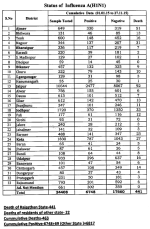
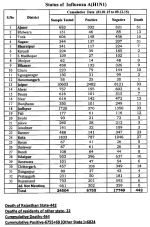
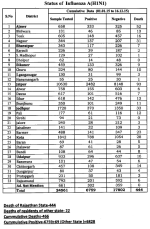
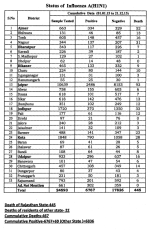
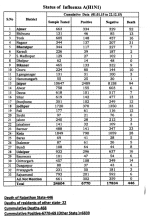
Rajasthan Influenza 2015, 468 fatalities
- Thread starter tetano
- Start date
Ronan Kelly
Retired 2020
Ronan Kelly
Retired 2020
From Barmer district, Rajasthan: Further evidence of India's epic flu season in 2015. - Ro
Sound of H1 N1 preparation before treatment
Patrika News Network Posted: 2015-12-14 8:34:31 p.m. IST Updated: 2015-12-14 8:34:31 p.m. IST
Barmer.
Mercury fall below 10 degrees in the Barmer raising concerns about swine flu. Last year that killed 25 people H1 N1 virus prevention is the medical establishment just look at the preparations. Last year was the worst affected. Nearly 146 people were infected with the virus. As a result, the time required special Savcheti. The medical establishment is now engaged in the preparations.
...
Swine flu situation in the district
Year // # infected // death // first patient// last patient
2009 // 46 // 9 November to February
2010 // 23 // 1 September October
2011 // 2 // 1 May -
2012 // 5 // 1 February April
2013 // 31 // 12 January March
2014 // 1// - April -
2015 // 146 // 25 January March
(Figures are based on the medical department.)
...
http://rajasthanpatrika.patrika.com/...r-1493108.html
Sound of H1 N1 preparation before treatment
Patrika News Network Posted: 2015-12-14 8:34:31 p.m. IST Updated: 2015-12-14 8:34:31 p.m. IST
Barmer.
Mercury fall below 10 degrees in the Barmer raising concerns about swine flu. Last year that killed 25 people H1 N1 virus prevention is the medical establishment just look at the preparations. Last year was the worst affected. Nearly 146 people were infected with the virus. As a result, the time required special Savcheti. The medical establishment is now engaged in the preparations.
...
Swine flu situation in the district
Year // # infected // death // first patient// last patient
2009 // 46 // 9 November to February
2010 // 23 // 1 September October
2011 // 2 // 1 May -
2012 // 5 // 1 February April
2013 // 31 // 12 January March
2014 // 1// - April -
2015 // 146 // 25 January March
(Figures are based on the medical department.)
...
http://rajasthanpatrika.patrika.com/...r-1493108.html
Ronan Kelly
Retired 2020
Ronan Kelly
Retired 2020
Ronan Kelly
Retired 2020
Swine flu death
Patrika News Network Posted: 2015-12-23 1:46:56 a.m. IST Updated: 2015-12-23 1:46:56 IST
Swine Flu Death Swine Flu
Nawalgarh.
Digal, a resident of the village, a man died during treatment in Delhi. The deceased is said to be positive for swine flu. According to information Bissau Digal Ramesh Kumar (40) was employed in the Army Ordnance Depot civil. Civil depot in Delhi these days he was employed.
The last four-five days to get worse on Monday she was taken to a hospital. During the investigation it was confirmed positive for swine flu. In the evening he died during treatment.
His body was taken Tuesday Digal. Where he was cremated. A boy and a girl of the deceased. The victim's father Natthu Singh Bissau were killed while on duty in the army. Big Brother Roshan Bissau is sergeant in the army.
Swine flu began treatment
Pclngi sector Mawata village of New Girl's Dhani Ram Saini, swine flu in Jaipur on Saturday Muet deceased by the medical department of the team of people who come in contact with the family and began investigating. But the family is not satisfied with the investigation on Monday in Jaipur SMS and JK Lone investigation was conducted.
Mnksas on Tuesday directed the PSC in charge Dr. Block Simaco Udaipurwati. LR Rawat Rawat giving directions headed by the deceased's family and team exposed 17 people to check the treatment started.
DR. Rawat said that swine flu prevention Osaltmivil capsule adults and children to give syrup of the salt treatment is started. Rawat said the treatment will last five to seven consecutive days.
http://rajasthanpatrika.patrika.com/story/rajasthan/swine-flu-death-13-1522135.html
Patrika News Network Posted: 2015-12-23 1:46:56 a.m. IST Updated: 2015-12-23 1:46:56 IST
Swine Flu Death Swine Flu
Nawalgarh.
Digal, a resident of the village, a man died during treatment in Delhi. The deceased is said to be positive for swine flu. According to information Bissau Digal Ramesh Kumar (40) was employed in the Army Ordnance Depot civil. Civil depot in Delhi these days he was employed.
The last four-five days to get worse on Monday she was taken to a hospital. During the investigation it was confirmed positive for swine flu. In the evening he died during treatment.
His body was taken Tuesday Digal. Where he was cremated. A boy and a girl of the deceased. The victim's father Natthu Singh Bissau were killed while on duty in the army. Big Brother Roshan Bissau is sergeant in the army.
Swine flu began treatment
Pclngi sector Mawata village of New Girl's Dhani Ram Saini, swine flu in Jaipur on Saturday Muet deceased by the medical department of the team of people who come in contact with the family and began investigating. But the family is not satisfied with the investigation on Monday in Jaipur SMS and JK Lone investigation was conducted.
Mnksas on Tuesday directed the PSC in charge Dr. Block Simaco Udaipurwati. LR Rawat Rawat giving directions headed by the deceased's family and team exposed 17 people to check the treatment started.
DR. Rawat said that swine flu prevention Osaltmivil capsule adults and children to give syrup of the salt treatment is started. Rawat said the treatment will last five to seven consecutive days.
http://rajasthanpatrika.patrika.com/story/rajasthan/swine-flu-death-13-1522135.html
Ronan Kelly
Retired 2020
Ronan Kelly
Retired 2020
June 2015 ? VOL. 63
Correspondence
Preparedness of India?s Largest State in Combating Influenza A (H1N1) Outbreak of 2015
Sudhir Mehta1, Raman Sharma1, L Harshvardhan2, Ruchi Singh3
1Senior Professor of Medicine and Member, State Task Force, 2Associate Professor of Medicine, SMS Medical College, Jaipur, Rajasthan; 3State Microbiologist (IBSP), Medical and Health Directorate, Government of Rajasthan, Rajasthan Sir, Rajasthan is the largest state of India, with an area of 0.34 million sq kilometers and population of 68.55 millions. Nearly 75% population resides in far-flung rural areas including vast arid zone. Influenza was never a health problem in the state till the H1N1 pandemic of 2009-10 which served as a wake-up call for state administration. Since then, there has been a continual and integrated re-enforcement of public health system including healthcare facilities at peripheral level, surveillance system and critical care facilities. There has been expansion of diagnostic laboratories (RT-PCR), pharmacy outlets and vaccine distribution system. Rajasthan, despite having adverse geographical location, has efficiently tackled the present outbreak of H1N1. The following sketch of this integrated effort is an example of how resource-poor state can re-organize it?s infrastructure. There is a widespread network of government controlled medical centres; 8 medical college hospitals, 113 district hospitals, 194 dispensaries, 568 community health centers, 2139 primary health centres and 14408 sub-health centres. There are 214 critical care and 896 isolation beds at medical colleges, district and sub-district level hospitals. A mammoth surveillance exercise was carried out; 8.36 million houses were visited by health-workers who identified 0.82 million people with influenza-like illness (ILI) symptoms (category A- 0.75 million, category B- 13,810 and category C- 402). At district and sub-district centres OPD, 8.01 million people were screened with nearly 1.61 million having ILI symptoms (40,416 in B and 1,514 in C category). Besides this, more than 60,000 patients with ILI were screened at medical college hospitals. Till 24th March, 2015, 22,155 samples of suspected patients were tested, with cumulative positive rate of 29.26%. From 1st January till 24th March 2015, there have been 408 deaths (6.29%). Nearly 0.42 million tablets have been made available to patients in categories B and C. Testing facilities (RT-PCR) are available at 7 medical college hospitals and 3 private laboratories. Viral transport media are made available at district and sub-district hospitals. The Directorate has created awareness about H1N1 at community level through advertisements on TV, radio, print and electronic media, erecting hoardings in cities and towns and distribution of pamphlets. A special vigil is being kept on large gatherings during fairs and festivals. As compared to other states of India (Figure 1), there has been early containment of H1N1 outbreak in the state. Home isolation and treatment with Oseltamivir in category B patients have dampened the H1N1 ?fire?.

The authors acknowledge the guidance of Prof Ashok Panagariya, Chairman of the State Task Force on Swine Flu. No potential conflict of interest. Data obtained from Medical and Health Directorate, Government of Rajasthan.
http://www.japi.org/june_2015/24_correspondence_preparedness_of_indias_largest.html
Correspondence
Preparedness of India?s Largest State in Combating Influenza A (H1N1) Outbreak of 2015
Sudhir Mehta1, Raman Sharma1, L Harshvardhan2, Ruchi Singh3
1Senior Professor of Medicine and Member, State Task Force, 2Associate Professor of Medicine, SMS Medical College, Jaipur, Rajasthan; 3State Microbiologist (IBSP), Medical and Health Directorate, Government of Rajasthan, Rajasthan Sir, Rajasthan is the largest state of India, with an area of 0.34 million sq kilometers and population of 68.55 millions. Nearly 75% population resides in far-flung rural areas including vast arid zone. Influenza was never a health problem in the state till the H1N1 pandemic of 2009-10 which served as a wake-up call for state administration. Since then, there has been a continual and integrated re-enforcement of public health system including healthcare facilities at peripheral level, surveillance system and critical care facilities. There has been expansion of diagnostic laboratories (RT-PCR), pharmacy outlets and vaccine distribution system. Rajasthan, despite having adverse geographical location, has efficiently tackled the present outbreak of H1N1. The following sketch of this integrated effort is an example of how resource-poor state can re-organize it?s infrastructure. There is a widespread network of government controlled medical centres; 8 medical college hospitals, 113 district hospitals, 194 dispensaries, 568 community health centers, 2139 primary health centres and 14408 sub-health centres. There are 214 critical care and 896 isolation beds at medical colleges, district and sub-district level hospitals. A mammoth surveillance exercise was carried out; 8.36 million houses were visited by health-workers who identified 0.82 million people with influenza-like illness (ILI) symptoms (category A- 0.75 million, category B- 13,810 and category C- 402). At district and sub-district centres OPD, 8.01 million people were screened with nearly 1.61 million having ILI symptoms (40,416 in B and 1,514 in C category). Besides this, more than 60,000 patients with ILI were screened at medical college hospitals. Till 24th March, 2015, 22,155 samples of suspected patients were tested, with cumulative positive rate of 29.26%. From 1st January till 24th March 2015, there have been 408 deaths (6.29%). Nearly 0.42 million tablets have been made available to patients in categories B and C. Testing facilities (RT-PCR) are available at 7 medical college hospitals and 3 private laboratories. Viral transport media are made available at district and sub-district hospitals. The Directorate has created awareness about H1N1 at community level through advertisements on TV, radio, print and electronic media, erecting hoardings in cities and towns and distribution of pamphlets. A special vigil is being kept on large gatherings during fairs and festivals. As compared to other states of India (Figure 1), there has been early containment of H1N1 outbreak in the state. Home isolation and treatment with Oseltamivir in category B patients have dampened the H1N1 ?fire?.
The authors acknowledge the guidance of Prof Ashok Panagariya, Chairman of the State Task Force on Swine Flu. No potential conflict of interest. Data obtained from Medical and Health Directorate, Government of Rajasthan.
http://www.japi.org/june_2015/24_correspondence_preparedness_of_indias_largest.html
Ronan Kelly
Retired 2020
A Study of Outbreak of Swine Flu (H1N1) in
North - West Zone of Rajasthan (Current Status- 2015)
Surendra Kumar
Journal of The Association of Physicians of India ■ Vol. 64 ■ July 2016
http://www.japi.org/july_2016/07_oa_a_study_of_outbreak.pdf
Absract
Background: The outbreak of H1N1 virus had previously reported in India
during 2009 flu pandemic. In 2015, the outbreak became widespread
throughout India. The states of Gujarat and Rajasthan are severely
effected. We studied an outbreak of H1N1 Virus in north-west zone of
Rajasthan 2015.
Objective: To demonstrate the current epidemiological scenario of swine
flu (H1N1) in north-west zone of Rajasthan with different demographic
factors.
Methods: We screened total 6390 patients. Out of them 1405 samples of
suspected cases collected from different parts of north-west Rajasthan
and analyzed by RT-PCR at Sardar Patel Medical College, Bikaner.
Results: A total of 1405 samples examined during three and half months
period, out of which 181 cases found positive for H1N1. Out of them 85
(46.97%) males and 96 (53.03%) females (M:F=1:1.13). Most patients (116)
were in age group 21-50 years which was 64.09% of total positive cases
(Mean age=37.09 ? 16.07years). The mean time of onset of symptoms
to hospitalization was 5.12 ? 3.38 days. Only 11.05% patients presented
within 48 hours whereas 64.09% presented between 3-5 days of onset
of symptoms. 109 (60.22%) patients were from rural areas, whereas 72
(39.77%) belonged to urban areas. Total 13 (7.18%) deaths occurred
among positive cases. 69.23% deaths were recorded in the age group of
25 to 50 years. The mean age of death being 44.69 years. Females had
significant higher mortality (9 females out of 13 deaths). 76.92% died
within 3 days of hospitalization, despite of starting Oseltamivir in a dose
of 150 mg/bd on the day of admission. 84.61% of the patients who died
had one or more risk factors. Bilateral pneumonia was observed in all the
13 patients and MODS in 2 patients.
Conclusions: With the above observation of swine flu trend it is likely
that incidence is more in young to middle age group, majority of them
having no risk factors, should form the target of future studies. However
fatality is highest in patients with co-morbid condition or predisposing
risk factors need to vaccinate this group should form a basis on which
future directions and interventions have to be built up to reduce the
morbidity and mortality. Females have slightly increased susceptibility
for infection M:F=1:1.13). but mortality is much higher in this sex group.
More patients belong to rural areas reflecting the need of creating public
awareness especially in rural areas at primary health centre level and
where illiteracy is common and crowded urban areas to present early
at screening centres, so future outbreak can be prevent. The in-hospital
mortality of 7.18% despite of starting Oseltamivir has raised concern
about identifying the so called ?Rapid Progressors? [76.92% died within
3 days of hospitalization]. Despite of all mortality is less in north-west
zone as compared to rest of Rajasthan
...
North - West Zone of Rajasthan (Current Status- 2015)
Surendra Kumar
Journal of The Association of Physicians of India ■ Vol. 64 ■ July 2016
http://www.japi.org/july_2016/07_oa_a_study_of_outbreak.pdf
Absract
Background: The outbreak of H1N1 virus had previously reported in India
during 2009 flu pandemic. In 2015, the outbreak became widespread
throughout India. The states of Gujarat and Rajasthan are severely
effected. We studied an outbreak of H1N1 Virus in north-west zone of
Rajasthan 2015.
Objective: To demonstrate the current epidemiological scenario of swine
flu (H1N1) in north-west zone of Rajasthan with different demographic
factors.
Methods: We screened total 6390 patients. Out of them 1405 samples of
suspected cases collected from different parts of north-west Rajasthan
and analyzed by RT-PCR at Sardar Patel Medical College, Bikaner.
Results: A total of 1405 samples examined during three and half months
period, out of which 181 cases found positive for H1N1. Out of them 85
(46.97%) males and 96 (53.03%) females (M:F=1:1.13). Most patients (116)
were in age group 21-50 years which was 64.09% of total positive cases
(Mean age=37.09 ? 16.07years). The mean time of onset of symptoms
to hospitalization was 5.12 ? 3.38 days. Only 11.05% patients presented
within 48 hours whereas 64.09% presented between 3-5 days of onset
of symptoms. 109 (60.22%) patients were from rural areas, whereas 72
(39.77%) belonged to urban areas. Total 13 (7.18%) deaths occurred
among positive cases. 69.23% deaths were recorded in the age group of
25 to 50 years. The mean age of death being 44.69 years. Females had
significant higher mortality (9 females out of 13 deaths). 76.92% died
within 3 days of hospitalization, despite of starting Oseltamivir in a dose
of 150 mg/bd on the day of admission. 84.61% of the patients who died
had one or more risk factors. Bilateral pneumonia was observed in all the
13 patients and MODS in 2 patients.
Conclusions: With the above observation of swine flu trend it is likely
that incidence is more in young to middle age group, majority of them
having no risk factors, should form the target of future studies. However
fatality is highest in patients with co-morbid condition or predisposing
risk factors need to vaccinate this group should form a basis on which
future directions and interventions have to be built up to reduce the
morbidity and mortality. Females have slightly increased susceptibility
for infection M:F=1:1.13). but mortality is much higher in this sex group.
More patients belong to rural areas reflecting the need of creating public
awareness especially in rural areas at primary health centre level and
where illiteracy is common and crowded urban areas to present early
at screening centres, so future outbreak can be prevent. The in-hospital
mortality of 7.18% despite of starting Oseltamivir has raised concern
about identifying the so called ?Rapid Progressors? [76.92% died within
3 days of hospitalization]. Despite of all mortality is less in north-west
zone as compared to rest of Rajasthan
...