• FluTrackers.com Inc. does not provide medical advice. Information on this web site is collected from various internet resources, and the FluTrackers board of directors makes no warranty to the safety, efficacy, correctness or completeness of the information posted on this site by any author or poster. The information collated here is for instructional and/or discussion purposes only and is NOT intended to diagnose or treat any disease, illness, or other medical condition. Every individual reader or poster should seek advice from their personal physician/healthcare practitioner before considering or using any interventions that are discussed on this website. By continuing to access this website you agree to consult your personal physican before using any interventions posted on this website, and you agree to hold harmless FluTrackers.com Inc., the board of directors, the members, and all authors and posters for any effects from use of any medication, supplement, vitamin or other substance, device, intervention, etc. mentioned in posts on this website, or other internet venues referenced in posts on this website.
  • We are not asking for any donations. Do not donate to any entity who says they are raising funds for us.

PNAS: Genesis and pathogenesis of the 1918 pandemic H1N1 influenza A virus

tetano

Editor, Senior Moderator
Genesis and pathogenesis of the 1918 pandemic H1N1 influenza A virus

Michael Worobeya,1,
Guan-Zhu Hana, and
Andrew Rambautb,c,d

Author Affiliations

Edited by Neil M. Ferguson, Imperial College London, London, United Kingdom, and accepted by the Editorial Board April 8, 2014 (received for review December 30, 2013)


Significance

The origin of the 1918 pandemic influenza A virus (IAV) and the reasons for its unusual severity are two of the foremost biomedical mysteries of the past century. We infer that the virus arose via reassortment between a preexisting human H1 IAV lineage and an avian virus. Phylogenetic, seroarcheological, and epidemiological evidence indicates those born earlier or later than ∼1880?1900 would have had some protection against the 1918 H1N1 virus, whereas many young adults born from ∼1880?1900 may have lacked such protection because of childhood exposure to an antigenically distinct H3N8 virus. Our findings suggest that better understanding of how initial exposure shapes lifetime immunity may enhance the prediction and control of future IAV pandemics and seasonal epidemics.
Abstract

The source, timing, and geographical origin of the 1918?1920 pandemic influenza A virus have remained tenaciously obscure for nearly a century, as have the reasons for its unusual severity among young adults. Here, we reconstruct the origins of the pandemic virus and the classic swine influenza and (postpandemic) seasonal H1N1 lineages using a host-specific molecular clock approach that is demonstrably more accurate than previous methods. Our results suggest that the 1918 pandemic virus originated shortly before 1918 when a human H1 virus, which we infer emerged before ∼1907, acquired avian N1 neuraminidase and internal protein genes. We find that the resulting pandemic virus jumped directly to swine but was likely displaced in humans by ∼1922 by a reassortant with an antigenically distinct H1 HA. Hence, although the swine lineage was a direct descendent of the pandemic virus, the post-1918 seasonal H1N1 lineage evidently was not, at least for HA. These findings help resolve several seemingly disparate observations from 20th century influenza epidemiology, seroarcheology, and immunology. The phylogenetic results, combined with these other lines of evidence, suggest that the high mortality in 1918 among adults aged ∼20 to ∼40 y may have been due primarily to their childhood exposure to a doubly heterosubtypic putative H3N8 virus, which we estimate circulated from ∼1889?1900. All other age groups (except immunologically naive infants) were likely partially protected by childhood exposure to N1 and/or H1-related antigens. Similar processes may underlie age-specific mortality differences between seasonal H1N1 vs. H3N2 and human H5N1 vs. H7N9 infections.


http://www.pnas.org/content/early/2014/04/24/1324197111.abstract
 

Attachments

Last edited by a moderator:
Re: PNAS: Genesis and pathogenesis of the 1918 pandemic H1N1 influenza A virus

The interesting part of the discussion section of the above paper in relation to current epizootic derived H5N1 & H7N9 human infections, suggests that:

-- those 'primed' during childhood with type 1 HA viruses (such as H1 & H2 subtypes) are likely more susceptible to complications when infected with novel H7N9 avian influenza viruses;

-- those 'primed' during childhood with type 2 HA viruses (such as H3N2) are likely more susceptible to complications when infected with novel H5N1 avian influenza viruses.

This suggests also targeted control measures and preventative use of some vaccines which may enhance heterotypic protection toward H5 or H7 AIVs.

For individual born during prevalent circulation of type 1 HA viruses (before H1 was replaced by H3 subtypes, and after H1 re-emerged in 1977 and in 2009), the infection with H5N1 may be less pathogenic, as observed in age-related morbidity and mortality in affected regions.

For individual born during prevalent circulation of type 2 HA viruses (after 1968), the infection with H7N9 may be less pathogenic as seen in age-related morbidity and mortality in China (65+ years old).
 
Re: PNAS: Genesis and pathogenesis of the 1918 pandemic H1N1 influenza A virus

why would childhood infection provide better priming
than adulthood infection ?
I didn't see that theory before.
 
Re: PNAS: Genesis and pathogenesis of the 1918 pandemic H1N1 influenza A virus

The original antigenic sin theory
 
Re: PNAS: Genesis and pathogenesis of the 1918 pandemic H1N1 influenza A virus

OK, I saw that theory before. But it doesn't make sense to me.
If that effect were so significant it should be possible to demonstrate
it in another controlled setting.


and we give trivalent vax to the children

it was worst in 1918 in remote populations

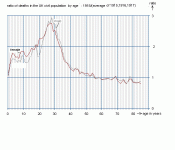
excess deaths in 1918 decline almost linearly with age,
with childhood OAS I'd expect another curve (leveling off)

in a seasonal or pandemic wave people (and animals) are protected
for some months from other flus
 
Re: PNAS: Genesis and pathogenesis of the 1918 pandemic H1N1 influenza A virus

> Even if most or all 20-to 40-y-olds in 1918 had already been exposed to the putative H1
> virus circulating between ∼1900 and 1918, we speculate that their
> initial exposure to an H3 virus

... at age 0-22

> might nevertheless have interfered
> with their immune responses to the 1918 HA

but not to the 1900-1917 HA ?
and then suddenly it gave so strong protection since 1920 ?


and there was clear protection in wave 2 in 1918 in those infected
(even asymptomatic) in wave 1
 
Re: PNAS: Genesis and pathogenesis of the 1918 pandemic H1N1 influenza A virus

why would childhood infection provide better priming
than adulthood infection ?
I didn't see that theory before.

May be also the A.D.E. (Antigen-dependent enhancement)? I've seen earlier suggestions about ADE and possible skewed age-related morbidity and mortality toward old adults in China.

Through ADE, an individual primed with a mismatched strain in relation to current one, would develop a stronger Abs response toward the former (ie: primed w/ H1--> when H7 infected--> +++H1 Abs, instead of a mounting specific Abs response toward H7).

-- primed H1---> +++Abs vs H5 ---> ---Abs vs H7
-- primed H3---> +++Abs vs H7 ---> ---Abs vs H5
 
Re: PNAS: Genesis and pathogenesis of the 1918 pandemic H1N1 influenza A virus

In addition, it would be useful to draw a graphic function of H1 / H7 peak incidence in Chinese affected regions.
 
Re: PNAS: Genesis and pathogenesis of the 1918 pandemic H1N1 influenza A virus

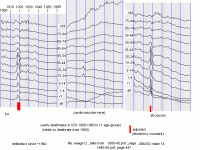
antibody response was quite good in 1918, see how the deathrate
went down in 1919,1920,1921

they argue that a new HA came in ~1922, probably a less virulent one.
If they think H1 circulated since 1901 it could just have been the re-emerged
old H1 (how did it survive the pandemic - maybe in animals

Although 1929 was still quite bad after 11 years of circulation
 
Re: PNAS: Genesis and pathogenesis of the 1918 pandemic H1N1 influenza A virus

that A.D.E. was it ever observed in humans on a large scale ?

we have H3 and H1 since 1977, they should have noticed it

and mice,ferrets in labs ?


only 2 pubmed hits for "Antigen-dependent enhancement"
and only 20 google hits
none about influenza
 
Re: PNAS: Genesis and pathogenesis of the 1918 pandemic H1N1 influenza A virus

such hypothesizing papers should be discussed.
In the magazines, blogs, webpages,conferences,journals.

But that is not supported by the current scientific system.
It's unwanted by the authors, reviewers, those who fund it.

PNAS doesn't allow commenting, such as PLOS.
When you send email to the authors, they don't like it,
won't correct errors, discuss it - it's not good for them
if possible problems become public.
We saw many examples for that meanwhile, even here at FT.

I see this as a followup to the Smith et. al. paper
their reference 9.) discussed here:
http://www.flutrackers.com/forum/showthread.php?t=115588
http://www.flutrackers.com/forum/showthread.php?t=136616
 
Re: PNAS: Genesis and pathogenesis of the 1918 pandemic H1N1 influenza A virus

a more severe outcome in children or young adults "primed" as children with seasonal H3N2
has never been observed, afaik. Not in 1977 nor in 2009 nor in all those years of
cocirculating H1 and H3 since 1977.
Nor was it demonstrated in mice,ferrets in the labs afaik.

And if that negative priming effect "works" with natural infection, shouldn't it also
work with vaccine ? After all the know antigenic changes that are observed in
vaccinated and exposed people are the same.
Shouldn't that have given a discussion whether trivalent vaccine is suitable ?
The anti-vax people would have jumped on it.

I'm not happy that they always write "20-40" year old and "born in 1880-1900"
when there are clear and substantial differences in that group.
The peak excess mortality happened at age ~28 and then almost linearly
declined until age ~40 where the decline started to become less steep
but still continued until age at least 80. If that steepness reduction hadn't happened
at age ~40, all the reduction would have been exhausted at age ~45 and there had been
no more room for decline above that age.

We have the effect that H1 just isn't as deadly in the elderly as H3
observed after 1977 with seasonal H3,H1 and 2009 pandemic H1
just this season.
It became worse for the elderly in the later years, 1929 , Liverpool 1951, though.
 

Attachments

  • engl18.gif
    engl18.gif
    9.7 KB · Views: 1
  • rat1918h.gif
    rat1918h.gif
    18.2 KB · Views: 1
  • us18r.GIF
    us18r.GIF
    10.2 KB · Views: 1
Re: PNAS: Genesis and pathogenesis of the 1918 pandemic H1N1 influenza A virus

Shouldn't that have given a discussion whether trivalent vaccine is suitable ?

There is a quad out now with two B strains, but I don't think triggering original antigenic sin is driven by strain count in a vaccine. I thought it was more complex than that - along the lines of a certain divergence from the vaccine or previous infecting live virus by the circulating virus.

A CDC article tetano posted in 2012:

http://www.flutrackers.com/forum/showthread.php?p=436322
Historical records and findings from laboratory animal studies suggest that persons who were exposed to influenza once before 1918 (e.g., A/H3Nx 1890 pandemic strain) were likely to have dysregulated, pathologic cellular immune responses to infections with the A/H1N1 1918 pandemic strain. The immunopathologic effects transiently increased susceptibility to ultimately lethal secondary bacterial pneumonia. The extreme mortality rate associated with the 1918?19 pandemic is unlikely to recur naturally. However, T-cell?mediated immunopathologic effects should be carefully monitored in developing and using universal influenza vaccines.

Here's a controlled study on vaccines:

Paradoxical response to a novel influenza virus vaccine strain: the effect of prior immunization
Conclusions: the decrease in serologic response to influenza vaccine among healthy, young adults who were previously vaccinated appears to be unique for this year's influenza vaccine. Further studies are required to determine the frequency and clinical significance of this phenomenon observed in younger healthy adults, and whether it is a general one. Based on its proven efficacy, influenza vaccine should continue to be given on an annual basis to high risk children and adults and to all those 65 years or older.

Then there are observations in pigs:
http://www.ars.usda.gov/research/publications/publications.htm?seq_no_115=204405
http://www.newscientist.com/article/dn17077-flu-outbreak-the-pig-connection.html?page=1#.U2HmTaLGDMo

If anyone figures out exactly how original antigenic sin works in influenza - then I'll worry about flu being used as a bioweapon. ;)
 
Re: PNAS: Genesis and pathogenesis of the 1918 pandemic H1N1 influenza A virus

ahh, the Shanks/Bundage theory.

When they say "suggests" that means that they suggest it.
it sounds absurd to me and I don't think that theory is widely supported.

I didn't see other known experts supporting it.

----------------------------------------------------------------------------------
A: n=68, vaxed with A/Texas/36/91(H1N1),A/Nanchang/933/95(H3N2),B/Beijing/184/93
B: n=70, vaxed with TX,BJ only
A had lower postvaccination HAIs Tx:127 vs. 359, NC:31 vs. 93,BJ:140 vs. 205
----------------------------------------------------------------------------------
I remember the 2009 Canada discussion (Skowronski) that the seasonal vax gave fewer
protection in 2009 than no vax
--------------------------------------------------------
http://www.ncbi.nlm.nih.gov/pmc/articles/PMC3003248/
Reichert et.al. OAS in p2009 ?
--------------------------------------------------------
http://www.ncbi.nlm.nih.gov/pmc/articles/PMC3086238/
Morens et.al. generally about OAS-phenomenon
----------------------------------------
http://www.ncbi.nlm.nih.gov/pmc/articles/PMC3382187/
Skowronski et.al.
(B/Victoria-vax after Yamagata vax increased Yamagata antibodies
more than Victoria ones)
----------------------------------------------------------
http://www.ars.usda.gov/research/publications/publications.htm?seq_no_115=204405[/URL]
IA1930-vax made MN2003 infection even worse (n=3) while infection with live
IA1930 was protective
---------------------------------------------------------
 
Re: PNAS: Genesis and pathogenesis of the 1918 pandemic H1N1 influenza A virus

so the theory is : (?)
you are better protected in future against the strain of the
_first_ flu that you got in life.

less so for the 2nd,3rd,...


and that's why H3N2 is more deadly for the elderly than H1 - H3 is around only since 1968
 
Re: PNAS: Genesis and pathogenesis of the 1918 pandemic H1N1 influenza A virus

http://www.nature.com/news/study-revives-bird-origin-for-1918-flu-pandemic-1.14723
-------------------------------------
closest avian to 1918-HA (BM18) are
A/mallard/Alberta/127/1977 (Alb77) in America and
A/duck/Zhejiang/0611-15/2011 (Zhe11) in Eurasia

nucleotide,amino differences

Alb77-BM18 : 321,41
Alb77-Sw31 : 341,56
Alb77-Hu33 : 379,78
Alb77-Sw76 : 366,72
Alb77-Hu06 : 401,93
Alb77-Mx09 : 407,99
Alb77-Zhe11: 225,19

Zhe11-BM18 : 326,36
Zhe11-Sw31 : 350,53
Zhe11-Hu33 : 377,71
Zhe11-sw76 : 374,66
Zhe11-hu06 : 397,90
Zhe11-Mx09 : 415,96

the human H1 drifts faster away from the avian than the swine H1,
especially amino acids (nonsynonymous, antigenically)
and especially in the first years after 1918

But is it because it's only 13 years to Sw31 but 37 years to Hu33 (via 1907) ?


---------------------------------------------------------

human H1 and swine H1 share 16 of their ~125/110 differences to BM18.
That doesn't work so well with the theory thast swine H1 descends from BM18
but human H1 not.


either the swine lineage split away in ~1915 and the human one in ~1914
in which case you had to wonder why there was no immunity in 1918

or human H1 and swine H1 both descend from BM18 and separated in ~1921
and had higher mutation rates than usual until 1930
---------edit---------------
well, that rate of common mutations could be normal
I checked the further development of common mutations in
the swine and human H1-lineages and got 70 common mutation-positions
-- with 16 of them having different mutations, 54 the same --
by 1977 in swine and 2006 in humans (subtract 27 years here for the 1950-1977 freezing)

238 and 242 differences to BM18 here with 358 mutual differences = 74.6% after 120 years
while we had 111 and 131 and 208 --> 86.0% after 28 years
--------------------------------------
comparing with H3 ... 6 mutations in HA per year looks normal in humans, a bit less in swine
--> ~1914 as MRCAD for seasonal H1 and BM18
 
Re: PNAS: Genesis and pathogenesis of the 1918 pandemic H1N1 influenza A virus

looking at the HA-sequences again (I may have done that earlier - forgot)
I tend to agree that 1918 is not the ancester of seasonal H1 from the 30s.
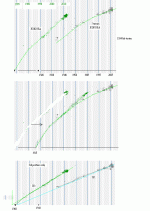
H1-HA has a lower mutation rate than H3-HA

in the first years after introduction we can see more mutations
due to adaption, i.e. nonsynonymous ones

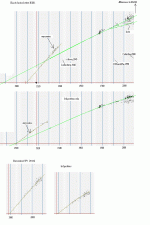
see attached picture (now doing the same with early swine H1N1 vs. Euro-swine(1978)
and H3N2v, triple reassortant swine(1998)...)


----------------------------------------------------------

that would mean, however, that we had that quickly spreading pandemic H1 in 1918,
even spreading in summer, and then it was replaced and _killed_ in ~1922 already by an earlier,
seasonal H1, in a nonspectacular seasonal wave !
Something that with our experience with later pandemics is hard to understand.

Like old H1N1 from 2008 would return now and kill pH1N1(2009).
At least in HA , while obtaining some of the other segments by reassortment.


or better : like a new variant would appear, similar to pH1N1(2009), which did split
from pH1N1(2009) in HA in Mexican swine in 2005 and circulated since then undetected
and locally in some Mexican swine farm , but now reassorted with pH1N1(2009)
to form a new variant that takes over and goes seasonal and kills pH1N1(2009) ....


in 1922 (or 1920 ?) it mat have been good, since it relaced the more virulent BM18
but today, as pH1N1(2009) is relatively mild, it could be the other way round

----------edit-----------------------
I finished the swine - H1N1-HA mutations-over-time diagram

it's even more evident here : the classical H1N1 evolves slower in HA
than other strains, even if you only consider the 3rd positions in the codons
(--> mostly synonymous)

------------
unless you assume that these swine HAs from 1930,1931 aren't real, contain
additional lab-growth-created mutations ?!?
And the Jamesburg/1942 is correct, nonfrozen
 

Attachments

  • H1O5B.GIF
    H1O5B.GIF
    21.8 KB · Views: 1
  • swo5a.gif
    swo5a.gif
    25.4 KB · Views: 1
Re: PNAS: Genesis and pathogenesis of the 1918 pandemic H1N1 influenza A virus

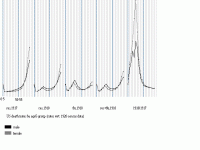
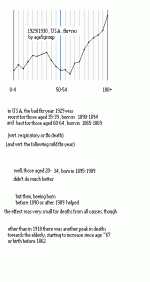
it seems that the peak in the age-curve had shifted
towards age 35-39 by 1929 , thus supporting the
theory that immunity from previous exposure played
a role, rather than age-related physiology
(which played a role in the >65, though)


[see also : http://www.flutrackers.com/forum/attachment.php?attachmentid=17665&d=1399125789 ]


attachment.php


-------------------edit------------------
that 1929v1.gif - picture, I'm not so sure now whether to consider it as strong evidence
for the maintained lack of immunity in the 1883-1893 cohort,
 

Attachments

  • 1929v1.gif
    1929v1.gif
    6.4 KB · Views: 1
Re: PNAS: Genesis and pathogenesis of the 1918 pandemic H1N1 influenza A virus

ahh, the Shanks/Bundage theory.

When they say "suggests" that means that they suggest it.
it sounds absurd to me and I don't think that theory is widely supported.

I didn't see other known experts supporting it.

Hmmm...I see the authors of the paper discussed here reference Shanks/Brundage. As much as I don't like the idea of natural immunity setting one up for a worse outcome than no immunity, why do you think the possibility is absurd?

ETA: I admit I haven't read both the papers entirely, but what I did read makes me think they are in agreement in general concept. What do you think?
 
Last edited:
Re: PNAS: Genesis and pathogenesis of the 1918 pandemic H1N1 influenza A virus

we must have a thread, when the paper came out - or the Gagnon et.al. paper

...found it :
http://www.flutrackers.com/forum/showthread.php?t=209761

about this paper:
http://www.plosone.org/article/info...6;jsessionid=19696606CB89A6B03F2FB028E2573B08

I remember, when I first read it it sounded totally silly to me -
according to my knowledge/feeling at that time.
I even thought that H3N2 in 1889ff might have given immunity for 1918
-the more the older they were in 1889, i.e. after puberty. I no longer think this.

I may reread it now...

----------------------
we didn't see it in other flu-outbreaks, epidemics, epizootics
it didn't seem to fit the 1918 age-structure
it suddenly came up, wasn't mentioned as a possibility before
it's hard to explain chemically/physiologically/evolutionary
---------------------

this "modified" theory, that first infection in life protects more
than infection with subsequent different strains, how is it called ?
Still OAS ? well, yes

http://en.wikipedia.org/wiki/Original_antigenic_sin

-----------------------------------------------------------

rather Gagnon et.al. argued that H3N2 infection was not only useless wrt.
1918, but even toxic. That's what sounded absurd to me. And even does ...
although I'm less certain now and should rethink.

> this increased [1918] mortality resulted from an early life exposure to influenza
> during the previous Russian flu pandemic of 1889–90. We posit that in specific instances,
> development of immunological memory to an influenza virus strain in early life may lead
> to a dysregulated immune response to antigenically novel strains
> encountered in later life, thereby increasing the risk of death.

it would be a serious defect in our immune system

-----edit----------
that hypothetical negative connection between infection in 1889-93 and death in 1918
would have been observed in 1918ff

-----------edit------------------------
Romola Davenport Oxford Institute of Ageing
In collaboration with Jim Oeppen, MPI for Demography, Rostock
http://www.geog.cam.ac.uk/people/davenport/davenport7.pdf

http://www.cidrap.umn.edu/news-pers...ases-sparks-discussion-original-antigenic-sin

Oeppen:

The Madrid data are probably unique in historical research into influenza pandemics.
We know of no individual mortality database of this size, either for 1889/90 or 1918/20.

There is no
marked change in the relative risk around 1900, and thus no evidence from these data that a
hypothesised antigenic shift at that time affected mortality in 1918.

almost certainly
indicate that the form of the virus in circulation prior to c. 1850 was closely related to the
1918 flu, in all likelihood an H1 virus

------------------------------------------------
searching pubmed for "original antigenic sin" and influenza gives 48 hits

Humans and ferrets with prior H1N1 influenza virus infections do not exhibit evidence of
original antigenic sin after infection or vaccination with the 2009 pandemic H1N1 virus.

High-throughput sequencing of natively paired antibody chains provides evidence for
original antigenic sin shaping the antibody response to influenza vaccination.

For both H1N1 and H3N2, the proportion of the population seropositive to recently
circulated strains peaks in school-age children, reaches a minimum between
ages 35-65, then rises again in the older ages
if the first infection of a lifetime dominates subsequent immune responses,
we demonstrate that it is possible to reproduce the observed relationship
between age and seroprevalence.

The mortality pattern during the 1957 pandemic indicates that antigenic imprinting plays
an important role in determining age-specific influenza virulence and that both shift years
and major drift years contribute significantly to antigenic imprints [Canada]

Following 2009 H1N1 vaccination, subjects previously given a seasonal influenza virus
vaccination exhibited significantly lower antibody responses, as determined by
hemagglutination inhibition assay, than subjects who had not received the seasonal
influenza virus vaccination.


Prior receipt of 2008–09 TIV was associated with increased risk of medically
attended pH1N1 illness during the spring–summer 2009 in Canada.
The occurrence of bias (selection, information) or confounding cannot be ruled out.


-----------------------------------------------
 
Back
Top Bottom