Translation Google
Avian flu: for the first time there has been a massive contagion from birds to mammals in Latin America
By Yvette Sierra Praeli on February 20, 2023
So far, more than 600 sea lions and more than 55,000 birds killed by the H5N1 virus have been registered in protected areas of Peru.
The presence of the virus dates back to the 1990s when it was found in places of poultry production. After 2020, a change in the dynamics of the virus occurred and it began to be detected more frequently in wild species.
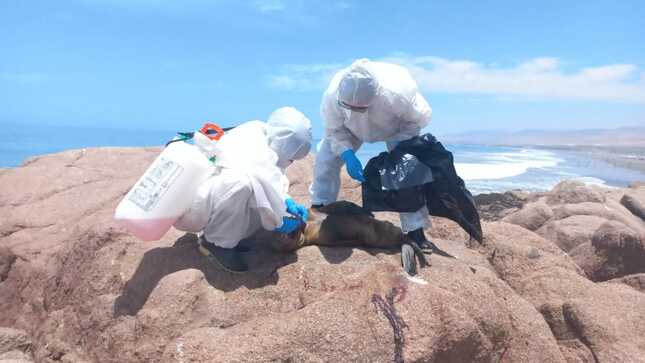
First it was the seabirds that appeared dead on the coast of Peru due to the presence of the H5N1 virus or bird flu , but then the disease spread to mammals, particularly sea lions.
In Latin America, for the first time the jump of this virus from birds to mammals has been recorded in a massive way , indicate the scientists who are following the trail of this epidemic unleashed on almost the entire planet. "It is the first report in Latin America of contagion of avian influenza in many mammals at the same time, since until now the impact in Latin American countries had only been in birds, or some isolated case of a mammal," says Víctor Gamarra-Toledo. , researcher at the Natural History Museum (MUSA) of the National University of San Agustín de Arequipa.
Gamarra-Toledo explains that reports of contagion from birds to mammals had occurred in European countries such as Russia and Spain —in the latter country an outbreak of H5N1 in mink on a fur farm has recently been reported—, as well as in North America, but never It had previously been reported in Latin American countries. "The situation seems to be complicated because the virus could be adapting quite well."
Figures from the National Service for Natural Areas Protected by the State (Sernanp) indicate that more than 600 sea lions and 55,000 sea birds have been killed by the bird flu virus. However, these numbers correspond only to what is reported within protected areas.
The first cases of birds in Peru occurred in early November 2022. A few weeks after the first reports, on November 30, the National Agrarian Health Service (Senasa) declared a health emergency throughout the country for a period of 90 days.
During the period that the health emergency lasts, Senasa prohibited the movement of live domestic birds from places where the virus has been detected, the transfer of birds without a health certificate granted by this institution and the development of fairs or rooster events throughout the country. country, among other complementary measures.
The advance of bird flu
“The first report of massive death of birds, which was later confirmed to be due to avian flu, was between November 12 and 13, when Agrorural warned us of this mortality on Lobos de Tierra island, in the north, which is part of the Guaneras Islands, Islets and Points System National Reserve (RNSIIPG). At that moment we activated the health alert in coordination with Senasa”, says Deyvis Huamán, Director of Management of Sernanp Protected Natural Areas.
Huamán explains that the massive death affected, in a first wave, pelicans ( Pelicanus thagus ) and then continued with boobies ( Sula variegata ), until a third wave reached sea lions. “We have recorded dead birds in eight protected areas and wolves in 7 protected areas,” he adds.
The Sernanp official specified that until February 9 there was a record of 634 sea lions and 55,246 dead seabirds . The official indicates that this number must be greater than what was recorded because the measurements are not made every day or in the entire extension of the protected areas. What Huamán does specify is that the number of animals that die under normal circumstances is only between 10% and 20% of what is now being recorded with bird flu.
“It's a fairly aggressive subtype that obviously causes us concern. It started in birds, now it is in sea lions, and there is even a dolphin that, according to what we have been informed, has tested positive for avian flu", comments Huamán, therefore, he adds, it is important to avoid approaching animals that seem sick or have died because of the risk that the virus could be transmitted to people.
Huamán also shows his concern for what these massive deaths of species mean for conservation. In the case of pelicans, for example, the official says that many of those who have died in northern Peru were nesting . "There are at least two thousand abandoned nests," he says, but adds that pelican mortality is declining, so it is hoped that, in protected areas, as there is no intervention from human activities, these populations can recover. .
“What caught our attention the most were the Peruvian coastal seabirds, particularly the pelicans, because this virus killed about 20% of the known pelican population within protected areas. In four weeks, a very important part of the pelican population was lost, which is catastrophic for the species and its ecosystem," says Sergio Lambertucci, director of the Conservation Biology Research Group at the Biodiversity and Environment Research Institute (Inibioma). -Conicet), from the National University of Comahue. "20% mortality is a very high percentage for birds that live a long time and don't have a very high reproductive rate."
Lambertucci points out that the virus has also killed many boobies and guano birds in general, which means "a threat to the conservation of certain species" at least in this part of the planet. The most affected are usually waterfowl, including seabirds —continues Lambertucci—, including ducks, but there may be cases for many other species of birds. "In fact, at this moment we are doing a survey (inventory) of all the species of birds that have been affected by avian influenza on a global scale, which includes other groups such as scavengers, which feed on dead animals, and hunters. ", Add. The expert comments that for the moment there is no massive mortality, but cases have been reported among vultures, vultures and eagles.
Overcrowding of animals for food
The presence of this virus among animals is not recent, but dates back to the 1990s, when the virus was found in poultry production sites in Asian countries and then spread to other continents. Veterinarian Pablo Plaza, a researcher at the Biodiversity and Environment Research Institute (Inibioma-Conicet), explains that in recent years, after 2020, a change occurred in the dynamics of the virus and it began to be detected more frequently in wild species. .
“It is a virus mainly adapted to reproduce in birds, but in very close contact it can pass to mammals and even to humans, which is why poultry farm employees, and those who are in close contact with infected birds and other animals, are people who may be at risk,” adds Plaza.
For Plaza, it is important to analyze the behavior of the virus and its adaptation that it has had in the transmission to the sea lion, "because as the virus changes, a further step will be taken so that the risk of it being transmitted between beings arises. humans".
The vet also explains that it is a highly pathogenic virus —that is, highly contagious— that causes alterations in the lungs and even in the nervous system, therefore, animals infected with H5N1 die with signs of neurological and respiratory.
Until now, what was known about this virus is that it is not transmitted from individual to individual among mammals, and also that infections to humans are not frequent. However, transmission between European mink on a farm in Spain has recently been suggested. Gamarra-Toledo points out that from 2003 to 2021 only 850 cases of the H5N1 virus in humans have been reported, but the lethality has been 50%. "The lethality is worrisome."
Among the cases of animals that have died in Peru from bird flu is also a lioness at the Huancayo zoo in Junín. “This case occurred on January 23 and was confirmed because eagles that tested positive for bird flu died. And in Ecuador, a girl has been infected with the virus who had to be hospitalized.
Some migratory birds can carry the virus, therefore, the epidemic that began in Asia, continued through Europe and then to North America, now extends to the rest of the American continent. However, the origin of this problem is in poultry, Lambertucci mentions; that is, it is in the production systems of the animals that serve as food for people. “They can be chickens, geese, ducks, in general, many animals that are raised together and under stressful conditions, when the virus arrives it becomes the perfect cocktail for an epidemic to be generated. And if they are in areas where there are wild birds that can interact, such as a wetland or a lagoon, these individuals can be infected.
Patricia Castañeda, Director of Food Policies and Research at the Association for the Rescue and Protection of Animals (Arba), explains the problems of mass production systems for animals. In the case of laying hens —says Castañeda— they have an average productive life of two years during which they live in confined spaces, crowded in cages, where they cannot exercise their natural behaviors, such as spreading their wings or taking baths. of Earth. "Under these conditions it is much more likely that they can get sick and infect different conditions typical of the species."
Castañeda explains that in Peru there are three types of breeding for chickens. The most widely used is the cage, called battery, which is used in 90% of poultry production companies. "They are spaces with artificial light where they place a large number of chickens for two years with a high level of stress, which is a trigger to reduce the immune system." The other forms of breeding are the so-called shed or corral and those that are raised in open spaces, outside of cages.
In recent weeks, the spread of avian influenza in animals has been reported in at least thirteen countries on the continent from Canada and the United States, passing through Honduras, Mexico, Panama, Chile, Colombia, Ecuador, Peru, Venezuela and Bolivia. In addition, in mid-February cases were also confirmed for Argentina and Uruguay. In several of these countries, cases of outbreaks in laying hen farms have been reported; in Bolivia, for example, 250,000 of these infected birds have been reported.
https://es.mongabay.com/2023/02/contagio-masivo-de-aves-a-mamiferos-de-gripe-aviar-en-peru/



 #influenzaaviar ) is confirmed in 3 dead sea lions in Lima and a dolphin, from Paita (Piura), according to the official document of @Senasa_Peru. In addition, the results of a lion from the Huancayo municipal zoo are awaited. (1/5) @Minsa_Peru @SerforPeru