• FluTrackers.com Inc. does not provide medical advice. Information on this web site is collected from various internet resources, and the FluTrackers board of directors makes no warranty to the safety, efficacy, correctness or completeness of the information posted on this site by any author or poster. The information collated here is for instructional and/or discussion purposes only and is NOT intended to diagnose or treat any disease, illness, or other medical condition. Every individual reader or poster should seek advice from their personal physician/healthcare practitioner before considering or using any interventions that are discussed on this website. By continuing to access this website you agree to consult your personal physican before using any interventions posted on this website, and you agree to hold harmless FluTrackers.com Inc., the board of directors, the members, and all authors and posters for any effects from use of any medication, supplement, vitamin or other substance, device, intervention, etc. mentioned in posts on this website, or other internet venues referenced in posts on this website.
  • We are not asking for any donations. Do not donate to any entity who says they are raising funds for us.

One in Six Americans Have Had H1N1; 10,000 Have Died

Treyfish

Moderator


Updated: Thursday, 10 Dec 2009, 2:41 PM EST
Published : Thursday, 10 Dec 2009, 2:37 PM EST
There have been 50 million case of the H1N1 virus, commonly known as swine flu, in the U.S., with more than 200,000 hospitalizations and nearly 10,000 deaths, the Centers For Disease Control and Prevention (CDC) said Thursday.
That means one in six Americans were infected with the virus between April and Nov. 14, CDC Director Dr Thomas R. Frieden said at a press conference in Atlanta.
The H1N1 virus was still affecting children and young adults more than older people, with about 85 percent of H1N1-related deaths among the young, Frieden said.
"It has been a much worse flu season for people under the age of 65," he said.
He said 85 million doses of H1NI vaccine were available Thursday, 12 million more than at the same time last week.
"Vaccination remains the most important thing you can do to protect your family," he said.:tiphat:http://www.myfoxorlando.com/dpp/new...H1N1-10000-Have-Died-fc-200912101260473926069
 
Re: One in Six Americans Have Had H1N1; 10,000 Have Died

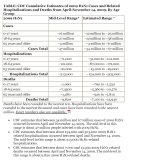
estimates Dec.JPG

http://cdc.gov/h1n1flu/pdf/december10.pdf
 
Re: One in Six Americans Have Had H1N1; 10,000 Have Died

Case fatality ratios using the new CDC estimates;

0-17: 0.007%
18-64: 0.028%
65+ : 0.032%
Overall: 0.021%
 
Re: One in Six Americans Have Had H1N1; 10,000 Have Died

These are the actual notes from a pathologist emailed to me and printed with permission. Edited for readability. Bolding mine.

Please take heed. There is a very dangerous side to Swine Flu.

Florida1
(Sharon Sanders)


"We did an autopsy last week on a fellow who died of swine flu. We got the laboratory tests back from our swabs, but he seemed to fit? I will just read ... out the circumstances of the death because I think it's a pretty typical story.

The guy was aged 47 years.

He died on July 14. but six days before on July 8, he had started to feel unwell with flu-like symptoms of sore throat, joint pains and headaches. Then he was coughing and had a loss appetite.

Those symptoms continued until the Sunday, July 12. He then started to cough up a blood. He had a persistent cough and on the Monday night he was observed by his family members to have difficulty breathing. Then the next day, around 10 o'clock, he was found dead in bed. An ambulance was called, but he was already dead. A fairly short but typical length of illness of about 6-7 days.

He was not diabetic but as far as I'm aware just hypertensive (and over weight).

I will just go to the heart of it. And that's to do with the lungs. There was a little bit of straw-colored fluid around the lungs in the chest cavity, which is a non-specific finding, but when the doctor who I was supervising doing to case was looking at the airways, the trachea and the bronchi, and they were really red, like tomato, beetroot red. They are normally a light-pink color, so clearly inflamed. And this was all the way down the bronchiole tree.

People who die of bronchi pneumonia or standard pneumonia, you will often see pus in the airways, but there was no pus in this guy's airways, just intensely red.

The histology of the airways showed a lot of epithelial ulceration. A loss of the surface lining cells with obviously bleeding underneath, which I think partly explains why he was coughing up blood. And acute inflammation of the upper air passages -- the trachea and the main bronchi. But not of the sort that looks like acute bronchitis with neutrophils. Neutrophils are what's colloquially called pus cells. And if you have got acute bronchitis from say a bacteria like staph. or something like that, they are the first line of defense cells that go and gobble up the bacteria.

In this particular case, there were hardly any neutrophils because it's not a bacterial infection, it's a viral infection.

Not much evidence of a secondary bacterial infection at all.

Which is a little surprising, but that?s what we saw. There were hardly any neutrophils. There were some floating around, but the main cells were lymphocytes which are more to do with chronic inflammation and viral infections as well. And other forms of acute inflammatory cells as well called eosinophils and they named that because of the intense orange color of the cytoplasm of the cells when you stain them with a particular stain.

But their function is more related to allergy. So if you see a lot of eosinophils in lungs in particular, you might think of asthma or some allergic phenomenon that's attracting those eosinophils to that site. I am not suggesting for a minute that this was an allergic phenomenon at all. This was a viral-type process. For whatever reason, and I don?t understand it, those sorts of cells -- the eosinophils and the lymphocytes were being attracted to that inflammatory area.

That was the first thing -- so intense inflammation of the upper air passages. The lungs were heavy. They were about twice to three times as heavy (as normal). The left lung is normally less than the right because it has got two lobes and the right lung has got three lobes. And the left lung in this case weighed 630 grams and the right lung weighed 830 grams. The left lung is generally about 200-250 and the right about 350-400 or so. At least double normal for each.

All the organs in large people tend to be bigger anyway, particularly the liver and heart. The lungs not so much. Those weights are pathological of something, they are not standard weights.

There is supportive tissue in the lungs, but the bulk of lungs is air. And there shouldn?t be any bleeding into the tissue of the lungs, but what we were seeing was precisely that. We were seeing areas of what looked to be hemorrhage throughout both lungs, particularly in the lower lobes.

That again is quite different to your standard bacterial pneumonia, where you see pus in the small airways and you see what's called consolidation of the lungs by lobar pneumonia say from an ordinary bacterial organism that you might acquire at home or in the community. We saw those abnormalities in conjunction with the upper airway inflammation.
We knew we were onto something which was not standard pneumonia and the story of course was of a flu-like illness and he fitted the bill with him being at risk for swine flu.

So we were hot on the trail of that and we took swabs of the trachea, of the lung and the nasopharynx and I think they all came back positive for swine flu.

That in short are the findings.

Again, consistent with viral pneumonia where there are not many neutrophils but there are a lot of lymphocytes, mainly lymphocytes in the alveoli spaces, those grapelike sacks that do the gas exchange. A lot of chronic inflammatory cells, mainly lymphocytes, some eosinophils and little aggregates of neutrophils.

If you were to show this to a pathologist blind without any story, this should not be regarded as a standard pneumonia. It really shows the typical features of what would be a viral pneumonia; some sort of viral lower respiratory tract infection.

And then we looked at the heart. Sometimes with a viral infection you can get what's known as myocarditis, which is inflammation of the heart basically. There was no evidence that this fellow had that.

...

(We) couldn?t see any inflammation anywhere else except maybe the spleen. That?s not surprising because it has a lymphoid immunological function anyway. But in a viral infection, you get very non-specific changes in the spleen.

This really was upper and lower air passages and nowhere else.

The viral pneumonia, the virus (is) basically nuking the alveoli and causing severe hypoxia.

Yes, I think it?s that. This guy never made it to ICU so I don't have any of those parameters. I am only guessing, but I think it was partly that and also the effects of a viremia -- just having a pretty virulent virus spreading rapidly through the body and particularly being attracted to a very important site like your lungs makes people profoundly unwell. And on a background of these people having diabetes, high blood pressure, obesity and so on.

Viral pneumonia, I said. I don?t know what the mechanism is. Probably hypoxia eventually because of the inflammation in the lungs -- there was a lot of that.

(Pulmonary hemorrhage) was part of the inflammatory process.

We're on a learning curve here. we don?t know what the pathology of swine flu actually is when it gets down to it. If you recover from it, fine. Nobody is going to biopsy your lungs after you have made a recovery. It's only when people die and they are submitted to autopsy that people like me take over the case and start looking at their lungs.

The sorts of people we really won't be autopsying because their cause of death is known, are the people who are on ventilators in ICU. We are seeing a different population -- people who die at home of unknown causes or where the GP won't sign a death certificate. They don't come to the ICU's attention.''

 
Re: One in Six Americans Have Had H1N1; 10,000 Have Died

So, if 1 in 6 have gotten the flu and 10,000 have died, then if the attack rate is 60%, then we can expect a total of 185M cases, resulting in Presto! 36,000 deaths. Either this is an incredible coincidence and this virus is truly "no more serious than seasonal flu" or someone has taken the hospitalization data and backed out an estimate of total cases that will prove that this is "no more serious than seasonal flu".

I hate to sound cynical, but this number, or its equivalent in other countries (i.e. - Ukraine having 6,000 seasonal flu deaths per year with a population of ~50M) keeps popping up, as though flu viruses in the 21st Century always kill 0.0012% of the population.
 
Re: One in Six Americans Have Had H1N1; 10,000 Have Died

Can we use the CDCs most recent estimate (which only covers up to Nov 14) to give a current fatality estimate Dec 10?

The previous estimate on Oct 17 had a fatality estimate of 3900.
So 5,920 fatalities occurred in the four weeks between estimates. 1,480 per week on average. During this time the % P&I averaged 7.3%.
In the four weeks since Nov 14, % P&I has averaged 7.7%. So factoring at least 1,500 deaths per week for the last four weeks, the current death toll is more likely to be 16,000 in the United States.
 
Re: One in Six Americans Have Had H1N1; 10,000 Have Died

Of course not :). I'm just saying that for the next four weeks we're going to hear from every news report and newspaper that H1N1 has killed 10,000 in the US, but on the day the estimate is issued, it's already under by 6000 fatalities. Ah well.
 
Re: One in Six Americans Have Had H1N1; 10,000 Have Died

I think you are correct and I think we should say "at least".
 
Re: One in Six Americans Have Had H1N1; 10,000 Have Died

Of course not :). I'm just saying that for the next four weeks we're going to hear from every news report and newspaper that H1N1 has killed 10,000 in the US, but on the day the estimate is issued, it's already under by 6000 fatalities. Ah well.
And keep in mind that 10,000 is the mid-range estimate.
 
Re: One in Six Americans Have Had H1N1; 10,000 Have Died

I hate to sound cynical, but this number, or its equivalent in other countries (i.e. - Ukraine having 6,000 seasonal flu deaths per year with a population of ~50M) keeps popping up, as though flu viruses in the 21st Century always kill 0.0012% of the population.

Actually, having tracked Ukraine for most of the past month, the deaths they are reporting due to Pandemic H1N1 is LESS than their seasonal average - they have reported 474 deaths in a month and a half, which is only about 3,500 per year (and the attack rate is so high already that there aren't enough people in Ukraine to allow this number of infections per day for an entire year).

Of course, like in the rest of the world, these deaths are in young and healthy individuals, so there is something at least slightly misleading about comaring seasonal flu deaths with pandemic ones in the first place.
 
Re: One in Six Americans Have Had H1N1; 10,000 Have Died

-snip-
Flu estimates are tricky and inexact because many illnesses are relatively mild and go unreported, and hospitalizations and deaths often involve maladies beyond the flu. The CDC actually thinks that between 34 million and 67 million Americans have gotten sick from swine flu, but Frieden gave 50 million as a midpoint estimate.

Flu estimates are also difficult to compare. Seasonal flu kills about 36,000 Americans each year, according to a long-standing estimate. But that number includes many elderly people who had not only seasonal flu and related pneumonia but also heart attacks and strokes. The new CDC swine flu estimates do not include heart attacks and strokes, mainly because there hasn't been time to collect that kind of data.

So it's likely the new estimate is conservative, and undercounts elderly deaths, CDC officials acknowledged.

-snip-

http://www.msnbc.msn.com/id/34365895/ns/health-cold_and_flu/
 
Re: One in Six Americans Have Had H1N1; 10,000 Have Died

-snip-
Betsy McKay: Thanks, Dr. Frieden. Betsy McKay from the Wall Street Journal. One clarification: is this the same -- are you using the same methodology for the estimates as did you in October? I just wanted to see if we have 10,000 deaths now, is that -- which means there have been 6,000 in the past month? And secondly, I am wondering if you could talk more broadly about how this compares so far with seasonal flu. I mean, I know the time period is different. But are you thinking now that this is, you know, taking a worse toll than seasonal flu generally or less?

Thomas Frieden: So, the methodology details are all given on our website. Please refer to our website for that detail. It′s not quite that you can take the current estimate and subtract the previous estimate to see what happened in the past month? There is some correction for late reporting. But there has been a lot more disease in the month that′s reported than in the months before. In terms of comparison of this year′s flu with H1N1 influenza with seasonal flu, we know that it′s much milder for older people. It′s much less likely to result in death because older people are much less likely to get infected. But it has been a much worse flu season for people under the age of 65, particularly younger adults and children. The estimate we have ? the estimate that we're releasing here is not done in the same way that gives us the 36,000 estimate. That estimate is a different methodology. And will give a slightly larger number than this number would give. But if you were to compare, even though it's not a directly applicable comparison, under 50 in that estimate, there are less than 1,000 deaths a year in age under 50. We didn't break out in this ?we′re not able to at this time, the 50 to 64 versus 50. But a large portion of those adults are under 50. So it is really many times more severe in terms of severe illness and hospitalizations are several times higher for children and young adults as well in H1N1 than in a usual flu season. On the phone?
-snip-
http://cdc.gov/media/transcripts/2009/t091210.htm
 
Re: One in Six Americans Have Had H1N1; 10,000 Have Died

Actually, having tracked Ukraine for most of the past month, the deaths they are reporting due to Pandemic H1N1 is LESS than their seasonal average - they have reported 474 deaths in a month and a half, which is only about 3,500 per year (and the attack rate is so high already that there aren't enough people in Ukraine to allow this number of infections per day for an entire year).

Of course, like in the rest of the world, these deaths are in young and healthy individuals, so there is something at least slightly misleading about comaring seasonal flu deaths with pandemic ones in the first place.
My comment regarding Ukraine probably wasn't clear, but I was commenting more on the estimate of annual seasonal flu deaths being 6,000, which is approximately one-sixth of those estimated in the U.S. and their population is approximately one-sixth that of the U.S. I think the same models are being used by many nations, which tells me that they are not accounting for climatic differences, differences in population demographics, or differences in the quality of health care. There are other examples, but I don't have the numbers handy.
 
Re: One in Six Americans Have Had H1N1; 10,000 Have Died

-snip-
Betsy McKay: Thanks, Dr. Frieden. Betsy McKay from the Wall Street Journal. One clarification: is this the same -- are you using the same methodology for the estimates as did you in October? I just wanted to see if we have 10,000 deaths now, is that -- which means there have been 6,000 in the past month? And secondly, I am wondering if you could talk more broadly about how this compares so far with seasonal flu. I mean, I know the time period is different. But are you thinking now that this is, you know, taking a worse toll than seasonal flu generally or less?

Thomas Frieden: So, the methodology details are all given on our website. Please refer to our website for that detail. It′s not quite that you can take the current estimate and subtract the previous estimate to see what happened in the past month? There is some correction for late reporting. But there has been a lot more disease in the month that′s reported than in the months before. In terms of comparison of this year′s flu with H1N1 influenza with seasonal flu, we know that it′s much milder for older people. It′s much less likely to result in death because older people are much less likely to get infected. But it has been a much worse flu season for people under the age of 65, particularly younger adults and children. The estimate we have ? the estimate that we're releasing here is not done in the same way that gives us the 36,000 estimate. That estimate is a different methodology. And will give a slightly larger number than this number would give. But if you were to compare, even though it's not a directly applicable comparison, under 50 in that estimate, there are less than 1,000 deaths a year in age under 50. We didn't break out in this ?we′re not able to at this time, the 50 to 64 versus 50. But a large portion of those adults are under 50. So it is really many times more severe in terms of severe illness and hospitalizations are several times higher for children and young adults as well in H1N1 than in a usual flu season. On the phone?
-snip-
http://cdc.gov/media/transcripts/2009/t091210.htm

Magic words these.
 
Re: One in Six Americans Have Had H1N1; 10,000 Have Died

RoRo;327937[B said:
The estimate we have ? the estimate that we're releasing here is not done in the same way that gives us the 36,000 estimate. That estimate is a different methodology. [/B]
Is that so? Then by some fantastic coincidence, the estimated number of annual seasonal flu deaths just happens to match up precisely with the estimated number of H1N1 deaths that will occur this year. Amazing! :rolleyes:
 
Re: One in Six Americans Have Had H1N1; 10,000 Have Died

Detailed version of CDC's Extrapolations and Ranges

http://www.cdc.gov/h1n1flu/estimates/results_2009_h1n1.htm

Carefully notice the VERY HUGE ranges in CDC calculations

NUMBER OF HOSPITALITATIONS* : range 153,378-302,258 ; mid 213,024

NUMBER OF CASES : range 34,017,532-67,037,534 ; mid 47,246,422

NUMBER OF DEATHS : range 7,061-13,915 ; mid 9,807

... of which : CHILDREN (0-17) : range 784-1,545 ; mid 1,089

I would question if U.S. states are that bad in diagnostics and/or reporting, as lowest extrapolated number of deaths is around 2 and a half times sum of reported numbers from all states

As CDC writes
The true number of cases, hospitalizations and deaths may lie within the ranges provided or it's also possible that they may lie outside the ranges.

* reported number of hospitalizations 71,118
 
Back
Top