• FluTrackers.com Inc. does not provide medical advice. Information on this web site is collected from various internet resources, and the FluTrackers board of directors makes no warranty to the safety, efficacy, correctness or completeness of the information posted on this site by any author or poster. The information collated here is for instructional and/or discussion purposes only and is NOT intended to diagnose or treat any disease, illness, or other medical condition. Every individual reader or poster should seek advice from their personal physician/healthcare practitioner before considering or using any interventions that are discussed on this website. By continuing to access this website you agree to consult your personal physican before using any interventions posted on this website, and you agree to hold harmless FluTrackers.com Inc., the board of directors, the members, and all authors and posters for any effects from use of any medication, supplement, vitamin or other substance, device, intervention, etc. mentioned in posts on this website, or other internet venues referenced in posts on this website.
  • We are not asking for any donations. Do not donate to any entity who says they are raising funds for us.

North American Bat Death Toll Exceeds 6 Million From White-nose Syndrome

Re: USA: Bats Die by the Thousands

Re: USA: Bats Die by the Thousands

Source: http://www.nashuatelegraph.com/apps/pbcs.dll/article?AID=/20080707/NEWS01/615534186/-1/news
Published: Monday, July 7, 2008
Disease taking a toll on state's bat population
By ANDREW WOLFE, Staff Writer
awolfe@nashuatelegraph.com

New Hampshire's bats are back, but their ranks have been ravaged by a disease that has devastated bat populations elsewhere in the Northeast, a researcher and a state wildlife official said.

New Hampshire's bat population hasn't been as hard-hit by white nose syndrome as those in Vermont and New York, but the losses are noticeable, said bat researchers Scott Reynolds, of North East Ecological Services, and Emily Brunkhurst, a New Hampshire Fish and Game biologist.

"They are back," Brunkhurst said. "We have gotten some calls from some people . . . who traditionally had them, and the numbers are lower. Significantly lower in some cases, missing in others. I have gotten calls from people who say, 'I've had bats for years, and I don't now.' "

Bats that returned to the state also have been in poor health compared with past years, and fewer are reproducing, Reynolds said.

"I think we're on the front end of something that's just going to be getting worse in the next few years," Reynolds said, adding later, "If the numbers are down and reproduction is down, the big impact will be next year. . . . This may be the front edge of the storm."


Researchers have a few clues, but no solution, to the mystery of what causes white nose syndrome, so named for a fungus that appears around the snouts of affected bats during hibernation. The disease seems to cause bats to burn through their body fat reserves too quickly during hibernation, leading to starvation and dehydration, experts said.

White nose syndrome has hit hardest among little brown bats, one of the most common species, known for its voracious consumption of mosquitoes. A little brown bat eats about half its weight, or about 4,000 mosquitoes, every night ? and what's bad for the predator typically is good for the prey.

"If in fact we have 500,000 fewer bats in the landscape this year, that adds up to about 2 billion insects that are not eaten each night," Vermont Fish and Game bat biologist Scott Darling said.

The scope of white nose syndrome has been compared to Colony Collapse Disorder, which has been decimating North American honeybees, and its cause has remained similarly elusive.

Experts from around the United States and Canada gathered last month in Albany, N.Y., to share information on the disease and try to coordinate strategies for dealing with it.

"Take-home messages were essentially that this is an unprecedented mortality event this past winter," Reynolds said.

White nose syndrome was first identified in New York during the winter of 2006-07. Last winter, Reynolds said, some affected hibernating populations had been all but wiped out.

"Some sites have 90 percent loss," Reynolds said. "Others have as little as 80 percent loss, but it's all of that order."

Researchers simply don't know how far the disease may spread or how bad the impact might be, and they've been wary of predictions, mainly for fear that their estimates would sound incredible, Reynolds said.

"The reductions are overwhelming," Reynolds said. "Because the numbers are so big, they are sensitive that if their counting methods are not accurate, it's going to be seen as alarmist.

"We do know we've never seen anything like this. We know the numbers are huge, but we don't know what the numbers are."


Reynolds has been studying bats for 15 years, focusing on a summer breeding colony in Peterborough, which draws bats from all around the regions affected by white nose syndrome. New Hampshire bats generally hibernate elsewhere, as the state has few caves or mines suitable for winter hibernation.

That colony typically includes from 1,500-2,000 bats, and the population this summer is down by about 25 percent ? a drop well beyond the normal swings, he said.

Reynolds said he has tagged some 4,500 bats from the Peterborough colony over the years, and many of his tagged bats have been found dead of white nose syndrome in hibernacula in Vermont and New York.

"It's only a matter of time before the full impact is felt by this colony," he said.


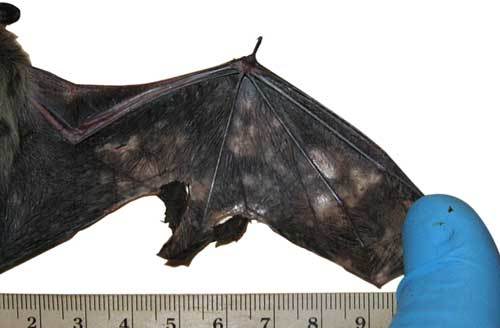
Beyond the population drop, Reynolds and other experts said, bats that survived the winter don't seem to be as healthy as usual. Many bats have visible damage to their wings, including scar tissue, tears and holes, apparently caused by dehydration during hibernation, Reynolds and Darling said, and some still seem to be carrying the telltale white fungus.

"I'm still getting one to two calls a day about dead and dying bats," Darling said. "We thought once they left the caves and mines and got out into their summer habitat . . . their weights would go up and they'd be back in good shape."

Reynolds has noted that many more female bats than usual haven't produced offspring, probably because their body fat reserves were too diminished to deal with it, he said.


"They had enough energy to survive, but not enough for anything extra, like reproduction," Reynolds said.

Researchers know little about the disease and hope that further studies in late summer and fall will at least shed light on whether their health got better or worse over the summer, Darling said. Further declines over the summer might point to an environmental cause, such as pollutants. If the disease does its damage mainly during hibernation, he said, that would suggest some sort of biological pathogen.

"There is a relatively well-coordinated and comprehensive effort to try to tackle this," Darling said.

So far, researchers have been unable to find any hint of a bacterial or viral cause, Reynolds said, but they've found a previously unidentified species of cold-weather fungus. The question is whether it's new to bats or just new to researchers.

"We know we're finding fungus, but we don't know that it's a new fungus for them," Reynolds said of the bats.

Scientists "didn't know this fungus existed before," Reynolds said. "The mycologist was almost giddy talking about it."

The new fungus isn't the same one that causes the distinctive white snouts, however, Reynolds said. Some researchers have suggested fungus on the snouts might actually cause the disease, simply by irritating the bats to the point where they can't get a proper winter's sleep.

"We still are a long ways from indicting the fungus as a cause of death in these animals," Darling said.

The combination of new funguses striking bees and bats and the recent worldwide amphibian fungus epidemic have Darling concerned about the entire "ecological infrastructure," he said.

"It's more than just about bats. It's about broader implications," Darling said. "I'm hoping that when we do pin this down, and I'm hopeful that we will, that there will be a public will to address that problem."
Andrew Wolfe can be reached at 594-6410 or awolfe@nashuatelegraph.com.

ON THE NET
Information on the white nose syndrome Conference.

Information on white nose syndrome.

Bats and white nose syndrome in New Hampshire.

View a video presentation on white nose syndrome by U.S. Fish and Wildlife biologist Susi von Oettingen, of Concord.

Related nashuatelegraph.com coverage

* How you can help solve bat mystery
 
Re: USA: Bats Die by the Thousands

Re: USA: Bats Die by the Thousands

The mysterious death of bats has continued this summer, but researchers are closing in on a cause
By Beth Daley, Globe Staff | July 28, 2008

After a series of provocative discoveries in recent months, scientists believe bats in the Northeast might be in greater peril from a mysterious sickness than originally thought.

Researchers now think that a fuzzy white fungus found on thousands of dead and dying bats in New England and New York last winter might be the primary cause of the illness.
Scientists have learned that the unidentified fungus seems to thrive in the cold temperatures found in caves and mines in winter - when bats are hibernating and most vulnerable.

As worrisome is that many bats continued to die this spring, dashing hopes that they would recuperate when they emerged from hibernation and resumed feeding. Hundreds of animals with scarred wings, both dead and alive, were discovered in Vermont, Massachusetts, and New Hampshire through June. The wing damage can kill bats and likely was caused by the fungus, researchers say.

1217252051_0167.jpg


Biologists are also growing increasingly concerned that the fungus may be spreading to tens of thousands of healthy bats as the animals huddle together while sleeping in their summer roosts.

Humans are not believed to be at risk from the illness, but a large die-off would likely affect people indirectly. The nocturnal mammals eat enormous amounts of crop-infesting and human-biting insects, and scientists say they know so little about bats that their ecological importance may become apparent only once they disappear.

"We could be at the beginning of something much uglier," said Paul Cryan, a bat specialist with the United States Geological Survey in Colorado. He said researchers are beginning to realize that even if they identify a definite cause, it may be too late for thousands of bats. "What do we do then? We are thinking ahead to the spread of it."

The disease was first seen two winters ago, when thousands of bats died in four New York caves within seven miles of each other. Many of the bats had an unusual white fungus on their bodies. By last winter, 25 caves and mines spread across 135 miles were found to have sick or dying bats in Massachusetts, Vermont, Connecticut, and New York. Pennsylvania bats may also be affected.

Scientists originally dubbed the sickness "white nose syndrome" because of the fungus but believed it to be a secondary problem, one that grew on the bats when they were weakened by something else. That's because fungi are rarely fatal by themselves.

But a meticulous search for another pathogen using cutting edge technology has come up short. While researchers say they are not ruling out other causes, such as something in the environment, a recent discovery that the fungus grows best in cold temperatures is training their attention back to it.

Bats' immune systems appear to shut down when they are in deep hibernation, likely to conserve energy and because the parasites, bacteria, and viruses that would attack them are not normally active in the cold either. If a fungus exists in the caves that thrives in cold conditions, it could overtake the bats before their immune system has a chance to respond.

Scientists' hypothesize that the bats could be waking up in the winter from the fungus - either to jumpstart their immune systems or simply to groom themselves. Under either scenario, the bats would burn up enormous amounts of fat reserves they need to survive the winter. That may be why so many skinny bats were seen dying on cave floors this past winter or flying into and out of mines in a futile search for food.

"The attention has narrowed and focused on the fungus," said Vishnu Chaturvedi, director of the Mycology Laboratory at the New York State Department of Health and part of a team that discovered the cold-loving fungus. He said it will take time before scientists know for sure what is going on - and longer to find a solution - but "we're getting a number of clues."

Some scientists are growing discouraged that they will find the answers in time. Some caves struck hard by the illness have lost 97 percent of their bat populations. A bat researcher monitoring a summer roost in New Hampshire estimates that about 25 percent of his colony is gone, likely from the bat sickness.

Worries intensified this spring when researchers discovered bats with inflexible, scarred wings, likely from the fungus. Wings make up more than 75 percent of a bat's surface area and are critical for flying as well as for blood flow and to enable the animals to exchange heat, gas, and water with the air. If the wings are too damaged, the animal can die.

"We thought if they made it through the winter they would be good to go, but that does not appear to be the case," said Jon Reichard, a Boston University graduate student who is monitoring two summer bat roosts in Massachusetts and New Hampshire where he has found hundreds of bats with damaged wings.

Scientists are beginning to study whether bats might be harboring dormant fungal spores in summer roosts, increasing the risk of transmission.

This is a frightening scenario: Bats migrate as far as 250 miles from their winter hibernating sites to their summer roosts, where they mix with bats from other far-off caves and mines. In the fall, they will travel back to their hibernation sites to mingle and mate with still other bats. If new bats are infected, the fungus could begin to grow on them as soon as temperatures dip low enough.

"This condition represents a grave threat to (bats in) the northeastern US," said David Blehert, director of diagnostic microbiology at the US Geological Survey National Wildlife Health Center in Wisconsin.


Beth Daley can be reached at bdaley@globe.com.
http://www.boston.com/news/science/articles/2008/07/28/wing_damage?mode=PF
 
Re: USA: Bats Die by the Thousands

Re: USA: Bats Die by the Thousands

Thanks Farmer,
bad news.

"Bats' immune systems appear to shut down when they are in deep hibernation, likely to conserve energy and because the parasites, bacteria, and viruses that would attack them are not normally active in the cold either. If a fungus exists in the caves that thrives in cold conditions, it could overtake the bats before their immune system has a chance to respond.
...
Some scientists are growing discouraged that they will find the answers in time. Some caves struck hard by the illness have lost 97 percent of their bat populations.
...
The nocturnal mammals eat enormous amounts of crop-infesting and human-biting insects, and scientists say they know so little about bats that their ecological importance may become apparent only once they disappear.
...
Scientists are beginning to study whether bats might be harboring dormant fungal spores in summer roosts, increasing the risk of transmission.

This is a frightening scenario: Bats migrate as far as 250 miles from their winter hibernating sites to their summer roosts, where they mix with bats from other far-off caves and mines. In the fall, they will travel back to their hibernation sites to mingle and mate with still other bats. If new bats are infected, the fungus could begin to grow on them as soon as temperatures dip low enough."


Don't leave the bats to extinction, as many other Earth creatures.

Exists enaugh labs to find an countermeasure versus the fungi to be sprayed in the main breeding caves, maybe.

Or to be sprayed on the bats and be apsorbed through their skin, to help them fight the illness.

And some envir. fund from which financing the above.
 
Re: USA: Bats Die by the Thousands

Re: USA: Bats Die by the Thousands

Mysterious bat deaths under study

Sunday, September 28, 2008

By Sara Foss (Contact)

Gazette Reporter

HAGUE ? Nancy Heaslip kneels at the mouth of an entrance to an old graphite mine, waiting for the little brown bats.

She doesn?t have to wait long. They are plentiful tonight, emerging from the mine and fluttering about in the night sky. Occasionally one or two of them flies into a harmless trap positioned about 10 feet from the mine entrance, and Heaslip scoops them up and stuffs them in brown paper lunch bags. The time of capture is written on the bags in black pen.

7:18 . . . 7:30 . . . 7:59 . . .

Heaslip, who is wearing thick gloves and a headlamp, does this for an hour, and then transports the paper bags ? about 40 of them ? to a nearby work station. There the bats are weighed, their forearms are measured with calipers, and they are photographed prior to being either banded and freed, or euthanized, slipped into vials and stored in a cooler on dry ice. These bats will go to a lab for further scrutiny and testing.

It?s a painstaking process, and the four-member team labors until well after 1 a.m. They are led by Al Hicks, the mammal specialist for the New York State Department of Environmental Conservation?s endangered species program, and they are here to help solve a mystery: Why are the bats dying?

Last winter, tens of thousands of hibernating bats died in caves and mines in eastern and upstate New York, Vermont, Massachusetts and northwestern Connecticut. Many, but not all, of these bats had a white fungus around their muzzles and other parts of their bodies; as a result, biologists named the affliction white-nose syndrome. Some of the bats hibernating in affected areas survived, but not many: In eight New York caves, the mortality rate ranged from 80 percent to 100 percent
.

white nose

Scientists have many questions about white-nose syndrome, and few answers. They don?t know what it is. They don?t know whether the bats are transmitting it among themselves, or whether people are spreading it, or whether it?s even killing the bats. What they do know is that what?s happening is unprecedented.

?Nothing similar has ever happened,? said Merlin Tuttle, director of Bat Conservation International, based in Austin, Texas, home of the world?s largest urban bat population. ?There isn?t even a case, that we know of, of a major die-off of bats associated with disease. We?re looking at a big mystery so far.?

?Any time we start having mass die-offs, we ought to be taking it very seriously as a potential canary in the coal mine,? Tuttle continued. ?We may be looking at a serious environmental crisis.? He suggested there are probably multiple causes. One factor, he said, may be population decline in groups of insects that bats rely on for food.

Tuttle doesn?t view the bat die-off as an isolated incident. Recently, scientists have been baffled by the unexplained disappearance of millions of commercial honeybees, a phenomenon known as colony collapse disorder, and a few years ago scientists reported that a strange new fungus that kills frogs, toads and other species of amphibians was spreading around the globe.

Hicks, too, views the bat die-off as symptomatic of an environment in crisis. He suggested that the world?s increasing population and ?the increased rate that we move things around on this planet? are taxing the earth. ?Our ability to move quickly and frequently around the planet allows ever increasing movement of organisms,? he said. Invasive species such as zebra mussels and purple loosestrife threaten to throw New York?s ecosystem out of whack, he said.

New York is considered the epicenter of the bat die-off.

discovery

In winter 2007, the state DEC received a report of unusual bat behavior at a cave outside of Albany. Heaslip, a wildlife biologist, led an expedition to Hailes Cave at Thacher Park, where she discovered hundreds of dead bats. These bats were emaciated and dehydrated, their fat reserves were exhausted and they were dying, or had died, of starvation.

Biologists had hoped the deaths at Hailes Cave were an isolated incident. But today, white-nose syndrome has been found at more than 30 sites in four states: New York, Vermont, Connecticut and Massachusetts. This is a notable increase from 2007, when there were only four affected sites, all in caves located within seven miles of each other in Albany County.

Based on what happened between 2007 and 2008, scientists expect the number of white-nose sites to increase again this winter, said Robyn Niver, an endangered species biologist with the Northeast Region of the U.S. Fish and Wildlife Service. Over the summer, people reported seeing dead and dying little brown bats at their summer roosts in the four states with confirmed cases of white-nose syndrome, and also in New Hampshire and Pennsylvania.

?This is potentially devastating for Northeastern bat species,? Niver said.

Little brown bats, the most numerous bats in the Northeast, are being killed off in the greatest numbers. But the Indiana bat, which is listed as an endangered species, has also suffered, as have northern long-eared and small-footed bats, eastern pipistrelle and other bats using the same caves and mines.

detective work

Under darkening skies last week, Hicks and his crew hiked down an old mining road, using GPS to pinpoint the location of the mine entrance. Once they found it, they descended into a gully and began readying for a long night. It was a warm night for late September in the Adirondacks, which was good: When the temperature dips below 50 degrees, bats are disinclined to venture outside.

The trap they set up resembled a metal mattress frame and was strung with thin strings that were light enough to avoid detection, but strong enough to withstand the fluttering of the bats. Normally, the ensnared bats would automatically drop into a large bag at the base of the trap, but Hicks wanted to limit the bats? contact with each other ? ?we?re not sure if white-nose is contagious? ? and so all of the captured bats are bagged separately, by hand. To convince the bats to fly into the trap, rather than around it, a wall of sticks was erected on both sides of the trap.

At the work station, the team weighed the bats, measured their forearms, spread their wings to look for unusual scarring and holes ? evidence of white-nose syndrome ? and photographed their wings. The information, which describes the body condition of these bats, is recorded on a chart.

?This is an adult bat,? Hicks said, squinting at the squirming brown ball in his gloved palm. ?Ow! I don?t like being bitten. The mass is 8.2 (grams).? He studied the wing. ?There?s damage to the wing,? he said. ?The membrane is not straight. ... But it looks like it?s healed.? The bat was placed on the table, and its wing was photographed. Another bat also had damaged wings: tiny holes and visible scarring.

Hicks was replicating an earlier study done years ago by Thomas Kunz, the director of the Center for Ecology and Conservation Biology at Boston University. The data his team gathers will be compared to data about bats in other affected sites in the Northeast, to data about bats in control sites in Kentucky and Pennsylvania where no trace of white-nose syndrome has been found, and to the bats in Kunz?s original study. The euthanized bats will be sent to a lab so scientists can learn more about the bats? body content: the fat levels of the bats going into hibernation ? ?do they have enough fat?? ? and what the composition of that fat is.

Hicks will collect bats once more before hibernation, and then twice while they are hibernating. In the other states where white-nose has been found, biologists are leading similar expeditions. Hicks said it?s unclear whether the white-nose fungus is causing the bats to be sick, or whether it?s a symptom of a sickness afflicting bats with weakened immune systems.

The states where white-nose has been found are also participating in a study of whether hibernating bats are waking up too early in the year, and whether these hibernating bats have enough fat stored to make it through the winter, according to Niver. A routine count of the endangered Indiana bat will be conducted this winter; the U.S. Fish and Wildlife Services expects the census to yield valuable information about how the species is faring post-white-nose syndrome.

necessary creatures

Bats are an important part of the ecosystem, and help keep the insect population in check, Tuttle said. ?Bats are critically important in keeping insects in balance,? he said.

A bat can eat 50 percent to 75 percent of its body weight in flying insects a night during the summer months.

One of the first cases of white-nose syndrome was observed in 2008, in a non-commercial section of Howe Caverns in Schoharie County by caver Joe Armstrong, who serves as conservation chairman of the Northeastern Cave Conservancy. He had heard about the bat die-off in Albany County, and immediately contacted Hicks. At the time, Armstrong was taking a count of the bat population in Howe?s Cavern; only one bat out of 77, he said, exhibited the tell-tale fungus associated with white-nose syndrome.

Armstrong has continued to document the numbers of bats in area caves. Caves that were home to 1,000 to 1,500 bats in 2005, he said, had only a handful of bats in them last year; a cave where he had once counted 400 hibernating bats only had two.

http://www.dailygazette.com/news/2008/sep/28/0928_batty/
 
Re: USA: Bats Die by the Thousands

Re: USA: Bats Die by the Thousands

Source: http://www.myfoxphilly.com/myfox/pa...n=2&locale=EN-US&layoutCode=TSTY&pageId=3.2.1

Deadly, Mystery Bat Disease Spreads To New Jersey
Last Edited: Saturday, 24 Jan 2009, 4:37 PM EST
Created: Saturday, 24 Jan 2009, 4:35 PM EST

NEWARK, N.J. -- A mysterious disease that has killed thousands of bats in New England has spread to New Jersey.

And it's perplexing wildlife officials and raising concerns of a possible increase in bugs and pests.

The state Environmental Protection Department's Division of Fish and Wildlife says hundreds of bats are dying at two caves in Morris County that serve as a home to the furry insect-eaters during winter hibernation.

Mick Valent, the division's principal zoologist, says several bats found last month later died in rehabilitation, and others were found dead or emaciated.

All displayed a white fungus around their muzzles, a sign of what is called white-nose syndrome.


The disease has confounded biologists, who only know that the fungus and the deaths occur concurrently. It isn't known if the fungus is a cause or a symptom.
 
Re: USA: Bats Die by the Thousands

Re: USA: Bats Die by the Thousands

"The disease has confounded biologists, who only know that the fungus and the deaths occur concurrently. It isn't known if the fungus is a cause or a symptom."


A year without scientific explanation about allow us to make speculations.

For the bees emerges out that there were new kind of chemical pesticides involved into many exterminations.

Maybe the bats have indeed weakened their immune systems because of pollution, so they succubed to the fungus. Are such illness present also at some last natural resort sites, if not than maybe ...
 
Re: USA: Bats Die by the Thousands

Re: USA: Bats Die by the Thousands

Source: http://www.post-gazette.com/pg/09027/944734-358.stm

White nose syndrome now threatening Pennsylvania bats

Tuesday, January 27, 2009
By John Hayes, Pittsburgh Post-Gazette

After nine months of research, biologists have confirmed the presence of a mysterious disease that has killed hundreds of thousands of bats in the northeastern United States.

White nose syndrome, so called for the fungus found around the faces and wings of many afflicted bats, isn't contagious to humans, household pets or other animals. But its sudden appearance, unknown pathology and potential to seriously harm the population of an environmentally vital mammal have scientists concerned.

Previously confirmed in New York, Vermont, Connecticut, Massachusetts and New Jersey, conclusive evidence of white nose syndrome in Pennsylvania was discovered in late December at an old iron mine near Shindle, Mifflin County, according to the Pennsylvania Game Commission, the state agency responsible for wildlife management.

DeeAnn Reeder, a biologist with Bucknell University, and Greg Turner, a biologist with the Game Commission's Wildlife Diversity Section, found the curious fungus during weekly field studies of three known Pennsylvania hibernation caves. The research is part of a multistate effort in Pennsylvania, New York, Vermont, Michigan and Kentucky funded primarily by the U.S. Fish and Wildlife Service.

After weeks with no changes among bats in the Mifflin County mine, on Dec. 20 Reeder and Turner noticed bats waking from hibernation and moving toward the mine's gated entrance -- unusual December behavior. A small amount of white fungus was detected on some. On Dec. 29, about 150 of the mine's 2,200 wintering bats appeared to be affected, Reeder and Turner said. By Jan. 5, about 45 percent of the colony had moved toward the mine's entrance. Dozens of bats suddenly developed the fungus around their muzzles and wing membranes, while others displayed additional symptoms.


Several of the bats were sent to the National Wildlife Health Center in Madison, Wis., which reported last week that preliminary tests were positive for white nose syndrome.

"The visible fungus appears on some, but not all, [afflicted] bats, and a significant percentage of bats in affected hibernacula move closer to the entrance," said Turner. "The bats eventually leave their hibernacula -- often in daylight, which is unnatural."

Most of the prematurely exiting bats die, but some may return to the cavern.

"[We] cannot determine what the bats are searching for, or if they're hunting for anything," said Turner. "Most bats found dead on the landscape have depleted their fat reserves."

The outbreak has impacted recreational caving. Last year, the Pennsylvania Department of Conservation and Natural Resources closed Barton Cave, a popular Fayette County spelunking site, for one year as a precaution. And the National Speleological Society, which owns or manages 13 cave preserves nationwide, has banned spelunkers from five of its sites -- including Tytoona Cave Nature Preserve in Blair County -- until more is known.

The little brown bat has been hardest hit by white nose syndrome, but deaths have been reported among other species including northern myotis, Eastern small-footed myotis, long-eared Eastern pipistrelle and the endangered Indiana bat.


Researchers admit they're in the first stages of understanding the outbreak. While infection seems to spread from bat to bat, they don't know whether the fungus is a cause or symptom of the disorder. Afflicted bats are found emaciated and seem to have starved to death. Most troubling is that the impacted geographic area is expanding. First noticed in bat colonies in New York in 2006, white nose syndrome has spread to some, though not all, hibernacula in Connecticut, Massachusetts, Vermont, New Jersey and now Pennsylvania.

Hardy mammals that have survived for about 50 million years, bats play an important ecological role in the environment. A bat can consume 25 percent of its body weight in flying insects during a night's feeding. In Pennsylvania alone, bats collectively eat tons of insects each night, impacting agriculture and the spread of insect-borne disease, not to mention backyard comfort.

Game Commission biologist Lisa Williams said the sudden appearance and rapid expansion of white nose disease has been frustrating for scientists and wildlife agencies.
John Hayes can be reached at jhayes@post-gazette.com or 412-263-1991
 
Re: USA: Bats Die by the Thousands

Re: USA: Bats Die by the Thousands

#29:
" First noticed in bat colonies in New York in 2006, white nose syndrome has spread to some, though not all, hibernacula in Connecticut, Massachusetts, Vermont, New Jersey and now Pennsylvania.

Hardy mammals that have survived for about 50 million years, bats play an important ecological role in the environment. A bat can consume 25 percent of its body weight in flying insects during a night's feeding.


Infectuous spreading, or not.

But it is not infectious if looking at #29:

"... the fungus found around the faces and wings of many afflicted bats, isn't contagious to humans, household pets or other animals."


So it can be linked to agriculture also, as were for the bees on the afected landscapes near the agricultural new pesticide treated ones (EU/It/...).

#29:
"In Pennsylvania alone, bats collectively eat tons of insects each night, impacting agriculture and the spread of insect-borne disease, not to mention backyard comfort."

Maybe the insects they feed on carried into harming chems/gmo which disrupted the bats immune system and make it colapsing after the starving wintering period in the caves.
 
Re: USA: Bats Die by the Thousands

Re: USA: Bats Die by the Thousands

Source: http://www.poughkeepsiejournal.com/article/20090203/NEWS01/90203023

Bats are dying off across the Hudson Valley
February 3, 2009

ROSENDALE ? Deadly white-nose syndrome is striking more bats over a larger area this winter, reaching south into New Jersey and Pennsylvania and emptying caves in hard-hit areas like New York.

?There are not as many as there are supposed to be,? bat counter Ryan von Linden whispered deep inside a cave in New York?s Hudson Valley. His headlamp swept across isolated clusters of bats hanging of the rock ceiling. ?Not even close.?

Two winters after it was first observed, bats in at least a half-dozen states have been infected by white nose and a suspicious sighting has closed a cave preserve in West Virginia as a precaution. While researchers recently identified the fungus that creates the distinctive white smudges on hibernating bats? noses and wings, they are scrambling to find a way to stop the scourge before it spreads even farther.

?The cause for concern is that this is going to race across the country faster than we can come up with a solution,? said Alan Hicks, a wildlife biologist with New York?s Department of Environmental Conservation. ?Now that is entirely possible.?

Hicks and von Linden were among more than a dozen researchers who recently lowered themselves by rope into a sprawling old limestone mine about 80 miles north of New York City to assess white nose damage. They spent the day clambering over rocks and padding across patches of subterranean ice to count bats, a painstaking process that requires digital pictures of every bat hibernating in the cathedral-like space.

The news was grim.

Hicks estimated the number of Indiana bats, an endangered species, is down 15 to 35 percent from last year?s cave-wide count of roughly 19,000. The number of little brown bats, a species devastated by white nose, was also down.

Cave counters speak to each other in church whispers, but some hibernating bats are bothered just the same. A chorus of squeaks echoed in the blackness above and a few fluttered by visitors? headlamps.

The researchers also plucked 14 groggy little brown bats from the rock, weighed them, measured them, snipped a little spot of hair on their backs and stuck a tiny radio transmitter to their backs to track their activity levels. It is part of ongoing research to better understand the syndrome.

Bats with white nose burn through their fat stores before spring, driving some to rouse early from hibernation in a futile search for food. The syndrome poses no health threat to humans, though some scientists say that if bat populations diminish too much, the insects and crop pests they eat could flourish.

First noticed in a few caves west of Albany two winters ago, white nose spread fast last winter to dozens of caves within a roughly 150-mile radius, affecting New York and southern New England.

It?s spreading again this winter.

Bats with white nose were recently found in New Jersey?s Morris County and in an old iron mine in Shindle, Pa., more than 200 miles away from the outbreak?s epicenter. In West Virginia, the National Speleological Society has temporarily shut down the John Guilday Caves Nature Preserve as a possible white nose sighting is investigated. If confirmed, it would increase the radius of infected caves to around 450 miles.

Researchers at the U.S. Geological Survey?s Wildlife Health Center this fall established that the sugary smudges on affected bats are a previously undescribed type of fungus that thrives in the refrigerator-like cold of winter caves. David Blehert, head of microbiology at the Madison, Wis., center, is leading experiments to definitively establish whether the fungus causes white-nose syndrome.

Still, there is enough circumstantial evidence to lead biologists to focus on ways to stop the fungus.

Since the fungus likes it cold and moist, they could try to lower humidity levels in at least some crucial caves, though that could create other problems. Researchers are also looking at the possibility of a fungicide, or even a fungus-killing bacteria that could spread from bat to bat. Ward Stone, New York?s wildlife pathologist, said he has been able to culture a bacteria that lives on big brown bats and kills the white-nose fungus in a lab.

Still, tests need to be performed to see if any of the options are realistic. And as Blehert notes, time is ?our biggest enemy.?

Already, there are 40 confirmed white nose sites in the last few years, said Jeremy Coleman, white nose coordinator for the U.S. Fish and Wildlife Service based in Cortland, N.Y. He added the numbers could soon rise as cave inspections and bat counts begin in earnest this month.

?It could get a lot worse,? Coleman said, ?because the season?s early.?
 
Re: USA: Bats Die by the Thousands

Re: USA: Bats Die by the Thousands

Source: http://www.pittsburghlive.com/x/pittsburghtrib/news/cityregion/s_610067.html

Pennsylvania bats dying from syndrome
By Allison M. Heinrichs
TRIBUNE-REVIEW
Tuesday, February 3, 2009

The Pennsylvania Game Commission is asking the public to help it determine the extent of a disease that is killing the state's wintering bat communities.


Last week game commission conservation officers confirmed that bats were dead or dying of White-Nose Syndrome in a Lackawanna County abandoned mine near Carbondale. Today they announced that several hundred brown bats are dead from the syndrome at another cave in the county.

The bats, which are not supposed to emerge from hibernation for six weeks, are flying from their caves and dropping dead at the entrance, game commission officials said.

People should not enter the caves and shouldn't handle the bats, officials cautioned.

"Roughly 50 percent of the bats in the mine near Carbondale displayed the characteristic white fungus," Kevin Wenner, an agency biologist, said in a news release.

"Some (are) dying in the mine, while others were flying around and dying outside on top of the snow. The bases of several trees near the mine entrance had piles of dead bats around them. Hundreds were visible on top of the most recent snow, so I suspect there are thousands of dead bats."

White-Nose Syndrome is caused by a white fungus that appears around the muzzles and on wing membranes of infected bats. The syndrome first surfaced in New York and spread through New England, so Pennsylvania officials have anticipated an outbreak since last spring.

In New York it illed more than 90 percent of the bats in infected colonies.

Bats in a Mifflin County mine have tested positive for the fungi.

"This mine may be the next hibernaculum where bats 'fly and die,'" agency biologist Greg Turner said. "There's a good chance bats are leaving other hibernacula instate and dying on the landscape, but we haven't found them yet. That is why we are asking for the public's help."

The game commission is asking that anyone who encounters dead or dying bats call the nearest Game Commission region office (724-238-9523 in Southwestern Pennsylvania) or fill out the "Report Sick Bats" form in the left-hand column of the agency's Web page.


Allison M. Heinrichs can be reached at aheinrichs@tribweb.com or 412-380-5607.
 
Re: USA: Bats Die by the Thousands

Re: USA: Bats Die by the Thousands

#31:
"Researchers at the U.S. Geological Survey?s Wildlife Health Center this fall established that the sugary smudges on affected bats are a previously undescribed type of fungus that thrives in the refrigerator-like cold of winter caves. David Blehert, head of microbiology at the Madison, Wis., center, is leading experiments to definitively establish whether the fungus causes white-nose syndrome.

Still, there is enough circumstantial evidence to lead biologists to focus on ways to stop the fungus.

Since the fungus likes it cold and moist, they could try to lower humidity levels in at least some crucial caves, though that could create other problems. Researchers are also looking at the possibility of a fungicide, or even a fungus-killing bacteria that could spread from bat to bat. Ward Stone, New York?s wildlife pathologist, said he has been able to culture a bacteria that lives on big brown bats and kills the white-nose fungus in a lab.

Still, tests need to be performed to see if any of the options are realistic. And as Blehert notes, time is ?our biggest enemy.?


Some resolving tryings starts to pop out.

Hopefully, the "thrives in the refrigerator like cold" quality, don't unveil an lab refrigerator history of the fungus :rolleyes:

Now, apart wild speculations, disseminating new bacterial agents could atack the fungus, but as all knows, such lab bacteria can than mutate in some new strain on the field, and generate new problems.

Additionaly, if the fungus is an secondary consequence of an ruined immune system (and some sci. texts here published seems to point that it can't infect other organism), it would not work.

Lowering humidity would deminish the fungus proliferation, no matter the source of the illness, so it seems an good option if it is possible to achieve.

Strange that the NY region where it first appeared have not more answers now.

We hope that this story would not finish as the one with the many kinds of life forms on Earth in our time period - exterminated, or near it, at the same time when tons of scientific studies explained it why maybe and where it happens, but with no real "push button" power to change anything about ...
 
Re: USA: Bats Die by the Thousands

Re: USA: Bats Die by the Thousands

From a blog. Pics and YouTube included in the link.
----------------------------------------------------------------

Hibernating Cave Bats Receive Heaters
I hope you are reading this blog post in a cozy, climate-controlled environment. A few lucky bats in the wild may soon experience similar comfort when their drafty caves are outfitted with heaters.

This is no mere cave home remodeling project, but rather an attempt by scientists to curb the spread of white-nose syndrome, a fungal disease that's killed at least a half million bats since the deadly illness was first discovered in upstate New York during the winter of 2006.

The mysterious disease causes a white fungus to grow on the faces and wing membranes of hibernating bats. The fungus prevents bats from staying in hibernation mode. If you woke up and found fungus growing on your body, you'd be pretty startled too. The agitated bats, when roused, then expend more energy and may become dehydrated. The depletion of body fat reserves can also cause emaciation, leading to death.

According to researchers, affected bat populations commonly suffer 75 to 100 percent mortality.
“We have no idea why it’s spreading so rapidly,” says Justin Boyles, a graduate student in biology at Indiana State University and co-author of a paper on the disease that's published in Frontiers in Ecology and the Environment e-View.

Boyles and colleague Craig Willis of the University of Winnipeg suspect that by adding heat sources to caves where bats are known to hibernate, they might help to eliminate bat body energy lost as the flying mammals attempt to keep warm.

On paper, at least, the idea works. The researchers think they have a chance at getting bat mortality closer to 8 percent. And the plan isn't as far fetched as you might think, since bats often fly to the warmest parts of their cave when aroused out of hibernation.

“They already do this in the wild,” Boyles said. “What we’re suggesting is accentuating that behavior.”

Willis added, “By insulating the bat boxes and carefully selecting where we will place them, we think we can solve this issue."

The heaters, consisting of protected coils placed in wooden boxes, won't get rid of white-nose syndrome, but they could buy worried scientists some time to find a cause for the disease, along with prevention and treatment for it, if possible.

“I can’t even guess what the cure or the solution to this is going to be,” says Boyles. “This isn’t a cure. We’re going for a stopgap.”

http://blogs.discovery.com/news_animal/2009/03/hibernating-cave-bats-receive-heaters.html
 
Re: USA: Bats Die by the Thousands

Re: USA: Bats Die by the Thousands

Thanks mixin (#34).

The video was interesting.

There were some interesting sentences from this video.

It was observed that there were some aparently "in health" bats (without skin signs of the fungus).

These bats also went out of the caves (actualy out and near the filmed house perimeter) in non-evening/night time, but in the middle of the day, even if the day temperature isn't risen, but it is cold and snow around.

They start searching for food and water, but there is no food in the air, and they try to drink snow.

Apart the syndrome question, it seems very odd that the bats went out of their cave/roof so much earlier, when it is not their normal environmental condition. This was commented as the result of their illness which disoriented them.

Another spec.

What if such behaviour (cited above) and the wrong interpretation of the bats inner biological sensors is a result of wrong and changed mixed inputs which they sensed from an globaly changed (so also localy) warmer cave environment?

As it is now for the plants, the fish, and also for the birds, an more warmer or even only more intermitently changed weather/water/air environment, changed also their behaviour and start new migrations, which are proved by new research, so the same can now aflicted the bat population, and be the primary reason for the insurgence of their immune lowering with an secondary appearance of an fungal illness.

The same caves can now be more subjected to altered air humidity and streams, which can than stimulate the insurgence of fungal particles on those cave surface layers, and on the bats appended on it.
 
Re: USA: Bats Die by the Thousands

Re: USA: Bats Die by the Thousands

Source: http://www.stamfordadvocate.com/localnews/ci_11979770

Bat population shows huge declines
By Devon Lash
STAFF WRITER
Posted: 03/23/2009 08:29:18 PM EDT
Updated: 03/23/2009 08:30:56 PM EDT

STAMFORD -- A mysterious white fungus has decimated the bat population in nine states this winter, causing concern that more insects could spread disease and pesticide use could increase this summer.

Bats are the largest predator of night-flying insects.

In all, 80 percent to 90 percent of the bats in Connecticut's major hibernaculas died after White-nose syndrome swept through caves and mines in New England and New York, where bats hang in hibernation. Scientists are trying to determine how the fungus is connected to the deaths.

A cave in Connecticut that had 3,300 bats now would have 300, said Jenny Dickson, a supervising wildlife biologist with the state Department of Environmental Protection.

"We went from no mortality to a tremendous amount of mortality," Dickson said.

Places in New York and Vermont with 100 times as many bats in one site are seeing similar decreases, she said.


Scientists are not sure how the fungus spreads and why it took off so rapidly this winter.

"We don't have all the answers we need yet," Dickson said. "It's critical for us to try to stop this from spreading in New England or throughout the country."

Nine states from Vermont to Virginia have been affected, with a death toll in the hundreds of thousands, said Robyn Niver, an endangered species biologist for the U.S. Fish and Wildlife Service.

The affected bats, which include little brown bats, northern long-eared bats and eastern pipistrelles, are starving and dehydrated, Dickson said.

Female bats have one to two offspring per year, and no one knows what a decimated population will mean for nature's equilibrium, Niver said.


Without bats as predators, night-flying insects such as moths and mosquitoes could thrive, which means pesticide use could increase, Dickson said

Dr. Michael Parry, Stamford Hospital's director of infectious diseases and microbiology, said it was too early to speculate whether the decrease in bats will cause a spike in human diseases. But the theory is sound, Parry said.


"More mosquitoes would translate into more potential for insect-born illnesses," such as West Nile Virus and equine encephalitis, he said.

In 2008, the state reported that mosquitoes tested positive for the West Nile virus in 26 cities and towns, nearly twice the number from a year earlier.

Seven people contracted West Nile Virus in 2008, according to a report released in October. There were four cases of West Nile Virus in 2007.

The extent of the damage to the bat population in Connecticut remains to be seen, particularly in Fairfield County, where most of the bats migrate to neighboring states in the winter to hibernate, Dickson said.

Many hibernate in upstate New York, where White-nose syndrome first was documented in 2007, she said.

In 2008, New York's Department of Environmental Conservation documented tremendous mortality in hibernating bats. Other New England states, such as Vermont, Massachusetts, New Hampshire and Connecticut, began seeing signs of the white fungus.

"Here we are a year later and the news is not getting better," Dickson said. "The mortality we're seeing is phenomenal -- piles of dead bat bodies."

Niver said the U.S. Fish and Wildlife Service is applying for grants to fund research to determine what White-nose syndrome is and how scientists can stop its spread.

-- Residents should report erratic bat behavior, such as flying during the day, and the status of bat colonies on personal property by calling (860) 675-8130.

-- Staff Writer Devon Lash can be reached at 964-2242 or devon.lash@scni.com.
 
Re: USA: Bats Die by the Thousands

Re: USA: Bats Die by the Thousands

As they says: 1+1 is not 2 in biology.

With all of the human science and technology it couldn't be appured what is the reason ...

At least, now we know that we don't know.


The dolphin/whales beaching seems fall in the same cat., or maybe we can say that there is an terrible marine mammals effort to escape out from the omnipresent fragorous infrasounds ...
 
Re: USA: Bats Die by the Thousands

Re: USA: Bats Die by the Thousands

Source: http://www.newsleader.com/article/20090421/NEWS01/904210320/1002

Mysterious bat-killing disease found in 2 Va. caves

The Washington Post ? April 21, 2009

WASHINGTON ? First, the frogs began disappearing, with as many as 122 species becoming extinct worldwide since 1980. Then honeybee colonies began to collapse. Scientists fear that bats might be next.

For the past three years, biologists in Virginia have been nervously watching a strange die-off of bats in the Northeast as a mysterious fungus spread rapidly through hibernating bat colonies, leaving caves that once served as safe havens for the hibernating creatures carpeted with the tiny, emaciated carcasses of an estimated 1 million dead bats.

Biologists here were hoping that the fungus would somehow be contained or would burn itself out. Instead, they were shocked last week when researchers confirmed the presence of the fungus, dubbed white nose syndrome for the ring of white fungus that collects on bats' muzzles and wings, in two caves in the state: Breathing Cave in Bath County and Clover Hollow in Giles County, hundreds of miles from the other known infected caves.

"We thought we'd have more time to prepare," said Rick Reynolds, a wildlife biologist with the Virginia Department of Game and Inland Fisheries. But it wouldn't have mattered. "Unfortunately, no one knows what to do about it."


What is known is this: As many as 90 to 100 percent of the bats in infected colonies have died within a year of finding the fungus. And with its spread this far south, there's no reason to think it will stop. Scientists are beginning to whisper the unthinkable: complete annihilation of some species.

Just south of the infected Virginia caves, in Kentucky, Tennessee and northern Alabama, gather some of the largest populations of hibernating bats in the world. And these bats have been tracked flying hundreds of miles from their home caves. They could potentially come into contact with and infect or be infected by any number of other species of bats and the as yet incurable disease could be unstoppable.

"If this continues to spread, we are talking about extinctions," said Thomas Kunz, an ecologist and bat expert at Boston University. "I've studied bats for 44 years. This is unprecedented in my lifetime. It's not alarmist. These are just the facts."

(2 of 3)

Bats, like the disappearing honeybees and frogs, play a critical role in the delicate balance of nature. A single bat will eat 50 to 100 percent of its body weight in insects in a single night. Kunz conservatively calculates that the million bats that have died would have consumed about 694 tons of insects in one year: the equivalent weight of about 11 Abrams M1 tanks.
Advertisement

"You take these bats away, there are a lot of unknowns," Kunz said. "What are these insects going to do that aren't being eaten? They can cause serious damage to crops, gardens and forests, further upsetting both the natural and human-altered ecosystems."

In one study of eight Texas counties, Kunz said, researchers found that if bats disappeared, farmers would have to spend as much as $1.2 million more on pesticides each year. That means more-expensive food, more chemicals in the food supply and the environment, and who knows what other cascading effects on the animals that depend on bats as a source of food or their guano for nutrition. "Eventually, there's a threshold that's going to be reached," Kunz said. "That's not going to recover."

White nose syndrome does not appear to affect humans. That's a blessing and a curse, Kunz said. "There's been little attention and little sense of urgency about this," he said. "Most of us are doing this research on a shoestring."


The fungus appears to be similar to a cold-loving fungus found in caves in Europe. Hibernating bats there, although their populations are far smaller than those in the United States, have shown signs of infection, but none have died.

Did recreational cavers bring the fungus from Europe to the United States? Did spores travel in the wind? Has an always-present fungus been "activated" by something? "I don't think we can rule anything out," said David Blehert, a microbiologist with the U.S. Geological Survey who is researching the disease. "We just don't know."

Because the fungus appears to have leapfrogged this year from caves in the Northeast to Virginia and West Virginia, in caves better known for their popularity among recreational cavers than for big bat populations, the U.S. Fish and Wildlife Service recently issued an advisory closing all caves in 17 states adjacent to the outbreak. No one knows how the disease is spreading _ whether bats are infecting other bats or humans are tracking the fungus into caves on their shoes, scientific survey gear or caving equipment, or some combination of the two. But officials say they want to err on the side of caution. "We're under no delusions that this is going to stop the spread of the disease," said Diana Weaver, a spokeswoman for the Fish and Wildlife Service. "We're just hoping to slow it down enough for science to catch up and find some answers."

(3 of 3)

In Virginia, site of the most recent outbreak, wildlife biologist Rick Reynolds raced to a school in Cumberland County one morning last week. He'd gotten a call that a bat was flying about in the cold in broad daylight. That was a bad sign. Healthy cave bats are nocturnal and go out only at night during warmer months.
They spend the winter hibernating deep inside caves, crevices or old mines. They hang upside down on cave walls in massive clusters, drop their body temperatures, which usually run about 100 degrees, to match the cave's cool climate and fall into a motionless sleep called torpor.

The bat had white spots on its nose and wings. Reynolds' heart sank. He brought the bat back to his office in Verona, bagged it and shoved it in the office freezer. He'll ship it to researchers to test for white nose syndrome. If the bat tests positive, it will mean the disease is on the march south.


Later, an hour away, in Breathing Cave in the Allegheny Mountains near the West Virginia line, Reynolds met with Rick Lambert of the Virginia Speleological Survey, who has been volunteering to check some of Virginia's 4,500 caves for the fungus.
They crawled on their bellies through the cave's narrow passage to reach the infected colony of little brown bats. The fungus is little more than a skin irritant, they explain, much like athlete's foot. Scientists aren't sure how it's killing the bats.

The best hypothesis is that the fungus is somehow disturbing the bats, causing them to wake more often than usual. They might be waking up so often that they use up their fat stores and starve to death. That's why infected bats are seen in the daylight, emaciated and searching for food. As the two men whispered, some of the fungus-covered bats stirred. Reynolds shook his head. "Nobody expected anything like this."

The two made their counts and took their leave.

"I'd like to give some advice to the southern states," Reynolds said. To him, the spread of the deadly fungus is only a matter of time. "I just don't know what that would be."
 
Re: USA: Bats Die by the Thousands

Re: USA: Bats Die by the Thousands

Source: http://www.nj.com/news/index.ssf/2009/05/disease_leads_to_steep_decline.html

Disease leads to steep decline in New Jersey bat population
by Brian Murray/The Star-Ledger
Sunday May 10, 2009, 7:23 AM

Between the densely forested banks of the Musconetcong River, a lone brown bat fluttered and tilted through a light drizzle to scoop up the newly hatched mayflies hovering over the dark water as it flowed through Stephen's State Park.

It is a scene quickly disappearing from New Jersey -- and the rest of the Northeast.

Extinction is a possibility for North American bats, biologists said last week as they continued to battle the enigmatic "white-nose syndrome" that has killed more than 1 million of the winged mammals since 2007 in nine states from Vermont to Virginia.


Bats help nature maintain an ecological balance and assist agriculture by feeding on insects. They also devour the pests that tend to bug people cooking or camping out in the summer months. Biologists contend a bat population of 100,000 eats upward of 21 tons of insects from spring to fall.

Last month, scientists entered the Hibernia mine in Rockaway Township, one of the region's largest bat "hibernaculum" or hibernating locations, to check on the bats before they normally fly out to summer roosting areas.

"We counted only 750 bats. ... We normally find between 26,000 and 29,000 bats in our counts there at the same time each year," said Mick Valent, a zoologist with the state Division of Fish and Wildlife.

It is unclear whether the missing bats, 95 percent of the population, are dead. But that has been the trend in other states since New York biologist Alan Hicks discovered the syndrome in 2006.


"White-nose syndrome" was discovered in New Jersey in January when Valent found hundreds of dead bats in the Hibernia mine. Other bats displayed classic traits of the syndrome -- prematurely leaving hibernation and frantically taking to the skies in search of insects that had not yet hatched. With their fat reserves exhausted and food unavailable, the bats froze and died.

Valent said there is a chance that some of the Hibernia mine bats survived and left the mine days before he got there.

"Some states had found bats in the areas of their summer roosts two to three weeks earlier than normal," Valent said. "I do know we had a high mortality. But we'll have a better sense of mortality in the fall when we see how many survived the summer and return to the hibernaculum."


Yet white-nose syndrome -- so-named because of a strange white fungus that appears on the noses and wings of affected bats --stresses bats even after they emerge from hibernation. Scientists are finding the wing membranes damaged on many bats and they fear the females may not be able to reproduce.

"We've found scar tissue and actual decomposition on the wings. If they can't navigate properly in flight, they can't feed and they can't reproduce,"
said Professor Thomas Kuhns, director of the Center for Ecology and Conservation Biology at Boston University.

The nine species of bats found in New Jersey, for example, mate in the fall before entering the hibernaculum, but suspend fertilization throughout hibernation and until they re-emerge in the spring. If the female bat has enough fat reserves, it will ovulate, become pregnant and give birth to one pup in summer.

"We predict some of them will not have enough fat to ovulate and ones with damaged wings will not get enough food to produce milk for the pups," said
Kuhns, who will lead a research team this summer to observe female bat roosting sites known as "maternity colonies" in old barns and trees.

Other biologists from several states, private organizations and government agencies may be close to determining a cause, how it spreads, and how to stop a potential wildfire-run across the nation. The fear is that white-nose syndrome will move to North America's largest bat colonies in the South and Southwest.

"We have a strong circumstantial case for the fungus," said microbiologist David Blehert at the National Health Center of the United States Geological Survey in Wisconsin, noting that until now, scientists were unsure whether the fungus was a symptom, side effect or the actual culprit.

"We have a paper coming out in the next two weeks, which ... describes the fungus as a new species and names it. The best data we have to date is, that it is associated with and causes severe skin infections with the bats we studied," he added.

Yet the bat deaths may still be part of a more complex relationship between the fungus and other factors, said Kuhns of Boston University, noting studies have found hibernating bats lack necessary unsaturated fats -- an important ingredient for survival and reproduction.


"It seems likely if the animals are not coming out in good condition from hibernation, the chances of raising young is not going to be successful. I think were are facing a double whammy," said Hicks, the New York biologist.
 
Re: USA: Bats Die by the Thousands

Re: USA: Bats Die by the Thousands

How many ramaining years was propheted after the bees extintion ... 5 ?
 
Re: USA: Bats Die by the Thousands

Re: USA: Bats Die by the Thousands

Source: http://www.theleafchronicle.com/art...nnessee+closes+caves+over+bat+fungus+outbreak

Dunbar Cave to remain open amid statewide cave closure

By ANN WALLACE ? The Leaf-Chronicle ? July 7, 2009


Tennessee wildlife officials are concerned about an endangered gray bat species in Middle Tennessee dying out.

Officials are so worried they have closed access to all caves on public lands for a year.

The massive closure effort is an attempt to deter the continued spread of a fungus that has killed almost a half-million bats from New York to Virginia in the last three years.

'We're at a critical moment in history," said Angela English, Tennessee Wildlife Resources Agency wildlife diversity coordinator for Region 2, which covers Middle Tennessee.


"We're talking about the potential extinction of an entire species," said English.

Monday's TWRA statement indicated the closures are a response to a request from the U.S. Fish and Wildlife Service. The Nature Conservancy has also agreed to close all caves on its property.

The temporary closures are effective immediately and include caves, sinkholes, tunnels and abandoned mines.

Dunbar Cave in Clarksville, however will remain open. A state official said Tuesday morning the cave is exempt from the closure because of its strong cave access controls and the strength of its cave tourism program.

As previously reported in The Leaf-Chronicle, the deadly fungus is called White-Nose Syndrome, or WNS, because white appears on the faces, ears, wings and feet of hibernating bats.

Once a colony is affected, the fungus spreads rapidly and has killed at least 95 percent of bats at one hibernation site in just two years.

????
On the Net:
http://www.tennessee.gov/twra/
 
Re: USA: Bats Die by the Thousands

Re: USA: Bats Die by the Thousands

#43:
"Dunbar Cave in Clarksville, however will remain open. A state official said Tuesday morning the cave is exempt from the closure because of its strong cave access controls and the strength of its cave tourism program."


Every time an closure containment wide effort is conducted (animals or humans),
some factor must divert or pose at risk the whole effort, by particular reasons.
 
Back
Top Bottom