Shiloh
Editor, Senior Moderator
Re: USA: Bats Die by the Thousands
Re: USA: Bats Die by the Thousands
Source: http://www.nashuatelegraph.com/apps/pbcs.dll/article?AID=/20080707/NEWS01/615534186/-1/news
Published: Monday, July 7, 2008
Disease taking a toll on state's bat population
By ANDREW WOLFE, Staff Writer
awolfe@nashuatelegraph.com
New Hampshire's bats are back, but their ranks have been ravaged by a disease that has devastated bat populations elsewhere in the Northeast, a researcher and a state wildlife official said.
New Hampshire's bat population hasn't been as hard-hit by white nose syndrome as those in Vermont and New York, but the losses are noticeable, said bat researchers Scott Reynolds, of North East Ecological Services, and Emily Brunkhurst, a New Hampshire Fish and Game biologist.
"They are back," Brunkhurst said. "We have gotten some calls from some people . . . who traditionally had them, and the numbers are lower. Significantly lower in some cases, missing in others. I have gotten calls from people who say, 'I've had bats for years, and I don't now.' "
Bats that returned to the state also have been in poor health compared with past years, and fewer are reproducing, Reynolds said.
"I think we're on the front end of something that's just going to be getting worse in the next few years," Reynolds said, adding later, "If the numbers are down and reproduction is down, the big impact will be next year. . . . This may be the front edge of the storm."
Researchers have a few clues, but no solution, to the mystery of what causes white nose syndrome, so named for a fungus that appears around the snouts of affected bats during hibernation. The disease seems to cause bats to burn through their body fat reserves too quickly during hibernation, leading to starvation and dehydration, experts said.
White nose syndrome has hit hardest among little brown bats, one of the most common species, known for its voracious consumption of mosquitoes. A little brown bat eats about half its weight, or about 4,000 mosquitoes, every night ? and what's bad for the predator typically is good for the prey.
"If in fact we have 500,000 fewer bats in the landscape this year, that adds up to about 2 billion insects that are not eaten each night," Vermont Fish and Game bat biologist Scott Darling said.
The scope of white nose syndrome has been compared to Colony Collapse Disorder, which has been decimating North American honeybees, and its cause has remained similarly elusive.
Experts from around the United States and Canada gathered last month in Albany, N.Y., to share information on the disease and try to coordinate strategies for dealing with it.
"Take-home messages were essentially that this is an unprecedented mortality event this past winter," Reynolds said.
White nose syndrome was first identified in New York during the winter of 2006-07. Last winter, Reynolds said, some affected hibernating populations had been all but wiped out.
"Some sites have 90 percent loss," Reynolds said. "Others have as little as 80 percent loss, but it's all of that order."
Researchers simply don't know how far the disease may spread or how bad the impact might be, and they've been wary of predictions, mainly for fear that their estimates would sound incredible, Reynolds said.
"The reductions are overwhelming," Reynolds said. "Because the numbers are so big, they are sensitive that if their counting methods are not accurate, it's going to be seen as alarmist.
"We do know we've never seen anything like this. We know the numbers are huge, but we don't know what the numbers are."
Reynolds has been studying bats for 15 years, focusing on a summer breeding colony in Peterborough, which draws bats from all around the regions affected by white nose syndrome. New Hampshire bats generally hibernate elsewhere, as the state has few caves or mines suitable for winter hibernation.
That colony typically includes from 1,500-2,000 bats, and the population this summer is down by about 25 percent ? a drop well beyond the normal swings, he said.
Reynolds said he has tagged some 4,500 bats from the Peterborough colony over the years, and many of his tagged bats have been found dead of white nose syndrome in hibernacula in Vermont and New York.
"It's only a matter of time before the full impact is felt by this colony," he said.
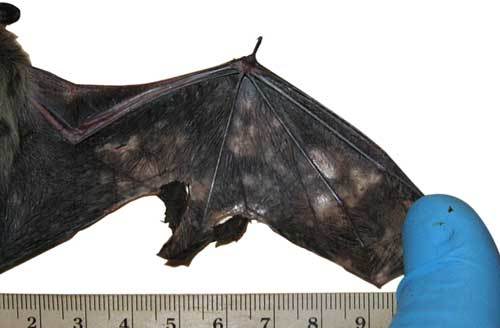
Beyond the population drop, Reynolds and other experts said, bats that survived the winter don't seem to be as healthy as usual. Many bats have visible damage to their wings, including scar tissue, tears and holes, apparently caused by dehydration during hibernation, Reynolds and Darling said, and some still seem to be carrying the telltale white fungus.
"I'm still getting one to two calls a day about dead and dying bats," Darling said. "We thought once they left the caves and mines and got out into their summer habitat . . . their weights would go up and they'd be back in good shape."
Reynolds has noted that many more female bats than usual haven't produced offspring, probably because their body fat reserves were too diminished to deal with it, he said.
"They had enough energy to survive, but not enough for anything extra, like reproduction," Reynolds said.
Researchers know little about the disease and hope that further studies in late summer and fall will at least shed light on whether their health got better or worse over the summer, Darling said. Further declines over the summer might point to an environmental cause, such as pollutants. If the disease does its damage mainly during hibernation, he said, that would suggest some sort of biological pathogen.
"There is a relatively well-coordinated and comprehensive effort to try to tackle this," Darling said.
So far, researchers have been unable to find any hint of a bacterial or viral cause, Reynolds said, but they've found a previously unidentified species of cold-weather fungus. The question is whether it's new to bats or just new to researchers.
"We know we're finding fungus, but we don't know that it's a new fungus for them," Reynolds said of the bats.
Scientists "didn't know this fungus existed before," Reynolds said. "The mycologist was almost giddy talking about it."
The new fungus isn't the same one that causes the distinctive white snouts, however, Reynolds said. Some researchers have suggested fungus on the snouts might actually cause the disease, simply by irritating the bats to the point where they can't get a proper winter's sleep.
"We still are a long ways from indicting the fungus as a cause of death in these animals," Darling said.
The combination of new funguses striking bees and bats and the recent worldwide amphibian fungus epidemic have Darling concerned about the entire "ecological infrastructure," he said.
"It's more than just about bats. It's about broader implications," Darling said. "I'm hoping that when we do pin this down, and I'm hopeful that we will, that there will be a public will to address that problem."
Andrew Wolfe can be reached at 594-6410 or awolfe@nashuatelegraph.com.
ON THE NET
Information on the white nose syndrome Conference.
Information on white nose syndrome.
Bats and white nose syndrome in New Hampshire.
View a video presentation on white nose syndrome by U.S. Fish and Wildlife biologist Susi von Oettingen, of Concord.
Related nashuatelegraph.com coverage
* How you can help solve bat mystery
Re: USA: Bats Die by the Thousands
Source: http://www.nashuatelegraph.com/apps/pbcs.dll/article?AID=/20080707/NEWS01/615534186/-1/news
Published: Monday, July 7, 2008
Disease taking a toll on state's bat population
By ANDREW WOLFE, Staff Writer
awolfe@nashuatelegraph.com
New Hampshire's bats are back, but their ranks have been ravaged by a disease that has devastated bat populations elsewhere in the Northeast, a researcher and a state wildlife official said.
New Hampshire's bat population hasn't been as hard-hit by white nose syndrome as those in Vermont and New York, but the losses are noticeable, said bat researchers Scott Reynolds, of North East Ecological Services, and Emily Brunkhurst, a New Hampshire Fish and Game biologist.
"They are back," Brunkhurst said. "We have gotten some calls from some people . . . who traditionally had them, and the numbers are lower. Significantly lower in some cases, missing in others. I have gotten calls from people who say, 'I've had bats for years, and I don't now.' "
Bats that returned to the state also have been in poor health compared with past years, and fewer are reproducing, Reynolds said.
"I think we're on the front end of something that's just going to be getting worse in the next few years," Reynolds said, adding later, "If the numbers are down and reproduction is down, the big impact will be next year. . . . This may be the front edge of the storm."
Researchers have a few clues, but no solution, to the mystery of what causes white nose syndrome, so named for a fungus that appears around the snouts of affected bats during hibernation. The disease seems to cause bats to burn through their body fat reserves too quickly during hibernation, leading to starvation and dehydration, experts said.
White nose syndrome has hit hardest among little brown bats, one of the most common species, known for its voracious consumption of mosquitoes. A little brown bat eats about half its weight, or about 4,000 mosquitoes, every night ? and what's bad for the predator typically is good for the prey.
"If in fact we have 500,000 fewer bats in the landscape this year, that adds up to about 2 billion insects that are not eaten each night," Vermont Fish and Game bat biologist Scott Darling said.
The scope of white nose syndrome has been compared to Colony Collapse Disorder, which has been decimating North American honeybees, and its cause has remained similarly elusive.
Experts from around the United States and Canada gathered last month in Albany, N.Y., to share information on the disease and try to coordinate strategies for dealing with it.
"Take-home messages were essentially that this is an unprecedented mortality event this past winter," Reynolds said.
White nose syndrome was first identified in New York during the winter of 2006-07. Last winter, Reynolds said, some affected hibernating populations had been all but wiped out.
"Some sites have 90 percent loss," Reynolds said. "Others have as little as 80 percent loss, but it's all of that order."
Researchers simply don't know how far the disease may spread or how bad the impact might be, and they've been wary of predictions, mainly for fear that their estimates would sound incredible, Reynolds said.
"The reductions are overwhelming," Reynolds said. "Because the numbers are so big, they are sensitive that if their counting methods are not accurate, it's going to be seen as alarmist.
"We do know we've never seen anything like this. We know the numbers are huge, but we don't know what the numbers are."
Reynolds has been studying bats for 15 years, focusing on a summer breeding colony in Peterborough, which draws bats from all around the regions affected by white nose syndrome. New Hampshire bats generally hibernate elsewhere, as the state has few caves or mines suitable for winter hibernation.
That colony typically includes from 1,500-2,000 bats, and the population this summer is down by about 25 percent ? a drop well beyond the normal swings, he said.
Reynolds said he has tagged some 4,500 bats from the Peterborough colony over the years, and many of his tagged bats have been found dead of white nose syndrome in hibernacula in Vermont and New York.
"It's only a matter of time before the full impact is felt by this colony," he said.
Beyond the population drop, Reynolds and other experts said, bats that survived the winter don't seem to be as healthy as usual. Many bats have visible damage to their wings, including scar tissue, tears and holes, apparently caused by dehydration during hibernation, Reynolds and Darling said, and some still seem to be carrying the telltale white fungus.
"I'm still getting one to two calls a day about dead and dying bats," Darling said. "We thought once they left the caves and mines and got out into their summer habitat . . . their weights would go up and they'd be back in good shape."
Reynolds has noted that many more female bats than usual haven't produced offspring, probably because their body fat reserves were too diminished to deal with it, he said.
"They had enough energy to survive, but not enough for anything extra, like reproduction," Reynolds said.
Researchers know little about the disease and hope that further studies in late summer and fall will at least shed light on whether their health got better or worse over the summer, Darling said. Further declines over the summer might point to an environmental cause, such as pollutants. If the disease does its damage mainly during hibernation, he said, that would suggest some sort of biological pathogen.
"There is a relatively well-coordinated and comprehensive effort to try to tackle this," Darling said.
So far, researchers have been unable to find any hint of a bacterial or viral cause, Reynolds said, but they've found a previously unidentified species of cold-weather fungus. The question is whether it's new to bats or just new to researchers.
"We know we're finding fungus, but we don't know that it's a new fungus for them," Reynolds said of the bats.
Scientists "didn't know this fungus existed before," Reynolds said. "The mycologist was almost giddy talking about it."
The new fungus isn't the same one that causes the distinctive white snouts, however, Reynolds said. Some researchers have suggested fungus on the snouts might actually cause the disease, simply by irritating the bats to the point where they can't get a proper winter's sleep.
"We still are a long ways from indicting the fungus as a cause of death in these animals," Darling said.
The combination of new funguses striking bees and bats and the recent worldwide amphibian fungus epidemic have Darling concerned about the entire "ecological infrastructure," he said.
"It's more than just about bats. It's about broader implications," Darling said. "I'm hoping that when we do pin this down, and I'm hopeful that we will, that there will be a public will to address that problem."
Andrew Wolfe can be reached at 594-6410 or awolfe@nashuatelegraph.com.
ON THE NET
Information on the white nose syndrome Conference.
Information on white nose syndrome.
Bats and white nose syndrome in New Hampshire.
View a video presentation on white nose syndrome by U.S. Fish and Wildlife biologist Susi von Oettingen, of Concord.
Related nashuatelegraph.com coverage
* How you can help solve bat mystery