WEEKLY BULLETIN ON OUTBREAKS
AND OTHER EMERGENCIES
Week 5: 24 – 30 January 2022
Data as reported by: 17:00; 30 January 2022
...
Lassa Fever Nigeria
170 Cases
32 Deaths
19.0% CFR
EVENT DESCRIPTION
Nigeria is currently reporting an increase in the weekly number of
laboratory-confirmed Lassa fever cases. From week 52 in 2021 to
week two in 2022, a higher number of cases have been reported
compared to the same time period in years 2018 to 2021 (total of
124 cases were reported from week 52 in 2021 to week 2 in 2022
versus 31 cases in the same period of 2021; 98 cases in 2020; 84
in 2019; and 31 in 2018).
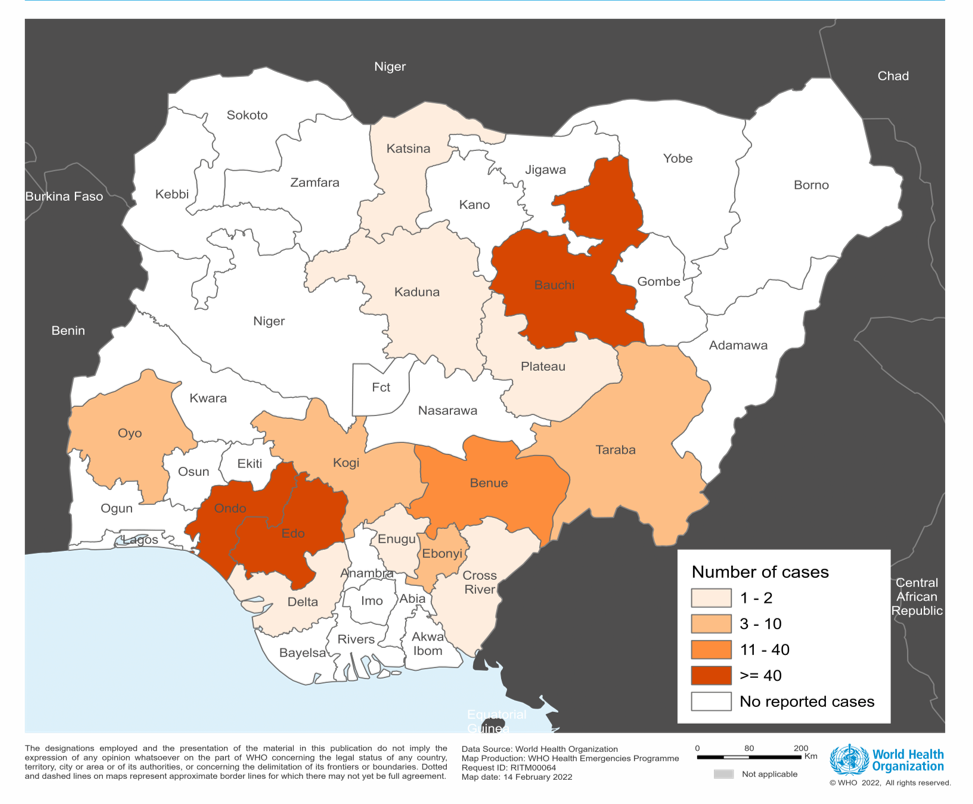
In 2022, from week 1 (ending 9 January) through to week 3
(ending 23 January), a total of 759 suspected cases with 170
confirmed and 32 deaths (CFR = 18.8%) were reported in 12
of 36 states across the country. In week 3, the number of new
confirmed cases increased to 74 cases from 48 in week 2, 2022.
The new cases were reported from Ondo, Bauchi, Edo, Oyo,
Ebonyi, Benue, Katsina, Kaduna and Taraba States. Majority of
the cases (74%) are from Edo (48), and Ondo (48) and Bauchi
(39) States. Four health workers infections are reported.
The predominant age-group affected is that between 21-30 years
(range: 1 to 80 years, median age: 30 years). The male to female
ratio for confirmed cases is 1:0.9.
In contrast, the number of suspected cases has increased from
354 cases from week 1 to week 3 in 2021 to 759 cases in 2022 for
the same period, hence doubling the number of suspected cases
reported in the prior year. Furthermore, the number of confirmed
cases is 40 in 2021 versus 170 in 2022 for the same reporting
period. A total of six states and 17 local government areas (LGAs)
were affected in 2021 against 12 states and 37 LGAs in 2022.
However, the CFR was higher in 2021 (25.0%, 10/40) compared
to 2022 (19.0%, 32/170) for the same period.
PUBLIC HEATH ACTIONS
The Nigeria Centre for Disease Control (NCDC) activated
the National Emergency Operations Centre alert mode for
effective multi-sectoral, multi-disciplinary coordination of
the response, and state public health operation centres were
activated in affected States.
The 2021 Lassa fever high burden states preparedness/
response engagement meeting has been conducted
The national rapid response teams (NRRT) have been
deployment to Edo, Ondo, Bauchi, Benue, Taraba, Ebonyi
and Oyo states and Lassa fever alert letters have been sent
to States
Confirmed cases are being treated at identified treatment
centres across the states and the dissemination of reviewed
case management and safe burial practices guidelines is
ongoing
An update of Viral Haemorrhagic Fever Case Investigation
Form (CIF) database as well as enhanced surveillance
including contact tracing and active case finding in affected
state are also ongoing
In-depth investigation of healthcare worker infections has
been performed
Medical response commodities have been distributed to
states and treatment centres.
Risk communications and community engagement activities
have been scaled up through television, radio, print, social
media and other strategies.
The Federal Ministry of Environment is implementing a Lassa
Fever environmental response campaign in affected states.
SITUATION INTERPRETATION
Lassa fever is endemic in Nigeria and the peak of outbreaks
is usually observed during the dry season (December–April);
therefore, the number of cases is expected to increase in the
coming weeks or months. However, transmission occurs all
year round with sporadic cases being reported at levels below
epidemic thresholds. The increase in number of cases reported
this year and the observed geographical extension of the disease
compared to previous epidemic season are concerning. This is
because the country is supposed to have developed capacities
for Lassa fever prevention and control from previous outbreaks.
However, the lower-case fatality ratio for this year 2022 compared
to 2021 may be considered as a positive impact of previous
outbreak management experience. Late health care seeking
among patients as well as inadequate bed capacity per treatment
centre for case management are still reported.
PROPOSED ACTIONS
Prevention of Lassa fever relies on promoting good
“community hygiene” to discourage rodents from entering
homes. Effective measures include storing grain and other
foodstuffs in rodent-proof containers, disposing of garbage
far from the home, maintaining clean households and
considering keeping cats.
Infection prevention and control measures, strengthening
disease surveillance, active case finding, and health workers
capacity building activities should be reinforced.
Risk communication activities toward affected communities
are paramount to promote rapid health seeking behaviour for
patients and further reduce case fatality ratio of the disease.
OEW05-2430012022.pdf (1.760Mb)
https://apps.who.int/iris/handle/10665/351433