• FluTrackers.com Inc. does not provide medical advice. Information on this web site is collected from various internet resources, and the FluTrackers board of directors makes no warranty to the safety, efficacy, correctness or completeness of the information posted on this site by any author or poster. The information collated here is for instructional and/or discussion purposes only and is NOT intended to diagnose or treat any disease, illness, or other medical condition. Every individual reader or poster should seek advice from their personal physician/healthcare practitioner before considering or using any interventions that are discussed on this website. By continuing to access this website you agree to consult your personal physican before using any interventions posted on this website, and you agree to hold harmless FluTrackers.com Inc., the board of directors, the members, and all authors and posters for any effects from use of any medication, supplement, vitamin or other substance, device, intervention, etc. mentioned in posts on this website, or other internet venues referenced in posts on this website.
  • We are not asking for any donations. Do not donate to any entity who says they are raising funds for us.

Nigeria: 2021/2022 Lassa fever

Source: https://www.vanguardngr.com/2022/01/102-die-as-17-states-record-4632-lassa-fever-cases-2/


102 die as 17 States record 4,632 Lassa fever cases
January 11, 2022

Nigeria recorded 102 Lassa fever deaths from a total cumulatively from week 1-52 of 2021 in 38 Local Government Areas, LGAs of 17 States.

Disclosing this in its Lassa fever Situation Report, EpiWeek52:27December–2January,2021, the Nigeria Centre for Disease Control, NCDC, said the affected states have been alerted on the disturbing trend.

The states affected include Edo (212), Ondo (175), Bauchi (39), Taraba (22), Ebonyi (18), Plateau (9), Benue (8), Kaduna (8), Enugu (5), Nasarawa (3), Kogi (3), FCT (3), Cross River (1), Imo (1), Anambra (1), Delta (1), and Abia (1).In week 52 (December 27, 2021, to January 2, 2022), three new deaths were recorded, even as the number of new confirmed cases decreased from 29 in week 51, 2021 to 28 cases.“These were reported from Ondo, Edo, Bauchi, Kaduna and Taraba States and the Federal Capital Territory (FCT)...

+++++++++++++++++++++++

Source: https://punchng.com/lassa-fever-kills-who-doctor-other-in-benue/

Lassa fever kills WHO doctor, other in Benue
John Charles
11 January 2022

Two people, one of them a medical doctor identified as Samuel Nyityo, have died of Lassa fever in Benue State.

The other person is said to be in a stable condition.

The medical doctor, who was working with the World Health Organisation, was diagnosed with Lassa fever and was rushed to Irrua in Edo State, where he died on Sunday...
 
WEEKLY BULLETIN ON OUTBREAKS
AND OTHER EMERGENCIES

Week 2: 3 – 9 January 2022
Data as reported by: 17:00; 9 January 2022

...

Lassa Fever Nigeria

482 Cases
99 Death
21.0% CFR


EVENT DESCRIPTION

Nigeria has been experiencing a Lassa fever (LF) outbreak since
2017. Although the country has seen a decreasing trend, week
51 2021 saw a spike of 29 cases after the highest number of 15
cases was recorded in week 25 2021.

During week 51 (week ending 26 December 2021), a 7.0%
increase was seen in new LF cases (29 cases) compared to the 10
cases reported in the previous week (week 50). These new cases
were identified from four states: Bauchi (18), Edo (6), Ondo (4)
and Plateau States (1). Three new deaths from Bauchi (2) and
Edo (1) were reported in the same period. There were 29 case
patients admitted to treatment centres during the reporting week,
and 487 contacts under follow up. Two new healthcare worker
infections were recorded in week 51.

Since the beginning of 2021 and as of 26 December, there has
been, a cumulative total of 4 482 suspected Lassa fever, of
which 482 (13.0%) were laboratory confirmed and five were
probable cases. The confirmed cases occurred across 67 Local
Government Authorities (LGAs) in 17 states that recorded at
least one confirmed case. Edo State recorded the highest number
of confirmed cases at 203 (42%), followed by Ondo State with
163 (34%); and Bauchi with 35 cases (7.3%), all accounting for
83.0% of all confirmed cases. A total of 10 health workers were
infected with the disease in 2021.

Furthermore, from week 1 to week 51 2021, 99 deaths were
reported with a case fatality ratio (CFR) of 21.0% which is similar
for the same period in 2020. The largest age-group affected is 21-
30 years (range: <1 to 70 years, median age 29 years). The male
to female ratio for confirmed cases in 1:0.9.

PUBLIC HEALTH ACTIONS

National Rapid Response Team have been deployed from
the Nigerian Centre for Disease Control (NCDC) to support
response activities in Kaduna, Bauchi and Taraba states.

Response teams conducted a lassa fever preparedness and
response engagement meeting in high burden States.

The five Lassa fever molecular laboratories in the NCDC
network are working full capacity to ensure that all samples
are tested and results provided within the shorted turnaround time.
National Lassa fever multi-partner, multi-sectoral Technical
Working Group (TWG) continues to coordinate the response
activities at all levels

Multi-sectoral Public Health Emergency Operation Centres
(PHEOC) were activated in affected States
Surveillance activities have been enhanced in affected states,
with contact tracing and active case finding underway.

Risk communication and community engagement activities
have been scaled up within affected states using television,
radios, social media and other strategies.

The Lassa Fever Environmental response campaign has been
implemented in high burden states by the Federal Ministry of
Environment.

SITUATION INTERPRETATION

While the Lassa fever outbreak in Nigeria appears to be declining,
there is little room for complacency as the vector is endemic to
the region and environmental conditions are favourable to disease
spread. Active case finding and contact tracing and follow-up need
to continue to prevent resurgence of the disease in this endemic
region. Furthermore, the local and national authorities need to
remain vigilant on this event in the wake of the shifting priorities
to other health emergencies, particularly COVID-19 pandemic.

PROPOSED ACTIONS

Nigerian health authorities need to continue to enhance
surveillance and response even when the Lassa fever outbreak
in the country is slowing down. More so, affected states need
to be supported to develop and implement Lassa fever response
sustainability plan. aged 9 months or over.

...
OEW02-0309012022.pdf (‎1.946Mb)‎

https://apps.who.int/iris/handle/10665/351001
 
Source: https://www.channelstv.com/2022/01/17/nigeria-confirms-48-new-lassa-fever-cases/

Nigeria Confirms 48 Lassa Fever Cases In One Week
Channels Television
Updated January 17, 2022

The Nigeria Centre for Disease Control (NCDC) has confirmed 48 cases of Lassa fever in the country in 2022.

This is according to the NCDC’s epidemiological report for January 3 to January 9 published on the agency’s website.

According to the update, the new cases were confirmed in 10 states and 22 local government areas in Nigeria. Bauchi (29%), Edo (27%), and Ondo (23%) states account for 79 per cent of the cases...
 
Source: https://dailytrust.com/lassa-fever-fg-tasks-nigerians-on-preventive-measures

Lassa fever: FG tasks Nigerians on preventive measures
By Baba Martins
Mon, 24 Jan 2022 03:53:51 GMT

The Minister of State for the Environment, Sharon IKeazor, has tasked Nigerians curtail Lassa fever outbreak.

He asked citizens to keep their surroundings clean, keep food away from rodents, store grains and other foodstuffs in rodent proof containers and cook all food thoroughly before consumption.

Addressing reporters in Abuja at the weekend, he cite the recent report by the Nigeria Centre for Disease Control that 96 confirmed cases and 11 deaths were recorded from January 3 to 16 in 27 local government areas across Bauchi, Edo, Ondo, Benue, Taraba, Kaduna, Plateau, Kogi, Cross River, Ebonyi and Oyo States...
 
Source: https://punchng.com/lassa-fever-kills-32-in-three-weeks-infects-759-in-26-states/

Lassa fever kills 32 in three weeks, infects 759 in 26 states
Deborah Tolu-Kolawole
30 January 2022

Data from the Nigeria Centre for Disease Control on Saturday revealed that no fewer than 32 individuals lost their lives to Lassa fever in three weeks.

This is as the centre notes that a total of 759 suspected cases were reported within the period across 26 states and the Federal Capital Territory...
 
WEEKLY BULLETIN ON OUTBREAKS
AND OTHER EMERGENCIES

Week 5: 24 – 30 January 2022
Data as reported by: 17:00; 30 January 2022

...
Lassa Fever Nigeria

170 Cases
32 Deaths
19.0% CFR


EVENT DESCRIPTION

Nigeria is currently reporting an increase in the weekly number of
laboratory-confirmed Lassa fever cases. From week 52 in 2021 to
week two in 2022, a higher number of cases have been reported
compared to the same time period in years 2018 to 2021 (total of
124 cases were reported from week 52 in 2021 to week 2 in 2022
versus 31 cases in the same period of 2021; 98 cases in 2020; 84
in 2019; and 31 in 2018).

In 2022, from week 1 (ending 9 January) through to week 3
(ending 23 January), a total of 759 suspected cases with 170
confirmed and 32 deaths (CFR = 18.8%) were reported in 12
of 36 states across the country. In week 3, the number of new
confirmed cases increased to 74 cases from 48 in week 2, 2022.
The new cases were reported from Ondo, Bauchi, Edo, Oyo,
Ebonyi, Benue, Katsina, Kaduna and Taraba States. Majority of
the cases (74%) are from Edo (48), and Ondo (48) and Bauchi
(39) States. Four health workers infections are reported.

The predominant age-group affected is that between 21-30 years
(range: 1 to 80 years, median age: 30 years). The male to female
ratio for confirmed cases is 1:0.9.

In contrast, the number of suspected cases has increased from
354 cases from week 1 to week 3 in 2021 to 759 cases in 2022 for
the same period, hence doubling the number of suspected cases
reported in the prior year. Furthermore, the number of confirmed
cases is 40 in 2021 versus 170 in 2022 for the same reporting
period. A total of six states and 17 local government areas (LGAs)
were affected in 2021 against 12 states and 37 LGAs in 2022.
However, the CFR was higher in 2021 (25.0%, 10/40) compared
to 2022 (19.0%, 32/170) for the same period.

PUBLIC HEATH ACTIONS

The Nigeria Centre for Disease Control (NCDC) activated
the National Emergency Operations Centre alert mode for
effective multi-sectoral, multi-disciplinary coordination of
the response, and state public health operation centres were
activated in affected States.

The 2021 Lassa fever high burden states preparedness/
response engagement meeting has been conducted

The national rapid response teams (NRRT) have been
deployment to Edo, Ondo, Bauchi, Benue, Taraba, Ebonyi
and Oyo states and Lassa fever alert letters have been sent
to States

Confirmed cases are being treated at identified treatment
centres across the states and the dissemination of reviewed
case management and safe burial practices guidelines is
ongoing

An update of Viral Haemorrhagic Fever Case Investigation
Form (CIF) database as well as enhanced surveillance
including contact tracing and active case finding in affected
state are also ongoing

In-depth investigation of healthcare worker infections has
been performed

Medical response commodities have been distributed to
states and treatment centres.

Risk communications and community engagement activities
have been scaled up through television, radio, print, social
media and other strategies.

The Federal Ministry of Environment is implementing a Lassa
Fever environmental response campaign in affected states.

SITUATION INTERPRETATION

Lassa fever is endemic in Nigeria and the peak of outbreaks
is usually observed during the dry season (December–April);
therefore, the number of cases is expected to increase in the
coming weeks or months. However, transmission occurs all
year round with sporadic cases being reported at levels below
epidemic thresholds. The increase in number of cases reported
this year and the observed geographical extension of the disease
compared to previous epidemic season are concerning. This is
because the country is supposed to have developed capacities
for Lassa fever prevention and control from previous outbreaks.
However, the lower-case fatality ratio for this year 2022 compared
to 2021 may be considered as a positive impact of previous
outbreak management experience. Late health care seeking
among patients as well as inadequate bed capacity per treatment
centre for case management are still reported.

PROPOSED ACTIONS

Prevention of Lassa fever relies on promoting good
“community hygiene” to discourage rodents from entering
homes. Effective measures include storing grain and other
foodstuffs in rodent-proof containers, disposing of garbage
far from the home, maintaining clean households and
considering keeping cats.

Infection prevention and control measures, strengthening
disease surveillance, active case finding, and health workers
capacity building activities should be reinforced.

Risk communication activities toward affected communities
are paramount to promote rapid health seeking behaviour for
patients and further reduce case fatality ratio of the disease.


OEW05-2430012022.pdf (‎1.760Mb)‎

https://apps.who.int/iris/handle/10665/351433
 
Source: https://guardian.ng/news/lassa-feve...aths-four-health-workers-infected-in-january/

Lassa fever: NCDC registers 40 deaths, four health workers infected in January
By NAN
06 February 2022 | 9:13 am

The Nigeria Centre for Disease Control (NCDC), registered 40 Lassa fever-related deaths in January, adding that four health workers were also infected following the latest outbreak of Lassa fever in the country.

The NCDC, via its verified website, made this known on Sunday morning, saying that it is currently distributing medical response commodities to states and treatment centres...
 
Source: https://punchng.com/lassa-fever-death-toll-hits-48-20-health-workers-infected/

Lassa fever: Death toll hits 48, 20 health workers infected
Deborah Tolu-Kolawole
14 February 2022

The Nigeria Centre for Disease Control, on Sunday, confirmed that 20 health workers had been infected with the Lassa fever since the beginning of the year, while the death toll had increased to 48.

The centre noted this in its latest Lassa fever situation report, which was published on its website.

Lassa fever, a disease that is endemic in Nigeria, occurs throughout the year but more cases are recorded during the dry season.

The NCDC appealed to health workers to “maintain a high index of suspicion for Lassa fever, be vigilant and look out for symptoms of Lassa fever. Not all fevers are malaria.”...
 
Source: https://www.who.int/emergencies/disease-outbreak-news/item/lassa-fever---nigeria


Lassa Fever - Nigeria

14 February 2022


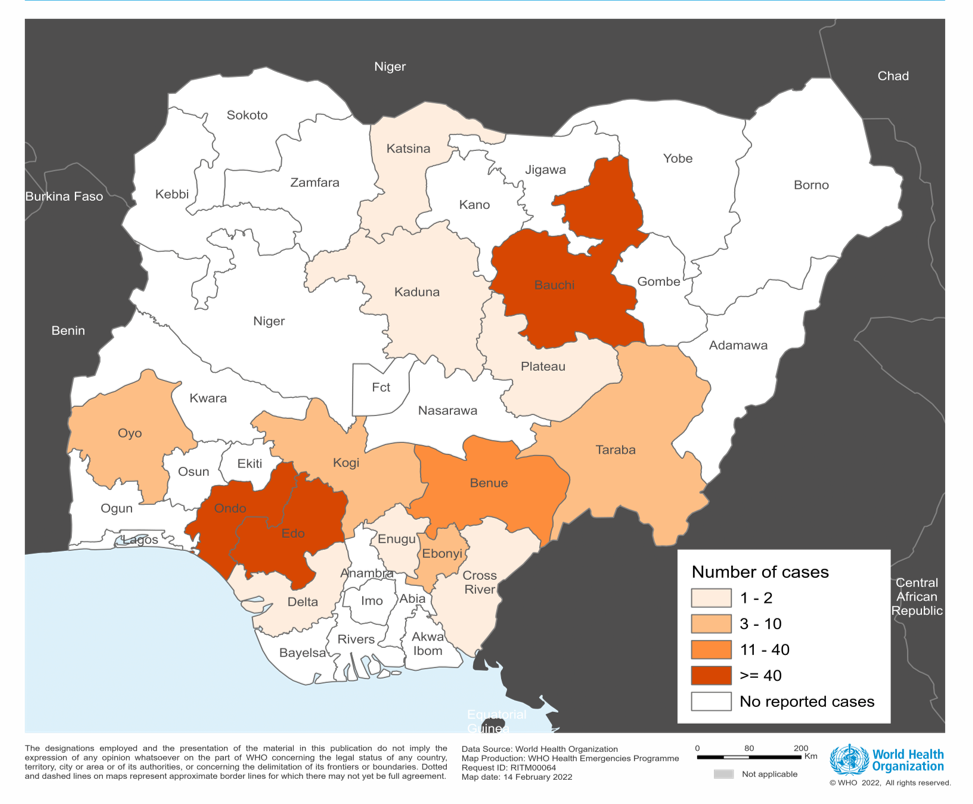
In Nigeria, from 3 to 30 January 2022, 211 laboratory confirmed Lassa fever cases including 40 deaths (case fatality ratio: 19%) have been cumulatively reported in 14 of the 36 Nigerian states and the Federal Capital Territory across the country (Figure 1). Three states account for 82% of confirmed cases: Ondo (63), Edo (57) and Bauchi (53). The other states affected are Benue (11), Ebonyi (5), Oyo (5), Taraba (5), Kogi (4), Enugu (2), Kaduna (2), Cross River (1), Delta (1), Katsina (1) and Plateau (1) (Figure 2).

Of the 211 laboratory confirmed cases, five cases have been reported among health workers in two states, Edo (3) and Benue (2).
Figure 1. Weekly number of reported confirmed Lassa Fever cases and deaths in Nigeria during the epidemiological weeks one (commencing 2 January) through four (commencing 23 January) in 2022.

In contrast, noticeably less Lassa fever cases with less geographical spread were reported for the same period (epidemiological weeks 1- 4) in 2021 (54 confirmed cases, including 12 deaths, from 8 States).
Lassa fever is endemic in Nigeria and the annual peak of Lassa fever cases is typically observed during the dry season (December–April). Thus, the number of infections is expected to rise further until the end of the dry season.

While endemic in Nigeria, cases are much higher than the previous epidemic seasons. This could be attributed to reduced response capacity in surveillance and laboratory testing. It is necessary to continue to monitor the annual peaks of Lassa fever in order to contextualize incidence and inform the effective management of Lassa fever.
Figure 2. Confirmed cases of Lassa fever by States reported in Nigeria from 3 – 30 January 2022


Public health response
  • Coordination: The Nigeria Centre for Disease Control (NCDC) has activated the National Emergency Operations Centre alert mode for effective multi-sectoral, multi-disciplinary coordination of the response. Similarly, state public health operation centres were activated in affected states. National rapid response teams (NRRT) have been deployed to the Federal Capital Territory and Bauchi, Benue, Ebonyi, Edo, Nasarawa, Ondo, Oyo and Taraba States.
  • Case Management and Infection Prevention and Control (IPC): Case management, and infection prevention and control (IPC) guidelines have been disseminated. Public and health-care worker advisories have been distributed. Case management and IPC training for treatment centre health-care workers have been conducted.
  • Surveillance: Enhanced surveillance activities for Lassa fever are ongoing in all states including increased case finding. Reported data is used to generate situational updates by the NCDC and inform further response plans.
  • Clinical management: Confirmed cases are being treated at identified treatment centres across the states. Medical response commodities have been distributed to states and treatment centres.
  • Laboratory capacity: The seven national Lassa fever laboratories within the NCDC network that can perform molecular tests are working with full capacity to ensure timely processing of samples.
  • Community engagement: Risk communications and community engagement activities have been scaled up through television, radio, print, social media and other strategies.
  • Vector and environmental control: The Federal Ministry of Environment is implementing a Lassa fever environmental response campaign in affected states.


WHO risk assessment

Lassa fever is a viral haemorrhagic fever that is primarily transmitted to humans via contact with food or household items contaminated with urine or faeces from Mastomys rats. Though to a lesser extent, secondary human-to-human transmission can also occur through direct contact with the blood, secretions, organs or other body fluids of infected persons, especially in health-care settings.

As aforementioned, the peak of Lassa fever cases in humans typically occurs in the dry season (December-April) and follows the reproduction cycle of the Mastomys rats in the wet season (May – November). Given that 90-95% of human infections are due to indirect exposure (through food or household items contaminated by infected rats’ excreta) or direct contact with infected Mastomys rats, the very high density and high circulation of Lassa fever virus in the rat population poses a risk for further human infection during the dry season.

Approximately 80% of Lassa virus infections in humans are either asymptomatic or mild, however, infection in the remaining 20% manifests as a febrile illness of variable severity associated with multiple organ dysfunctions with or without haemorrhage. The overall case fatality ratio among all infected people is approximately 1% but is significantly higher among patients hospitalized with severe illness (around 15%).

Timely diagnosis results in more rapid isolation of patients and provision of treatment, while also reducing the risk of person-to-person transmission in health care settings. Early supportive care with rehydration and symptomatic treatment improves survival of patients.

The current overall risk is considered high at national level. While Lassa fever is endemic in Nigeria and the country has developed an increased capacity for the prevention and control of Lassa fever outbreaks, including strengthened surveillance, diagnostic and treatment capacity, several factors contribute to the current elevated risk level. These include an increase in the number of confirmed cases compared to previous epidemic seasons, gaps in surveillance and varying degrees of subnational response capacity, delays in sample shipment for laboratory testing, a decrease of case management capacity due to conversion of dedicated Lassa fever facilities into COVID-19 health-care facilities and suboptimal IPC procedures. These factors combined warrant the need for further improvement and support of the country’s capacity to detect and respond to Lassa fever outbreaks. In addition, the five confirmed cases among health workers, which included two workers caring for the same patient in the emergency ward, further emphasizes the urgent need to strengthen IPC measures.

The overall regional and global risk is considered low due to minimal cross-border transmission from Nigeria to neighbouring countries. Lassa fever is known to be endemic in West African countries, primarily in Sierra Leone, Guinea, Liberia and Nigeria, but may exist in other countries in the same region.


WHO advice

Mastomys rats are the main reservoir for Lassa virus and so abundant in endemic areas in West Africa that it is not possible to eliminate them from the environment. Prevention of Lassa fever relies on promoting good “community hygiene” to discourage rodents from entering homes. Effective measures include storing grain and other foodstuffs in rodent-proof containers, disposing of waste far from the home, maintaining clean households and considering keeping cats. Precaution should be taken when handling Mastomys rats. All animal products should be thoroughly cooked.

Those caring for affected persons should be careful and avoid contact with blood and body fluids.

In health-care settings, health workers and volunteers should apply standard infection prevention and control (IPC) measures when caring for individuals, regardless of their presumed diagnosis. These include basic hand hygiene, respiratory hygiene, use of personal protective equipment (to block splashes or other contact with infected materials) and safe injection practices.

Health workers caring for those with suspected or confirmed Lassa fever should apply extra infection control measures to prevent contact with the person’s blood, body fluids and contaminated surfaces or materials such as clothing and bedding. When in close contact (within 1 meter) of individuals with Lassa fever, health workers should wear face protection (a face shield or a medical mask and goggles), a clean, non-sterile long-sleeved gown, and gloves (sterile gloves for some procedures).

Personnel working in laboratories are also at risk. Samples taken from suspected Lassa fever cases for diagnostics should be handled by trained staff and processed in suitably equipped laboratories under maximum biological containment conditions.

WHO continues to advise all countries endemic for Lassa fever on the need to enhance early detection and treatment of cases to reduce the case fatality rate.

WHO advises against any restrictions on travel or trade to or from Nigeria and the affected areas based on the currently available information.
 
Source: https://www.premiumtimesng.com/heal...-21-deaths-91-new-infections-in-one-week.html


Lassa Fever: Nigeria records 21 deaths, 91 new infections in one week
The report shows that Ondo, Edo, and Bauchi states accounted for 73 per cent of the confirmed cases.
byMariam Ileyemi
February 26, 2022

In week seven of 2022, spanning between February 14 and 21, Nigeria recorded 21 additional fatalities and 91 new infections from Lassa fever, says the latest situation report released by the Nigeria Centre for Disease Control (NCDC).

The report, which was released on Friday, noted that the number of confirmed cases increased from 77 in the previous week to 91 in the reporting week.

The new cases, NCDC noted, were recorded in Edo and Delta; South-eastern states of Ebonyi and Enugu; Taraba, Bauchi and Gombe states in North-east; Kogi and Nasarawa states in North-central, and Ondo State in the South-west.

The centre further noted that cumulatively from the first week to the seventh week of 2022, 86 deaths have been reported so far with a case fatality rate (CFR) of 19.1 per cent.

The agency said the new case fatality rate is lower than 27.5 per cent that was recorded for the same period in 2021.

NCDC added that a total of 450 people have been infected by Lassa fever, while there are currently 356 suspected cases across 74 Local Government Areas in 21 states of the federation...
 
Another Doctor Allegedly Dies Of Lassa Fever

On Mar 1, 2022

Dr Abel Obetta, has reportedly died of Lassa Fever after allegedly getting infected in a hospital.

A colleague of Dr. Obetta, with the Twitter handle, @sports_doctor2 disclosed this on Monday and also lamented in his tweet that the amount medical doctors are paid as hazard allowance by the Federal Government is too small compared to the risk they are exposed to.

The post shared on his Twitter handle reads, “This is Dr. Abel. Dr. Abel is the second doctor dying from Lassa fever this year. Guess where he got it from? – Hospital. Guess how much he was paid as a hazard allowance? – 5k. The sacrifice is too much and it’s not worth it!!! Oh, I’m heartbroken. R.I.P Dr. Abel”

This disclosure is coming after the Nigeria Centre for Disease Control reported that 30 health workers have been infected with the disease.
...
https://von.gov.ng/2022/03/01/another-doctor-allegedly-dies-of-lassa-fever/
 
Back
Top