• FluTrackers.com Inc. does not provide medical advice. Information on this web site is collected from various internet resources, and the FluTrackers board of directors makes no warranty to the safety, efficacy, correctness or completeness of the information posted on this site by any author or poster. The information collated here is for instructional and/or discussion purposes only and is NOT intended to diagnose or treat any disease, illness, or other medical condition. Every individual reader or poster should seek advice from their personal physician/healthcare practitioner before considering or using any interventions that are discussed on this website. By continuing to access this website you agree to consult your personal physican before using any interventions posted on this website, and you agree to hold harmless FluTrackers.com Inc., the board of directors, the members, and all authors and posters for any effects from use of any medication, supplement, vitamin or other substance, device, intervention, etc. mentioned in posts on this website, or other internet venues referenced in posts on this website.
  • We are not asking for any donations. Do not donate to any entity who says they are raising funds for us.

Indonesia Discussion

Re: Indonesia BF - 5/22-5/23

Re: Indonesia BF - 5/22-5/23

Commentary

Human H5N1 Sequences from North Sumatra Indonesia

Recombinomics Commentary

May 23, 2006

Full genetic sequencing of two viruses isolated from cases in this cluster has been completed by WHO H5 reference laboratories in Hong Kong and the USA. Sequencing of all eight gene segments found no evidence of genetic reassortment with human or pig influenza viruses and no evidence of significant mutations. The viruses showed no mutations associated with resistance to the neuraminidase inhibitors, including oseltamivir (Tamiflu).

The human viruses from this cluster are genetically similar to viruses isolated from poultry in North Sumatra during a previous outbreak.

Although the above WHO description has more detail than earlier description of the first confirmed human case in Indonesia

Genotyping of the PCR-amplified isolate from the confirmed case shows high homogeneity with other H5N1 isolates from poultry in Java, and no evidence of reassortment.

Or the second confirmed case

The sequence showed that the virus was essentially the same A(H5N1) avian influenza virus that had already been circulating in poultry in Indonesia, he said.

The sequence from the first case has been made public and it had a number of features that distinguishing it from poultry in Java. There was high homology with the poultry isolates, but the sequence had a novel HA cleavage site as well as an extra glycosylation site on HA. Subsequent reports indicated almost all isolates from West Java / Lampung had the novel cleavage site raising question of the origin of the H5N1 infecting people in the area.

In contrast, as noted above, the second sequence was "essentially the same" as avian influenza. But not considered essentially the same as the first isolate, suggest the second isolate from Indonesia was the sequence without the novel cleavage site.

For the index isolate, only the HA and NA sequence of the CDC has been released. It is likely that the described Hong Kong version of the sequences are virtually identical.

The two North Sumatra sequences sound like they are closely related to each, which would have been expected for isolates from relatives infected around the same time in the same location. The comments on reassortment are not surprising. H5N1 has never been shown to reassort with human or swine sequences although H5N1 isolates have acquire mammalian polymorphism via recombination. Similarly, the H1N1 pandemic strain of 1918 had no evidence of reassortment, but had polymorphisms from human and swine H1N1 isolates from the early 1930's indicating the pandemic strain was also a recombinant between two H1N1 serotypes. Swine H5N1 is closely related to avian H5N1 and neither are efficiently transmitted to humans.

However, the North Sumatra cluster was generated by extended human to human transmission (H2H), covering at least three generations (H2H2H2H), raising questions about acquired plymorphisms which may not be considered "significant" by the sequencers. Interestingly they only spoke of wild type NA sequences, resulting in Tamiflu sensitivity. This would be expected, since yesterday the United States announced deployment of its Tamflu reserves to Asia.

However, yesterday WHO announced use of amantadines in combination with Tamiflu, but the above description fails to indicate that the isolates are amantadine sensitive. Since prior poultry isolates in Indonesia have been shown to be amantadine resistant, but none have been shown to be Tamiflu resistant, the exclusion of comments on amantadine suggests the human isolates, like some of the poultry isolates, are amantadine resistant.

Similarly, there is no mention of the presence of the PB2 polymorphism, E627K, which when combined with a wild type H5N1 cleavage site is almost always fatal in mammals. This change has been found in human H5N1 isolates from the 1997 outbreak in Hong Kong as well as outbreaks in more recent outbreaks in Vietnam and Thailand. The change has also been found in fatal infections of wild and domestic cats and well as a domestic dog.

However, such interpretations of carefully parsed updates should not be necessary. All eight gene segments of all of the H5N1 in Indonesia should be released. The sequences in West Java raise serious question about the origin of the infections and the determine of the what is and is not significant in the current isolates should be determined by the scientific community and not a small group of sequencers overly focused on reassortment, which was also not demonstrated in earlier lab experiments mixing 1997 avian H5N1 with human H3N2 genes and will probably not be demonstrated when 2004 H5N1 is mixed with human H3N2 genes.

The current cluster has extended H2H transmission chains. Careful analysis of the full sequences could provide genetic clues on possible reason why the transmission was efficient and deadly. Seven of the eight cluster members have died, making this cluster the deadliest reported to date. This deadly combination may be due to a wild type cleavage site of RERRRKKR coupled with a PB2 E627K polymorphism, which in the past has been fatal in almost all human infections coupled with the RERRRKKR cleavage site.

However, there is no reason to be speculating on the sequestered sequences.

They should be released immediately.

Media Link

Map
 
Re: Indonesia Discussion

I would like to remind everyone about our policy of no bashing of any members, organizations, countries, religions, cultures, governments, institutions, etc.

THIS IS A FIRM POLICY.


Thank you.

S.
 
Re: Indonesia Discussion

IMO, the res ipsa loquitur, the facts speak for themselves.

Niman's bimodal chain is occam's razor accurate, and this time it extends through 3 or 4 individuals in a month long chain which may yet continue due to the "escape" of the latest infected father who must have been sleeping somewhere in the village while he hid from the authorities.

This is Phase 4 per WHO's own guidelines.

The politics of this event control, irrespective of the assured expansion of those who will become diseased, both in Indonesia and consequentially therefrom.
a. The government there is at risk of being overthrown due to the rage of the populace which rage we saw a glimpse today by the people of the village in Sumatra, ready to and actively resisting PPE and rational protective steps to reduce risk of contamination and disease infection.
b. The government there must promote the continuance of international trade and commerce or the economic infrastructure of Indonesia would literally collapse within days, again leading to its overthrow.

Given those two choices above, there is no choice; the answer is clear, and that is to muddle along until there is nothing more that can be done.

The collapse of the markets in 1918 were sudden and unexpected. In this case, the collapse is expected among the illuminati, but not among the lumpen proletariat. Hence, history will repeat itself.

The fact that Indonesia does not now call for vax plants to be constructed within their country at whatever cost is "key". Failure by that government to identify the only universally acknowledged solution to terminate and temper the pandemic now started (imo as I define the multiple clusters to be undenounceable, unstoppable heralds of the pandemic stage 6) signals to the first world that the pandemic will in fact occur, just as nature will itself present.

The missing 50,000 cartons of Aussie Tamiflu, never mentioned since the gift was passed to Indonesia, is certainly "suspect". Accountability has not been demanded of the Indo government officials. Were it stolen, the people of Indonesia would again have good reason to overthrow their government. This subject is dynamite. It remains safely buried, it appears.
 
Last edited:
Re: Indonesia Discussion

>The missing 50,000 cartons of Aussie Tamiflu, never mentioned since the gift was passed to Indonesia, is certainly "suspect". Accountability has not been demanded of the Indo government officials. Were it stolen, the people of Indonesia would again have good reason to overthrow their government. This subject is dynamite. It remains safely buried, it appears

GR, since we are playing conspiracies here, perhaps the cartons have not gone missing at all. maybe they have been used.
 
Re: Indonesia Discussion

AnneZ said:
>The missing 50,000 cartons of Aussie Tamiflu, never mentioned since the gift was passed to Indonesia, is certainly "suspect". Accountability has not been demanded of the Indo government officials. Were it stolen, the people of Indonesia would again have good reason to overthrow their government. This subject is dynamite. It remains safely buried, it appears

GR, since we are playing conspiracies here, perhaps the cartons have not gone missing at all. maybe they have been used.
Yes they were "used" in an international smuggling event. We must be honest here. The people who handled this drug were not giving it to the hospital because we had reports of 4 and 5 cartons available at major regional hospitals after its receipt. I've thought a lot about this. I'm guessing it was just sold off to international pharmacies and dealt out over the internet or to large industrial buyers like Bramson who took 10,000.
Storage of that much drug requires temp. controlled space, at a premium in hot Indonesia. 50,000 is not the same as 1000 (about the amount that's been handed out, imo). There's a serious rip off at $100 per carton x 40,000 makes someone $4 million. It's a nasty place. I was there; I saw the contempt by some of the rich towards the poor and those in stations below them. And if you don't think the poor don't get the message, look at the behavior of the people of Karo, now.

I posted long ago that nothing would get done, and nothing has been done. I posted that the place was corrupt, inherent to the cultural reality of a headman society. I posted that the culture was so deferential that nobody would do anything to offend or to lose face. The outcome was obvious and it is now for me merely ratified. The virus will do its thing. We here, in first world, will get its message as well.
 
Re: Indonesia Discussion

Dr Niman is posting about a new family cluster - Are these clusters connected?

Are we seeing the results of the uncle going back to his village and spreading the virus to his caregivers, friends, neighbors... who in turn scattered as he sickened and then died?

I am just throwing out possibilities based on human nature.
 
Re: Indonesia Discussion

Goju said:
Dr Niman is posting about a new family cluster - Are these clusters connected?
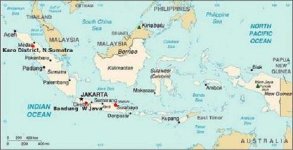
Don't think so. The Big Cluster is in North Sumatra -- in the Karo district. The most recent cluster (the two individuals hospitalized have already died) is in West Java in Bandung. See map below. I've also added Surabaya which is where the 'Lily' cluster is from.

Indonesia.JPG
 
Release the Sequences!

Release the Sequences!

They need to release the sequences so we can all see how
little they've changed or if they've changed a lot. This would
be reassuring ... or not.

The world deserves to know.
 
Re: Indonesian bird flu cluster may be human-to-human-to-human spread: WHO

Re: Indonesian bird flu cluster may be human-to-human-to-human spread: WHO

I read in one article that they couldn't pay for it and they didn't want to saddle their families with the bill when they died.
 
Re: Indonesia Discussion

Bird Flu Case May Be First Double Jump

<NYT_BYLINE type=" " version="1.0">By DONALD G. McNEIL Jr.
</NYT_BYLINE>Published: May 24, 2006
<NYT_TEXT>Reacting to the death on Monday of an Indonesian man, the World Health Organization said yesterday that the case appeared to be the first example of the avian flu jumping from human to human to human.

But the health agency quickly cautioned that this did not necessarily mean that the virus had mutated into a strain that could start a pandemic by jumping rapidly between people as ordinary flu does.
It is a "definite possibility" that the virus jumped more than once inside a family cluster, said Maria Cheng, a spokeswoman for the W.H.O. in Geneva. Although a second jump sounds alarming, "It doesn't look like the trend has changed," she said. "Each case was in very close contact with the previous one."
In the past there have been at least three cases of suspected human-to-human transmission of the A(H5N1) strain of bird flu; all were between family members who spent hours in close contact and would have breathed in large amounts of virus-contaminated droplets. The virus is known to attach itself to receptors deep in the lungs, not in the nose and throat as seasonal flu does.
The man who died was 32 and became sick on May 15. He is believed to have caught the flu while caring for his 10-year-old son, who died of the disease on May 13.
The boy attended a family pork roast in the village of Kubu Sembilang in northern Sumatra on April 29. The hostess, a 37-year-old woman, had become sick on April 27 and was coughing heavily, and several family members slept in her small room, the health agency said. She died May 4 and was buried without any tissue samples being taken; she is presumed to have spread the flu only because of her symptoms.
Six more family members who were at the barbecue fell sick in the first week of May. Five of them, including the 10-year-old, died in the second week of May; only one, the hostess's 25-year-old brother, recovered.
Thirty-three other people in Kubu Sembilang who had contact with the family have been quarantined or have been treated with Tamiflu, an antiviral drug, Ms. Cheng said.
The W.H.O. assumes that the incubation time for bird flu in humans is 7 to 10 days, longer than that of regular flu, she said.
Henry L. Niman, who runs recombinomics.com, a Web site tracking the genetics of flu cases, argues that the incubation period is closer to the two to four days of regular flu, so the boy may have been infected by another family member, meaning that the virus might have made three consecutive human-to-human jumps. But Ms. Cheng said the health agency's "working hypothesis" was still that it had jumped only twice.
An Indonesian health official, according to local news reports, said the boy's father had run away after falling ill and had been treated with Tamiflu. He was later found in the village again but refused treatment.
Ms. Cheng said the village had "not been as cooperative as we'd like."
Recalling outbreaks of Ebola in which African villagers had been terrified at the sight of foreign doctors arriving in hoods and white overalls, she said she thought that the W.H.O. team had worn civilian clothes, and put on masks only when talking to sick patients.

http://www.nytimes.com/2006/05/24/world/asia/24birdflu.html?_r=1&oref=slogin
 
Re: Indonesia Discussion

Bird flu case in Indonesia may have spread from person to person

5/24/2006, 8:15 AM CDT


An outbreak of the H5N1 avian influenza virus in North Sumatra has taken the lives of six family members, and the World Health Organization says that human-to-human transmission cannot be ruled out.

Yesterday, the Ministry of Health in Indonesia confirmed the virus in a 32-year-old man who developed symptoms on May 15, and died on May 22. This man was the seventh member of an extended family in the Kubu Sembelang village to become infected with the H5N1 virus, and the sixth to die. The first member of the family to fall ill died on May 4, but because no specimens were taken, the cause of her death cannot be determined. However, as her clinical course was compatible with H5N1 infection, epidemiologists at the outbreak site include this woman as the initial case in the cluster.

The newly confirmed case is a brother of the initial case, and his 10-year-old son died of H5N1 infection on May 13. The father was closely involved in caring for his son, and this contact is considered a possible source of infection.

Although the investigation is continuing, preliminary findings indicate that three of the confirmed cases spent the night of April 29 in a small room together with the initial case at a time when she was symptomatic and coughing frequently. These cases include the woman's two sons and a second brother, age 25, who is the sole surviving case among infected members of this family. Other infected family members lived in adjacent homes.

All the confirmed cases in the cluster can be directly linked to close and prolonged exposure to a patient during a phase of severe illness. Although human-to-human transmission cannot be ruled out, the search for a possible alternative source of exposure is continuing.

Both the Ministry of Health and WHO are concerned about the situation in Kubu Sembelang and have intensified investigation and response activities. Priority is now being given to the search for additional cases of influenza-like illness in other family members, close contacts, and the general community. To date, the investigation has found no evidence of spread within the general community and no evidence that efficient human-to-human transmission has occurred.

Full genetic sequencing of two viruses isolated from cases in this cluster has been completed by WHO H5 reference laboratories in Hong Kong and the U.S. Sequencing of all eight gene segments found no evidence of genetic reassortment with human or pig influenza viruses and no evidence of significant mutations. The viruses showed no mutations associated with resistance to the neuraminidase inhibitors, including oseltamivir (Tamiflu).

The human viruses from this cluster are genetically similar to viruses isolated from poultry in North Sumatra during a previous outbreak. The newly confirmed case brings the total in Indonesia to 41. Of these cases, 32 have been fatal.
 
Re: Indonesia Discussion

INTERVIEW-Experts track contacts of Indonesian family cluster
http://www.alertnet.org/thenews/newsdesk/HKG166549.htm

<!-- 24 May 2006 10:31:56 GMT ## for search indexer, do not remove--> 24 May 2006 10:31:56 GMT Source: Reuters

By Tan Ee Lyn JAKARTA, May 24 (Reuters) - Health experts are tracing anyone who might have had contact with an Indonesian family struck down by bird flu and is putting them on anti-viral drugs as a precaution, a senior WHO official said. Seven of the family members died this month but so far there is no evidence of anyone else being infected, the World Health Organisation has said.

"We are going wide, contacting the various contacts, putting on (anti-viral) Tamiflu whoever has had close contact, basically putting family members who have not been affected on Tamiflu as a precaution," Firdosi Mehta, acting representative of the WHO in Indonesia told Reuters. "There is active surveillance in the village, fever surveillance to look for any more cases that are occurring outside this immediate family cluster," he said.

The H5N1 bird flu virus infected as many as eight members of the family in the remote village of Kubu Sembilang in north Sumatra. It is the largest bird flu family cluster known to date and has drawn an enormous amount of attention from medical experts. Clusters are looked on with far more suspicion than isolated infections because they raise the possibility that the virus might have mutated to transmit more efficiently among humans.

That could spark a pandemic that can kill millions.

But Mehta urged against any over-reaction, saying this was not the first cluster that the world has known. He added it was little different from other family clusters that have been documented in the past in Hong Kong, Thailand and Vietnam.

Such limited human-to-human transmissions of the virus are invariably, up till now, the result of very close and prolonged contact when a person takes care of a sick relative who is coughing and probably infectious. HUMAN TRANSMISSION VERY HARD TO PROVE "This is not the first time, and we cannot conclusively discard or prove this to be human-to-human transmission," Mehta said, echoing a statement made by the WHO.

On Tuesday, the WHO said limited human-to-human transmission of bird flu might have occurred in the family, but there was no scientific evidence that the virus had mutated to allow it to spread easily among people.

"What is reassuring is two of the human samples from Kubu Sembilang have shown no evidence of reassortment or significant mutations. The lineage of these viruses are very similar to H5N1 viruses from avian specimens from north Sumatra," Mehta said. Human-to-human transmission is very difficult to prove because epidemiologists will have to eliminate all other possible causes, such as the presence of a non-human source or any other infecting agent in the environment.

But in the case of this rural family, they had slaughtered and cooked a pig and chickens for a feast on April 29, animals which are known to be highly susceptible to the virus. Efforts to test chickens and pigs for the virus have failed because residents there have refused to cooperate.
Tensions are high as they blame the government for not helping enough.

This large cluster meanwhile has re-ignited interest in a theory expounded by a growing number of scientists that genetics might predispose certain people to being infected by H5N1, which remains essentially a disease of birds. Some people who survived H5N1 have been found to have more of a type of receptor cells along their respiratory tracts that avian flu viruses like to bind to -- which in theory would explain why some humans might be more susceptible to H5N1. Such a genetic trait would also explain why cluster cases have invariably involved blood relations, and never husbands and wives. "It appears that familial susceptibility amongst certain races, certain cultures and certain groups of people appear to be having a play in the pathogenesis and behaviour of this virus when it jumps from one species, like poultry, to humans," Mehta said, but added that evidence for this was still sketchy.
 
Re: Indonesia Discussion

Format... I know it's evolving. I'm curious about genetics thoughts...

To some degree I agree that discussion or comments should be separate from newspaper-type copy and paste. But often or almost always this community knows more about what's going on than the reporters writing the articles. Where does their info get "peer reviewed" and clarified by our knowledgeable people in a civil way?

Where do maps go with info about outbreaks? Where do comments go about waterways that might be associated with the outbreak. Down here in venting?

Where do we have a logical discussion or make comments or ask relevant questions associated with a post?

I will not post any questions or comments again in the venting room unless I'm venting. Why should I? Venting is not how I feel. Outer Limits is not how I feel. I just want to tap our experts and logical thinkers.

Anyone else have some suggestions? How we set this up now will help when the pandemic fire goes gunnysack.
 
Re: Indonesia Discussion

the who said that they would up the level if human to human transmission has jumped three or more times? am i right at reading that? if so then shouldnt they have up'd the level already?
 
Re: Indonesia Discussion

dragonbecca said:
the who said that they would up the level if human to human transmission has jumped three or more times? am i right at reading that? if so then shouldnt they have up'd the level already?
* Phase 4: Small cluster(s), meaning less than 25 people, lasting less than two weeks, with limited human to human transmission occur, but spread is still highly localized, suggesting that the virus is not well adapted to humans.
:whistle:
 
Re: Indonesia Discussion

i still feel the level should be up'd to level 4 already. the W.H.O does not seem to be informing people of the reality of the situation, meaning how bad it can really get.
 
Re: Indonesia Discussion

Frm Post 23 ''We have to closely monitor the situation in Indonesia for at least 10 days. If it gets worse, we are ready to implement preventive measures under WHO's recommendations,'' he said.


Does anyone know what those preventive measures will be?
 
Re: Indonesia Discussion

10 days.... from now until June 8.

It starts "now". Mr. Escape Artist of Karo either infected a pile of people in his village or he didn't. We are watching.
 
Re: Indonesia Discussion

CreativeOne said:
Frm Post 23 ''We have to closely monitor the situation in Indonesia for at least 10 days. If it gets worse, we are ready to implement preventive measures under WHO's recommendations,'' he said.


Does anyone know what those preventive measures will be?
They are administering Tamiflu to a number of contacts.
 
Back
Top