• FluTrackers.com Inc. does not provide medical advice. Information on this web site is collected from various internet resources, and the FluTrackers board of directors makes no warranty to the safety, efficacy, correctness or completeness of the information posted on this site by any author or poster. The information collated here is for instructional and/or discussion purposes only and is NOT intended to diagnose or treat any disease, illness, or other medical condition. Every individual reader or poster should seek advice from their personal physician/healthcare practitioner before considering or using any interventions that are discussed on this website. By continuing to access this website you agree to consult your personal physican before using any interventions posted on this website, and you agree to hold harmless FluTrackers.com Inc., the board of directors, the members, and all authors and posters for any effects from use of any medication, supplement, vitamin or other substance, device, intervention, etc. mentioned in posts on this website, or other internet venues referenced in posts on this website.
  • We are not asking for any donations. Do not donate to any entity who says they are raising funds for us.

India - Bird Flu in POULTRY/ANIMALS Feb 5th - 10th 2008

Status
Not open for further replies.
Re: India - Bird Flu in Poultry/Animals Feb 5th +

Re: India - Bird Flu in Poultry/Animals Feb 5th +

Jharkhand to begin culling today </ARTTITLE>
18 Feb 2008, 1453 hrs IST
spacer.gif
,
spacer.gif
PTI
PAKUR (JHARKHAND): Eleven teams each comprising thirteen members on Monday set out for culling chickens as a preventive measure in Pakur's 21 villages bordering West Bengal's Birbhum district, official sources said.

The teams would begin culling under the guidance of District Rural Development Authority Director B P Singh, Sub-Divisional Officer A K Jha and Sub-Divisional Police Officer H N Mahali, the sources said.

The number of chickens culled could be known only after the return of the teams by the evening.

The step for culling is taken 20 days after Jharkhand received central orders to begin the exercise within a radius of five km of those Jharkhand districts adjoining the bird-flue hit districts of West Bengal to create an 'immunity belt'.

There is no no case of bird-flu reported in Jharkhand. :tiphat: http://timesofindia.indiatimes.com/India/Jharkhand_to_begin_culling_today_/articleshow/2792007.cms

<!--google_ad_region_end=article--><SCRIPT type=text/javascript> var RN = new String (Math.random()); var RNS = RN.substring (2,11); var b2 = '<iframe src=""\"http://adstil.indiatimes.com/RealMedia/ads/adstream_sx.ads/www.timesofindia.com/Stories/index.html/1'+RNS+'@Right3?\" WIDTH=255 HEIGHT=250 marginwidth=0 align="left" marginheight=0 hspace=1 vspace=0 frameborder=0 scrolling=no bordercolor=\"#000000\"> </iframe>'; if (doweshowbellyad==1) bellyad.innerHTML = b2; </SCRIPT>
 
Re: India - Bird Flu in Poultry/Animals Feb 5th +

Re: India - Bird Flu in Poultry/Animals Feb 5th +

West Bengal: Behind the 'sin'
Sagarika Roy, 18 February 2008, Monday​


Over 30 years in power is not a joke. But the state of West Bengal remains as it was – religious and superstitious sentiments still remain in vogue. And the Left Front government had no option but to accept because of political compulsion.


WEST BENGAL, after 30 years of Marxist rule, has proved yet again that superstitions reigns supreme in a more vigorous manner and rebellion against Marxist ideologies have powered out the Marxist think tanks.

Surprising but the cat came out of the bag when reports from different corners of the state suggested serious dissent against culling of the hens and chickens came from workers engaged in the culling process. Sections of the workers opposed the state move because they felt that culling “creatures of God” would send them to hell.

After culling several hundreds of hens and chickens they revolted. “Not all have the virus and instead of vaccination, we are ordered to kill hundreds of creatures of God. The state government will not save us from the sin we are committing,” they said.

Seems ridiculous! But believe it or not – the fact remains that the West Bengal government had to bow to the pressure born out of superstitions and lifted the ban on the sale and movement of poultry products within seven days of its imposition in the state on February 5. Originally the ban was for an indefinite period to check the spread of bird-flu.

The ban has been withdrawn on February 12 and the state’s non-vegetarian markets have gone back to its old glamour, selling chickens and eggs once again in full swing combating the sky-high price-hike of mutton.

The state animal husbandry minister Anisur Rahman announced that only after being assured that the virus of bird flu is no more active, the ban order had been withdrawn.

What Rahman has not propagated is a fear in religious corners. And that’s too before the state panchayat elections. He, like any party-man, had no other option but gave into political compulsion.

Bird-flu affected 14 districts in the state, and a sizable number of poultry owners belong to the minority community.

The bird flu outbreak was confirmed on January 15 for the first time in Birbhum and Dakshin Dinajpur districts and swiftly spread to the other districts. A total of 35 lakhs of chickens and hens have been culled, claimed the state government, adding that bird flu has caused a loss of about Rs 500 crores. It has demanded an aid of Rs 250 crores from the centre to cove the extensive losses.

The other pressure, which the state could not surmise however, came from the poultry owners who bring revenue for the state and have strong political equation.

The big players in the poultry market in and outside the state grumbled. The situation went to an extent where the union Agriculture Minister Sharad Pawar had to express surprise over the ban imposed by the West Bengal government on movement of poultry from the state. He said, “It’s the first time that such a decision has been taken. I will try to understand what the thinking is behind the decision before reacting,” he added. He felt since the poultry industry throughout the country has been affected, a different approach was needed.

The state government could well-understand the meaning of the statement and adhered to the new situation with a sullen face because they require Rs 80 crores for the compensation package, they need to distribute in rural areas, particularly because the bell for the panchayat vote has already started ringing. :tiphat: http://www.merinews.com/catFull.jsp?articleID=130319
 
Re: India - Bird Flu in Poultry/Animals Feb 5th +

Re: India - Bird Flu in Poultry/Animals Feb 5th +

Bird Flu: Centre in the dark
Pranesh Sarkar
KOLKATA, Feb. 19: Although rampant trading of chickens was reported in the Bird Flu affected blocks of West Bengal, despite a ban being imposed over trading of poultry for the next three months, the Centre had been kept in the dark in this regard.
A senior official of the department of animal husbandry, dairy & fisheries under the Central ministry of agriculture, told The Statesman on conditions of anonymity: ?We came to know about this from newspaper reports. But we are yet to receive any information in this regard officially. If trading of chickens and other poultry could not be stopped in the Bird Flu affected blocks, it might pose a serious threat.?
Officials of the department said that a better coordination between the Centre and the West Bengal government was needed in the post-culling operation period to nip the possibility of reemergence of the highly pathogenic H5N1 virus.
It can be recalled that the Centre had expressed dissatisfaction after the state reacted late to the Bird Flu outbreak initially. The Centre had also held the state responsible for not providing information at the earliest, which had actually worsened the situation.
However, after initial lapses, the state managed to tackle the situation with the help of Central teams. A number of teams from animal husbandry, dairying and fisheries department and the ministry of health and family welfare arrived here and helped the state to contain the situation in an efficient manner. Officials in New Delhi feel that the coordination should be maintained in the post-culling and mopping-up operations too as lackadaisical attitude could help the virus to reemerge.
Mr Pradeep Kumar, secretary to the animal husbandry, dairy & fisheries, was not available for comment.
However, the state animal resources department minister, Mr Anisur Rahman, earlier said they have strengthened the surveillance system to stop the trading of chickens in the Bird Flu affected blocks in the state along with some other measures. He also laid stress on awareness generating programmes in the bird flu affected blocks to make the backyard poultry farmers feel that trading of chickens in the next three months could cause further trouble.
:tiphat: http://www.thestatesman.net/page.news.php?clid=6&theme=&usrsess=1&id=191612
 
Re: India/Bengal Bird Flu Spread to Humans?

Re: India/Bengal Bird Flu Spread to Humans?

Hat tip to a friend of FT -

Bird flu update

There are no further reports from the HSADL, Bhopal of any sample testing positive from any part of the country, including West Bengal.

No unusual mortality was reported in West Bengal on 19th February, 2008.

The latest report brings out that a total of 173 Rapid Response Teams (RRTs) were engaged (19 for surveillance / mopping and 154 for disinfection and sanitization). The cumulative culling of poultry birds is 39.05 lakhs.

The cumulative total of eggs and feed destroyed till 19.02.2008 are 14,90,785 and 80,033 kg respectively.

There is also no change in the amount of compensation of Rs. 8.40 crores (approx.) paid to the affected families; which was reported yesterday.

In Assam, the poultry depopulation operation in the identified zone has been completed on 13.02.2008. Out of three districts in Bihar, culling has been completed in Purnia and Kishanganj districts. There are five blocks in Katihar district involved in the preventive culling. The exercise has been completed in four of the five blocks. The task is also expected to be completed in the remaining block today. In Jharkhand, culling has been completed in Jamtara district, as already reported. The exercise is currently in progress in Pakur district, which is also expected to be completed by 21.02.2008. No culling has yet been taken up in Orissa.

The Reserve Bank of India has issued guidelines to the banks on 19th February 2008 for implementation of relief measures for poultry industry. These include, one year?s moratorium on repayment of outstanding loans, conversion of working capital loans into term loans and reschedulement of term loans, etc.

MP:CP:birdflu(20.2.2008)

http://pib.nic.in/release/release.asp?relid=35495
 
Re: India - Bird Flu in Poultry/Animals Feb 5th +

Re: India - Bird Flu in Poultry/Animals Feb 5th +

Flu Trackers is in contact with one of the veterinarians who is involved in the culling and he reports that he is quarantined for a certain period of time as a precaution.
 
Re: India - Bird Flu in Poultry/Animals Feb 5th +

Re: India - Bird Flu in Poultry/Animals Feb 5th +

Kolkata

Around 100 crows found dead

By OUR CORRESPONDENT

Kolkata, Feb. 23: While the state animal husbandry department (AHD), claimed that the state has successfully controlled avian influenza, a sudden unexplained death of around 100 crows at Chetla in south Kolkata has sparked-off a bird flu scare in the city.

On Saturday, the residents of Chetla were shocked to see dead crows lying all around. While most of them were already dead, some died later.

"I saw the birds drooling and flapping their wings before collapsing," a local said. Soon crows started falling down from the trees. "We are suspecting some kind of neuro toxic agent which affected their nervous systems, causing death," chief municipal officer for health, Debdaipayan Chattopadhyay said.

Municipal officers have collected samples from the area which were sent to the Belgachia Institute of Veterinary Sciences for tests.

"Crows are carriers of bird flu but rarely die because of it. However, we might send the samples to Bhopal for confirmation," state animal resources development minister, Anisur Rehman said.

The state government is continuing with the culling operations in various parts of Murshidabad, like Beldanga and Shoktipur. After the culling and mopping up operations were over, the state has renewed efforts to cull chickens in many areas once again.

http://www.asianage.com/presentation/leftnavigation/metros/kolkata/around-100-crows-found-dead.aspx
 
Re: India - Bird Flu in Poultry/Animals Feb 5th +

Re: India - Bird Flu in Poultry/Animals Feb 5th +

Crow deaths trigger bird flu panic
KOLKATA, Feb. 23: Unnatural death of several crows in Chetla area this morning triggered off widespread panic suspecting outbreak of avian influenza. While officials from the city civic body rushed to the spot, panic-stricken poultry shop-owners in the area downed shutters.
Confirming the news, local councillor, Mr Firhad (Bobby) Hakim said: ?Around 100 crows in the 86 Pally area of Chetla died mysteriously and panic spread in the area. Thus people suspected it to be a case of bird flu.?
A team of health department officials comprising of the local borough health executive and a veterinary doctor rushed to the spot and samples were collected for testing.
The state animal husbandry minister, Mr Anisur Rehman denied having any knowledge about the deaths. ?No such incidents came to my notice till date,? he said. However, allaying fears of a suspected outbreak, chief municipal officer (health), Dr Deb Dwaipayan Chattopadhyay said: ?No symptoms of bird flu have been found in the crows till now. The cause of death could either be neurological toxicity or a gastric toxicity.?
Explaining the reason for the large number of deaths, Dr Chattopadhyay said there might have been some toxic reaction inside the birds, resulting from something they consumed.
He said primary reports received from the veterinary sciences institute in Belgacchia have not mentioned any symptoms of avian influenza.
?We can be sure about the cause of death only after receiving reports from the institute,? the CMOH said. A report on the unnatural deaths will be made available within the next three to four days from the institute. sns

http://www.thestatesman.net/page.news.php?clid=6&theme=&usrsess=1&id=192135
 
Re: India - Bird Flu in Poultry/Animals Feb 5th +

Re: India - Bird Flu in Poultry/Animals Feb 5th +

Commentary http://www.recombinomics.com/feed.xml http://www.newsnow.co.uk/nn/Recombinomics

Dead Crows Cause Panic in Calcutta

Recombinomics Commentary 22:02
February 23, 2008

On Saturday, the residents of Chetla were shocked to see dead crows lying all around. While most of them were already dead, some died later.

"I saw the birds drooling and flapping their wings before collapsing," a local said. Soon crows started falling down from the trees.

"Crows are carriers of bird flu but rarely die because of it. However, we might send the samples to Bhopal for confirmation," state animal resources development minister, Anisur Rehman said.

The above comments on dead crows falling from trees sound remarkably similar to reports in multiple cities in Bangladesh, where H5N1 has been confirmed in dead crows. There are also a number of public H5N1 sequences from crows in Asia and Africa, including clade 2.2, which has been reported in India and Pakistan.

Chelta is in the heart of Calcutta (see satellite maps here here here) and positive birds would serious damage claims of control in West Bengal.

The above statement about crows rarely dying from H5N1 is false, although India has yet to report H5N1 in any wild birds, including dead crows collected in areas where H5N1 has been confirmed in poultry.

The reasons behind the denials of H5N1 in wild birds are unclear, but India's track record is not.

H5N1 is in crows in India and Bangladesh, official comments or reports from India notwithstanding.

The H5N1 in wild birds in the region also cast serious doubt about claims that H5N1 infections in India has been limited to West Bengal, or claims of elimination of H5N1 from West Bengal.:tiphat:
http://www.recombinomics.com/News/02230802/Crows_Calcutta_Panic.html
 
Re: India - Bird Flu in Poultry/Animals Feb 5th +

Re: India - Bird Flu in Poultry/Animals Feb 5th +

<TABLE cellSpacing=0 cellPadding=4 width="100%" border=0><TBODY><TR><TD class=articleheader>Flu scare in fowl death
</TD></TR><TR><TD class=articleauthor>OUR CORRESPONDENT</TD></TR><TR><TD class=story align=left><TABLE cellSpacing=0 cellPadding=2 width=172 align=left border=0><TBODY><TR><TD>
25jhaBirdFlue__2.jpg
</TD></TR><TR><TD class=articleauthor align=left>Two dead fowls at the chicken rearing centre in Bokaro. Picture by Pankaj Singh </TD></TR></TBODY></TABLE>
Bokaro, Feb. 24: Following the death of 86 birds at a chicken rearing centre here today, the area has been cordoned off fearing bird flu attack.
However, the senior officials at the government-run centre ? which only sells eggs and rear chicken ? refuse to buy the bird flu logic at this stage. The dead birds ? 136 in total in five days ? were also sent to live research stock station in Ranchi.
On February 9, when the first death was reported at the centre ? located in Sector XII ? it was said that the death took place because of Fowl Carrizo, a disease said to be found common in chicken. But as nasal discharge of the affected ones was noticed before the death ? the first symptom in bird flu ? the officials are not rejecting the flu theory as well.
Dr Arun, posted at the centre, said that no doubt the death of chicken there is being reported each day but even in fowl cholera disease same type of symptoms are noticed. He added that the blood sample of the dead birds would be sent to High Security Animal Disease Laboratory in Bhopal.
The centre-in-charge, Vijay Kumar Mishra, said that though the fowls were kept in five shades, death was reported from only one place.​
</TD></TR></TBODY></TABLE>

http://www.telegraphindia.com/1080225/jsp/jharkhand/story_8944260.jsp
 
Re: India - Bird Flu in POULTRY/ANIMALS Feb 5th +

Re: India - Bird Flu in POULTRY/ANIMALS Feb 5th +

Bird flu scare in Varanasi


Varanasi: Bird flu scare has gripped this temple town with the Uttar Pradesh health department cautioning people against eating chicken after nearly 100 poultry birds were found dead in Lohia Nagar area.
Chief Medical Officer Abdul Halim, said the blood samples of the dead birds have been sent to Bhopal for tests. The birds have been buried as a precautionary measure, he said.
The birds were found dead by villagers near Havelia crossing under Sarnath police station on Sunday.
Divisional Animal Husbandry Officer Sardar Singh said it might be possible that the chickens died due to some other disease.

http://www.hindu.com/2008/03/04/stories/2008030452380300.htm
 
Re: India - Bird Flu in POULTRY/ANIMALS Feb 5th +

Re: India - Bird Flu in POULTRY/ANIMALS Feb 5th +

100 dead chickens found near Sarnath

Express news service
Posted online: Monday , March 03, 2008 at 09:55:49
Updated: Sunday , March 02, 2008 at 10:16:08 Print Email To Editor Post Comments

Varanasi, March 2 Nearly 100 chickens were found dead in two separate areas ? Varanasi-Ghazipur railway tracks in Lohia Nagar and Nevadhi Sandaha village near Sarnath ? on Sunday.
Locals first spotted dead chickens being consumed by crows and dogs at Lohia

Nagar in the morning. They reported the matter to the Animal Husbandary department and the Sarnath police.

While Station Officer Amit Srivastava led his team in burying the dead birds, the police detained Sudhir Singh, owner of the local Vikas Poultry Farm for questioning.

At the behest of Deputy Director (Animal Husbandary) Sardar Singh, a team led by Chief Veterinary Officer (CVO-Varanasi) B B Singh rushed to the spot.

They visited the poultry farm and found that samples of 21 live chickens found in the farm matched with the dead ones. ?According to the police, the poultry farm owner has denied ownership of the dead chickens,? said B B Singh. While the veterinary team was busy scanning the area, news came of more dead chickens found at Nevadhi Sandaha village under Chaubeypur police station ? a short distance from Lohia Nagar.

The team rushed to the village, a kilometre from Sarnath railway station and found at least 50 dead chickens near a culvert. Villagers told the team that the chickens had been lying there since Saturday. ?The stench suggests the chickens had died at least 48 hours ago. Hence, there is no point in conducting tests on them. We are now going to bury them,? Singh said.

?The dead chicken from Lohia Nagar will be sent to High Security Disease Control Lab in Bhopal, while serum and blood samples taken from living birds at the poultry farm will be sent to the lab in Pune,? he added.

Singh, however, did not rule out chances of bird flu spreading in the area. ?Only after the samples are tested, can anything be said about the possibility of bird flu. But it cannot be ruled out,? he said.

Meanwhile, Additional City Magistrate Devi Das, who accompanied the team, directed the vets to inspect other poultry farms in the 5-km radius around Sarnath. ?There are at least 14 poultry farms in the 5-km radius. According to instructions, we will carry out inspections as a precautionary measure,? Singh further said.

On January 26, a consignment of 5,000 chickens had arrived at Varanasi railway station from bird flu infected district of Birbhum in West Bengal. The consignment brought by local poultry owner Dipu Sonkar was

received by his employee Ghulab and immediately sent to poultry farms in Shahjahanpur in UP and Buxar in Bihar. The chickens were later culled.

?Though there are remote chances of bird flu spreading at a time when summer is setting in, but still we will not take any chances,? the CVO added.

http://www.expressindia.com/latest-news/100-dead-chickens-found-near-Sarnath/279304/
 
Re: India - Bird Flu in POULTRY/ANIMALS Feb 5th +

Re: India - Bird Flu in POULTRY/ANIMALS Feb 5th +

SMS helped check bird flu in Orissa

March 4th, 2008 - 11:22 am ICT

By Jatindra Dash
Bhubaneswar, March 4 (IANS) Sending alerts, monitoring poultry birds and communicating with field staff, Orissa managed it all through the humble SMS, effectively using the messages to prevent the spread of bird flu, which had resulted in the loss of Rs.5 billion in the neighbouring state of West Bengal. State government officials said they used the SMS as a tool of communication to help increase transmission speed of alerts and execute the necessary precautionary measures.

?We had introduced the ?SMS-based reporting system? in our department a year ago to track the health of livestock and breeding services in the state,? said Bishnupada Sethi, director of the state?s animal husbandry and veterinary services (AHD), who implemented the system.

Under this system, the officials codified villages and prevailing livestock diseases to source data from about 10,000 officials, including 2,000 veterinary doctors, working across the state.

?The field animal husbandry department staff at the grassroots, who mostly implement activities of the department, carry cell phones. They have been sending us their reports on cell phones at weekly intervals on a particular date, i.e., Sunday afternoon, through SMS,? Sethi told IANS.

The directorate compiles all the data and the consolidated report is generated by Monday every week for critical analysis and suitable remedial measures by the branch concerned.

During the outbreak of the flu in West Bengal, the government activated this system round-the-clock, he said. ?By using the system, we deployed vaccination teams in areas prone to diseases.?

?We were collecting reports from the field and on status of birds. Through SMS, we were sending instructions to the field staff.?

Citing an example of how effective the system proved, Sethi said the principal secretary of his department sent an SMS from the West Bengal border and the government suspended an official instantly for negligence of duty.

Using the system, the government monitored about a million poultry birds in the villages bordering West Bengal, he said. It is a great tool and is also helping the government monitor the state?s 28 million cattle.

The system has reduced the gap between the field functionaries and decision-makers leading to good governance.

The transparency in the system encourages the field staff to communicate openly and a sense of accountability at different level has been established. The feedback from the field staff through their active participation has empowered them, he said.

Though there was some initial resistance at some level, functionaries at different levels have been able to reap the benefits of receiving information for timely action, Sethi added.

http://www.thaindian.com/newsportal/sci-tech/sms-helped-check-bird-flu-in-orissa_10023704.html
<!-- google_ad_section_end -->
 
Re: India - Bird Flu in POULTRY/ANIMALS Feb 5th +

Re: India - Bird Flu in POULTRY/ANIMALS Feb 5th +

80,000 birds culled, Rs 20 lakh compensation in preventive culling


news.png
Guwahati, Mar 5: Almost 80,000 chickens and ducks were culled and more than Rs 20 lakh given as compensation to the affected the people in Assam during the preventive culling undertaken to avert outbreak of bird flu.


<script type="text/javascript"><!-- google_ad_client = "pub-8582020459985618"; google_ad_width = 250; google_ad_height = 250; google_ad_format = "250x250_as"; google_ad_type = "text_image"; //2007-12-04: News 250x250 google_ad_channel = "3915836862"; google_color_border = "FFFFCC"; google_color_bg = "FFFFFF"; google_color_link = "CC0000"; google_color_text = "333333"; google_color_url = "0066CC"; google_ui_features = "rc:10"; //--> </script> <script type="text/javascript" src="http://pagead2.googlesyndication.com/pagead/show_ads.js"> </script>State Veterinary and Animal Husbandry Minister Khorsing Ingti informed the Assembly today that though no bird flu case was reported in the state, preventive culling was undertaken in Dhubri and Kokrajhar districts, bordering West Bengal.

In replies to separate questions in the House, Mr Ingti informed that altogether 50,640 birds were culled in Kokrajhar and 29,069 birds in Dhubri, with the total figure being 79,709 in the two districts. As much as Rs 20,50,210 was given away as compensation, of which Rs 13,61,260 was given in Kokrajhar and Rs 6,88,950 in Dhubri.

On the number of animals that had died after being afflicted by anthrax, Mr Ingti informed that total 373 animals had died of anthrax between 2001-02 to 2006-07.


Of these, the maximum 151 animals died in 2002-03 and 106 in 2004-05, while no animals died of the disease in 2005-06

http://www.newkerala.com/one.php?action=fullnews&id=31132

 
Re: India - Bird Flu in POULTRY/ANIMALS Feb 5th +

Re: India - Bird Flu in POULTRY/ANIMALS Feb 5th +

<table border="0" cellpadding="4" cellspacing="0" width="100%"><tbody><tr><td class="articleheader">Bird flu back in Bengal villages
</td> </tr> <tr> <td class="articleauthor">OUR BUREAU</td> </tr> <tr> <td class="story" align="left">
Behrampore/ Calcutta, March 8: Fresh cases of bird flu have been detected in two Murshidabad villages, weeks after the Bengal government said culling operations were over and lifted the state-wide ban on selling chickens and ducks.​
District magistrate Subir Bhadra confirmed tonight that samples sent to the National Animal Research Laboratory in Bhopal from the two villages, Nayamukundapur and Bothra, had tested positive.​
Bhadra said about 60 rapid response teams would be trained tomorrow so they could start culling chickens and ducks in the affected areas from Monday morning.​
The samples were sent three days back after 600 chickens died in Nayamukundapur in Raghunathgunj Block II, about 50km from Behrampore, and over 300 perished in Bothra in Murshidabad-Jiagunj block, about 20km from the district headquarters.​
In Calcutta, animal resource development minister Anisur Rahman said he had heard about the fresh outbreak.​
?We didn?t carry out culling operations in two freshly affected blocks of Murshidabad in January when bird flu first hit Bengal. We shall begin culling there in full swing from Monday.?​
The minister said he would visit the affected blocks tomorrow or on Monday after briefing the chief minister. ?The situation is indeed worrisome,? he added.​
The state government had ordered culling operations from mid-January after 16 of Bengal?s 19 districts were found to have been affected by the deadly H5N1 strain of avian influenza.​
Nearly 40 lakh chickens and ducks were culled till February 5. The administration lifted the ban on sale of chickens and ducks seven days later, though mop-up operations are still on in pockets.​
On February 22, the government resumed culling in Murshidabad and Birbhum after a central government report said the job was incomplete in parts of the two districts.​
An official in Murshidabad, about 220km from Calcutta, said the administration launched a campaign tonight over loudspeakers, asking people to cooperate and hand over their poultry when culling teams visit their homes on Monday.


http://www.telegraphindia.com/1080309/jsp/frontpage/story_8998363.jsp#

</td></tr></tbody></table>
 
Re: India - Bird Flu in POULTRY/ANIMALS Feb 5th +

Re: India - Bird Flu in POULTRY/ANIMALS Feb 5th +

Bird flu resurfaces in West Bengal</ARTTITLE>
9 Mar 2008, 0308 hrs IST
spacer.gif
,
spacer.gif
Kounteya Sinha
spacer.gif
,
spacer.gif
TNN

SMS NEWS to 58888 for latest updates

spacer.gif
<TABLE cellSpacing=0 cellPadding=0 width="100%" border=0><TBODY><TR><TD vAlign=top align=left>
NEW DELHI: A fresh outbreak of bird-flu has occurred in West Bengal. Bhopal's High Security Animal Disease Laboratory confirmed on Friday night that samples sent from Raghunathganj and Jiaganj from Murshidabad district are positive with the highly pathogenic H5N1 strain of avian influenza virus.

Animal Husbandry secretary Pradeep Kumar confirmed to TOI, "We have a fresh outbreak. Two samples from Raghunathganj and Jiaganj tested positive. Samples were sent on March 6 to HSADL Bhopal. We notified the West Bengal government on Saturday."

He added, "Since the earlier outbreak in West Bengal had occurred in backyard poultry, culling teams had reported that villagers were hiding birds in infected districts from culling teams. The virus may have survived because of this. Fresh culling operations will start from Sunday."

Thirteen of the 19 districts of West Bengal were infected by the virus. The outbreak in West Bengal was confirmed on January 15. However, the state hadn't reported a fresh outbreak since February 2, making both the Centre and the state almost certain that the outbreak, which WHO had labelled as India's worst, may have finally been contained.

Incidentally, Murshidabad was the epicentre of the original outbreak. "Containment and culling operations will now have to be started afresh in 3-5 km radius around the newly-affected areas. One of the affected areas is a new village in a block which had earlier reported an outbreak," a highly-placed source told TOI.

The outbreak comes just days after the UN Food and Agriculture Organization warned that intensive surveillance should continue in high-risk areas as the possibility of new outbreaks remained high. "The virus could still be present in the environment despite heavy slaughtering and extensive disinfection of affected areas, or it could be reintroduced from other countries," FAO's chief veterinary officer Joseph Domenechhe said.

FAO had, however, commended India for its successful efforts to control the outbreak. In order to achieve rapid control, prevent virus spread to other states and to avoid the risk of human infection, the government had to cull over 3.9 million chickens and ducks, mainly backyard poultry. FAO officials had said, "Intensive culling in the predominantly backyard poultry sector appears to have stopped the disease in its tracks".

TOI had reported that the bird deaths were first noticed on January 4 but the Centre was informed only on January 11 by the state.

kounteya.sinha@timesgroup.com

http://timesofindia.indiatimes.com/rssarticleshow/msid-2848834,prtpage-1.cms

</TD></TR></TBODY></TABLE>
 
Re: India - Bird Flu in POULTRY/ANIMALS Feb 5th +

Re: India - Bird Flu in POULTRY/ANIMALS Feb 5th +

<TABLE id=table4 cellSpacing=0 cellPadding=0 border=0><TBODY><TR><TD class=Heading>New cases of bird flu confirmed in Indian villages

</TD></TR><TR><TD>
Agencies
Published: March 09, 2008, 12:33
</TD></TR><TR><TD class=ArticleBody>
Calcutta: New cases of bird flu have been confirmed in eastern India on Sunday, one month after four million birds were slaughtered to control the nation?s worst outbreak of the disease.

Preparations were underway to kill birds in villages in West Bengal were to be killed, officials said.

According to a local official, approximately 900 birds have died of the deadly H5N1 strain of the virus over the past week in two villages near Calcutta, where bird flu was previously confirmed.

In January, West Bengal experienced an outbreak of the disease, causing authorities to kill nearly four million birds.

Officials did not say whether they would reinstate the ban given the fresh outbreak.

So far, no known human cases of bird flu have been reported in India.

http://www.gulfnews.com/world/India/10196091.html
</TD></TR></TBODY></TABLE>​
 
Re: India - Bird Flu in POULTRY/ANIMALS Feb 5th +

Re: India - Bird Flu in POULTRY/ANIMALS Feb 5th +

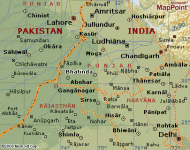
Not West Bengal, Bathinda is near Pakistan

3,000 birds die in Bathinda

Puneet Pal Singh Gill

Tribune News Service

Gehri Bhagi (Bathinda), March 8

Panic has gripped this village, near Bathinda, with more than 3,000 birds having died due to an unidentified disease at a poultry farm. Veterinarians of the Animal Husbandry Department have launched an inspection of all poultry farms within a radius of 3 km of the farm.

Department officials have ruled out the presence of avian influenza virus in the dead birds, but they feel that birds’ death might be due to some other deadly virus “because the birds did not react even to the antibiotic medicines given to them,” Dr Darshan Singh, deputy director of the department told The Tribune today.

The poultry birds started dying last week. When this correspondent visited the farm, only 40 birds were left alive. These too were visibly suffering from the disease.

“Samples have been collected from the poultry farm and sent to the High Security Animal Disease Laboratory, Bhopal. We don’t think it’s the case of avian influenza because the virus affects humans as well whereas the family of the poultry farm owner was unaffected by the disease,” Dr Darshan Singh said. Teams from the veterinary and animal husbandry departments have been visiting the farm ever since they got to know about the death of the birds.

Animal Husbandry Department officials have said the birds had nasal discharge, eye discharge, sneezing, riffled feathers and many more other symptoms. All birds were one month old.

Poultry farm owner Jagsir Singh, who has suffered a loss to the tune of around Rs 2-3 lakh in the death of the birds, said: “All this started almost a week ago.

On the first day, three birds died and I immediately contacted the microbiologist at the Veterinary Polyclinic in Bathinda. But the birds did not respond to the antibiotics given to them. On the second day, 78 birds died while the toll went up to 1,000 on the third day.

The next day 500 more birds died and by the end of this week, almost all birds had died. We thought that the death of the birds was due to some deadly virus because the they did not even get time to react to the medicines given to them.”

“All of my birds were fully vaccinated and all kinds of precautionary measures were taken ever since I started this poultry farm in 1999.

“From time to time, I have been taking guidance from the Animal Husbandry Department, Punjab Agricultural University as well as other veterinary doctors.

“Till date, mortality percentage at my farm was just 4-5, which is considered normal,” he added.

http://www.tribuneindia.com/2008/20080309/main3.htm

credits Siam


bathinda.gif
 
Status
Not open for further replies.
Back
Top Bottom