• FluTrackers.com Inc. does not provide medical advice. Information on this web site is collected from various internet resources, and the FluTrackers board of directors makes no warranty to the safety, efficacy, correctness or completeness of the information posted on this site by any author or poster. The information collated here is for instructional and/or discussion purposes only and is NOT intended to diagnose or treat any disease, illness, or other medical condition. Every individual reader or poster should seek advice from their personal physician/healthcare practitioner before considering or using any interventions that are discussed on this website. By continuing to access this website you agree to consult your personal physican before using any interventions posted on this website, and you agree to hold harmless FluTrackers.com Inc., the board of directors, the members, and all authors and posters for any effects from use of any medication, supplement, vitamin or other substance, device, intervention, etc. mentioned in posts on this website, or other internet venues referenced in posts on this website.
  • We are not asking for any donations. Do not donate to any entity who says they are raising funds for us.

India/Bengal/Tripura Bird Flu Spread to Humans?

Re: India/Bengal Bird Flu Spread to Humans?

Re: India/Bengal Bird Flu Spread to Humans?

I thought throat specimens are used for the real-time reverse-transcriptase polymerase test.


Yes, Florida1.....you are correct about the proper sample required.

India has never had a confirmed human H5N1 case.

Lucky or ???
 
Last edited by a moderator:
Re: India/Bengal Bird Flu Spread to Humans?

Re: India/Bengal Bird Flu Spread to Humans?

This testing error is too basic to be true.

Why are we not seeing some sort of outrage, correction or information from the WHO, CDC or network of leading international laboratories?

It strikes me as discordant that Indonesia can garner so much international pressure from openly refusing to dislose sequences, but India has not received public attention for this obvious data hiding technique.

J.
 
Re: India/Bengal Bird Flu Spread to Humans?

Re: India/Bengal Bird Flu Spread to Humans?

This testing error is too basic to be true.

Why are we not seeing some sort of outrage, correction or information from the WHO, CDC or network of leading international laboratories?

It strikes me as discordant that Indonesia can garner so much international pressure from openly refusing to dislose sequences, but India has not received public attention for this obvious data hiding technique.

J.


I have often wondered the same thing---there should have been outrage at the lack of lab diagnoses years ago. These viral fevers are not diagnosed, but at least they know a blood test is useless in diagnosing influenza:


Viral fever-hit Delhi goes on sick leave


New Delhi, February 22, 2008


Doctors said every third patient in Delhi had viral fever and the increase in the number of cases was up to ten folds. The best way to battle the infection is to avoid antibiotics wait out the fever, they said.

“Usually with viral fever, patients do not experience chills and rigours. The symptoms here are similar to malaria. Since serology tests are not done for viral infection, it is difficult to say what is causing this kind of fever,” said Dr HS Heera, professor of medicine at the government-run Lok Nayak Hospital.

If you know someone down with the infection, chances of you getting struck are four to five times higher. “Everyone in my family is down with viral; same in office. Many colleagues have not turned up at work for over a week,” said Sameer Chopra, CEO of a Gurgaon-based IT firm.

Doctors blame crowded places like offices, classrooms and buses for the easy spread of the infection. “A change of season always predisposes a person towards viral infections. The body takes some time to get acclimatised and during this time, viruses attack,” said Dr Bir Singh of AIIMS.

“Plus it is easy to catch an infection when in crowded places like classrooms, theatres and buses,” said Dr Bir Singh, professor of community medicine at the All India Institute for Medical Sciences (AIIMS).

The only way to avoid a viral infection is to eat healthy, drink plenty of fluids and stay away from infected persons, say experts. “The patients must not rush to office or school without having completely recovered from the illness. They must rest for four to five days, as the infection is self-limiting and consult a doctor if the temperature lasts for more than a week,” Heera said.

Recovering from a viral infection does not require any special treatment, he added. “Anti fever drugs are enough for curing viral. Doctors can only provide symptomatic relief but rest is the only medication,” added Dr Singh.

http://www.hindustantimes.com/Story...line=Viral+fever-hit+Delhi+goes+on+sick+leave
 
Re: India/Bengal Bird Flu Spread to Humans?

Re: India/Bengal Bird Flu Spread to Humans?

This testing error is too basic to be true.

Why are we not seeing some sort of outrage, correction or information from the WHO, CDC or network of leading international laboratories?

It strikes me as discordant that Indonesia can garner so much international pressure from openly refusing to dislose sequences, but India has not received public attention for this obvious data hiding technique.

J.

There is no evidence that India is hiding any data. This particular doctor may have been misquoted or mistaken about the tests being run on this one individual.
 
Re: India/Bengal Bird Flu Spread to Humans?

Re: India/Bengal Bird Flu Spread to Humans?

True, the potential for being misquoted is very high.

But haven't we seen numerous reports in this thread , or in others in the area, that show the wrong samples being taken or the wrong test administered? And it sounds like this is a historical error.

Whether or not the error is deliberate or inadvertent is not the real issue, IMO (despite my inflamatory comment).

The question is what's being done by the various agencies (including the press) to correct the error, obtain accurate data, and inform the world of what's really happening.

I wonder if governments, medical or charitable organizations will be able to acquire sufficient resources to aid these people if there isn't data that accurately describes the extent of the problem.

J.
 
Re: India/Bengal Bird Flu Spread to Humans?

Re: India/Bengal Bird Flu Spread to Humans?

I try to remember that these stories are being written by reporters with insufficient technical understanding of the process.

.
 
Re: India/Bengal Bird Flu Spread to Humans?

Re: India/Bengal Bird Flu Spread to Humans?

What would be useful here is to see the centralised direction that the Indian National Govt have supplied to all hospitals with regard to sample taking. I have not been able to find a website for their NIH that might include such data but may be looking in the wrong place.

Perhaps useful pressure would be for us (or the media) to track this data down so that it can be checked against WHO directions for H5N1 sample taking.

If there are any medic readers of FT from the region, this may be data they can access. This would provide clarity and re-assurance.

If the correct instructions are indeed there, it would suggest that improved communications in India are needed. In general, medics in India are very well educated and good about staying abreast of medical developments, so errors may be more down to the centre and a lack of correct information being publicised.

Footnote: do we have a thread here for medics that spells out the correct procedures and requirements for H5N1 testing?
 
Re: India/Bengal Bird Flu Spread to Humans?

Re: India/Bengal Bird Flu Spread to Humans?

Health authorities deny report of bird flu
Shillong | Friday, Feb 22 2008 IST


Health authorities in Meghalaya today denied that the girl, admitted in a hospital, was infected with the deadly H5N1 virus, but suffering from fever.
Anjalina Paslain (21) had been admitted with fever and rashes and kept in the isolation ward in Civil Hospital, Director of Health Services Dr KH Lakiang told UNI here. The patient was stable and recuperating, but still under strict observation, Dr Lakiang said. Denying media report that the girl was suspected to be suffering from bird flu, Dr Lakiang said blood and stool samples of the victim had been sent for test to National Institute of Communicable Diseases in Delhi for confirmation.
The victim, hailing from Saipung village in Jaintia Hills district, was first admitted at the local health centre, after which she was brought to a private hospital in Shillong, which further referred her to the civil hospital here.
Meanwhile, Director of Animal Husbandry and Veterinary Department, Dr D Khonglah said a Rapid Response Team had rushed and collected blood samples of chickens after mass deaths of birds in Saipung village.
The blood tests of the birds proved negative for H5N1 virus, Dr Khonglah said and ruled out any threat of the deadly virus.
The birds died due to Ranikhet disease as poultry owners skipped regular vaccinations, the veterinarian said.

-- (UNI) -- 22CA46.xml

http://news.webindia123.com/news/Articles/India/20080222/892625.html

hat-tip to pugmom
 
Re: India/Bengal Bird Flu Spread to Humans?

Re: India/Bengal Bird Flu Spread to Humans?

I thought throat specimens are used for the real-time reverse-transcriptase polymerase test.

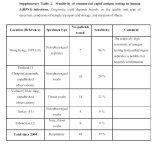
Sensitivity data from rapid antigen testing (from supplementary table to Jan 17, 2008 article in NEJM -[FONT=Arial, Helvetica, sans-serif]Update on Avian Influenza A (H5N1) Virus Infection in Humans. See thread: http://www.flutrackers.com/forum/showthread.php?t=55620[/FONT]

Rapid Antigen Testing Sensitivity WHO 20080117.jpg
 
Re: India/Bengal Bird Flu Spread to Humans?

Re: India/Bengal Bird Flu Spread to Humans?

Kerala - Thiruvananthapuram

Experts call for surveillance on avian influenza


Staff Reporter

Those working in poultry farms are a high-risk group

Autopsy be conducted in deaths due to unknown fever

Thiruvananthapuram: Public health experts have called for increased surveillance, including clinical, virological and serological surveillance, for avian influenza and to map out poultry farms in the State, which should be considered as high-risk zones.

At a Public Health Update on avian influenza, organised by the Department of Community Medicine, Medical College, K. Vijayakumar pointed out that the avian influenza virus should be considered a potential source for the next pandemic and that it was essential that the inter-sectoral coordination was strengthened.

The departments of animal husbandry, forests and agriculture should function together and equip a centre at the district-level to tackle the disease in the event of human cases. Verbal and pathological autopsy should be conducted in all cases of unknown fever deaths.

It has been proved scientifically that those working in poultry farms, especially those who handle the birds and those who prepare the birds to be sent to shops as poultry meat, are a high-risk group for the bird-to-human transmission of the virus.

It is important that awareness programmes on the disease were carried out amongst them and that behaviour change ? such as wearing protective gear and gloves while handling birds ? were induced in them.

Dr. Vijayakumar also suggested that the medical officers in the periphery are kept up to date on avian influenza threat and the available medical options before them. They should be trained to approach any un-diagnosed fever deaths or clustering of unexplained fever in high-risk groups (poultry workers) with caution.

While the message should be sent across to the field staff and the public, care should be taken not to create panic as so far, there have been few reported cases of bird-to-human transmission of H5N1 virus.

http://www.hindu.com/2008/02/23/stories/2008022361050300.htm
 
Re: India/Bengal Bird Flu Spread to Humans?

Re: India/Bengal Bird Flu Spread to Humans?

Three children of a family die of fever
Alpha Arzu
Three children of a family in Manikganj died of high fever suspected to be caused by Nipah virus, in the last three days giving a wake-up call to health officials about the return of the deadly virus after seven years.
?We are suspecting it to be Nipah virus that causes encephalitis as we had already conducted other investigations including that of avian influenza,? Professor Mahmudur Rahman, director of Institute of Epidemiology Disease Control and Research
(IEDCR) told New Age on Thursday.
The deceased, Yusuf (7), Azahar (9) and Joshna Akhter Joshi (11), children of Hashem Ali of Bishnupur village in Doulatpur Upazila under Manikganj district, had suffered from fever and cough since Saturday, family sources said.
?We will investigate whether it was Nipah virus that caused the deaths, but we are cent per cent sure that it is not bird flu,;) ? Mahmudur Rahman said.
Samples from the victims and others in the family were collected for biochemical tests of bird flu, Nipah, dengue and malaria, he informed.
Azahar died Monday after he was taken to a local hospital and his sister, Joshna, admitted to Ghior Government Sadar Hospital with high fever and cough, died Tuesday.
Their younger brother, Yusuf, fell sick with same complications ? fever and cough?and was first admitted to Ghior hospital and later shifted to Enam Medical College Hospital.
While the duty doctors found his condition deteriorating, they shifted Yusuf to Dhaka Shishu Hospital on Wednesday. The boy died next morning.
Dr Salim Shakur, director of the hospital told New Age on Thusrday, ?He was unconscious, when we received him at Shishu Hospital. We examined other conditions. It was very likely that he was infected with Nipah, as the symptoms were similar to that of other patients who suffered last year,?
A study conducted by local and foreign virologists earlier in 2005-2006 revealed that the outbreak of the virus was at the beginning limited to south-western districts of Bangladesh with a mortality rate of 50?100 per cent in different areas. The source of the virus was traced back to fruit bats.
Some experts are of the opinion that the virus-prone belt stretches along the course of the Padma river up to south-west India.
Extensive research found that pregnant bats harboured the virus and possibly transmitted them to humans. The experts did not rule out human to human transmission of the disease.
According to disease control department, seven out of 15 persons inflicted with Nipah virus died in 2007, while 11 persons out of 32 died in 2005. From January to April 2004, Nipah infection killed 45 persons in some south-western districts.
The outbreak of Nipah encephalitis was first recorded between April 25 and May 26 in 2001, causing nine deaths in Meherpur. Between January 11 and 28, 2003, another outbreak occurred in Naogaon, killing eight of the 17 affected.
In 2004, four members of a mendicant family at Faridpur died after they got infected. A rickshaw-puller who carried a patient to the hospital also was infected and died.
The bats become pregnant from November to April and most of the Nipah-like infection cases were reported during the period. The study found that usually a group of people were infected at a time and the victims were related.
Survey revealed that date and palm juices, contaminated by urine or droppings of Nipah-infected bats, could transmit the virus to human.
The study also showed that most of the people who died of this virus were not more than 15 years old. Experts advised that people should not eat fruits bitten or half-eaten by bats, or drink raw juices of palm and date in nipah-prevalent areas. :tiphat: http://www.newagebd.com/front.html#17
 
Re: India/Bengal Bird Flu Spread to Humans?

Re: India/Bengal Bird Flu Spread to Humans?

<TABLE cellSpacing=0 cellPadding=0 width="100%" border=0><TBODY><TR><TD class=vilotbiggest colSpan=2>Girl's death in bird flu-hit district reignites fear</TD></TR></TBODY></TABLE><TABLE cellSpacing=0 cellPadding=0 width="100%" border=0><TBODY><TR><TD height=8></TD></TR><TR><TD class=blackbold></TD></TR><TR><TD class=blacktextgen>Monday, 24 March , 2008, 19:30</TD></TR><TR><TD height=24></TD></TR><TR><TD vAlign=top align=left width="100%"></TD></TR><TR><TD height=32></TD></TR><TR><TD class=blacktext align=left>
Behrampore (WB): Although culling of chickens has officially been declared complete two weeks after bird flu resurfaced in several blocks of Birbhum district, a minor girl's death after eating chicken has given a scare.
<!-- AdTag -->
An eight-year-old girl died on Saturday and four others of her family fell ill after consuming chicken at Rampurhat block which was the worst affected in the first wave of bird flu attack in January.
Officials of the district health department and animal resource development, however, denied that the girl's death had anything to do with bird flu, claiming that she died of food poisoning.
http://sify.com/news/moreheadlines.php?ctid=2&cid=2487
The CMOH, Birbhum, S K Bhowmik, said on Monday that they were suffering from dysentery and vomited frequently, adding "Still, they have been kept under vigil."
He explained that in a bird flu attack a patient usually suffered from fever and respiratory problem both of which were non-existent in her case.
The girl, Sama Mehta, and her our family members were admitted to Rampurhat hospital.
While Sama died Saturday evening, the three others were release today, P K Mondal, the SDO, Ranmpurhat, said. Mondal said that the illness of the Menta family indicated that chickens were being sold freely in the affected blocks despite a ban imposed by the government. The block officials have been ordered to impose the ban on strictly, he said.

http://sify.com/printer_friendly.php?id=14629027&ctid=2&lid=1
</TD></TR></TBODY></TABLE>
 
Re: India/Bengal Bird Flu Spread to Humans?

Re: India/Bengal Bird Flu Spread to Humans?

Four Culling Workers Under Watch For Bird Flu Infection (Lead)

Wednesday 26th of March 2008
Four workers involved in culling operations in West Bengal were put under medical supervision for 'suspected symptoms' of bird flu infection.

'Four animal husbandry workers involved in culling and mop-up activities are under medical supervision,' a union health ministry statement said in the capital.

The bird flu virus resurfaced at a state-run poultry farm at the English Bazaar in Malda district two weeks ago. About 200 chickens have died at the poultry farm since March 13.

India's worst ever bird flu outbreak was declared in West Bengal Jan 15. It hit areas in Murshidabad and Malda districts after a month's gap and the culling of nearly four million birds.

'India has not reported a single case of human infection so far. But the current development is a little worrying as all the four under supervision were part of the culling operations. It means they were closely in touch with the poultry birds,' a health ministry official said on anonymity.

'We hope they do not turn out as positive cases,' he said.

However, the ministry clearly said India has not reported a single human case of bird flu and adequate stock of medicines and personal protective equipments are available with the state and district authorities.

Earlier in the day, authorities in West Bengal said that they have completed the culling operation in English Bazaar.

'We have begun a mopping up drive in some notified areas to slaughter the remaining chickens stocked at different poultry farms,' said N.K ****, deputy director of the West Bengal Animal Resource Department (ARD).

'We have decided to take police help if anyone refuses to hand over their chickens to our ARD teams. The operation would be carried out in all 24 mouzas, (small rural areas) including the Malda municipal area.

'We have already culled about 24,000 poultry birds in Malda. Though the target was to kill about 44,000 chickens initially, we saw the actual figure was about 24,000 as we started working in the field,' he said.

After India declared an outbreak of bird flu in January, it has affected 13 districts - South 24 Parganas, Howrah, Hooghly, Birbhum, South Dinajpur, Murshidabad, Nadia, Burdwan, Bankura, Malda, Cooch Behar, Purulia and West Midnapore.

http://newspostindia.com/report-44646
 
Re: India/Bengal Bird Flu Spread to Humans?

Re: India/Bengal Bird Flu Spread to Humans?

No human flu cases in WB, Tripura
NEW DELHI, April 17: No case of suspected human avian influenza has been reported in West Bengal and Tripura even as government authorities continue house-to-house surveillance for detection of an outbreak of bird flu in the two states. A total population of 4,04,714 in the 10-km area is under constant surveillance in the two states.
None of the 27 persons detected with fever/respiratory infection in Nadia district of West Bengal or 43 persons with fever/respiratory infection in Dhalai district of Tripura, showed any history of exposure to infected poultry, acco-rding to a health ministry release issued here today. There are adequate sto-cks of medicines with the state health authorities, it stated. n sns:tiphat:
http://www.thestatesman.net/page.news.php?clid=2&theme=&usrsess=1&id=200019
 
Re: India/Bengal/Tripura Bird Flu Spread to Humans?

UNDIAGNOSED FEVER - INDIA (TRIPURA)
***********************************
A ProMED-mail post
<http://www.promedmail.org>
ProMED-mail is a program of the
International Society for Infectious Diseases
<http://www.isid.org>

Date: Fri 2 May 2008
Source: tripurainfo.com [edited]
<http://www.tripurainfo.com/cgi-bin/news/display.cgi?MODE=Show&ID=7090>


After bird flu, fever hits Nadilak
----------------------------------
Altogether 109 cases of fever were reported at Nadilak village of
Bishalgarh subdivision, worst affected by the avian flu. Central RRT
[New Delhi-based rapid response team] has been assisting the State
authorities to continue the containment operations.

House to house surveillance by health workers is continuing. A
population of 19 482 has been covered in 0-3 km areas. Sources added
that none of villagers had exposure history to infected poultry. 153
Animal Health workers are under medical supervision and
chemoprophylaxis [Tamiflu treatment? - Mod.CP].

In the village of Hatearra under Mohanpur block of West Tripura
district [there have also been] containment operations to control the
outbreak. Active house-to-house surveillance is continuing. A
population of 24 011 has been covered in 0-3 km areas and 73 cases of
fever have been detected in the community and none of them had
exposure history to infected poultry.

In the Mohanpur block 155 Animal Health workers are under medical
supervision and chemoprophylaxis.

Meanwhile, state government said there is adequate stock of Tamiflu
and there are no suspect cases of human avian influenza.

---
Communicated by:
ProMED-mail Rapporteur Mary Marshall

[There have been several reports of suspected human cases of avian
influenza in parts of India where there has been avian influenza
disease in poultry. None have been confirmed. The intensive
surveillance of the population of Tripura state likewise has revealed
no human cases of avian influenza so far, but revealed many cases of
unidentified fever. Malaria may be the cause of many of these fevers
since Taindian News has today (3 May 2008) reported a widespread
outbreak of malaria in the state accompanied by 22 deaths (see:
<http://www.thaindian.com/newsportal/india-news/malaria-claims-22-lives-in-tripura_10044622.html>).

A map of Tripura state is available at
<http://www.mapsofindia.com/maps/tripura/tripura-district.htm>. - Mod.CP]

[see also:
Avian influenza (64): India (Tripura) 20080423.1434
Avian influenza (59): India (Tripura), South Korea (N Jeolla) 20080408.1295]
....................cp/ejp/jw

 
Re: India/Bengal/Tripura Bird Flu Spread to Humans?

UNDIAGNOSED FEVER - INDIA (TRIPURA)
***********************************

[There have been several reports of suspected human cases of avian
influenza in parts of India where there has been avian influenza
disease in poultry. None have been confirmed. The intensive
surveillance of the population of Tripura state likewise has revealed
no human cases of avian influenza so far, but revealed many cases of
unidentified fever. Malaria may be the cause of many of these fevers
since Taindian News has today (3 May 2008) reported a widespread
outbreak of malaria in the state accompanied by 22 deaths (see:
<http://www.thaindian.com/newsportal/india-news/malaria-claims-22-lives-in-tripura_10044622.html>).

A map of Tripura state is available at
<http://www.mapsofindia.com/maps/tripura/tripura-district.htm>. - Mod.CP]

[see also:
Avian influenza (64): India (Tripura) 20080423.1434
Avian influenza (59): India (Tripura), South Korea (N Jeolla) 20080408.1295]
....................cp/ejp/jw
If there is no poultry link, the patient isn't tested for H5N1, so of course there is no confirmation.
 
Re: India/Bengal/Tripura Bird Flu Spread to Humans?

[This is the exact reproduction of the last govt of India update on Tripura epizootics (http://www.mohfw.nic.in/Status Report on Avian Influenza in Tripura-30.4.2008.doc). Nothing new in report design, information scarcely in depth. IOH.]


Government of India - Ministry of Health and Family Welfare - Status Report on Avian Influenza in Tripura [30<SUP>th</SUP> April, 2008]

? Tripura


# District West Tripura

-- Village Nadilak, Block Bishalgarh [outbreak notified on 24.4.2008]


* Central RRT is assisting the State authorities.
* Containment operations are on.
* House to house surveillance by health workers is continuing.
* A population of 19482 has been covered in 0-3 Km area.
* 109 cases of fever/URI have been detected in the community. None of them had exposure history to infected poultry.
* 153 Animal Health workers are under medical supervision and chemoprophylaxis.


-- Village Hatearra; Block: Mohanpur [outbreak notified on 21.4.2008]


* Containment operations are on.
* Central RRT is assisting the State authorities.
* Active house to house surveillance is continuing.
* A population of 24011 has been covered in 0-3 Km area.
* 73 cases of fever/ URI have been detected in the community and none of them had exposure history to infected poultry.
* Three cases of fever/URI have reported in the identified hospital and none of them had exposure history.
* 155 Animal Health workers are under medical supervision and chemoprophylaxis.


* There is adequate stock of Tamiflu .


* There is no suspect case of human avian influenza.


* The situation is being monitored.

------
 
Re: India/Bengal/Tripura Bird Flu Spread to Humans?

[This is the exact reproduction of the last govt of India update on Tripura epizootics (http://www.mohfw.nic.in/Status Report on Avian Influenza in Tripura-30.4.2008.doc). Nothing new in report design, information scarcely in depth. IOH.]


Government of India - Ministry of Health and Family Welfare - Status Report on Avian Influenza in Tripura [30<SUP>th</SUP> April, 2008]

? Tripura


# District West Tripura

-- Village Nadilak, Block Bishalgarh [outbreak notified on 24.4.2008]


* Central RRT is assisting the State authorities.
* Containment operations are on.
* House to house surveillance by health workers is continuing.
* A population of 19482 has been covered in 0-3 Km area.
* 109 cases of fever/URI have been detected in the community. None of them had exposure history to infected poultry.
* 153 Animal Health workers are under medical supervision and chemoprophylaxis.


-- Village Hatearra; Block: Mohanpur [outbreak notified on 21.4.2008]


* Containment operations are on.
* Central RRT is assisting the State authorities.
* Active house to house surveillance is continuing.
* A population of 24011 has been covered in 0-3 Km area.
* 73 cases of fever/ URI have been detected in the community and none of them had exposure history to infected poultry.
* Three cases of fever/URI have reported in the identified hospital and none of them had exposure history.
* 155 Animal Health workers are under medical supervision and chemoprophylaxis.


* There is adequate stock of Tamiflu .


* There is no suspect case of human avian influenza.


* The situation is being monitored.

------
And notice that the number reported to be TESTED for H5N1 is ZERO. No suspect case = NO testing.
 
Re: India/Bengal/Tripura Bird Flu Spread to Humans?

Epidemiology of Cases of H5N1 Virus Infection in Indonesia, July 2005–June 2006

http://www.journals.uchicago.edu/doi/full/10.1086/519692

snip

Results. From July 2005 through June 2006, 54 cases of H5N1 virus infection were identified, with a case-fatality proportion of 76%. The median age was 18.5 years, and 57.4% of patients were male. More than one-third of cases occurred in 7 clusters of blood-related family members. Seventy-six percent of cases were associated with poultry contact, and the source of H5N1 virus infection was not identified in 24% of cases.


the same pourcentage was notified in China, I think..
25% without poultry contact.
 
Back
Top