• FluTrackers.com Inc. does not provide medical advice. Information on this web site is collected from various internet resources, and the FluTrackers board of directors makes no warranty to the safety, efficacy, correctness or completeness of the information posted on this site by any author or poster. The information collated here is for instructional and/or discussion purposes only and is NOT intended to diagnose or treat any disease, illness, or other medical condition. Every individual reader or poster should seek advice from their personal physician/healthcare practitioner before considering or using any interventions that are discussed on this website. By continuing to access this website you agree to consult your personal physican before using any interventions posted on this website, and you agree to hold harmless FluTrackers.com Inc., the board of directors, the members, and all authors and posters for any effects from use of any medication, supplement, vitamin or other substance, device, intervention, etc. mentioned in posts on this website, or other internet venues referenced in posts on this website.
  • We are not asking for any donations. Do not donate to any entity who says they are raising funds for us.

Icelandic volcano spews ash cloud - European flights hampered

Re: Icelandic volcano spews ash cloud - European flights disrupted

Re: Icelandic volcano spews ash cloud - European flights disrupted

Webcam Iceland volcano:


http://eldgos.mila.is/eyjafjallajokull-fra-thorolfsfelli/

Edit:

Amazing picture


x2_11fa004
 
Re: Icelandic volcano spews ash cloud - European flights disrupted

Re: Icelandic volcano spews ash cloud - European flights disrupted

> at least 100 million a day just for the Netherlands

ahh, this is in total, for whole Europe, as I understood.

150-200M and just for the airlines

the sum of the damage of the travelers should be more


how many people ?

> hundreds of thousands
 
Re: Icelandic volcano spews ash cloud - European flights disrupted

Re: Icelandic volcano spews ash cloud - European flights disrupted

Some info from: http://news.bbc.co.uk/2/hi/europe/8626505.stm

COUNTRIES AFFECTED
Airspace closed:
Austria, Belgium, Bosnia-Hercegovina, Czech Republic, Denmark, Estonia, Finland, Germany, Hungary, Ireland, Latvia, Luxembourg, Netherlands, Poland, Slovakia, Slovenia, Sweden, Switzerland, Ukraine, UK
Partial closures:
Belarus: No flights between 7,000-11,000m (23,000-36,000 ft)
Croatia: (North-western airspace closed)
France (northern airspace, including Paris, closed until Monday)
Italy (northern airspace closed until Monday)
Lithuania (air traffic control leaving decision to fly to individual companies)
Norway (limited flights in north)
Serbia
Flights operating:
Spain, Bulgaria, Greece and Turkey

Eur.gif

"I've only got enough medication for my epilepsy to last me until tomorrow, so my seizures are likely to start again unless I get access to that "
George Craib, Amsterdam
 
Re: Icelandic volcano spews ash cloud - European flights disrupted

Re: Icelandic volcano spews ash cloud - European flights disrupted

17/04/2010 | 15:07


Iceland Eruption: The Birds Fly into the Ash and Die

Iceland Review?s reporters, editor Bjarni Brynj?lfsson and photographer P?ll Stef?nsson, are now on location of the eruption at Sk?gar. Since the road is closed at Markarflj?t they had to take the very long route, flying to Egilstadir in eastern Iceland last night, rent a car and drive nonstop to Kirkjub?jarklaustur, where they arrived at five o?clock in the morning. They then drove into the wall of ash on their trail towards the Eyjafjallaj?kull area.

Visibility in the ash was zero at points and they had to stop until wind picked up and the ash had blown away.

<CENTER> </CENTER>
400x400_aska_17_4_ps.jpg

The sun tries to break through the smoke just before noon. Photo: P?ll Stef?nsson/Iceland Review

One of the most terrible consequences of an eruption like this is the effect on animals. Most domestic animals are still in house, but the birds have no shelter. They fly into the dark cloud, flap their wings like they have lost their bearings and then fall down and die. Our reporters saw a flock of geese fly straight into the deadly ash. Farmers have told of the desparate sound coming from the birds battling death. This is the season when birds are migrating back to Iceland.
/.../

http://www.icelandreview.com/icelandreview/daily_news/?cat_id=16567&ew_0_a_id=360964
 
Re: Icelandic volcano spews ash cloud - European flights disrupted

Re: Icelandic volcano spews ash cloud - European flights disrupted

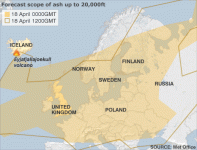
Uk Met office ash dispersion forecast : http://www.metoffice.gov.uk/corporate/pressoffice/2010/volcano.html

forecasters blog: http://www.metoffice.gov.uk/weather/europe/volcano/volcano_blog.html

Irish news is suggesting that current weather patterns over Northern Europe are likely to be unchanged until Friday.
http://www.rte.ie/player/#v=1070917

Iceland.png
http://www.metoffice.gov.uk/aviation/vaac/data/VAG_1271569746.png
 
Last edited:
Re: Icelandic volcano spews ash cloud - European flights disrupted

Re: Icelandic volcano spews ash cloud - European flights disrupted

Volcanic ash: Test flights raise hope for European air traffic
REUTERS, Apr 18, 2010, 05.00pm IST

LONDON: Air travel across much of Europe was paralysed for a fourth day on Sunday by a huge cloud of volcanic ash, but Dutch and German test flights carried out without apparent damage seemed to offer some hope of respite.

Dutch airline KLM said overnight inspection of an airliner after a test flight showed no damage to engines or other parts from ash in the atmosphere.

Lufthansa also reported problem-free test flights, while Italian and French carriers announced they would be flying empty airliners on Sunday to assess conditions.


For the moment, a clampdown on flights across much of Europe was strictly maintained, posing a growing problem for businesses including airlines, estimated to be losing $200 million a day, and thousands of travellers stranded worldwide.
Many countries closed their airspace until well into Sunday or Monday, and weather experts said wind patterns meant the cloud was not likely to move far until later in the week. They said the dark grey plume rising from an Icelandic volcano and drifting southwards through the upper atmosphere could become more concentrated on Tuesday and Wednesday.

For some businesses dependent on the speed of air freight, the impact has been immediate.

Kenya's flower exporters said they were already losing up to $2 million a day because they had not been able to airlift their blooms. Kenya accounts for about a third of flower imports into the European Union.

Volcanic ash has an abrasive effect and can strip off vital aerodynamic surfaces and paralyse an aircraft engine. Aircraft avionics and electronics, as well as windshields, can also be damaged.

KLM, acting on a European Union request, flew a Boeing 737-800 without passengers at the regular altitude of 10 km (6 miles) and up to the 13 km maximum on Saturday.

Germany's Lufthansa said it flew 10 empty planes to Frankfurt from Munich at altitudes of up to 8 km.

"We have not found anything unusual and no irregularities, which indicates the atmosphere is clean and safe to fly," said a spokeswoman for KLM, which is part of Air France-KLM.

German airline Air Berlin said it had also carried out test flights and expressed irritation at the shutdown of European air space.

"We are amazed that the results of the test flights done by Lufthansa and Air Berlin have not had any bearing on the decision-making of the air safety authorities," chief executive Joachim Hunold said.

"The closure of the air space happened purely because of the data of a computer simulation at the Vulcanic Ash Advisory Centre in London," he told the mass circulation Bild am Sonntag paper.

The air travel disruption is the worst since the Sept. 11 attacks on New York and Washington in 2001, when US airspace was closed for three days and European airlines were forced to halt all transatlantic services.

World leaders

The cloud has forced several world leaders to rearrange travel plans. US President Barack Obama, German Chancellor Angela Merkel and others cancelled trips to Poland for the funeral on Sunday of Polish President Lech Kaczynski, killed in a plane crash in Russia a week ago.
Russian President Dmitry Medvedev went ahead with his flight to Krakow.

US-based forecaster AccuWeather said the ash was in an area of weak wind flow and was unlikely to move far on Monday.

"The plume is expected to become more concentrated Tuesday and Wednesday, posing a greater threat to air travel. However, it is also expected to become narrower, impacting a smaller area," said AccuWeather.

It said an Atlantic storm and change in the direction of the jetstream on Thursday could break up the cloud.

Britain and Germany were among countries to declare their airspace closed late into Sunday.

France was closing its last airports from 1200 GMT until at least Monday morning.

Economists say they stand by their models or predictions for European growth, hoping normal service can resume this week.

But in a worst-case scenario in which European airspace is closed for months, one economist estimated lost travel and tourism revenue alone could knock 1-2 percentage points off regional growth as long as it lasts.

European growth had been predicted at 1-1.5 percent for 2010.

"That would mean a lot of European countries wouldn't get any growth this year," said Vanessa Rossi, senior economic fellow at Chatham House. "It would literally stifle the recovery. But the problem is it is incredibly hard to predict what will happen. Even the geologists can't tell us."

Airlines could suffer a severe financial blow. British Airways, hit by strikes last month that cost it around $70 million, cancelled all Sunday's flights. Ireland's Ryanair, Europe's biggest low-cost carrier, has cancelled all flights to and from northern European countries until 1200 GMT on Monday.

The fallout hit airline shares on Friday with Lufthansa, British Airways, Air Berlin, Air France-KLM, Iberia and Ryanair down between 1.4 and 3.0 percent.

Disruption spread to Asia, where dozens of Europe-bound flights were cancelled and hotels from Beijing to Singapore strained to accommodate stranded passengers.

More than four in five flights by US airlines to and from Europe were cancelled on Saturday.

Shipping company FedEx Corp said more than 100 FedEx Express flights headed to Europe were rerouted, diverted or cancelled within the past 72 hours.

The volcano began erupting on Wednesday for the second time in a month from below the Eyjafjallajokull glacier, hurling a plume of ash 6 to 11 km (3.7 to 6.9 miles) into the atmosphere.
http://timesofindia.indiatimes.com/...-European-air-traffic/articleshow/5828496.cms
 
Re: Icelandic volcano spews ash cloud - European flights disrupted

Re: Icelandic volcano spews ash cloud - European flights disrupted

After succesfull - no damage to the engines - testflights in the Netherlands and Germany, KLM will fly in 2 hours, 3 aircrafts to Asia. If permitted.
 
Re: Icelandic volcano spews ash cloud - European flights disrupted

Re: Icelandic volcano spews ash cloud - European flights disrupted

Times are GMT (US EST +5)

20.58 Restrictions on flights across UK controlled airspace will remain in place until at least 7pm tomorrow, air traffic control company Nats said tonight.

Dutch airspace remains shut until at least 7am.

20.35 Britain is considering using its navy and requisitioning merchant ships to ferry home citizens stranded abroad.


20.30 Austria's airports are expected to reopen for flights from 5am Irish time tomorrow.

'From the current standpoint, services from all Austrian airports can resume from Monday 5am', Austro Control said in a statement.

20.00 UK government ministers have said it will not be safe for flights to take place across most of northern Europe tomorrow.

19.30 P&O Irish Sea would like to confirm that services between Larne, Troon and Cairnryan continue to operate to schedule with spaces currently available for both vehicles and passengers on all sailings this evening and tomorrow morning.

18.54 Spain's secretary of state for EU affairs said this evening it was possible that 50% of flights in Europe could operate tomorrow.


18.50 All German airports will be closed at 7pm Irish time, except for Berlin's Tegel and Schoenefeld airports, Germany's air traffic controllers said.

The two Berlin airports will close at 9pm.

18.18 The European Commission says it is working to find solutions to the air disruption without compromising safety.

17.44 KLM has said European airspace is safe with the exception of the area between Iceland and Russia.

Dutch airline KLM is planning three commercial freight flights after 7pm Irish time today, but did not expect passenger flights to resume before tomorrow, Dutch media cited KLM as saying.


17.22 Belgian airspace will remain closed until at least 0600 GMT on Monday due to the cloud of volcanic ash from an eruption in Iceland, a spokesman for Transport Minister Etienne Schouppe said.

Airlines will, however, be permitted to fly planes back to Belgium without passengers if meteorological conditions allowed, the spokesman said.

17.17 The main association of European airports and airlines has called for a reassessment of restrictions.

'While Europe's airlines and airports consider safety to be an absolute priority, they are questioning the proportionality of the flight restrictions currently imposed,' ACI Europe said in a statement.


17.15 A list of countries as of 5pm and their airspace status:

AUSTRIA - Airspace expected to remain closed until at least 2400 GMT Sunday.

BELGIUM - Airspace closed until at least 1800 GMT Sunday.

BRITAIN - Airspace closed until at least 0600 GMT Monday.

BULGARIA - Sofia and Plovdiv airports open as of 1100 GMT Sunday. Other airports closed.

CZECH REPUBLIC - Airspace closed until at least 1000 GMT Monday.

DENMARK - Airspace closed until at least 0600 GMT Sunday. Update due around 1900 GMT.

ESTONIA - Airspace closed until Monday.

FINLAND - Airspace closed until at least 1500 GMT Monday.

FRANCE - Bordeaux, Marseille, Nice, Toulouse and several other southwest airports will remain open until at least 1300 GMT Monday.

GERMANY - Several airports open for flights heading in an easterly or northerly direction until 1800 GMT on Sunday.

HUNGARY - Airspace to remain closed until at least 1000 GMT Monday.

IRELAND - Airspace closed until at least 1200 GMT on Monday.

ITALY - Northern airspace closed until at least 0600 GMT Monday.

LATVIA - Airspace expected to stay closed until Monday.

LITHUANIA - Airspace closed indefinitely according to Vilnius airport.

LUXEMBOURG - Luxembourg airport closed until at least 1600 GMT Sunday.

NORWAY - Airspace opened for some traffic north of Bergen.
NETHERLANDS - Airspace closed until at least 1800 GMT Sunday.

POLAND - Six Polish airports, including Warsaw, reopen for commercial flights.

ROMANIA - Airspace closed until at least 0900 GMT Monday.

RUSSIA - All airports open.

SLOVAKIA - Airspace closed as of 1300 GMT on Friday.

SPAIN - The 17 airports closed over Sunday morning by the Spanish airport authorities are now all open.

SWEDEN - Airspace closed all Sunday and into Monday.

SWITZERLAND - Airspace closed until at least 1200 GMT Monday.

UKRAINE - Kiev's Borispol airport open.

http://www.rte.ie/news/2010/0418/travelupdates.html
 
Re: Icelandic volcano spews ash cloud - European flights disrupted

Re: Icelandic volcano spews ash cloud - European flights disrupted

Should planes fly in Iceland volcano ash? Be careful, study says.

Some European airlines have begun test flights to see if it is safe to fly through the volcano ash from Iceland's Eyjafjallaj?kull. But a NASA study says a little ash can cause serious problems.


<!-- pgallerycarousel --><SCRIPT type=text/javascript>//<![CDATA[ var pgallerycarousel_itemList = [ {"url_sm":"\/var\/ezflow_site\/storage\/images\/media\/images\/0418-iceland-volcano-space.jpg\/7745791-1-eng-US\/0418-Iceland-volcano-space.jpg_full_380.jpg","url_lg":"\/var\/ezflow_site\/storage\/images\/media\/images\/0418-iceland-volcano-space.jpg\/7745791-1-eng-US\/0418-Iceland-volcano-space.jpg_full_600.jpg","caption":"A NASA satellite captured this image of the volcanic ash plume from Eyjafjallaj\u00f6kull Volcano in Iceland Friday. With planes in Europe still grounded and pressure building to move thousands of stranded travelers, some airlines are sending up test flights to see if air travel is safe. ","credit":"Newscom","related":""} ]; // remove quote html entities for (i=0;i


</SCRIPT>
A NASA satellite captured this image of the volcanic ash plume from Eyjafjallaj?kull Volcano in Iceland Friday. With planes in Europe still grounded and pressure building to move thousands of stranded travelers, some airlines are sending up test flights to see if air travel is safe.


By Pete Spotts, Staff writer / April 18, 2010

As frustration mounts over the economic cloud an erupting volcano in Iceland has cast over the global airline industry, a handful of European airlines have started to fly empty airliners through Europe's skies to see if it's safe to resume air travel.

But a case study by the US National Aeronautics and Space Administration (NASA) suggests that even tenuous volcano ash clouds can inflict serious damage to an airliner. While the damage may not necessarily threaten the immediate flight, one cruise through an invisible ash plume can run up a multimillion-dollar repair tab.

The plume in the NASA study was so thin that the flight crew had none of the cues they ordinarily might rely on ? odd engine readings, the smell of smoke of sulfur in the cockpit, or even outside electrical phenomena such as St. Elmo's Fire ? to alert them to a plume's presence. And they had no visual clues on the aircraft after landing to tell them they'd encountered a plume.

The case study concludes that the engines sustained enough damage that key components could well have started to fail with only another 100 hours of flying time.

Iceland's Eyjafjallaj?kull volcano first sent steam and ash billowing into the sky last Thursday. Since then, canceled flights to, from, and within Europe have affected millions of travelers worldwide and reportedly is costing airlines some $200 million a day.

KLM, Lufthansa, and Air France, reportedly are conducting test flights over the continent, according to wire service reports. A KLM spokesperson noted that the airline had used several different airliners, which flew at altitudes above 10,000 feet.

KLM officials have indicated that an initial inspection of one of the carrier's Boeing 747s showed no "irregularities" during the flight, which reached an altitude of 41,000 feet. The same results held during an initial inspection of the aircraft after it returned.

How to deal with volcano ash: avoid it

Since several highly publicized airliner encounters with ash plumes in the 1980s, airlines have generally agreed that the best way to deal with ash plumes is to avoid them.

In one incident, all four engines of British Airways flight shut down when flying though the ash of an Indonesian eruption in 1982. The same thing occurred in 1989 when a KLM jet flew through a cloud of ash in Alaska.

Both flights were able to restart their engines, but only after losing more than 10,000 feet of altitude.

"Even when you set aside things like potential law suits from loss of life, and things like that, the damage to the plane by flying through the ash can run into tens of millions of dollars," says Benjamin Edwards, a volcanologist at Dickinson College in Carlisle, Pa.

KLM, for example, had to replace all four engines on the aircraft, which was less than a year old, at a cost of $80 million.

Ash essentially is pulverized rock. As explosive eruptions occur, the magma is blasted into tiny fragments that cool into jagged particles. Countries have become more skilled at tracking these plumes and alerting flight crews and air-traffic control centers to the plumes' presence.

The NASA flight

But on the night of Feb. 28, 2000, the crew of a DC-8 NASA used for atmospheric research discovered first-hand that ash plume forecasts are not perfect. The agency ended up paying a $3.2 million repair bill.
of a research project to study atmospheric ozone over the Arctic, according to a NASA technical report written by Thomas Grindell of NASA's Dryden Flight Research Center in Edwards, Calif., and Frank Burcham Jr. of Analytical Services and Materials, Inc., also in Edwards.

Some 35 hours earlier Iceland's Mt. Hekla volcano had sent clouds of ash and steam soaring to altitudes of 45,000 feet.

The DC-8 was cruising at just more than 500 miles an hour at 37,000 feet and some 200 miles north of where the plume was predicted to extend.

The sky was generally cloudless with no moonlight. But the highly sensitive research sensors aboard the craft detected a sudden rise in ash particles and sulfur dioxide. For seven minutes, the craft flew through a tenuous ash cloud some 800 miles from the volcano.

The only visual clue they had: They couldn't see stars in the night sky, a common phenomenon when flying through high-altitude cirrus clouds.
Cockpit instruments reported no unusual engine behavior. The crew smelled nothing unusual. And they saw no other visual clues that would tip them off to the presence of volcanic ash.

The crew reported the encounter to air-traffic controllers and continued to Kruna.

Damage wasn't immediately evident

Once the crew landed, a cursory inspection of the engines and the plane's exterior showed no evidence of an encounter with volcanic ash.

Technicians at the site didn't have sophisticated inspection gear at their disposal, so the plane was pronounced fit and the research project began.

But Mr. Grindle and his colleague write that once the aircraft returned to Dryden, deeper inspections showed that internal cooling passages had been clogged, with some of the engines' areas of highest temperature showing signs of unusual heat stress. One of the aircraft's engines sustained the heaviest damage. It was enough to prompt technicians to dismantle the other three as well.

In essence, all the engine's internal parts were coated with fine white powder. The leading edges of turbine blade were pitted. The build-up of heat from clogged cooling passages blistered coatings on several internal components.

Moreover, some research suggests that if the plane had encountered the ash in daylight, the crew still might have had no visual clue because the ash could well have been encased in ice ? looking like high-altitude cirrus clouds. A study of the incident by researchers at NASA's Jet Propulsion Laboratory published in 2002 notes that satellites failed to pick up evidence of ash at the point where the DC-8 encountered it; instead it indicated cirrus clouds.

The researchers posited that the ash in effect took a Trojan Horse approach. It served as seeds around which ice crystals could form. Ice striking the jet would leave no visible signs of collision. But once the crystals entered the engines, they would melt, freeing the ash. To weather satellites, the plume would look like icy clouds, not ash.

"The insidious nature of this encounter and the resulting damage was such that engine trending [readings from in-flight instruments] did not reveal a problem, yet hot section parts may have begun to fail [through blade erosion] if flown another 100 hours," the duo wrote.

http://www.csmonitor.com/USA/2010/0...-in-Iceland-volcano-ash-Be-careful-study-says.

 
Re: Icelandic volcano spews ash cloud - European flights disrupted

Re: Icelandic volcano spews ash cloud - European flights disrupted

why don't we have colored graphics likes these
weekly flu-surveillance pictures from Germany,France ?
http://websenti.b3e.jussieu.fr/sentiweb/index.php?lang=en
http://influenza.rki.de/agi/index.html

updated daily or such.
This is important enough and should be easy enough to do.

Alternatively just publish the measurements and we can make
our own graphics.
 
Re: Icelandic volcano spews ash cloud - European flights disrupted

Re: Icelandic volcano spews ash cloud - European flights disrupted

why don't we have colored graphics likes these
weekly flu-surveillance pictures from Germany,France ?
http://websenti.b3e.jussieu.fr/sentiweb/index.php?lang=en
http://influenza.rki.de/agi/index.html

updated daily or such.
This is important enough and should be easy enough to do.

Alternatively just publish the measurements and we can make
our own graphics.

Hi gsgs:tiphat:

have a look on this animation:


http://www.youtube.com/watch?v=K-4TB47N3_Y&feature=player_embedded

mcwetboy ? 18. April 2010 ? An animation made freely available by the Norwegian Meteorological Institute showing the spread of the ash spewed forth by the eruption of the Eyjafjallaj?kull volcano. I've converted it from the original animated GIF.

Yellow indicates ash that has fallen by itself, red ash that has fallen as a result of precipitation, and black where the ash cloud is at that moment in time.

More information, including the terms allowing me to reproduce it here, at http://burns.idium.net/met.no/?module...

Original animation at http://www.met.no/animation.gif


... and/or this one (second animation video on this site with headline "Path of Iceland Volcano Ash Cloud":


The Norwegian Institute for Air Research has produced a video of a simulation of the transport and dispersion of the ash cloud from Eyjafjallaj?kull Volcano.
http://geology.com/news/category/iceland-volcano.shtml
 
Last edited:
Re: Icelandic volcano spews ash cloud - European flights disrupted

Re: Icelandic volcano spews ash cloud - European flights disrupted

> http://www.met.no/animation.gif

yes, thanks. One picture every 3 hours

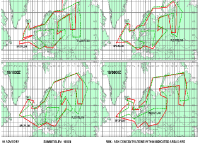
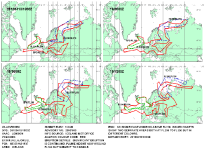
Some improvement suggestions:


the animation is too fast for me can we have each of the pictures ?
show the next picture only on keystroke
make the water(ocean) blue for better orientation
size is too big, IMO reduce by 50%


are these predictions or real measurements ?
the last picture is from Apr.21,06:00
 
Re: Icelandic volcano spews ash cloud - European flights disrupted

Re: Icelandic volcano spews ash cloud - European flights disrupted

thanks Pathfinder post #33 (and all others),
we can suspect reasonably,
that the in hurry air hubs opening,
were mostly a matter of heavy money drainage and trapped passengers,
not a realy safe flight,
especialy after the next further 100 flight hours on the same plane ...


post #33 (about an previous event research):


"Damage wasn't immediately evident

Once the crew landed, a cursory inspection of the engines and the plane's exterior showed no evidence of an encounter with volcanic ash.

Technicians at the site didn't have sophisticated inspection gear at their disposal, so the plane was pronounced fit and the research project began.

But Mr. Grindle and his colleague write that once the aircraft returned to Dryden, deeper inspections showed that internal cooling passages had been clogged, with some of the engines' areas of highest temperature showing signs of unusual heat stress. One of the aircraft's engines sustained the heaviest damage. It was enough to prompt technicians to dismantle the other three as well."

...

"In essence, all the engine's internal parts were coated with fine white powder. The leading edges of turbine blade were pitted.

The build-up of heat from clogged cooling passages blistered coatings on several internal components.

Moreover, some research suggests that if the plane had encountered the ash in daylight, the crew still might have had no visual clue because the ash could well have been encased in ice – looking like high-altitude cirrus clouds. A study of the incident by researchers at NASA's Jet Propulsion Laboratory published in 2002 notes that satellites failed to pick up evidence of ash at the point where the DC-8 encountered it; instead it indicated cirrus clouds.

The researchers posited that the ash in effect took a Trojan Horse approach. It served as seeds around which ice crystals could form. Ice striking the jet would leave no visible signs of collision.

But once the crystals entered the engines, they would melt, freeing the ash.

To weather satellites, the plume would look like icy clouds, not ash.

"The insidious nature of this encounter and the resulting damage was such that engine trending [readings from in-flight instruments] did not reveal a problem, yet hot section parts may have begun to fail [through blade erosion] if flown another 100 hours,"the duo wrote."
 
Re: Icelandic volcano spews ash cloud - European flights disrupted

Re: Icelandic volcano spews ash cloud - European flights disrupted

<CITE class=vcard>UK sends warships to rescue stranded Britons

</CITE>
<CITE class=vcard></CITE>
<CITE class=vcard>By JENNIFER QUINN and JAMEY KEATEN, Associated Press Writer Jennifer Quinn And Jamey Keaten, Associated Press Writer </CITE>? <ABBR class=recenttimedate title=2010-04-19T05:04:30-0700>28 mins ago</ABBR>
<!-- end .byline -->

LONDON ? Britain sent Royal Navy warships on Monday to rescue those stranded across the Channel by the volcanic ash cloud and the aviation industry blasted European officials, claiming there was "no coordination and no leadership" in the crisis that shut down most European airports for a fifth day.

Eurocontrol, the air traffic agency in Brussels, said less than one-third of flights in Europe were taking off Monday ? between 8,000 and 9,000 of the continent's 28,000 scheduled flights. Passengers in Asia who had slept on airport floors for days and were running out of money staged protests at airport counters.

All airports were open Monday in Spain and the country volunteered to become the new hub of Europe to get stranded passengers moving again. Infrastructure minister Jose Blanco said Spain could to take in around 100,000 people under the new emergency plan, which focuses on aircraft trying to bring Britons home from Asia, Latin America and North America.
Spain will also beef up train, bus and ferry services to get travelers to their destinations, he said.

European airlines sought financial compensation for a crisis that is costing the industry an estimated $200 million a day. British Airways said it was losing up to 20 million pounds ($30 million) a day and other airlines were also racking up huge losses.

Hundreds of thousands of travelers have been stuck since the volcano under Iceland's Eyjafjallajokull glacier begun erupting Wednesday for the second time in a month.

As pressure mounted from airlines, European civil aviation authorities were holding a conference call Monday about what steps could be taken toward opening airspace.

"It's embarrassing, and a European mess," said Giovanni Bisignani, chief executive of the International Air Transport Association. "It took five days to organize a conference call with the ministers of transport and we are losing $200 million per day (and) 750,000 passengers are stranded all over.

Does it make sense?"

In Paris, the IATA expressed its "dissatisfaction with how governments have managed it, with no risk assessment, no consultation, no coordination, and no leadership." The group urged governments to more urgently "focus on how and when we can safely reopen Europe's skies" ? such as with more in-depth study of the ash cloud.

With airlines pressing for a restrictions to be lifted, a senior Western diplomat said Monday that several NATO F-16 fighters that flew through the ash cloud had suffered engine damage ? evidence that the danger from the cloud is very real.

The official declined to provide more details on the military flights, except to say that glasslike deposits were found inside the planes' engines. He spoke on condition of anonymity due to the sensitivity of the information.

Some smaller airports reopened Monday but authorities in Britain, France, Germany, and the Netherlands ? home to four of Europe's five largest airports ? said their air space was still closed. Britain said it was keeping flight restrictions on through early Tuesday while Italy briefly lifted restrictions in the north then quickly closed down again after conditions worsened Monday.

Eurocontrol said Monday that southern Europe was mostly open for flights ? including Portugal, Spain, parts of Italy and France, the Balkans, Bulgaria, Greece and Turkey ? as were parts of northern Europe like Norway.

Several major airlines safely tested the skies with weekend flights that did not carry passengers. The announcement of successful test flights prompted some airline officials to wonder whether authorities had overreacted to concerns that the microscopic particles of ash could shut down jet engines.

In London, Prime Minister Gordon Brown said the aircraft carrier HMS Ark Royal and assault ship HMS Ocean would be sent across the English Channel. A third ship is being spent to Spain to pick up soldiers trying to get back to Britain after a tour of duty in Afghanistan.

"I expect Ocean to be in the Channel today. I expect the Ark Royal to moving towards the Channel later," Brown said after meeting with the government's emergency committee, known as COBRA.

He said Britain was speaking with Spanish authorities to see whether Britons stranded overseas could be flown there and then taken home by boat or bus.

Brown said the ash cloud had created "the biggest challenge to our aviation transport network for many years."

Tensions boiled over at Incheon International Airport in South Korea, where 30 frustrated passengers blocked a Korean Air ticketing counter and demanded officials arrange travel to anywhere in Europe after hearing about the test flights.
/.../

More at: http://news.yahoo.com/s/ap/eu_iceland_volcano
 
Re: Icelandic volcano spews ash cloud - European flights disrupted

Re: Icelandic volcano spews ash cloud - European flights disrupted

#39: "glasslike deposits were found inside the planes' engines"


it seems it will be cheaper for the air comp.s to relocate the stranded passengers by other vehicles, even by opening the money box for their alternative free accomodations,
than
to pay the changes/repairs of the engines/heated parts/heated el.cables/...
for all the planes which will be sent through the ash cloud now,
but which could starts failuring in flight 100 hours later ...

___
a "perfect" opportunity to check how it could be like a real airports hubs plains area grounding in an "infectious disease no-fly quarantine period" ...
 
Back
Top Bottom