
• FluTrackers.com Inc. does not provide medical advice. Information on this web site is collected from various internet resources, and the FluTrackers board of directors makes no warranty to the safety, efficacy, correctness or completeness of the information posted on this site by any author or poster. The information collated here is for instructional and/or discussion purposes only and is NOT intended to diagnose or treat any disease, illness, or other medical condition. Every individual reader or poster should seek advice from their personal physician/healthcare practitioner before considering or using any interventions that are discussed on this website. By continuing to access this website you agree to consult your personal physican before using any interventions posted on this website, and you agree to hold harmless FluTrackers.com Inc., the board of directors, the members, and all authors and posters for any effects from use of any medication, supplement, vitamin or other substance, device, intervention, etc. mentioned in posts on this website, or other internet venues referenced in posts on this website.
  • We are not asking for any donations. Do not donate to any entity who says they are raising funds for us.

How to remove a tick

Shiloh

Editor, Senior Moderator
Source: http://weblogs.baltimoresun.com/fea...g/2008/06/removing_a_tick_the_monday_con.html

Removing a tick -- the Monday consult

Lyme diseaseLyme Disease, and how to avoid it, is the subject of today's Consult, because it's the time of year to be outside. Readers wanted to know how to remove a tick, how to look for symptoms of the disease, and whether they should subject their kids to an annual Lyme disease test.

As it happens, the Maryland Department of Health & Mental Hygiene has a great web site on the subject. Here's a primer on how to remove the tick. You'll need tweezers.

As for how to recognize the symptoms of Lyme disease. ...in an interview with my colleague Michelle Deal-Zimmerman last year, Dr. Robert Edelman, a University of Maryland pediatrician and infectious disease specialist, said the surest sign is the distinctive bull's-eye rash, which 90 percent of those who get Lyme disease exhibit. Other symptoms are headache, fatigue, and muscle aches.

As for the blood test, he said that it may not always be helpful because it can take weeks after an infection for the test to register a positive result.

Our sometime expert Dr. Daniel Levy got back to me with a few other thoughts; I'm posting them as a comment below.

Now, as for next week: Karen, we'll get to positive vs. negative discipline then if possible. In the meantime, can you provide a few more details on what you want to know that might help the expert and other parents weigh in?

Comment From Dr. Dan Levy:

Ticks are insects that are attracted to warm-blooded animals, and feed by attaching themselves to the skin of an animal or human host. Typically, the tick injects a bit of saliva into the wound, which helps draw blood into its body. Since the tick attaches to the skin, the best means for removal is the use of a tweezer, with gentle, gradual traction on the head of the tick until it's wholly removed. If a tweezer isn't available, use a tissue and grasp the tick with the fingernails. Clean the area with alcohol or peroxide.

Lyme disease is a bacterial infection caused by the tiny deer tick, which is about the size of the head of a pin. It is known that the Lyme bacteria is injected into the host as the tick withdraws blood. If the tick is attached less than 24-36 hours there is little likelihood of infection.

Symptoms of Lyme often appear within days to several weeks of the bite. Common symptons include fever, headache, joint pain, and a round, slightly raised, red rash with a clear center known as a target lesion. If Lyme is suspected in a child, a blood test called a Lyme titer is done, but the child is generally treated because lab tests can be unreliable.

There is no acceptable vaccine for Lyme Disease, and kids should not be routinely tested for Lyme.

Dan Levy
 
Re: How to remove a tick

Source: http://www.slate.com/id/2193879/pagenum/all/#page_start

A Tick's LifeThe first in a series on revolting creatures.
By Constance Casey
Posted Tuesday, June 24, 2008, at 8:04 AM ET
080620_GR_ticksTN.jpg

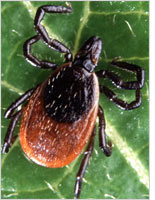
An adult deer tick

Ticks, which live on blood and nothing but blood, are loathsome to us. We strongly prefer not to share our blood, unless the act is voluntary and we get juice and doughnuts afterward.

It's good that ticks are loathsome, because getting them detached from us as quickly as possible is the best way to avoid being infected by the diseases they carry. Ticks not only extract blood, they ooze pathogens from their salivary glands into the wound they've sliced with their tiny claws and penetrated with their barbed mouthparts. Normal human beings don't sit around and watch with interest for days and days as this process takes place. (Undisturbed, a tick could happily sup for up to a week.)

It's generally known the danger these small creatures pose, particularly the deer tick?Ixodes scapularis. This tick's saliva is the medium for delivery of a particular spirochete, or corkscrew-shaped bacterium, called Borrelia burgdorferi?famous for causing Lyme disease. I managed to locate Willy Burgdorfer, the scientist who identified the Lyme spirochete in 1982, and asked, "Why did God make ticks?"

"I don't have the answer," Dr. Burgdorfer said. "There are a lot of things we assign to the good Lord and we ask the question, why? All I can advise is to check yourself for ticks and remove them fast."

We know about the tick's danger to us, but we haven't thought much about how the ticks themselves survive life's competitive drama?how they reproduce and how they die.

The tick's life is simple, fairly boring, but urgent. No host, no blood meal, and the tick dies. There's only one blood meal for each of the three stages of a tick's life?larva, nymph, and adult. At each stage, every one of the tick's behaviors has been honed by evolution to sense a victim and latch on.

Deer ticks don't find the mice, deer, or us by sight; they have no eyes. On the tips of their front legs they have sensors, the Haller's organs, that allow them to detect, from as far away as a few yards, the heat given off by warm-blooded animals and the molecules of carbon dioxide that we mammals exhale. Blow into a tube of ticks at a lab, and you'll see them begin to wave like excited fans at a Justin Timberlake concert.

Exhale on those other bloodsuckers, fleas, and they jump. The good news about ticks is that they cannot jump or fly. The bad news is that if you find a tick on your scalp, it has probably crawled up your body from about sock-top level. Ominously, the Centers for Disease Control and Prevention advises us to check for ticks between our legs and then in the belly button.

When the "mammal nearby" message is received, a tick's two front legs, equipped with claws that act like grappling hooks, thrust into the air while its three pairs of back legs hold on to a blade of grass, a twig, or a leaf. (Ticks are arachnids, with eight legs, in the family of spiders, scorpions, and mites. Insects have six legs. If you want to impress tick researchers, tell them that you know a tick in larva stage has only six legs.) A host brushes against a tick, and the tick hitches a ride.

He or she roams for a few hours looking for the right spot to attach. Then the two claws make the incision, and in goes the hypostome, shaped like a harpoon, with backward-facing barbs.

The tick then secretes a cementlike substance from its mouth, which glues it to the host and dissolves days later when the tick is sated and ready to drop off. Tick saliva also contains an anticoagulant to keep a host's blood flowing.

There they are, imbibing and drooling; it's the drooling that puts us at risk.
Perhaps we should sympathize because the tick itself is a host. (We, too, by the way, carry spirochetes?harmless ones, in our mouths.) The parasitic spirochete sits in the tick's midgut until the blood flows in. Then, stimulated by the blood's nutrients and warmth, the newly expanded crowd of spirochetes migrates to the tick's salivary glands.

Entomologists estimate it takes more than 24 hours for the spirochete to move up and out, thus the importance of checking your body for embedded ticks and removing them as soon as possible.


An adult tick isn't as dangerous to us as a nymph, which is tiny enough to be mistaken for a freckle on light skin. The tiny adolescent is also likely to have fed on a mouse, the most efficient reservoir for the dangerous spirochete. (Though heavily infested with B. burgdorferi, mice don't get sick. In any case, no one has heard mice complain of fever, aching joints, fatigue, rash, and mood disorders.)

The male adult tick expands his repertoire to include finding females. He looks, logically enough, on the biggest moving mammalian blood supply around?a deer. Deer are in one way relatively innocent in the Lyme disease story?they have components in their blood that prevent the spirochetes from surviving. But they are also orgy enablers; if there were fewer deer, there would be fewer ticks, because the ticks would have a harder time finding one another.

Male and female engage in an impressive combination of gourmandise and lust. Maybe not lust exactly; for the female, it's more like being interrupted at breakfast by the UPS guy, with a package of perishables. Here's the setup: The female has her hypostome planted in the deer, imbibing. A long meal is the cue to her body to produce her 2,000 or so eggs. The male approaches from below, then uses his mouthparts to pluck a packet of sperm called a spermatophore from his genital pore. He delivers the packet into his partner's genital pore with his hypostome, the same barbed hollow needle that he sticks into mammals. The male frequently remains attached, mouthparts locked in the female genital aperture, to prevent other males from linking up with his chosen mate. After the female drops to the ground, full of blood and sperm, she lays her eggs, and then the fun is definitely over. She begins to atrophy. Her intestines spill out in a yellow blob. "When does the male die?" I asked Durland Fish, who studies tick-borne pathogens at the Yale University School of Public Health. "When he runs out of energy or sperm, whatever comes first," Dr. Fish replied.

So death for the tick comes from starvation, dehydration, egg-laying, or old age, rather than from predation. We don't seem to have any natural allies in tick control. It's not well known what kind of animal eats ticks, though the larvae are vulnerable to fungi. Dr. Fish scornfully dismissed the guinea hen as a form of pest control?"a Christie Brinkley-ism." (The former model advocates buying a flock of the cackling black-and-white birds to clear your yard of ticks.)

I repeated the question of why God made ticks for Dr. Fish. He responded with a growl to what he took to be my facetious tone: "Nobody makes them. They're just there. Their object, like ours, is to make a living any way they can."

And the tick's place in the great web of life? "They transmit disease. They control population."

"Including us?" I asked.

"Whatever is susceptible to the disease.
 
Back
Top Bottom