Re: H5N1 bird flu spread by drinking water ?
@gsgs
Hi, please help me. You say there are lots of evidence that influenza spreads by saliva droplets and we all know, flu usually spreads from human to human. Please blog some links of evidence that influenza spreads by saliva droplets. I don't know. My opinion I wrote by the following article. I think there ist a
secondary biotic airborne transmission too, but first there must be an
abiotic vehicle for initial primary transmission:
The primary transmission of the influenza by the bio tables droplet infection is extremely improbably because influenza epidemics
- only in 9% of the cases (season 2004/2005) together with recognized amassments arise.
- regularly first with babies and children begin.
- virologic locally singularly arise (influenza-subtypes and fine classification).
- arise geographically locally singularly.
- in large cities and densely populated areas to be proven not with priority.
- predominantly in the colder regions of Germany arise.
- their maxima regularly in certain circle/circle-free cities reach.
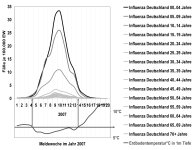
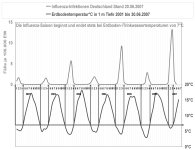
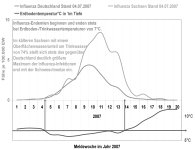
- strictly parallel to the hydrograph curve of the winter cooling sum run.
- by saliva droplets to hardly spread can. Saliva contains far less Influenza viruses than - heavier - the droplets from throats and nose.
The facts
Influenza epidemics step to small extent as well as recognized amassments on (9% of the cases in the season 2004/2005) (RKI 2006). They begin regularly first with babies and children and have in their age groups also their maxima.
Influenza epidemics step virologic locally singularly on (influenza-subtypes and fine classification) (AGI 2007).
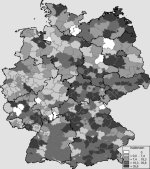
Influenza epidemics run also geographically locally singularly. They are not proven with priority in large cities and densely populated areas. They step predominantly in the colder regions of Germany on (the east also in the winter cold continental climate, southeast, altitudes) (RKI 2007). They reach their maxima regularly in certain circle/circle-free cities (absolute front runners: Frankenthal, Worms, district Stoll mountain) (RKI 2007).
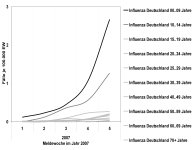
Influenza epidemics run strictly parallel to the hydrograph curve of the winter cooling sum.
Influenza epidemics can hardly spread by saliva droplets. Saliva contains far less Influenzaviruses than the substantially heavier droplets from throats and nose (ANONYMOUS 2003) (GOLDMANN 2001).
Human Influenzaviruses could being proven to pigs (faecal and oronasal), game lights (faecal and oronasal), cattle and goats in the eliminations of mammals such as, so that in principle the transmission path from the environment is over waters and the drinking water possible for BROWN (2004) (GRAVES et al. 1975) (KADEN et al. 2001) (KAWAOKA et al. 1986) (LANDOLT et al. 2003) (MARKOWSKA DANIEL et al. 1999) (RKI 1999) (VICENTE et al. 2002) (WEBSTER 1998) (ZHOU et al. 1996) (CARPENTER 2001). With considerable security in the future still further animal species infected with influenza A are discovered (WEBSTER 1998).
Elimination and inactivating of viruses during the drinking water processing
Drinking water is often not filtered in Germany or only roughly. The very small viruses are not removed surely thereby. For groundwater preparation wide-spread filtration plants for the distance of iron and manganese do not possess effect (WHO 2004) regarding the elimination of viruses. Even in Germany as particularly efficiently valid plants for the flocculation and filtration can, also with consideration of the common disinfection procedures, whose efficiency with sinking water temperature decreases [Chlorine and ozone treatment] and with micro organisms clumped in the water are only reduced effective [Chlorine, ozone treatment and UV irradiation], which do not reach from the WHO demanded eliminations and inactivating achievements (WHO 2004).
"Cooling chain of the public potable water supply"
Cold weather is with distance the most important parameter for the preservation of virulent Influenzaviruses in the water. The temperature minimum of the dam water in Germany amounts to during the months January and February 3-4?C. River water has its temperature minimum likewise in January and February of each yearly. Groundwater near the surface has in Germany at the groundwater surface - similar to the soil in 100 cm depth - its temperature minimum of for instance 3?C in February and March. Also from wells of larger depth taken groundwater can be colder with unsatisfactory sealing between the fountain and the surrounding rock by infiltration by surface water affected and therefore than the deeper groundwater. Bach hoists, from which surface water arrives on short ways at the wells, can have the same effect. Bank filtrate from wells, which were bored near the bank by surface waters, accepts the temperature in the winter of the cold surface water. Same applies to wells, from which with surface water enriched groundwater is promoted. The ground temperatures in a meter of depth correspond to the temperatures of the drinking water pipelines shifted frost-protected in the soils. The temperature minima of the ground temperatures in 100 cm depth amount to in Germany during the months February and March 3-5?C (DWD 2007). The temperatures of the drinking water pipelines and the drinking water transported in them adapt themselves to the ground temperatures. In the winter cold raw water remains cold in the drinking water processing plants and after the dressing to drinking water in the water tanks and water pipelines up to the annexe of the consumers. The temperature minimum of the drinking water at the annexe follows in particular the process of cold weather in the soil and in the water pipelines. It stops itself in the months February and March. The cold drinking water is only mixed in the dwellings at the taps with warm water from the house installation. Thus the constant "cooling chain of the public potable water supply" is described from the water winning to the consumers with a drinking water temperature of for instance 4-5?C in the months February and March of each yearly. Cold, young, freshly drinking water, taken out of surface water and badly protected groundwater near the surface as well as out of groundwater from roc, contaminated by Influenzaviruses, can be the abiotische vehicle, which transports virulent Influenzaviruses in the winter with 4-5?C conserved and over the constant "cooling chain of the public potable water supply" to humans.
Transmission paths of the drinking water
Infections by drinking water will not transfer alone by drinking the water. Further transmission paths are the inhalation of aerosols and the contact with the drinking water. Entrance gates with humans are conjunctiva, the nose mucous membrane, the mouth mucous membrane, the ear drum skin diaphragm, wounds and by catheters of affected other mucous membranes.
Conclusions
The primary transmission of the influenza by the bio tables droplet infection is already because of the strict dependence on environmental temperatures extremely improbable. The influenza must be transferred by increasingly a abiotisches vehicle efficient for the propagation of infections with increasing cold weather. Therefore must be searched for the transmission of the influenza for abiotischen vehicles dependent on cold weather. Drinking water is such a abiotisches vehicle. The stated references and indications show that cold drinking water can be that abiotische vehicle, with which virulent human Influenza viruses from the reservoirs arrives to humans and releases predominantly this way the seasonal influenza epidemics. That applies in particular also to the extremely lethal H5N1 bird flu, whose faecal transmission is indisputable.
References
AGI (2007): Arbeitsgemeinschaft Influenza
http://influenza.rki.de/agi
ANONYM (2003): Understanding Sars and other Respiratory Infections May 2003.
http://www.ifh-homehygiene.org/2003/2downloadabledoc/SARS.pdf
BROWN (2004): Influenza Virus Infections of Pigs, Part 1: swine, avian & human influenza viruses.
http://www.pighealth.com/influenza.htm ; Part 2: Transmission between pigs and other species. Veterinary Laboratories Agency, UK.
http://www.pighealth.com/influenzaB.htm
DWD (2007): Deutscher Wetterdienst (DWD), Wetterstation Erfurt-Bindersleben, Erdbodentemperaturen aus 100 cm Tiefe
GOLDMANN (2001): Epidemiology and Prevention of Pediatric Viral Respiratory Infections in Health-Care Institutions, Children?s Hospital and Harvard Medical School, Boston, Massachusetts, USA, Emerging Infectious Diseases, Special Issue.
http://www.cdc.gov/ncidod/eid/vol7no2/goldmann.htm
GRAVES et al. (1975): Human viruses in animals in West Bengal: An ecological analysis, Human Ecology, Volume 3, Number 2 / April, 1975, 105-130.
http://www.springerlink.com/content/u5408wx5t622ll82/
KADEN et al. (2001): Gef?hrliche Verwandtschaft. Schwarzwild - ein nat?rliches Reservoir f?r Infektionserreger und Ansteckungsquelle f?r Hausschweine? Bundes-forschungsanstalt f?r Viruskrankheiten der Tiere: Forschungsreport 1/2001: 24-28.
http://ticker-grosstiere.animal-health-online.de/20010902-00002/
KAWAOKA et al. (1986): Intestinal replication of influenza A viruses in two mammalian species, Archives of Virology, Volume 93, Numbers 3-4 / December, 1987, 303-308.
http://www.springerlink.com/content/g352726672xj5703/
LANDOLT et al. (2003): Comparison of the Pathogenesis of Two Genetically Different H3N2 Influenza A Viruses in Pigs, J Clin Microbiol. 2003 May; 41(5): 1936?1941.
http://www.pubmedcentral.nih.gov/articlerender.fcgi?tool=pmcentrez&rendertype=abstract&artid=154671
MARKOWSKA-DANIEL et al. (1999): Seroprevalence of influenza virus among wild boars in Poland. National Veterinary Research Institute, Swine Diseases Departement, Pulawy, Poland.
http://www.medwet.lublin.pl/Year 1999/vol99-05/art222-98.htm
RKI (1999): Robert Koch-Institut (RKI) Merkblatt f?r ?rzte Influenza ? Verh?tung und Bek?mpfung (Stand 1999).
www.gapinfo.de/gesundheitsamt/alle/seuche/infekt/viru/grippe/mba/index.htmRKI (2006): Infektionsepidemiologisches Jahrbuch meldepflichtiger Krankheiten f?r 2005, Datenstand: 1. M?rz 2006)
RKI (2007): Robert Koch-Institut Berlin, RKI, Datenbank der nach Infektionsschutzgesetz meldepflichtigen Infektionskrankheiten in Deutschland;
http://www3.rki.de/SurvStat/
VICENTE et al. (2002): Antibodies to selected viral and bacterial pathogens in European wild boars from southcentral Spain. J Wildl Dis. 38(3): 649-52.
http://www.ncbi.nlm.nih.gov/entrez/...ve&db=PubMed&list_uids=12238391&dopt=Abstract
WEBSTER (1998): Influenza: An Emerging Disease. Emerging Infectious Diseases 4(3).
http://www.cdc.gov/ncidod/eid/vol4no3/webster.htm
WHO (2004): World Health Organization (WHO), 2004, Guidelines for drinking-water quality, 3rd Ed.,
http://www.who.int/water_sanitation_health/dwq/gdwq3/en/print.html
ZHOU et al. (1996): Influenza infection in humans and pigs in southeastern China, Archives of Virology, Volume 141, Numbers 3-4 / March, 1996, 649-661.
http://www.springerlink.com/content/p220471r1r337521/
ZIMMERMANN (2001): Krankheiten des Schweines. Veterin?rmedizinische Fakult?t der Universit?t Bern, Vorlesungsskript: 49-51.
http://www.vetmed.unibe.ch/studvet/...ne_Skript_WZimmermann_234JK_WS0102_081101.pdf
best regards
Dipl.-Ing. Wilfried Soddemann
soddemann-aachen@t-online.de



 ).the lower areas of the Thames water (london)is recycled up to ten times
 even in the north of england problems happen a old work mate whoes father worked at a water treatment plant near us would now and again bring bottled water round for his son and grandchild,warnings were not issued
 thanks for that wilfred i will keep a open mind:tiphat: