Re: Guinea - A hemorrhagic disease killed 61 people including 8 health workers in Forest Guinea - Ebola lab confirmed in 13 cases
Re: Guinea - A hemorrhagic disease killed 61 people including 8 health workers in Forest Guinea - Ebola lab confirmed in 13 cases
[Source: European Centre for Disease Prevention and Control (ECDC), full PDF document: (
LINK). Edited.]
Rapid Risk Assessment: Outbreak of Ebola haemorrhagic fever in Guinea, 23 March 2014
Suggested citation: European Centre for Disease Prevention and Control. Outbreak of Ebola haemorrhagic fever in Guinea. 23 March 2014. Stockholm: ECDC; 2014.
? European Centre for Disease Prevention and Control, Stockholm, 2014
Main conclusions and recommendations
- An outbreak of Ebola haemorrhagic fever is currently ongoing in Guinea. Eighty cases were reported, including 59 deaths. This is the first such outbreak in Guinea.
- As of 23 March 2014, the situation in Sierra Leone is also under investigation, as there are concerns about the disease?s spread in the districts which border affected prefectures in Guinea.
- As the incubation period can be up to three weeks, it is likely that the Guinean health authorities will identify additional cases in the coming week. Additional cases could be identified in neighbouring regions. However, control measures, such as isolation of cases and active monitoring of contacts, currently implemented in Guinea with the support of international partners, should be able to control this outbreak and prevent further spread of the disease.
- It is unlikely, but not impossible, that travellers infected in Guinea could arrive in the EU while incubating the disease and develop symptoms while in the EU. These cases should immediately seek and receive medical attention and be isolated to prevent further transmission. Returning visitors from tropical countries that develop infectious disease symptoms such as fever, headache, diarrhoea or general malaise within three weeks after return should always seek rapid medical attention and mention their recent travel to the attending physician.
- EU citizens in Guinea are not at risk of becoming infected unless they are in direct contact with body fluids of dead or living infected persons or animals. Avoiding such contact would effectively mitigate this risk. The risk related to seeking medical care in Guinea depends on the implementation of precautionary measures in those settings.
Source and date of request
ECDC internal decision, 22 March 2014.
Public health issue
To assess the risk at the EU level associated with the current Ebola haemorrhagic fever outbreak in Guinea.
Consulted experts
ECDC experts (Herv? Zeller, Bertrand Sudre and Denis Coulombier).
Disease background information
Infection with Ebola viruses originating from Africa causes severe disease in humans.
The
onset of symptoms is sudden and includes
fever, muscle aches, weakness, headache and sore throat.
The next stage is characterised by
vomiting, diarrhoea, rash and malfunction of liver and kidneys. Some cases present with
profuse internal and external bleeding [1,2]. In final stage, patients are developing
multi-organ failure.
The
incubation period varies from 2 to 21 days.
The
case-fatality ratio is estimated to be between 50% and 90%.
Ebola viruses are
highly transmissible by direct contact with blood, secretions, organs or other body fluids of dead or living infected persons.
Transmission through
sexual contact may occur
up to seven weeks after clinical recovery, as observed for Marburg filovirus [3].
Transmission can also occur by
contact with dead or living infected animals, e.g. monkeys, chimpanzees, forest antelopes and bats [2].
Airborne transmission, as in measles or smallpox, has never been documented.
A review of the literature indicated
a low risk of transmission in the early phase of symptomatic patients, even with high-risk exposure.
Risk of transmission may
increase with transition to later stages of the disease with increasing viral titres. [4]
In a household study, secondary transmission only took place if direct contact occurred.
No transmission was reported without direct physical contact [5].
In an outbreak in 2000 in Uganda, the most important risk factor was direct repeated
contact with a sick person?s body fluids during the provision of care. The risk was higher when exposure took place during the late stages of the disease.
Simple physical contact with a sick person appeared not to be sufficient for contracting Ebola infection.
Transmission through
heavily contaminated fomites is apparently possible [6].
For viral haemorrhagic fevers like Marburg or Ebola infection, the goal of outbreak control is to stop direct human-to-human transmission through the early identification and systematic isolation of cases, timely contact tracing, proper personal protection, safely conducted burials, and improved community awareness about risk factors of Ebola infection and individual protective measures [7,8].
Nosocomial transmission can occur.
Healthcare workers can become infected through close contact with infected patients. The risk for infection can be significantly reduced through the appropriate use of infection control precautions and adequate barrier procedures [2,9].
Five species of ebolavirus have been identified, namely
Zaire, Sudan, Reston, Tai Forest and Bundibugyo, from samples collected during humans and non-human primates outbreaks since the first outbreak in the Democratic Republic of the Congo [10,11].
Surveillance of viral haemorrhagic fevers has been enhanced in several African countries [12].
In 2013, there were no reports of outbreaks of Ebola or Marburg viral infections in Africa.
The present event is the first human outbreak of Ebola in West Africa, with the exception of a non-fatal human case reported in November 1994 which occurred after conducting a necropsy on a wild chimpanzee in Ta? forest, C?te d'Ivoire [13].
However, Guinea is at the Western end of the rain forest belt and some limited serological evidence of Ebolavirus infections in humans has been documented in Guinea, although no human cases were reported [14,15].
There are
no specific prophylactic (vaccine) or therapeutic (antiviral drugs) options available to treat human infections, despite recent advances in research [16,17].
Event background information
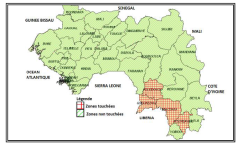
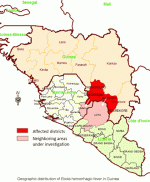
As of 22 March 2014, 80 cases of febrile illness, including 59 deaths (case-fatality ratio of 74%), were reported in Guinea. These suspected cases were recorded in the south-eastern prefectures of Gu?ck?dou, Macenta (which border Sierra Leone and Liberia), Kissidougou, and Conakry.
(...)
This disease is characterised by fever, diarrhea, vomiting, pronounced fatigue and, in some cases, haemorrhagic symptoms.
According the Guinean Ministry of Health, the Ebola viral etiology was confirmed on 22 March 2014 by the biosafety level-4 laboratory in Lyon, France [18].
Since 9 February 2014, Guinea has experienced febrile diseases in some districts of the Forested Guinea region [18,19]. It remains difficult to document the initial phase of the outbreak, and the following information should be considered with caution as it has not been confirmed by official sources.
According to media reports quoting health authorities in Guinea,
the deaths of a three-year-old child and an 18-year-old young adult were reported in Baladou, Gu?ck?dou Prefecture, on 12 and 14 March 2014, respectively.
At approximately the same time, nine deaths occurred in Gu?ck?dou commune [20]. Subsequently, a medical staff member from Gu?ck?dou hospital died; his sources of exposure were unknown. The director of the neighbouring Macenta hospital, who attended the funeral ceremony and was probably infected on this occasion, later developed the disease, and died.
Ten secondary cases were reported around the case in Gu?ck?dou, mainly among medical and laboratory staff and relatives. On 15 March, two additional suspected cases were hospitalised in Kissidougou and N?Z?r?kor? prefectures [21-23].
The origin of this outbreak is currently unknown.
However, exposure to bush meat has been suspected for the primary cases, as well as transmission through close contact with blood, secretions, organs or other biological fluids of infected animals.
Most of the secondary cases participated in funeral ceremonies and most were in direct contact with infected or deceased patients or had handled their bodies. This resulted in considering human-to-human transmission as the main of mode transmission, according to local health authorities.
Six of seven samples of clinical cases tested positive by RT-PCR assays for Ebola virus in the National Reference Centre for Viral Haemorrhagic Fevers (Institut Pasteur, INSERM BSL4 Laboratory, Lyon, France). Another five samples from contacts tested negative. Viral isolation and sequencing are in progress. Initial sequencing of a fragment from the L gene has shown a strong homology to Zaire ebolavirus [8,18,24-26].
On 21 March 2014, the Guinean Ministry of Health declared an outbreak of viral haemorrhagic fever which involved 59 suspected cases, including 25 deaths. It issued recommendations for early case detection, prevention of transmission in healthcare settings and preventive individual and community measures (educational public health messages for risk reduction) to prevent further transmission [19].
Control activities supported by WHO, UNICEF and M?decins Sans Fronti?res are being implemented, including contact tracing, enhanced surveillance and strengthening of infection control practices, free-of-charge access to healthcare for suspected cases, case isolation and management, and social mobilisation.
Media quoting WHO officials report that cases with similar symptoms, including fever, diarrhea, vomiting and bleeding, have also been reported in an area of
Sierra Leone near the border with Guinea.
On 22 March,
a 14-year-old suspected case who died in the town of Buedu in the eastern Kailahun District of Sierra Leone is under investigation. He had travelled to Guinea to attend the funeral of one of the outbreak's earlier victims. The health authorities in Sierra Leone are tracing contacts around the case [25].
The French Ministry of Foreign Affairs issued a travel advisory warning French citizens against travel to the affected parts of Guinea or areas of northern Liberia near the border between the two countries [27,28].
ECDC threat assessment for the EU
The presentation of this outbreak is consistent with Ebola haemorrhagic fever. Six cases have been confirmed by RT-PCR and therefore there is no doubt about the causative organism. The observed case-fatality ratio of 74% is consistent with what has been documented in previous Zaire ebolavirus outbreaks. Well-known risk factors commonly associated with such outbreaks include animal fluids (to which primary cases were exposed) and body fluids of patients (for example in connection with burials), to which secondary cases were exposed.
This is the first Ebolavirus outbreak in Western Africa.
However, this outbreak was not entirely unexpected as Guinea shares an ecological system known to be associated with Ebolavirus outbreaks, and some limited serological evidence of Ebolavirus infections in humans has been documented.
Currently,
four prefectures in Guinea are suspected to be affected, including the capital Conakry. Also, one district in Sierra Leone reported suspected cases. This is of particular concern, especially in a country with no previous experience in managing such outbreaks. Furthermore, Gu?ck?dou is a trading node connecting Guinea with neighbouring countries, and cases may therefore travel to neighbouring countries, potentially spreading the disease.
It is likely that more cases will be identified in the coming weeks, given the incubation period of up to three weeks and the challenges of containing this outbreak. In addition, active case-finding and contact monitoring may identify further cases.
Risk for the EU
The EU?s capacity to detect and confirm an infection with Ebola viruses is sufficient. The risk of patients developing symptoms of Ebola haemorrhagic fever in the EU can be assessed as follows.
WHO does not recommend that any travel or trade restrictions be applied to Guinea.
Tourists returning from Guinea
Non-stop international destinations from Conakry International Airport to the EU are
Paris and Brussels. However, other EU destinations can be accessed through a
Royal Air Maroc hub in Casablanca, which offers connections to
Paris, Nice, Lyon, Marseille, Toulouse, Barcelona, and Milan.
Other non-stop destinations from Conakry include
Senegal, C?te d?Ivoire, Mali, The Gambia, Mauritania, and Guinea-Bissau [29].
The risk of tourists becoming infected after a stay in Guinea and developing symptoms while in the EU is extremely low, even if they visited affected prefectures, because transmission can only occur in the context of direct contact with blood, secretions, organs or other body fluids of dead or living infected persons or animals.
Visiting families and friends
The risk for travellers visiting friends and relatives in Guinea is similarly low, unless the travellers have been in close physical contact with sick or dead persons or animals. In such a case, active contact tracing would identify the exposure and prevent further spread of the disease through active contact monitoring.
Exposed persons seeking medical attention in the EU
There is the possibility that persons suspecting exposure might seek medical attention in the EU while potentially incubating the disease, for example EU volunteers who worked in healthcare settings in the affected districts. These persons are likely to seek immediate medical attention and should be taken care of immediately if they develop any symptoms in order to prevent any further spread of the disease.
Patients presenting with symptoms and seeking medical attention in the EU
There is a remote possibility that persons who were exposed to Ebolavirus and developed symptoms would board a commercial flight to seek medical attention in the EU. It is highly likely that such patients would seek immediate medical attention upon arrival in the EU and then be isolated to prevent further transmission. In a guidance document, ECDC pointed out the very low risk to co-passengers on the same flight [30].
Laboratory samples shipped to EU laboratories
There is a theoretical risk that an improperly labelled biological sample is sent to an EU laboratory for further testing, without proper indication of a possible connection to an Ebolavirus infection. However, compliance with sample shipment regulations and universal precautions in the receiving laboratory should mitigate this risk [31].
Aircraft passengers exposed to an Ebola case during a flight
Guidelines for tracing contacts of Ebola or Marburg haemorrhagic fever cases on airplanes have been developed by ECDC [9].
As transmission can only occur in the context of direct contact with blood, secretions, organs or other body fluids of dead or living infected persons or animals, most airplane contacts pose a low to moderate risk of exposure.
However, due to the high pathogenicity of Ebola and an expected high susceptibility in airplane passengers, contact tracing should be considered when a potentially infectious, laboratory-confirmed index case of Ebola fever was on board a flight within the last 26 days (longest incubation period 21 days plus five days due to possible non-specific symptoms during the first five days).
Contact tracing should always be initiated if an index case has been symptomatic on board or was flying within four days before the onset of symptoms.
Contact tracing should be considered for the
entire cabin and crew.
Risk for EU residents in Guinea
The risk for EU residents in Guinea can be considered as very low, unless they are directly exposed to body fluids of dead or living infected persons or animals.
Avoiding such contact is an appropriate precautionary measure in this context.
The risk of acquiring the disease through exposure to contaminated fluids or equipment in healthcare settings in Guinea depends on the implementation of precautionary measures in those settings, e.g. isolation of cases, universal infection control measures.
There is a specific risk for healthcare workers and volunteers, especially if involved in caring for Ebola haemorrhagic fever patients. However, the level of precaution taken in such settings should effectively prevent the transmission of the disease.
There is a risk of transmission through unprotected sexual contact with a patient that has recently recovered from the disease.
_________
References
- Roddy P, Howard N, Van Kerkhove MD, Lutwama J, Wamala J, Yoti Z, et al. Clinical manifestations and case management of Ebola haemorrhagic fever caused by a newly identified virus strain, Bundibugyo, Uganda, 2007?2008. PloS one. 2012;7(12):e52986.
- European Centre for Disease Prevention and Control. Factsheet for health professionals. [internet]. 2014 [cited 2014 Mar 24]. Available from: http://www.ecdc.europa.eu/en/healthtopics/ebola_marburg_fevers/factsheet-for-health-professionals/Pages/factsheet_health_professionals.aspx
- Martini GA, Schmidt HA. [Spermatogenic transmission of the 'Marburg virus'. (Causes of 'Marburg simian disease')]. Klin Wochenschr. 1968 Apr 1;46(7):398-400.
- Colebunders R, Borchert M. Ebola haemorrhagic fever ? a review. J Infect. 2000 Jan;40(1):16-20.
- Dowell SF, Mukunu R, Ksiazek TG, Khan AS, Rollin PE, Peters CJ. Transmission of Ebola hemorrhagic fever: a study of risk factors in family members, Kikwit, Democratic Republic of the Congo, 1995. Commission de Lutte contre les Epidemies a Kikwit. J Infect Dis. 1999 Feb;179 Suppl 1:S87-91.
- Francesconi P, Yoti Z, Declich S, Onek PA, Fabiani M, Olango J, et al. Ebola hemorrhagic fever transmission and risk factors of contacts, Uganda. Emerg Infect Dis. 2003 Nov;9(11):1430-7.
- Raabea VN, Borcherta M. Infection control during filoviral hemorrhagic fever outbreaks. J Glob Infect Dis. 2012 Jan;4(1):69-74.
- World Health Organization. Ebola haemorrhagic fever ? fact sheet: WHO Media Centre; 2012 [20 March 2014]. Available from: http://www.who.int/mediacentre/factsheets/fs103/en/.
- European Centre for Disease Prevention and Control. Risk assessment guidelines for diseases transmitted on aircraft. Stockholm: ECDC; 2009. Available from: http://www.ecdc.europa.eu/en/publications/publications/0906_ter_risk_assessment_guidelines_for_infectious_diseases_transmitted_on_aircraft.pdf
- Ftika L, Maltezou HC. Viral haemorrhagic fevers in healthcare settings. J Hosp Infect. 2013 Mar;83(3):185-92.
- Li YH, Chen SP. Evolutionary history of Ebola virus. Epidemiol Infect. 2013 Sep 16:1-8.
- Emond RT, Evans B, Bowen ET, Lloyd G. A case of Ebola virus infection. Br Med J. 1977 Aug 27;2(6086):541-4.
- Mbonye A, Wamala J, Winyi K, Tugumizemo V, Aceng J, Makumbi I. Repeated outbreaks of viral hemorrhagic fevers in Uganda. Afr Health Sci. 2012 Dec;12(4):579-83.
- Formenty P, Hatz C, Le Guenno B, Stoll A, Rogenmoser P, Widmer A. Human infection due to Ebola virus, subtype Cote d'Ivoire: clinical and biologic presentation. J Infect Dis. 1999 Feb;179 Suppl 1:S48-53.
- World Health Organization. Ebola haemorrhagic fever ? Global Alert and Response (GAR). 2014 [cited 2014 22 March 2014]. Available from: http://www.who.int/csr/disease/ebola/en/.
- Feldmann H, Jones S, Klenk HD, Schnittler HJ. Ebola virus: from discovery to vaccine. Nat Rev Immunol. 2003 Aug;3(8):677-85.
- Marzi A, Feldmann H. Ebola virus vaccines: an overview of current approaches. Expert Rev Vaccines. 2014 Apr;13(4):521-31.
- Saphire EO. An update on the use of antibodies against the filoviruses. Immunotherapy. 2013 Nov;5(11):1221-33.
- Bah M. Guinea confirms Ebola as source of deadly epidemic. [internet]. 2014 [cited 2014 Mar 22]. Available from: Agence France-Presse, website: http://reliefweb.int/report/guinea/guinea-confirms-ebola-source-deadly-epidemic.
- Bureau de Presse de la Pr?sidence. ?pid?mie de la fi?vre virale h?morragique en Guin?e: D?claration du Ministre de la sant?. L'Express Guin?e [internet]. 2014 [cited 2014 Mar 21]. Available from: http://www.lexpressguinee.com/fichiers/blog16-999.php?pseudo=rub2&code=calb4122&langue=fr.
- Africatime.com ? Guin?e. Guin?e foresti?re: une maladie inconnue en Guin?e tue plusieurs personnes ? Gu?ck?dou 2014. Available from: http://fr.africatime.com/guinee/articles/guinee-forestiere-une-maladie-inconnue-en-guinee-tue-plusieurs-personnes-gueckedou.
- Afriquinfos.com. Guin?e : Une ?trange fi?vre fait 8 morts ? Macenta 2014. [internet]. 2014 [cited 2014 Mar 14]. Available from: http://www.afriquinfos.com/articles/2014/3/14/guinee-etrange-fievre-fait-morts-macenta-247658.asp.
- Guin?enews. Une ?trange maladie fait 9 morts dont 4 agents de sant? en Guin?e Foresti?re. [internet]. 2014 [cited 2014 Mar 15]. Available from: http://guineenews.org/2014/03/une-etrange-maladie-fait-9-morts-dont-4-agents-de-sante-en-guinee-forestiere-declare-dr-sakoba-keita/.
- Afrik.com. Guin?e : une myst?rieuse ?pid?mie tue 25 personnes. [internet]. 2014 [cited 2014 Mar 21]. Available from: http://www.afrik.com/guinee-une-mysterieuse-epidemie-fait-25-morts.
- Baize S, Pannetier D, National Reference Center for Viral Hemorrhagic Fevers ? Institut Pasteur/INSERM BSL4 Laboratory. Ebola virus disease ? West Africa: Guinea, Zaire Ebola virus suspected. ProMED mail [internet]. 2014 [cited 2014 Mar 23]. Available from: http://www.promedmail.org/direct.php?id=2349865.
- Reuters. Guinea confirms fever is Ebola, has killed up to 59. [internet]. 2014 [cited 2014 Mar 22]. Available from: http://uk.reuters.com/article/2014/03/22/us-guinea-ebola-idUKBREA2L0MI20140322.
- Muyembe-Tamfum JJ, Mulangu S, Masumu J, Kayembe JM, Kemp A, Paweska JT. Ebola virus outbreaks in Africa: past and present. Onderstepoort J Vet Res. 2012 Jun 20;79(2):451.
- French Ministry of Foreign Affairs. Conseils aux voyageurs [travel advice]. [internet]. 2014 [cited 2014 Mar 22]. Available from: http://www.diplomatie.gouv.fr/fr/conseils-aux-voyageurs/conseils-par-pays/guinee-12255/
- Ambassade de France en Guin?e. Message de s?curit? : fi?vre Ebola en Guin?e Foresti?re 2014. [internet]. 2014 [cited 2014 Mar 22]. Available from: http://www.ambafrance-gn.org/Message-de-securite-fievre.
- Guyana Civil Aviation Authority. Conakry Airport [internet]. 2014 [cited 2014 Mar 22]. Available from http://www.gcaa-gy.org/.
- World Health Organization. A guide for shippers of infectious substances, 2013. Geneva: WHO; 2013. [PowerPoint presentation]. Available from: http://www.who.int/ihr/infectious_substances/en/.
-
------