• FluTrackers.com Inc. does not provide medical advice. Information on this web site is collected from various internet resources, and the FluTrackers board of directors makes no warranty to the safety, efficacy, correctness or completeness of the information posted on this site by any author or poster. The information collated here is for instructional and/or discussion purposes only and is NOT intended to diagnose or treat any disease, illness, or other medical condition. Every individual reader or poster should seek advice from their personal physician/healthcare practitioner before considering or using any interventions that are discussed on this website. By continuing to access this website you agree to consult your personal physican before using any interventions posted on this website, and you agree to hold harmless FluTrackers.com Inc., the board of directors, the members, and all authors and posters for any effects from use of any medication, supplement, vitamin or other substance, device, intervention, etc. mentioned in posts on this website, or other internet venues referenced in posts on this website.
  • We are not asking for any donations. Do not donate to any entity who says they are raising funds for us.

Guinea - ​Resurgence of anthrax in Koubia: one death and several suspected cases (April 19, 2017)

Pathfinder

Editor, Senior Moderator
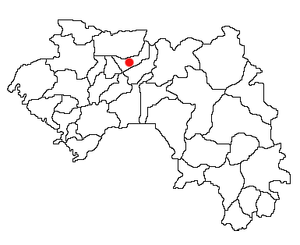
300px-GN-Koubia.png

https://en.wikipedia.org/wiki/Koubia_Prefecture

Translation Google

Resurgence of anthrax in Koubia: one death and several suspect cases
...
Epidemic

KOUBIA- Anthrax disease, which generally affects cattle, has resurfaced in Koubia, a prefecture of the middle Guinea. At least one dead and several suspects were registered, learned Africaguinee.com.

Victim Thierno Hassimiou Diallo surrendered after his admission to the regional hospital of Lab? on the morning of Tuesday April 18, 2017.

Dr Kalifa Diallo, a veterinary surgeon in charge of the prefecture of Lab?, confirmed the bad news. "There was a first victim coming from Koubia precisely from the locality of Madina Gnannou. The victim died as a result of the consumption of anthrax meat. She had developed the disease and then admitted to the hospital Lab? region, unfortunately she did not survive, "he explained.
...
Monitoring of anthrax cases requires a synergy of effort. The evacuation of the victims requires very delicate hygienic measures.

"The DGA of the Lab? regional hospital called me to help the forensic pathologist in the body packing for a secure expedition to Koubia. This requires hygienic measures. As this disease is very dangerous, they wanted to use the united WHO concept of health, which says that the human doctor and the veterinary surgeon must combine efforts to safeguard human health, it is in this context that they called on to us for the secure transport of the body " said Dr Diallo.

Alpha Ousmane Bah

For Africaguinee.com

Tel: (00224) 620 93 45 45

Created on Wednesday 19 April 2017 at 15:56

http://www.africaguinee.com/article...rbon-koubia-un-mort-et-plusieurs-cas-suspects
 
Translation Google

Appearance of anthrax in Koubia: local health authorities take stock of the disease

By Alaidhy Sow - May 4, 20170

Following the death of a person who allegedly consumed meat infected with the bacterial anthrax virus, health experts quickly mobilized to try to circumscribe the disease that had made several victims in 2014 in Koubia, Guineenews noted.

The Regional Epidemic Alert and Response Team (ERARE) in Lab?, headed by Dr. Abdoulaye Tounkourouma Bald?, is headed by WHO (World Health Organization) staff. The section on prevention and control of the disease at the DRS (regional health authority) of Lab?, was immediately transported to the site to take stock of the situation.

"It was with the cadres of the WHO, the health of Koubia and the DRS of Lab? that we together did the investigation. It was therefore considered suspicious case, any person brutally showing the symptoms of one of the clinical forms of the disease. The result of our investigation following consumption of the beef that was slaughtered reveals that fifty people consumed the meat in the village of Madina Niannou (sub-prefecture of Matakaou). Five developed the disease for an attack rate of 9%. The cases were in 6 families of Madina Niannou. The highest attack rate was 29%. The first symptoms occurred after the fourth and seventh day after the date of consumption of the meat (April 1, 2017). Among these patients, one was hospitalized at the regional hospital of Lab?. So it was the identified case and it was he who was also the owner of the animal. He was the one who slaughtered the sick animal and subsequently died, "he said.

Thus, all suspect cases were soon taken care of at the village health center. The victim was buried with dignity and in a safe way, says the Coordinator of the team ERARE Lab? which adds that more than five hundred inhabitants of the village have been sensitized on the methods of prevention and contamination of the charcoal.

To try to curb the spread of this disease, urgent measures have been taken to believe Dr. Abdoulaye Tounkourouma Bald? the head of the prevention and control of the disease at the Lab? DRS.

"The carcasses of two cows dead as a result of the coal were incinerated and then buried by the veterinary service. All other oxen were quarantined. 118 cattle, 27 sheep and 25 goats were vaccinated in the area. There was a supply of medication by the ERARE team to take care of, if there are new cases that are coming, "he announced.

Subsequently, recommendations were made by health professionals, including the strengthening of epidemiological surveillance in human, animal and environmental health for overall health security.

It was also recommended to follow the other people who had consumed the infected meat, to organize annually a vaccination campaign for the animals of the prefecture of Koubia for three consecutive years.

Because anthrax outbreaks are still in Koubia, said Dr. Bald? who announces that there will be a continuous awareness of the population on the control by the veterinary service of any slaughter before any consumption.

Alaidhy Sow Lab?, for Guin?enews.org


http://guineenews.org/apparition-charbon-a-koubia-autorites-sanitaires-locales-point-de-maladie/
 
Source: Week 18: 29 April - 05 May 2017

http://www.afro.who.int/en/clusters-a-programmes/whe/outbreaks-and-other-emergencies-updates.html


WEEKLY BULLETIN ON OUTBREAKS
AND OTHER EMERGENCIES
Week 18: 29 April ? 05 May 2017
Data as reported by 17:00 05 May 2017

Excerpt:

Anthrax Guinea

On 16 April 2017, the Regional Health Department of Lab? informed
the central Ministry of Health of a suspected outbreak of anthrax in
Matakou sub-district, Koubia district in the north of Guinea. The index
case, a 35 year old man from Hamdallaye village developed ill-health
on 7 April 2017. He presented to Matakaou health centre on 11 April
2017 with fever, swelling of the lower lip with black crusts, difficulty
to swallow, and shortness of breath. His condition continued to deteriorate
and he was referred to Lab? regional hospital on 13 April
2017 from where he died on 18 April 2017. The case-patient reportedly
slaughtered his cow on 01 April 2017 and the whole family ate the
meat. Part of the meat was sold off to a local butcher.
Three children to the index case, aged 9, 5 and 3 years, developed
milder illnesses on 7 April 2017. Two of the children, 9 and 3 year old
boys, presented to the local health facility on 11 April 2017 with swelling
of the cheeks with vesicles. The third child, 5 year old girl, was
admitted on 13 April 2017 with swelling around the eyes. On 14 April
2017, another 9 year old boy from a different family (who consumed
the same meat) developed oedema of the neck with vesicles and presented
to the local health facility on 14 April 2017. The attending clinician
made a provisional diagnosis of anthrax. By 03 May 2017, the
children were showing good clinical improvement. No new case has
been reported since 3 May 2017. As of 27 April 2017, a total of 5 cases
including one death (case fatality rate of 20%) have been reported.
No biological samples were obtained from these cases to facilitate
confirmation of the outbreak.
Preliminary outbreak investigation conducted by a multidisciplinary
rapid response team from the Ministry of Health, Veterinary Services
and WHO established that the slaughtered cow was actually sick.
Over 50 other persons from six families in the community reportedly
bought and consumed the meat.

Public health actions
? From 15 - 16 April 2017, the Veterinary services carried out vaccination of animals in and around the affected area. Anthrax vaccine
was administered to 118 cows, 25 goats and 27 sheep. Movement of livestock from the affected communities has been quarantined.
? Active case finding and awareness raising on signs and symptoms of anthrax is being undertaken in the community.
? Case management is being provided in the local prefectural hospital and health center using antibiotics, antipyretic and dressing of
cutaneous lesions.
? Risk communication and social mobilization are being conducted in the affected communities, aimed to identify the persons who consumed
the meat, encourage early health care seeking behavior, etc.

Situation interpretation
A suspected outbreak of anthrax has been reported in Koubia district in the north of Guinea. This region, mainly inhabited by populations who
are both cattle keepers and agriculturalists, has had recurrent outbreaks of anthrax in the past. A Ministry of Health report indicates that three
different outbreaks of anthrax occurred between 2014 and 2016, affecting 145 domestic animals and 57 human cases including 11 deaths.
While outbreak investigation was conducted as expected, no human and animal biological samples were obtained to facilitate confirmation of
the outbreak. This was a missed opportunity. The response to this suspected outbreak needs to be systematically reviewed in order to identify
challenges encountered, both in the public and animal heath sectors. Findings from the after-action review should be used to strengthen
structures and systems for epidemic preparedness and response, in the context of One Health.

 
Back
Top Bottom