Source:
 Week 18: 29 April - 05 May 2017
http://www.afro.who.int/en/clusters-a-programmes/whe/outbreaks-and-other-emergencies-updates.html
Week 18: 29 April - 05 May 2017
http://www.afro.who.int/en/clusters-a-programmes/whe/outbreaks-and-other-emergencies-updates.html
WEEKLY BULLETIN ON OUTBREAKS
AND OTHER EMERGENCIES
Week 18: 29 April ? 05 May 2017
Data as reported by 17:00 05 May 2017
Excerpt:
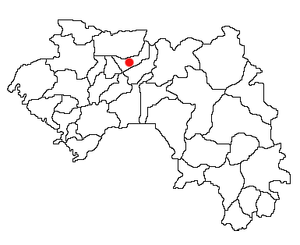
Anthrax Guinea
On 16 April 2017, the Regional Health Department of Lab? informed
the central Ministry of Health of a suspected outbreak of anthrax in
Matakou sub-district, Koubia district in the north of Guinea. The index
case, a 35 year old man from Hamdallaye village developed ill-health
on 7 April 2017. He presented to Matakaou health centre on 11 April
2017 with fever, swelling of the lower lip with black crusts, difficulty
to swallow, and shortness of breath. His condition continued to deteriorate
and he was referred to Lab? regional hospital on 13 April
2017 from where he died on 18 April 2017. The case-patient reportedly
slaughtered his cow on 01 April 2017 and the whole family ate the
meat. Part of the meat was sold off to a local butcher.
Three children to the index case, aged 9, 5 and 3 years, developed
milder illnesses on 7 April 2017. Two of the children, 9 and 3 year old
boys, presented to the local health facility on 11 April 2017 with swelling
of the cheeks with vesicles. The third child, 5 year old girl, was
admitted on 13 April 2017 with swelling around the eyes. On 14 April
2017, another 9 year old boy from a different family (who consumed
the same meat) developed oedema of the neck with vesicles and presented
to the local health facility on 14 April 2017. The attending clinician
made a provisional diagnosis of anthrax. By 03 May 2017, the
children were showing good clinical improvement. No new case has
been reported since 3 May 2017. As of 27 April 2017, a total of 5 cases
including one death (case fatality rate of 20%) have been reported.
No biological samples were obtained from these cases to facilitate
confirmation of the outbreak.
Preliminary outbreak investigation conducted by a multidisciplinary
rapid response team from the Ministry of Health, Veterinary Services
and WHO established that the slaughtered cow was actually sick.
Over 50 other persons from six families in the community reportedly
bought and consumed the meat.
Public health actions
? From 15 - 16 April 2017, the Veterinary services carried out vaccination of animals in and around the affected area. Anthrax vaccine
was administered to 118 cows, 25 goats and 27 sheep. Movement of livestock from the affected communities has been quarantined.
? Active case finding and awareness raising on signs and symptoms of anthrax is being undertaken in the community.
? Case management is being provided in the local prefectural hospital and health center using antibiotics, antipyretic and dressing of
cutaneous lesions.
? Risk communication and social mobilization are being conducted in the affected communities, aimed to identify the persons who consumed
the meat, encourage early health care seeking behavior, etc.
Situation interpretation
A suspected outbreak of anthrax has been reported in Koubia district in the north of Guinea. This region, mainly inhabited by populations who
are both cattle keepers and agriculturalists, has had recurrent outbreaks of anthrax in the past. A Ministry of Health report indicates that three
different outbreaks of anthrax occurred between 2014 and 2016, affecting 145 domestic animals and 57 human cases including 11 deaths.
While outbreak investigation was conducted as expected, no human and animal biological samples were obtained to facilitate confirmation of
the outbreak. This was a missed opportunity. The response to this suspected outbreak needs to be systematically reviewed in order to identify
challenges encountered, both in the public and animal heath sectors. Findings from the after-action review should be used to strengthen
structures and systems for epidemic preparedness and response, in the context of One Health.