
Install the app
How to install the app on iOS
Follow along with the video below to see how to install our site as a web app on your home screen.
Note: This feature may not be available in some browsers.
-
FluTrackers.com Inc. does not provide medical advice. Information on this web site is collected from various internet resources, and the FluTrackers board of directors makes no warranty to the safety, efficacy, correctness or completeness of the information posted on this site by any author or poster. The information collated here is for instructional and/or discussion purposes only and is NOT intended to diagnose or treat any disease, illness, or other medical condition. Every individual reader or poster should seek advice from their personal physician/healthcare practitioner before considering or using any interventions that are discussed on this website. By continuing to access this website you agree to consult your personal physican before using any interventions posted on this website, and you agree to hold harmless FluTrackers.com Inc., the board of directors, the members, and all authors and posters for any effects from use of any medication, supplement, vitamin or other substance, device, intervention, etc. mentioned in posts on this website, or other internet venues referenced in posts on this website.
-
We are not asking for any donations. Do not donate to any entity who says they are raising funds for us.
You are using an out of date browser. It may not display this or other websites correctly.
You should upgrade or use an alternative browser.
You should upgrade or use an alternative browser.
Germany - H5N1 avian flu in wild birds 2024-2026
- Thread starter Shiloh
- Start date

Pathfinder
Editor, Senior Moderator
Volume 32, Number 5—May 2026
Dispatch
Highly Pathogenic Avian Influenza A(H5N1) Clade 2.3.4.4b Virus and Mass Mortality in Eurasian Cranes, Germany, 2025
...
Anne Günther, Christof Herrmann, Julia Sehl-Ewert, Simon Piro, Ann Kathrin Ahrens, Sten Calvelage, Anne Pohlmann, Martin Beer, and Timm Harder

Author affiliation: Friedrich-Loeffler-Institut, Greifswald–Insel Riems, Germany (A. Günther, J. Sehl-Ewert, A.K. Ahrens, S. Calvelage, A. Pohlmann, M. Beer, T. Harder); Agency for Environment, Nature Conservation, and Geology Mecklenburg-Western Pomerania, Güstrow, Germany (C. Herrmann, S. Piro)
Abstract
In autumn 2025, highly pathogenic avian influenza A(H5N1) clade 2.3.4.4b virus, genotype EA-2024-DI.2.1, caused systemic infections leading to a mass mortality event among the western migrating subpopulation of Eurasian cranes (Grus grus) in Germany. Gregarious behavior at feeding and resting sites likely promoted rapid viral spread within the population.
Eurasian cranes (Grus grus) migrate along eastern, central, and western European flyways. Mass mortalities caused by goose/Guangdong (Gs/Gd)–like highly pathogenic avian influenza viruses (HPAIVs) of subtype H5 have shown susceptibility in G. grus cranes previously, on the eastern and central flyway in West Asia during the 2021–22 and 2024–25 influenza seasons (1), and in Eastern Europe during 2023–24 (2,3). Cranes on the Western European flyway were spared from the severe outbreak event, despite the ongoing HPAIV enzootic in Europe, until October 2025, when widespread deaths were detected in Germany, and thereafter in France and Spain.
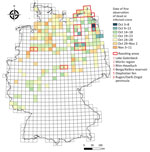
Figure 1. Locations of notifications for deceased or infected cranes in study of highly pathogenic avian influenza A(H5N1) clade 2.3.4.4b virus, Germany, 2025. Notifications are from the period October 3–November 11, 2025....
Each year, >420,000 cranes migrate through Germany (4). Birds migrating from Scandinavia typically roost along the coast in Mecklenburg-Western Pomerania, whereas cranes from Finland, Poland, and the Baltic region prefer inland staging sites such as Lake Galenbeck, the Müritz region, Rhin-Havelluch, or the Berga/Kelbra reservoir (Figure 1). Birds that roost in the roosting region Diepholzer fen (Figure 1) in northwestern Germany continue on to wintering areas in France and Spain.
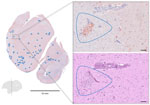
Figure 2. Representative histopathologic findings in influenza A(H5N1)֪–infected cranes from study of highly pathogenic avian influenza A(H5N1) clade 2.3.4.4b virus causing mass mortality in cranes, Germany, 2025. Immunohistochemistry of a coronal brain...
The first deceased cranes in Germany were found in early October 2025 at Lake Galenbeck and were confirmed HPAIV A(H5N1)–positive shortly afterward. As of March 2026, no increased mortality has been reported from regions north (Sweden) and east (Poland and the Baltic countries) of the index site. Six cranes associated with the initial outbreak underwent necropsy. Carcasses were well preserved and in good nutritional and body condition. Gross lesions were consistent with an acute systemic process and dominated by pancreatic necrosis, pulmonary edema, and occasional epicardial and proventricular hemorrhages (Appendix 1). We examined 3 birds histopathologically. Immunohistochemistry revealed the highest influenza A virus–specific antigen loads in the central nervous system (CNS) and pancreas; moderate loads in the heart, spleen, and kidneys; and low antigen loads in respiratory and intestinal tissues. Despite widespread viral antigen distribution, necrosis was present only in subsets of antigen-positive areas. The lesion pattern largely corresponds to previous reports in cranes, particularly severe pancreatic necrosis and CNS involvement (3). Because immunohistochemistry was not performed in the previous study, we cannot directly compare viral antigen loads. In our cases, widespread antigen detection with only limited inflammation and necrosis suggests a peracute and rapidly progressive disease course (Figure 2; Appendix 1). Reported neurologic signs in the field, including uncoordinated movements and lack of escape behavior, correlate with widespread CNS infection.
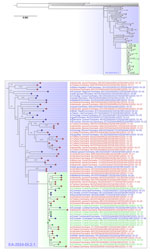
Figure 3. Maximum-likelihood tree based on whole-genome analyses from study of highly pathogenic avian influenza A(H5N1) clade 2.3.4.4b virus causing mass mortality in cranes, Germany, 2025. Tree at top depicts the H5N1...
We confirmed HPAIV H5N1 infection by real-time quantitative reverse transcription PCR in oropharyngeal and cloacal swab samples and in lung and brain tissues, finding very high virus loads (Appendix 1). Genome sequencing of 9 cranes and 25 HPAIV H5N1–positive samples from wild birds, as well as 43 samples from domestic holdings, identified HPAIV H5N1 clade 2.3.4.4b of genotype EA-2024-DI.2.1 (Figure 3; Appendix 1). Since September 2025, DI.2.1-like viruses have been detected almost simultaneously at multiple sites across Europe (5), appearing to be a sublineage of the Gs/Gd-like HPAIV genotype EA-2024-DI.2, which dominated the European HPAIV epizootiology in 2024 and the first half of 2025 (6). Phylogenetic analyses indicated that all sequences derived from HPAIV H5–positive cranes fall into a monophyletic cluster of EA-2024-DI.2.1 (Figure 3). The cluster is interspersed with sequences from domestic poultry and other wild bird species from different families. That clustering pattern in the phylogenetic tree could indicate a closely linked and direct spread within crane flocks in Germany after a primary introduction. However, our early data do not enable us to reliably distinguish direct spread from the possibilities of a diffuse dissemination in wild or domestic birds, or both, with repeated spillover to crane populations, or dissemination from an unsampled host compartment with repeated spillover to the sampled species. The detection of mild or even asymptomatic cases (e.g., in dabbling ducks) and related sequence data will help to better discern dissemination patterns in avian wildlife.
Veterinary authorities and bird conservation organizations initiated carcass removal; efforts varied and were often hindered by the challenging wetland terrain. Removing carcasses has been deemed useful for reducing the incidence of infections in other gregarious species (7). Despite mitigation attempts, 18,164 deceased cranes were reported in Germany during October–December 2025, vastly outnumbering previously reported detections of HPAIV H5 clade 2.3.4.4b in cranes in Germany in 2020 (H5N8, n = 2) and 2023 (H5N1, n = 9).
By early November 2025, crane mortality slowed and finally almost stopped in Germany. As the cranes continued their migration, the virus spread to France and Spain. At Lake du Der-Chantecoq in northeastern France, 4,000–5,000 dead cranes were recorded during October through mid-November; an estimated 15,000–20,000 cranes died across France. In Spain, the estimated range of fatalities was 1,000–1,500, including 900 around the Gallocanta lagoon. Altogether, the estimated mortality rate along the Western European flyway in autumn 2025 was ≈10% of the crane flyway population, >420,000 cranes (4). The nearly identical, phylogenetically very closely related sequences of HPAIV H5N1 from Eurasian cranes suggest that, once DI.2.1 entered the population, cranes became both severely affected hosts and efficient amplifiers, contributing to rapid intraspecies-specific spread along the flyway. Close contact at night roosts in shallow waters likely accelerated the transmission of the virus through contaminated surface water; even minimal environmental viral loads in surface water have been shown to be sufficient for infecting susceptible species (8).
The source species and location of the current genotype DI.2.1 of HPAIV H5N1 have not been elucidated. Additional sequence data from a broader European perspective will help to identify HPAIV H5N1 outbreaks in poultry farms as possible sources or sinks of the virus and to trace transmission chains. Although cranes dominated in the clinical manifestation of the current H5N1 epizootic, they may not necessarily be the main drivers in virus spread. The same virus variant was detected in Germany simultaneously in several anseriform species, representing other possible reservoir host groups, such as geese, wigeons, and mallards (Figure 3; Appendix 1). However, when compared with that of previous seasons, mortality in those species was low and sporadic; possible causes were partial population immunity or characteristics of the current H5N1 genotype. Although those species might have been clinically less vulnerable, they were not necessarily protected from virus infection and excretion. In contrast, the crane population appeared to be fully susceptible, likely because of a lack of prior exposure to HPAIV H5 in Western Flyway populations; other unresolved intrinsic (cell receptor distributions, immune genetics etc.) and extrinsic factors might have been involved. Unfortunately, no stored serum samples are available to confirm the assumption of a seronegative population. Furthermore, it remains unclear if HPAIV H5 circulation influenced cranes’ migratory behavior, such as avoiding heavily affected roosting sites.
As of November 17, 2025, more than 18,000 dead cranes had been reported in Germany alone in this outbreak. The full effect of the HPAI-associated mass mortality on the population structure of the Western Flyway crane population must be studied. The event highlights critical knowledge gaps in our understanding the epidemiology of HPAIV H5 in wild birds; those gaps primarily result from inadequate active monitoring and the lack of serologic data needed to assess population immunity. In addition, the networks driving HPAIV H5 transmission and spread within and between wild bird and poultry populations remain poorly understood. The characteristics of the current DI2.1 genotype require detailed investigation, particularly in wild Anseriformes birds.
Dr. Günther is a veterinarian and a postdoctoral researcher at the Friedrich-Loeffler-Institut, Greifswald–Insel Riems, Germany. Her primary research interests are avian viruses and other pathogens with potential influence on avian species conservation, wildlife, and public health concerns.
...
https://wwwnc.cdc.gov/eid/article/32/5/26-0170_article