
Install the app
How to install the app on iOS
Follow along with the video below to see how to install our site as a web app on your home screen.
Note: This feature may not be available in some browsers.
-
FluTrackers.com Inc. does not provide medical advice. Information on this web site is collected from various internet resources, and the FluTrackers board of directors makes no warranty to the safety, efficacy, correctness or completeness of the information posted on this site by any author or poster. The information collated here is for instructional and/or discussion purposes only and is NOT intended to diagnose or treat any disease, illness, or other medical condition. Every individual reader or poster should seek advice from their personal physician/healthcare practitioner before considering or using any interventions that are discussed on this website. By continuing to access this website you agree to consult your personal physican before using any interventions posted on this website, and you agree to hold harmless FluTrackers.com Inc., the board of directors, the members, and all authors and posters for any effects from use of any medication, supplement, vitamin or other substance, device, intervention, etc. mentioned in posts on this website, or other internet venues referenced in posts on this website. -
We are not asking for any donations. Do not donate to any entity who says they are raising funds for us.
You are using an out of date browser. It may not display this or other websites correctly.
You should upgrade or use an alternative browser.
You should upgrade or use an alternative browser.
Discussion thread VII - COVID-19: Endemic Stage
- Thread starter Pathfinder
- Start date

gsgs
Registered User
they talk about millions ... the 4 trillion in relief payments are forgotten
I remember, how I was shocked in late March 2020 when I learned how
expensive the pandemic is.
Yet everything is fine now .. except 1M deaths and inflation
https://en.wikipedia.org/wiki/CARES_Act
https://en.wikipedia.org/wiki/American_Rescue_Plan_Act_of_2021
I remember, how I was shocked in late March 2020 when I learned how
expensive the pandemic is.
Yet everything is fine now .. except 1M deaths and inflation
https://en.wikipedia.org/wiki/CARES_Act
https://en.wikipedia.org/wiki/American_Rescue_Plan_Act_of_2021

Pathfinder
Editor, Senior Moderator
Wastewater tests show COVID infections surging, but pandemic fatigue limits precautions
Tulane professor says public should be made more aware of risks
BY: TIM HENDERSON - JANUARY 23, 2024 10:29 AM
...
Although it’s spotty and inconsistent in many places, wastewater testing is pointing to a new wave of COVID-19 infections, with as many as one-third of Americans expected to contract the disease by late February.
With pandemic fatigue also in full force, and deaths and hospitalizations well down from peaks in 2021 because of high vaccination and immunity rates, many people are inclined to shrug off the new wave, fueled by the JN.1 variant. But COVID-19 continues to take thousands of lives a month. Older, sicker people need to take particular precautions, experts point out, and everybody should think about the debilitating condition known as long COVID that can strike even young, healthy people and last years.
...
Like many experts, Hoerger said everybody should be more aware of the high risk and try to avoid getting infected or reinfected with COVID-19, since every new infection increases the chance of long COVID.
...
“Everyone is vulnerable in some way. The best way to avoid getting long COVID is to avoid getting COVID,” Hoerger said.
...
To me it’s almost unethical that we’re not warning people that this highly transmissible virus is still with us and some people should really be taking precautions.
– David Freedman, Clemson University environmental engineer
...
Older people and cancer patients make up an increasing proportion of COVID-19 deaths, according to Stateline’s analysis. People 65 or older made up 88% of those deaths last year, compared with 69% in the peak year for deaths, 2021. Cancer patients made up 12% of COVID-19 deaths last year, up from 5% in 2021.
In some states with older populations, COVID-19 deaths remain stubbornly high compared with other states. Vermont had the lowest COVID-19 death rate in the country in 2021 but now ranks fourth in the number of deaths per capita, behind Kentucky, West Virginia and Mississippi.
...
https://lailluminator.com/2024/01/23/wastewater-covid/
Tulane professor says public should be made more aware of risks
BY: TIM HENDERSON - JANUARY 23, 2024 10:29 AM
...
Although it’s spotty and inconsistent in many places, wastewater testing is pointing to a new wave of COVID-19 infections, with as many as one-third of Americans expected to contract the disease by late February.
With pandemic fatigue also in full force, and deaths and hospitalizations well down from peaks in 2021 because of high vaccination and immunity rates, many people are inclined to shrug off the new wave, fueled by the JN.1 variant. But COVID-19 continues to take thousands of lives a month. Older, sicker people need to take particular precautions, experts point out, and everybody should think about the debilitating condition known as long COVID that can strike even young, healthy people and last years.
...
Like many experts, Hoerger said everybody should be more aware of the high risk and try to avoid getting infected or reinfected with COVID-19, since every new infection increases the chance of long COVID.
...
“Everyone is vulnerable in some way. The best way to avoid getting long COVID is to avoid getting COVID,” Hoerger said.
...
To me it’s almost unethical that we’re not warning people that this highly transmissible virus is still with us and some people should really be taking precautions.
– David Freedman, Clemson University environmental engineer
...
Older people and cancer patients make up an increasing proportion of COVID-19 deaths, according to Stateline’s analysis. People 65 or older made up 88% of those deaths last year, compared with 69% in the peak year for deaths, 2021. Cancer patients made up 12% of COVID-19 deaths last year, up from 5% in 2021.
In some states with older populations, COVID-19 deaths remain stubbornly high compared with other states. Vermont had the lowest COVID-19 death rate in the country in 2021 but now ranks fourth in the number of deaths per capita, behind Kentucky, West Virginia and Mississippi.
...
https://lailluminator.com/2024/01/23/wastewater-covid/
Pathfinder
Editor, Senior Moderator
The CDC may be reconsidering its COVID isolation guidance
FEBRUARY 14, 2024 6:01 AM ET
Pien Huang
The Centers for Disease Control and Prevention may soon drop its isolation guidance for people with COVID-19. The planned change was reported in The Washington Post on Tuesday, attributed to several unnamed CDC officials.
Currently, people who test positive are advised to stay home for at least five days to reduce the chances of spreading the coronavirus to others. The unnamed officials told the Post that the agency will advise people to rely on symptoms instead. If a person doesn't have a fever and the person's symptoms are mild or resolving, they could still go to school or work. These changes could come as early as April.
The CDC hasn't yet confirmed the report. In an email, an agency spokesperson wrote that the CDC has "no updates to COVID guidelines to announce at this time. We will continue to make decisions based on the best evidence and science to keep communities healthy and safe."
...
https://www.npr.org/sections/health...may-be-reconsidering-covid-isolation-guidance
FEBRUARY 14, 2024 6:01 AM ET
Pien Huang
The Centers for Disease Control and Prevention may soon drop its isolation guidance for people with COVID-19. The planned change was reported in The Washington Post on Tuesday, attributed to several unnamed CDC officials.
Currently, people who test positive are advised to stay home for at least five days to reduce the chances of spreading the coronavirus to others. The unnamed officials told the Post that the agency will advise people to rely on symptoms instead. If a person doesn't have a fever and the person's symptoms are mild or resolving, they could still go to school or work. These changes could come as early as April.
The CDC hasn't yet confirmed the report. In an email, an agency spokesperson wrote that the CDC has "no updates to COVID guidelines to announce at this time. We will continue to make decisions based on the best evidence and science to keep communities healthy and safe."
...
https://www.npr.org/sections/health...may-be-reconsidering-covid-isolation-guidance
Pathfinder
Editor, Senior Moderator
German patient vaccinated against Covid 217 times
23 hours ago
By Michelle Roberts,Digital health editor
A 62-year-old man from Germany has, against medical advice, been vaccinated 217 times against Covid, doctors report. The bizarre case is documented in The Lancet Infectious Diseases journal. The shots were bought and given privately within the space of 29 months. The man appears to have suffered no ill effects, researchers from the University of Erlangen-Nuremberg say.
'Very interested'
"We learned about his case via newspaper articles," Dr Kilian Schober, from the university's microbiology department, said. "We then contacted him and invited him to undergo various tests in Erlangen. He was very interested in doing so." The man provided fresh blood and saliva samples. The researchers also tested some frozen blood samples of his that had been stored in recent years.
...
https://www.bbc.com/news/health-68477735
------------------------------
CORRESPONDENCE|ONLINE FIRST
Adaptive immune responses are larger and functionally preserved in a hypervaccinated individual
...
In summary, our case report shows that SARS-CoV-2 hypervaccination did not lead to adverse events and increased the quantity of spike-specific antibodies and T cells without having a strong positive or negative effect on the intrinsic quality of adaptive immune responses. While we found no signs of SARS-CoV-2 breakthrough infections in HIM to date, it cannot be clarified whether this is causally related to the hypervaccination regimen. Importantly, we do not endorse hypervaccination as a strategy to enhance adaptive immunity.
...
https://www.thelancet.com/journals/laninf/article/PIIS1473-3099(24)00134-8/fulltext
23 hours ago
By Michelle Roberts,Digital health editor
A 62-year-old man from Germany has, against medical advice, been vaccinated 217 times against Covid, doctors report. The bizarre case is documented in The Lancet Infectious Diseases journal. The shots were bought and given privately within the space of 29 months. The man appears to have suffered no ill effects, researchers from the University of Erlangen-Nuremberg say.
'Very interested'
"We learned about his case via newspaper articles," Dr Kilian Schober, from the university's microbiology department, said. "We then contacted him and invited him to undergo various tests in Erlangen. He was very interested in doing so." The man provided fresh blood and saliva samples. The researchers also tested some frozen blood samples of his that had been stored in recent years.
...
https://www.bbc.com/news/health-68477735
------------------------------
CORRESPONDENCE|ONLINE FIRST
Adaptive immune responses are larger and functionally preserved in a hypervaccinated individual
- Katharina Kocher [SUP]†[/SUP]
- Carolin Moosmann [SUP]†[/SUP]
- Felix Drost
- Christine Schülein
- Pascal Irrgang
- Philipp Steininger
- et al.
- Show all authors
- Show footnotes
...
In summary, our case report shows that SARS-CoV-2 hypervaccination did not lead to adverse events and increased the quantity of spike-specific antibodies and T cells without having a strong positive or negative effect on the intrinsic quality of adaptive immune responses. While we found no signs of SARS-CoV-2 breakthrough infections in HIM to date, it cannot be clarified whether this is causally related to the hypervaccination regimen. Importantly, we do not endorse hypervaccination as a strategy to enhance adaptive immunity.
...
https://www.thelancet.com/journals/laninf/article/PIIS1473-3099(24)00134-8/fulltext
Pathfinder
Editor, Senior Moderator
The CDC released updated recommendations on March 1, 2024:
Hat tip Lance:
CIDRAP- CDC announces new respiratory virus guidance, ends COVID isolation policy
March 1, 2024, 06:49 PM
https://flutrackers.com/forum/forum...ry-virus-guidance-ends-covid-isolation-policy
Hat tip Lance:
CIDRAP- CDC announces new respiratory virus guidance, ends COVID isolation policy
March 1, 2024, 06:49 PM
https://flutrackers.com/forum/forum...ry-virus-guidance-ends-covid-isolation-policy

sharon sanders
Editor-in-Chief & President
Not medical advice. I am at extremely high risk for a bad COVID-19 outcome. I have several risk factors.
I received a Novavax booster last week. I did not feel any consequences. This was my 2nd Novavax booster. I think I prefer this one over the Moderna or Pfizer.
Generally going into the Spring and Summer I am still avoiding crowds. I do go into a restaurant at low volume times, i.e. 8 am. I prep my nose and gargle with mouthwash before and after. We try to sit outside and away from other tables if inside. I stay boosted. I always carry an N95 mask. I wear it inside all stores. I also always carry a hand sanitizer.
So far I have not contracted COVID-19, or any other illness, that I know of. I like not getting colds, flu, novavirus, sinus infections, etc.
I am not getting negative comments anymore when I wear a mask, but I did tell a neighbor last week that I had just come back from getting a booster shot and I could tell they were making a huge effort not to comment. I perceived that they are not in favor of COVID-19 vaccines. When I called the pharmacy to see if they carried the Novavax vaccine, the pharmacist said I did not need an appointment because "no one wants them" (meaning all COVID-19 vaccines).
I have no idea if I have any medium or long term problems from the COVID-19 vaccines but I have not had any cardiac, circulatory, cancer events that I know of. Time will tell. Meanwhile - I am still alive and do not have long-covid either. So...who knows....?
I received a Novavax booster last week. I did not feel any consequences. This was my 2nd Novavax booster. I think I prefer this one over the Moderna or Pfizer.
Generally going into the Spring and Summer I am still avoiding crowds. I do go into a restaurant at low volume times, i.e. 8 am. I prep my nose and gargle with mouthwash before and after. We try to sit outside and away from other tables if inside. I stay boosted. I always carry an N95 mask. I wear it inside all stores. I also always carry a hand sanitizer.
So far I have not contracted COVID-19, or any other illness, that I know of. I like not getting colds, flu, novavirus, sinus infections, etc.
I am not getting negative comments anymore when I wear a mask, but I did tell a neighbor last week that I had just come back from getting a booster shot and I could tell they were making a huge effort not to comment. I perceived that they are not in favor of COVID-19 vaccines. When I called the pharmacy to see if they carried the Novavax vaccine, the pharmacist said I did not need an appointment because "no one wants them" (meaning all COVID-19 vaccines).
I have no idea if I have any medium or long term problems from the COVID-19 vaccines but I have not had any cardiac, circulatory, cancer events that I know of. Time will tell. Meanwhile - I am still alive and do not have long-covid either. So...who knows....?
Pathfinder
Editor, Senior Moderator
France -
Translation Google
Covid: Is Taylor Swift the origin of a cluster?
American singer Taylor Swift gave four performances in Paris last May. Since then, many Internet users have reported symptoms or even proven cases of Covid. A situation that many fans minimize, but which worries others.
By Thomas Graindorge
Published on 05/17/2024 at 7:34 p.m., modified 05/17/2024 at 10:54 p.m.
...
As our colleague Marianne reports , several "swifties" (name given to Taylor Swift aficionados) reported , after the concerts on May 9, 10, 11 and 12, due to Covid symptoms . “All the people I know have fallen ill ,” testifies one of them on X (ex-Twitter). “After the Taylor Swift concert, I had Covid like the majority of the concert. But it was worth it,” said another. “I think there are a lot of people who caught it there ,” questioned an Internet user.
It would seem that this phenomenon is not just an illusion or a fad of social networks. If we are to believe the Public Health France bulletin of May 14, emergency visits for suspected Covid are increasing among those under 15 (+20%) and those 15 and over (+28%). . Taylor Swift 's four event concerts brought together some 180,000 people. “ The conditions are then met because we spend more than 3 hours singing, shouting, howling our happiness at being together in closed places , ” analyzes doctor Antoine Flahault on his X account .
Paris La Défense Arena, which hosted the star, however, denies any responsibility to this day. On its website, we can read that “ Paris La Défense Arena guarantees you a healthy space for the duration of the event. The room was designed to manage air treatment, guaranteeing spectators a welcome in optimal health, safety and comfort conditions . But for some, this type of event is far from smiling.
For lawyer and activist Elisa Rojas, “ this is far from being a funny anecdote, it is serious . No one to take the opportunity to remind people of the risks linked to Covid and the means to protect themselves ,” she denounces on X. Taylor Swift is due to perform on Sunday June 2 and Monday June 3 in Lyon. The lawyer thus asks a fan account of the singer to warn “everyone of the risks of Covid infections. Previous shows have been proven [HASHTAG="t56426"]covid[/HASHTAG] clusters. “It’s everyone’s health that is at stake . ”
https://www.capital.fr/economie-politique/covid-taylor-swift-est-elle-a-lorigine-dun-cluster-1496920
---------------------------------
Covid-19: mega-concerts causing new epidemics?
Published on 05/19/2024 09:56
Article written by franceinfo - E. Lagarde, V. Lucas, L. Lavieille, @RevelateursFTV
Could Taylor Swift's concerts in Paris have led to the creation of giant clusters? With 180,000 people over four days, many fans say they tested positive for Covid-19 after the American singer's concerts.
After Taylor Swift 's concert , several dozen fans reported falling ill on social networks. 45,000 people shouting and singing in the largest concert hall in Europe is a situation conducive to creating a source of contamination. The event reminds us of a reality: Covid-19 is still circulating. The week of May 13, cases were also on the rise among young people. The owners of the concert hall emphasize that all standards were respected.
Insufficient measures
The case greatly interested Pascal Morenton, professor of physics. He simulated air quality based on data provided by the concert hall. Regulatory, but not sufficient. “After 2 hours, I found a rate of 1,772 PPM, which is almost twice the recommended rate for an enclosed space ,” he explains. For him, since Covid, the installations have not progressed enough.
https://www.francetvinfo.fr/sante/m...l-origine-de-nouvelles-epidemies_6553706.html
--------------------------------------------------
Cases of Covid-19 after Taylor Swift concerts: the organizer explains
After American star Taylor Swift's four concerts in Paris, many fans reported symptoms linked to Covid-19 or even proven cases. When questioned, the management of Paris La Défense Arena ensures that all health standards have been respected.
By Xavier Martinage
Published on 05/21/2024 at 7:33 a.m., modified to10:48 a.m.
Concerts which were eagerly awaited by Taylor Swift fans . On May 9, 10, 11 and 12, the American star brought together more than 180,000 people in the largest venue in Europe, Paris La Défense Arena in Nanterre. So many enthusiastic “swifties” (name given to Taylor Swift aficionados) who nevertheless reported symptoms linked to Covid-19 after the concerts . On social networks, numerous testimonies have poured in while the Covid-19 virus is still circulating and cases are on the rise among young people.
But were the health standards sufficient at the beginning of May in the concert hall? Questioned by France Télévisions , the owners of Paris La Défense Arena highlighted the measures taken ahead of the events: “ The air that comes in is completely purified and then it is renewed every two hours by these seven air extractors which reject it outside. We went well beyond what was asked of us at the regulatory level within the framework of Covid standards ,” explained Bathilde Lorenzetti, director of Paris La Défense Arena.
Too high a CO2 level
But was that really the case? Or was it insufficient? For our colleagues from France Télévisions, a physics professor simulated the air quality based on data provided by the concert hall. He recorded, in two hours, a CO2 level of 1,172 ppm , “almost twice the recommended rate for an enclosed space” . Is there a risk when going to a concert today? “Sometimes yes ,” according to him.
...
https://www.capital.fr/economie-pol...-taylor-swift-lorganisateur-sexplique-1496972
---------------------------------------
OSCOUR national information bulletin of May 14, 2024
Published on May 15, 2024
Updated on May 15, 2024
...
Passages for suspected COVID-19 are increasing among those under 15 years old (+20% or +8 passages) and among those aged 15 and over (+28% or +71 passages). The increase is mainly marked among those aged 75 and over (+46% or +48 passages). This upward trend has been observed for several weeks.
...
https://www.santepubliquefrance.fr/...-national-d-information-oscour-du-14-mai-2024
Translation Google
Covid: Is Taylor Swift the origin of a cluster?
American singer Taylor Swift gave four performances in Paris last May. Since then, many Internet users have reported symptoms or even proven cases of Covid. A situation that many fans minimize, but which worries others.
By Thomas Graindorge
Published on 05/17/2024 at 7:34 p.m., modified 05/17/2024 at 10:54 p.m.
...
As our colleague Marianne reports , several "swifties" (name given to Taylor Swift aficionados) reported , after the concerts on May 9, 10, 11 and 12, due to Covid symptoms . “All the people I know have fallen ill ,” testifies one of them on X (ex-Twitter). “After the Taylor Swift concert, I had Covid like the majority of the concert. But it was worth it,” said another. “I think there are a lot of people who caught it there ,” questioned an Internet user.
It would seem that this phenomenon is not just an illusion or a fad of social networks. If we are to believe the Public Health France bulletin of May 14, emergency visits for suspected Covid are increasing among those under 15 (+20%) and those 15 and over (+28%). . Taylor Swift 's four event concerts brought together some 180,000 people. “ The conditions are then met because we spend more than 3 hours singing, shouting, howling our happiness at being together in closed places , ” analyzes doctor Antoine Flahault on his X account .
Paris La Défense Arena, which hosted the star, however, denies any responsibility to this day. On its website, we can read that “ Paris La Défense Arena guarantees you a healthy space for the duration of the event. The room was designed to manage air treatment, guaranteeing spectators a welcome in optimal health, safety and comfort conditions . But for some, this type of event is far from smiling.
For lawyer and activist Elisa Rojas, “ this is far from being a funny anecdote, it is serious . No one to take the opportunity to remind people of the risks linked to Covid and the means to protect themselves ,” she denounces on X. Taylor Swift is due to perform on Sunday June 2 and Monday June 3 in Lyon. The lawyer thus asks a fan account of the singer to warn “everyone of the risks of Covid infections. Previous shows have been proven [HASHTAG="t56426"]covid[/HASHTAG] clusters. “It’s everyone’s health that is at stake . ”
https://www.capital.fr/economie-politique/covid-taylor-swift-est-elle-a-lorigine-dun-cluster-1496920
---------------------------------
Covid-19: mega-concerts causing new epidemics?
Published on 05/19/2024 09:56
Article written by franceinfo - E. Lagarde, V. Lucas, L. Lavieille, @RevelateursFTV
Could Taylor Swift's concerts in Paris have led to the creation of giant clusters? With 180,000 people over four days, many fans say they tested positive for Covid-19 after the American singer's concerts.
After Taylor Swift 's concert , several dozen fans reported falling ill on social networks. 45,000 people shouting and singing in the largest concert hall in Europe is a situation conducive to creating a source of contamination. The event reminds us of a reality: Covid-19 is still circulating. The week of May 13, cases were also on the rise among young people. The owners of the concert hall emphasize that all standards were respected.
Insufficient measures
The case greatly interested Pascal Morenton, professor of physics. He simulated air quality based on data provided by the concert hall. Regulatory, but not sufficient. “After 2 hours, I found a rate of 1,772 PPM, which is almost twice the recommended rate for an enclosed space ,” he explains. For him, since Covid, the installations have not progressed enough.
https://www.francetvinfo.fr/sante/m...l-origine-de-nouvelles-epidemies_6553706.html
--------------------------------------------------
Cases of Covid-19 after Taylor Swift concerts: the organizer explains
After American star Taylor Swift's four concerts in Paris, many fans reported symptoms linked to Covid-19 or even proven cases. When questioned, the management of Paris La Défense Arena ensures that all health standards have been respected.
By Xavier Martinage
Published on 05/21/2024 at 7:33 a.m., modified to10:48 a.m.
Concerts which were eagerly awaited by Taylor Swift fans . On May 9, 10, 11 and 12, the American star brought together more than 180,000 people in the largest venue in Europe, Paris La Défense Arena in Nanterre. So many enthusiastic “swifties” (name given to Taylor Swift aficionados) who nevertheless reported symptoms linked to Covid-19 after the concerts . On social networks, numerous testimonies have poured in while the Covid-19 virus is still circulating and cases are on the rise among young people.
But were the health standards sufficient at the beginning of May in the concert hall? Questioned by France Télévisions , the owners of Paris La Défense Arena highlighted the measures taken ahead of the events: “ The air that comes in is completely purified and then it is renewed every two hours by these seven air extractors which reject it outside. We went well beyond what was asked of us at the regulatory level within the framework of Covid standards ,” explained Bathilde Lorenzetti, director of Paris La Défense Arena.
Too high a CO2 level
But was that really the case? Or was it insufficient? For our colleagues from France Télévisions, a physics professor simulated the air quality based on data provided by the concert hall. He recorded, in two hours, a CO2 level of 1,172 ppm , “almost twice the recommended rate for an enclosed space” . Is there a risk when going to a concert today? “Sometimes yes ,” according to him.
...
https://www.capital.fr/economie-pol...-taylor-swift-lorganisateur-sexplique-1496972
---------------------------------------
OSCOUR national information bulletin of May 14, 2024
Published on May 15, 2024
Updated on May 15, 2024
...
Passages for suspected COVID-19 are increasing among those under 15 years old (+20% or +8 passages) and among those aged 15 and over (+28% or +71 passages). The increase is mainly marked among those aged 75 and over (+46% or +48 passages). This upward trend has been observed for several weeks.
...
https://www.santepubliquefrance.fr/...-national-d-information-oscour-du-14-mai-2024
Pathfinder
Editor, Senior Moderator
Translation Google
Covid-19 interview : “This new wave could well disrupt the Olympics”, warns Professor Antoine Flahault
In mid-June 2024, contaminations and hospitalizations linked to Covid-19 are on the rise and suggest the emergence of a new summer wave.
By Timothée L’Angevin
Published on June 14, 2024 at 4:25 p.m.
Will Covid -19 come and play spoilsport during the Paris Olympics ? If the situation is very different from the first waves of contamination in June 2024, it is very likely that France will experience an explosion of cases in the weeks to come , due to the mixing of populations and the emergence of a new variant of Omicron, warns actu.fr Professor Antoine Flahault, epidemiologist and director of the Institute of Global Health at the University of Geneva, also author of the book Prévenez-moi! .
“KP.3, a new variant about which we don’t yet know much”
Actu : Based on the data available to you, can we confirm an increase in cases in recent days/weeks?
Antoine Flahault: Yes, the early signals provided by wastewater monitoring (which makes it possible to detect the viral load in the population, in the absence of tests which are rarely used anymore) have shown for several weeks an increase in the circulation of SARS -CoV-2 in France and other European countries such as the United Kingdom and Portugal.
We do not have much information on the predominant variants in France. In Portugal, more than two-thirds of cases in which virus sequences could be identified are due to a new Omicron sub-variant called KP.3, about which little is yet known. I would not be surprised to learn that in France the same sub-variant is also required.
“Summer fails to completely stem the risk of a Covid wave”
How can we explain that contaminations are increasing, when we are (normally) in a period that is not very conducive to winter viruses?
AF: SARS-CoV-2 and its variants are not “winter viruses”. Almost every summer since the start of the pandemic, we have experienced waves of Covid. They are generally less strong than in winter and less severe too, but still associated with an increase in hospitalizations, deaths and cases of long Covid.
Summer braking is therefore very relative. Perhaps in the summer, with more social contact outdoors, better ventilation of premises, the closure of schools with the holidays, we can hope to reduce the reproduction rate of the virus by around 40%, but Covid remains such a transmissible disease, its reproduction rate is so high compared to that of the flu for example, that the summer does not manage to completely stop the risk of a wave of Covid.
Can we talk about a new wave?
AF: It is still a little early to know if the currently visible increase signals the start of a summer wave of Covid, but it is the most likely hypothesis. This wave of Covid which is expected in Europe in the coming weeks could well disrupt the Paris Olympic Games this summer, unfortunately.
“A wave as severe as that of last summer”
Should we really fear an explosion of cases this summer with population mixing?
AF: We have no reason today to fear a particularly severe wave of Covid this summer, but it is entirely possible that a fairly strong wave of contaminations will occur in France, concomitantly with the period of the Olympic Games. A wave, which could be similar in amplitude and severity to that which occurred last summer. We did not have the same memory of it as at the start of the pandemic because the hospitals were not saturated nor the morgues, largely thanks to vaccination, fortunately.
What would be the consequences for sporting events and for our healthcare system?
AF: We see that the French team competing for the Euro football is currently suffering, in Germany, from an epidemic whose origin probably viral and respiratory has not been communicated to us. This is exactly the type of inconvenience that athletes could suffer from in the event of high circulation of the coronavirus during this period.
They are young, probably all vaccinated or previously immunized against previous variants of SARS-COV-2, in good health and should therefore not suffer from serious forms or complications of Covid, apart from in certain cases persistent forms of long Covid , because they can reach everyone.
However, the very elderly, immunocompromised people, pregnant women and their newborns are at greater risk. They must be protected and take precautions to avoid contamination.
“The French are concerned about issues other than Covid-19”
Are these alerts taken seriously enough by the authorities?
AF: The public authorities and the French population in general seem concerned about issues other than Covid today. And yet, with almost certainty, a new wave of contaminations is looming and the authorities should perhaps better prepare for it in the context of upcoming sporting events.
Recommending now to meet in well-ventilated places, rather on terraces and outdoors, would be a timely and inexpensive first initiative. It would have the advantage of reminding us that the coronavirus has not been eliminated, that it is once again actively circulating in the territory and that it can continue to wreak havoc on the population.
What should public authorities do to limit damage during the competition?
AF: At the moment when the only warning signals come from wastewater, public authorities should above all redouble their vigilance with regard to Covid. They can prepare to reintroduce prevention messages, in particular the wearing of FFP2 masks in closed places and on public transport.
Along with other experts on the subject, allow me to remind you that if public authorities decided on an ambitious prevention plan aimed at substantially and lastingly improving indoor air quality, we could probably live free from threats. of these highly contagious respiratory viruses which are transmitted almost exclusively in closed, crowded and poorly ventilated places where people spend more than an hour.
Satisfactory ventilation should be ensured as a high priority in nurseries, schools, hospitals and nursing homes, but also bars, cafes and restaurants.
https://actu.fr/societe/covid-19-ce...o-alerte-le-pr-antoine-flahault_61204810.html
Covid-19 interview : “This new wave could well disrupt the Olympics”, warns Professor Antoine Flahault
In mid-June 2024, contaminations and hospitalizations linked to Covid-19 are on the rise and suggest the emergence of a new summer wave.
By Timothée L’Angevin
Published on June 14, 2024 at 4:25 p.m.
Will Covid -19 come and play spoilsport during the Paris Olympics ? If the situation is very different from the first waves of contamination in June 2024, it is very likely that France will experience an explosion of cases in the weeks to come , due to the mixing of populations and the emergence of a new variant of Omicron, warns actu.fr Professor Antoine Flahault, epidemiologist and director of the Institute of Global Health at the University of Geneva, also author of the book Prévenez-moi! .
“KP.3, a new variant about which we don’t yet know much”
Actu : Based on the data available to you, can we confirm an increase in cases in recent days/weeks?
Antoine Flahault: Yes, the early signals provided by wastewater monitoring (which makes it possible to detect the viral load in the population, in the absence of tests which are rarely used anymore) have shown for several weeks an increase in the circulation of SARS -CoV-2 in France and other European countries such as the United Kingdom and Portugal.
We do not have much information on the predominant variants in France. In Portugal, more than two-thirds of cases in which virus sequences could be identified are due to a new Omicron sub-variant called KP.3, about which little is yet known. I would not be surprised to learn that in France the same sub-variant is also required.
“Summer fails to completely stem the risk of a Covid wave”
How can we explain that contaminations are increasing, when we are (normally) in a period that is not very conducive to winter viruses?
AF: SARS-CoV-2 and its variants are not “winter viruses”. Almost every summer since the start of the pandemic, we have experienced waves of Covid. They are generally less strong than in winter and less severe too, but still associated with an increase in hospitalizations, deaths and cases of long Covid.
Summer braking is therefore very relative. Perhaps in the summer, with more social contact outdoors, better ventilation of premises, the closure of schools with the holidays, we can hope to reduce the reproduction rate of the virus by around 40%, but Covid remains such a transmissible disease, its reproduction rate is so high compared to that of the flu for example, that the summer does not manage to completely stop the risk of a wave of Covid.
Can we talk about a new wave?
AF: It is still a little early to know if the currently visible increase signals the start of a summer wave of Covid, but it is the most likely hypothesis. This wave of Covid which is expected in Europe in the coming weeks could well disrupt the Paris Olympic Games this summer, unfortunately.
“A wave as severe as that of last summer”
Should we really fear an explosion of cases this summer with population mixing?
AF: We have no reason today to fear a particularly severe wave of Covid this summer, but it is entirely possible that a fairly strong wave of contaminations will occur in France, concomitantly with the period of the Olympic Games. A wave, which could be similar in amplitude and severity to that which occurred last summer. We did not have the same memory of it as at the start of the pandemic because the hospitals were not saturated nor the morgues, largely thanks to vaccination, fortunately.
What would be the consequences for sporting events and for our healthcare system?
AF: We see that the French team competing for the Euro football is currently suffering, in Germany, from an epidemic whose origin probably viral and respiratory has not been communicated to us. This is exactly the type of inconvenience that athletes could suffer from in the event of high circulation of the coronavirus during this period.
They are young, probably all vaccinated or previously immunized against previous variants of SARS-COV-2, in good health and should therefore not suffer from serious forms or complications of Covid, apart from in certain cases persistent forms of long Covid , because they can reach everyone.
However, the very elderly, immunocompromised people, pregnant women and their newborns are at greater risk. They must be protected and take precautions to avoid contamination.
“The French are concerned about issues other than Covid-19”
Are these alerts taken seriously enough by the authorities?
AF: The public authorities and the French population in general seem concerned about issues other than Covid today. And yet, with almost certainty, a new wave of contaminations is looming and the authorities should perhaps better prepare for it in the context of upcoming sporting events.
Recommending now to meet in well-ventilated places, rather on terraces and outdoors, would be a timely and inexpensive first initiative. It would have the advantage of reminding us that the coronavirus has not been eliminated, that it is once again actively circulating in the territory and that it can continue to wreak havoc on the population.
What should public authorities do to limit damage during the competition?
AF: At the moment when the only warning signals come from wastewater, public authorities should above all redouble their vigilance with regard to Covid. They can prepare to reintroduce prevention messages, in particular the wearing of FFP2 masks in closed places and on public transport.
Along with other experts on the subject, allow me to remind you that if public authorities decided on an ambitious prevention plan aimed at substantially and lastingly improving indoor air quality, we could probably live free from threats. of these highly contagious respiratory viruses which are transmitted almost exclusively in closed, crowded and poorly ventilated places where people spend more than an hour.
Satisfactory ventilation should be ensured as a high priority in nurseries, schools, hospitals and nursing homes, but also bars, cafes and restaurants.
https://actu.fr/societe/covid-19-ce...o-alerte-le-pr-antoine-flahault_61204810.html
Pathfinder
Editor, Senior Moderator
Pathfinder
Editor, Senior Moderator
Related to:
https://flutrackers.com/forum/forum...nt-joe-biden-has-tested-positive-for-covid-19
5 things to know about Biden’s case of Covid
By LAUREN GARDNER and ERIN SCHUMAKER
07/17/2024 08:35 PM EDT
...
His infection is the latest in a string of high-profile positive tests in Washington, including Department of Health and Human Services Secretary Xavier Becerra and Rep. Barbara Lee (D-Calif.).
...
While being vaccinated and boosted against Covid protects against severe disease and death, being 81 ups Biden’s chance of getting seriously sick. Adults over 65 have the highest risk of developing severe disease from Covid, and more than 81 percent of Covid-related deaths occur in that age group, according to the Centers for Disease Control and Prevention.
“Even if somebody has been fully vaccinated and boosted multiple times, if you’re in his age group, the age in and of itself is a risk factor for more severe cases of Covid,” said Dr. Céline Gounder, an epidemiologist and infectious disease specialist at New York University’s medical school and editor-at-large for public health at KFF Health News.
...
Biden’s infection comes as high or very high Covid virus levels are being recorded in the wastewater of 26 states, Gounder said. The CDC’s latest Covid data shows a significant uptick in emergency room visits due to the disease, and the test positivity rate as of July 6 was 11 percent.
...
https://www.politico.com/news/2024/07/17/5-things-to-know-about-bidens-case-covid-00169215
https://flutrackers.com/forum/forum...nt-joe-biden-has-tested-positive-for-covid-19
5 things to know about Biden’s case of Covid
By LAUREN GARDNER and ERIN SCHUMAKER
07/17/2024 08:35 PM EDT
...
His infection is the latest in a string of high-profile positive tests in Washington, including Department of Health and Human Services Secretary Xavier Becerra and Rep. Barbara Lee (D-Calif.).
...
While being vaccinated and boosted against Covid protects against severe disease and death, being 81 ups Biden’s chance of getting seriously sick. Adults over 65 have the highest risk of developing severe disease from Covid, and more than 81 percent of Covid-related deaths occur in that age group, according to the Centers for Disease Control and Prevention.
“Even if somebody has been fully vaccinated and boosted multiple times, if you’re in his age group, the age in and of itself is a risk factor for more severe cases of Covid,” said Dr. Céline Gounder, an epidemiologist and infectious disease specialist at New York University’s medical school and editor-at-large for public health at KFF Health News.
...
Biden’s infection comes as high or very high Covid virus levels are being recorded in the wastewater of 26 states, Gounder said. The CDC’s latest Covid data shows a significant uptick in emergency room visits due to the disease, and the test positivity rate as of July 6 was 11 percent.
...
https://www.politico.com/news/2024/07/17/5-things-to-know-about-bidens-case-covid-00169215
sharon sanders
Editor-in-Chief & President

Pathfinder
Editor, Senior Moderator
Covid hits British Olympic swimming star who had close contact with U.S. athlete
JULY 29, 20247:08 PM ET
Brian Mann
NANTERRE, France — British sports officials say one of their star swimmers, three-time Olympic gold medalist Adam Peaty, has tested positive for COVID.
The announcement comes a day after Peaty competed in the 100-meter breaststroke final, mingling closely with other athletes in Paris, including American Nic Fink.
...
The statement confirmed Peaty was experiencing symptoms of illness on Sunday prior to competing and interacting with other athletes.
"Adam Peaty was feeling unwell on Sunday ahead of his men's 100 meter breaststroke final," the statement said.
...
Peaty broke no Olympic COVID rules, because there are none
There are no COVID-specific health rules for the Paris Summer Olympics.
That's a break from strict restrictions implemented at the Tokyo Games in 2021 and the Beijing Winter Games in 2022.
On the medal podium Sunday night, Peaty hugged Italian gold medalist Martinenghi and Fink, who won silver in the event.
...
https://www.npr.org/2024/07/29/nx-s1-5055889/covid-british-olympic-swimmer-adam-peaty
------------------------
Is there a COVID outbreak at the Olympics? 6 athletes test positive in less than 1 week
July 29, 2024, 2:43 PM CST / Updated July 29, 2024, 3:04 PM CST / Source: TODAY
By Caroline Kee
Several athletes competing at the 2024 Paris Summer Olympics, including five Australian water polo players and a British swimmer, have tested positive for COVID-19, according to officials. The uptick in cases has raised questions around the measures in place to stop the spread of COVID at the Olympics.
This year's Games are considered the first post-pandemic Olympics. Unlike the postponed 2020 Summer Olympics in Tokyo, and the 2022 Winter Olympics in Beijing, there are no strict protocols or restrictions around COVID-19 in Paris.
However, COVID-19 is still spreading around the world. The United States is facing a summer wave, and the virus is also spreading in Europe, including in the Olympic Village.
...
https://www.today.com/health/coronavirus/covid-olympics-2024-rcna164070
----------------------------------------
Australian swimming camp hit by Covid as medal hope Lani Pallister tests positive
Kieran Pender in Paris
Tue 30 Jul 2024 05.32 EDT
Australia’s Lani Pallister has withdrawn from the women’s 1500m freestyle after testing positive for Covid, the Australian Olympic Committee announced an hour before her anticipated heat swim on Tuesday.
...
The AOC’s announcement has sparked fears of a growing Covid risk on the pool deck, after British swim star Adam Peaty tested positive on Monday less than 24 hours after winning silver in the 100m breaststroke.
Pallister is not the only Australian Olympian to go down with Covid in Paris – several members of the women’s water polo team, the Stingers, tested positive on the eve of the Games.
...
https://www.theguardian.com/sport/a...-swimming-lani-pallister-tests-positive-covid
JULY 29, 20247:08 PM ET
Brian Mann
NANTERRE, France — British sports officials say one of their star swimmers, three-time Olympic gold medalist Adam Peaty, has tested positive for COVID.
The announcement comes a day after Peaty competed in the 100-meter breaststroke final, mingling closely with other athletes in Paris, including American Nic Fink.
...
The statement confirmed Peaty was experiencing symptoms of illness on Sunday prior to competing and interacting with other athletes.
"Adam Peaty was feeling unwell on Sunday ahead of his men's 100 meter breaststroke final," the statement said.
...
Peaty broke no Olympic COVID rules, because there are none
There are no COVID-specific health rules for the Paris Summer Olympics.
That's a break from strict restrictions implemented at the Tokyo Games in 2021 and the Beijing Winter Games in 2022.
On the medal podium Sunday night, Peaty hugged Italian gold medalist Martinenghi and Fink, who won silver in the event.
...
https://www.npr.org/2024/07/29/nx-s1-5055889/covid-british-olympic-swimmer-adam-peaty
------------------------
Is there a COVID outbreak at the Olympics? 6 athletes test positive in less than 1 week
July 29, 2024, 2:43 PM CST / Updated July 29, 2024, 3:04 PM CST / Source: TODAY
By Caroline Kee
Several athletes competing at the 2024 Paris Summer Olympics, including five Australian water polo players and a British swimmer, have tested positive for COVID-19, according to officials. The uptick in cases has raised questions around the measures in place to stop the spread of COVID at the Olympics.
This year's Games are considered the first post-pandemic Olympics. Unlike the postponed 2020 Summer Olympics in Tokyo, and the 2022 Winter Olympics in Beijing, there are no strict protocols or restrictions around COVID-19 in Paris.
However, COVID-19 is still spreading around the world. The United States is facing a summer wave, and the virus is also spreading in Europe, including in the Olympic Village.
...
https://www.today.com/health/coronavirus/covid-olympics-2024-rcna164070
----------------------------------------
Australian swimming camp hit by Covid as medal hope Lani Pallister tests positive
Kieran Pender in Paris
Tue 30 Jul 2024 05.32 EDT
Australia’s Lani Pallister has withdrawn from the women’s 1500m freestyle after testing positive for Covid, the Australian Olympic Committee announced an hour before her anticipated heat swim on Tuesday.
...
The AOC’s announcement has sparked fears of a growing Covid risk on the pool deck, after British swim star Adam Peaty tested positive on Monday less than 24 hours after winning silver in the 100m breaststroke.
Pallister is not the only Australian Olympian to go down with Covid in Paris – several members of the women’s water polo team, the Stingers, tested positive on the eve of the Games.
...
https://www.theguardian.com/sport/a...-swimming-lani-pallister-tests-positive-covid
Pathfinder
Editor, Senior Moderator
Translation Google
Paris 2024 Olympics: after first cases of Covid-19 in the athletes' village, should we be worried?
Shortly after winning the bronze medal, swimmer Adam Peaty tested positive for Covid. While the British delegation is optimistic about his participation in the relays scheduled for this weekend, the breaststroker will have to take precautions in the Olympic Village.
By Maxime Poul
July 31 , 2024 at 2:34 p.m.
Covid is coming to the Paris Olympics. Three years after the Tokyo Olympics, which were held a year late under strict restrictions and without an audience due to the Covid-19 pandemic , the virus is back to try to spoil the party, or at least the adventure of some athletes who had to give up certain events.
This is particularly the case for Australia's Lani Pallister, who did not line up for the 1,500m swimming heats on Tuesday, at the decision of the Australian Olympic Committee. The day after his silver medal won on Sunday in the 100m breaststroke final, Britain's Adam Peaty also tested positive for Covid-19 and will have to take maximum precautions if he hopes to return to competition for the relay events scheduled for next weekend.
For this, the Olympic Games Organizing Committee (Cojo) warns athletes who have tested positive, as well as those with respiratory symptoms , who are in the village, but without real strict restrictions. The latter are invited to "wear a mask in the presence of others, limit contact and wash their hands regularly with soap and water or hydroalcoholic gel", the Cojo tells us, which indicates that it "regularly reminds" athletes of "the good practices to follow". Especially since the village effect could make us fear the worst.
The decision "is up to the NOC and the athlete's staff"
Paris 2024 also does not impose any restrictions on athletes who test positive in terms of isolation period. "This decision is up to the NOC and the athlete's staff," the OCOG told Le Parisien. For example, after testing positive earlier this week, Lani Pallister was ordered to isolate in her room in the Olympic Village, but by the Australian Olympic Committee and not the organizers. A decision taken "to save Pallister's energy for the 4 x 200 m freestyle relay on Thursday," the Australian committee specified. In other words, any athlete, even if positive for Covid-19, can continue to train if their NOC wishes.
Within the Olympic Village , Paris 2024 only recommends "following barrier gestures, in particular wearing a mask, by the person concerned, in the event of symptoms, in crowded places and in the presence of vulnerable people." While the Cojo encourages people with symptoms to get tested "as soon as possible", it does not impose anything.
The potential transmission of the virus should therefore depend on the decisions taken by the National Olympic Committees. The potential transmission of the virus should therefore depend on decisions taken by the National Olympic Committees. Asked about his 100 m freestyle series on Tuesday morning, the British swimmer Matt Richards, Adam Peaty’s teammate, recalled that athletes are "here to compete". "If we get a little sick during the race, we will continue to compete. That's how we do things," he declared, without failing to recall that he will do his best to "avoid" Covid-19.
https://www.leparisien.fr/jo-paris-...ter-31-07-2024-J2XQNUDCKRBKBK4APLYTZQKH7Y.php
Paris 2024 Olympics: after first cases of Covid-19 in the athletes' village, should we be worried?
Shortly after winning the bronze medal, swimmer Adam Peaty tested positive for Covid. While the British delegation is optimistic about his participation in the relays scheduled for this weekend, the breaststroker will have to take precautions in the Olympic Village.
By Maxime Poul
July 31 , 2024 at 2:34 p.m.
Covid is coming to the Paris Olympics. Three years after the Tokyo Olympics, which were held a year late under strict restrictions and without an audience due to the Covid-19 pandemic , the virus is back to try to spoil the party, or at least the adventure of some athletes who had to give up certain events.
This is particularly the case for Australia's Lani Pallister, who did not line up for the 1,500m swimming heats on Tuesday, at the decision of the Australian Olympic Committee. The day after his silver medal won on Sunday in the 100m breaststroke final, Britain's Adam Peaty also tested positive for Covid-19 and will have to take maximum precautions if he hopes to return to competition for the relay events scheduled for next weekend.
For this, the Olympic Games Organizing Committee (Cojo) warns athletes who have tested positive, as well as those with respiratory symptoms , who are in the village, but without real strict restrictions. The latter are invited to "wear a mask in the presence of others, limit contact and wash their hands regularly with soap and water or hydroalcoholic gel", the Cojo tells us, which indicates that it "regularly reminds" athletes of "the good practices to follow". Especially since the village effect could make us fear the worst.
The decision "is up to the NOC and the athlete's staff"
Paris 2024 also does not impose any restrictions on athletes who test positive in terms of isolation period. "This decision is up to the NOC and the athlete's staff," the OCOG told Le Parisien. For example, after testing positive earlier this week, Lani Pallister was ordered to isolate in her room in the Olympic Village, but by the Australian Olympic Committee and not the organizers. A decision taken "to save Pallister's energy for the 4 x 200 m freestyle relay on Thursday," the Australian committee specified. In other words, any athlete, even if positive for Covid-19, can continue to train if their NOC wishes.
Within the Olympic Village , Paris 2024 only recommends "following barrier gestures, in particular wearing a mask, by the person concerned, in the event of symptoms, in crowded places and in the presence of vulnerable people." While the Cojo encourages people with symptoms to get tested "as soon as possible", it does not impose anything.
The potential transmission of the virus should therefore depend on the decisions taken by the National Olympic Committees. The potential transmission of the virus should therefore depend on decisions taken by the National Olympic Committees. Asked about his 100 m freestyle series on Tuesday morning, the British swimmer Matt Richards, Adam Peaty’s teammate, recalled that athletes are "here to compete". "If we get a little sick during the race, we will continue to compete. That's how we do things," he declared, without failing to recall that he will do his best to "avoid" Covid-19.
https://www.leparisien.fr/jo-paris-...ter-31-07-2024-J2XQNUDCKRBKBK4APLYTZQKH7Y.php
Pathfinder
Editor, Senior Moderator
JWeiland@JPWeiland
·Aug 2
August 2nd update:
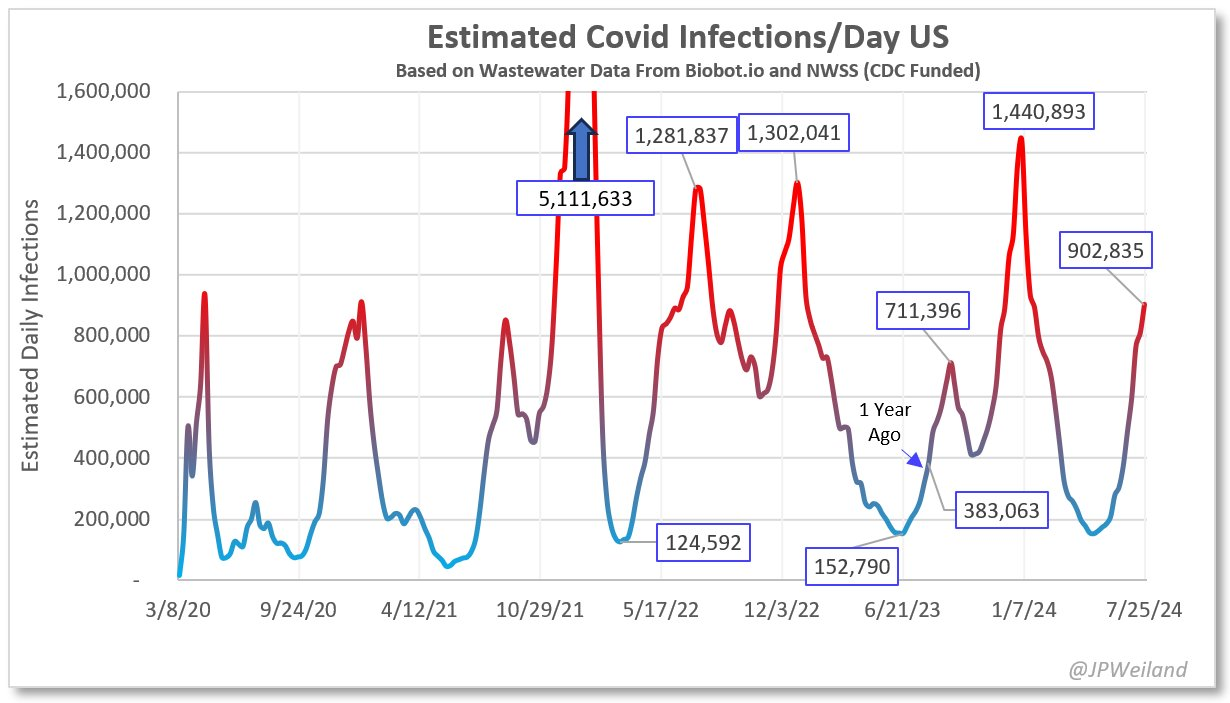
Estimated daily infections rise to 900,000 as KP.3.1.1 nears dominance with some speed.
 900,000 new infections/day
1 in every 37 people currently infected
59% higher than 12 month avg.
12:05 PM · Aug 2, 2024
·Aug 2
August 2nd update:
Estimated daily infections rise to 900,000 as KP.3.1.1 nears dominance with some speed.
900,000 new infections/day1 in every 37 people currently infected59% higher than 12 month avg.12:05 PM · Aug 2, 2024
Attachments
sharon sanders
Editor-in-Chief & President
NOT MEDICAL ADVICE
As I have done during the last 4 years of the pandemic I am updating my vaccine status and my plans for the fall and holiday season of 2024 regarding COVID-19 prevention.
So far I have not contracted COVID-19 (that I know of). I am high risk for a bad outcome so I have taken every booster at the recommended time. I took several Moderna, one Pfizer, and a couple Novavax. My personal favorite is Novavax because there were no side effects that I know of.
However, this fall I am not getting the COVID-19 vaccine. I am also not taking the seasonal flu vaccine. This is because I have started a vaccine series for Shingles. I have had my first shot and the next one will be in December. I have a unstable immune system and I feel the Shingles antibody assignment is enough for the next few months.
BUT - I am continuing my usual life style of avoidance. I do not attend any crowded events, inside or out. I always wear an N95 mask inside the grocery store and similar venues. I have only been to a restaurant a couple of times this year and I prepped first: 1) I was currently vaccinated. 2) I do a nostril prep. 3) I gargle with Listerine before and after. 4) Use hand sanitizer. Also, I went at low volume times and sat away from other customers. I do drive up/take out - but frankly the cost is so excessive for what you get...the treat is really ruined for me. I won't say what our anniversary dinner cost at a nice restaurant. Let's just say I thought about putting on a mask and offering to do the dishes in the back. There were only two other occupied tables. It wasn't the quality of the food or service. Anyway....
At the holidays, I will be attending uncrowded outdoor events and sometimes using fans to direct air away from me. I always carry an N95 mask just-in-case.
FluTrackers has never participated in the HHS fall flu vaccine push campaign. Our position has always been that vaccines are medicine and people should consult their medical practitioner.
Take care of you and thank you for following!
As I have done during the last 4 years of the pandemic I am updating my vaccine status and my plans for the fall and holiday season of 2024 regarding COVID-19 prevention.
So far I have not contracted COVID-19 (that I know of). I am high risk for a bad outcome so I have taken every booster at the recommended time. I took several Moderna, one Pfizer, and a couple Novavax. My personal favorite is Novavax because there were no side effects that I know of.
However, this fall I am not getting the COVID-19 vaccine. I am also not taking the seasonal flu vaccine. This is because I have started a vaccine series for Shingles. I have had my first shot and the next one will be in December. I have a unstable immune system and I feel the Shingles antibody assignment is enough for the next few months.
BUT - I am continuing my usual life style of avoidance. I do not attend any crowded events, inside or out. I always wear an N95 mask inside the grocery store and similar venues. I have only been to a restaurant a couple of times this year and I prepped first: 1) I was currently vaccinated. 2) I do a nostril prep. 3) I gargle with Listerine before and after. 4) Use hand sanitizer. Also, I went at low volume times and sat away from other customers. I do drive up/take out - but frankly the cost is so excessive for what you get...the treat is really ruined for me. I won't say what our anniversary dinner cost at a nice restaurant. Let's just say I thought about putting on a mask and offering to do the dishes in the back. There were only two other occupied tables. It wasn't the quality of the food or service. Anyway....
At the holidays, I will be attending uncrowded outdoor events and sometimes using fans to direct air away from me. I always carry an N95 mask just-in-case.
FluTrackers has never participated in the HHS fall flu vaccine push campaign. Our position has always been that vaccines are medicine and people should consult their medical practitioner.
Take care of you and thank you for following!
sharon sanders
Editor-in-Chief & President
via email -
What We Know About Covid's Impact on Your Brain: QuickTake
2024-09-13 02:00:27.756 GMT
By Jason Gale
(Bloomberg) -- Many of Covid’s earliest and most alarming
effects involve the brain, including a lost sense of smell,
sluggish thinking, headaches, delirium and strokes. More than
four years after the pandemic began, researchers are recognizing
the profound impacts Covid can have on brain health, as millions
of survivors suffer from persistent issues such as brain fog,
depression and cognitive slowing, all of which hinder their
ability to work and otherwise function. Scientists now worry
that these symptoms may be early indicators of a coming surge in
dementia and other mental conditions, prolonging the pandemic’s
societal, economic and health burden.
What Studies Show
In 2021, UK researchers reported early results from a study
comparing brain scans taken before and after the pandemic began.
They discovered signs of damage and accelerated aging in the
brain, particularly in the region responsible for smell, even in
patients who had experienced mostly mild cases of Covid months
earlier.
Research has since shown that Covid-related cognitive
deficits can persist for years, especially in older adults and
those who suffered more severe cases. For instance, a study of
seniors hospitalized during China’s first Covid wave showed that
2 1/2 yearslater, 40% developed cognitive impairment, compared
with just 14% of their uninfected spouses. A 2024 UK study of
people hospitalized for Covid treatment revealed a significant
worsening of psychiatric and cognitive symptoms three years
after discharge. Half experienced moderate to severe depression,
a quarter suffered severe cognitive decline, and one in nine
showed a loss of mental function equivalent to a 30-point drop
on the IQ scale, where a score of 100 is average.
snip
How Covid Harms the Brain
The effects of a SARS-CoV-2 infection on the brain are the
focus of intense research and remain only partially understood.
Studies suggest that during acute infection, the virus may
damage nerves, particularly in the olfactory bulb — which houses
the nerves that transmit smell impulses to the brain — leading
to problems that can persist for years. In some cases, the virus
may infect the brain through this pathway, altering the organ’s
structure and resulting in impaired cognition and fatigue.
Persistent viral remnants or the initial infection itself
may trigger neuroinflammation and disrupt the immune system,
causing antibodies and T cells to mistakenly attack healthy
brain cells, damage blood vessels, and harm the blood-brain
barrier. Additional research points to blood clots that may
drive immune activation, restricting the supply of oxygen and
nutrients to the brain, and altered levels of key hormones
cortisol and dopamine that may be linked to changes in gut
health.
.........
----------------------------------------------------
Please see our scientific library for many studies on the clinical and pathological effects - including the brain:
https://flutrackers.com/forum/forum/welcome-to-the-scientific-library/pathological-findings
What We Know About Covid's Impact on Your Brain: QuickTake
2024-09-13 02:00:27.756 GMT
By Jason Gale
(Bloomberg) -- Many of Covid’s earliest and most alarming
effects involve the brain, including a lost sense of smell,
sluggish thinking, headaches, delirium and strokes. More than
four years after the pandemic began, researchers are recognizing
the profound impacts Covid can have on brain health, as millions
of survivors suffer from persistent issues such as brain fog,
depression and cognitive slowing, all of which hinder their
ability to work and otherwise function. Scientists now worry
that these symptoms may be early indicators of a coming surge in
dementia and other mental conditions, prolonging the pandemic’s
societal, economic and health burden.
What Studies Show
In 2021, UK researchers reported early results from a study
comparing brain scans taken before and after the pandemic began.
They discovered signs of damage and accelerated aging in the
brain, particularly in the region responsible for smell, even in
patients who had experienced mostly mild cases of Covid months
earlier.
Research has since shown that Covid-related cognitive
deficits can persist for years, especially in older adults and
those who suffered more severe cases. For instance, a study of
seniors hospitalized during China’s first Covid wave showed that
2 1/2 yearslater, 40% developed cognitive impairment, compared
with just 14% of their uninfected spouses. A 2024 UK study of
people hospitalized for Covid treatment revealed a significant
worsening of psychiatric and cognitive symptoms three years
after discharge. Half experienced moderate to severe depression,
a quarter suffered severe cognitive decline, and one in nine
showed a loss of mental function equivalent to a 30-point drop
on the IQ scale, where a score of 100 is average.
snip
How Covid Harms the Brain
The effects of a SARS-CoV-2 infection on the brain are the
focus of intense research and remain only partially understood.
Studies suggest that during acute infection, the virus may
damage nerves, particularly in the olfactory bulb — which houses
the nerves that transmit smell impulses to the brain — leading
to problems that can persist for years. In some cases, the virus
may infect the brain through this pathway, altering the organ’s
structure and resulting in impaired cognition and fatigue.
Persistent viral remnants or the initial infection itself
may trigger neuroinflammation and disrupt the immune system,
causing antibodies and T cells to mistakenly attack healthy
brain cells, damage blood vessels, and harm the blood-brain
barrier. Additional research points to blood clots that may
drive immune activation, restricting the supply of oxygen and
nutrients to the brain, and altered levels of key hormones
cortisol and dopamine that may be linked to changes in gut
health.
.........
----------------------------------------------------
Please see our scientific library for many studies on the clinical and pathological effects - including the brain:
https://flutrackers.com/forum/forum/welcome-to-the-scientific-library/pathological-findings
sharon sanders
Editor-in-Chief & President
FluTrackers.com
@FluTrackers
·
Now
While we track many public health threats - we already have an
ongoing pandemic and it is #Covid_19 .
It is airborne and can also be spread through touch.
Take care of you, however you perceive this.
https://flutrackers.com/forum/forum/-2019-ncov-new-coronavirus/-2019-ncov-studies-research-academia…
@FluTrackers
·
Now
While we track many public health threats - we already have an
ongoing pandemic and it is #Covid_19 .
It is airborne and can also be spread through touch.
Take care of you, however you perceive this.
https://flutrackers.com/forum/forum/-2019-ncov-new-coronavirus/-2019-ncov-studies-research-academia…
sharon sanders
Editor-in-Chief & President
Meant as a bit of humor, but it isn't really....
I have a close relative whose work says to come back after the 5th day of COVID-19 symptom onset...except people are shedding virus for 9 days...
https://www.tiktok.com/@thishourhas22minutes/video/7416384106239462661?lang=en
Please see:
J Glob Health . Duration of SARS-CoV-2 shedding: A systematic review
I have a close relative whose work says to come back after the 5th day of COVID-19 symptom onset...except people are shedding virus for 9 days...
https://www.tiktok.com/@thishourhas22minutes/video/7416384106239462661?lang=en
Please see:
J Glob Health . Duration of SARS-CoV-2 shedding: A systematic review
sharon sanders
Editor-in-Chief & President
Video - Some smart people talking about COVID-19.
Has Everyone Forgotten About COVID?
https://www.youtube.com/watch?v=YXaHqgDnEDs
Has Everyone Forgotten About COVID?
https://www.youtube.com/watch?v=YXaHqgDnEDs