Translation Google
"MONKEYPOX": TRANSMISSION, MORTALITY... HOW IS THE CURRENT MPOX EPIDEMIC DIFFERENT FROM 2022?
Tom Kerkour
THE 08/16/2024 at 1:57 p.m.
Since Wednesday, August 14, "monkey pox" (mpox) has been the subject of the highest alert from the World Health Organization. The disease had already led to a health emergency in 2022.
Two years later, "monkey pox" is once again worrying health authorities. On Wednesday, August 14, the World Health Organization declared the monkeypox epidemic a "public health emergency of international concern" after the spread of a new "variant" (clade 1b) in the Democratic Republic of Congo.
Other cases have since been identified in Burundi and Uganda. On Thursday, a first case was detected in Europe, in Sweden. In 2022, even though the epidemic had originated in Africa, it was its explosion on the Old Continent and in North America that triggered the WHO's first maximum alert.
Affected populations, lethality, symptoms... What are the differences between these two waves? While many uncertainties remain, here is what we know at this early stage of the epidemic.
• Mainly broadcast in Africa... at this stage
The first difference between the two epidemics at this stage is the area of diffusion. In 2022, if the first cases were first identified in West Africa, particularly in Nigeria, mpox then spread to all continents. In May of that year, cases were first identified sporadically in the United Kingdom, Spain, Portugal... Before affecting North America, then Israel, India...
"We must not forget that in 2022, we have already experienced a real MPOX pandemic," emphasizes Benjamin Davido, infectious disease specialist at the Raymond-Poincaré hospital in Garches (Hauts-de-Seine).
For now, the new outbreak appears to be endemic in nature, rather confined to African countries. The new strain was identified in the Democratic Republic of Congo, where more than 16,000 "potential" cases and 548 deaths have been recorded this year, before spreading to Burundi, Ivory Coast, Kenya, Rwanda and Uganda.
However, rare cases of this new type of virus have been identified on the Asian continent, in Pakistan, and in Europe, in Sweden . "It is likely that other imported cases of clade 1 (a variant, editor's note) will be recorded in the European region in the coming days and weeks," warned the European branch of the WHO .
For infectiologist Benjamin Davido, the study of these new cases outside the African continent will make it possible to determine whether or not we are facing a shift in an epidemic. "The functioning of clade 1b in the Caucasian population" is poorly understood, he notes.
• The general population more concerned, a different route of contamination?
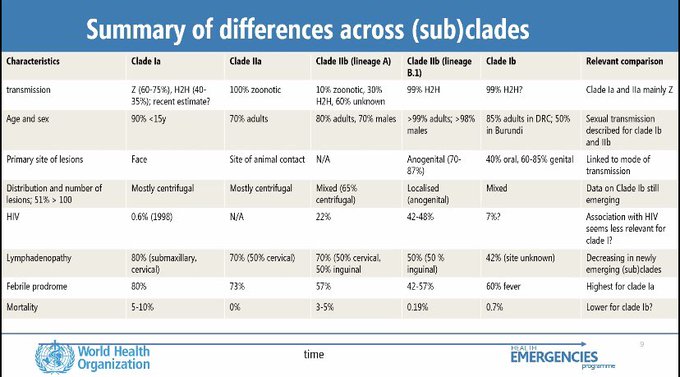
Although not a sexually transmitted infection (STI) per se, the previous outbreak of mpox had homosexual or bisexual men as its primary victims. As the CDC, the American health authority, had reported , "monkeypox" was spreading faster within this community than in the rest of the general population.
For its part, the WHO recalled that "the risk of contracting monkeypox is not limited to men who have sex with men." "Anyone who has been in close contact with an infected person is at risk," the institution added, while acknowledging that "the virus (had) been detected in queer communities."
This first strain of mpox was mainly contracted through contact with contaminated animals. But also through close contact - without necessarily involving sexual intercourse, since the presence of the virus in bodily fluids has not been established.
In 2024, the circulation of the virus looks different. "Detailed information on transmission is not available for most cases in the African region," a WHO analysis warns. But "available information suggests that modes of transmission in this region are more diverse, including human-to-human transmission due to different types of physical or close contact, direct or indirect, and, in some settings, zoonotic (animal) exposure."
Human-to-human transmission occurs through "prolonged face-to-face contact through respiratory droplets" or through "direct contact" with an infected person, notes the French Ministry of Health .
It should be noted that in the Democratic Republic of Congo, children under 15 years of age are the most affected population, according to the WHO. "In historically affected countries, such as the Democratic Republic of Congo, children under 15 years of age account for most reported smallpox cases," the institution says.
How can we explain the contamination of children, for a disease that previously mainly affected men in their forties? "It will be useful to study the mode of exposure of new patients," notes Dr. Davido. "Determine whether they were infected by exposure through proximity within the home (...) or by droplets."
These new cases will help determine whether the stronger transmission of the virus is the result of an evolution towards respiratory transmission by droplets - until now secondary - or a much stronger transmission by contact.
• Similar symptoms, but higher mortality?
One constant emerges from the various outbreaks of the disease over time and across countries. The symptoms seem to remain stable . The first and most visible sign is the appearance of skin lesions - and lesions of the mucous membranes, particularly genital, when the disease results from sexual intercourse.
Other problems may then appear: fever, headaches, body aches and asthenia. Sore throats are also reported.
What about mortality? The new type of mpox called clade 1b seems to be more deadly, "around 4%, with a large range of 1 to 10%", specifies the Parisian infectiologist. In France, no deaths from the disease have been recorded, neither in 2022 nor in 2024. But the consensus on the lethality of the new variant could evolve after the analysis of new cases outside the African continent.
https://www.bfmtv.com/sante/variole...-de-mpox-differe-de-2022_AV-202408160306.html